IDENTIFY,ELIMINATE,PREVENT
Presenter : Gloria Kgagabi
2015-06-12
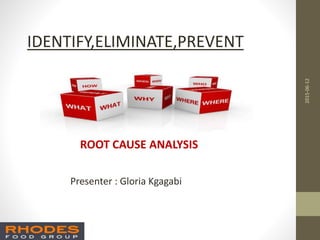
ROOT CAUSE ANALYSIS
OBJECTIVES
• Gain an overview of a problem solving process.
• Learn how to apply common root cause
analysis tools such as 5 whys and cause
effect diagrams to identify root causes.
• Learn how to prioritise root causes with a
pareto chart.
• Understand the pitfalls in root cause
analysis.
2015-06-12
PROGRAM OUTLINE
• Introduction to root cause analysis.
• Overview of a problem solving process.
• Root cause analysis using 5 whys.
• Root cause analysis using cause effect
diagrams.
• Root cause prioritisation using pareto
chart.
• Pitfalls to avoid.
2015-06-12
2015-06-12
“When we
fail to grasp
the
systematic
source of
problems,
we are left
to ‘push on`
symptoms
rather than
eliminate
causes”
-Peter Senge
the fifth discipline
2015-06-12
What is root cause analysis ?
 Root cause analysis (RCA) is a technique that helps guide
people to discover and understand the initiating cause(s) of a
problem, with the goal of determining missing or inadequately
applied that prevent reoccurrence(s).
2015-06-12
Root cause-the evil at the
bottom
• The root cause is the – “evil at the bottom” that sets in motion
the entire cause- and –effect cause chain causing the
problem(s)
Symptom
Visible
problem
Higher- level cause
First- level cause
2015-06-12
Why Root cause analysis ?
• RCA helps to identify what, how and why an
event or failure occurred.
• Root causes are underlying, are reasonably
identifiable, can be controlled by management
and allow for the generation of solutions.
• Only when you are able to determine why an
event or failure occurred will you be able to
specify workable corrective and preventative
measure(s)
2015-06-12
Principles of RCA
•System thinking approach
•Prevention of reoccurrence
•Pareto principle
•Employee engagement
•Continuous improvement
2015-06-12
Overview of problem
solving process
2015-06-12
Root cause analysis
Albert Einstein
“Problems that exist
in the world cannot
be solved by the
level of thinking
that created them”
2015-06-12
A simple problem solving
process
DEFINE THE
PROBLEM
COLLECT DATA
IDENTIFY ROOT CAUSES
IMPLEMENT
COUNTERMEASURES
EVALUATE AND FOLLOW
UP
2015-06-12
Dealing with root causes
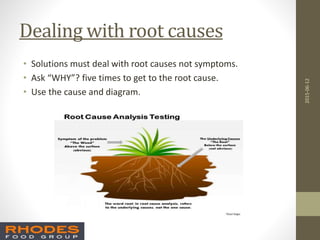
• Solutions must deal with root causes not symptoms.
• Ask “WHY”? five times to get to the root cause.
• Use the cause and diagram.
2015-06-12
2015-06-12
Every defect is a treasure !
Kiichiro Toyada-founder of
toyota
“Every defect is a
treasure, if the
company can
uncover its and
work to prevent it
across the
corporation”
2015-06-12
Benefits of 5 whys
• Helps to identify the root of a
problem.
• Determines the relationship between
different root causes of a problem.
• One of the simplest tools , easy to
complete without statistical analysis.
2015-06-12
Example of 5 whys
2015-06-12
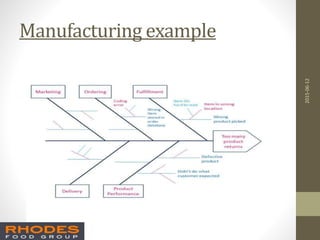
Cause and effect diagram
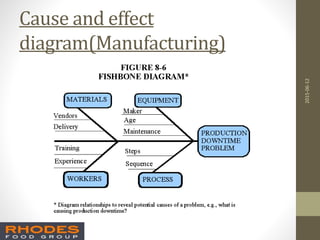
PURPOSE:
• To capture the casual relationship between cause and
effect.
• To stratify the causes into meaningful groupings
2015-06-12
Cause and effect
diagram(Manufacturing)
2015-06-12
Manufacturing example
2015-06-12
Combining 5 whys and cause
effect diagrams
• The 5 whys can be used individually or as a part
of the C & E diagram.
• The C & E diagram helps you to explore all
potential or real causes that result in a single
defect or failure.
• Once all inputs are established on the fish bone
you can use the 5 whys technique to drill down
to the root causes.
2015-06-12
2015-06-12
Pareto chart
PURPOSE:
• To show relative significance of the
identified root causes.
WHEN TO USE:
• To differentiate the ‘vital few’ problems or
causes from the ‘trivial many’.
2015-06-12
EXAMPLE-Pareto chart
2015-06-12
2015-06-12
PITFALLS TO AVOID
Pitfalls to avoid
• The use of RCA is focused on who caused the
problem-placing blame instead of finding out
how the problem arises.
• The use of RCA focuses only on analysis rather
than eliminating the problem.
• No one can solve a problem at their desk, involve
relevant stake holders.(Otherwise the problem
will keep on reoccurring).
2015-06-12
2015-06-12
THERE IS NO STUPID QUESTION: STUPID
PEOPLE DON’T ASK QUESTIONS.
2015-06-12

Root cause analysis 1

  • 1.
    IDENTIFY,ELIMINATE,PREVENT Presenter : GloriaKgagabi 2015-06-12 ROOT CAUSE ANALYSIS
  • 2.
    OBJECTIVES • Gain anoverview of a problem solving process. • Learn how to apply common root cause analysis tools such as 5 whys and cause effect diagrams to identify root causes. • Learn how to prioritise root causes with a pareto chart. • Understand the pitfalls in root cause analysis. 2015-06-12
  • 3.
    PROGRAM OUTLINE • Introductionto root cause analysis. • Overview of a problem solving process. • Root cause analysis using 5 whys. • Root cause analysis using cause effect diagrams. • Root cause prioritisation using pareto chart. • Pitfalls to avoid. 2015-06-12
  • 4.
  • 5.
    “When we fail tograsp the systematic source of problems, we are left to ‘push on` symptoms rather than eliminate causes” -Peter Senge the fifth discipline 2015-06-12
  • 6.
    What is rootcause analysis ?  Root cause analysis (RCA) is a technique that helps guide people to discover and understand the initiating cause(s) of a problem, with the goal of determining missing or inadequately applied that prevent reoccurrence(s). 2015-06-12
  • 7.
    Root cause-the evilat the bottom • The root cause is the – “evil at the bottom” that sets in motion the entire cause- and –effect cause chain causing the problem(s) Symptom Visible problem Higher- level cause First- level cause 2015-06-12
  • 8.
    Why Root causeanalysis ? • RCA helps to identify what, how and why an event or failure occurred. • Root causes are underlying, are reasonably identifiable, can be controlled by management and allow for the generation of solutions. • Only when you are able to determine why an event or failure occurred will you be able to specify workable corrective and preventative measure(s) 2015-06-12
  • 9.
    Principles of RCA •Systemthinking approach •Prevention of reoccurrence •Pareto principle •Employee engagement •Continuous improvement 2015-06-12
  • 10.
    Overview of problem solvingprocess 2015-06-12
  • 11.
    Root cause analysis AlbertEinstein “Problems that exist in the world cannot be solved by the level of thinking that created them” 2015-06-12
  • 12.
    A simple problemsolving process DEFINE THE PROBLEM COLLECT DATA IDENTIFY ROOT CAUSES IMPLEMENT COUNTERMEASURES EVALUATE AND FOLLOW UP 2015-06-12
  • 13.
    Dealing with rootcauses • Solutions must deal with root causes not symptoms. • Ask “WHY”? five times to get to the root cause. • Use the cause and diagram. 2015-06-12
  • 14.
  • 15.
    Every defect isa treasure ! Kiichiro Toyada-founder of toyota “Every defect is a treasure, if the company can uncover its and work to prevent it across the corporation” 2015-06-12
  • 16.
    Benefits of 5whys • Helps to identify the root of a problem. • Determines the relationship between different root causes of a problem. • One of the simplest tools , easy to complete without statistical analysis. 2015-06-12
  • 17.
    Example of 5whys 2015-06-12
  • 18.
    Cause and effectdiagram PURPOSE: • To capture the casual relationship between cause and effect. • To stratify the causes into meaningful groupings 2015-06-12
  • 19.
  • 20.
  • 21.
    Combining 5 whysand cause effect diagrams • The 5 whys can be used individually or as a part of the C & E diagram. • The C & E diagram helps you to explore all potential or real causes that result in a single defect or failure. • Once all inputs are established on the fish bone you can use the 5 whys technique to drill down to the root causes. 2015-06-12
  • 22.
  • 23.
    Pareto chart PURPOSE: • Toshow relative significance of the identified root causes. WHEN TO USE: • To differentiate the ‘vital few’ problems or causes from the ‘trivial many’. 2015-06-12
  • 24.
  • 25.
  • 26.
    Pitfalls to avoid •The use of RCA is focused on who caused the problem-placing blame instead of finding out how the problem arises. • The use of RCA focuses only on analysis rather than eliminating the problem. • No one can solve a problem at their desk, involve relevant stake holders.(Otherwise the problem will keep on reoccurring). 2015-06-12
  • 27.
    2015-06-12 THERE IS NOSTUPID QUESTION: STUPID PEOPLE DON’T ASK QUESTIONS.
  • 28.