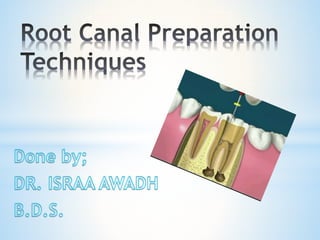
*Objectives of Root Canal Preparation. 
*The principles of shaping. 
*Standardized technique 
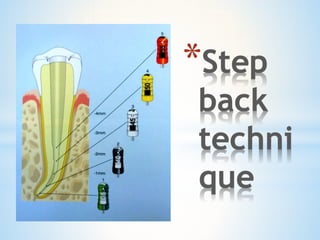
*Step back technique 
*Modified step back technique 
*Step down technique 
*Crown down technique 
*Hybrid technique 
*Double flared technique 
*Modified double flared technique 
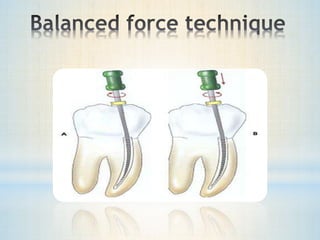
*Balanced force technique
* 
1.Eliminate microorganisms. 
2.Remove remaining pulp tissues. 
3.Remove debris. 
4.Shape the root canal system so that it 
may be obturated.
* 
* Develop a continuously tapering funnel 
from the apex to coronal orifice. 
* Maintain the original shape of the canal. 
* Maintain the apical foramen in its original 
position. 
* Keep the apical opening as small as possible.
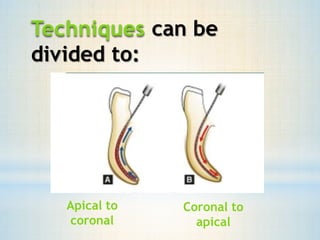
Techniques can be 
divided to: 
Apical to 
coronal 
Coronal to 
apical
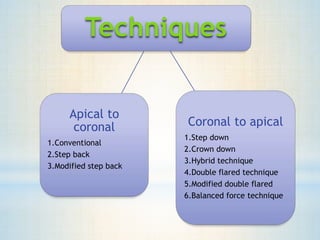
Techniques 
Apical to 
coronal 
1.Conventional 
2.Step back 
3.Modified step back 
Coronal to apical 
1.Step down 
2.Crown down 
3.Hybrid technique 
4.Double flared technique 
5.Modified double flared 
6.Balanced force technique
*Also known as conventional technique. One of 
the first technique to be used introduced by 
Ingle. 
*In this technique standardized reamers of 
increasing sizes were used sequentially to 
enlarge the apical part of the canal. 
*The coronal two third were prepared, again, 
mainly by reaming.
*Determine working length and 
select the initial apical file. 
*Do circumferential filing by applying 
lateral pressure and then with 
drawn. 
*Increase the apical constriction 2 to 
3 files sizes more than initial apical 
file but with the same working 
length.
*Chances of loss of working length due to accumulation of 
dentin debris. 
*Does not take in to consideration the elliptical forms and large 
diameter of root canals. 
*Obturation with this techniques dose not provide adequate 
sealing of root canal confines specially in curved canals . 
*Passage of irrigants and medicaments 
is not adequately obtained through the 
root canals. 
*Increased incidence of ledging, zipping 
and perforation in curved canals.
*Weine, Martin, Walton, and Mullaney were early advocated of the step 
back in 1969. also called telescopic or serial root canal preparation. 
*The essence of this technique is preparation of the a distinct apical 
stop and to over come the problem of the curved root canal. 
*Its divided in to two phases; 
Phase I Is the apical preparation . 
 Phase II is the preparation of the remainder of the canal. 
The completion of the preparation is the refining phases IIA and IIB to 
produce the continuing taper from apex to cervical portion of the 
canal.
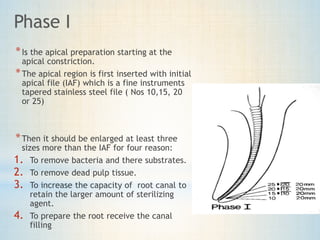
Phase I 
*Is the apical preparation starting at the 
apical constriction. 
*The apical region is first inserted with initial 
apical file (IAF) which is a fine instruments 
tapered stainless steel file ( Nos 10,15, 20 
or 25) 
*Then it should be enlarged at least three 
sizes more than the IAF for four reason: 
1. To remove bacteria and there substrates. 
2. To remove dead pulp tissue. 
3. To increase the capacity of root canal to 
retain the larger amount of sterilizing 
agent. 
4. To prepare the root receive the canal 
filling
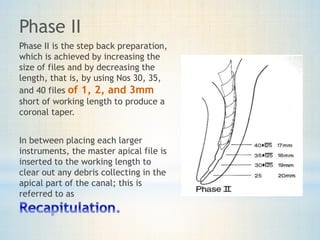
Phase II 
Phase II is the step back preparation, 
which is achieved by increasing the 
size of files and by decreasing the 
length, that is, by using Nos 30, 35, 
and 40 files of 1, 2, and 3mm 
short of working length to produce a 
coronal taper. 
In between placing each larger 
instruments, the master apical file is 
inserted to the working length to 
clear out any debris collecting in the 
apical part of the canal; this is 
referred to as
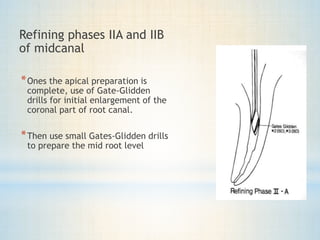
Refining phases IIA and IIB 
of midcanal 
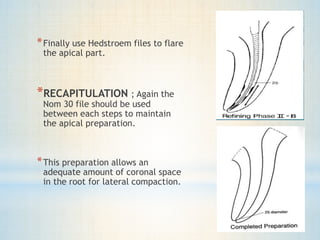
*Ones the apical preparation is 
complete, use of Gate-Glidden 
drills for initial enlargement of the 
coronal part of root canal. 
*Then use small Gates-Glidden drills 
to prepare the mid root level
*Finally use Hedstroem files to flare 
the apical part. 
*RECAPITULATION ; Again the 
Nom 30 file should be used 
between each steps to maintain 
the apical preparation. 
*This preparation allows an 
adequate amount of coronal space 
in the root for lateral compaction.
*Gates-Glidden Drills are side 
cutting instruments with 
safety tips. They can be used 
with both crowns down as 
well as step back fashion to 
enlarge the coronal third of 
the canal during endodontic 
treatment. 
*used with handpiece 
*Different sizes , 6 sizes (#1 - 
#6) coded by rings or colored 
bands on shank.
*slightly flexible and will follow the canal 
shape but can perforate the canal if used 
too deeply. 
*Should be used only in the straight sections 
of the canal.
Advantages of step back 
*Proper apical stop 
*Less chances of apical transportation 
*Greater flare coronally 
Limitations 
*Debris extruded will block the canal 
*Loss of working length 
*Tendency to straiten the canal 
*Time consuming.
*Modified step back 
• Ones the apical preparation is completed,2-3 mm of the 
apical portion of the canal is prepared with the MAF. Step 
back procedure begins from the 3mm short of the apical 
constriction. 
• Gives almost a parallel cylindrical retention form to 
primary gutta-percha point.
*
*introduction 
Extrusion of canal contents during instrumentation 
has shown to cause postoperative discomfort and 
delayed healing. This problem was found with 
most of instrumentation techniques. 
To withstand this problem a different approach 
called the coronal to apical approach was 
introduced which advocated shaping the coronal 
aspect of a root canal first before apical 
instrumentation commented.
* 
* the pulp chamber filled with irrigant or lubricant now canal is 
penetrated using Hedstroem files of sizes nos. 15, 20 and 
25,the working length can be established at this time. 
* The coronal thirds of the canal is then flared with Gates 
Glidden drills nos. 2 and 3 and no.4 are used sequentially 
shorter, thus, flaring the coronal segment of the root canal. 
*This followed by apical instrumentation using a descending 
file sequence, progressing 1mm per consecutive instrument, 
apically. Its important to recapitulate with no.25 file to 
prevent blockage. 
*Note; The apical portion of the canal prepared by enlarging 
the canal at the corrected working length 2-3sizes at least in 
order to get clear dentin.
* 
*Permits straighter access to the apical region. 
*Eliminate coronal interference which allows 
better determination of apical canal sizes. 
*Removes bulk of tissue and microorganisms 
before apical shaping. 
*Allows deeper penetration of irrigants. 
*The working length is less likely to change. 
*Less amount of necrotic debris could be 
extruded throw the apical foramen. 
*Less chance of zipping near the apical 
constriction due to increased in the access 
opening.
* 
*More time consuming than the step back 
technique. 
*Excessively flared preparation in the coronal 
and middle thirds may weaken the tooth and 
create problems. 
*If large, less flexible rotary instruments are 
used too rapidly and deeply in the root canal, a 
ledge may form. 
*In canals that curve severely the rotary 
instruments cannot be precurved.
* 
*Marshall and Pappin advocated a “Crown-Down 
Pressureless Preparation” which involves early 
coronal flaring with Gates-Glidden burs, followed by 
incremental removal of dentin from a coronal to 
apical direction, hence the term “crown-down”. 
*Straight k – type files are used in a large to small 
sequence with a reaming motion and no apical 
pressure, thereby “Pressureless” 
*This technique resulted in a rounder canal shape 
when compared to usual step back technique.
* 
*In this technique a combination of step-back and 
crown-down preparation is used. 
*Both rotary and hand instruments are used to 
prepare the canal. 
*Check the patency of canal using number 10 or 15 k 
flex files. 
*Prepare the coronal third of canal using hand or 
Gates-Glidden drills till the point of curveture 
without applying excessive pressure. 
*Determine the working length. 
*Prepare the apical portion of canal using step back 
technique.
*Recapitulate and irrigate the canal at every step so as to 
maintain patency of the canal. 
*Blend step back with step down procedure. 
Advantages 
*Less chances of ledge formation. 
*This technique maintains the integrity of dentin by 
avoiding excessive removal of radicular dentin.
*It was introduced by Fava. 
*In this, canal is explored using a small file. Then 
prepared in crown-down manner using k files in 
decreasing sizes. 
*After this, step back technique is in 1mm increments 
with increasing file sizes. 
*Frequent irrigation and recapitulation using master 
apical file is done during instrumentation.
Indications 
*Straight root canals. 
*Straight portion of curved canals of mature teeth. 
Contraindications 
*Calcified canals. 
*Young permanent teeth. 
*Teeth with open apex as they have thin 
dentinal walls and great pulp volume.
*In this, preparation was commenced in the coronal part 
of the root canal. 
*A #40 Flex R file was instrumented in the straight part of 
the canal , using the balanced force technique. 
*Sequentially, larger sizes of files were used to instrument 
the straight part of the canal using the balanced force 
technique and the coronal 4 to 5 mm of root canal was 
instrumented with Gates-Glidden drills. 
*A #20 Flex R file was taken to the working length and the 
canal prepared using the balanced force technique by 
sequential use of files.
*Preparation at the working length was continued 
until clean dentin was removed, the master 
apical varying between #40 and #45. 
*A step back technique using balanced forces was 
then used to prepare the remaining curved 
portion of the canal
*This technique was developed by Roane and Sabala in 
1985.It’s involves using blunt-tipped files. 
*The balanced force technique recognizes the fact that 
instruments are guided by the canal walls when rotated. 
*Since the files will cut in both a clockwise and 
anticlockwise rotation, the balanced force concept of 
instrumentation consists of placing the file to length and 
then a clockwise rotation (less than 180 degrees) engages 
dentin. 
* This is followed by a anticlockwise rotation (at least 120 
degrees) with apical pressure to cut and enlarge the 
canal. 
* The degree of apical pressure varies from light pressure 
with small instruments to heavy pressure with large 
instruments
*. The clockwise rotation pulls the instrument into the 
canal in an apical direction. The anticlockwise cutting 
rotation forces the file in a coronal direction while 
cutting circumferentially. 
* Following the cutting rotation the file is repositioned 
and the process is repeated until the corrected working 
length is reached. At this point a final clockwise 
rotation is employed to evacuate the debris.
*With the help of this technique, there are lesser 
chances of canal transportation. 
*One can manipulate the files at any point in the canal 
without creating a ledge or blockage. 
*File cutting occurs only at apical extent of the file. 
*Extrusion of material is less than with other 
techniques.
References 
Textbook of Endodontics 
Anil Kohli 
Endodontics, Volume 1 
Ingle, Bakland
Root canal preparation techniques _ endodontic treatment

Root canal preparation techniques _ endodontic treatment

  • 2.
    *Objectives of RootCanal Preparation. *The principles of shaping. *Standardized technique *Step back technique *Modified step back technique *Step down technique *Crown down technique *Hybrid technique *Double flared technique *Modified double flared technique *Balanced force technique
  • 3.
    * 1.Eliminate microorganisms. 2.Remove remaining pulp tissues. 3.Remove debris. 4.Shape the root canal system so that it may be obturated.
  • 4.
    * * Developa continuously tapering funnel from the apex to coronal orifice. * Maintain the original shape of the canal. * Maintain the apical foramen in its original position. * Keep the apical opening as small as possible.
  • 5.
    Techniques can be divided to: Apical to coronal Coronal to apical
  • 6.
    Techniques Apical to coronal 1.Conventional 2.Step back 3.Modified step back Coronal to apical 1.Step down 2.Crown down 3.Hybrid technique 4.Double flared technique 5.Modified double flared 6.Balanced force technique
  • 8.
    *Also known asconventional technique. One of the first technique to be used introduced by Ingle. *In this technique standardized reamers of increasing sizes were used sequentially to enlarge the apical part of the canal. *The coronal two third were prepared, again, mainly by reaming.
  • 9.
    *Determine working lengthand select the initial apical file. *Do circumferential filing by applying lateral pressure and then with drawn. *Increase the apical constriction 2 to 3 files sizes more than initial apical file but with the same working length.
  • 10.
    *Chances of lossof working length due to accumulation of dentin debris. *Does not take in to consideration the elliptical forms and large diameter of root canals. *Obturation with this techniques dose not provide adequate sealing of root canal confines specially in curved canals . *Passage of irrigants and medicaments is not adequately obtained through the root canals. *Increased incidence of ledging, zipping and perforation in curved canals.
  • 12.
    *Weine, Martin, Walton,and Mullaney were early advocated of the step back in 1969. also called telescopic or serial root canal preparation. *The essence of this technique is preparation of the a distinct apical stop and to over come the problem of the curved root canal. *Its divided in to two phases; Phase I Is the apical preparation .  Phase II is the preparation of the remainder of the canal. The completion of the preparation is the refining phases IIA and IIB to produce the continuing taper from apex to cervical portion of the canal.
  • 13.
    Phase I *Isthe apical preparation starting at the apical constriction. *The apical region is first inserted with initial apical file (IAF) which is a fine instruments tapered stainless steel file ( Nos 10,15, 20 or 25) *Then it should be enlarged at least three sizes more than the IAF for four reason: 1. To remove bacteria and there substrates. 2. To remove dead pulp tissue. 3. To increase the capacity of root canal to retain the larger amount of sterilizing agent. 4. To prepare the root receive the canal filling
  • 14.
    Phase II PhaseII is the step back preparation, which is achieved by increasing the size of files and by decreasing the length, that is, by using Nos 30, 35, and 40 files of 1, 2, and 3mm short of working length to produce a coronal taper. In between placing each larger instruments, the master apical file is inserted to the working length to clear out any debris collecting in the apical part of the canal; this is referred to as
  • 15.
    Refining phases IIAand IIB of midcanal *Ones the apical preparation is complete, use of Gate-Glidden drills for initial enlargement of the coronal part of root canal. *Then use small Gates-Glidden drills to prepare the mid root level
  • 16.
    *Finally use Hedstroemfiles to flare the apical part. *RECAPITULATION ; Again the Nom 30 file should be used between each steps to maintain the apical preparation. *This preparation allows an adequate amount of coronal space in the root for lateral compaction.
  • 17.
    *Gates-Glidden Drills areside cutting instruments with safety tips. They can be used with both crowns down as well as step back fashion to enlarge the coronal third of the canal during endodontic treatment. *used with handpiece *Different sizes , 6 sizes (#1 - #6) coded by rings or colored bands on shank.
  • 18.
    *slightly flexible andwill follow the canal shape but can perforate the canal if used too deeply. *Should be used only in the straight sections of the canal.
  • 19.
    Advantages of stepback *Proper apical stop *Less chances of apical transportation *Greater flare coronally Limitations *Debris extruded will block the canal *Loss of working length *Tendency to straiten the canal *Time consuming.
  • 20.
    *Modified step back • Ones the apical preparation is completed,2-3 mm of the apical portion of the canal is prepared with the MAF. Step back procedure begins from the 3mm short of the apical constriction. • Gives almost a parallel cylindrical retention form to primary gutta-percha point.
  • 21.
  • 22.
    *introduction Extrusion ofcanal contents during instrumentation has shown to cause postoperative discomfort and delayed healing. This problem was found with most of instrumentation techniques. To withstand this problem a different approach called the coronal to apical approach was introduced which advocated shaping the coronal aspect of a root canal first before apical instrumentation commented.
  • 23.
    * * thepulp chamber filled with irrigant or lubricant now canal is penetrated using Hedstroem files of sizes nos. 15, 20 and 25,the working length can be established at this time. * The coronal thirds of the canal is then flared with Gates Glidden drills nos. 2 and 3 and no.4 are used sequentially shorter, thus, flaring the coronal segment of the root canal. *This followed by apical instrumentation using a descending file sequence, progressing 1mm per consecutive instrument, apically. Its important to recapitulate with no.25 file to prevent blockage. *Note; The apical portion of the canal prepared by enlarging the canal at the corrected working length 2-3sizes at least in order to get clear dentin.
  • 25.
    * *Permits straighteraccess to the apical region. *Eliminate coronal interference which allows better determination of apical canal sizes. *Removes bulk of tissue and microorganisms before apical shaping. *Allows deeper penetration of irrigants. *The working length is less likely to change. *Less amount of necrotic debris could be extruded throw the apical foramen. *Less chance of zipping near the apical constriction due to increased in the access opening.
  • 26.
    * *More timeconsuming than the step back technique. *Excessively flared preparation in the coronal and middle thirds may weaken the tooth and create problems. *If large, less flexible rotary instruments are used too rapidly and deeply in the root canal, a ledge may form. *In canals that curve severely the rotary instruments cannot be precurved.
  • 27.
    * *Marshall andPappin advocated a “Crown-Down Pressureless Preparation” which involves early coronal flaring with Gates-Glidden burs, followed by incremental removal of dentin from a coronal to apical direction, hence the term “crown-down”. *Straight k – type files are used in a large to small sequence with a reaming motion and no apical pressure, thereby “Pressureless” *This technique resulted in a rounder canal shape when compared to usual step back technique.
  • 29.
    * *In thistechnique a combination of step-back and crown-down preparation is used. *Both rotary and hand instruments are used to prepare the canal. *Check the patency of canal using number 10 or 15 k flex files. *Prepare the coronal third of canal using hand or Gates-Glidden drills till the point of curveture without applying excessive pressure. *Determine the working length. *Prepare the apical portion of canal using step back technique.
  • 30.
    *Recapitulate and irrigatethe canal at every step so as to maintain patency of the canal. *Blend step back with step down procedure. Advantages *Less chances of ledge formation. *This technique maintains the integrity of dentin by avoiding excessive removal of radicular dentin.
  • 31.
    *It was introducedby Fava. *In this, canal is explored using a small file. Then prepared in crown-down manner using k files in decreasing sizes. *After this, step back technique is in 1mm increments with increasing file sizes. *Frequent irrigation and recapitulation using master apical file is done during instrumentation.
  • 32.
    Indications *Straight rootcanals. *Straight portion of curved canals of mature teeth. Contraindications *Calcified canals. *Young permanent teeth. *Teeth with open apex as they have thin dentinal walls and great pulp volume.
  • 33.
    *In this, preparationwas commenced in the coronal part of the root canal. *A #40 Flex R file was instrumented in the straight part of the canal , using the balanced force technique. *Sequentially, larger sizes of files were used to instrument the straight part of the canal using the balanced force technique and the coronal 4 to 5 mm of root canal was instrumented with Gates-Glidden drills. *A #20 Flex R file was taken to the working length and the canal prepared using the balanced force technique by sequential use of files.
  • 34.
    *Preparation at theworking length was continued until clean dentin was removed, the master apical varying between #40 and #45. *A step back technique using balanced forces was then used to prepare the remaining curved portion of the canal
  • 36.
    *This technique wasdeveloped by Roane and Sabala in 1985.It’s involves using blunt-tipped files. *The balanced force technique recognizes the fact that instruments are guided by the canal walls when rotated. *Since the files will cut in both a clockwise and anticlockwise rotation, the balanced force concept of instrumentation consists of placing the file to length and then a clockwise rotation (less than 180 degrees) engages dentin. * This is followed by a anticlockwise rotation (at least 120 degrees) with apical pressure to cut and enlarge the canal. * The degree of apical pressure varies from light pressure with small instruments to heavy pressure with large instruments
  • 37.
    *. The clockwiserotation pulls the instrument into the canal in an apical direction. The anticlockwise cutting rotation forces the file in a coronal direction while cutting circumferentially. * Following the cutting rotation the file is repositioned and the process is repeated until the corrected working length is reached. At this point a final clockwise rotation is employed to evacuate the debris.
  • 38.
    *With the helpof this technique, there are lesser chances of canal transportation. *One can manipulate the files at any point in the canal without creating a ledge or blockage. *File cutting occurs only at apical extent of the file. *Extrusion of material is less than with other techniques.
  • 39.
    References Textbook ofEndodontics Anil Kohli Endodontics, Volume 1 Ingle, Bakland