Biomechanical Preparation:
Shaping And Cleaning Of Radicular
Space
Dr Sonica
Purewal
Endodontic treatment:
 Proper access preparation into pulp space
 Shaping and cleaning of root canals
 Obturation

 Biomechanical preparation/ cleaning and shaping:
 Cleaning: Removal of pulp tissue and debris mainly done by irrigation
 Shaping of canal to receive obturation mainly done by
instrumentation
 Grossman (1955) defined it as attainment of free access through the
root canal to the apical foramen to cleanse the root canals, to avoid
injury to periapical tissues, to enlarge the canal to receive the
medicaments and to facilitate obturation of root canal.
Introduction
 To debride and disinfect the root canal system
 Shape and contour root canal walls: facilitate the
sealing of root canal completely with well
compacted inert filling material.
Objectives
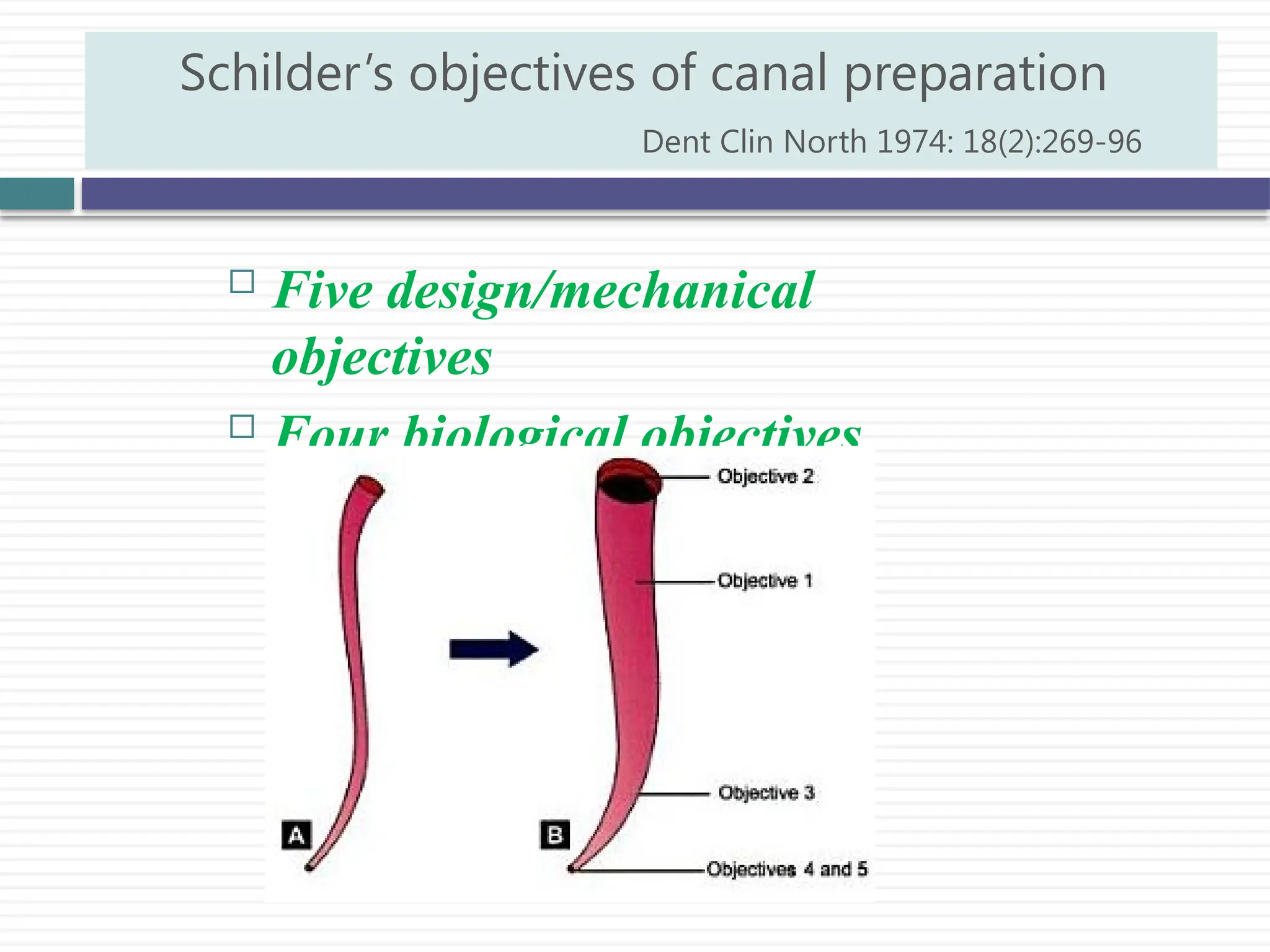
 Five design/mechanical
objectives
 Four biological objectives
Schilder’s objectives of canal preparation
Dent Clin North 1974: 18(2):269-96
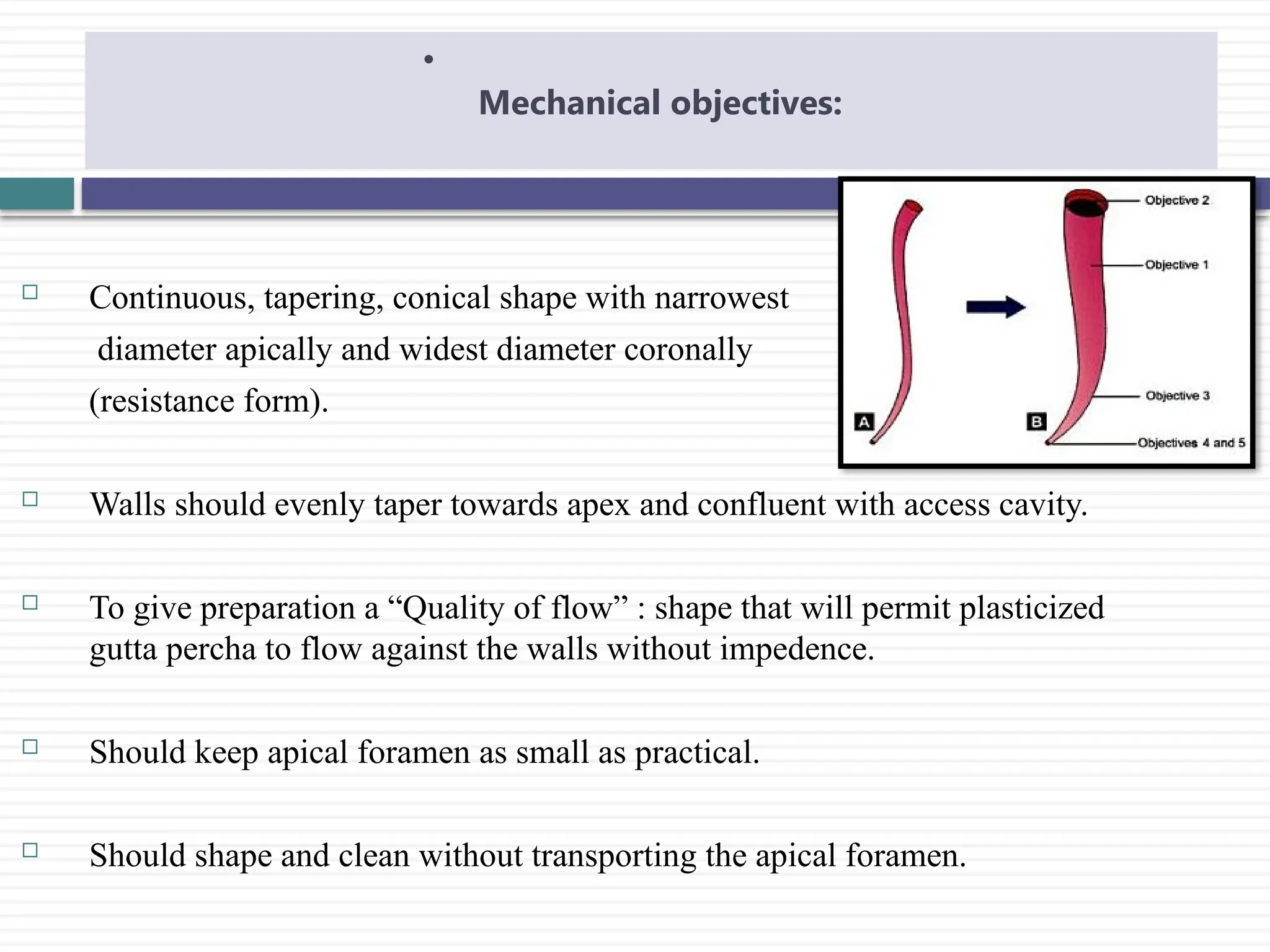
 Continuous, tapering, conical shape with narrowest
diameter apically and widest diameter coronally
(resistance form).
 Walls should evenly taper towards apex and confluent with access cavity.
 To give preparation a “Quality of flow” : shape that will permit plasticized
gutta percha to flow against the walls without impedence.
 Should keep apical foramen as small as practical.
 Should shape and clean without transporting the apical foramen.
•
Mechanical objectives:
1. Confinement of instrumentation to the roots themselves
2. Ensuring that all the necrotic debris are not forced
beyond foramen
3. Removal of all tissues from root canal space
4. Creation of sufficient space for optimal obturation of
radicular space
Biological objectives
1. Negotiating canal: patency filing
2. Coronal pre-enlargement( in some techniques)
3. Working length measurement
4. Root canal shaping techniques
5. Root canal working width
Phases in shaping of the root canal
Instrumentation:
 sterile instruments to be used in wet canals(irrigant).
 Clean the instrument using wet gauze after each use
 Must be fitted with instrument stops- rubber stoppers
 Discard the instrument if strain is present
Guidelines
 Anatomical considerations: most critical area for canal
disinfection: apical 3-4 mm
 Precurving of the instrument
 Irrigation: facilitate motion,debride and disinfect the root
canal. 2ml of irrigant per canal per instrument change.
 Avoid extrusion of debris outside the apical foramen
 Recapitulation: returning to a smaller instrument from time to
time before advancing to a larger size instrument: ensure
patency of canal.
Shaping and cleaning guidelines
• Root canal preparation
techniques
.Hand instrumentation
.Rotary instrumentation
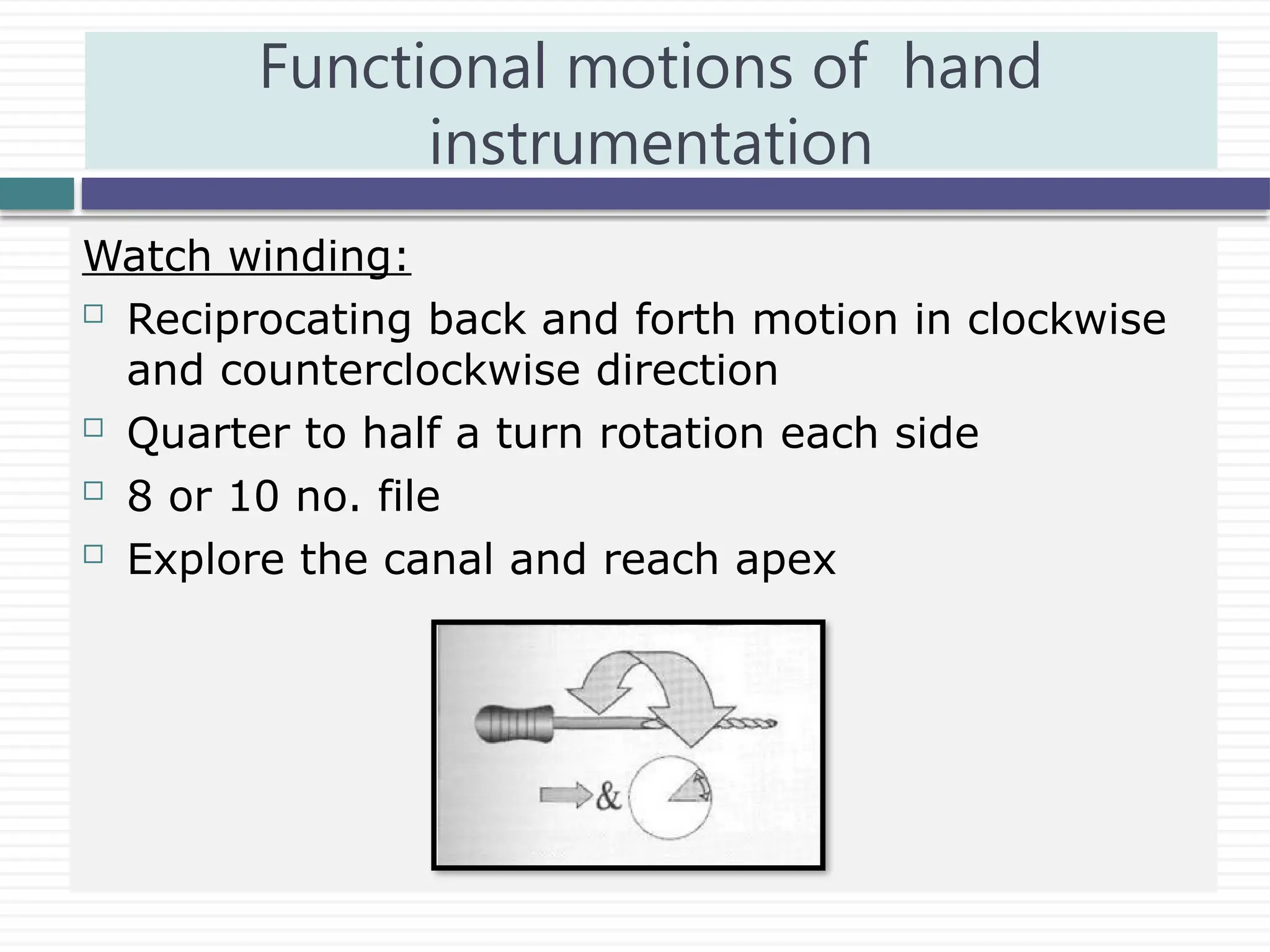
Watch winding:
 Reciprocating back and forth motion in clockwise
and counterclockwise direction
 Quarter to half a turn rotation each side
 8 or 10 no. file
 Explore the canal and reach apex
Functional motions of hand
instrumentation
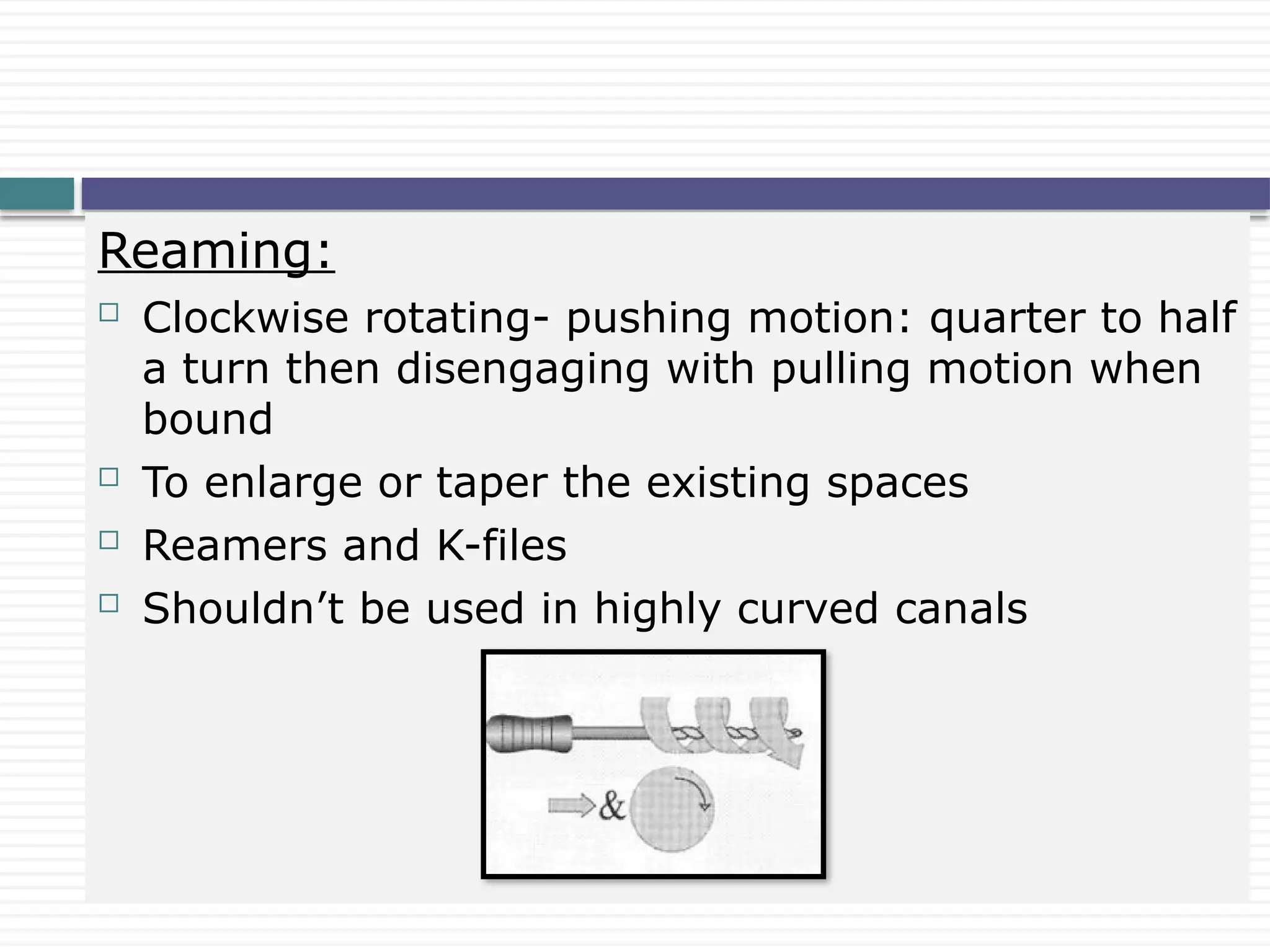
Reaming:
 Clockwise rotating- pushing motion: quarter to half
a turn then disengaging with pulling motion when
bound
 To enlarge or taper the existing spaces
 Reamers and K-files
 Shouldn’t be used in highly curved canals
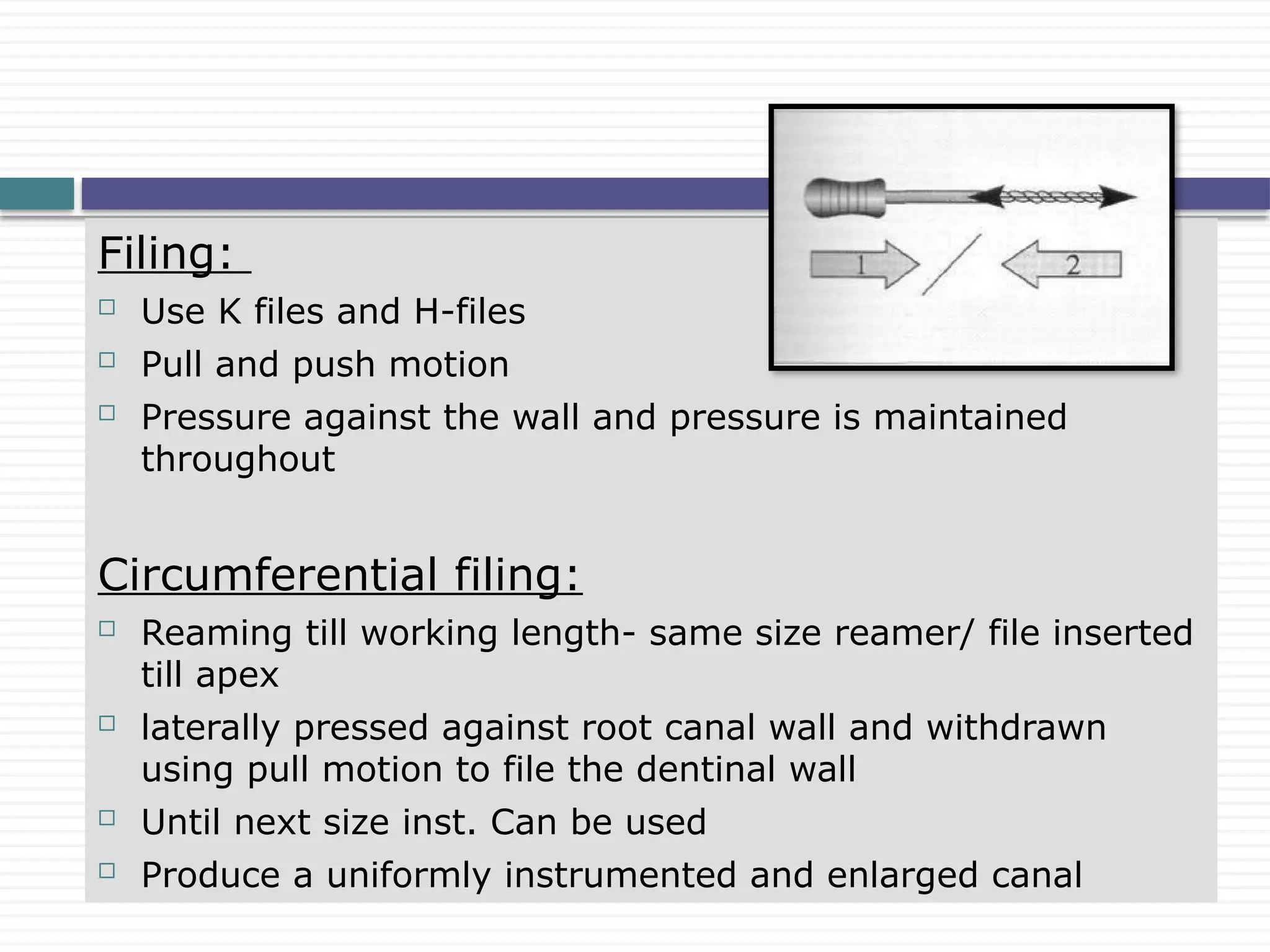
Filing:
 Use K files and H-files
 Pull and push motion
 Pressure against the wall and pressure is maintained
throughout
Circumferential filing:
 Reaming till working length- same size reamer/ file inserted
till apex
 laterally pressed against root canal wall and withdrawn
using pull motion to file the dentinal wall
 Until next size inst. Can be used
 Produce a uniformly instrumented and enlarged canal
Anticurvature filing:
. Abou Rass (1980)
 Furcal wall of mesial root of molars prone to perforation
during coronal enlargement –curvature- thin dentin
 To prevent- anticurvature filing is advocated i.e away
from curvature
 Shank of the handle is pushed away from inside of
curve
 Balances the cutting flutes against the safer part of
root canal.
 Step back technique-
. Conventional(Schilder and Weine)
. Modified step back
. Passive step back (Torabinejad)
 Crown down/ step down technique-
. Crowndown pressureless
. Double flare
. Balanced force technique
 Hybrid technique
Various instrumentation techniques
 Also called as telescopic or serial root canal preparation (Schilder
and Weine)
Phase I - Apical preparation starting at the apical constriction.
 Explore the canal with a fine instrument and establish the working
length
 The first active instrument to be inserted should be a fine 0.02
tapered, stainless steel file coated with a lubricant
 The motion of the instrument should be watch winding and
retraction and it should be taken to the working length
Step back method
Dent Clin North Am 1969: 13: 483–486.
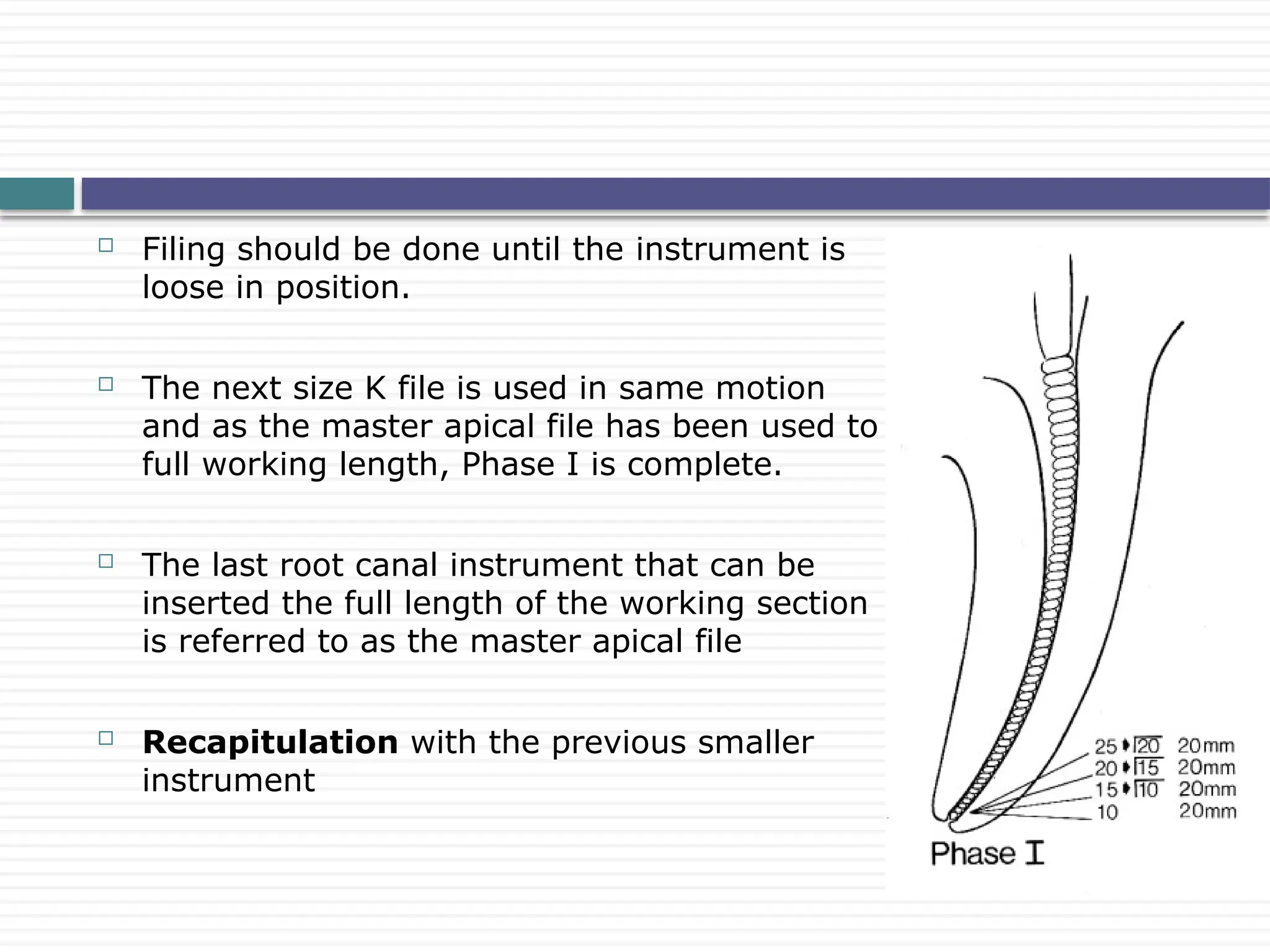
 Filing should be done until the instrument is
loose in position.
 The next size K file is used in same motion
and as the master apical file has been used to
full working length, Phase I is complete.
 The last root canal instrument that can be
inserted the full length of the working section
is referred to as the master apical file
 Recapitulation with the previous smaller
instrument
 The preparation steps back up the canal 1 mm
and one larger instrument at a time.
 Recapitulation to full length with master apical
file follows to ensure patency to the
constriction.
Phase II is the preparation of the remainder of the canal, gradually
stepping back while increasing in size.
Refining Phase II-A Gates-Glidden drill
Nos. 2, 3, and 4 used to create coronal and
mid root preparations.
 Refining Phase IIB is a return to master apical file, smoothing
all around the walls with vertical push-pull strokes, to perfect the
taper from the apical constriction to the cervical canal orifice
 The preparation is completed in the apical area, and then the
step-back procedure begins 2 to 3 mm up the canal.
 This gives a short, almost parallel retention form to receive the
primary gutta-percha point
 A slight tug-back should be felt when the gutta-percha point is
removed (retention form).
Modified Step-Back Technique
 Has been described by Torabinejad in 1994.
 Provides an unforceful and gradual enlargement of root canals in
an apical coronal direction.
 Insert progressively larger hand instruments as deep as they
would passively go in order to gain insight into the canal anatomy
and do some enlargement prior to reaching the WL.
 Subsequent use of GG drills or Peeso reamers will provide
additional coronal enlargement and improve tactile feedback from
the apical region as well as better access for irrigants
Passive Step back method
Oral Surg Oral Med Oral Pathol 1994: 77: 398–401.
Crown down/ step down technique
Technique Manual. ed. Portland OR: Oregon Health Sciences University; 1980
J Endod 1984;10:491.
 Given by Marshall & Pappin in 1980 and later evaluated by
Morgan & Montgomery in 1984.
 This instrumentation technique was suggested to minimize the
extrusion of canal contents.
 Coronal pre enlargement-by #35 hand file
 Coronal preparation- by GG drills
 A larger size hand file is used with no apical force followed by
incrementally smaller instruments progressing deeper into the
canal.
 The final step is to enlarge the apical area to three sizes larger
than the first file that bound at WL.
 This is accomplished by going through the sequence of
descending instrument sizes starting with a file one size larger
than the starting size in the preceding series.
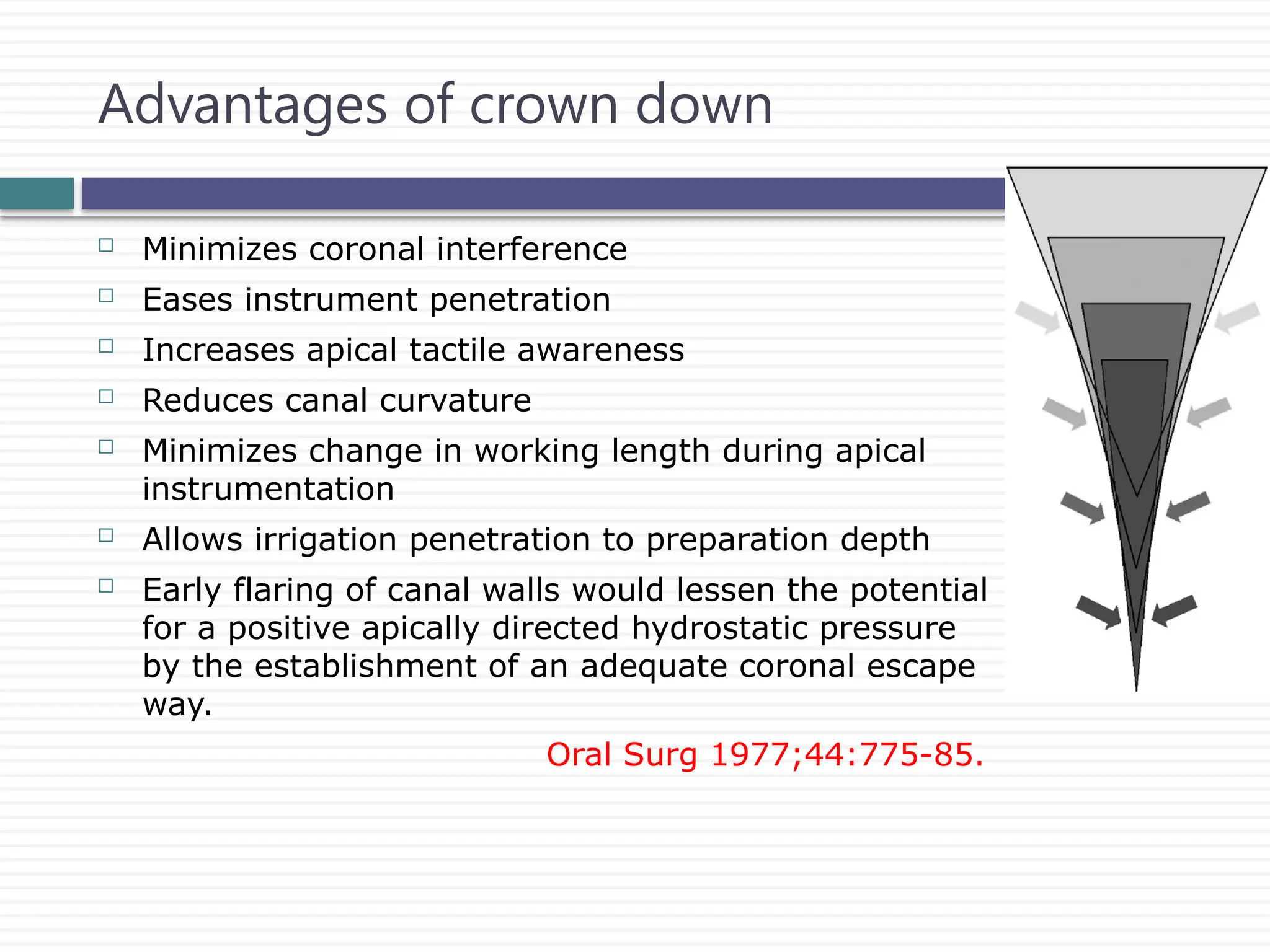
 Minimizes coronal interference
 Eases instrument penetration
 Increases apical tactile awareness
 Reduces canal curvature
 Minimizes change in working length during apical
instrumentation
 Allows irrigation penetration to preparation depth
 Early flaring of canal walls would lessen the potential
for a positive apically directed hydrostatic pressure
by the establishment of an adequate coronal escape
way.
Oral Surg 1977;44:775-85.
Advantages of crown down
 The great taper in the cervical and middle thirds leads to more
effective removal of canal contents and the root canal is better
cleansed (therefore preventing iatrogenic apical contamination)
J Endodon 1975;1:211-4.
 Reduces the contact area of each instrument (therefore reducing
torque and increasing cutting efficiency and safety)
 A direct comparison between crown down and step back has shown
that using crown down will result in less tip contact, less force, and
less torque compared with step back.
 Crown down is safer than step back
Int Endod J 1999;32:108–14.
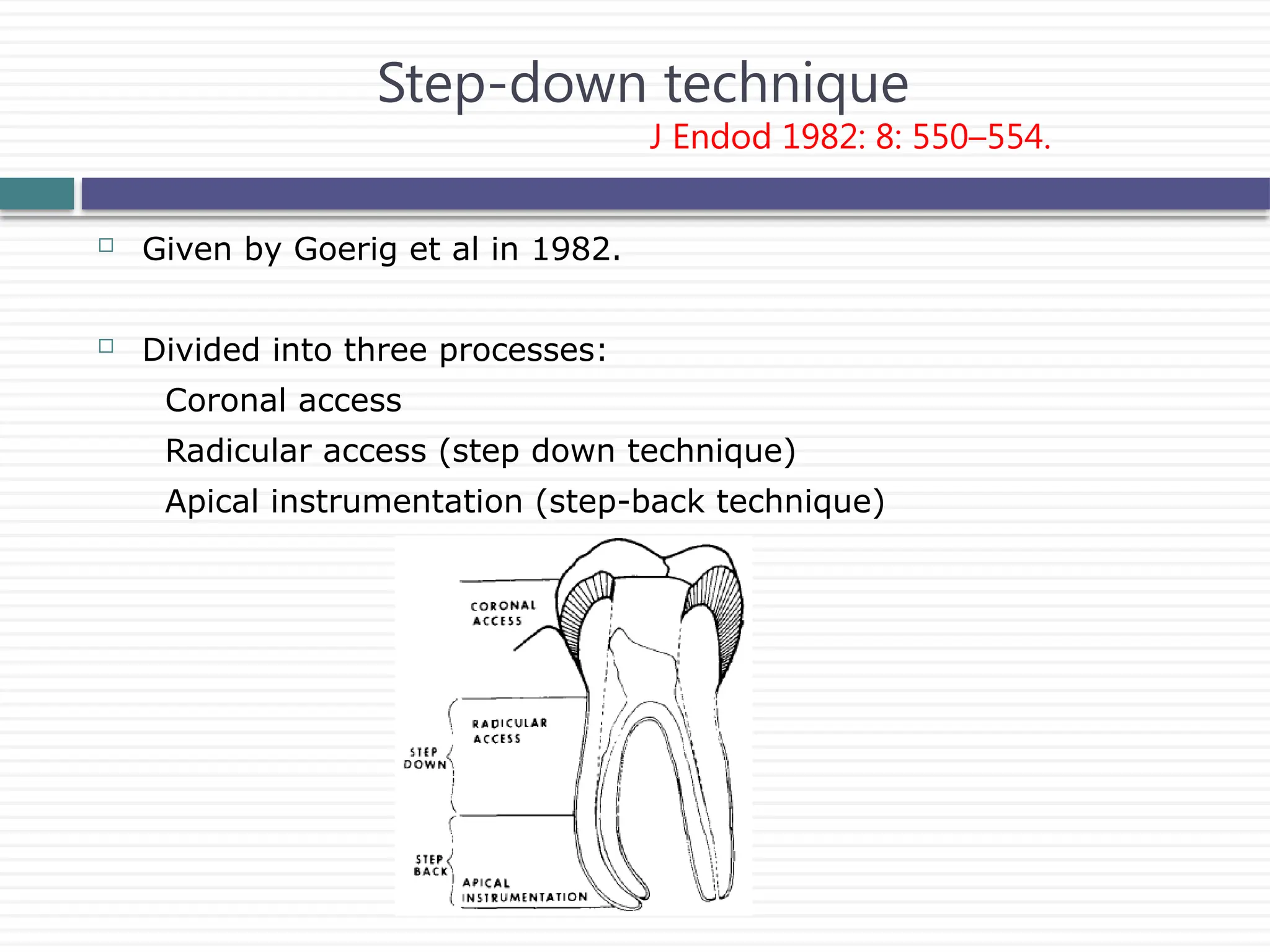
 Given by Goerig et al in 1982.
 Divided into three processes:
Coronal access
Radicular access (step down technique)
Apical instrumentation (step-back technique)
Step-down technique
J Endod 1982: 8: 550–554.
Double flare technique
J Endod 1983: 9: 76–80.
 Described by Fava in 1983.
 Prepare the canal with instrument of large diameter with a stop
fitted equivalent to the measurement to the cervical third
 It must not bind in the walls of the root canal to prevent the
creation of hydrostatic pressure
 Decreasing the diameter of the instrument at the same time that
its length is increased by 1 mm, until reaching end of the middle
third
 After maintaining the patency with # 15 or #20 k file, reach up to
the working length by preparing in same manner.
 At working length, prepare it 3 times larger and follow step back
method as described by Weine.
 Is indicated in cases of straight root canals or in the straight
portions of curved canals of mature teeth.
 Contraindications
Calcified canals
Young permanent teeth
Teeth with an open apex
J Endod 1983: 9: 76–80.
 Roane et al. introduced Balanced Force concept of canal preparaton in
1985
 For every action there is an equal and opposite reaction.
 coronal and mid-thirds of a canal are flared with GG drills, beginning with
small sizes
 Balanced Force hand instrumentation begins with the typical triad of
movements: placing, cutting, and removing instruments using only rotary
motions
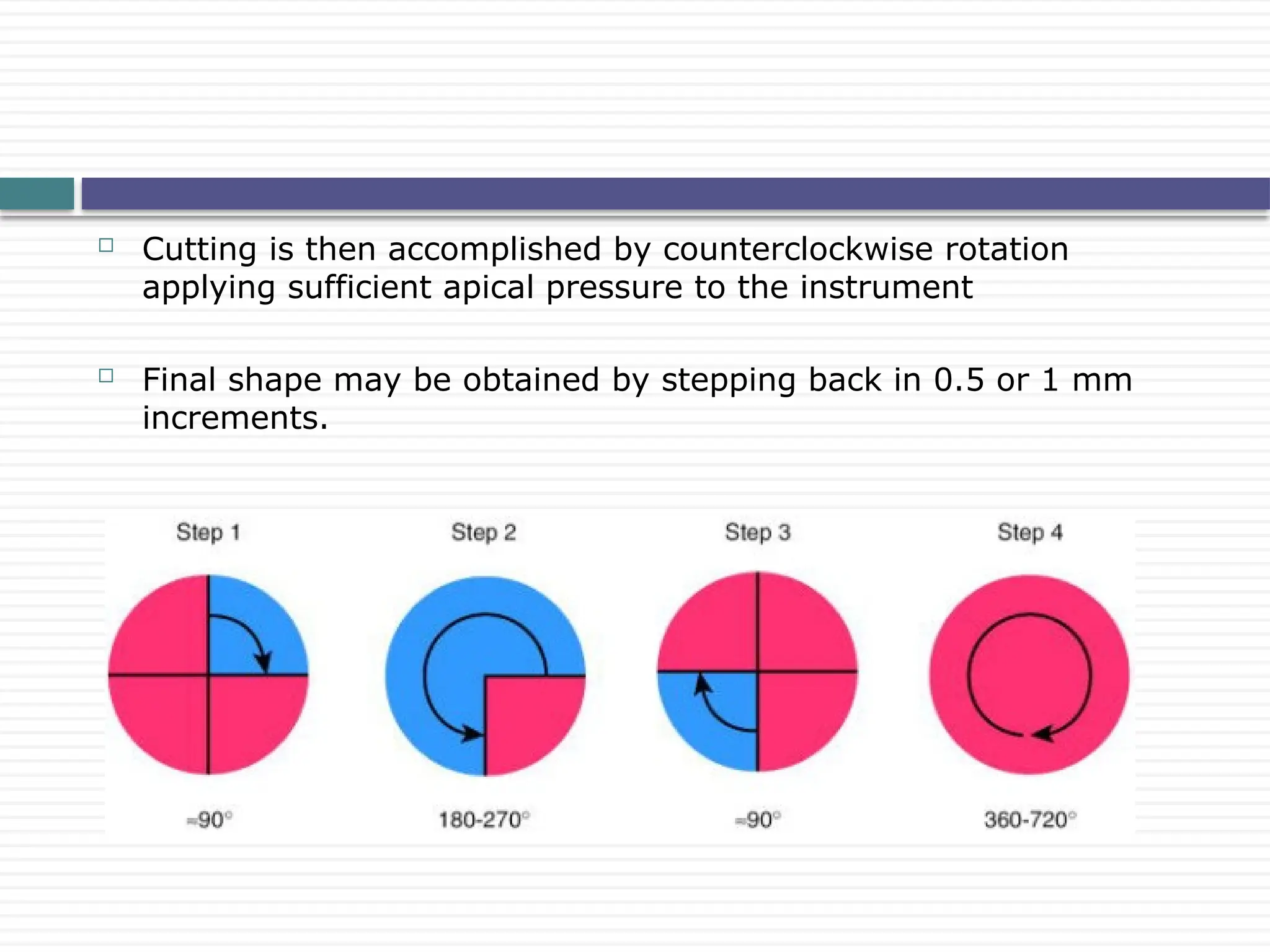
 Insertion is done by a quarter-turn clockwise rotation while slight or no
apical pressure is applied.
Balanced force technique
J Endod 1984: 10: 349–353.
 Cutting is then accomplished by counterclockwise rotation
applying sufficient apical pressure to the instrument
 Final shape may be obtained by stepping back in 0.5 or 1 mm
increments.
 Balanced Force technique may be used with any file with
symmetrical cross section.
J Endod 1987;13:479.
 Shaping and transportation control are considered optimal when a
Flex-R file is used.
J Endod 1992;18:19.
 The Flex-R file design removes the transition angles inherent to
the tip of standard K-files
 The specific tip design prevents Flex-R files from transporting the
canal into the external wall of a curve
 BF technique produced significantly less deviation from the centre
of the original canal.
J Endod. 1992 Jan;18(1):19-24
 The small quantity of debris and irrigants extruded by balanced
force instrumentation was lower than that created by the hybrid
instrumentation group, but similar to the engine-driven
techniques.
Int Endod J. 2001 Jul;34(5):354-8.
 Significantly less apical transportation with the use of the
balanced force technique when compared with a step-back
technique in canals
J Endod. 1989 Jun;15(6):240-5
 The hybrid concept combines the best features of different
systems for safe, quick, and predictable results.
 Straight line access
 Working length
 Master apical file size determination
 Glide path
 Body shaping
 Apical preparation
 The technique involves the use of a variety of instruments:
Hybrid technique
• GG drills and K-files for establishing straight-line access;
• ProTaper instruments for body shaping and apical preenlargement;
• NiTi K-files or LightSpeed instruments for apical widening
Dent Clin N Am 48 (2004) 183–202
 Described by Saunders & Saunders (1992).
 A #40 Flex R file was instrumented in the straight part of the canal,
using the balanced force technique
 Sequentially larger sizes of files were used to instrument this
straight part of the canal
 At this stage the coronal 4 to 5 mm of the root canal was
instrumented with Gates Glidden drills
 A #20 Flex R file was then taken to the working length and the
canal prepared using the balanced force technique by sequential use
 Preparation at the working length was continued until clean dentin
was removed, the master apical file varying between #40 and 45.
 A step-back technique using balanced forces was then used to
prepare the remaining curved portion of the canal.
Modified double flare technique
J Endod 1992: 18: 32–36.
 When a pulling (filing) motion is initiated, the greatest amount of
cutting occurs at the inner curve and apex because of the action
of a lever arm and fulcrum.
 By pulling, the operator loses control and cannot direct the
cutting forces evenly along the entire canal.
 When using Ni Ti rotary instruments, a reaming motion replaces
the filing movement.
 Less straightening will be accomplished
 Results in less canal transportation and better centering of canal.
 Vessey found that more rounded preparations are produced when
using a reaming action instead of a filing movement.
Oral Surg Oral Med oral Pathol 1969; 27: 543-547.
Continuous reaming motion
 Described by Wildey & Senia (1989)
 A new SW instrument was introduced.
Canal Master technique
OOO 1989: 67: 198–207.
 Described by Tronstad in 1991
 Apical 2-5 mm of root canal is prepared in
cylindrical shape rather than tapered
 This is obtained by rotating the k file at exact
working length to create a shelf.
Apical box technique
Clinical Endodontics. Stuttgart: G.Thieme-Verlag, 1991
Step 1: Access and coronal preflaring
Step 2: Determine working length and Initial apical rotary
 Nonbinding instruments advance in steps of 1 mm to 2 mm to the
working length with slow, controlled movements.
Step 3: Determine Master apical rotary
 Binding instruments
 Used with controlled forward (1 mm to 2 mm) and backward (2
mm to 4 mm) ‘‘pecking’’ movements.
 The forward motion reams the canal, whereas the backward
motion tends to clean the cutting head
 The MAR may be 6 to 12 LightSpeed instruments larger than the
IAR.
Step 4: Step-back and recapitulation
Zurich LightSpeed technique
 Step 1: Determine the LightSpeed size that is used to begin
rotary instrumentation (sizing or gauging the apical canal
diameter)
 Step 2: Determine the apical preparation size
12 ‘‘pecks’’ rule
‘‘pecking’’ movement translates into downward cut of the dentin
followed by a slight withdrawal of about 1 to 3 mm.
 Step 3: Complete apical instrumentation
 Step 4: Instrument mid-root
 Step 5: Recapitulate
Manufacturers recommended LightSpeed
technique
 This system consists of a pump, a hose, a special valve, and a
connector that needs to be cemented into the access cavity
 Cleaning action is then provided by oscillations of the irrigation
solution (1% to 3% NaOCl) at a reduced pressure.
Non instrument technique(NIT)
Lussi et al J Endod 1993;19:549.
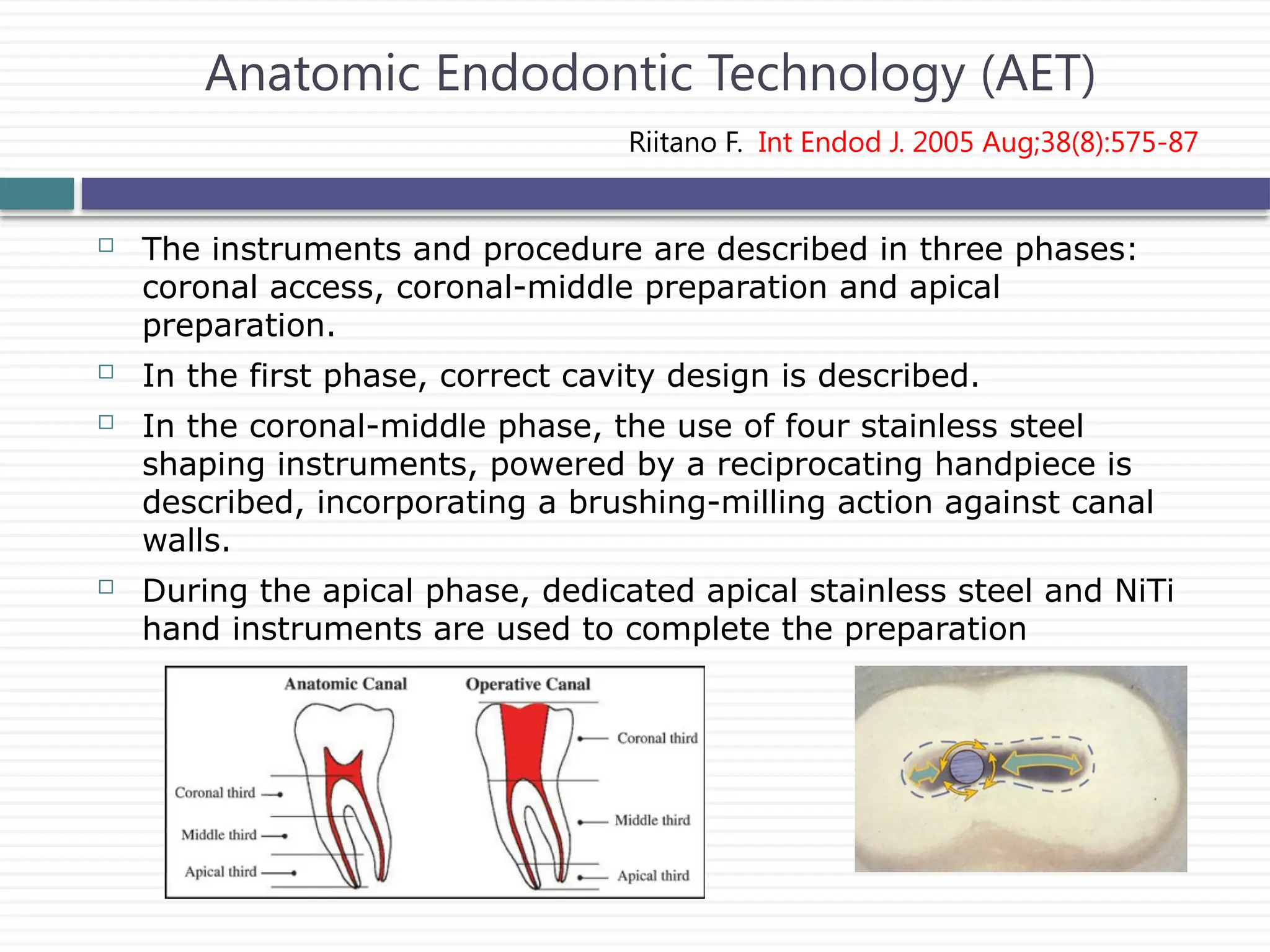
 The instruments and procedure are described in three phases:
coronal access, coronal-middle preparation and apical
preparation.
 In the first phase, correct cavity design is described.
 In the coronal-middle phase, the use of four stainless steel
shaping instruments, powered by a reciprocating handpiece is
described, incorporating a brushing-milling action against canal
walls.
 During the apical phase, dedicated apical stainless steel and NiTi
hand instruments are used to complete the preparation
Anatomic Endodontic Technology (AET)
Riitano F. Int Endod J. 2005 Aug;38(8):575-87
Challenges
Root canal preparation is adversely influenced by
 Highly variable root-canal anatomy
 Relative inability of the operator to visualize this anatomy from
radiographs
Most difficult curves to deal with are to
the buccal and/or the lingual because they
are directly in line with the x-ray beam.
Three main issues are presently considered most challenging and
controversial in root canal shaping:
 Identification, accessing, and enlargement of the main canals
without procedural errors
 Establishing and maintaining adequate working lengths
throughout the shaping procedure
 Selection of preparation sizes and overall geometries that allow
adequate disinfection and subsequent obturation.
Procedural errors
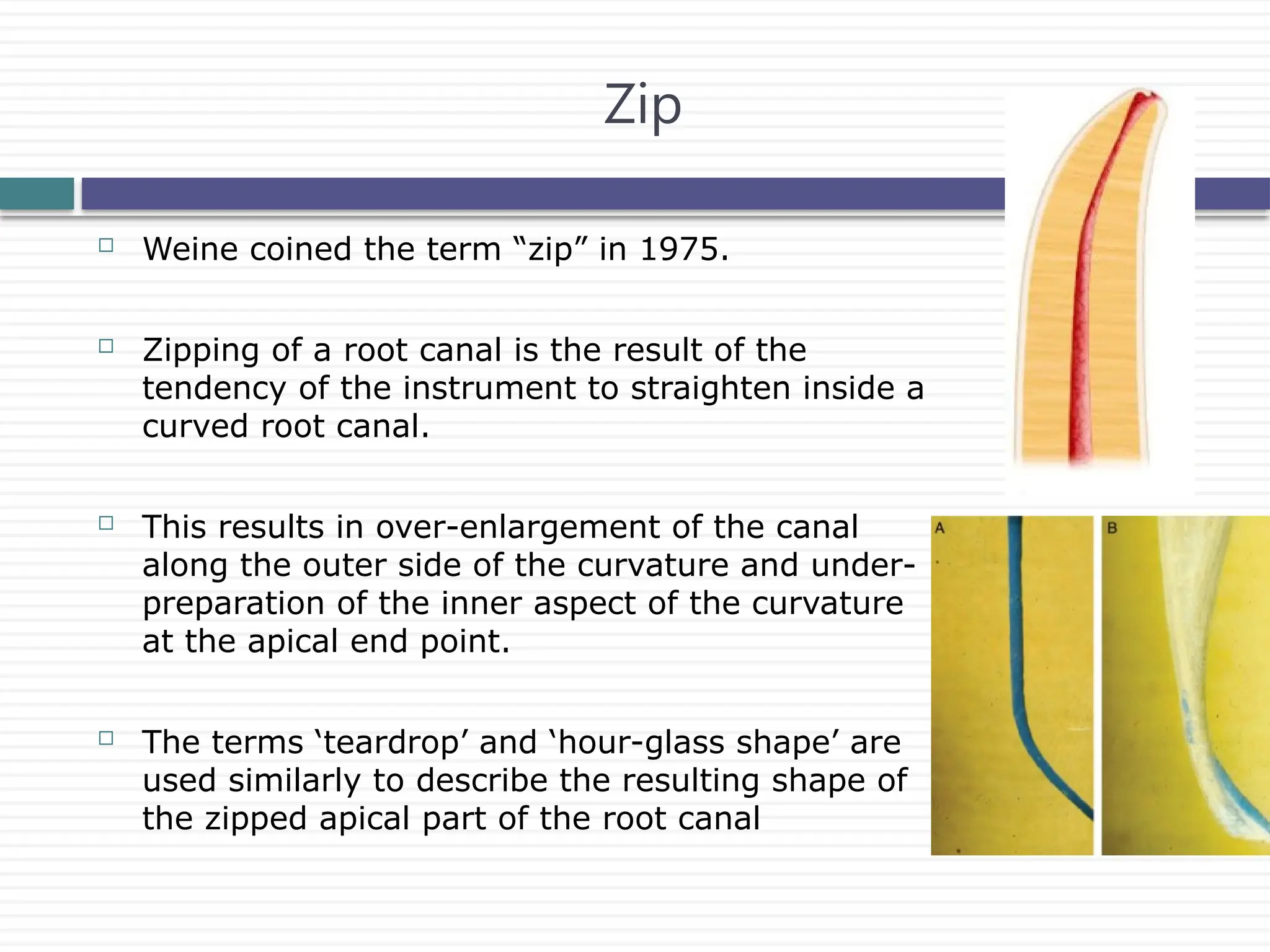
 Weine coined the term “zip” in 1975.
 Zipping of a root canal is the result of the
tendency of the instrument to straighten inside a
curved root canal.
 This results in over-enlargement of the canal
along the outer side of the curvature and under-
preparation of the inner aspect of the curvature
at the apical end point.
 The terms ‘teardrop’ and ‘hour-glass shape’ are
used similarly to describe the resulting shape of
the zipped apical part of the root canal
Zip
 Creation of an ‘elbow’ is associated with
zipping
 A narrow region of the root canal at the
point of maximum curvature as a result of
the irregular widening that occurs coronally
along the inner aspect and apically along
the outer aspect of the curve.
 The irregular conicity and insufficient taper
and flow associated with elbow may
jeopardize cleaning and filling the apical
part of the root canal
Elbow
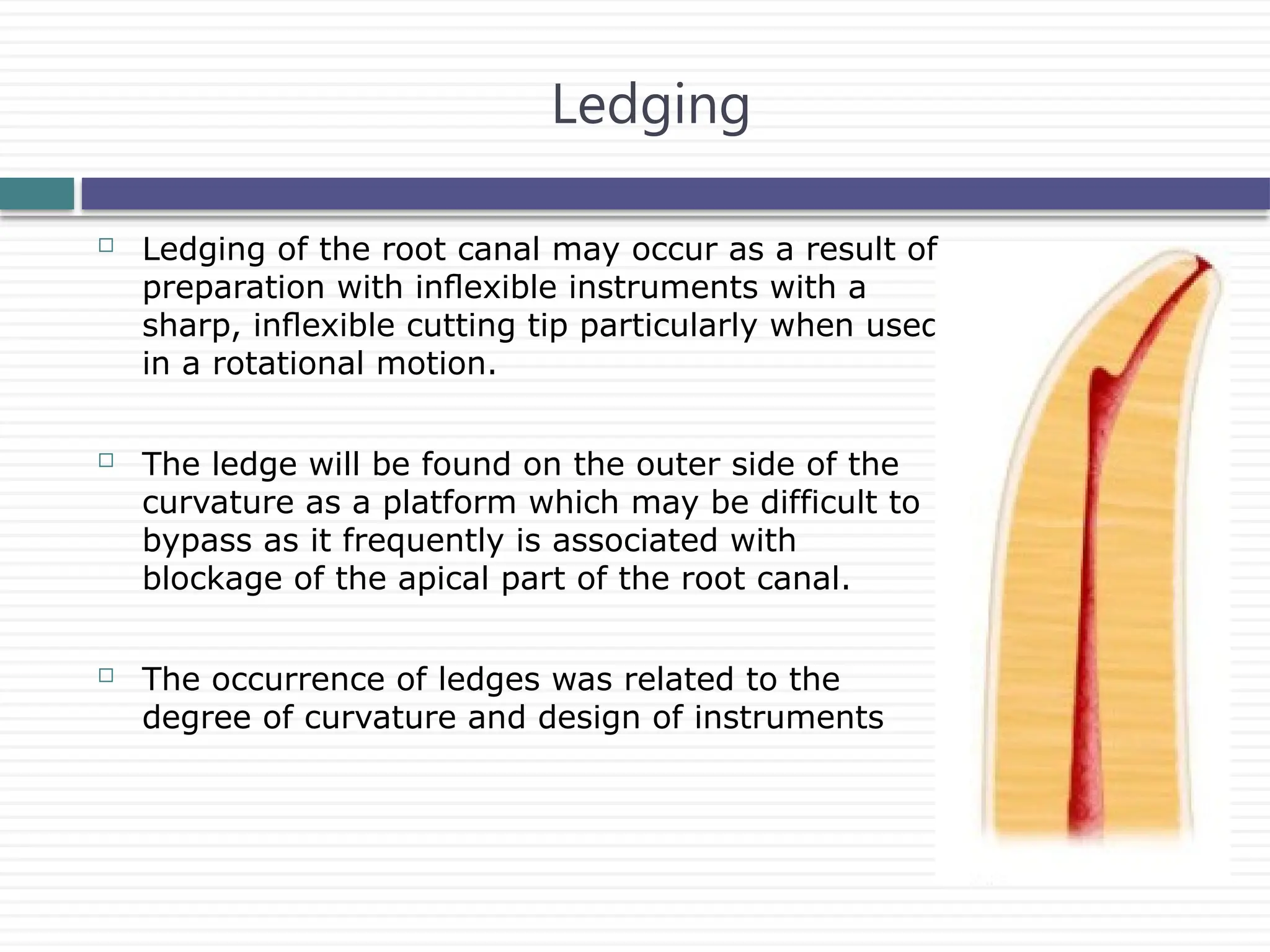
 Ledging of the root canal may occur as a result of
preparation with inflexible instruments with a
sharp, inflexible cutting tip particularly when used
in a rotational motion.
 The ledge will be found on the outer side of the
curvature as a platform which may be difficult to
bypass as it frequently is associated with
blockage of the apical part of the root canal.
 The occurrence of ledges was related to the
degree of curvature and design of instruments
Ledging
 Perforations are associated with destruction of
the root cementum and irritation and/or infection
of the periodontal ligament and are difficult to
seal.
 The incidence of perforations in clinical treatment
as well as in experimental studies has been
reported as ranging from 2.5 to 10%
 A consecutive clinical problem of perforations is
that a part of the original root canal will remain
un- or underprepared if it is not possible to
regain access to the original root canal apically
of the perforation.
Perforation
 Actively cutting tips such as with Quantec SC produced more
apical zips and perforations than instruments with noncutting tips
such as ProFile and Lightspeed.
J Endodon 1997; 23:698–702.
 An impact of canal geometry on outcome: the more severe the
angle and radius of the curve, the more severe canal
transportation.
 The manual technique produced lesser canal transportation
(0.10 mm) than the oscillatory and rotary techniques (0.37 and
0.22 mm, respectively)
J Endod. 2007 Aug;33(8):962-5
Instrument fracture
 Rotary instrumentation is potentially associated with an increased
risk of instrument breakage
 Spili et al. found overall a 3.3% prevalence of instrument
fractures but a prevalence of 5.1% after the introduction of NiTi
rotaries (4.4% NiTi versus 0.7% stainless steel).
J Endod. 2005 Dec;31(12):845-50.
 Instruments used in rotary motion separate in two distinct
modes: torsional and flexural
J Endodon 2000;26:161–5.
 Torsional fracture occurs when an instrument tip is locked in a
canal while the shank continues to rotate, thereby exerting
sufficient torque to fracture the tip.
 Flexural fractures occur after repeated subthreshold loads have
led to metal fatigue.
 Increased severity of angle and radius of the curve, around which
the instrument rotates, decreases instrument life spans
 Crown-down approach is superior to stepping back in decreasing
fracture risks by preventing a large portion of an instrument from
engaging root dentin (“taper lock”)
Int Endod J 1999;32:108–14.
 A light touch for all techniques using rotary NiTi instruments is
recommended to avoid forcing rotary instruments into taper lock.
 Angle of curvature is determined by the angle formed by the
lines that intersect at the circle’s centre.
 The circle’s radius is the radius of the curved portion of the root
canal space and defines how abruptly the canal curves.
 As the radius of curvature decreases, instrument stress and strain
increases, and the fatigue life decreases
Torque
 Is the term used about forces that act in a rotational manner.
 Torque is the ability of the handpiece to withstand lateral pressure on
the revolving tool without decreasing its speed or reducing its cutting
efficiency.
 High torque is very active and the incidence of instrument locking
and consequently deformation and
separation would tend to increase
 Low torque would reduce the cutting
efficiency of the instrument, and
instrument progression in the canal
would be difficult
 During root canal preparation all the instruments are subjected to
different levels of torque.
 If the level of the torque is equal or greater than the torque at
deformation or at separation, the instrument will either deform or
separate.
 A possible solution of this problem is to use a low-torque
endodontic motor, which operates below the maximum
permissible torque limit of each and every rotary instrument.
Endodontology, Vol. 13, 2001
 With low torque control motors, the motor will stop rotating and
can even reverse the direction of rotation when the instrument is
subjected to torque levels equal to the torque values set on the
motor.
 A torque-controlled motor is loaded right up to the instrument-
specific torque, the motor stops momentarily and/or starts
rotating counter-clockwise (auto-reverse function) to disengage
the locked instrument.
Endod Dent Traumatol 2000; 16 : 95-100
 Incorporation of gear systems within the handpiece
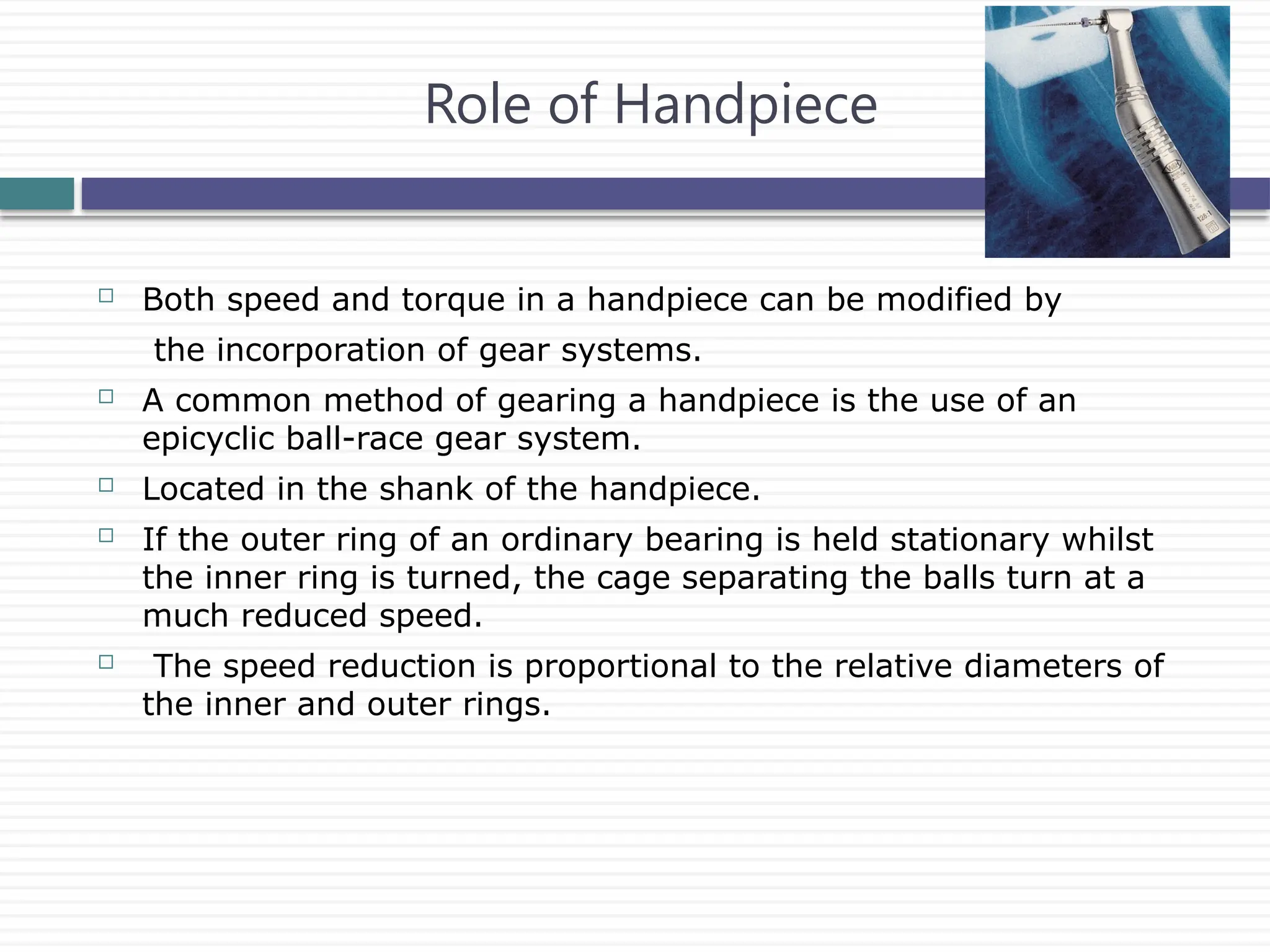
Role of Handpiece
 Both speed and torque in a handpiece can be modified by
the incorporation of gear systems.
 A common method of gearing a handpiece is the use of an
epicyclic ball-race gear system.
 Located in the shank of the handpiece.
 If the outer ring of an ordinary bearing is held stationary whilst
the inner ring is turned, the cage separating the balls turn at a
much reduced speed.
 The speed reduction is proportional to the relative diameters of
the inner and outer rings.
 The greater the file’s lateral resistance, the greater the torque
required to instrument the canal which makes the file less
efficient.
 Rotary speed is dependent on the torque requirements of the file
system. As the torque requirement is decreased, file speed can be
increased.
J Endod 2006;32:1031–1043
Loss of working length and debris
accumulation
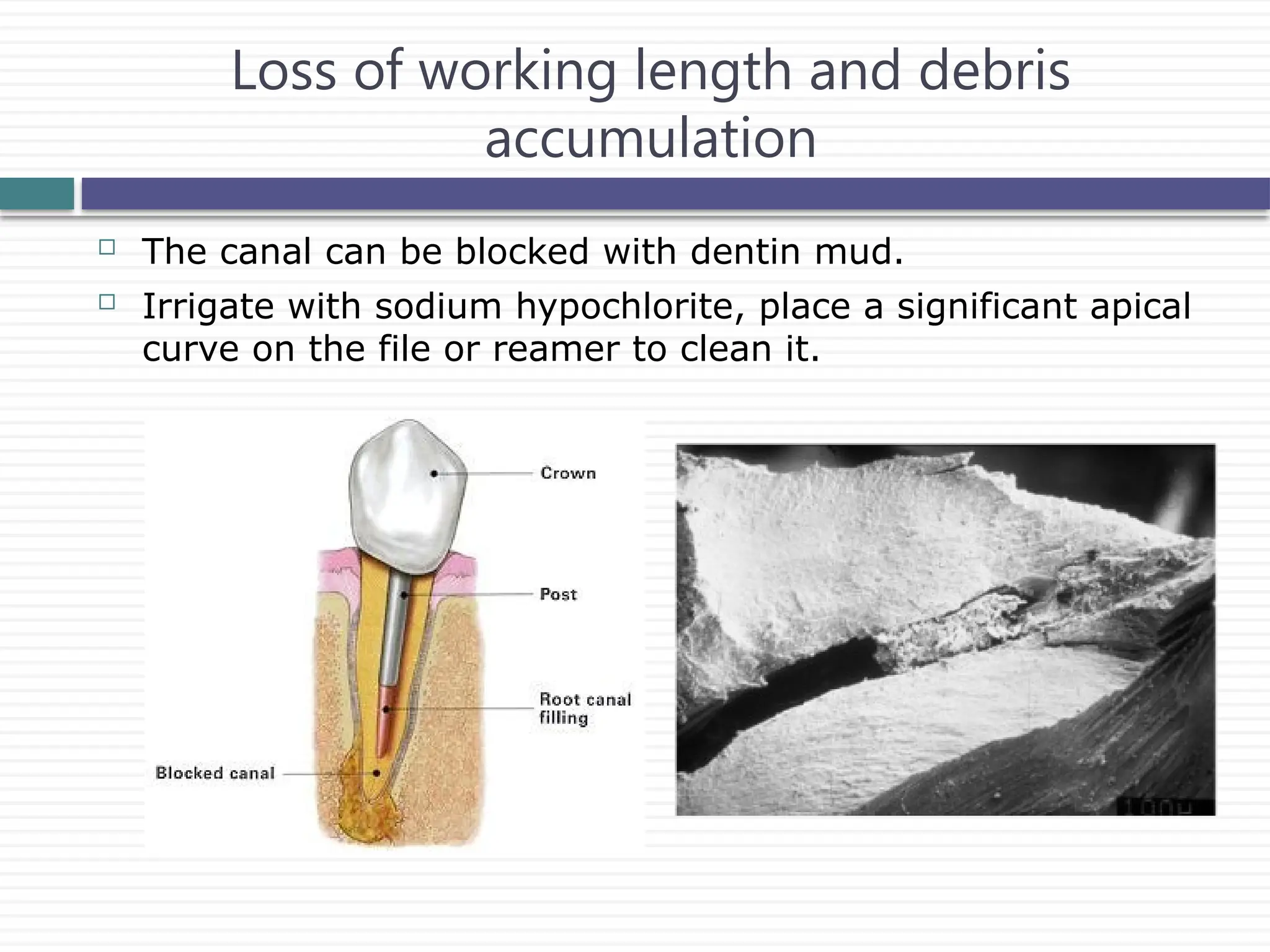
 The canal can be blocked with dentin mud.
 Irrigate with sodium hypochlorite, place a significant apical
curve on the file or reamer to clean it.
Effective time for the irrigant
 NiTi rotary systems speed up the treatment very much so that
the effective time for the irrigant is strongly reduced.
 This fact may undermine the extent of chemical cleaning.
Reduction in tactile sensation
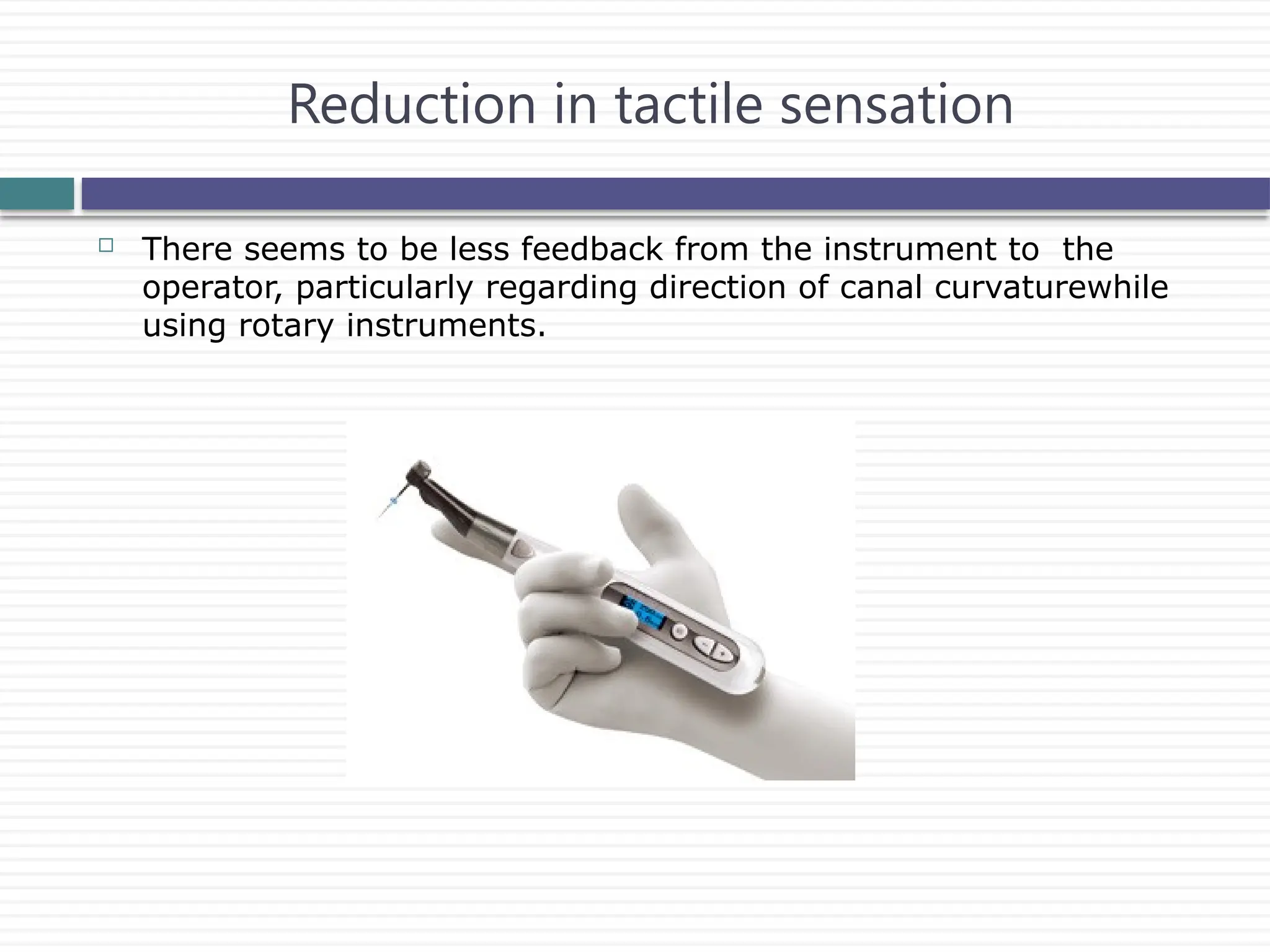
 There seems to be less feedback from the instrument to the
operator, particularly regarding direction of canal curvaturewhile
using rotary instruments.
 Narrow apex or Wide apex ?????
 Apical patency?????
Contraversial issues
 Three major elements determine the predictability of successful
endodontics.
knowledge
Skill
Desire
 Discipline and skills need to be developed, but the critical factor is
desire.
 It can be done if we want to do it.
 Successful endodontics is a decision.
Conclusion
Radicular space preparation 1.pptx dentistry

Radicular space preparation 1.pptx dentistry

  • 1.
    Biomechanical Preparation: Shaping AndCleaning Of Radicular Space Dr Sonica Purewal
  • 2.
    Endodontic treatment:  Properaccess preparation into pulp space  Shaping and cleaning of root canals  Obturation   Biomechanical preparation/ cleaning and shaping:  Cleaning: Removal of pulp tissue and debris mainly done by irrigation  Shaping of canal to receive obturation mainly done by instrumentation  Grossman (1955) defined it as attainment of free access through the root canal to the apical foramen to cleanse the root canals, to avoid injury to periapical tissues, to enlarge the canal to receive the medicaments and to facilitate obturation of root canal. Introduction
  • 3.
     To debrideand disinfect the root canal system  Shape and contour root canal walls: facilitate the sealing of root canal completely with well compacted inert filling material. Objectives
  • 4.
     Five design/mechanical objectives Four biological objectives Schilder’s objectives of canal preparation Dent Clin North 1974: 18(2):269-96
  • 5.
     Continuous, tapering,conical shape with narrowest diameter apically and widest diameter coronally (resistance form).  Walls should evenly taper towards apex and confluent with access cavity.  To give preparation a “Quality of flow” : shape that will permit plasticized gutta percha to flow against the walls without impedence.  Should keep apical foramen as small as practical.  Should shape and clean without transporting the apical foramen. • Mechanical objectives:
  • 6.
    1. Confinement ofinstrumentation to the roots themselves 2. Ensuring that all the necrotic debris are not forced beyond foramen 3. Removal of all tissues from root canal space 4. Creation of sufficient space for optimal obturation of radicular space Biological objectives
  • 7.
    1. Negotiating canal:patency filing 2. Coronal pre-enlargement( in some techniques) 3. Working length measurement 4. Root canal shaping techniques 5. Root canal working width Phases in shaping of the root canal
  • 8.
    Instrumentation:  sterile instrumentsto be used in wet canals(irrigant).  Clean the instrument using wet gauze after each use  Must be fitted with instrument stops- rubber stoppers  Discard the instrument if strain is present Guidelines
  • 9.
     Anatomical considerations:most critical area for canal disinfection: apical 3-4 mm  Precurving of the instrument  Irrigation: facilitate motion,debride and disinfect the root canal. 2ml of irrigant per canal per instrument change.  Avoid extrusion of debris outside the apical foramen  Recapitulation: returning to a smaller instrument from time to time before advancing to a larger size instrument: ensure patency of canal. Shaping and cleaning guidelines
  • 10.
    • Root canalpreparation techniques .Hand instrumentation .Rotary instrumentation
  • 11.
    Watch winding:  Reciprocatingback and forth motion in clockwise and counterclockwise direction  Quarter to half a turn rotation each side  8 or 10 no. file  Explore the canal and reach apex Functional motions of hand instrumentation
  • 12.
    Reaming:  Clockwise rotating-pushing motion: quarter to half a turn then disengaging with pulling motion when bound  To enlarge or taper the existing spaces  Reamers and K-files  Shouldn’t be used in highly curved canals
  • 13.
    Filing:  Use Kfiles and H-files  Pull and push motion  Pressure against the wall and pressure is maintained throughout Circumferential filing:  Reaming till working length- same size reamer/ file inserted till apex  laterally pressed against root canal wall and withdrawn using pull motion to file the dentinal wall  Until next size inst. Can be used  Produce a uniformly instrumented and enlarged canal
  • 14.
    Anticurvature filing: . AbouRass (1980)  Furcal wall of mesial root of molars prone to perforation during coronal enlargement –curvature- thin dentin  To prevent- anticurvature filing is advocated i.e away from curvature  Shank of the handle is pushed away from inside of curve  Balances the cutting flutes against the safer part of root canal.
  • 15.
     Step backtechnique- . Conventional(Schilder and Weine) . Modified step back . Passive step back (Torabinejad)  Crown down/ step down technique- . Crowndown pressureless . Double flare . Balanced force technique  Hybrid technique Various instrumentation techniques
  • 16.
     Also calledas telescopic or serial root canal preparation (Schilder and Weine) Phase I - Apical preparation starting at the apical constriction.  Explore the canal with a fine instrument and establish the working length  The first active instrument to be inserted should be a fine 0.02 tapered, stainless steel file coated with a lubricant  The motion of the instrument should be watch winding and retraction and it should be taken to the working length Step back method Dent Clin North Am 1969: 13: 483–486.
  • 17.
     Filing shouldbe done until the instrument is loose in position.  The next size K file is used in same motion and as the master apical file has been used to full working length, Phase I is complete.  The last root canal instrument that can be inserted the full length of the working section is referred to as the master apical file  Recapitulation with the previous smaller instrument
  • 18.
     The preparationsteps back up the canal 1 mm and one larger instrument at a time.  Recapitulation to full length with master apical file follows to ensure patency to the constriction. Phase II is the preparation of the remainder of the canal, gradually stepping back while increasing in size. Refining Phase II-A Gates-Glidden drill Nos. 2, 3, and 4 used to create coronal and mid root preparations.
  • 19.
     Refining PhaseIIB is a return to master apical file, smoothing all around the walls with vertical push-pull strokes, to perfect the taper from the apical constriction to the cervical canal orifice
  • 20.
     The preparationis completed in the apical area, and then the step-back procedure begins 2 to 3 mm up the canal.  This gives a short, almost parallel retention form to receive the primary gutta-percha point  A slight tug-back should be felt when the gutta-percha point is removed (retention form). Modified Step-Back Technique
  • 21.
     Has beendescribed by Torabinejad in 1994.  Provides an unforceful and gradual enlargement of root canals in an apical coronal direction.  Insert progressively larger hand instruments as deep as they would passively go in order to gain insight into the canal anatomy and do some enlargement prior to reaching the WL.  Subsequent use of GG drills or Peeso reamers will provide additional coronal enlargement and improve tactile feedback from the apical region as well as better access for irrigants Passive Step back method Oral Surg Oral Med Oral Pathol 1994: 77: 398–401.
  • 22.
    Crown down/ stepdown technique Technique Manual. ed. Portland OR: Oregon Health Sciences University; 1980 J Endod 1984;10:491.  Given by Marshall & Pappin in 1980 and later evaluated by Morgan & Montgomery in 1984.  This instrumentation technique was suggested to minimize the extrusion of canal contents.  Coronal pre enlargement-by #35 hand file  Coronal preparation- by GG drills
  • 23.
     A largersize hand file is used with no apical force followed by incrementally smaller instruments progressing deeper into the canal.  The final step is to enlarge the apical area to three sizes larger than the first file that bound at WL.  This is accomplished by going through the sequence of descending instrument sizes starting with a file one size larger than the starting size in the preceding series.
  • 24.
     Minimizes coronalinterference  Eases instrument penetration  Increases apical tactile awareness  Reduces canal curvature  Minimizes change in working length during apical instrumentation  Allows irrigation penetration to preparation depth  Early flaring of canal walls would lessen the potential for a positive apically directed hydrostatic pressure by the establishment of an adequate coronal escape way. Oral Surg 1977;44:775-85. Advantages of crown down
  • 25.
     The greattaper in the cervical and middle thirds leads to more effective removal of canal contents and the root canal is better cleansed (therefore preventing iatrogenic apical contamination) J Endodon 1975;1:211-4.  Reduces the contact area of each instrument (therefore reducing torque and increasing cutting efficiency and safety)  A direct comparison between crown down and step back has shown that using crown down will result in less tip contact, less force, and less torque compared with step back.  Crown down is safer than step back Int Endod J 1999;32:108–14.
  • 26.
     Given byGoerig et al in 1982.  Divided into three processes: Coronal access Radicular access (step down technique) Apical instrumentation (step-back technique) Step-down technique J Endod 1982: 8: 550–554.
  • 27.
    Double flare technique JEndod 1983: 9: 76–80.  Described by Fava in 1983.  Prepare the canal with instrument of large diameter with a stop fitted equivalent to the measurement to the cervical third  It must not bind in the walls of the root canal to prevent the creation of hydrostatic pressure  Decreasing the diameter of the instrument at the same time that its length is increased by 1 mm, until reaching end of the middle third  After maintaining the patency with # 15 or #20 k file, reach up to the working length by preparing in same manner.  At working length, prepare it 3 times larger and follow step back method as described by Weine.
  • 28.
     Is indicatedin cases of straight root canals or in the straight portions of curved canals of mature teeth.  Contraindications Calcified canals Young permanent teeth Teeth with an open apex J Endod 1983: 9: 76–80.
  • 29.
     Roane etal. introduced Balanced Force concept of canal preparaton in 1985  For every action there is an equal and opposite reaction.  coronal and mid-thirds of a canal are flared with GG drills, beginning with small sizes  Balanced Force hand instrumentation begins with the typical triad of movements: placing, cutting, and removing instruments using only rotary motions  Insertion is done by a quarter-turn clockwise rotation while slight or no apical pressure is applied. Balanced force technique J Endod 1984: 10: 349–353.
  • 30.
     Cutting isthen accomplished by counterclockwise rotation applying sufficient apical pressure to the instrument  Final shape may be obtained by stepping back in 0.5 or 1 mm increments.
  • 31.
     Balanced Forcetechnique may be used with any file with symmetrical cross section. J Endod 1987;13:479.  Shaping and transportation control are considered optimal when a Flex-R file is used. J Endod 1992;18:19.  The Flex-R file design removes the transition angles inherent to the tip of standard K-files  The specific tip design prevents Flex-R files from transporting the canal into the external wall of a curve
  • 32.
     BF techniqueproduced significantly less deviation from the centre of the original canal. J Endod. 1992 Jan;18(1):19-24  The small quantity of debris and irrigants extruded by balanced force instrumentation was lower than that created by the hybrid instrumentation group, but similar to the engine-driven techniques. Int Endod J. 2001 Jul;34(5):354-8.  Significantly less apical transportation with the use of the balanced force technique when compared with a step-back technique in canals J Endod. 1989 Jun;15(6):240-5
  • 33.
     The hybridconcept combines the best features of different systems for safe, quick, and predictable results.  Straight line access  Working length  Master apical file size determination  Glide path  Body shaping  Apical preparation  The technique involves the use of a variety of instruments: Hybrid technique • GG drills and K-files for establishing straight-line access; • ProTaper instruments for body shaping and apical preenlargement; • NiTi K-files or LightSpeed instruments for apical widening Dent Clin N Am 48 (2004) 183–202
  • 34.
     Described bySaunders & Saunders (1992).  A #40 Flex R file was instrumented in the straight part of the canal, using the balanced force technique  Sequentially larger sizes of files were used to instrument this straight part of the canal  At this stage the coronal 4 to 5 mm of the root canal was instrumented with Gates Glidden drills  A #20 Flex R file was then taken to the working length and the canal prepared using the balanced force technique by sequential use  Preparation at the working length was continued until clean dentin was removed, the master apical file varying between #40 and 45.  A step-back technique using balanced forces was then used to prepare the remaining curved portion of the canal. Modified double flare technique J Endod 1992: 18: 32–36.
  • 35.
     When apulling (filing) motion is initiated, the greatest amount of cutting occurs at the inner curve and apex because of the action of a lever arm and fulcrum.  By pulling, the operator loses control and cannot direct the cutting forces evenly along the entire canal.  When using Ni Ti rotary instruments, a reaming motion replaces the filing movement.  Less straightening will be accomplished  Results in less canal transportation and better centering of canal.  Vessey found that more rounded preparations are produced when using a reaming action instead of a filing movement. Oral Surg Oral Med oral Pathol 1969; 27: 543-547. Continuous reaming motion
  • 36.
     Described byWildey & Senia (1989)  A new SW instrument was introduced. Canal Master technique OOO 1989: 67: 198–207.
  • 37.
     Described byTronstad in 1991  Apical 2-5 mm of root canal is prepared in cylindrical shape rather than tapered  This is obtained by rotating the k file at exact working length to create a shelf. Apical box technique Clinical Endodontics. Stuttgart: G.Thieme-Verlag, 1991
  • 38.
    Step 1: Accessand coronal preflaring Step 2: Determine working length and Initial apical rotary  Nonbinding instruments advance in steps of 1 mm to 2 mm to the working length with slow, controlled movements. Step 3: Determine Master apical rotary  Binding instruments  Used with controlled forward (1 mm to 2 mm) and backward (2 mm to 4 mm) ‘‘pecking’’ movements.  The forward motion reams the canal, whereas the backward motion tends to clean the cutting head  The MAR may be 6 to 12 LightSpeed instruments larger than the IAR. Step 4: Step-back and recapitulation Zurich LightSpeed technique
  • 39.
     Step 1:Determine the LightSpeed size that is used to begin rotary instrumentation (sizing or gauging the apical canal diameter)  Step 2: Determine the apical preparation size 12 ‘‘pecks’’ rule ‘‘pecking’’ movement translates into downward cut of the dentin followed by a slight withdrawal of about 1 to 3 mm.  Step 3: Complete apical instrumentation  Step 4: Instrument mid-root  Step 5: Recapitulate Manufacturers recommended LightSpeed technique
  • 40.
     This systemconsists of a pump, a hose, a special valve, and a connector that needs to be cemented into the access cavity  Cleaning action is then provided by oscillations of the irrigation solution (1% to 3% NaOCl) at a reduced pressure. Non instrument technique(NIT) Lussi et al J Endod 1993;19:549.
  • 41.
     The instrumentsand procedure are described in three phases: coronal access, coronal-middle preparation and apical preparation.  In the first phase, correct cavity design is described.  In the coronal-middle phase, the use of four stainless steel shaping instruments, powered by a reciprocating handpiece is described, incorporating a brushing-milling action against canal walls.  During the apical phase, dedicated apical stainless steel and NiTi hand instruments are used to complete the preparation Anatomic Endodontic Technology (AET) Riitano F. Int Endod J. 2005 Aug;38(8):575-87
  • 43.
    Challenges Root canal preparationis adversely influenced by  Highly variable root-canal anatomy  Relative inability of the operator to visualize this anatomy from radiographs Most difficult curves to deal with are to the buccal and/or the lingual because they are directly in line with the x-ray beam.
  • 44.
    Three main issuesare presently considered most challenging and controversial in root canal shaping:  Identification, accessing, and enlargement of the main canals without procedural errors  Establishing and maintaining adequate working lengths throughout the shaping procedure  Selection of preparation sizes and overall geometries that allow adequate disinfection and subsequent obturation.
  • 45.
  • 46.
     Weine coinedthe term “zip” in 1975.  Zipping of a root canal is the result of the tendency of the instrument to straighten inside a curved root canal.  This results in over-enlargement of the canal along the outer side of the curvature and under- preparation of the inner aspect of the curvature at the apical end point.  The terms ‘teardrop’ and ‘hour-glass shape’ are used similarly to describe the resulting shape of the zipped apical part of the root canal Zip
  • 47.
     Creation ofan ‘elbow’ is associated with zipping  A narrow region of the root canal at the point of maximum curvature as a result of the irregular widening that occurs coronally along the inner aspect and apically along the outer aspect of the curve.  The irregular conicity and insufficient taper and flow associated with elbow may jeopardize cleaning and filling the apical part of the root canal Elbow
  • 48.
     Ledging ofthe root canal may occur as a result of preparation with inflexible instruments with a sharp, inflexible cutting tip particularly when used in a rotational motion.  The ledge will be found on the outer side of the curvature as a platform which may be difficult to bypass as it frequently is associated with blockage of the apical part of the root canal.  The occurrence of ledges was related to the degree of curvature and design of instruments Ledging
  • 49.
     Perforations areassociated with destruction of the root cementum and irritation and/or infection of the periodontal ligament and are difficult to seal.  The incidence of perforations in clinical treatment as well as in experimental studies has been reported as ranging from 2.5 to 10%  A consecutive clinical problem of perforations is that a part of the original root canal will remain un- or underprepared if it is not possible to regain access to the original root canal apically of the perforation. Perforation
  • 50.
     Actively cuttingtips such as with Quantec SC produced more apical zips and perforations than instruments with noncutting tips such as ProFile and Lightspeed. J Endodon 1997; 23:698–702.  An impact of canal geometry on outcome: the more severe the angle and radius of the curve, the more severe canal transportation.  The manual technique produced lesser canal transportation (0.10 mm) than the oscillatory and rotary techniques (0.37 and 0.22 mm, respectively) J Endod. 2007 Aug;33(8):962-5
  • 51.
    Instrument fracture  Rotaryinstrumentation is potentially associated with an increased risk of instrument breakage  Spili et al. found overall a 3.3% prevalence of instrument fractures but a prevalence of 5.1% after the introduction of NiTi rotaries (4.4% NiTi versus 0.7% stainless steel). J Endod. 2005 Dec;31(12):845-50.  Instruments used in rotary motion separate in two distinct modes: torsional and flexural J Endodon 2000;26:161–5.  Torsional fracture occurs when an instrument tip is locked in a canal while the shank continues to rotate, thereby exerting sufficient torque to fracture the tip.
  • 52.
     Flexural fracturesoccur after repeated subthreshold loads have led to metal fatigue.  Increased severity of angle and radius of the curve, around which the instrument rotates, decreases instrument life spans  Crown-down approach is superior to stepping back in decreasing fracture risks by preventing a large portion of an instrument from engaging root dentin (“taper lock”) Int Endod J 1999;32:108–14.  A light touch for all techniques using rotary NiTi instruments is recommended to avoid forcing rotary instruments into taper lock.
  • 53.
     Angle ofcurvature is determined by the angle formed by the lines that intersect at the circle’s centre.  The circle’s radius is the radius of the curved portion of the root canal space and defines how abruptly the canal curves.  As the radius of curvature decreases, instrument stress and strain increases, and the fatigue life decreases
  • 54.
    Torque  Is theterm used about forces that act in a rotational manner.  Torque is the ability of the handpiece to withstand lateral pressure on the revolving tool without decreasing its speed or reducing its cutting efficiency.  High torque is very active and the incidence of instrument locking and consequently deformation and separation would tend to increase  Low torque would reduce the cutting efficiency of the instrument, and instrument progression in the canal would be difficult
  • 55.
     During rootcanal preparation all the instruments are subjected to different levels of torque.  If the level of the torque is equal or greater than the torque at deformation or at separation, the instrument will either deform or separate.  A possible solution of this problem is to use a low-torque endodontic motor, which operates below the maximum permissible torque limit of each and every rotary instrument. Endodontology, Vol. 13, 2001
  • 56.
     With lowtorque control motors, the motor will stop rotating and can even reverse the direction of rotation when the instrument is subjected to torque levels equal to the torque values set on the motor.  A torque-controlled motor is loaded right up to the instrument- specific torque, the motor stops momentarily and/or starts rotating counter-clockwise (auto-reverse function) to disengage the locked instrument. Endod Dent Traumatol 2000; 16 : 95-100  Incorporation of gear systems within the handpiece
  • 57.
    Role of Handpiece Both speed and torque in a handpiece can be modified by the incorporation of gear systems.  A common method of gearing a handpiece is the use of an epicyclic ball-race gear system.  Located in the shank of the handpiece.  If the outer ring of an ordinary bearing is held stationary whilst the inner ring is turned, the cage separating the balls turn at a much reduced speed.  The speed reduction is proportional to the relative diameters of the inner and outer rings.
  • 58.
     The greaterthe file’s lateral resistance, the greater the torque required to instrument the canal which makes the file less efficient.  Rotary speed is dependent on the torque requirements of the file system. As the torque requirement is decreased, file speed can be increased.
  • 59.
  • 60.
    Loss of workinglength and debris accumulation  The canal can be blocked with dentin mud.  Irrigate with sodium hypochlorite, place a significant apical curve on the file or reamer to clean it.
  • 61.
    Effective time forthe irrigant  NiTi rotary systems speed up the treatment very much so that the effective time for the irrigant is strongly reduced.  This fact may undermine the extent of chemical cleaning.
  • 62.
    Reduction in tactilesensation  There seems to be less feedback from the instrument to the operator, particularly regarding direction of canal curvaturewhile using rotary instruments.
  • 63.
     Narrow apexor Wide apex ?????  Apical patency????? Contraversial issues
  • 64.
     Three majorelements determine the predictability of successful endodontics. knowledge Skill Desire  Discipline and skills need to be developed, but the critical factor is desire.  It can be done if we want to do it.  Successful endodontics is a decision. Conclusion