Cleaning and shaping
fwefwegv
Cleaning and Shaping
1
outline
• Cleaning & Shaping
• Techniques: step back and crown down
Endodontic treatment mainly consists of three steps:
• Cleaning and shaping of the root canal system
• Disinfection
• Obturation
Cleaning and shaping is one of the most important step in the root
canal therapy for obtaining success in the root canal treatment.
3
Cleaning
• It comprises the removal of all potentially pathogenic contents
from the root canal system.
Shaping
• The establishment of a specifically shaped cavity which performs
the dual role of three-dimensional progressive access into the
canal and creating an apical preparation which will permit the
final obturation instruments and materials to fit easily
4
5
Objectives
Mecanical Objectives:
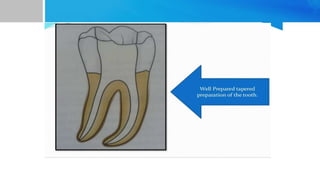
• Continuously tapering cone (narrower apically)
– This shape mimics the natural canal shape.
– Creates the resistance form to hold gutta-percha in the canal.
• Avoid transportation of the foramen.
• Keep the apical opening as small as possible.
Biological objectives:
– To remove the pulp tissue
– Bacteria and their by-products from the root canal space.
DIFFERENT MOVEMENTS OF INSTRUMENTS
Reaming: it is commonly done by use of reamers , though files can
also be used. It involves clockwise rotation of an instrument.
Filing: the term filing indicates push-pull motion with the
instrument(file)
6
Combination of Reaming and Filing
• In this technique file is inserted with a quarter turn clockwise and
apically directed pressure (i.e. reaming) and then is subsequently
withdrawn (i.e. filing).
Balanced Force Technique
• This technique involves oscillation of instrument right and left
with different arcs in either direction
7
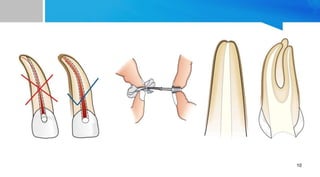
BASIC PRINCIPLES OF CANAL INSTRUMENTATION
 There should be a straight line access to the canal orifices
 canal must always be prepared in wet environment.
 Preparation of canal should be completed while retaining its
original form and the shape .
 Exploration of the orifice is always done with smaller file to
gauge the canal size and the configuration
8
 Canal enlargement should be done by using instruments in the
sequential order without skipping sizes.
 After each insertion and removal of the file, its flutes should be
cleaned and inspected
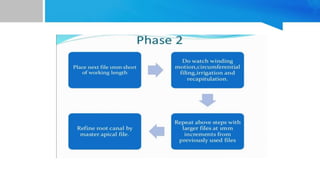
 Recapitulation is regularly done to loosen debris by returning to
working length. The canal walls should not be enlarged during
recapitulation.
 Over preparation and too aggressive over enlargement of the
curved canals should be avoided
9
10
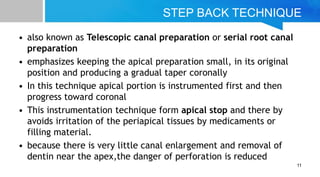
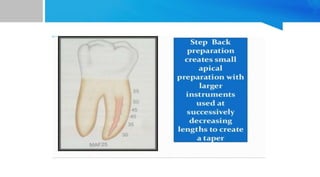
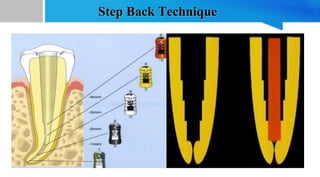
STEP BACK TECHNIQUE
• also known as Telescopic canal preparation or serial root canal
preparation
• emphasizes keeping the apical preparation small, in its original
position and producing a gradual taper coronally
• In this technique apical portion is instrumented first and then
progress toward coronal
• This instrumentation technique form apical stop and there by
avoids irritation of the periapical tissues by medicaments or
filling material.
• because there is very little canal enlargement and removal of
dentin near the apex,the danger of perforation is reduced
11
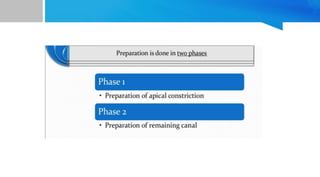
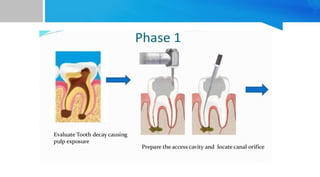
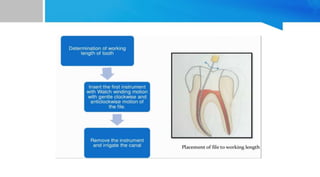
• After the access opening is made, the working length is
determined on a measuremnt radiograph
• The first file that binds in the canal at the working length is
considered as initial apical file(IAF)
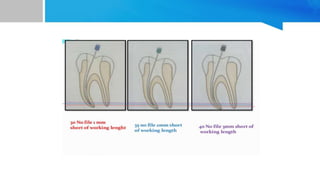
• Starting with the IAF, the root canal is enlarged to working length
through four file sizes
• For large canals- minimum MAF #40-50
• For small canals – minimum MAF # 35-40
12
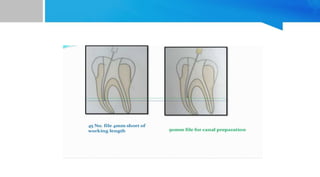
• The master apical file (MAF) is by definition the largest file that
binds slightly at the corrected working length.
• The MAF is determined by passively placing successively larger
files at the correct working length until a size is reached that
slightly binds at the tip
• After the root canal has been enlarged throughout its entire
length to the size of MAF
• The subsequent files are each made 1mm shorter than the
previous file
13
22
Step Back Technique
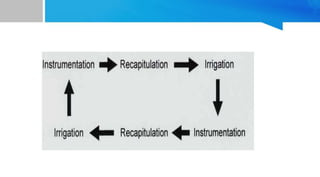
Recapitulation
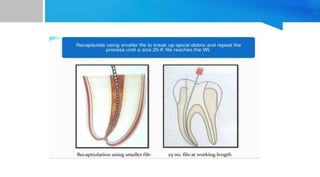
• This accomplished, after each successively larger file, by
irrigating and the returning to a file smaller than the file which
prepared the apical portion of the canal
Irrigation
• Is used between each file also to remove debris
• Failure to recapitulate will result in canal blokage
23
 Advantage of Step Back Technique
• More flare at coronal part of root canal with proper apical stop
 Disadvantages of Step Back Technique
• Difficult to irrigate apical region
• More chances of pushing debris periapically.
• Time consuming.
• Increased chances of iatrogenic errors for example ledge
formation in curved canals
• Difficult to penetrate instruments in canal so there is More
chances of instrument fracture
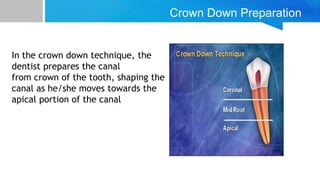
Crown Down Preparation
In the crown down technique, the
dentist prepares the canal
from crown of the tooth, shaping the
canal as he/she moves towards the
apical portion of the canal
Technique of Crown Down Preparation
• First step in the crown down technique is the access cavity
preparation with no pulp chamber obstructions.
• Locate the canal orifices with sharp explorer
• Now fill the access cavity with an irrigant and start preflaring of
the canal orifices by using Gates-Glidden drills or the nickle-
titanium rotary instruments.
• Gates-Glidden drills can be used after scouting the canal orifices
with number 10 or 15 files.
• The crown down approach begins with larger Gates-Glidden first
• Frequent irrigation with sodium hypochlorite and recapitulation
with a smaller file (usually No. 10 file) to prevent canal blockage
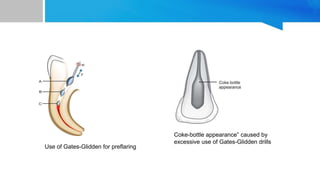
Use of Gates-Glidden for preflaring
Coke-bottle appearance” caused by
excessive use of Gates-Glidden drills
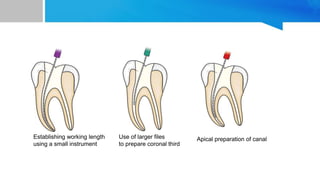
• After establishing coronal and mid root enlargement explore
the canal and establish the working length with small instruments
• Introduce larger files to coronal part of the canal and prepare it.
Smaller number files deeper into the canal in sequential order
and prepare the apical part of the canal
• Final apical preparation is prepared and finished along with
frequent irrigation of the canal system
Establishing working length
using a small instrument
Use of larger files
to prepare coronal third
Apical preparation of canal
Advantage of crown down
• Removal of tissue debris coronally, thus minimizing the
extrusion of debris periapically.
• Reduction of postoperative sensitivity which could result
from periapical extrusion of debris.
• Greater volumes of irrigants can reach in canal irregularities
because of coronal flaring.
• Rapid removal of contaminated and infected tissues from
the root canal system.
33
Reference
• Textbook of Endodontics - Jaypee Brothers; 2nd edition (26 Nov
2010)
• Endodontics principles and practice 5th edition

Cleaning AND Shaping.pptx

  • 1.
  • 2.
    outline • Cleaning &Shaping • Techniques: step back and crown down
  • 3.
    Endodontic treatment mainlyconsists of three steps: • Cleaning and shaping of the root canal system • Disinfection • Obturation Cleaning and shaping is one of the most important step in the root canal therapy for obtaining success in the root canal treatment. 3
  • 4.
    Cleaning • It comprisesthe removal of all potentially pathogenic contents from the root canal system. Shaping • The establishment of a specifically shaped cavity which performs the dual role of three-dimensional progressive access into the canal and creating an apical preparation which will permit the final obturation instruments and materials to fit easily 4
  • 5.
    5 Objectives Mecanical Objectives: • Continuouslytapering cone (narrower apically) – This shape mimics the natural canal shape. – Creates the resistance form to hold gutta-percha in the canal. • Avoid transportation of the foramen. • Keep the apical opening as small as possible. Biological objectives: – To remove the pulp tissue – Bacteria and their by-products from the root canal space.
  • 6.
    DIFFERENT MOVEMENTS OFINSTRUMENTS Reaming: it is commonly done by use of reamers , though files can also be used. It involves clockwise rotation of an instrument. Filing: the term filing indicates push-pull motion with the instrument(file) 6
  • 7.
    Combination of Reamingand Filing • In this technique file is inserted with a quarter turn clockwise and apically directed pressure (i.e. reaming) and then is subsequently withdrawn (i.e. filing). Balanced Force Technique • This technique involves oscillation of instrument right and left with different arcs in either direction 7
  • 8.
    BASIC PRINCIPLES OFCANAL INSTRUMENTATION  There should be a straight line access to the canal orifices  canal must always be prepared in wet environment.  Preparation of canal should be completed while retaining its original form and the shape .  Exploration of the orifice is always done with smaller file to gauge the canal size and the configuration 8
  • 9.
     Canal enlargementshould be done by using instruments in the sequential order without skipping sizes.  After each insertion and removal of the file, its flutes should be cleaned and inspected  Recapitulation is regularly done to loosen debris by returning to working length. The canal walls should not be enlarged during recapitulation.  Over preparation and too aggressive over enlargement of the curved canals should be avoided 9
  • 10.
  • 11.
    STEP BACK TECHNIQUE •also known as Telescopic canal preparation or serial root canal preparation • emphasizes keeping the apical preparation small, in its original position and producing a gradual taper coronally • In this technique apical portion is instrumented first and then progress toward coronal • This instrumentation technique form apical stop and there by avoids irritation of the periapical tissues by medicaments or filling material. • because there is very little canal enlargement and removal of dentin near the apex,the danger of perforation is reduced 11
  • 12.
    • After theaccess opening is made, the working length is determined on a measuremnt radiograph • The first file that binds in the canal at the working length is considered as initial apical file(IAF) • Starting with the IAF, the root canal is enlarged to working length through four file sizes • For large canals- minimum MAF #40-50 • For small canals – minimum MAF # 35-40 12
  • 13.
    • The masterapical file (MAF) is by definition the largest file that binds slightly at the corrected working length. • The MAF is determined by passively placing successively larger files at the correct working length until a size is reached that slightly binds at the tip • After the root canal has been enlarged throughout its entire length to the size of MAF • The subsequent files are each made 1mm shorter than the previous file 13
  • 22.
  • 23.
    Recapitulation • This accomplished,after each successively larger file, by irrigating and the returning to a file smaller than the file which prepared the apical portion of the canal Irrigation • Is used between each file also to remove debris • Failure to recapitulate will result in canal blokage 23
  • 25.
     Advantage ofStep Back Technique • More flare at coronal part of root canal with proper apical stop  Disadvantages of Step Back Technique • Difficult to irrigate apical region • More chances of pushing debris periapically. • Time consuming. • Increased chances of iatrogenic errors for example ledge formation in curved canals • Difficult to penetrate instruments in canal so there is More chances of instrument fracture
  • 26.
    Crown Down Preparation Inthe crown down technique, the dentist prepares the canal from crown of the tooth, shaping the canal as he/she moves towards the apical portion of the canal
  • 27.
    Technique of CrownDown Preparation • First step in the crown down technique is the access cavity preparation with no pulp chamber obstructions. • Locate the canal orifices with sharp explorer • Now fill the access cavity with an irrigant and start preflaring of the canal orifices by using Gates-Glidden drills or the nickle- titanium rotary instruments. • Gates-Glidden drills can be used after scouting the canal orifices with number 10 or 15 files. • The crown down approach begins with larger Gates-Glidden first • Frequent irrigation with sodium hypochlorite and recapitulation with a smaller file (usually No. 10 file) to prevent canal blockage
  • 28.
    Use of Gates-Gliddenfor preflaring Coke-bottle appearance” caused by excessive use of Gates-Glidden drills
  • 29.
    • After establishingcoronal and mid root enlargement explore the canal and establish the working length with small instruments • Introduce larger files to coronal part of the canal and prepare it. Smaller number files deeper into the canal in sequential order and prepare the apical part of the canal • Final apical preparation is prepared and finished along with frequent irrigation of the canal system
  • 30.
    Establishing working length usinga small instrument Use of larger files to prepare coronal third Apical preparation of canal
  • 32.
    Advantage of crowndown • Removal of tissue debris coronally, thus minimizing the extrusion of debris periapically. • Reduction of postoperative sensitivity which could result from periapical extrusion of debris. • Greater volumes of irrigants can reach in canal irregularities because of coronal flaring. • Rapid removal of contaminated and infected tissues from the root canal system.
  • 33.
    33 Reference • Textbook ofEndodontics - Jaypee Brothers; 2nd edition (26 Nov 2010) • Endodontics principles and practice 5th edition

Editor's Notes

  • #23 Apical portion is instrumented first & an Apical matrix?? or stop is formed to avoid canal perforation & irritation of periapical region. Adv- better debridement, savings in operator time.