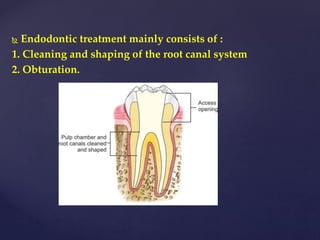
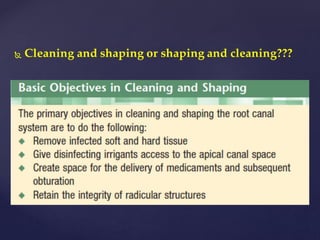
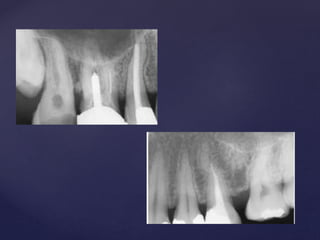
 Endodontic treatment mainly consists of :
1. Cleaning and shaping of the root canal system
2. Obturation.
 Mechanical Objectives of Root Canal Preparation
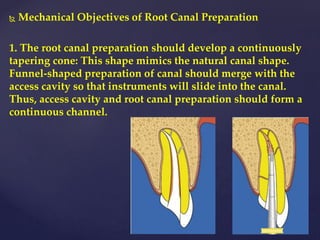
1. The root canal preparation should develop a continuously
tapering cone: This shape mimics the natural canal shape.
Funnel-shaped preparation of canal should merge with the
access cavity so that instruments will slide into the canal.
Thus, access cavity and root canal preparation should form a
continuous channel.
 Mechanical Objectives of Root Canal Preparation
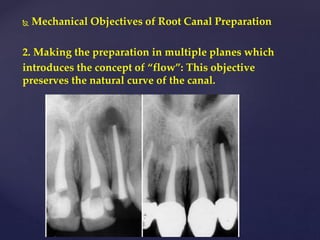
2. Making the preparation in multiple planes which
introduces the concept of “flow”: This objective
preserves the natural curve of the canal.
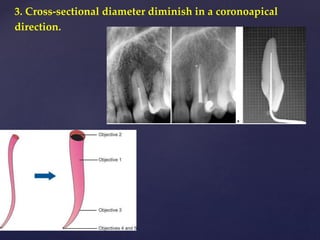
3. Cross-sectional diameter diminish in a coronoapical
direction.
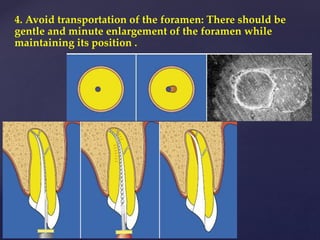
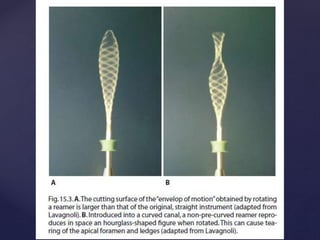
4. Avoid transportation of the foramen: There should be
gentle and minute enlargement of the foramen while
maintaining its position .
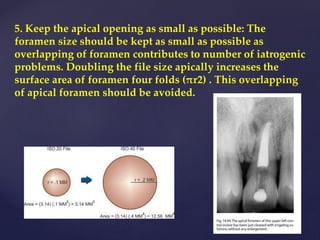
5. Keep the apical opening as small as possible: The
foramen size should be kept as small as possible as
overlapping of foramen contributes to number of iatrogenic
problems. Doubling the file size apically increases the
surface area of foramen four folds (πr2) . This overlapping
of apical foramen should be avoided.
 Biologic Objectives of Root Canal Preparation
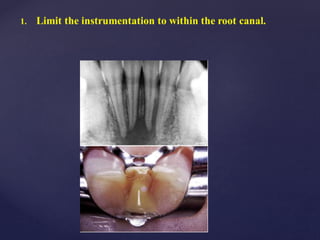
1. Limit the instrumentation to within the root canal.
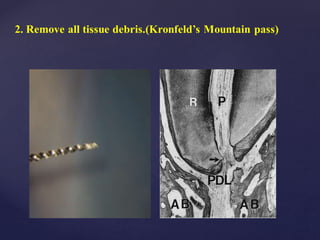
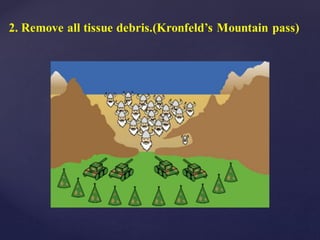
2. Remove all tissue debris.
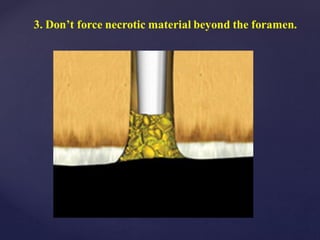
3. Don’t force necrotic material beyond the foramen.
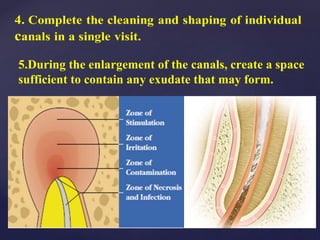
4. Complete the cleaning and shaping of individual canals in
a single visit.
5. During the enlargement of the canals, create a space
sufficient to contain any exudate that may form.
5.During the enlargement of the canals, create a space
sufficient to contain any exudate that may form.
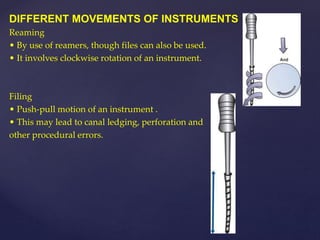
DIFFERENT MOVEMENTS OF INSTRUMENTS
Reaming
• By use of reamers, though files can also be used.
• It involves clockwise rotation of an instrument.
Filing
• Push-pull motion of an instrument .
• This may lead to canal ledging, perforation and
other procedural errors.
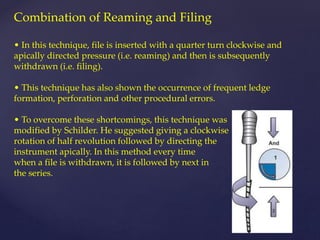
Combination of Reaming and Filing
• In this technique, file is inserted with a quarter turn clockwise and
apically directed pressure (i.e. reaming) and then is subsequently
withdrawn (i.e. filing).
• This technique has also shown the occurrence of frequent ledge
formation, perforation and other procedural errors.
• To overcome these shortcomings, this technique was
modified by Schilder. He suggested giving a clockwise
rotation of half revolution followed by directing the
instrument apically. In this method every time
when a file is withdrawn, it is followed by next in
the series.
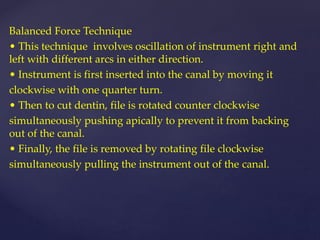
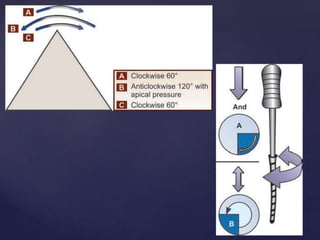
Balanced Force Technique
• This technique involves oscillation of instrument right and
left with different arcs in either direction.
• Instrument is first inserted into the canal by moving it
clockwise with one quarter turn.
• Then to cut dentin, file is rotated counter clockwise
simultaneously pushing apically to prevent it from backing
out of the canal.
• Finally, the file is removed by rotating file clockwise
simultaneously pulling the instrument out of the canal.
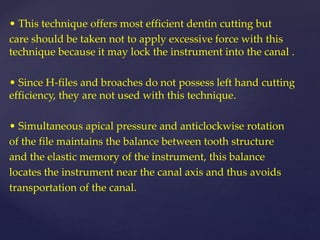
• This technique offers most efficient dentin cutting but
care should be taken not to apply excessive force with this
technique because it may lock the instrument into the canal .
• Since H-files and broaches do not possess left hand cutting
efficiency, they are not used with this technique.
• Simultaneous apical pressure and anticlockwise rotation
of the file maintains the balance between tooth structure
and the elastic memory of the instrument, this balance
locates the instrument near the canal axis and thus avoids
transportation of the canal.
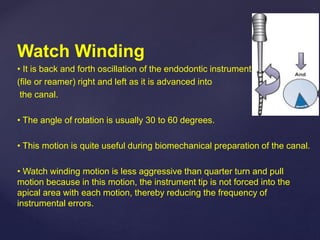
Watch Winding
• It is back and forth oscillation of the endodontic instrument
(file or reamer) right and left as it is advanced into
the canal.
• The angle of rotation is usually 30 to 60 degrees.
• This motion is quite useful during biomechanical preparation of the canal.
• Watch winding motion is less aggressive than quarter turn and pull
motion because in this motion, the instrument tip is not forced into the
apical area with each motion, thereby reducing the frequency of
instrumental errors.
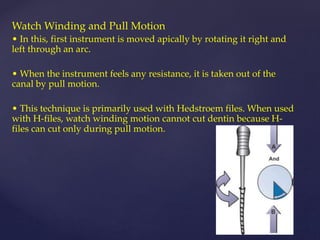
Watch Winding and Pull Motion
• In this, first instrument is moved apically by rotating it right and
left through an arc.
• When the instrument feels any resistance, it is taken out of the
canal by pull motion.
• This technique is primarily used with Hedstroem files. When used
with H-files, watch winding motion cannot cut dentin because H-
files can cut only during pull motion.
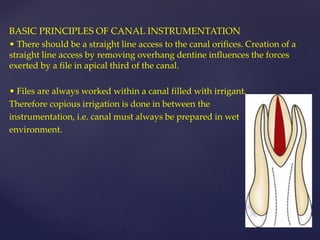
BASIC PRINCIPLES OF CANAL INSTRUMENTATION
• There should be a straight line access to the canal orifices. Creation of a
straight line access by removing overhang dentine influences the forces
exerted by a file in apical third of the canal.
• Files are always worked within a canal filled with irrigant.
Therefore copious irrigation is done in between the
instrumentation, i.e. canal must always be prepared in wet
environment.
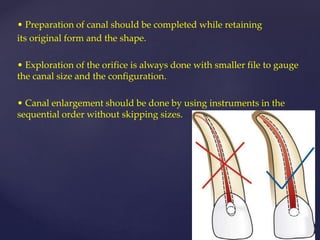
• Preparation of canal should be completed while retaining
its original form and the shape.
• Exploration of the orifice is always done with smaller file to gauge
the canal size and the configuration.
• Canal enlargement should be done by using instruments in the
sequential order without skipping sizes.
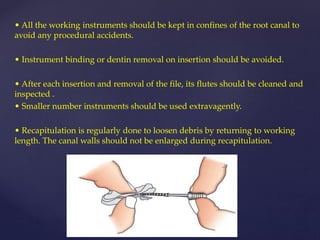
• All the working instruments should be kept in confines of the root canal to
avoid any procedural accidents.
• Instrument binding or dentin removal on insertion should be avoided.
• After each insertion and removal of the file, its flutes should be cleaned and
inspected .
• Smaller number instruments should be used extravagently.
• Recapitulation is regularly done to loosen debris by returning to working
length. The canal walls should not be enlarged during recapitulation.
• Overpreparation and too aggressive over enlargement of the curved
canals should be avoided.
• Creation of an apical stop may be impossible if apical foramen is
already very large. Overusing of larger files should be avoided in such
cases as it may result in further enlargement of apical opening.
• Never force the instrument in the canal. Forcing or continuing to
rotate an instrument may break the instrument.
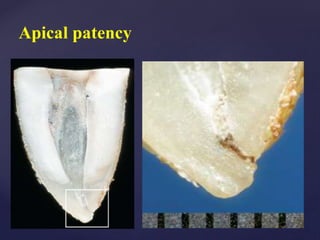
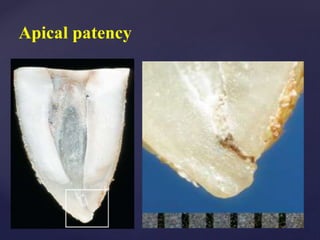
• Establish the apical patency before starting the biomechanical
preparation of tooth. Apical patency of the canal established and
checked, by passing a smaller number file (No. 10) across the apex. The
aim is to allow for creation of a preparation and filling extending fully
to the periodontal ligament. Establishing the patency is believed to be
nonharmful considering the blood supply and immune response
present in the periapical area.
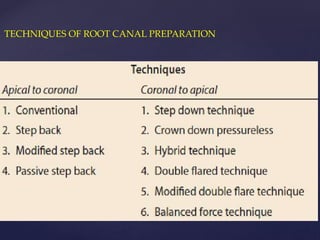
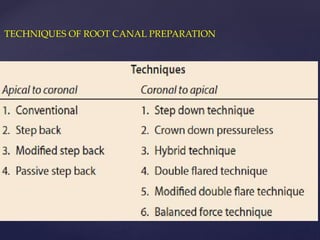
TECHNIQUES OF ROOT CANAL PREPARATION
STANDARDIZED PREPARATION TECHNIQUE (CONVENTIONAL
TECHNIQUE) (Ingle’s technique).
Disadvantages
• Chances of loss of working length due to accumulation of dentin debris.
• Canals prepared with standardized technique end up wider than the
instrument size would suggest.
• Does not take into consideration the elliptical forms and large diameter of
root canals.
• Obturation with conventional techniques does not provide
adequate sealing of root canal confines.
• Passage of irrigants and medicaments is not adequately
obtained through the root canals.
• Increased incidences of ledging, zipping and perforation
in curved canals.
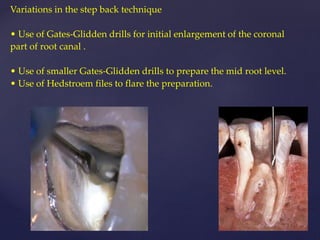
Variations in the step back technique
• Use of Gates-Glidden drills for initial enlargement of the coronal
part of root canal .
• Use of smaller Gates-Glidden drills to prepare the mid root level.
• Use of Hedstroem files to flare the preparation.
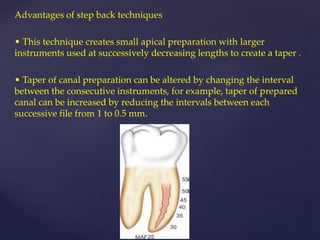
Advantages of step back techniques
• This technique creates small apical preparation with larger
instruments used at successively decreasing lengths to create a taper .
• Taper of canal preparation can be altered by changing the interval
between the consecutive instruments, for example, taper of prepared
canal can be increased by reducing the intervals between each
successive file from 1 to 0.5 mm.
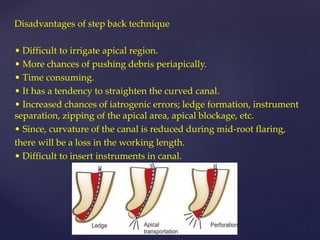
Disadvantages of step back technique
• Difficult to irrigate apical region.
• More chances of pushing debris periapically.
• Time consuming.
• It has a tendency to straighten the curved canal.
• Increased chances of iatrogenic errors; ledge formation, instrument
separation, zipping of the apical area, apical blockage, etc.
• Since, curvature of the canal is reduced during mid-root flaring,
there will be a loss in the working length.
• Difficult to insert instruments in canal.
MODIFIED STEP BACK TECHNIQUE
• In this technique, the preparation is completed in apical third of the
canal.
• After this, step back procedure is started 2 to 3 mm short of minor
diameter/apical constriction so as to give an almost parallel retention
form at the apical area.
• This receives the primary gutta-percha point which shows
slight tug back, when the point is removed. This explains that cone fits
snuggly into the last 2 to 3 mm of the prepared canal.
Passive step back technique
• Developed by Torabinajed.
• Involves combination of hand and rotary instruments for coronal flare before
apical preparation.
• 15 No. file is inserted passively to estimated working length.
• Then number 20, 25, 30, 35 and 40 are inserted passively.
• Number 2 Gates-Glidden drill is inserted till it feels resistance and
activated.
• Then numbers 3 and 4 Gates-Gliddens are used.
• Finally number 20 file is inserted into canal up to working length and canal is
prepared by filing with instruments progressively short of the working length.
Advantages of passive step back technique
• Removal of debris and minor canal obstructions.
• Knowledge of the canal morphology.
• Gradual passive enlargement of the canal in an apical to coronal
direction.
• This technique can also be used with ultrasonic instruments.
• Decrease incidence of procedural errors like transportation of the
canal, ledge or zip formation.
TECHNIQUES OF ROOT CANAL PREPARATION
CORONAL TO APICAL APPROACH TECHNIQUE
Extrusion of canal contents during instrumentation has shown to cause
postoperative discomfort and delayed healing. This is a problem with
virtually all instrumentation techniques. Hession found that:
• Instrumentation tends to force canal contents toward the apical
foramen.
• This occurs most often when the size of the instrument closely
approximates that of the canal.
• Early apical flaring provides a piston-in-cylinder effect.
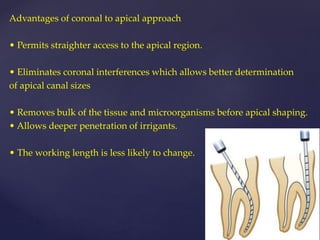
• A different approach called the “coronal to apical approach” was
introduced which advocated shaping the coronal aspect of a root canal
first before apical instrumentation commented.
Advantages of coronal to apical approach
• Permits straighter access to the apical region.
• Eliminates coronal interferences which allows better determination
of apical canal sizes
• Removes bulk of the tissue and microorganisms before apical shaping.
• Allows deeper penetration of irrigants.
• The working length is less likely to change.
• Eliminates the amount of necrotic debris that could be extruded
through the apical foramen during instrumentation.
• Freedom from constraints of the apical enlarging instruments.
• The increased access allows greater control and less chance of zipping
near the apical constriction.
• It provides a coronal escapeway that reduces the “piston in a cylinder
effect” responsible for debris extrusion from the apex.
STEP DOWN TECHNIQUE
The reverse flaring technique , Coronal two third pre-enlargement,
Ccervical flaring technique .
The procedure involves the preparation of the coronal thirds
in two phases:
Phase I: The root canal is penetrated using Hedstroem files of sizes nos.
15, 20, and 25 to 16 mm to 18 mm or where they bind.
Phase II: Gates-Glidden drills nos. 2 and 3 and no. 4 are used
sequentially shorter, thus, flaring the coronal segment of the root canal.
This is followed by apical instrumentation, which involves two steps:
Step I: Determination of the working length and creation of an apical
stop of size no. 25.
Step II: Shaping the remaining canal in a step down approach, using a
descending file sequence, progressing 1 mm per consecutive instrument,
apically. It is important to recapitulate with no. 25 file to prevent
blockage.
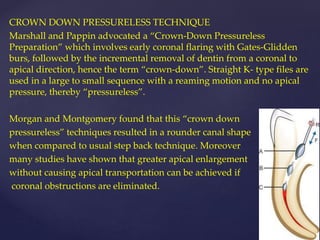
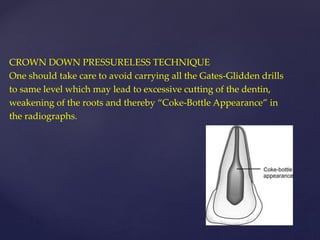
CROWN DOWN PRESSURELESS TECHNIQUE
Marshall and Pappin advocated a “Crown-Down Pressureless
Preparation” which involves early coronal flaring with Gates-Glidden
burs, followed by the incremental removal of dentin from a coronal to
apical direction, hence the term “crown-down”. Straight K- type files are
used in a large to small sequence with a reaming motion and no apical
pressure, thereby “pressureless”.
Morgan and Montgomery found that this “crown down
pressureless” techniques resulted in a rounder canal shape
when compared to usual step back technique. Moreover
many studies have shown that greater apical enlargement
without causing apical transportation can be achieved if
coronal obstructions are eliminated.
CROWN DOWN PRESSURELESS TECHNIQUE
One should take care to avoid carrying all the Gates-Glidden drills
to same level which may lead to excessive cutting of the dentin,
weakening of the roots and thereby “Coke-Bottle Appearance” in
the radiographs.
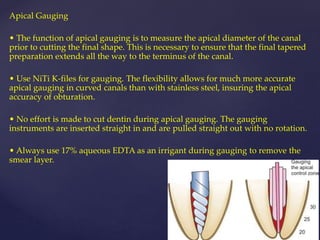
Apical Gauging
• The function of apical gauging is to measure the apical diameter of the canal
prior to cutting the final shape. This is necessary to ensure that the final tapered
preparation extends all the way to the terminus of the canal.
• Use NiTi K-files for gauging. The flexibility allows for much more accurate
apical gauging in curved canals than with stainless steel, insuring the apical
accuracy of obturation.
• No effort is made to cut dentin during apical gauging. The gauging
instruments are inserted straight in and are pulled straight out with no rotation.
• Always use 17% aqueous EDTA as an irrigant during gauging to remove the
smear layer.
HYBRID TECHNIQUE OF CANAL PREPARATION (STEP DOWN/STEP
BACK)
• Both rotary and hand instruments are used .
• Check the patency of canal using number 10 or 15 K flex files.
• Prepare the coronal third of canal using hand or Gates- Glidden drills
till the point of curvature without applying excessive pressure.
• Determine the working length.
• Prepare the apical portion of canal using step back technique.
• Recapitulate and irrigate the canal at every step so as to maintain
patency of the canal.
• Blend step back with step down procedure.
Advantages
• Less chances of ledge formation.
• This technique maintains the integrity of dentin by avoiding excessive
removal of radicular dentin.
DOUBLE FLARE TECHNIQUE
It was introduced by Fava. In this, canal is explored using a small file.
Then canal is prepared in crown down manner using K files in
decreasing sizes. After this, step back technique is followed in 1 mm
increments with increasing file sizes. Frequent irrigation and
recapitulation using master apical file is done during instrumentation.
Indications
• Straight root canals.
• Straight portions of curved canals of mature teeth.
Contraindications
• Calcified canals.
• Young permanent teeth.
• Teeth with open apex as they have thin dentinal walls and great pulp
volume.
Advantages
• Greater taper in the cervical and middle third such that removal of
canal contents is more effective and root canal is better cleaned.
• Elected technique in cases of necrotic or gangrenous teeth.
• Improved quality of root canal filling when compared to conventional
technique.
• The flared technique maintains the root canal shape and produces
neither the hour glass appearance nor the apical zip.
• With the use of instruments of large diameter far from the apical area,
the potential for creation of iatrogenic errors is greatly decreased. This
facilitates irrigation procedure and permits easier placement of posts.
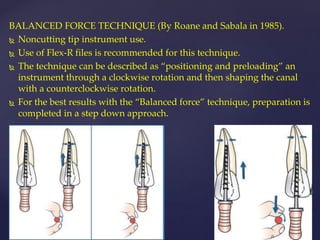
BALANCED FORCE TECHNIQUE (By Roane and Sabala in 1985).
 Noncutting tip instrument use.
 Use of Flex-R files is recommended for this technique.
 The technique can be described as “positioning and preloading” an
instrument through a clockwise rotation and then shaping the canal
with a counterclockwise rotation.
 For the best results with the “Balanced force” technique, preparation is
completed in a step down approach.
Advantages of balanced force technique
• With the help of this technique, there are lesser chances of canal
transportation.
• One can manipulate the files at any point in the canal without creating
a ledge or blockage.
• File cutting occurs only at apical extent of the file.
• Extrusion of material is less than with other techniques.
SPECIAL ANATOMIC PROBLEMS IN
CANAL CLEANING AND SHAPING
• Management of curved canals.
• Management of calcified canals.
• Management of C-shaped canals.
• Management of S-shaped canals
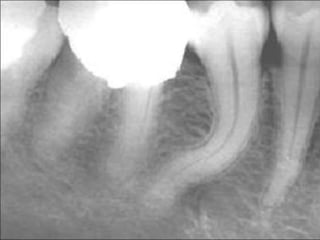
• Management of Curved Canals
A curvature of 20° in a narrow canal is almost
difficult to negotiate
whereas a curvature of 30° can be negotiated if
canal is wide.
Factor affecting success of negotiation of a curved
canal:
• Degree of curvature
• Flexibility of instrument
• Size of root canal
• Width of root canal
• Skill of operator
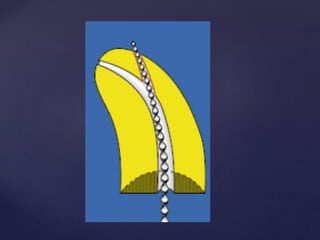
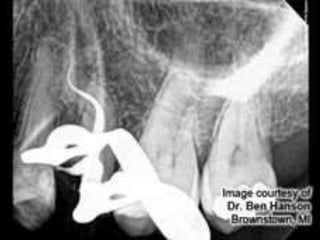
 Ultimate challenge during instrumentation ,why?
• Ledge
• Perforation
• Strip perforation
• Transportaion
• Blokage of the canal
• Fracturing instruments
Clinical significance
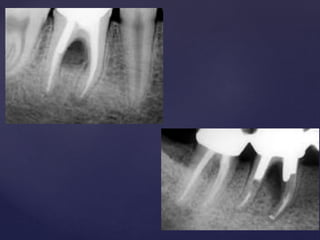
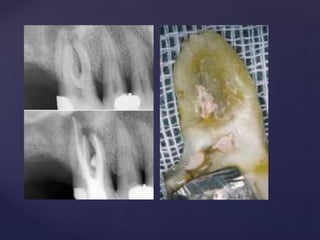
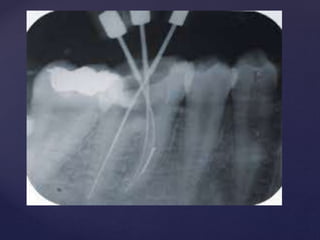
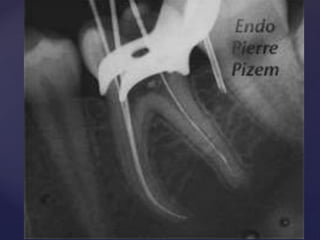
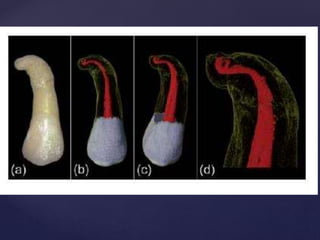
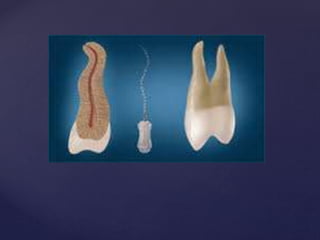
o Gradual curvature of the mesial canals in the
apical third.
o Acute curvature in the apical third.
o Curvature throughout the canal.
o Dilacerated root canal .
o S-shaped root canal.
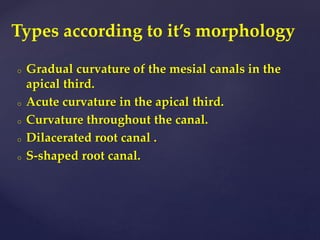
Types according to it’s morphology
 Decreasing the restoring force by means
of which straight file apt to bend against
the curved dentine surface
 Decreasing the length of the file which is
aggressively cutting at a given span.
Techniques used for management
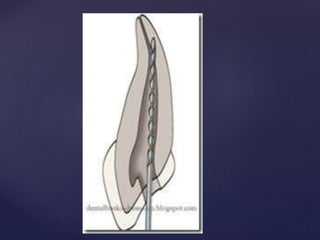
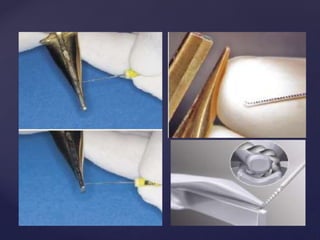
1. Precurving the file
A precurved file traverses the curve better than a straight
file. Precurving is done in two ways:
• Placing a gradual curve for the entire length of the file
• Placing a sharp curve of nearly 45° near the apical end
of the instrument
 Decreasing the restoring force is done
by:
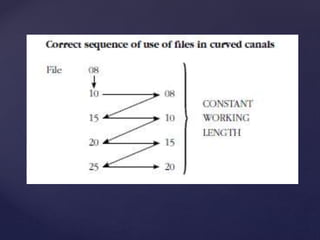
2. Extravagant use of smaller number files as
they can follow canal curvature
3. Use of intermediate size of files
4. Use of flexible files
 Decreasing the restoring force is done
by:
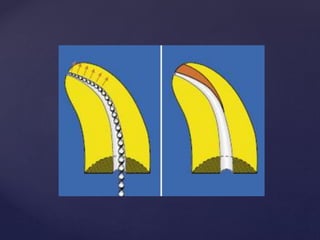
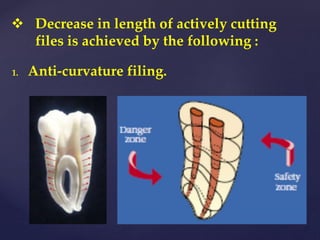
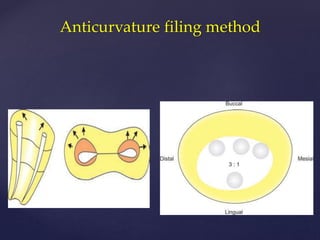
1. Anti-curvature filing.
 Decrease in length of actively cutting
files is achieved by the following :
Anticurvature filing method
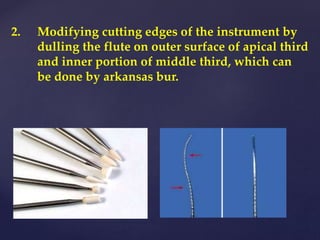
2. Modifying cutting edges of the instrument by
dulling the flute on outer surface of apical third
and inner portion of middle third, which can
be done by arkansas bur.
3. Change Instrumentation technique
 Crown-down technique benefits
• Reduced coronal binding of instruments.
• Less likelihood for a change in the working
length measurement during preparation.
• Less risk of inoculation of endodontic pathogens
into the periradicular tissues.
• Enhanced penetration of irrigant into the root
canal system .
• Less risk of extrusion of irrigant and debris.
 Balanced forced technique
• Efficient and less prone to cause iatrogenic
damage and maintains the instruments centrally
within the root canal.
• Extrusion of debris apically is also reduced,
resulting in less postoperative pain.
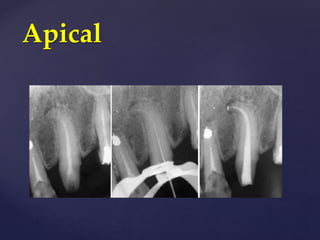
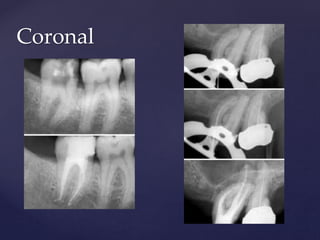
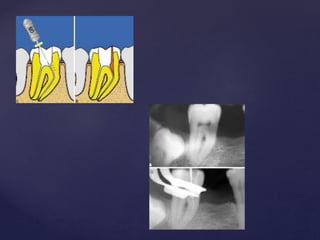
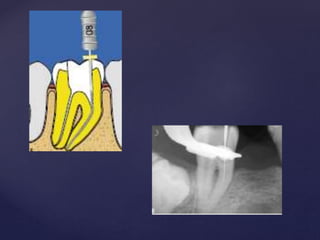
1. Apical
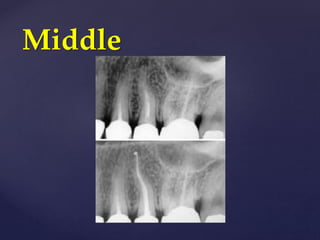
2. Middle
3. Coronal
4. Combination
Types according to it’s location
Apical
Coronal
Middle
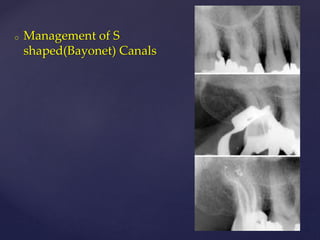
o Management of S
shaped(Bayonet) Canals
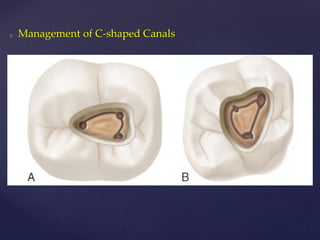
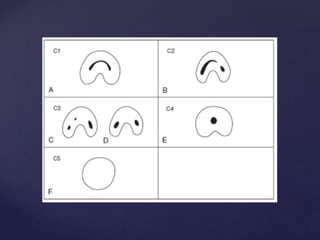
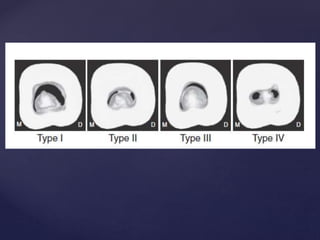
o Management of C-shaped Canals
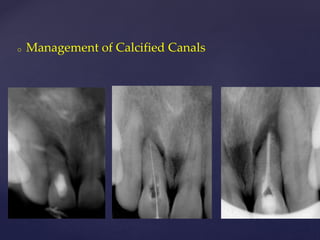
o Management of Calcified Canals
Guidelines for Negotiating Calcified Canals
• Copious irrigation all times with 2.5 to 5.25 percent
NaOCl enhances dissolution of organic debris, lubricates
the canal, and keeps dentin chips and pieces of calcified
material in solution.
• Always advance instruments slowly in calcified canals.
• Always clean the instrument on withdrawal and
inspect before reinserting it into the canal.
• When a fine instrument reaches the approximate canal
length, do not remove it; rather obtain a radiograph to
ascertain the position of the file.
Use chelating agents to assist canal penetration.
• Flaring of the canal orifice and enlargement of coronal
third of canal space improves tactile perception.
• The use of nickel-titanium rotary orifice penetrating
instruments also helps in these cases.
• Well angulated periapical and bite wing radiographs
should be taken. They not only indicate the position of
canals but also give important information about the
relative position of canal orifice in calcified cases. Failure
to recognize changes in the axis of the tooth that occurs
during crown restoration, can lead to perforations.
Proximal restorations can be used as guide to locate
canals.
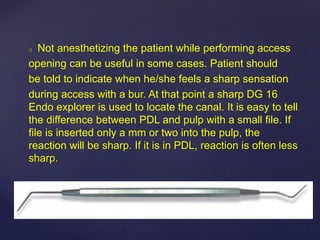
o Not anesthetizing the patient while performing access
opening can be useful in some cases. Patient should
be told to indicate when he/she feels a sharp sensation
during access with a bur. At that point a sharp DG 16
Endo explorer is used to locate the canal. It is easy to tell
the difference between PDL and pulp with a small file. If
file is inserted only a mm or two into the pulp, the
reaction will be sharp. If it is in PDL, reaction is often less
sharp.
• Avoid removing large amount of dentin in the
hope of finding a canal orifice. By doing this all the
pulp floor landmarks are lost also the strength and
dentinal thickness of tooth gets compromised.
• Small round burs should be used to create a glide
path to the orifice. This will further ease the
instruments into the proper lane to allow effortless
introduction of files into the canals.
Cleaning & shaping

Cleaning & shaping

  • 2.
     Endodontic treatmentmainly consists of : 1. Cleaning and shaping of the root canal system 2. Obturation.
  • 4.
     Mechanical Objectivesof Root Canal Preparation 1. The root canal preparation should develop a continuously tapering cone: This shape mimics the natural canal shape. Funnel-shaped preparation of canal should merge with the access cavity so that instruments will slide into the canal. Thus, access cavity and root canal preparation should form a continuous channel.
  • 5.
     Mechanical Objectivesof Root Canal Preparation 2. Making the preparation in multiple planes which introduces the concept of “flow”: This objective preserves the natural curve of the canal.
  • 6.
    3. Cross-sectional diameterdiminish in a coronoapical direction.
  • 7.
    4. Avoid transportationof the foramen: There should be gentle and minute enlargement of the foramen while maintaining its position .
  • 10.
    5. Keep theapical opening as small as possible: The foramen size should be kept as small as possible as overlapping of foramen contributes to number of iatrogenic problems. Doubling the file size apically increases the surface area of foramen four folds (πr2) . This overlapping of apical foramen should be avoided.
  • 11.
     Biologic Objectivesof Root Canal Preparation 1. Limit the instrumentation to within the root canal. 2. Remove all tissue debris. 3. Don’t force necrotic material beyond the foramen. 4. Complete the cleaning and shaping of individual canals in a single visit. 5. During the enlargement of the canals, create a space sufficient to contain any exudate that may form.
  • 19.
    5.During the enlargementof the canals, create a space sufficient to contain any exudate that may form.
  • 21.
    DIFFERENT MOVEMENTS OFINSTRUMENTS Reaming • By use of reamers, though files can also be used. • It involves clockwise rotation of an instrument. Filing • Push-pull motion of an instrument . • This may lead to canal ledging, perforation and other procedural errors.
  • 22.
    Combination of Reamingand Filing • In this technique, file is inserted with a quarter turn clockwise and apically directed pressure (i.e. reaming) and then is subsequently withdrawn (i.e. filing). • This technique has also shown the occurrence of frequent ledge formation, perforation and other procedural errors. • To overcome these shortcomings, this technique was modified by Schilder. He suggested giving a clockwise rotation of half revolution followed by directing the instrument apically. In this method every time when a file is withdrawn, it is followed by next in the series.
  • 23.
    Balanced Force Technique •This technique involves oscillation of instrument right and left with different arcs in either direction. • Instrument is first inserted into the canal by moving it clockwise with one quarter turn. • Then to cut dentin, file is rotated counter clockwise simultaneously pushing apically to prevent it from backing out of the canal. • Finally, the file is removed by rotating file clockwise simultaneously pulling the instrument out of the canal.
  • 25.
    • This techniqueoffers most efficient dentin cutting but care should be taken not to apply excessive force with this technique because it may lock the instrument into the canal . • Since H-files and broaches do not possess left hand cutting efficiency, they are not used with this technique. • Simultaneous apical pressure and anticlockwise rotation of the file maintains the balance between tooth structure and the elastic memory of the instrument, this balance locates the instrument near the canal axis and thus avoids transportation of the canal.
  • 26.
    Watch Winding • Itis back and forth oscillation of the endodontic instrument (file or reamer) right and left as it is advanced into the canal. • The angle of rotation is usually 30 to 60 degrees. • This motion is quite useful during biomechanical preparation of the canal. • Watch winding motion is less aggressive than quarter turn and pull motion because in this motion, the instrument tip is not forced into the apical area with each motion, thereby reducing the frequency of instrumental errors.
  • 27.
    Watch Winding andPull Motion • In this, first instrument is moved apically by rotating it right and left through an arc. • When the instrument feels any resistance, it is taken out of the canal by pull motion. • This technique is primarily used with Hedstroem files. When used with H-files, watch winding motion cannot cut dentin because H- files can cut only during pull motion.
  • 28.
    BASIC PRINCIPLES OFCANAL INSTRUMENTATION • There should be a straight line access to the canal orifices. Creation of a straight line access by removing overhang dentine influences the forces exerted by a file in apical third of the canal. • Files are always worked within a canal filled with irrigant. Therefore copious irrigation is done in between the instrumentation, i.e. canal must always be prepared in wet environment.
  • 29.
    • Preparation ofcanal should be completed while retaining its original form and the shape. • Exploration of the orifice is always done with smaller file to gauge the canal size and the configuration. • Canal enlargement should be done by using instruments in the sequential order without skipping sizes.
  • 30.
    • All theworking instruments should be kept in confines of the root canal to avoid any procedural accidents. • Instrument binding or dentin removal on insertion should be avoided. • After each insertion and removal of the file, its flutes should be cleaned and inspected . • Smaller number instruments should be used extravagently. • Recapitulation is regularly done to loosen debris by returning to working length. The canal walls should not be enlarged during recapitulation.
  • 31.
    • Overpreparation andtoo aggressive over enlargement of the curved canals should be avoided. • Creation of an apical stop may be impossible if apical foramen is already very large. Overusing of larger files should be avoided in such cases as it may result in further enlargement of apical opening. • Never force the instrument in the canal. Forcing or continuing to rotate an instrument may break the instrument. • Establish the apical patency before starting the biomechanical preparation of tooth. Apical patency of the canal established and checked, by passing a smaller number file (No. 10) across the apex. The aim is to allow for creation of a preparation and filling extending fully to the periodontal ligament. Establishing the patency is believed to be nonharmful considering the blood supply and immune response present in the periapical area.
  • 32.
    TECHNIQUES OF ROOTCANAL PREPARATION
  • 33.
    STANDARDIZED PREPARATION TECHNIQUE(CONVENTIONAL TECHNIQUE) (Ingle’s technique). Disadvantages • Chances of loss of working length due to accumulation of dentin debris. • Canals prepared with standardized technique end up wider than the instrument size would suggest. • Does not take into consideration the elliptical forms and large diameter of root canals. • Obturation with conventional techniques does not provide adequate sealing of root canal confines. • Passage of irrigants and medicaments is not adequately obtained through the root canals. • Increased incidences of ledging, zipping and perforation in curved canals.
  • 34.
    Variations in thestep back technique • Use of Gates-Glidden drills for initial enlargement of the coronal part of root canal . • Use of smaller Gates-Glidden drills to prepare the mid root level. • Use of Hedstroem files to flare the preparation.
  • 35.
    Advantages of stepback techniques • This technique creates small apical preparation with larger instruments used at successively decreasing lengths to create a taper . • Taper of canal preparation can be altered by changing the interval between the consecutive instruments, for example, taper of prepared canal can be increased by reducing the intervals between each successive file from 1 to 0.5 mm.
  • 36.
    Disadvantages of stepback technique • Difficult to irrigate apical region. • More chances of pushing debris periapically. • Time consuming. • It has a tendency to straighten the curved canal. • Increased chances of iatrogenic errors; ledge formation, instrument separation, zipping of the apical area, apical blockage, etc. • Since, curvature of the canal is reduced during mid-root flaring, there will be a loss in the working length. • Difficult to insert instruments in canal.
  • 37.
    MODIFIED STEP BACKTECHNIQUE • In this technique, the preparation is completed in apical third of the canal. • After this, step back procedure is started 2 to 3 mm short of minor diameter/apical constriction so as to give an almost parallel retention form at the apical area. • This receives the primary gutta-percha point which shows slight tug back, when the point is removed. This explains that cone fits snuggly into the last 2 to 3 mm of the prepared canal.
  • 39.
    Passive step backtechnique • Developed by Torabinajed. • Involves combination of hand and rotary instruments for coronal flare before apical preparation. • 15 No. file is inserted passively to estimated working length. • Then number 20, 25, 30, 35 and 40 are inserted passively. • Number 2 Gates-Glidden drill is inserted till it feels resistance and activated. • Then numbers 3 and 4 Gates-Gliddens are used. • Finally number 20 file is inserted into canal up to working length and canal is prepared by filing with instruments progressively short of the working length.
  • 40.
    Advantages of passivestep back technique • Removal of debris and minor canal obstructions. • Knowledge of the canal morphology. • Gradual passive enlargement of the canal in an apical to coronal direction. • This technique can also be used with ultrasonic instruments. • Decrease incidence of procedural errors like transportation of the canal, ledge or zip formation.
  • 41.
    TECHNIQUES OF ROOTCANAL PREPARATION
  • 42.
    CORONAL TO APICALAPPROACH TECHNIQUE Extrusion of canal contents during instrumentation has shown to cause postoperative discomfort and delayed healing. This is a problem with virtually all instrumentation techniques. Hession found that: • Instrumentation tends to force canal contents toward the apical foramen. • This occurs most often when the size of the instrument closely approximates that of the canal. • Early apical flaring provides a piston-in-cylinder effect. • A different approach called the “coronal to apical approach” was introduced which advocated shaping the coronal aspect of a root canal first before apical instrumentation commented.
  • 43.
    Advantages of coronalto apical approach • Permits straighter access to the apical region. • Eliminates coronal interferences which allows better determination of apical canal sizes • Removes bulk of the tissue and microorganisms before apical shaping. • Allows deeper penetration of irrigants. • The working length is less likely to change.
  • 44.
    • Eliminates theamount of necrotic debris that could be extruded through the apical foramen during instrumentation. • Freedom from constraints of the apical enlarging instruments. • The increased access allows greater control and less chance of zipping near the apical constriction. • It provides a coronal escapeway that reduces the “piston in a cylinder effect” responsible for debris extrusion from the apex.
  • 45.
    STEP DOWN TECHNIQUE Thereverse flaring technique , Coronal two third pre-enlargement, Ccervical flaring technique . The procedure involves the preparation of the coronal thirds in two phases: Phase I: The root canal is penetrated using Hedstroem files of sizes nos. 15, 20, and 25 to 16 mm to 18 mm or where they bind. Phase II: Gates-Glidden drills nos. 2 and 3 and no. 4 are used sequentially shorter, thus, flaring the coronal segment of the root canal. This is followed by apical instrumentation, which involves two steps: Step I: Determination of the working length and creation of an apical stop of size no. 25. Step II: Shaping the remaining canal in a step down approach, using a descending file sequence, progressing 1 mm per consecutive instrument, apically. It is important to recapitulate with no. 25 file to prevent blockage.
  • 46.
    CROWN DOWN PRESSURELESSTECHNIQUE Marshall and Pappin advocated a “Crown-Down Pressureless Preparation” which involves early coronal flaring with Gates-Glidden burs, followed by the incremental removal of dentin from a coronal to apical direction, hence the term “crown-down”. Straight K- type files are used in a large to small sequence with a reaming motion and no apical pressure, thereby “pressureless”. Morgan and Montgomery found that this “crown down pressureless” techniques resulted in a rounder canal shape when compared to usual step back technique. Moreover many studies have shown that greater apical enlargement without causing apical transportation can be achieved if coronal obstructions are eliminated.
  • 47.
    CROWN DOWN PRESSURELESSTECHNIQUE One should take care to avoid carrying all the Gates-Glidden drills to same level which may lead to excessive cutting of the dentin, weakening of the roots and thereby “Coke-Bottle Appearance” in the radiographs.
  • 48.
    Apical Gauging • Thefunction of apical gauging is to measure the apical diameter of the canal prior to cutting the final shape. This is necessary to ensure that the final tapered preparation extends all the way to the terminus of the canal. • Use NiTi K-files for gauging. The flexibility allows for much more accurate apical gauging in curved canals than with stainless steel, insuring the apical accuracy of obturation. • No effort is made to cut dentin during apical gauging. The gauging instruments are inserted straight in and are pulled straight out with no rotation. • Always use 17% aqueous EDTA as an irrigant during gauging to remove the smear layer.
  • 49.
    HYBRID TECHNIQUE OFCANAL PREPARATION (STEP DOWN/STEP BACK) • Both rotary and hand instruments are used . • Check the patency of canal using number 10 or 15 K flex files. • Prepare the coronal third of canal using hand or Gates- Glidden drills till the point of curvature without applying excessive pressure. • Determine the working length. • Prepare the apical portion of canal using step back technique. • Recapitulate and irrigate the canal at every step so as to maintain patency of the canal. • Blend step back with step down procedure. Advantages • Less chances of ledge formation. • This technique maintains the integrity of dentin by avoiding excessive removal of radicular dentin.
  • 50.
    DOUBLE FLARE TECHNIQUE Itwas introduced by Fava. In this, canal is explored using a small file. Then canal is prepared in crown down manner using K files in decreasing sizes. After this, step back technique is followed in 1 mm increments with increasing file sizes. Frequent irrigation and recapitulation using master apical file is done during instrumentation. Indications • Straight root canals. • Straight portions of curved canals of mature teeth. Contraindications • Calcified canals. • Young permanent teeth. • Teeth with open apex as they have thin dentinal walls and great pulp volume.
  • 51.
    Advantages • Greater taperin the cervical and middle third such that removal of canal contents is more effective and root canal is better cleaned. • Elected technique in cases of necrotic or gangrenous teeth. • Improved quality of root canal filling when compared to conventional technique. • The flared technique maintains the root canal shape and produces neither the hour glass appearance nor the apical zip. • With the use of instruments of large diameter far from the apical area, the potential for creation of iatrogenic errors is greatly decreased. This facilitates irrigation procedure and permits easier placement of posts.
  • 52.
    BALANCED FORCE TECHNIQUE(By Roane and Sabala in 1985).  Noncutting tip instrument use.  Use of Flex-R files is recommended for this technique.  The technique can be described as “positioning and preloading” an instrument through a clockwise rotation and then shaping the canal with a counterclockwise rotation.  For the best results with the “Balanced force” technique, preparation is completed in a step down approach.
  • 53.
    Advantages of balancedforce technique • With the help of this technique, there are lesser chances of canal transportation. • One can manipulate the files at any point in the canal without creating a ledge or blockage. • File cutting occurs only at apical extent of the file. • Extrusion of material is less than with other techniques.
  • 54.
    SPECIAL ANATOMIC PROBLEMSIN CANAL CLEANING AND SHAPING • Management of curved canals. • Management of calcified canals. • Management of C-shaped canals. • Management of S-shaped canals
  • 55.
    • Management ofCurved Canals A curvature of 20° in a narrow canal is almost difficult to negotiate whereas a curvature of 30° can be negotiated if canal is wide. Factor affecting success of negotiation of a curved canal: • Degree of curvature • Flexibility of instrument • Size of root canal • Width of root canal • Skill of operator
  • 57.
     Ultimate challengeduring instrumentation ,why? • Ledge • Perforation • Strip perforation • Transportaion • Blokage of the canal • Fracturing instruments Clinical significance
  • 65.
    o Gradual curvatureof the mesial canals in the apical third. o Acute curvature in the apical third. o Curvature throughout the canal. o Dilacerated root canal . o S-shaped root canal. Types according to it’s morphology
  • 70.
     Decreasing therestoring force by means of which straight file apt to bend against the curved dentine surface  Decreasing the length of the file which is aggressively cutting at a given span. Techniques used for management
  • 71.
    1. Precurving thefile A precurved file traverses the curve better than a straight file. Precurving is done in two ways: • Placing a gradual curve for the entire length of the file • Placing a sharp curve of nearly 45° near the apical end of the instrument  Decreasing the restoring force is done by:
  • 73.
    2. Extravagant useof smaller number files as they can follow canal curvature 3. Use of intermediate size of files 4. Use of flexible files  Decreasing the restoring force is done by:
  • 74.
    1. Anti-curvature filing. Decrease in length of actively cutting files is achieved by the following :
  • 75.
  • 76.
    2. Modifying cuttingedges of the instrument by dulling the flute on outer surface of apical third and inner portion of middle third, which can be done by arkansas bur.
  • 77.
    3. Change Instrumentationtechnique  Crown-down technique benefits • Reduced coronal binding of instruments. • Less likelihood for a change in the working length measurement during preparation. • Less risk of inoculation of endodontic pathogens into the periradicular tissues. • Enhanced penetration of irrigant into the root canal system . • Less risk of extrusion of irrigant and debris.
  • 78.
     Balanced forcedtechnique • Efficient and less prone to cause iatrogenic damage and maintains the instruments centrally within the root canal. • Extrusion of debris apically is also reduced, resulting in less postoperative pain.
  • 79.
    1. Apical 2. Middle 3.Coronal 4. Combination Types according to it’s location
  • 80.
  • 82.
  • 85.
  • 86.
    o Management ofS shaped(Bayonet) Canals
  • 87.
    o Management ofC-shaped Canals
  • 90.
    o Management ofCalcified Canals
  • 91.
    Guidelines for NegotiatingCalcified Canals • Copious irrigation all times with 2.5 to 5.25 percent NaOCl enhances dissolution of organic debris, lubricates the canal, and keeps dentin chips and pieces of calcified material in solution. • Always advance instruments slowly in calcified canals. • Always clean the instrument on withdrawal and inspect before reinserting it into the canal. • When a fine instrument reaches the approximate canal length, do not remove it; rather obtain a radiograph to ascertain the position of the file.
  • 92.
    Use chelating agentsto assist canal penetration. • Flaring of the canal orifice and enlargement of coronal third of canal space improves tactile perception. • The use of nickel-titanium rotary orifice penetrating instruments also helps in these cases. • Well angulated periapical and bite wing radiographs should be taken. They not only indicate the position of canals but also give important information about the relative position of canal orifice in calcified cases. Failure to recognize changes in the axis of the tooth that occurs during crown restoration, can lead to perforations. Proximal restorations can be used as guide to locate canals.
  • 93.
    o Not anesthetizingthe patient while performing access opening can be useful in some cases. Patient should be told to indicate when he/she feels a sharp sensation during access with a bur. At that point a sharp DG 16 Endo explorer is used to locate the canal. It is easy to tell the difference between PDL and pulp with a small file. If file is inserted only a mm or two into the pulp, the reaction will be sharp. If it is in PDL, reaction is often less sharp.
  • 94.
    • Avoid removinglarge amount of dentin in the hope of finding a canal orifice. By doing this all the pulp floor landmarks are lost also the strength and dentinal thickness of tooth gets compromised. • Small round burs should be used to create a glide path to the orifice. This will further ease the instruments into the proper lane to allow effortless introduction of files into the canals.