Senatus Populusque Romanus

ROME
“All Roads Lead There”
#29
World History
Unit 5
Chapter 6
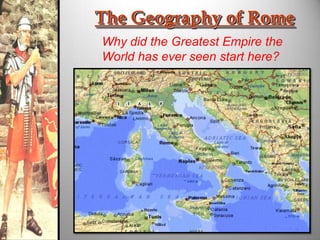
The Geography of Rome
Why did the Greatest Empire the
World has ever seen start here?
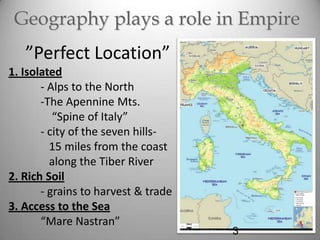
Geography plays a role in Empire

”Perfect Location”
1. Isolated
- Alps to the North
-The Apennine Mts.
“Spine of Italy”
- city of the seven hills15 miles from the coast
along the Tiber River
2. Rich Soil
- grains to harvest & trade
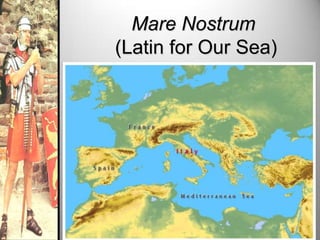
3. Access to the Sea
“Mare Nastran”

3
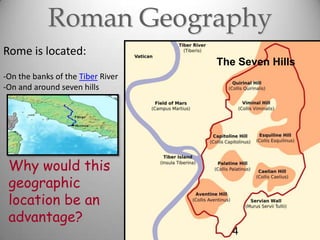
Roman Geography
Rome is located:

The Seven Hills

-On the banks of the Tiber River
-On and around seven hills

Why would this
geographic
location be an
advantage?
4
Mare Nostrum
(Latin for Our Sea)
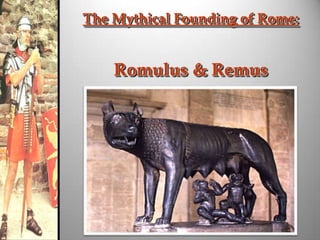
The Mythical Founding of Rome:

Romulus & Remus
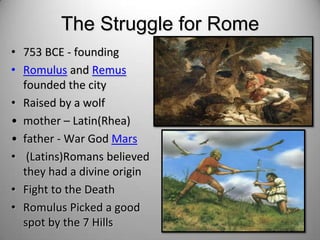
The Struggle for Rome
• 753 BCE - founding
• Romulus and Remus
founded the city
• Raised by a wolf
• mother – Latin(Rhea)
• father - War God Mars
• (Latins)Romans believed
they had a divine origin
• Fight to the Death
• Romulus Picked a good
spot by the 7 Hills
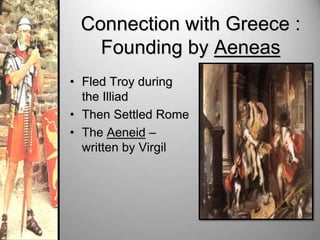
Connection with Greece :
Founding by Aeneas
• Fled Troy during
the Illiad
• Then Settled Rome
• The Aeneid –
written by Virgil
Early Civilization
-Italy

was originally occupied by many
different groups of people

-Two main groups

1) Greek Colonists
2) The Etruscans

-The Etruscans ruled much of central Italy and Rome itself

-Ancestors of the Romans, the Latins(Indo-European)
settled in the area that is now Rome around 800 B.C.
9
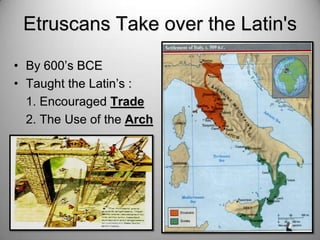
Etruscans Take over the Latin's
• By 600’s BCE
• Taught the Latin’s :
1. Encouraged Trade
2. The Use of the Arch
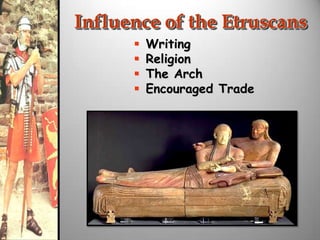
Influence of the Etruscans





Writing
Religion
The Arch
Encouraged Trade
Etruscan Rule
• King – Senate{Latin Nobles}
who advised the King
These hardworking Latin Farmers
wanted their independence
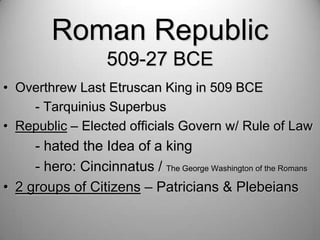
Roman Republic
509-27 BCE
• Overthrew Last Etruscan King in 509 BCE
- Tarquinius Superbus
• Republic – Elected officials Govern w/ Rule of Law

- hated the Idea of a king
- hero: Cincinnatus / The George Washington of the Romans
• 2 groups of Citizens – Patricians & Plebeians
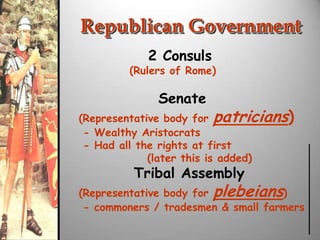
Republican Government
2 Consuls

(Rulers of Rome)

Senate

(Representative body for patricians)
- Wealthy Aristocrats
- Had all the rights at first
(later this is added)

Tribal Assembly

(Representative body for plebeians)
- commoners / tradesmen & small farmers
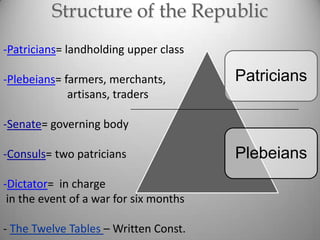
Structure of the Republic
-Patricians= landholding upper class

-Plebeians= farmers, merchants,
artisans, traders

Patricians

-Senate= governing body
-Consuls= two patricians
-Dictator= in charge
in the event of a war for six months
- The Twelve Tables – Written Const.

Plebeians
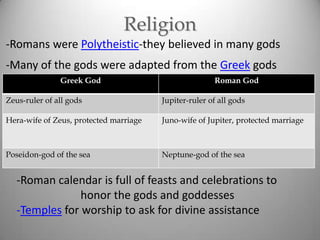
Religion
-Romans were Polytheistic-they believed in many gods
-Many of the gods were adapted from the Greek gods
Greek God

Roman God

Zeus-ruler of all gods

Jupiter-ruler of all gods

Hera-wife of Zeus, protected marriage

Juno-wife of Jupiter, protected marriage

Poseidon-god of the sea

Neptune-god of the sea

-Roman calendar is full of feasts and celebrations to
honor the gods and goddesses
-Temples for worship to ask for divine assistance
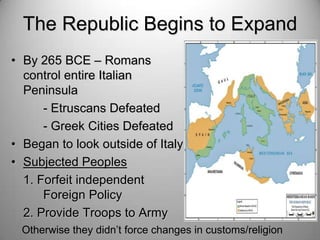
The Republic Begins to Expand
• By 265 BCE – Romans
control entire Italian
Peninsula
- Etruscans Defeated
- Greek Cities Defeated
• Began to look outside of Italy
• Subjected Peoples
1. Forfeit independent
Foreign Policy
2. Provide Troops to Army
Otherwise they didn’t force changes in customs/religion
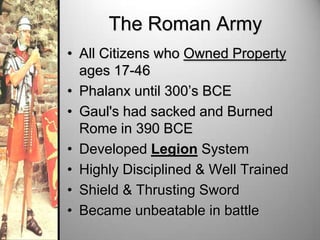
The Roman Army
• All Citizens who Owned Property
ages 17-46
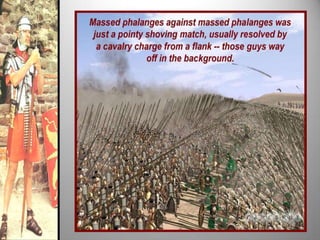
• Phalanx until 300’s BCE
• Gaul's had sacked and Burned
Rome in 390 BCE
• Developed Legion System
• Highly Disciplined & Well Trained
• Shield & Thrusting Sword
• Became unbeatable in battle
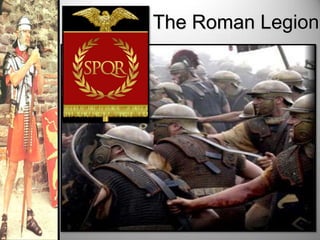
The Roman Legion
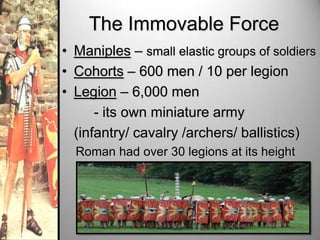
The Immovable Force
• Maniples – small elastic groups of soldiers
• Cohorts – 600 men / 10 per legion
• Legion – 6,000 men
- its own miniature army
(infantry/ cavalry /archers/ ballistics)
Roman had over 30 legions at its height
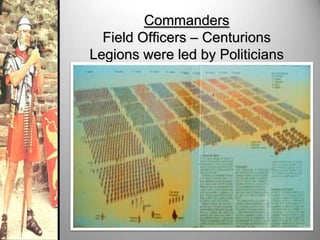
Commanders
Field Officers – Centurions
Legions were led by Politicians
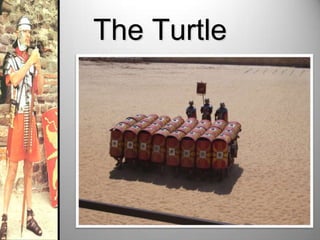
The Turtle
Final Exam
• Term I – Final Exam – 250 pts
Multiple Choice –
90
Fill in Blank 40
Matching / Religions 15
True & False 50
Map/pick 15 of 20
15
(Regions / Cities / Physical Features)

* Rome – Matching
(People & Terms)
Notebook – 250 pts

40
Assignment
Rome’s Perfect Location & Punic Wars

- Due ___________

Who is Fran Tarkington???????
The Punic Wars
• Latin Word for “Phoenician”
Rome v Carthage
• Rome – Looking to extend power
into the Mediterranean
• Carthage – Feared their trade
would be threatened
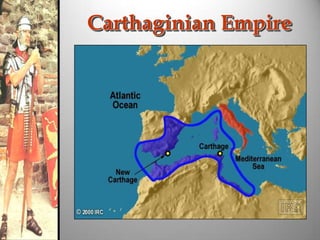
Carthaginian Empire
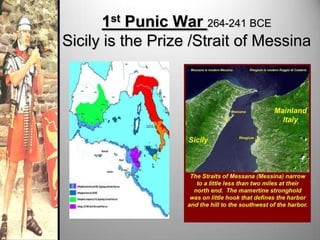
1st Punic War 264-241 BCE
Sicily is the Prize /Strait of Messina
Roman Ingenuity
•
•
•
•

Rome’s strong army
Carthage’s strong navy
Romans are losing hundreds of ships
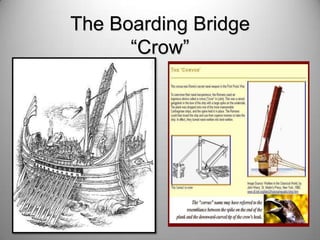
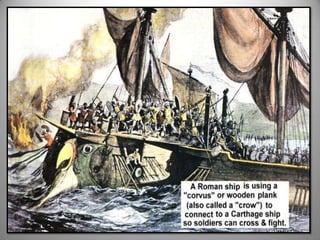
Devise a way to fight land battles at sea
- practical thinkers
• Sicily becomes their 1st Province
The Boarding Bridge
“Crow”
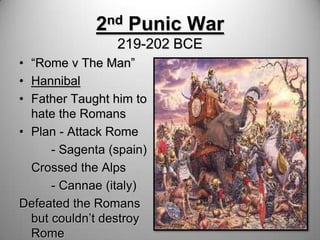
nd
2

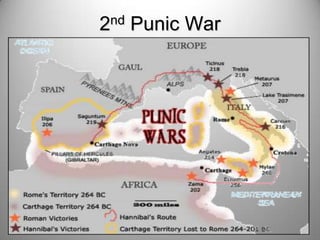
Punic War

219-202 BCE
• “Rome v The Man”
• Hannibal
• Father Taught him to
hate the Romans
• Plan - Attack Rome
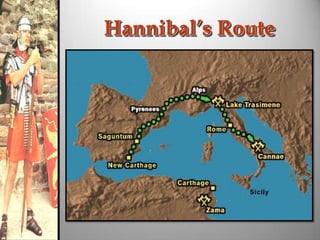
- Sagenta (spain)
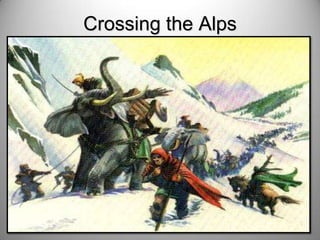
Crossed the Alps
- Cannae (italy)
Defeated the Romans
but couldn’t destroy
Rome
Crossing the Alps
Hannibal’s Route
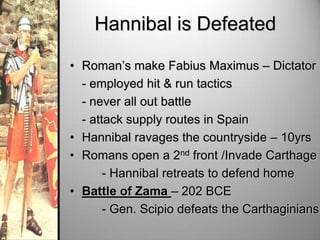
Hannibal is Defeated
• Roman’s make Fabius Maximus – Dictator
- employed hit & run tactics
- never all out battle
- attack supply routes in Spain
• Hannibal ravages the countryside – 10yrs
• Romans open a 2nd front /Invade Carthage
- Hannibal retreats to defend home
• Battle of Zama – 202 BCE
- Gen. Scipio defeats the Carthaginians
nd
2

Punic War
Peace Terms
1. Carthage must give up Navy
2. Pay annual Tribute to Rome
3. Surrender holdings on Iberian Pen.
- Carthage is not Destroyed
Many Romans Call for Destruction
Iraq “Gulf War” 1990
Iraq Invaded again 2003
3rd Punic War
149-146 BCE

• Romans Siege Carthage-Surrender
1. Enslaved entire Population
2. Burn the City to the Ground
3. Sewed the Fields with Salt

Roman Legions make more gains
1. Macedonia
2. Greece

3. Egypt(allied)

By 133 BCE – Imperial Republic
spread across the Med.
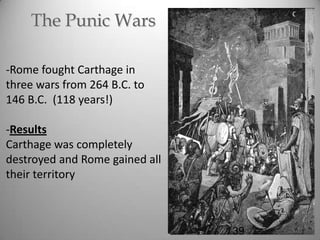
The Punic Wars
-Rome fought Carthage in
three wars from 264 B.C. to
146 B.C. (118 years!)
-Results
Carthage was completely
destroyed and Rome gained all
their territory

39
END
Assignment
• p. 184 – Questions
Terms & Names # 1 - 8
Main Ideas # 9 – 18
Critical Thinking # 1- 4
• Study Guide for Extra Credit
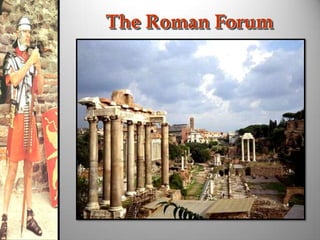
The Roman Forum
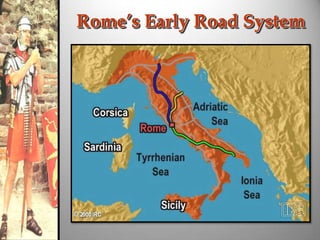
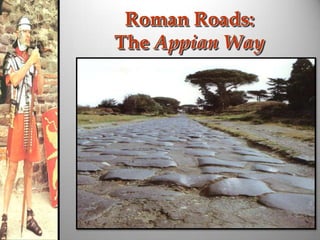
Rome’s Early Road System
Roman Roads:
The Appian Way
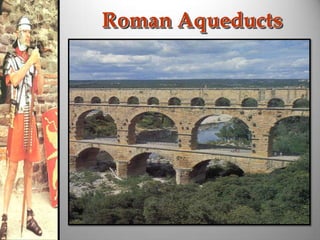
Roman Aqueducts
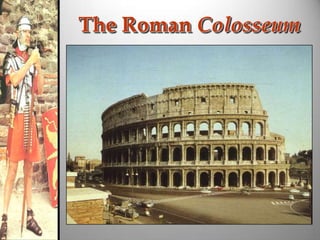
The Roman Colosseum
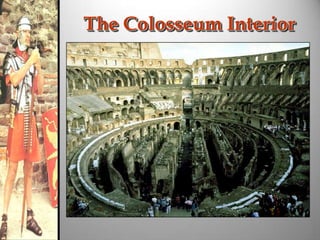
The Colosseum Interior
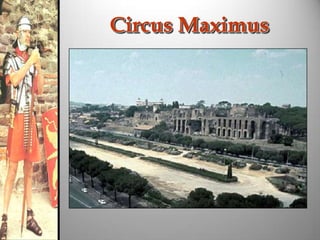
Circus Maximus

Ancient rome 1

  • 1.
    Senatus Populusque Romanus ROME “AllRoads Lead There” #29 World History Unit 5 Chapter 6
  • 2.
    The Geography ofRome Why did the Greatest Empire the World has ever seen start here?
  • 3.
    Geography plays arole in Empire ”Perfect Location” 1. Isolated - Alps to the North -The Apennine Mts. “Spine of Italy” - city of the seven hills15 miles from the coast along the Tiber River 2. Rich Soil - grains to harvest & trade 3. Access to the Sea “Mare Nastran” 3
  • 4.
    Roman Geography Rome islocated: The Seven Hills -On the banks of the Tiber River -On and around seven hills Why would this geographic location be an advantage? 4
  • 5.
  • 6.
    The Mythical Foundingof Rome: Romulus & Remus
  • 7.
    The Struggle forRome • 753 BCE - founding • Romulus and Remus founded the city • Raised by a wolf • mother – Latin(Rhea) • father - War God Mars • (Latins)Romans believed they had a divine origin • Fight to the Death • Romulus Picked a good spot by the 7 Hills
  • 8.
    Connection with Greece: Founding by Aeneas • Fled Troy during the Illiad • Then Settled Rome • The Aeneid – written by Virgil
  • 9.
    Early Civilization -Italy was originallyoccupied by many different groups of people -Two main groups 1) Greek Colonists 2) The Etruscans -The Etruscans ruled much of central Italy and Rome itself -Ancestors of the Romans, the Latins(Indo-European) settled in the area that is now Rome around 800 B.C. 9
  • 10.
    Etruscans Take overthe Latin's • By 600’s BCE • Taught the Latin’s : 1. Encouraged Trade 2. The Use of the Arch
  • 11.
    Influence of theEtruscans     Writing Religion The Arch Encouraged Trade
  • 12.
    Etruscan Rule • King– Senate{Latin Nobles} who advised the King These hardworking Latin Farmers wanted their independence
  • 13.
    Roman Republic 509-27 BCE •Overthrew Last Etruscan King in 509 BCE - Tarquinius Superbus • Republic – Elected officials Govern w/ Rule of Law - hated the Idea of a king - hero: Cincinnatus / The George Washington of the Romans • 2 groups of Citizens – Patricians & Plebeians
  • 14.
    Republican Government 2 Consuls (Rulersof Rome) Senate (Representative body for patricians) - Wealthy Aristocrats - Had all the rights at first (later this is added) Tribal Assembly (Representative body for plebeians) - commoners / tradesmen & small farmers
  • 15.
    Structure of theRepublic -Patricians= landholding upper class -Plebeians= farmers, merchants, artisans, traders Patricians -Senate= governing body -Consuls= two patricians -Dictator= in charge in the event of a war for six months - The Twelve Tables – Written Const. Plebeians
  • 16.
    Religion -Romans were Polytheistic-theybelieved in many gods -Many of the gods were adapted from the Greek gods Greek God Roman God Zeus-ruler of all gods Jupiter-ruler of all gods Hera-wife of Zeus, protected marriage Juno-wife of Jupiter, protected marriage Poseidon-god of the sea Neptune-god of the sea -Roman calendar is full of feasts and celebrations to honor the gods and goddesses -Temples for worship to ask for divine assistance
  • 17.
    The Republic Beginsto Expand • By 265 BCE – Romans control entire Italian Peninsula - Etruscans Defeated - Greek Cities Defeated • Began to look outside of Italy • Subjected Peoples 1. Forfeit independent Foreign Policy 2. Provide Troops to Army Otherwise they didn’t force changes in customs/religion
  • 18.
    The Roman Army •All Citizens who Owned Property ages 17-46 • Phalanx until 300’s BCE • Gaul's had sacked and Burned Rome in 390 BCE • Developed Legion System • Highly Disciplined & Well Trained • Shield & Thrusting Sword • Became unbeatable in battle
  • 20.
  • 21.
    The Immovable Force •Maniples – small elastic groups of soldiers • Cohorts – 600 men / 10 per legion • Legion – 6,000 men - its own miniature army (infantry/ cavalry /archers/ ballistics) Roman had over 30 legions at its height
  • 22.
    Commanders Field Officers –Centurions Legions were led by Politicians
  • 23.
  • 24.
    Final Exam • TermI – Final Exam – 250 pts Multiple Choice – 90 Fill in Blank 40 Matching / Religions 15 True & False 50 Map/pick 15 of 20 15 (Regions / Cities / Physical Features) * Rome – Matching (People & Terms) Notebook – 250 pts 40
  • 25.
    Assignment Rome’s Perfect Location& Punic Wars - Due ___________ Who is Fran Tarkington???????
  • 26.
    The Punic Wars •Latin Word for “Phoenician” Rome v Carthage • Rome – Looking to extend power into the Mediterranean • Carthage – Feared their trade would be threatened
  • 27.
  • 28.
    1st Punic War264-241 BCE Sicily is the Prize /Strait of Messina
  • 29.
    Roman Ingenuity • • • • Rome’s strongarmy Carthage’s strong navy Romans are losing hundreds of ships Devise a way to fight land battles at sea - practical thinkers • Sicily becomes their 1st Province
  • 30.
  • 32.
    nd 2 Punic War 219-202 BCE •“Rome v The Man” • Hannibal • Father Taught him to hate the Romans • Plan - Attack Rome - Sagenta (spain) Crossed the Alps - Cannae (italy) Defeated the Romans but couldn’t destroy Rome
  • 33.
  • 34.
  • 35.
    Hannibal is Defeated •Roman’s make Fabius Maximus – Dictator - employed hit & run tactics - never all out battle - attack supply routes in Spain • Hannibal ravages the countryside – 10yrs • Romans open a 2nd front /Invade Carthage - Hannibal retreats to defend home • Battle of Zama – 202 BCE - Gen. Scipio defeats the Carthaginians
  • 36.
  • 37.
    Peace Terms 1. Carthagemust give up Navy 2. Pay annual Tribute to Rome 3. Surrender holdings on Iberian Pen. - Carthage is not Destroyed Many Romans Call for Destruction Iraq “Gulf War” 1990 Iraq Invaded again 2003
  • 38.
    3rd Punic War 149-146BCE • Romans Siege Carthage-Surrender 1. Enslaved entire Population 2. Burn the City to the Ground 3. Sewed the Fields with Salt Roman Legions make more gains 1. Macedonia 2. Greece 3. Egypt(allied) By 133 BCE – Imperial Republic spread across the Med.
  • 39.
    The Punic Wars -Romefought Carthage in three wars from 264 B.C. to 146 B.C. (118 years!) -Results Carthage was completely destroyed and Rome gained all their territory 39
  • 40.
  • 41.
    Assignment • p. 184– Questions Terms & Names # 1 - 8 Main Ideas # 9 – 18 Critical Thinking # 1- 4 • Study Guide for Extra Credit
  • 42.
  • 43.
  • 44.
  • 45.
  • 46.
  • 47.
  • 48.