GAttA Chapter 29

  Unit 18 -
Impressionism,
     etc
 The Later Nineteenth
       Century
Industrialization of Europe and U.S.
             about 1850
Realism: The Painting
   of Modern Life
Time Periods

     Realism         1848-1860s
  Impressionism      1872-1880s
Post-Impressionism   1880s-1890s
   Symbolism           1890s
   Art Nouveau       1890s-1914
Key Ideas
1.   The Realist art movement was philosophically based on
     the theory of positivism
2.   Japanese art had a profound impact on late 19th century
     painting.
3.   Plein-air painting dominates much of Impressionist art.
4.   Post-Impressionists reacted against what they saw as the
     ephemeral quality of Impressionist painting.
5.   Symbolist painters seek to portray mystical personal
     visions.
6.   In the late 19th century, the skyscraper was born as a result
     of new technological advances, the invention of the
     elevator, and the rise of land values.
7.   Art Nouveau seeks to create a unified artistic experience
     combining painting, sculpture, and architecture ; relies on
     organic forms and motifs.
Innovations of Realism
1. Japonisme – prints of genre or landscape scenes;
   flat, odd angles or tilted objects
2. Artificial atmosphere of the studio gives way to
   plein-air (outside) work
3. Trying to capture effects of atmosphere and light
   outside
4. Would frequently do a series of same object at
   different times of day or series of photos
5. Invention of lithography (printmaking) 1798 =
   mass production of color prints = Delacroix,
   Goya, Daumier, Toulouse-Lautrec
Characteristics of Realism
1. Paint things you could experience with the 5
   senses.
2. Tended to be genre pieces showing lower
   class, since they were perceived to be honest,
   sincere, and at one with the earth.
Figure 29-1 GUSTAVE COURBET, The Stone Breakers, 1849. Oil on canvas,
   5’ 3” x 8’ 6”. Formerly at Gemäldegalerie, Dresden (destroyed in 1945).
Figure 29-2 GUSTAVE COURBET, Burial at Ornans, 1849. Oil on canvas, approx. 10’ x 22’.
                               Louvre, Paris.
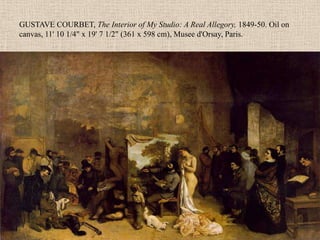
GUSTAVE COURBET, The Interior of My Studio: A Real Allegory, 1849-50. Oil on
canvas, 11' 10 1/4" x 19' 7 1/2" (361 x 598 cm), Musee d'Orsay, Paris.
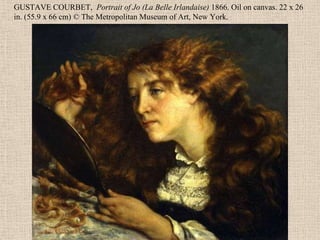
GUSTAVE COURBET, Portrait of Jo (La Belle Irlandaise) 1866. Oil on canvas. 22 x 26
in. (55.9 x 66 cm) © The Metropolitan Museum of Art, New York.
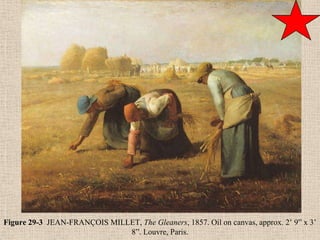
Figure 29-3 JEAN-FRANÇOIS MILLET, The Gleaners, 1857. Oil on canvas, approx. 2’ 9” x 3’
                              8”. Louvre, Paris.
Figure 29-4 [11th] JEAN-BAPTISTE-CAMILLE COROT, The Harbor of La Rochelle, 1851.
                         Oil on canvas, approx. 1’ 8” x 2’ 4”.
Figure 29-4 HONORÉ DAUMIER, Rue Transnonain, 1834. Lithograph, approx. 1’ x 1’ 5 1/2”.
       Philadelphia Museum of Art, Philadelphia (bequest of Fiske and Marie Kimball).
Figure 29-6 HONORÉ DAUMIER, The Third-Class Carriage, ca. 1862. Oil on canvas, 2’ 1
              3/4” x 2’ 11 1/2”. Metropolitan Museum of Art, New York.
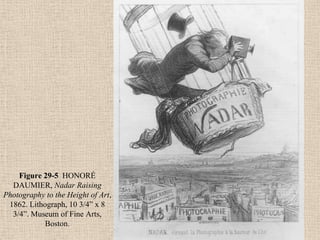
Figure 29-5 HONORÉ
  DAUMIER, Nadar Raising
Photography to the Height of Art,
 1862. Lithograph, 10 3/4” x 8
  3/4”. Museum of Fine Arts,
            Boston.
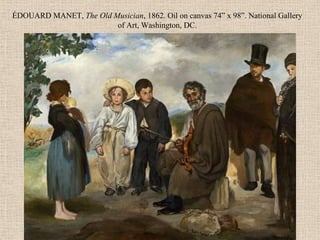
ÉDOUARD MANET, The Old Musician, 1862. Oil on canvas 74” x 98”. National Gallery
                        of Art, Washington, DC.
Figure 29-7 ÉDOUARD MANET, Le Déjeuner sur l’herbe (Luncheon on the Grass), 1863. Oil
                 on canvas, approx. 7’ x 8’ 10”. Musée d’Orsay, Paris.
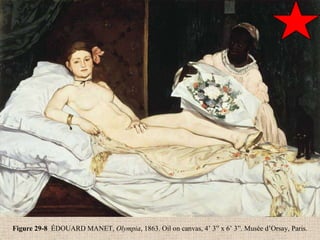
Figure 29-8 ÉDOUARD MANET, Olympia, 1863. Oil on canvas, 4’ 3” x 6’ 3”. Musée d’Orsay, Paris.
The French Academy and Other
       Classical Models

 • What was the importance & influence
   of the French Royal Academy of Art,
   the artists it trained, & the styles it
   promoted?
 • What explained the popularity of other
   classical models in art?
Figure 29-9 ADOLPHE-WILLIAM
  BOUGUEREAU, Nymphs and Satyr,
1873. Oil on canvas, approx. 8’ 6” high.
Sterling and Francine Clark Art Institute,
      Williamstown, Massachusetts.
Rosa Bonheur was the most famous woman artist of the first three quarters of the
nineteenth century. Her family supported her in that endeavor. From age ten on,
Bonheur spent hours sketching animals in parks on the outskirts of Paris; by age
seventeen she was contributing to the family income by making copies of paintings
in the Louvre. Since it was not possible for a woman to attend the official schools
of art at this time, her father, Raymond Bonheur—a landscape artist and teacher—
served as her instructor.
Bonheur was politically and artistically conservative. She worked in a very
traditional way, making sketches and studies in preparation for larger, final
paintings. Bonheur believed in direct observation of nature and was determined to
be accurate in all details. To this end, she dissected animal parts, sketched from
life, and attended horse fairs. This was not the type of event normally attended by
women. To avoid the taunts and comments a woman could receive if she were seen
at a horse fair, Bonheur applied for permission from the prefecture of police to
dress in men’s clothing, and received authorization to do so in 1852.
Rosa Bonheur was the first woman to receive a cross of the Legion of Honor in
France, a reward for outstanding achievement in her field. The honor was bestowed
upon her personally by the Empress Eugenie, wife of emperor Napoleon III, in
June 1865. The empress wanted to show, as she said, that "genius has no sex."
MARIE-ROSALIE (ROSA) BONHEUR, The Horse Fair, ca. 1852. Oil on canvas, 10.5” x 25”,
                     Albright-Knox Gallery, Buffalo NY.
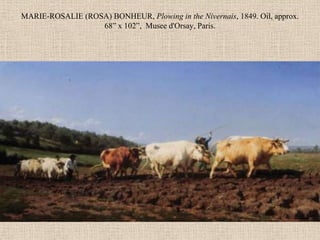
MARIE-ROSALIE (ROSA) BONHEUR, Plowing in the Nivernais, 1849. Oil, approx.
                  68” x 102”, Musee d'Orsay, Paris.
Figure 29-10 MARIE-ROSALIE (ROSA) BONHEUR, The Horse Fair, 1853–1855. Oil on
             canvas, 8’ x 16’ 7.5”. Metropolitan Museum of Art, New York.
American and German Realism
 • Who were the American artists, and
   what are key works of Realist art?
 • Why were the German artists’
   interested in regional and national
   characteristics, folk customs and
   culture?
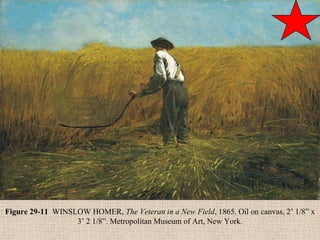
Figure 29-11 WINSLOW HOMER, The Veteran in a New Field, 1865. Oil on canvas, 2’ 1/8” x
                  3’ 2 1/8”. Metropolitan Museum of Art, New York.
WINSLOW HOMER, Snap the Whip, 1872. Oil on canvas, 12” x 20”, Metropolitan Museum of
                               Art, New York.
WINSLOW HOMER, The Gulf Stream, 1899. Oil on canvas, 28” x 49”, Metropolitan Museum
                             of Art, New York.
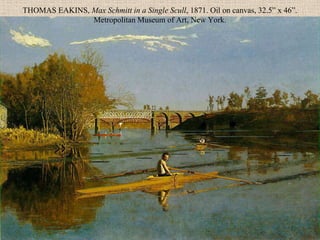
THOMAS EAKINS, Max Schmitt in a Single Scull, 1871. Oil on canvas, 32.5” x 46”.
               Metropolitan Museum of Art, New York.
Figure 29-12 THOMAS
  EAKINS, The Gross Clinic,
1875. Oil on canvas, 8’ x 6’ 6”.
 Jefferson Medical College of
 Thomas Jefferson University,
         Philadelphia.
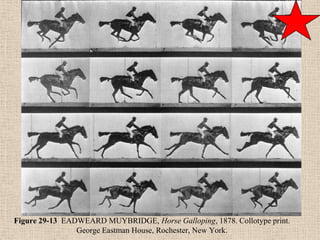
Figure 29-13 EADWEARD MUYBRIDGE, Horse Galloping, 1878. Collotype print.
                George Eastman House, Rochester, New York.
Figure 29-14 JOHN
SINGER SARGENT, The
  Daughters of Edward
Darley Boit, 1882. Oil on
canvas, 7’ 3 3/8” x 3 5/8”.
  Museum of Fine Arts,
         Boston.
•Dominating piece
                •


   JOHN SINGER SARGENT,
   Madame X (Madame Pierre
 Gautreau), 1883. Oil on canvas,
82” by 43”, Metropolitan Museum
       of Art, New York.
JOHN SINGER SARGENT,
 Portrait of a Young Girl, 1880-
1884. Oil on canvas, 65cm x 46cm,
    Baltimore Museum of Art,
            Baltimore.
JOHN SINGER SARGENT, The Black Brook, 1908. Oil on canvas, 82” by 43”, Tate
                          Gallery, London.
Figure 29-15 HENRY OSSAWA TANNER, The Thankful Poor, 1894. Oil on canvas, 3’ 8
             1/4” x 2’ 11 1/2”. Collection of William H. and Camille Cosby.
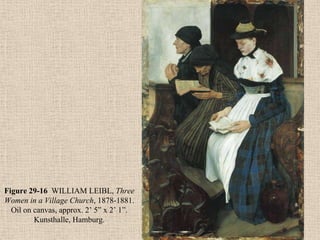
Figure 29-16 WILLIAM LEIBL, Three
Women in a Village Church, 1878-1881.
  Oil on canvas, approx. 2’ 5” x 2’ 1”.
         Kunsthalle, Hamburg.
Pre-Raphaelite Brotherhood

• How did the Pre-Raphaelites’ choice of
  subject matter contrast to the Realists’
  subject matter?
• What were the influences of the literary
  world & of the critic John Ruskin on the art
  of the Pre-Raphaelites?
• Who were the artists & what were the styles
  of the Pre-Raphaelite movement?
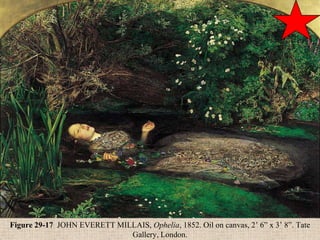
Figure 29-17 JOHN EVERETT MILLAIS, Ophelia, 1852. Oil on canvas, 2’ 6” x 3’ 8”. Tate
                             Gallery, London.
JOHN EVERETT MILLAIS. A Huguenot, on
St. Bartholomew's Day Refusing to Shield
Himself from Danger by Wearing the Roman
Catholic Badge. 1852. Oil on canvas. Manson
and Woods Ltd., London.
JOHN EVERETT MILLAIS,
The Ransom, 1860-1862. Oil on
canvas, 51” x 45”. J Paul Getty
          Museum.
JOHN EVERETT MILLAIS,
Cinderella, 1881. Oil on canvas,
51” x 45”. Kevin Alfred Strom
            Gallery.
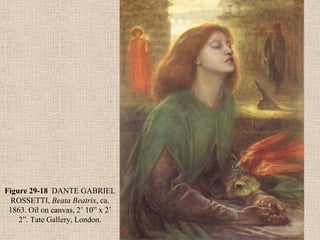
Figure 29-18 DANTE GABRIEL
  ROSSETTI, Beata Beatrix, ca.
 1863. Oil on canvas, 2’ 10” x 2’
    2”. Tate Gallery, London.
DANTE GABRIEL
ROSSETTI, Lady Lilith,
1867. Oil on canvas, 38” x
33.5”, Delaware Art Museum,
Delaware.
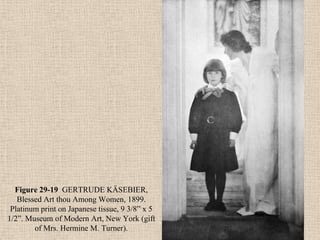
Figure 29-19 GERTRUDE KÄSEBIER,
   Blessed Art thou Among Women, 1899.
 Platinum print on Japanese tissue, 9 3/8” x 5
1/2”. Museum of Modern Art, New York (gift
        of Mrs. Hermine M. Turner).

19 a real pics

  • 1.
    GAttA Chapter 29 Unit 18 - Impressionism, etc The Later Nineteenth Century
  • 2.
    Industrialization of Europeand U.S. about 1850
  • 3.
    Realism: The Painting of Modern Life
  • 4.
    Time Periods Realism 1848-1860s Impressionism 1872-1880s Post-Impressionism 1880s-1890s Symbolism 1890s Art Nouveau 1890s-1914
  • 5.
    Key Ideas 1. The Realist art movement was philosophically based on the theory of positivism 2. Japanese art had a profound impact on late 19th century painting. 3. Plein-air painting dominates much of Impressionist art. 4. Post-Impressionists reacted against what they saw as the ephemeral quality of Impressionist painting. 5. Symbolist painters seek to portray mystical personal visions. 6. In the late 19th century, the skyscraper was born as a result of new technological advances, the invention of the elevator, and the rise of land values. 7. Art Nouveau seeks to create a unified artistic experience combining painting, sculpture, and architecture ; relies on organic forms and motifs.
  • 6.
    Innovations of Realism 1.Japonisme – prints of genre or landscape scenes; flat, odd angles or tilted objects 2. Artificial atmosphere of the studio gives way to plein-air (outside) work 3. Trying to capture effects of atmosphere and light outside 4. Would frequently do a series of same object at different times of day or series of photos 5. Invention of lithography (printmaking) 1798 = mass production of color prints = Delacroix, Goya, Daumier, Toulouse-Lautrec
  • 7.
    Characteristics of Realism 1.Paint things you could experience with the 5 senses. 2. Tended to be genre pieces showing lower class, since they were perceived to be honest, sincere, and at one with the earth.
  • 8.
    Figure 29-1 GUSTAVECOURBET, The Stone Breakers, 1849. Oil on canvas, 5’ 3” x 8’ 6”. Formerly at Gemäldegalerie, Dresden (destroyed in 1945).
  • 9.
    Figure 29-2 GUSTAVECOURBET, Burial at Ornans, 1849. Oil on canvas, approx. 10’ x 22’. Louvre, Paris.
  • 10.
    GUSTAVE COURBET, TheInterior of My Studio: A Real Allegory, 1849-50. Oil on canvas, 11' 10 1/4" x 19' 7 1/2" (361 x 598 cm), Musee d'Orsay, Paris.
  • 11.
    GUSTAVE COURBET, Portraitof Jo (La Belle Irlandaise) 1866. Oil on canvas. 22 x 26 in. (55.9 x 66 cm) © The Metropolitan Museum of Art, New York.
  • 12.
    Figure 29-3 JEAN-FRANÇOISMILLET, The Gleaners, 1857. Oil on canvas, approx. 2’ 9” x 3’ 8”. Louvre, Paris.
  • 13.
    Figure 29-4 [11th]JEAN-BAPTISTE-CAMILLE COROT, The Harbor of La Rochelle, 1851. Oil on canvas, approx. 1’ 8” x 2’ 4”.
  • 14.
    Figure 29-4 HONORÉDAUMIER, Rue Transnonain, 1834. Lithograph, approx. 1’ x 1’ 5 1/2”. Philadelphia Museum of Art, Philadelphia (bequest of Fiske and Marie Kimball).
  • 15.
    Figure 29-6 HONORÉDAUMIER, The Third-Class Carriage, ca. 1862. Oil on canvas, 2’ 1 3/4” x 2’ 11 1/2”. Metropolitan Museum of Art, New York.
  • 16.
    Figure 29-5 HONORÉ DAUMIER, Nadar Raising Photography to the Height of Art, 1862. Lithograph, 10 3/4” x 8 3/4”. Museum of Fine Arts, Boston.
  • 17.
    ÉDOUARD MANET, TheOld Musician, 1862. Oil on canvas 74” x 98”. National Gallery of Art, Washington, DC.
  • 18.
    Figure 29-7 ÉDOUARDMANET, Le Déjeuner sur l’herbe (Luncheon on the Grass), 1863. Oil on canvas, approx. 7’ x 8’ 10”. Musée d’Orsay, Paris.
  • 19.
    Figure 29-8 ÉDOUARDMANET, Olympia, 1863. Oil on canvas, 4’ 3” x 6’ 3”. Musée d’Orsay, Paris.
  • 20.
    The French Academyand Other Classical Models • What was the importance & influence of the French Royal Academy of Art, the artists it trained, & the styles it promoted? • What explained the popularity of other classical models in art?
  • 21.
    Figure 29-9 ADOLPHE-WILLIAM BOUGUEREAU, Nymphs and Satyr, 1873. Oil on canvas, approx. 8’ 6” high. Sterling and Francine Clark Art Institute, Williamstown, Massachusetts.
  • 22.
    Rosa Bonheur wasthe most famous woman artist of the first three quarters of the nineteenth century. Her family supported her in that endeavor. From age ten on, Bonheur spent hours sketching animals in parks on the outskirts of Paris; by age seventeen she was contributing to the family income by making copies of paintings in the Louvre. Since it was not possible for a woman to attend the official schools of art at this time, her father, Raymond Bonheur—a landscape artist and teacher— served as her instructor. Bonheur was politically and artistically conservative. She worked in a very traditional way, making sketches and studies in preparation for larger, final paintings. Bonheur believed in direct observation of nature and was determined to be accurate in all details. To this end, she dissected animal parts, sketched from life, and attended horse fairs. This was not the type of event normally attended by women. To avoid the taunts and comments a woman could receive if she were seen at a horse fair, Bonheur applied for permission from the prefecture of police to dress in men’s clothing, and received authorization to do so in 1852. Rosa Bonheur was the first woman to receive a cross of the Legion of Honor in France, a reward for outstanding achievement in her field. The honor was bestowed upon her personally by the Empress Eugenie, wife of emperor Napoleon III, in June 1865. The empress wanted to show, as she said, that "genius has no sex."
  • 23.
    MARIE-ROSALIE (ROSA) BONHEUR,The Horse Fair, ca. 1852. Oil on canvas, 10.5” x 25”, Albright-Knox Gallery, Buffalo NY.
  • 24.
    MARIE-ROSALIE (ROSA) BONHEUR,Plowing in the Nivernais, 1849. Oil, approx. 68” x 102”, Musee d'Orsay, Paris.
  • 25.
    Figure 29-10 MARIE-ROSALIE(ROSA) BONHEUR, The Horse Fair, 1853–1855. Oil on canvas, 8’ x 16’ 7.5”. Metropolitan Museum of Art, New York.
  • 26.
    American and GermanRealism • Who were the American artists, and what are key works of Realist art? • Why were the German artists’ interested in regional and national characteristics, folk customs and culture?
  • 27.
    Figure 29-11 WINSLOWHOMER, The Veteran in a New Field, 1865. Oil on canvas, 2’ 1/8” x 3’ 2 1/8”. Metropolitan Museum of Art, New York.
  • 28.
    WINSLOW HOMER, Snapthe Whip, 1872. Oil on canvas, 12” x 20”, Metropolitan Museum of Art, New York.
  • 29.
    WINSLOW HOMER, TheGulf Stream, 1899. Oil on canvas, 28” x 49”, Metropolitan Museum of Art, New York.
  • 30.
    THOMAS EAKINS, MaxSchmitt in a Single Scull, 1871. Oil on canvas, 32.5” x 46”. Metropolitan Museum of Art, New York.
  • 31.
    Figure 29-12 THOMAS EAKINS, The Gross Clinic, 1875. Oil on canvas, 8’ x 6’ 6”. Jefferson Medical College of Thomas Jefferson University, Philadelphia.
  • 32.
    Figure 29-13 EADWEARDMUYBRIDGE, Horse Galloping, 1878. Collotype print. George Eastman House, Rochester, New York.
  • 33.
    Figure 29-14 JOHN SINGERSARGENT, The Daughters of Edward Darley Boit, 1882. Oil on canvas, 7’ 3 3/8” x 3 5/8”. Museum of Fine Arts, Boston.
  • 34.
    •Dominating piece • JOHN SINGER SARGENT, Madame X (Madame Pierre Gautreau), 1883. Oil on canvas, 82” by 43”, Metropolitan Museum of Art, New York.
  • 35.
    JOHN SINGER SARGENT, Portrait of a Young Girl, 1880- 1884. Oil on canvas, 65cm x 46cm, Baltimore Museum of Art, Baltimore.
  • 36.
    JOHN SINGER SARGENT,The Black Brook, 1908. Oil on canvas, 82” by 43”, Tate Gallery, London.
  • 37.
    Figure 29-15 HENRYOSSAWA TANNER, The Thankful Poor, 1894. Oil on canvas, 3’ 8 1/4” x 2’ 11 1/2”. Collection of William H. and Camille Cosby.
  • 38.
    Figure 29-16 WILLIAMLEIBL, Three Women in a Village Church, 1878-1881. Oil on canvas, approx. 2’ 5” x 2’ 1”. Kunsthalle, Hamburg.
  • 39.
    Pre-Raphaelite Brotherhood • Howdid the Pre-Raphaelites’ choice of subject matter contrast to the Realists’ subject matter? • What were the influences of the literary world & of the critic John Ruskin on the art of the Pre-Raphaelites? • Who were the artists & what were the styles of the Pre-Raphaelite movement?
  • 40.
    Figure 29-17 JOHNEVERETT MILLAIS, Ophelia, 1852. Oil on canvas, 2’ 6” x 3’ 8”. Tate Gallery, London.
  • 41.
    JOHN EVERETT MILLAIS.A Huguenot, on St. Bartholomew's Day Refusing to Shield Himself from Danger by Wearing the Roman Catholic Badge. 1852. Oil on canvas. Manson and Woods Ltd., London.
  • 42.
    JOHN EVERETT MILLAIS, TheRansom, 1860-1862. Oil on canvas, 51” x 45”. J Paul Getty Museum.
  • 43.
    JOHN EVERETT MILLAIS, Cinderella,1881. Oil on canvas, 51” x 45”. Kevin Alfred Strom Gallery.
  • 44.
    Figure 29-18 DANTEGABRIEL ROSSETTI, Beata Beatrix, ca. 1863. Oil on canvas, 2’ 10” x 2’ 2”. Tate Gallery, London.
  • 45.
    DANTE GABRIEL ROSSETTI, LadyLilith, 1867. Oil on canvas, 38” x 33.5”, Delaware Art Museum, Delaware.
  • 46.
    Figure 29-19 GERTRUDEKÄSEBIER, Blessed Art thou Among Women, 1899. Platinum print on Japanese tissue, 9 3/8” x 5 1/2”. Museum of Modern Art, New York (gift of Mrs. Hermine M. Turner).