Chapter 26
New Perspectives
on Art and Audience
Jeff Koons
Pink Panther, 1988. Porcelain
Commodity Art
Jeff Koons
• became a Wall Street commodities
broker to support his art-making.
• he is the artist who reinvented
Duchamp’s readymades for the
consumer age, and as a result he
constantly is involved in high-profile
copyright cases.
• Koons took Duchmap’s concept to
whole ne level when he created a
factory-scale art production
company to make his art that also
made him super rich.
• He is also known as the maker of
some of the most genuinely
perplexing works of art out there.
Jeff Koons. Michael Jackson and
Bubbles, 1988. Porcelain, 3’ 6” × 5’
10-1⁄2” × 2’ 8-1⁄2”. Sonnabend
Gallery, NY.
Jeff Koons is often portrayed
as the contemporary art world’s
supreme operator, in the
tradition of Duchamp and
Warhol: “provocative,
consistently self-referential
icon who seems to both
embody and parody the art
world’s worst excesses and to
stay one jump ahead of his
audience’s expectations at all
times.”(Robert Ayres, Art Info
2008)
Heim Steinbach
• known for his arrangements of
found objects on shelves;
• works in the tradition of Marcel
Duchamp;
• explores the role of the artist as
a collector and curator of
cultural artifacts;
• “We communicate through
objects just as we
communicate through
language,” he has explained.
• “We see objects, we have
feelings about them, and we
feel them when we touch
them.” (Heim Steinbach).
Heim Steinbach, Ultra Red #2.
1986. Mixed media.63 x 76 x 19
inches. Sonnabend Galelry, New
York, NY.
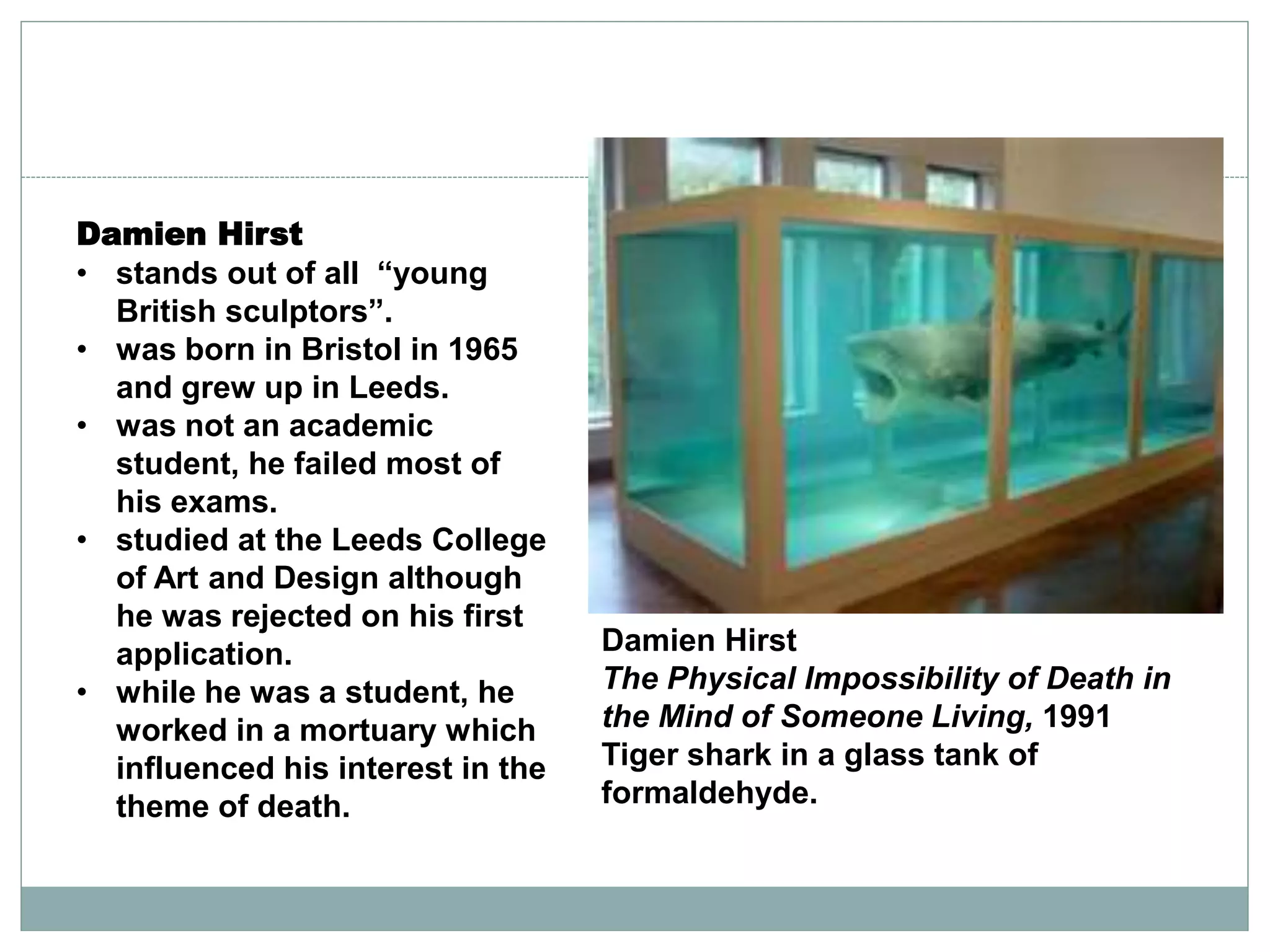
Damien Hirst
The Physical Impossibility of Death in
the Mind of Someone Living, 1991
Tiger shark in a glass tank of
formaldehyde.
Damien Hirst
• stands out of all “young
British sculptors”.
• was born in Bristol in 1965
and grew up in Leeds.
• was not an academic
student, he failed most of
his exams.
• studied at the Leeds College
of Art and Design although
he was rejected on his first
application.
• while he was a student, he
worked in a mortuary which
influenced his interest in the
theme of death.
Damien Hirst
For the Love of God (2007).
the only surviving human part
of the original is the teeth.
The piece is a platinum cast
of an 18th century human
skull covered in £15,000,000
worth of diamonds.
• Hirst is a leading member of the UK
postmodernist art group known as
Young British Artists.
• He jolted the artworld in the 1990s with
his series of dead animals preserved
and floating in formaldehyde.
• Influenced by Francis Bacon, his most
famous works of avant-garde art
include A Thousand Years (1989), a
glass case with maggots and flies
feeding off a rotting cow's head.
• Another important piece is The
Physical Impossibility of Death in the
Mind of Someone Living (1991), a tiger
shark in a glass tank of formaldehyde
CoLab, Ahearn, and Osorio
Colab
• is the abbreviation of the New York City artists' group Collaborative
Projects;
• Included artists of various disciplines.
The artists who came together to form Collaborative Projects Inc., NYC
(aka Colab) in the late 1970s/early 1980s are:
• John Ahearn,
• Charlie Ahearn,
• Diego Cortez,
• Jane Dickson,
• Jenny Holzer,
• Joe Lewis,
• James Nares,
• Tom Otterness,
• Kiki Smith,
• Betsy Sussler
Postmodern Arenas
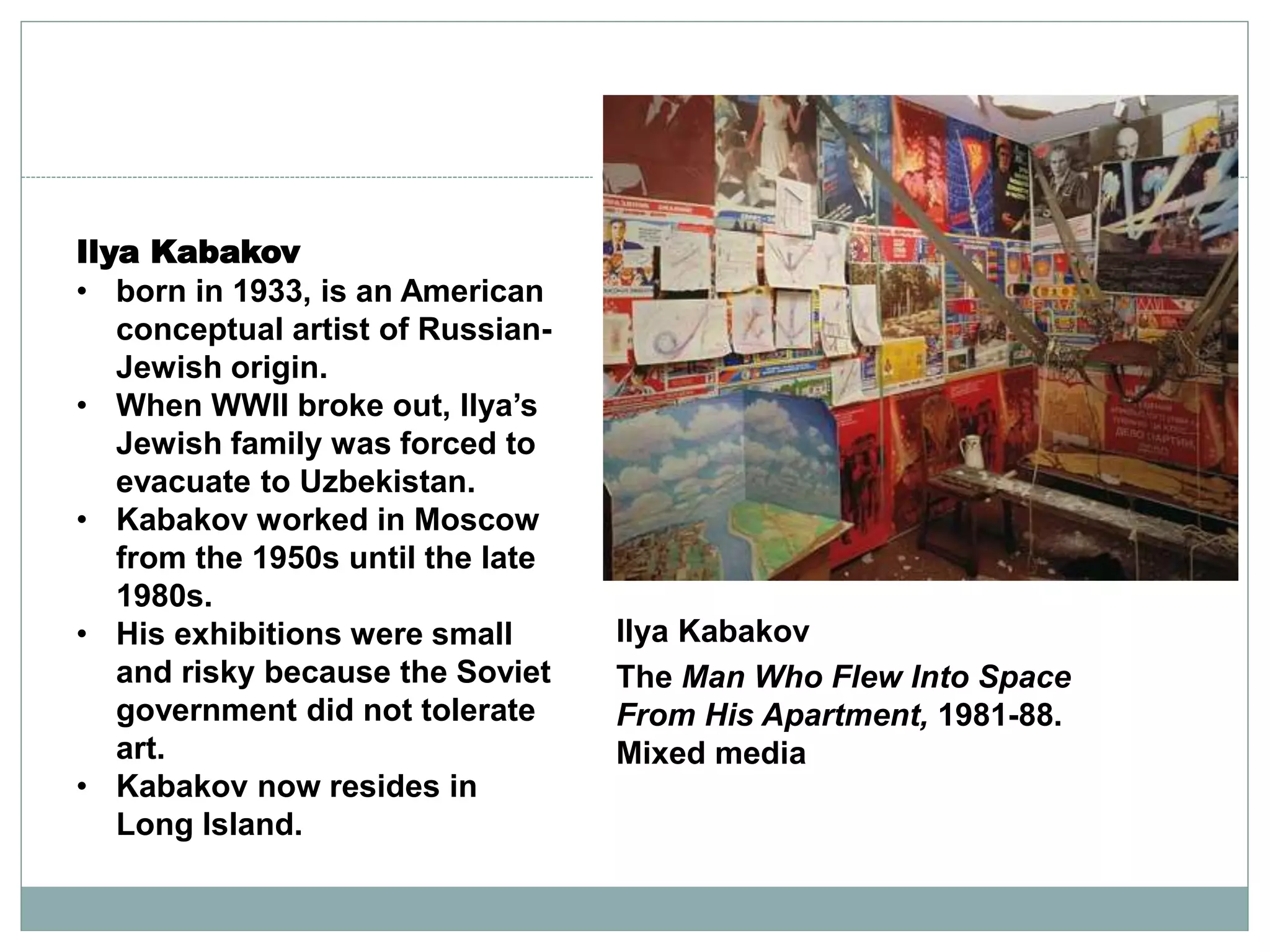
Ilya Kabakov
The Man Who Flew Into Space
From His Apartment, 1981-88.
Mixed media
Ilya Kabakov
• born in 1933, is an American
conceptual artist of Russian-
Jewish origin.
• When WWII broke out, Ilya’s
Jewish family was forced to
evacuate to Uzbekistan.
• Kabakov worked in Moscow
from the 1950s until the late
1980s.
• His exhibitions were small
and risky because the Soviet
government did not tolerate
art.
• Kabakov now resides in
Long Island.
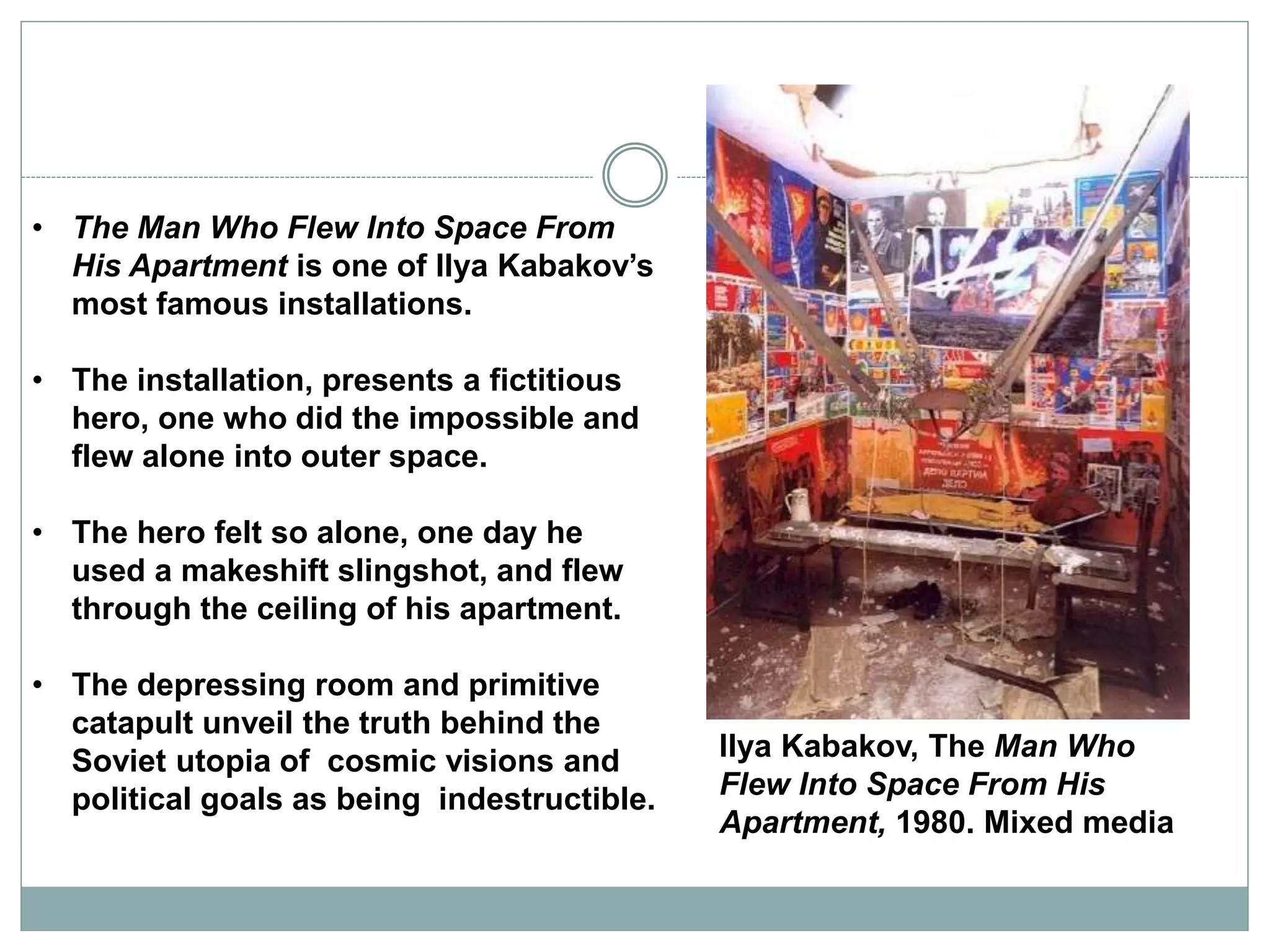
• The Man Who Flew Into Space From
His Apartment is one of Ilya Kabakov’s
most famous installations.
• The installation, presents a fictitious
hero, one who did the impossible and
flew alone into outer space.
• The hero felt so alone, one day he
used a makeshift slingshot, and flew
through the ceiling of his apartment.
• The depressing room and primitive
catapult unveil the truth behind the
Soviet utopia of cosmic visions and
political goals as being indestructible.
Ilya Kabakov, The Man Who
Flew Into Space From His
Apartment, 1980. Mixed media
• Kabakov used fictional
biographies, mostly inspired by his
own life, in trying to understand
the rise and fall of the Soviet
Union.
• Many of Ilya Kabakov installations
during the 1990s appear as
"metasystems" of Soviet
civilization in the form of metaphor,
as in "The Red Pavilion" (Russian
Pavilion of Venice Biennale, 1993).
• Despite the metaphoric starting
point of many of Kabakov’s
installations, and despite their
roots in Soviet culture, they
acquire other universal meanings.
Ilya Kabakov. The Red Pavilion,
1993. Mixed media
Christian Boltanski
Untitled, 1988. Mixed media
Christian Boltanski
• was born Sept 6, 1944,
Paris, France. He lives and
works in Malakoff near
Paris.
• his dominant theme is his
own life story, both actual
and reinvented, which he
tells through collections of
photographs and objects.
Since the 1960s, he worked
with the ephemera of the
human experience.
Artworks in his signature
style include obituary
photographs and lights.
Viola
• video and installation artist
known for exploring
themes of existential
introspection;
• considered a pioneer of
new media art
• is interested in technology
as a means to convey his
ideas;
• pursues timeless themes
like birth, death, and
extremes of emotion.
Bill Viola. The Theater of Memory,
1985. Video/sound installation.
Orange County Museum of Art,
California
Tony Cragg
• made artworks installed
on the floor and wall
reliefs out of broken
pieces of found broken
objects;
• focuses on how materials
and forms affect our
ideas and emotions;
• does not imitate nature;
he is concerned with why
things look like they do
and why they are as they
are.
Strangely Familiar: British and
American Sculpture
Tony Cragg, Britain Seen From the
North, 1981;
Richard Deacon
• contemporary Welsh artist with
an interest in the process of
fabricating shapes with visible
structures;
• known for his writhing abstract
drawings and sculptures.
• works with a variety of
materials, including steel, wood,
ceramic, vinyl, and foam,Richard Deacon, Tall Tree in
the Year, 1984.
Galvanized steel, laminated
wood, canvas 123 5/8 x 98 ½
inches. Private collection,
London
Martin Puryear
• combines abstraction with
traditional woodworking
techniques;
• creates metaphical works
which explore the subtleties
of culture and identity;
• After completing his studies
in United States, he went to
study at the Royal Swedish
Academy of Arts in Stockholm
• there he focused on the
austere aesthetics of modern
design.
Martin Puryear, Old Mole,
1985. 5 feet 1 inches × 5 feet
1 inches × 2 feet 10 inches.
Philadelphia Museum of Art.
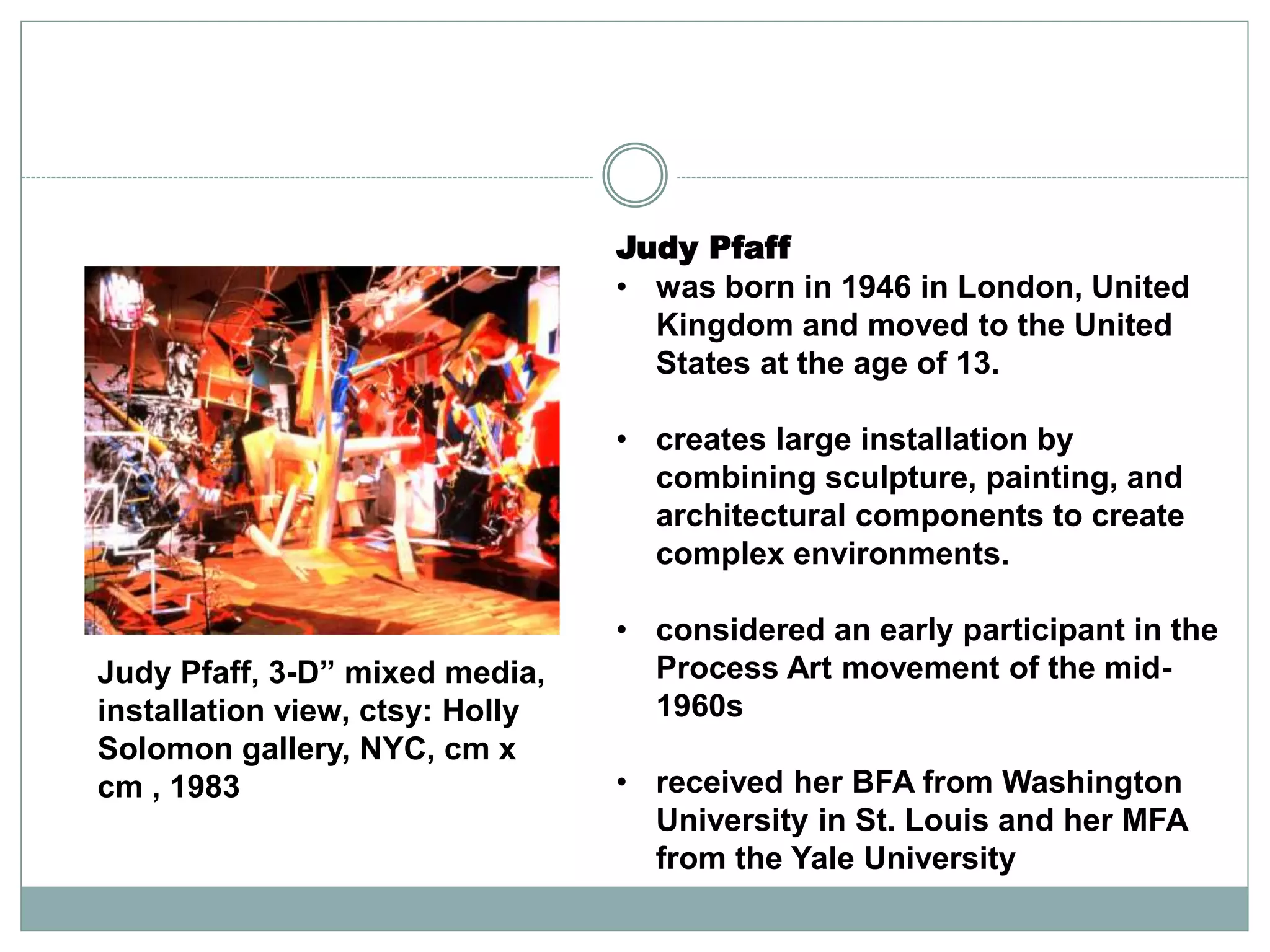
Judy Pfaff
• was born in 1946 in London, United
Kingdom and moved to the United
States at the age of 13.
• creates large installation by
combining sculpture, painting, and
architectural components to create
complex environments.
• considered an early participant in the
Process Art movement of the mid-
1960s
• received her BFA from Washington
University in St. Louis and her MFA
from the Yale University
Judy Pfaff, 3-D” mixed media,
installation view, ctsy: Holly
Solomon gallery, NYC, cm x
cm , 1983
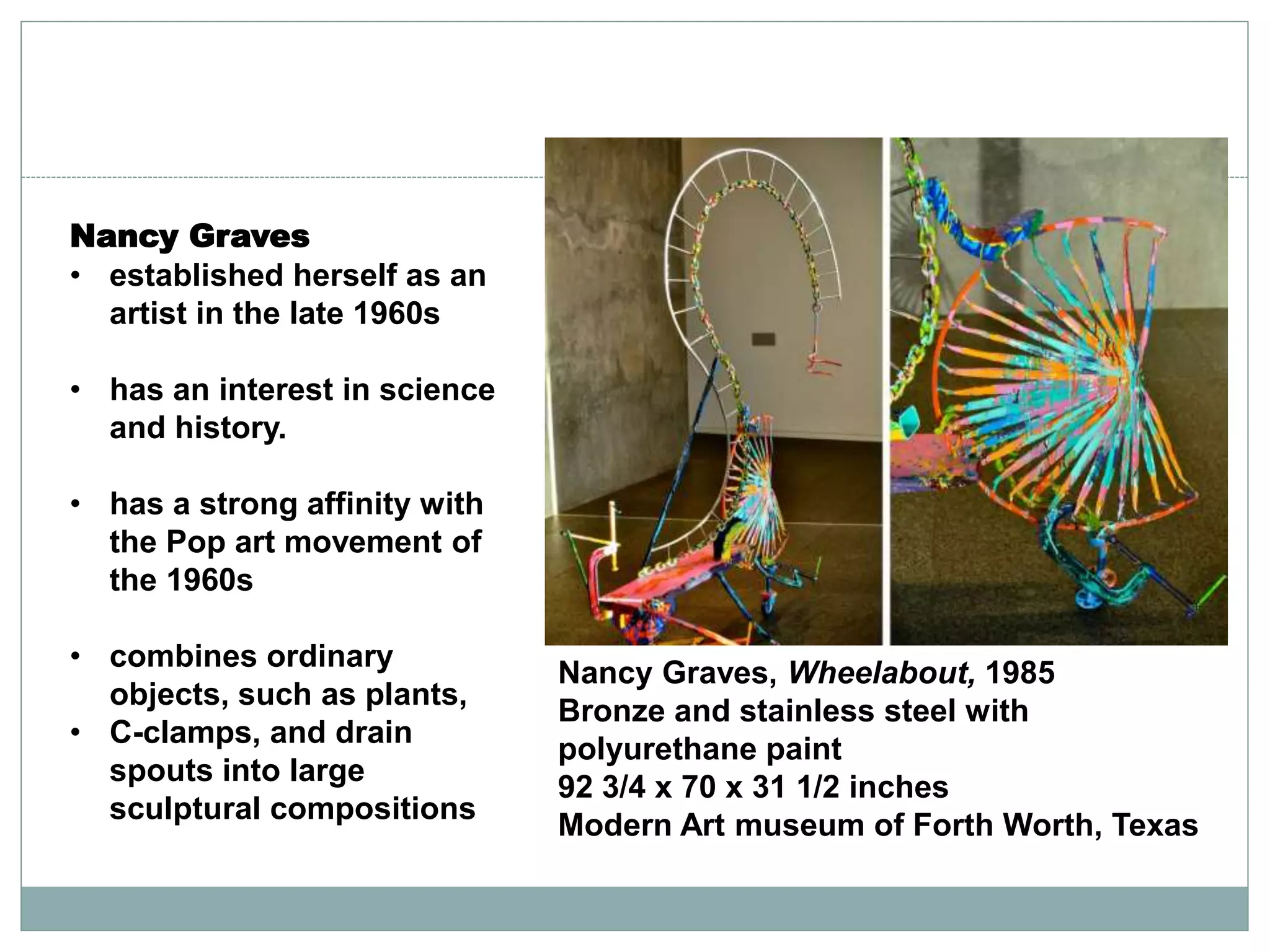
Nancy Graves
• established herself as an
artist in the late 1960s
• has an interest in science
and history.
• has a strong affinity with
the Pop art movement of
the 1960s
• combines ordinary
objects, such as plants,
• C-clamps, and drain
spouts into large
sculptural compositions
Nancy Graves, Wheelabout, 1985
Bronze and stainless steel with
polyurethane paint
92 3/4 x 70 x 31 1/2 inches
Modern Art museum of Forth Worth, Texas
Donald Lipski
• is a sculptor living and working in
Philadelphia since 2006.
• is best known for altering of
found objects to create poetic
artworks
• has in recent years created many
public sculptures.
• focusses on sculptural
explorations of landscape and
interior space;
Donald Lipski. The Starry
Night, Razor blades on wall
Installation at the Capp Street
Project, San Francisco 1994
Representing Art History
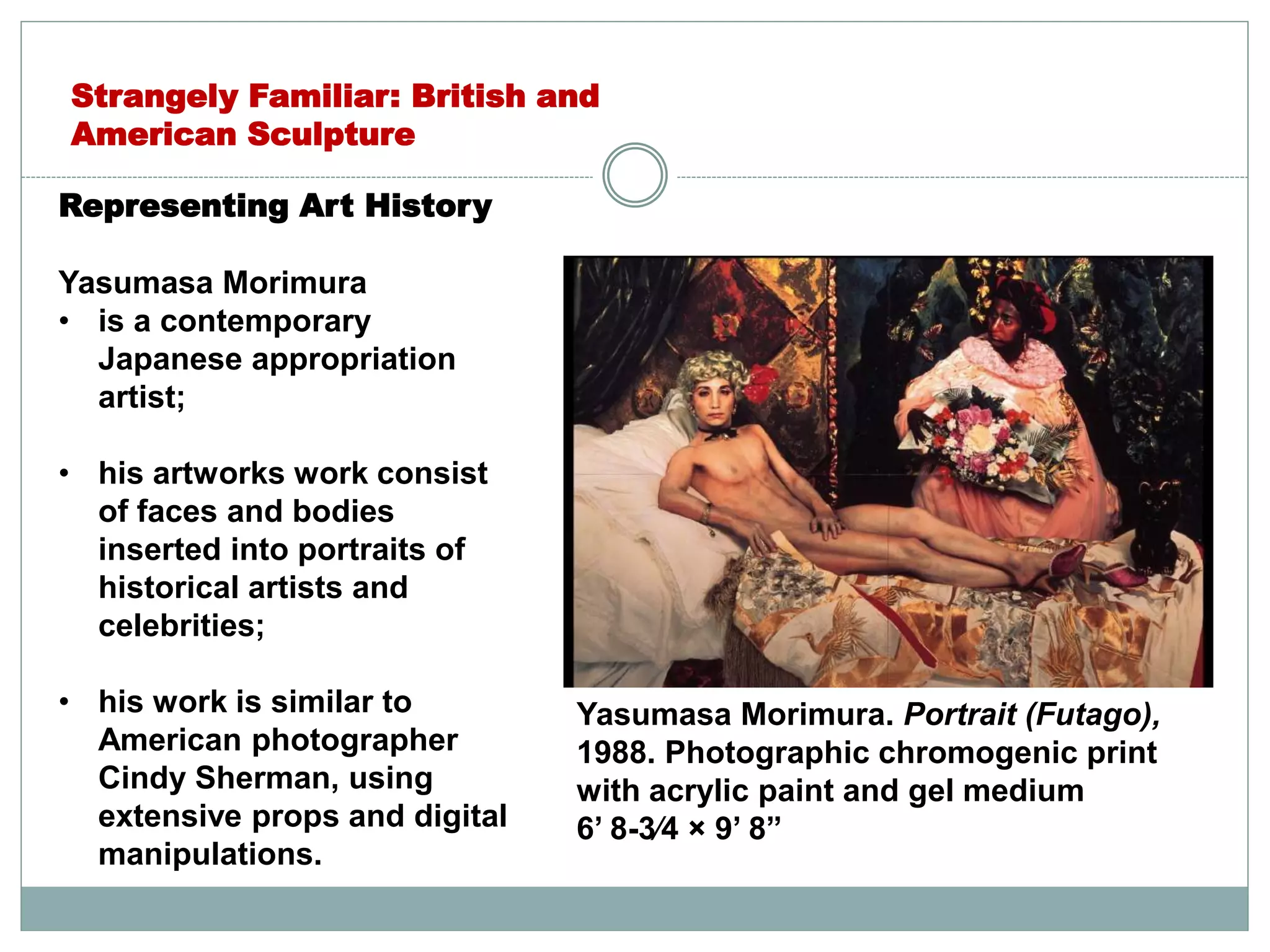
Yasumasa Morimura
• is a contemporary
Japanese appropriation
artist;
• his artworks work consist
of faces and bodies
inserted into portraits of
historical artists and
celebrities;
• his work is similar to
American photographer
Cindy Sherman, using
extensive props and digital
manipulations.
Strangely Familiar: British and
American Sculpture
Yasumasa Morimura. Portrait (Futago),
1988. Photographic chromogenic print
with acrylic paint and gel medium
6’ 8-3⁄4 × 9’ 8”
Anxiety and Artistic Influence
Matthew Barney
• was born in San Francisco in 1967;
he is a sculptor and filmmaker;
• is best known as the producer and
creator of the Cremaster films, a
series of five works created out of
sequence
• The films generally feature Barney in
different roles, including characters
as a magician, Harry Houdini, and
the infamous murderer Gary Gilmore.
Matthew Barney. “The
Apprentice,” Cremaster 3
2002. Video to film
transfer 182 mins.
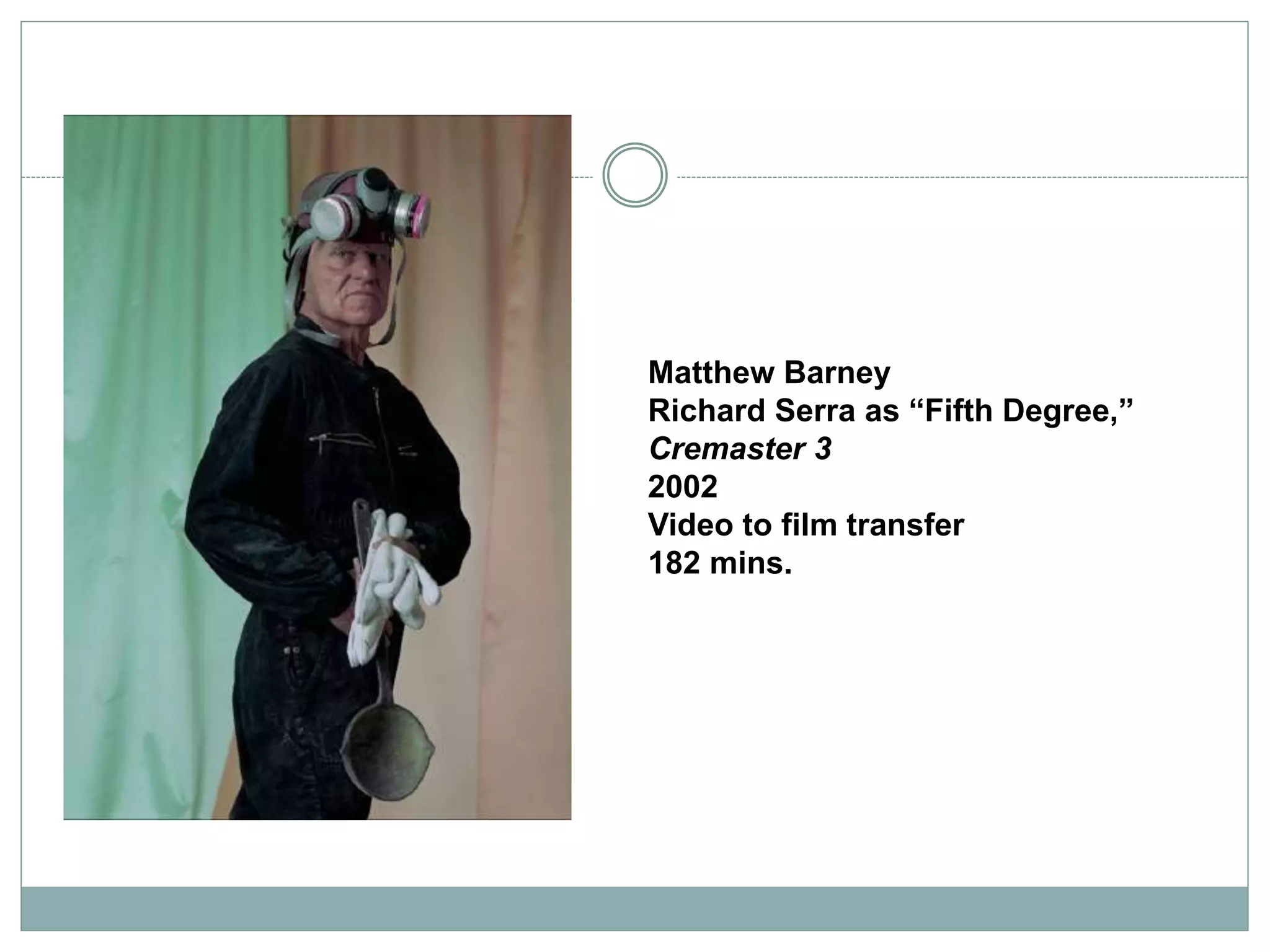
Matthew Barney
Richard Serra as “Fifth Degree,”
Cremaster 3
2002
Video to film transfer
182 mins.
Cutting Art History Down to
Size
Raymond Pettibon
• is a contemporary American
artist known for his stylized ink
drawings
• he combines images and text;
• blends historical content with
consumer culture as critiques of
contemporary society.
• uses comics, cartoons, and
other pop culture
iconographyas sources of
inspiration.
Raymond Pettibon,
No Title (Vavoom, you see...),
1989. 14 x 11 inches
DIY In the Artist’s Studio
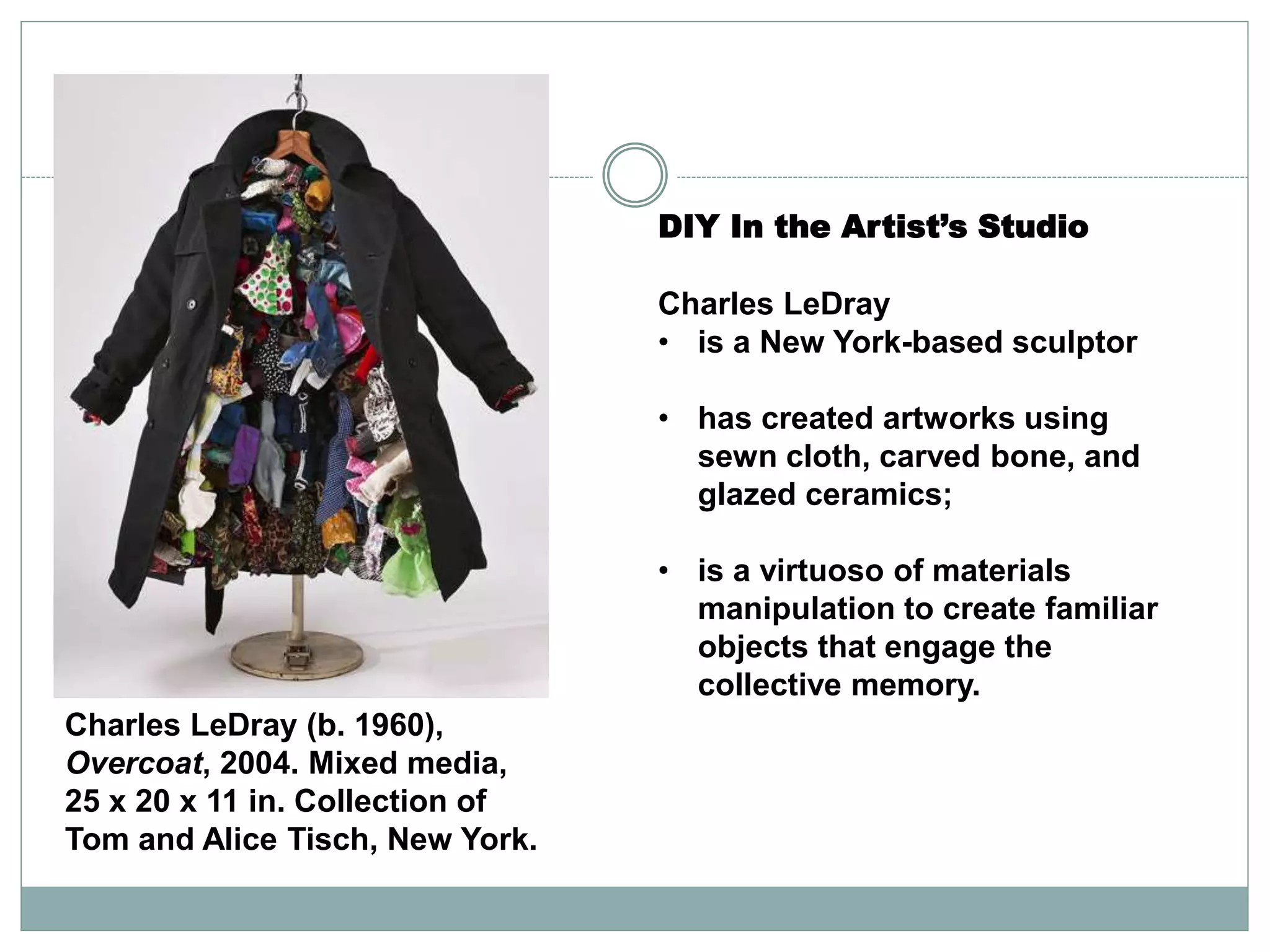
Charles LeDray
• is a New York-based sculptor
• has created artworks using
sewn cloth, carved bone, and
glazed ceramics;
• is a virtuoso of materials
manipulation to create familiar
objects that engage the
collective memory.
Charles LeDray (b. 1960),
Overcoat, 2004. Mixed media,
25 x 20 x 11 in. Collection of
Tom and Alice Tisch, New York.
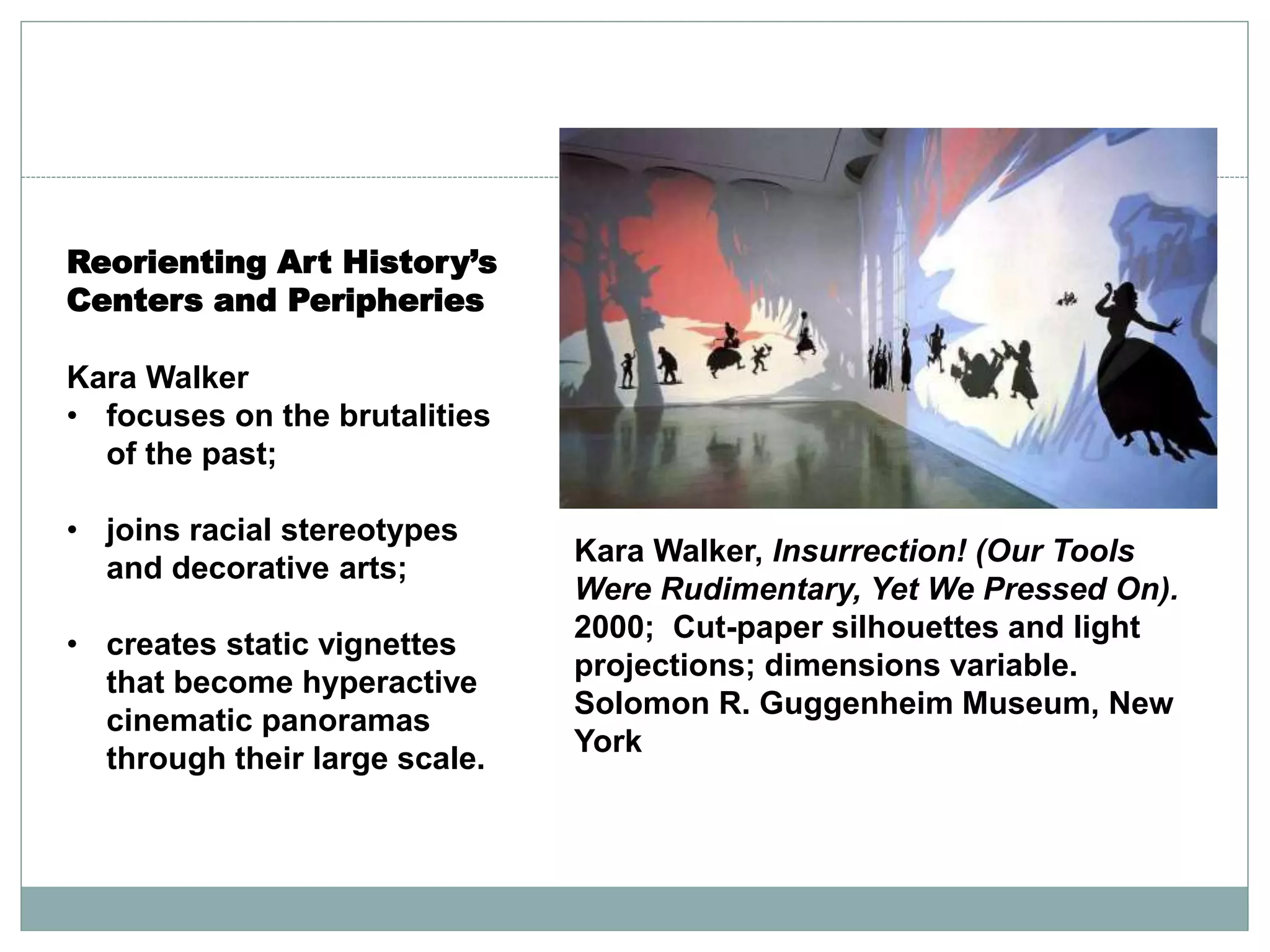
Reorienting Art History’s
Centers and Peripheries
Kara Walker
• focuses on the brutalities
of the past;
• joins racial stereotypes
and decorative arts;
• creates static vignettes
that become hyperactive
cinematic panoramas
through their large scale.
Kara Walker, Insurrection! (Our Tools
Were Rudimentary, Yet We Pressed On).
2000; Cut-paper silhouettes and light
projections; dimensions variable.
Solomon R. Guggenheim Museum, New
York
New Perspectives on
Childhood and Identity
Sally Mann
• incorporates black and white
photographs of her children,
which are presented with
“ordinary moments of
childhood, suspended in time
and transformed into aesthetic
objects, takes on a distorted,
even uncanny quality”
(Arnason and Mansfield 719).
• focuses on gender
assumptions
Sally Mann, The New Mothers, 1989
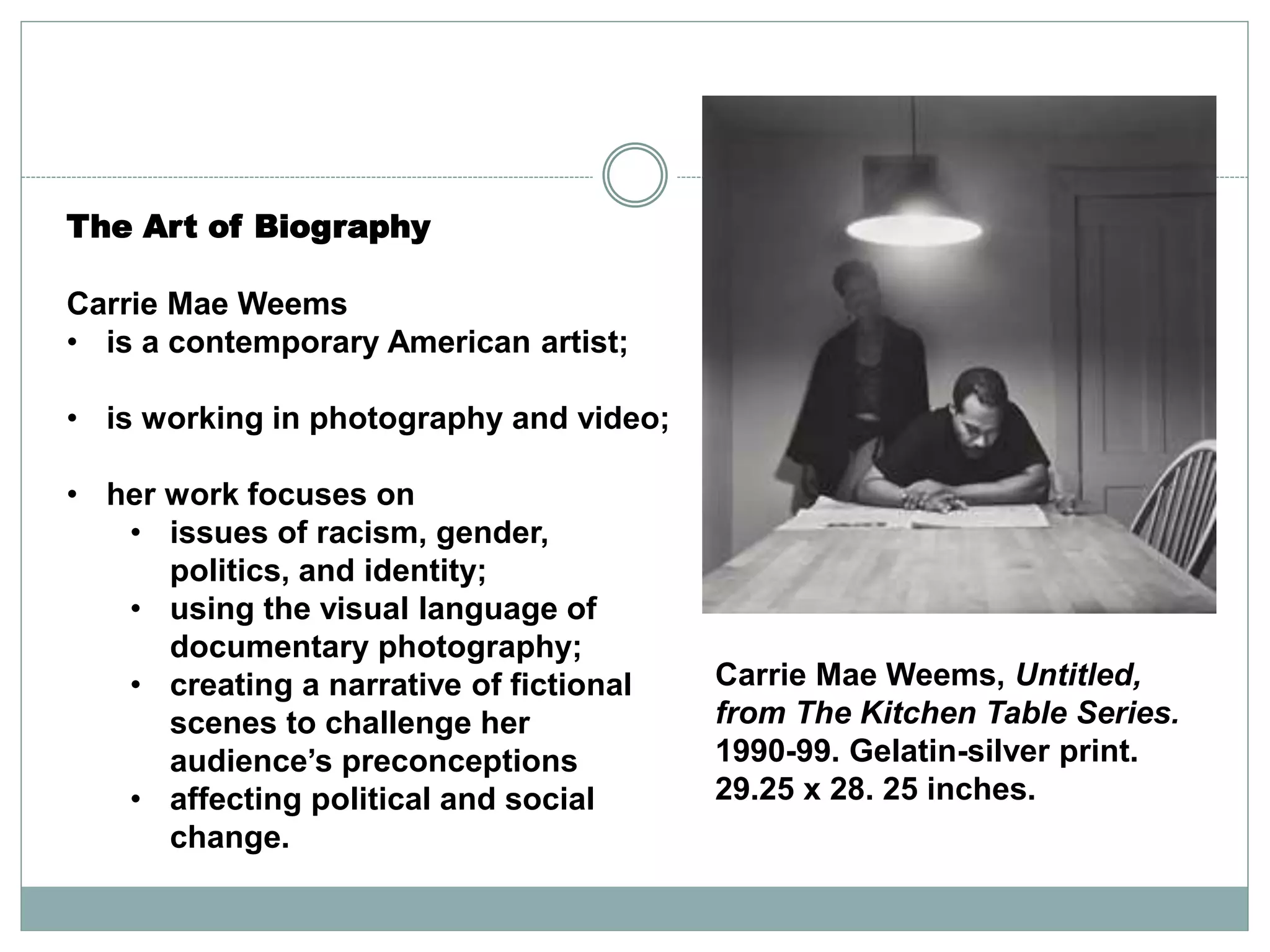
The Art of Biography
Carrie Mae Weems
• is a contemporary American artist;
• is working in photography and video;
• her work focuses on
• issues of racism, gender,
politics, and identity;
• using the visual language of
documentary photography;
• creating a narrative of fictional
scenes to challenge her
audience’s preconceptions
• affecting political and social
change.
Carrie Mae Weems, Untitled,
from The Kitchen Table Series.
1990-99. Gelatin-silver print.
29.25 x 28. 25 inches.
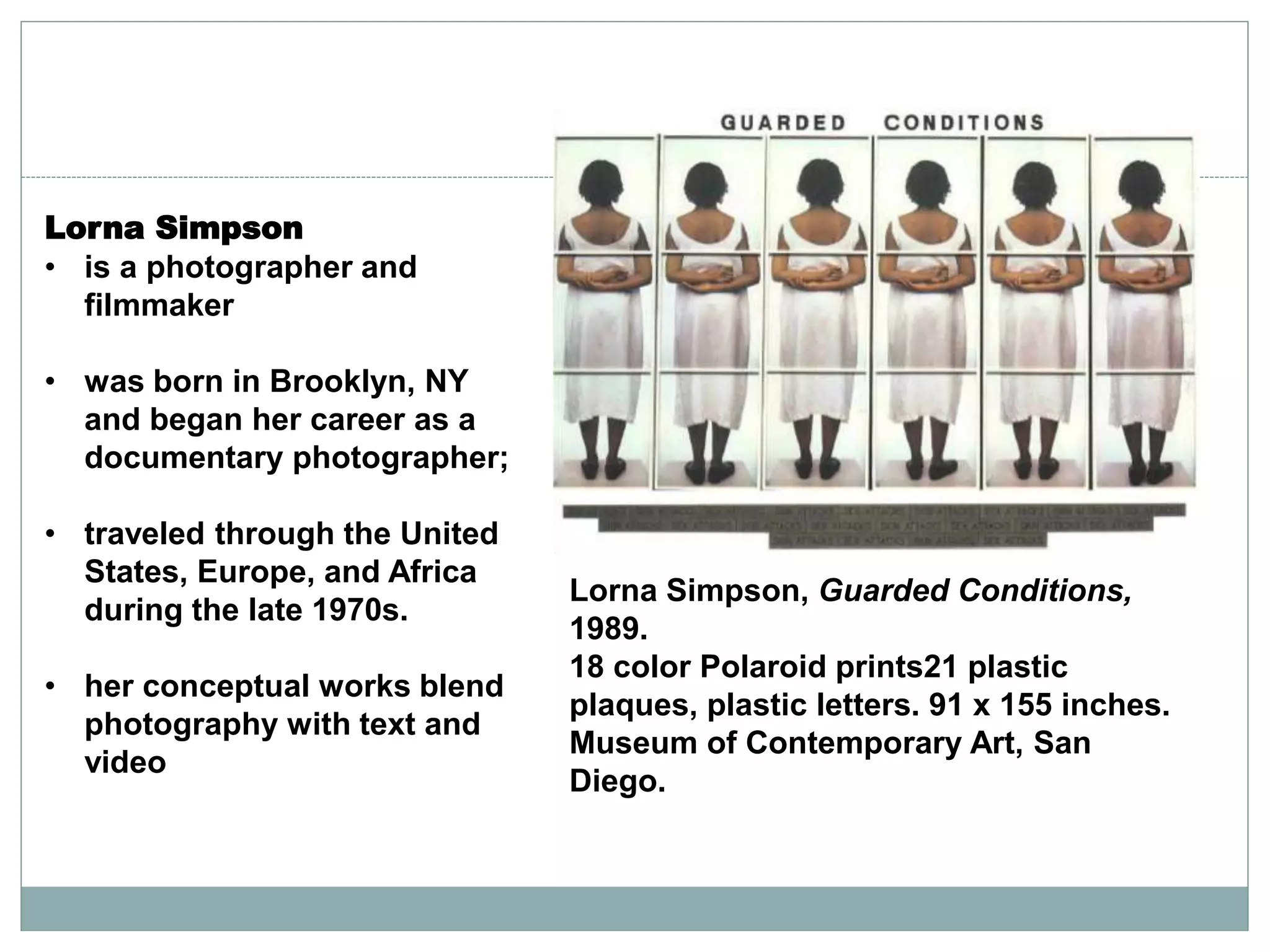
Lorna Simpson
• is a photographer and
filmmaker
• was born in Brooklyn, NY
and began her career as a
documentary photographer;
• traveled through the United
States, Europe, and Africa
during the late 1970s.
• her conceptual works blend
photography with text and
video
Lorna Simpson, Guarded Conditions,
1989.
18 color Polaroid prints21 plastic
plaques, plastic letters. 91 x 155 inches.
Museum of Contemporary Art, San
Diego.
Nan Goldin
• is a photographer known for her
candid portraiture;
• Her subjects are captured many
times putting on makeup or
clothes in front of a mirror;
• creates images that act as a
visual autobiography
documenting herself and those
closest to her,;
• is Influenced by the fashion
photography she saw in
magazines.
Nan Goldin, C Putting on Her
Make-Up at the Second Tip,
Bangkok, 1992. Cibachrome
print, 30” x 40”. Edition of 15.
Jonathan Lasker
• abstract painter best known for
incorporating biomorphic shapes and
geometric patterns, in his artworks
Roni Horn
• is well known for her text-based
sculptures and rubber floor
installations
• explores the poems of Emily
Dickinson
Fiona Rae
• is a British painter known for her
work involving
• abstract forms in bright colors,
• and psychedelic designs
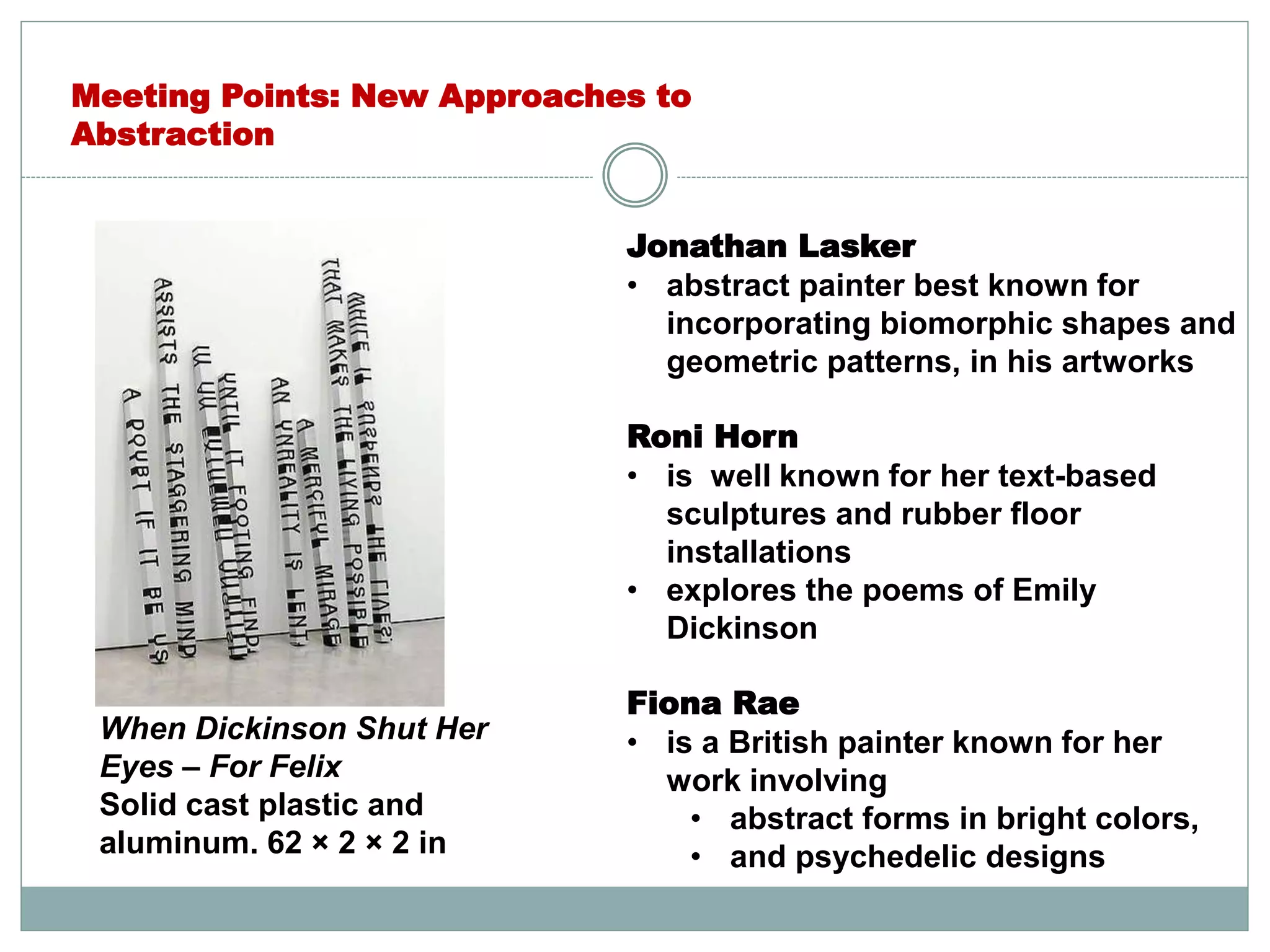
Meeting Points: New Approaches to
Abstraction
When Dickinson Shut Her
Eyes – For Felix
Solid cast plastic and
aluminum. 62 × 2 × 2 in

Chapter 26 - New Perspectives on Art and Audience

  • 1.
  • 2.
    Jeff Koons Pink Panther,1988. Porcelain Commodity Art Jeff Koons • became a Wall Street commodities broker to support his art-making. • he is the artist who reinvented Duchamp’s readymades for the consumer age, and as a result he constantly is involved in high-profile copyright cases. • Koons took Duchmap’s concept to whole ne level when he created a factory-scale art production company to make his art that also made him super rich. • He is also known as the maker of some of the most genuinely perplexing works of art out there.
  • 3.
    Jeff Koons. MichaelJackson and Bubbles, 1988. Porcelain, 3’ 6” × 5’ 10-1⁄2” × 2’ 8-1⁄2”. Sonnabend Gallery, NY. Jeff Koons is often portrayed as the contemporary art world’s supreme operator, in the tradition of Duchamp and Warhol: “provocative, consistently self-referential icon who seems to both embody and parody the art world’s worst excesses and to stay one jump ahead of his audience’s expectations at all times.”(Robert Ayres, Art Info 2008)
  • 4.
    Heim Steinbach • knownfor his arrangements of found objects on shelves; • works in the tradition of Marcel Duchamp; • explores the role of the artist as a collector and curator of cultural artifacts; • “We communicate through objects just as we communicate through language,” he has explained. • “We see objects, we have feelings about them, and we feel them when we touch them.” (Heim Steinbach). Heim Steinbach, Ultra Red #2. 1986. Mixed media.63 x 76 x 19 inches. Sonnabend Galelry, New York, NY.
  • 5.
    Damien Hirst The PhysicalImpossibility of Death in the Mind of Someone Living, 1991 Tiger shark in a glass tank of formaldehyde. Damien Hirst • stands out of all “young British sculptors”. • was born in Bristol in 1965 and grew up in Leeds. • was not an academic student, he failed most of his exams. • studied at the Leeds College of Art and Design although he was rejected on his first application. • while he was a student, he worked in a mortuary which influenced his interest in the theme of death.
  • 6.
    Damien Hirst For theLove of God (2007). the only surviving human part of the original is the teeth. The piece is a platinum cast of an 18th century human skull covered in £15,000,000 worth of diamonds. • Hirst is a leading member of the UK postmodernist art group known as Young British Artists. • He jolted the artworld in the 1990s with his series of dead animals preserved and floating in formaldehyde. • Influenced by Francis Bacon, his most famous works of avant-garde art include A Thousand Years (1989), a glass case with maggots and flies feeding off a rotting cow's head. • Another important piece is The Physical Impossibility of Death in the Mind of Someone Living (1991), a tiger shark in a glass tank of formaldehyde
  • 7.
    CoLab, Ahearn, andOsorio Colab • is the abbreviation of the New York City artists' group Collaborative Projects; • Included artists of various disciplines. The artists who came together to form Collaborative Projects Inc., NYC (aka Colab) in the late 1970s/early 1980s are: • John Ahearn, • Charlie Ahearn, • Diego Cortez, • Jane Dickson, • Jenny Holzer, • Joe Lewis, • James Nares, • Tom Otterness, • Kiki Smith, • Betsy Sussler Postmodern Arenas
  • 8.
    Ilya Kabakov The ManWho Flew Into Space From His Apartment, 1981-88. Mixed media Ilya Kabakov • born in 1933, is an American conceptual artist of Russian- Jewish origin. • When WWII broke out, Ilya’s Jewish family was forced to evacuate to Uzbekistan. • Kabakov worked in Moscow from the 1950s until the late 1980s. • His exhibitions were small and risky because the Soviet government did not tolerate art. • Kabakov now resides in Long Island.
  • 9.
    • The ManWho Flew Into Space From His Apartment is one of Ilya Kabakov’s most famous installations. • The installation, presents a fictitious hero, one who did the impossible and flew alone into outer space. • The hero felt so alone, one day he used a makeshift slingshot, and flew through the ceiling of his apartment. • The depressing room and primitive catapult unveil the truth behind the Soviet utopia of cosmic visions and political goals as being indestructible. Ilya Kabakov, The Man Who Flew Into Space From His Apartment, 1980. Mixed media
  • 10.
    • Kabakov usedfictional biographies, mostly inspired by his own life, in trying to understand the rise and fall of the Soviet Union. • Many of Ilya Kabakov installations during the 1990s appear as "metasystems" of Soviet civilization in the form of metaphor, as in "The Red Pavilion" (Russian Pavilion of Venice Biennale, 1993). • Despite the metaphoric starting point of many of Kabakov’s installations, and despite their roots in Soviet culture, they acquire other universal meanings. Ilya Kabakov. The Red Pavilion, 1993. Mixed media
  • 11.
    Christian Boltanski Untitled, 1988.Mixed media Christian Boltanski • was born Sept 6, 1944, Paris, France. He lives and works in Malakoff near Paris. • his dominant theme is his own life story, both actual and reinvented, which he tells through collections of photographs and objects. Since the 1960s, he worked with the ephemera of the human experience. Artworks in his signature style include obituary photographs and lights.
  • 12.
    Viola • video andinstallation artist known for exploring themes of existential introspection; • considered a pioneer of new media art • is interested in technology as a means to convey his ideas; • pursues timeless themes like birth, death, and extremes of emotion. Bill Viola. The Theater of Memory, 1985. Video/sound installation. Orange County Museum of Art, California
  • 13.
    Tony Cragg • madeartworks installed on the floor and wall reliefs out of broken pieces of found broken objects; • focuses on how materials and forms affect our ideas and emotions; • does not imitate nature; he is concerned with why things look like they do and why they are as they are. Strangely Familiar: British and American Sculpture Tony Cragg, Britain Seen From the North, 1981;
  • 14.
    Richard Deacon • contemporaryWelsh artist with an interest in the process of fabricating shapes with visible structures; • known for his writhing abstract drawings and sculptures. • works with a variety of materials, including steel, wood, ceramic, vinyl, and foam,Richard Deacon, Tall Tree in the Year, 1984. Galvanized steel, laminated wood, canvas 123 5/8 x 98 ½ inches. Private collection, London
  • 15.
    Martin Puryear • combinesabstraction with traditional woodworking techniques; • creates metaphical works which explore the subtleties of culture and identity; • After completing his studies in United States, he went to study at the Royal Swedish Academy of Arts in Stockholm • there he focused on the austere aesthetics of modern design. Martin Puryear, Old Mole, 1985. 5 feet 1 inches × 5 feet 1 inches × 2 feet 10 inches. Philadelphia Museum of Art.
  • 16.
    Judy Pfaff • wasborn in 1946 in London, United Kingdom and moved to the United States at the age of 13. • creates large installation by combining sculpture, painting, and architectural components to create complex environments. • considered an early participant in the Process Art movement of the mid- 1960s • received her BFA from Washington University in St. Louis and her MFA from the Yale University Judy Pfaff, 3-D” mixed media, installation view, ctsy: Holly Solomon gallery, NYC, cm x cm , 1983
  • 17.
    Nancy Graves • establishedherself as an artist in the late 1960s • has an interest in science and history. • has a strong affinity with the Pop art movement of the 1960s • combines ordinary objects, such as plants, • C-clamps, and drain spouts into large sculptural compositions Nancy Graves, Wheelabout, 1985 Bronze and stainless steel with polyurethane paint 92 3/4 x 70 x 31 1/2 inches Modern Art museum of Forth Worth, Texas
  • 18.
    Donald Lipski • isa sculptor living and working in Philadelphia since 2006. • is best known for altering of found objects to create poetic artworks • has in recent years created many public sculptures. • focusses on sculptural explorations of landscape and interior space; Donald Lipski. The Starry Night, Razor blades on wall Installation at the Capp Street Project, San Francisco 1994
  • 19.
    Representing Art History YasumasaMorimura • is a contemporary Japanese appropriation artist; • his artworks work consist of faces and bodies inserted into portraits of historical artists and celebrities; • his work is similar to American photographer Cindy Sherman, using extensive props and digital manipulations. Strangely Familiar: British and American Sculpture Yasumasa Morimura. Portrait (Futago), 1988. Photographic chromogenic print with acrylic paint and gel medium 6’ 8-3⁄4 × 9’ 8”
  • 20.
    Anxiety and ArtisticInfluence Matthew Barney • was born in San Francisco in 1967; he is a sculptor and filmmaker; • is best known as the producer and creator of the Cremaster films, a series of five works created out of sequence • The films generally feature Barney in different roles, including characters as a magician, Harry Houdini, and the infamous murderer Gary Gilmore. Matthew Barney. “The Apprentice,” Cremaster 3 2002. Video to film transfer 182 mins.
  • 21.
    Matthew Barney Richard Serraas “Fifth Degree,” Cremaster 3 2002 Video to film transfer 182 mins.
  • 22.
    Cutting Art HistoryDown to Size Raymond Pettibon • is a contemporary American artist known for his stylized ink drawings • he combines images and text; • blends historical content with consumer culture as critiques of contemporary society. • uses comics, cartoons, and other pop culture iconographyas sources of inspiration. Raymond Pettibon, No Title (Vavoom, you see...), 1989. 14 x 11 inches
  • 23.
    DIY In theArtist’s Studio Charles LeDray • is a New York-based sculptor • has created artworks using sewn cloth, carved bone, and glazed ceramics; • is a virtuoso of materials manipulation to create familiar objects that engage the collective memory. Charles LeDray (b. 1960), Overcoat, 2004. Mixed media, 25 x 20 x 11 in. Collection of Tom and Alice Tisch, New York.
  • 24.
    Reorienting Art History’s Centersand Peripheries Kara Walker • focuses on the brutalities of the past; • joins racial stereotypes and decorative arts; • creates static vignettes that become hyperactive cinematic panoramas through their large scale. Kara Walker, Insurrection! (Our Tools Were Rudimentary, Yet We Pressed On). 2000; Cut-paper silhouettes and light projections; dimensions variable. Solomon R. Guggenheim Museum, New York
  • 25.
    New Perspectives on Childhoodand Identity Sally Mann • incorporates black and white photographs of her children, which are presented with “ordinary moments of childhood, suspended in time and transformed into aesthetic objects, takes on a distorted, even uncanny quality” (Arnason and Mansfield 719). • focuses on gender assumptions Sally Mann, The New Mothers, 1989
  • 26.
    The Art ofBiography Carrie Mae Weems • is a contemporary American artist; • is working in photography and video; • her work focuses on • issues of racism, gender, politics, and identity; • using the visual language of documentary photography; • creating a narrative of fictional scenes to challenge her audience’s preconceptions • affecting political and social change. Carrie Mae Weems, Untitled, from The Kitchen Table Series. 1990-99. Gelatin-silver print. 29.25 x 28. 25 inches.
  • 27.
    Lorna Simpson • isa photographer and filmmaker • was born in Brooklyn, NY and began her career as a documentary photographer; • traveled through the United States, Europe, and Africa during the late 1970s. • her conceptual works blend photography with text and video Lorna Simpson, Guarded Conditions, 1989. 18 color Polaroid prints21 plastic plaques, plastic letters. 91 x 155 inches. Museum of Contemporary Art, San Diego.
  • 28.
    Nan Goldin • isa photographer known for her candid portraiture; • Her subjects are captured many times putting on makeup or clothes in front of a mirror; • creates images that act as a visual autobiography documenting herself and those closest to her,; • is Influenced by the fashion photography she saw in magazines. Nan Goldin, C Putting on Her Make-Up at the Second Tip, Bangkok, 1992. Cibachrome print, 30” x 40”. Edition of 15.
  • 29.
    Jonathan Lasker • abstractpainter best known for incorporating biomorphic shapes and geometric patterns, in his artworks Roni Horn • is well known for her text-based sculptures and rubber floor installations • explores the poems of Emily Dickinson Fiona Rae • is a British painter known for her work involving • abstract forms in bright colors, • and psychedelic designs Meeting Points: New Approaches to Abstraction When Dickinson Shut Her Eyes – For Felix Solid cast plastic and aluminum. 62 × 2 × 2 in