1
Content
• Introduction
• What is Robotics
• History
• The Three Laws Of Robotics
• Why Robotics ?
• Types of ROBOTS
• Components of ROBOTS
• Advantages and Disadvantages
• Future Prospects
• Reference
2
3
Robotics is the branch
of mechanical engineering,
electrical
engineering and computer
science that deals with the
design, construction,
operation, and application
of robots, as well as
computer systems for their
control, sensory feedback,
and information processing.
4
HISTORY OF ROBOTICS
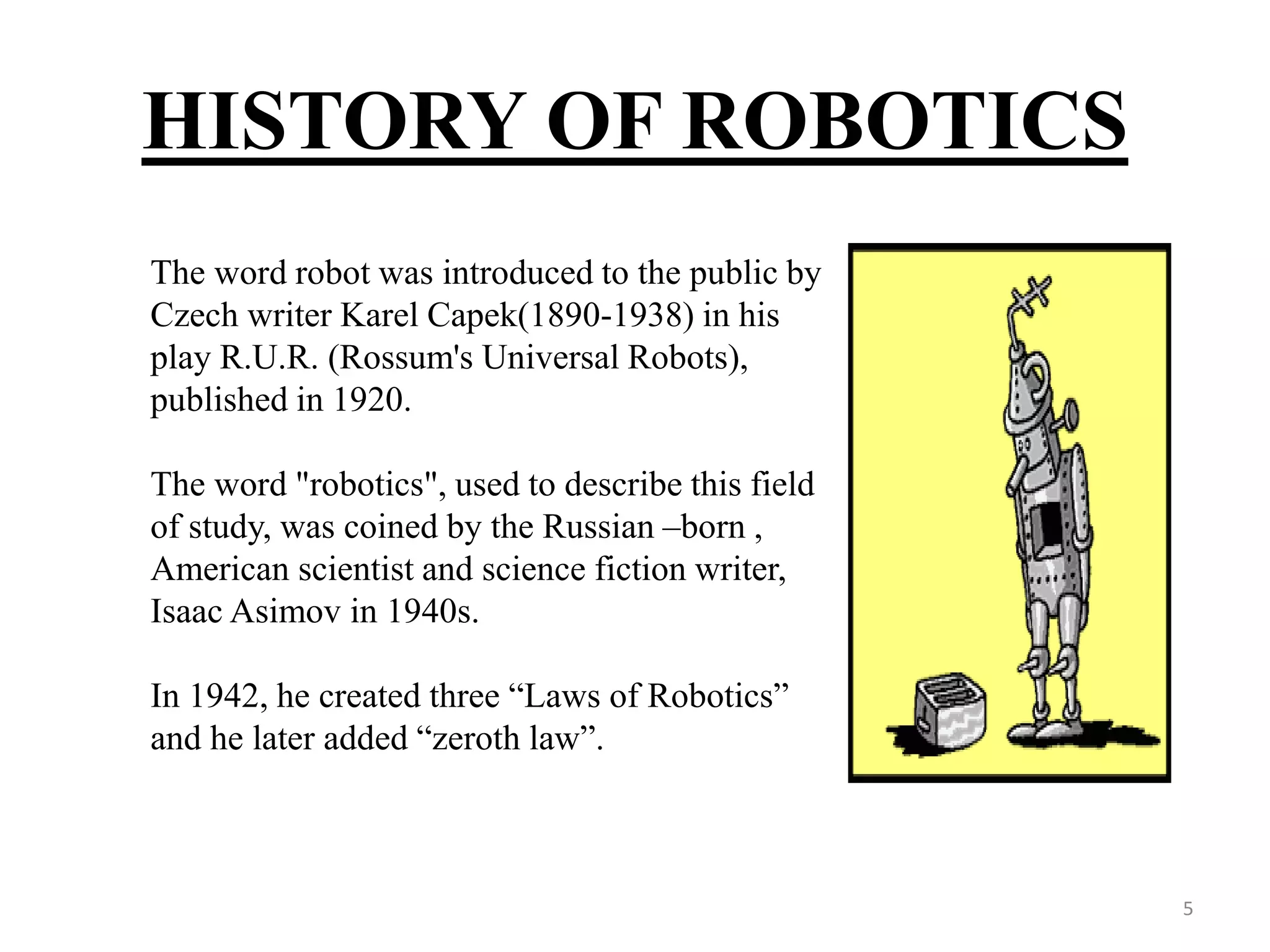
The word robot was introduced to the public by
Czech writer Karel Capek(1890-1938) in his
play R.U.R. (Rossum's Universal Robots),
published in 1920.
The word "robotics", used to describe this field
of study, was coined by the Russian –born ,
American scientist and science fiction writer,
Isaac Asimov in 1940s.
In 1942, he created three “Laws of Robotics”
and he later added “zeroth law”.
5
Zeroth Law : A robot may not injure humanity,
or, through inaction, allow humanity to come to
harm.
First Law : A robot may not injure a human
being, or, through inaction, allow a human being to
come to harm, unless this would violate a higher
order law
Second Law: A robot must obey orders given it
by human beings, except where such orders would
conflict with a higher order law
Third Law : A robot must protect its own
existence as long as such protection does not conflict
with a higher order law.
6
The First Robot
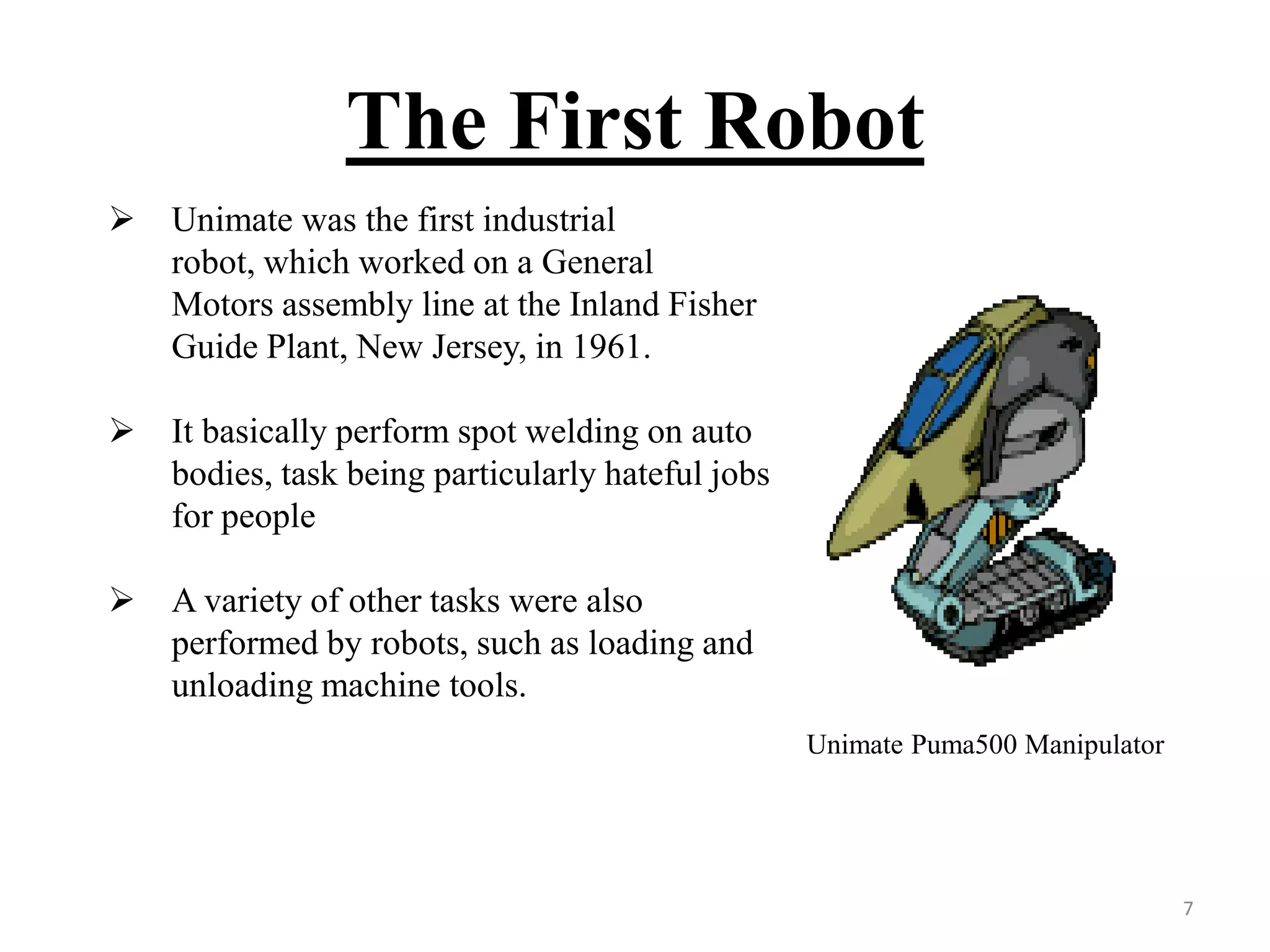
Unimate Puma500 Manipulator
 Unimate was the first industrial
robot, which worked on a General
Motors assembly line at the Inland Fisher
Guide Plant, New Jersey, in 1961.
 It basically perform spot welding on auto
bodies, task being particularly hateful jobs
for people
 A variety of other tasks were also
performed by robots, such as loading and
unloading machine tools.
7
Why Robotics ?
• Speed.
• It can work
hazardous/dangerous
environment.
• To perform repetitive task.
• Efficiency
• Accuracy
• Adaptability
8
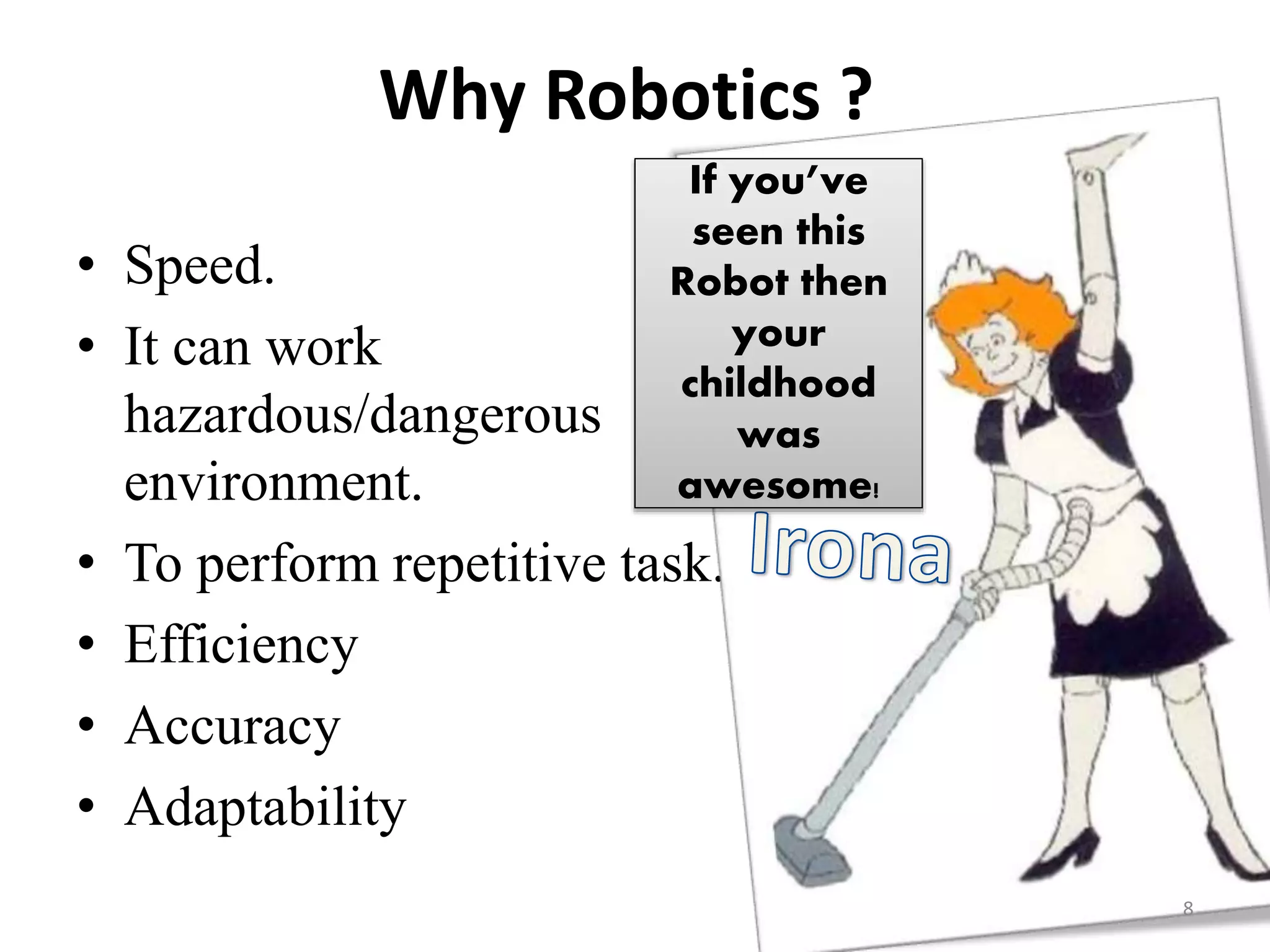
If you’ve
seen this
Robot then
your
childhood
was
awesome!
Types of Robots
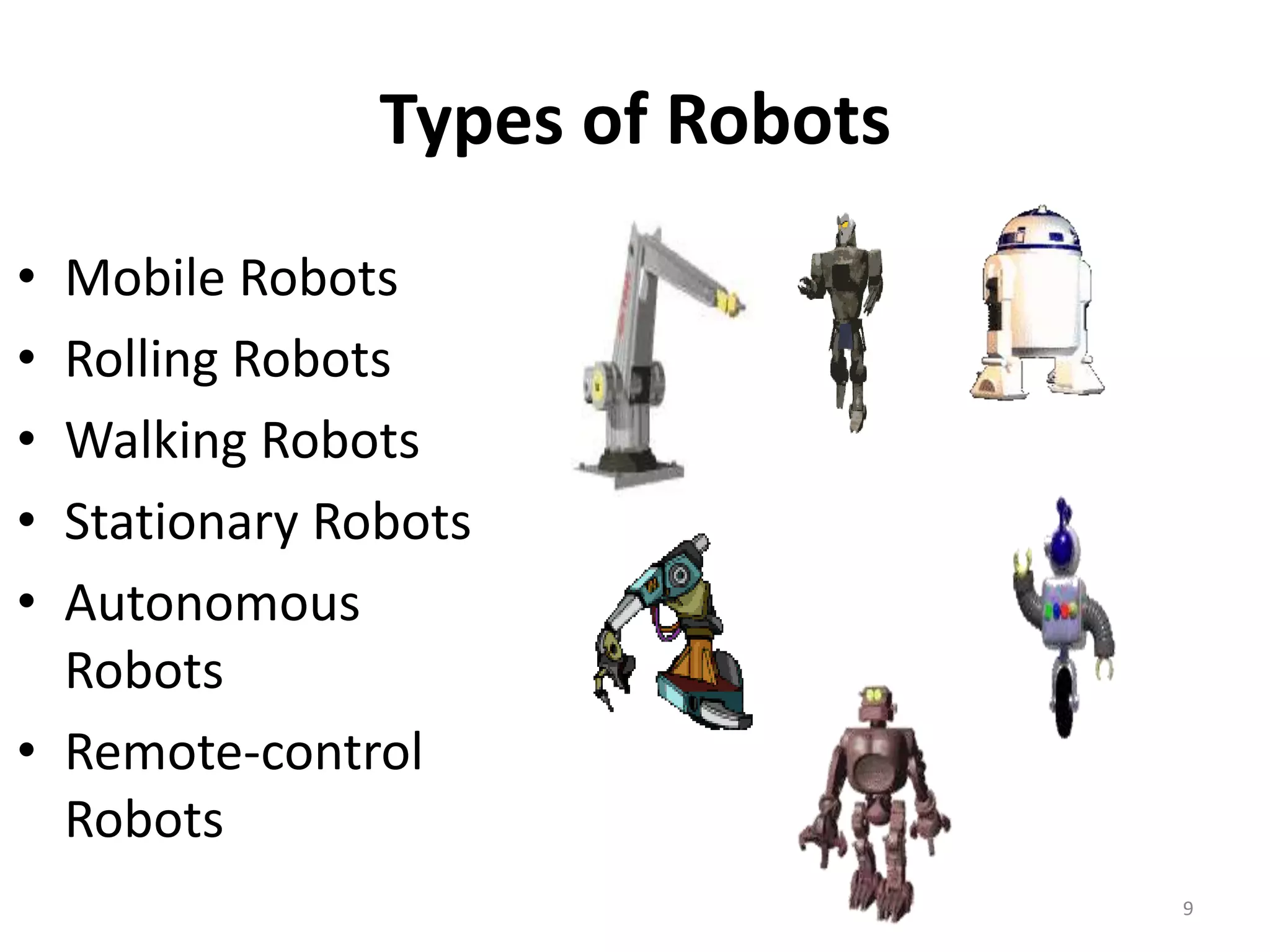
• Mobile Robots
• Rolling Robots
• Walking Robots
• Stationary Robots
• Autonomous
Robots
• Remote-control
Robots
9
Types of Robots
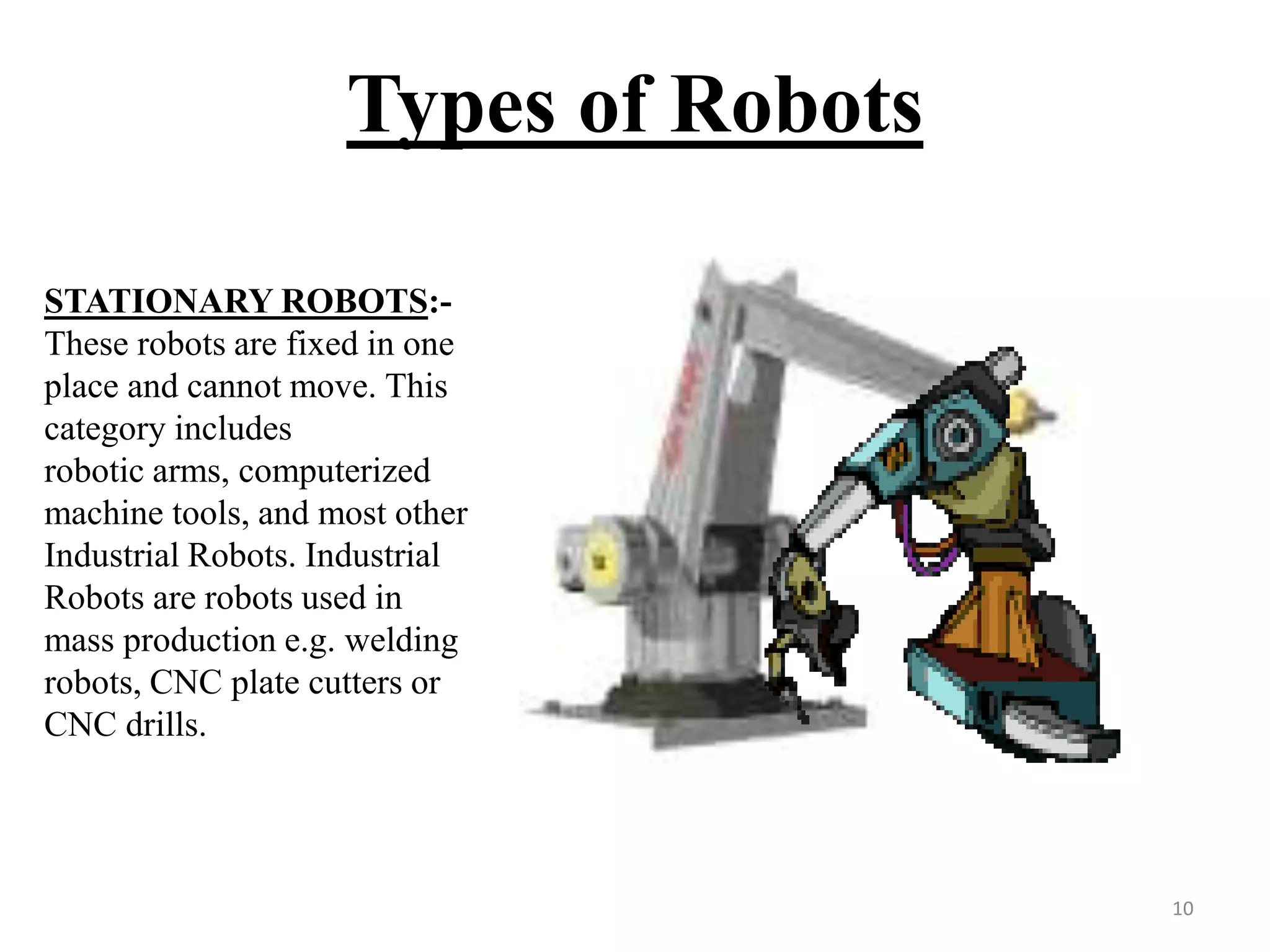
STATIONARY ROBOTS:-
These robots are fixed in one
place and cannot move. This
category includes
robotic arms, computerized
machine tools, and most other
Industrial Robots. Industrial
Robots are robots used in
mass production e.g. welding
robots, CNC plate cutters or
CNC drills.
10
MOBILE ROBOTS
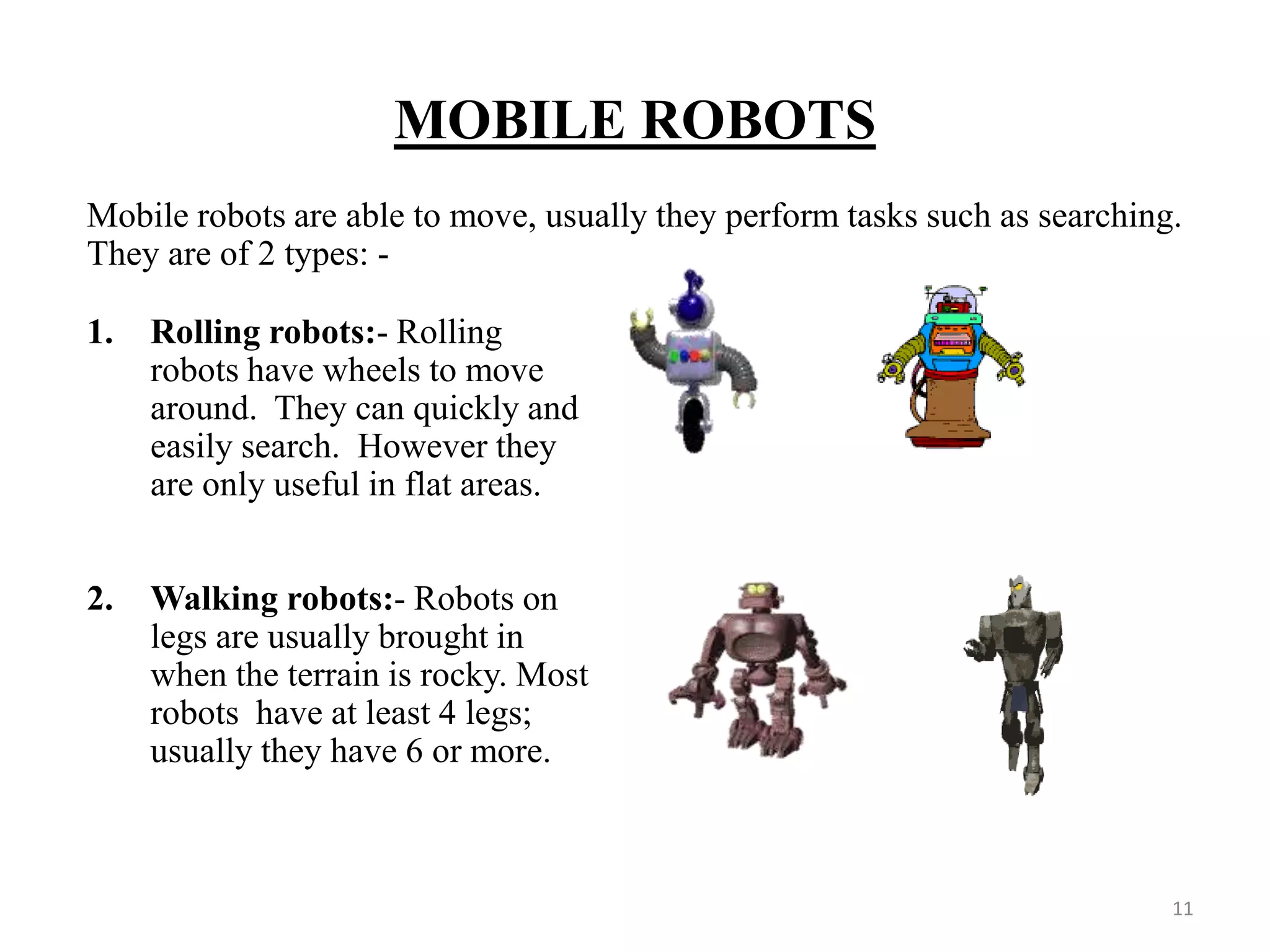
Mobile robots are able to move, usually they perform tasks such as searching.
They are of 2 types: -
1. Rolling robots:- Rolling
robots have wheels to move
around. They can quickly and
easily search. However they
are only useful in flat areas.
2. Walking robots:- Robots on
legs are usually brought in
when the terrain is rocky. Most
robots have at least 4 legs;
usually they have 6 or more.
11
AUTONOMOUS ROBOTS
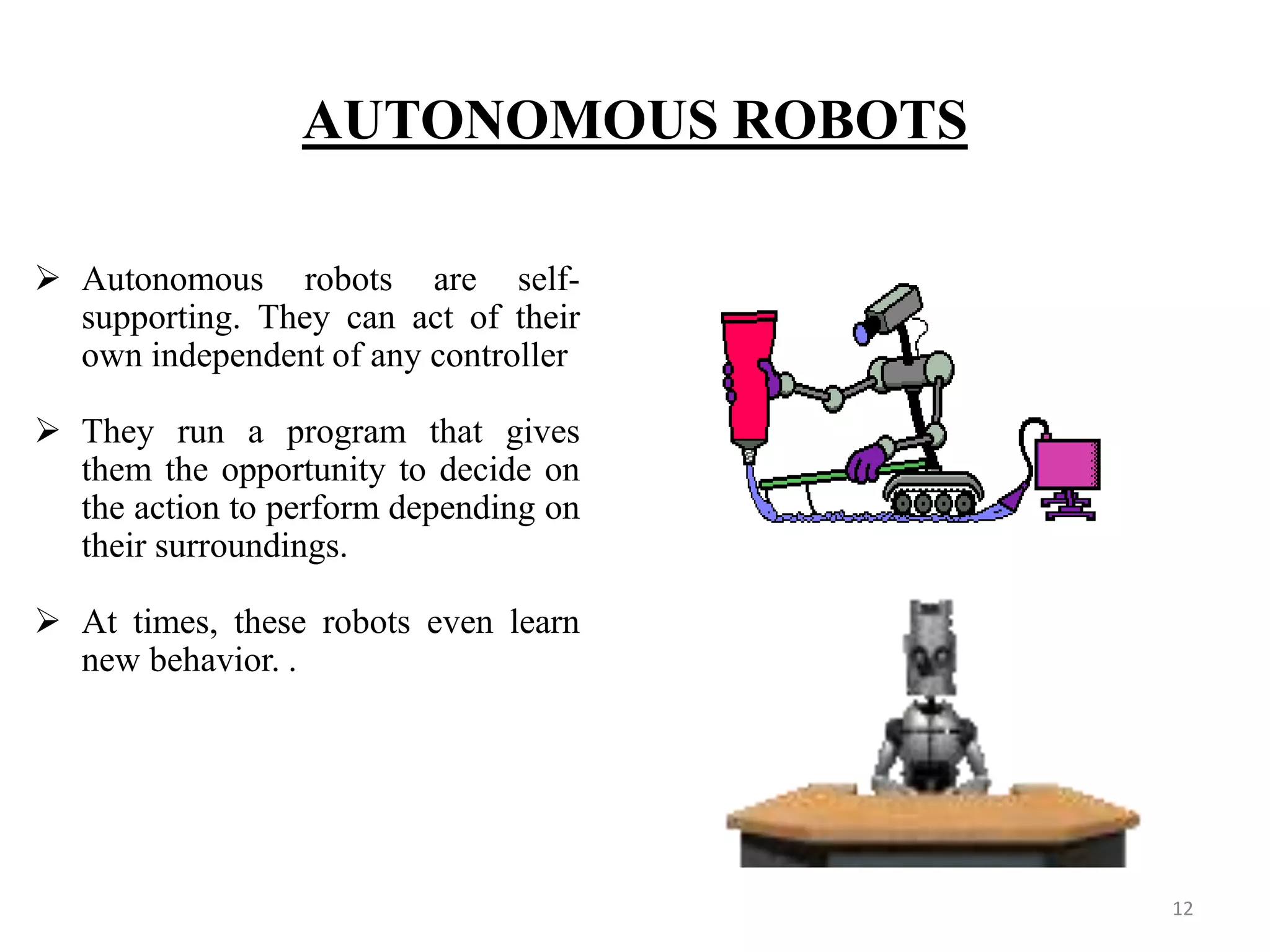
 Autonomous robots are self-
supporting. They can act of their
own independent of any controller
 They run a program that gives
them the opportunity to decide on
the action to perform depending on
their surroundings.
 At times, these robots even learn
new behavior. .
12
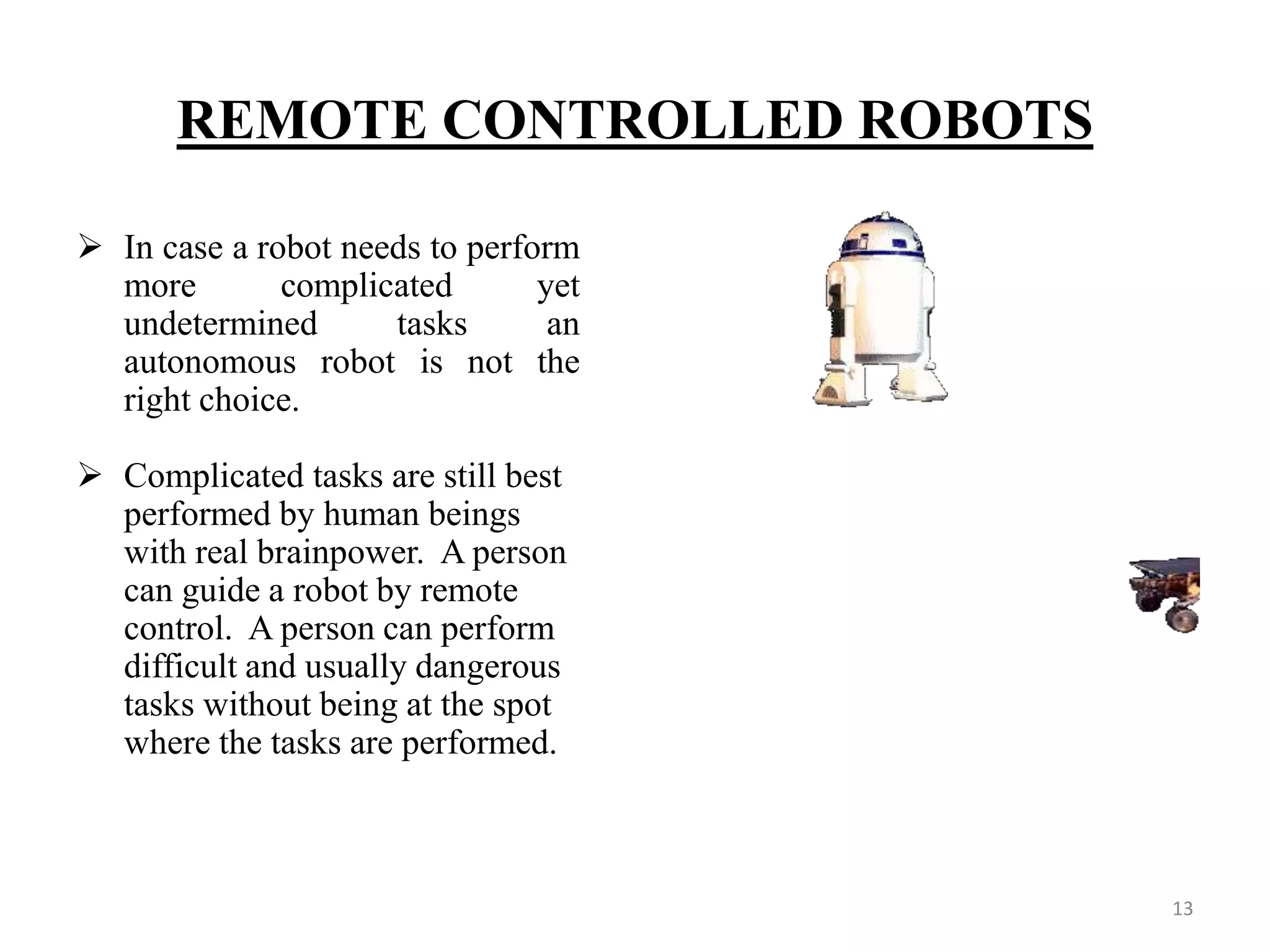
REMOTE CONTROLLED ROBOTS
 In case a robot needs to perform
more complicated yet
undetermined tasks an
autonomous robot is not the
right choice.
 Complicated tasks are still best
performed by human beings
with real brainpower. A person
can guide a robot by remote
control. A person can perform
difficult and usually dangerous
tasks without being at the spot
where the tasks are performed.
13
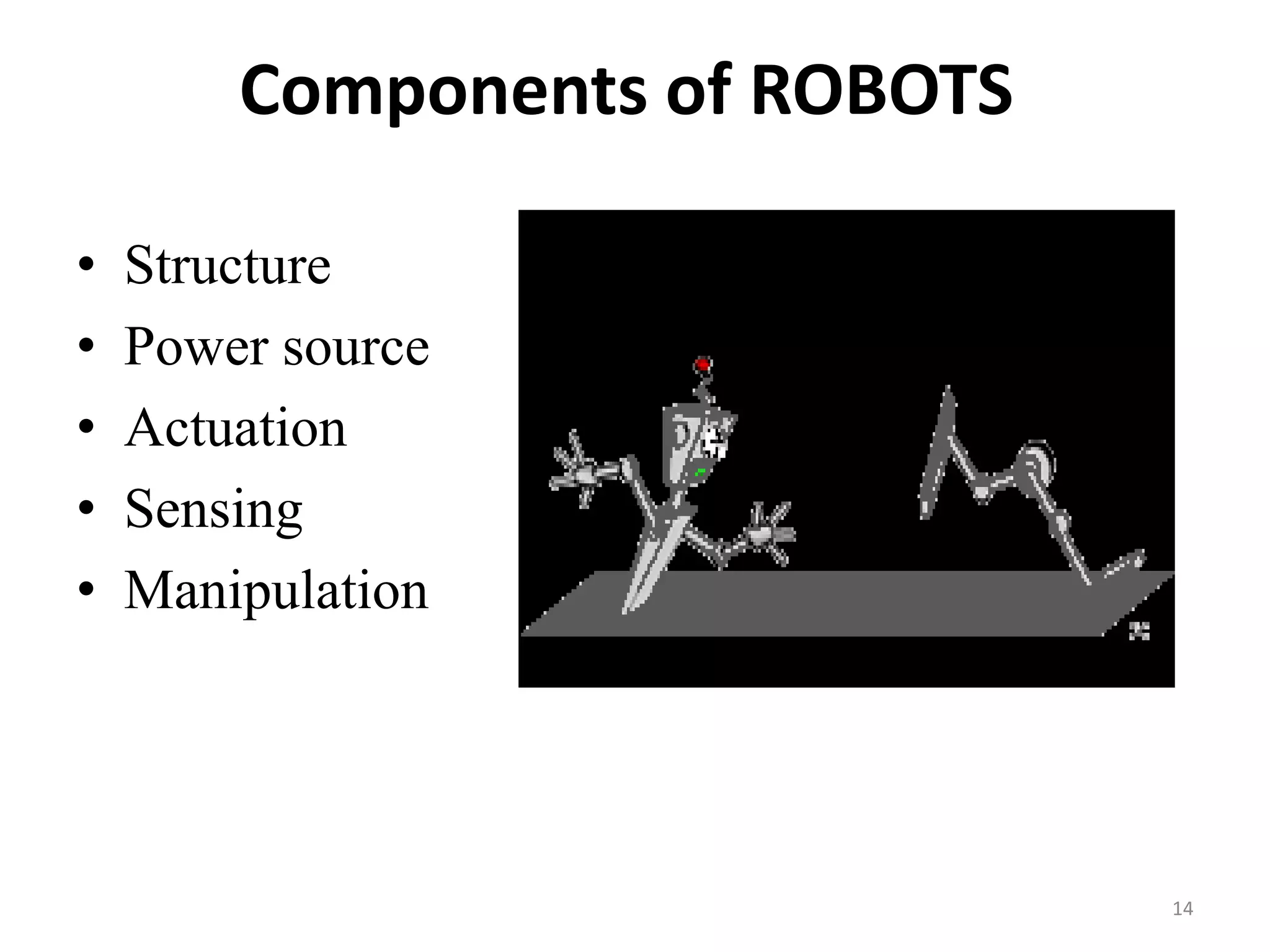
Components of ROBOTS
• Structure
• Power source
• Actuation
• Sensing
• Manipulation
14
Structure
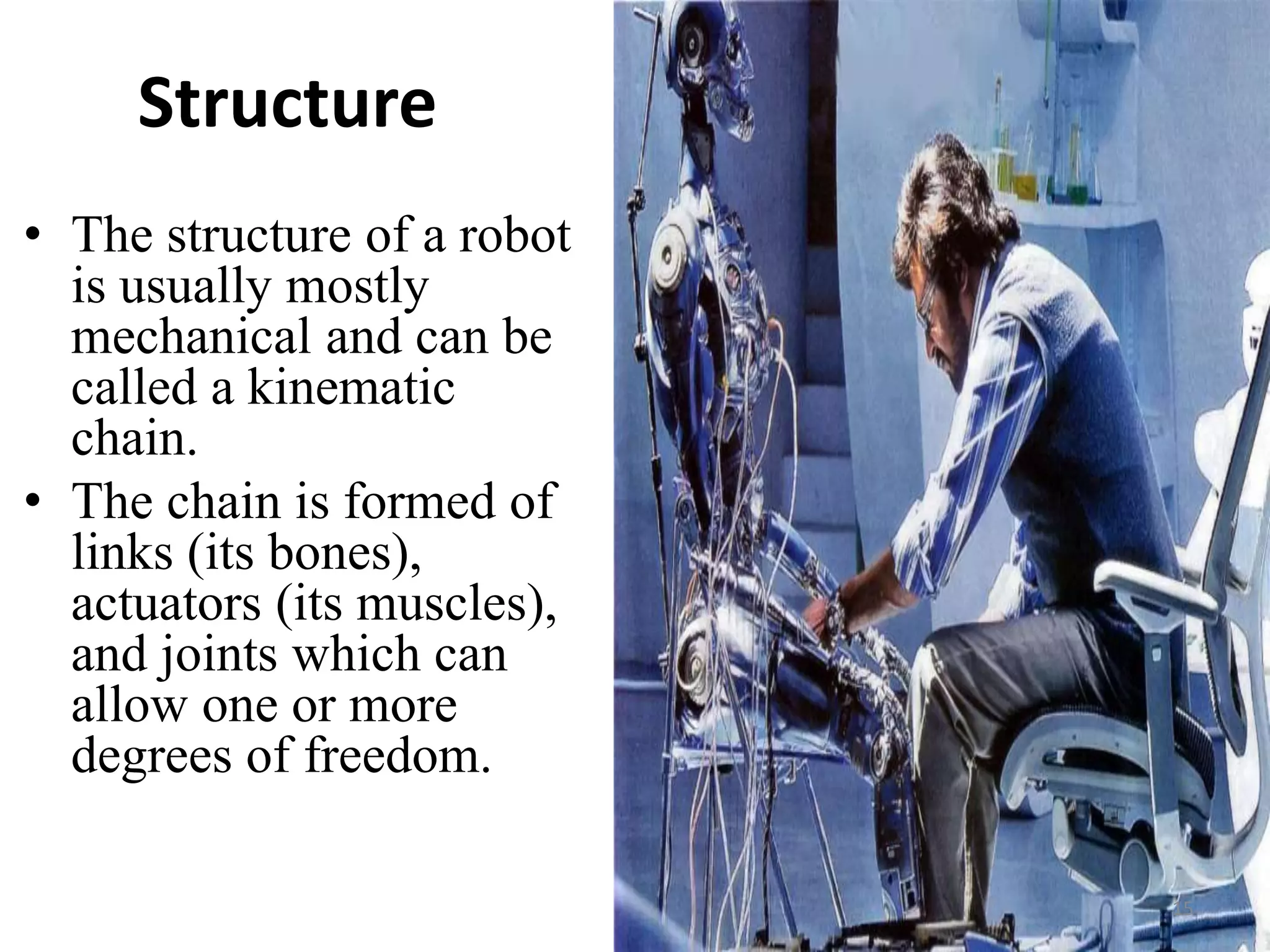
• The structure of a robot
is usually mostly
mechanical and can be
called a kinematic
chain.
• The chain is formed of
links (its bones),
actuators (its muscles),
and joints which can
allow one or more
degrees of freedom.
15
Power source
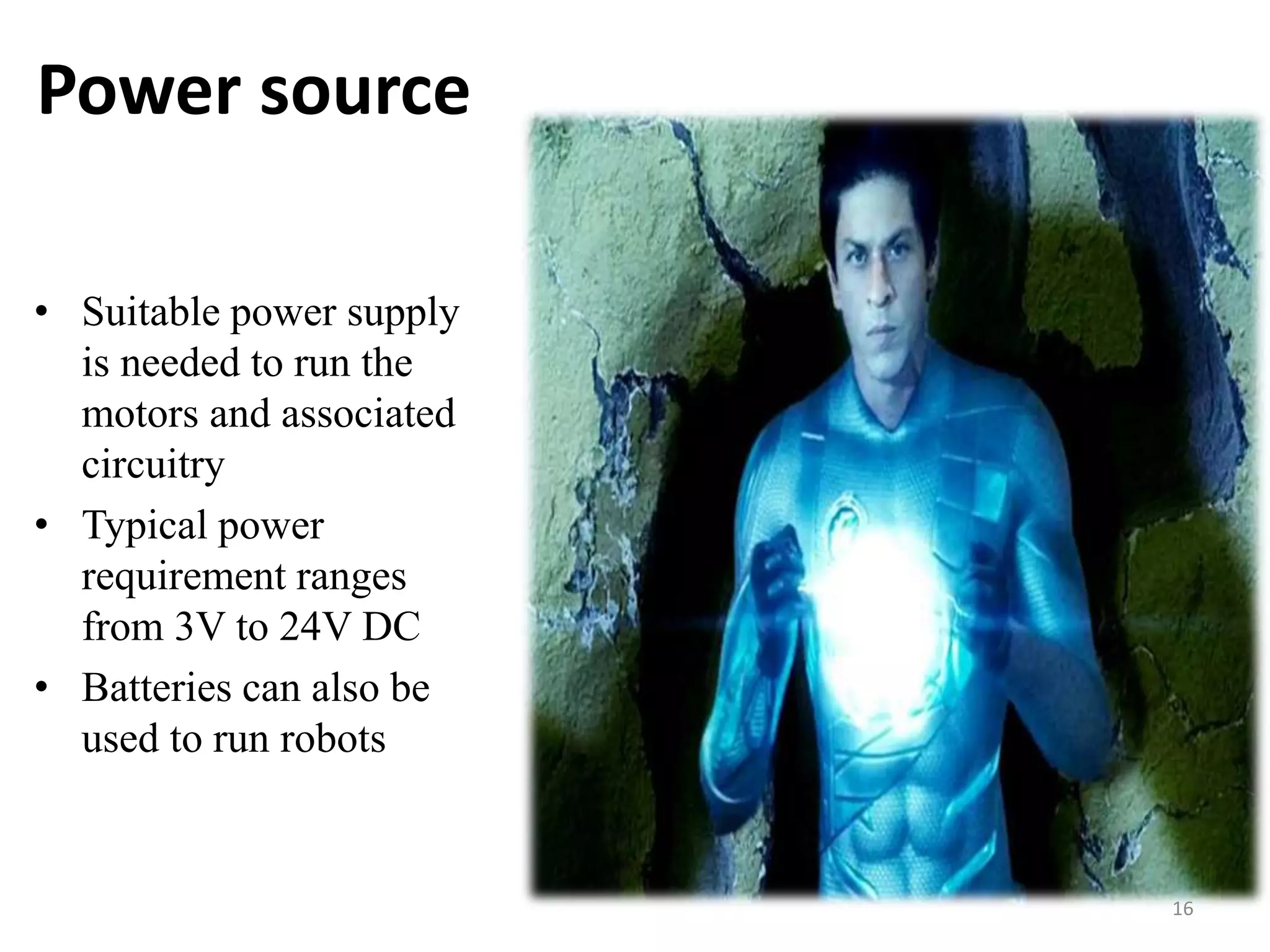
• Suitable power supply
is needed to run the
motors and associated
circuitry
• Typical power
requirement ranges
from 3V to 24V DC
• Batteries can also be
used to run robots
16
Actuation
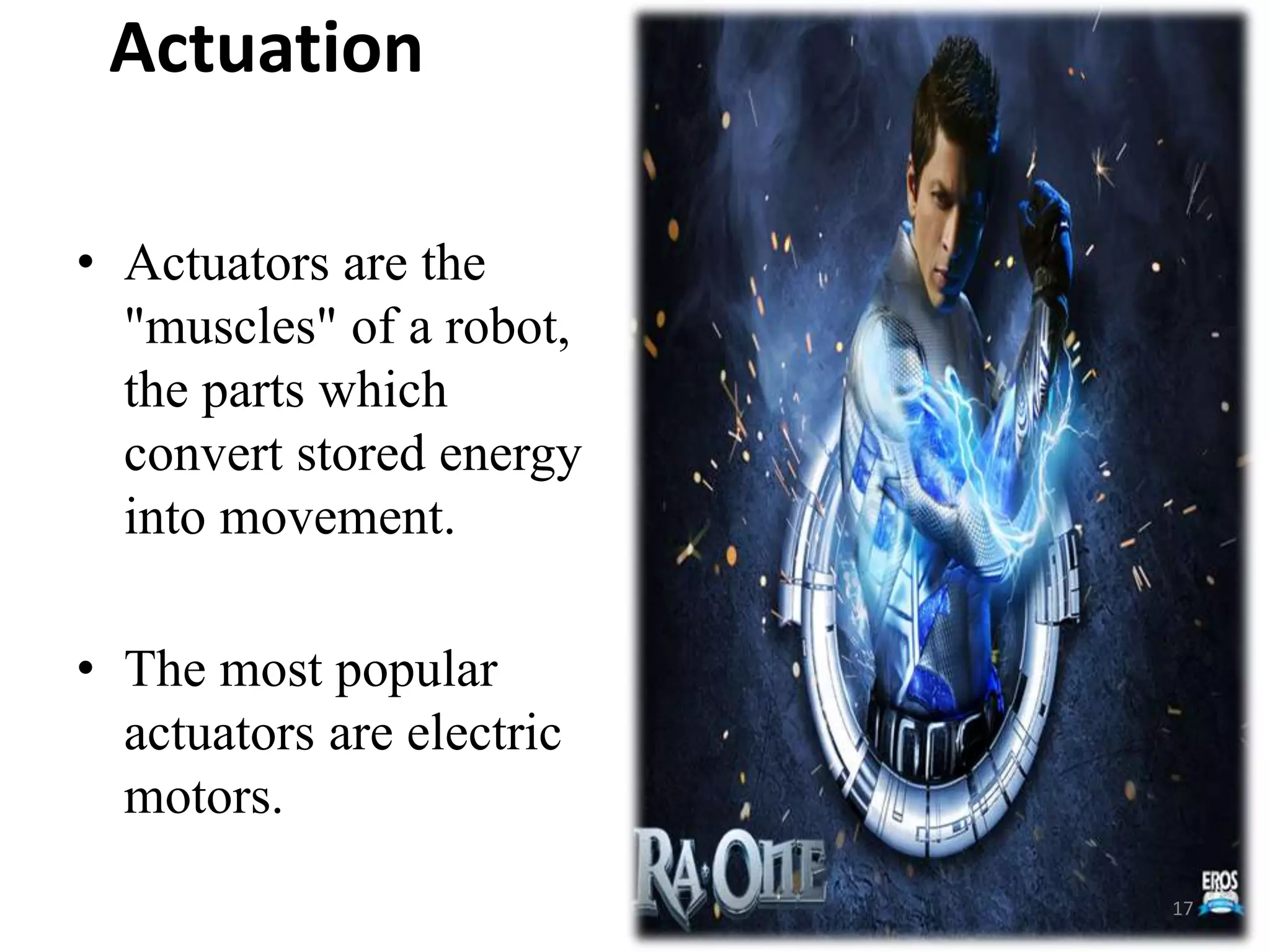
• Actuators are the
"muscles" of a robot,
the parts which
convert stored energy
into movement.
• The most popular
actuators are electric
motors.
17
Manipulation
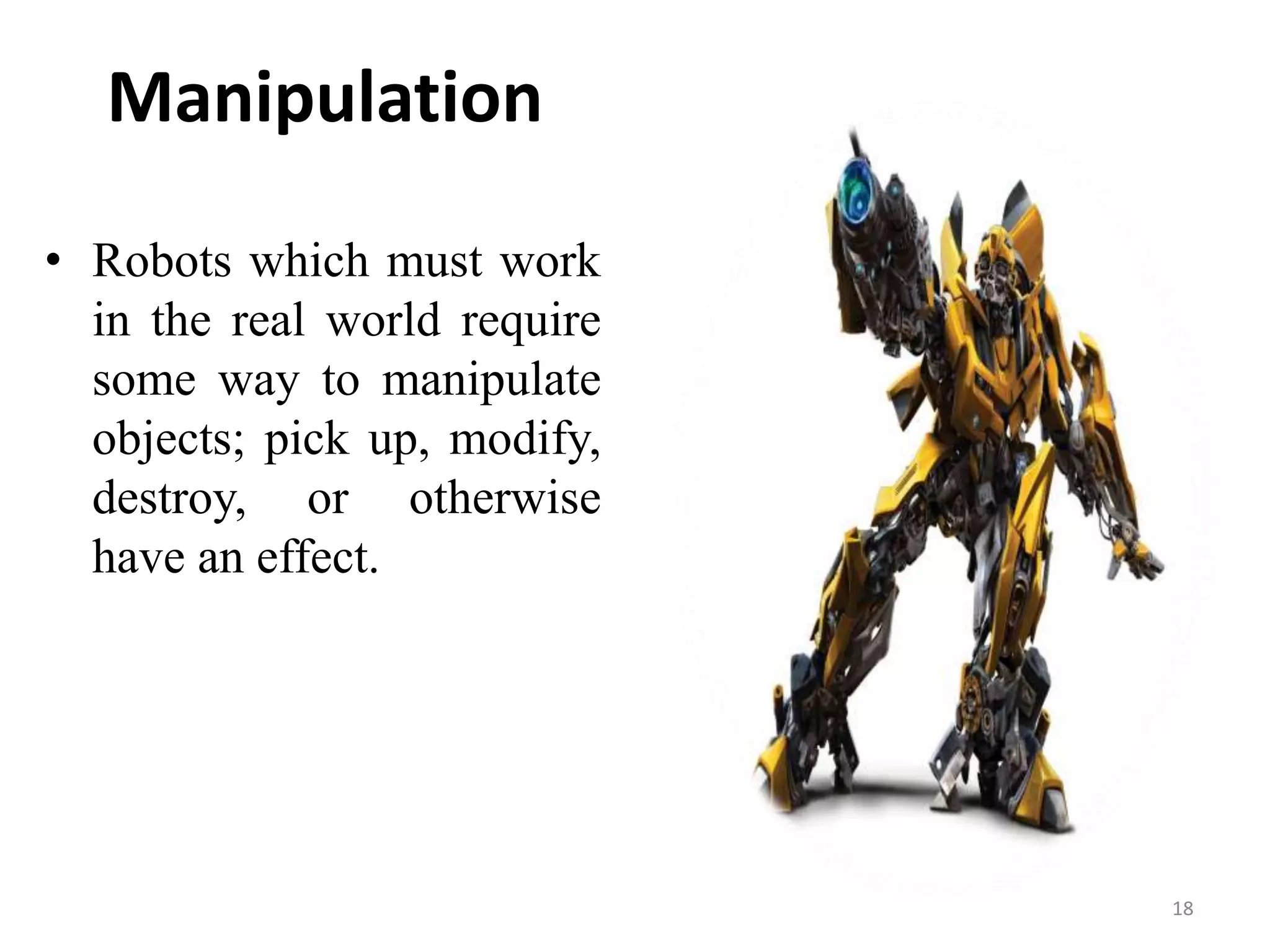
• Robots which must work
in the real world require
some way to manipulate
objects; pick up, modify,
destroy, or otherwise
have an effect.
18
Future Prospects
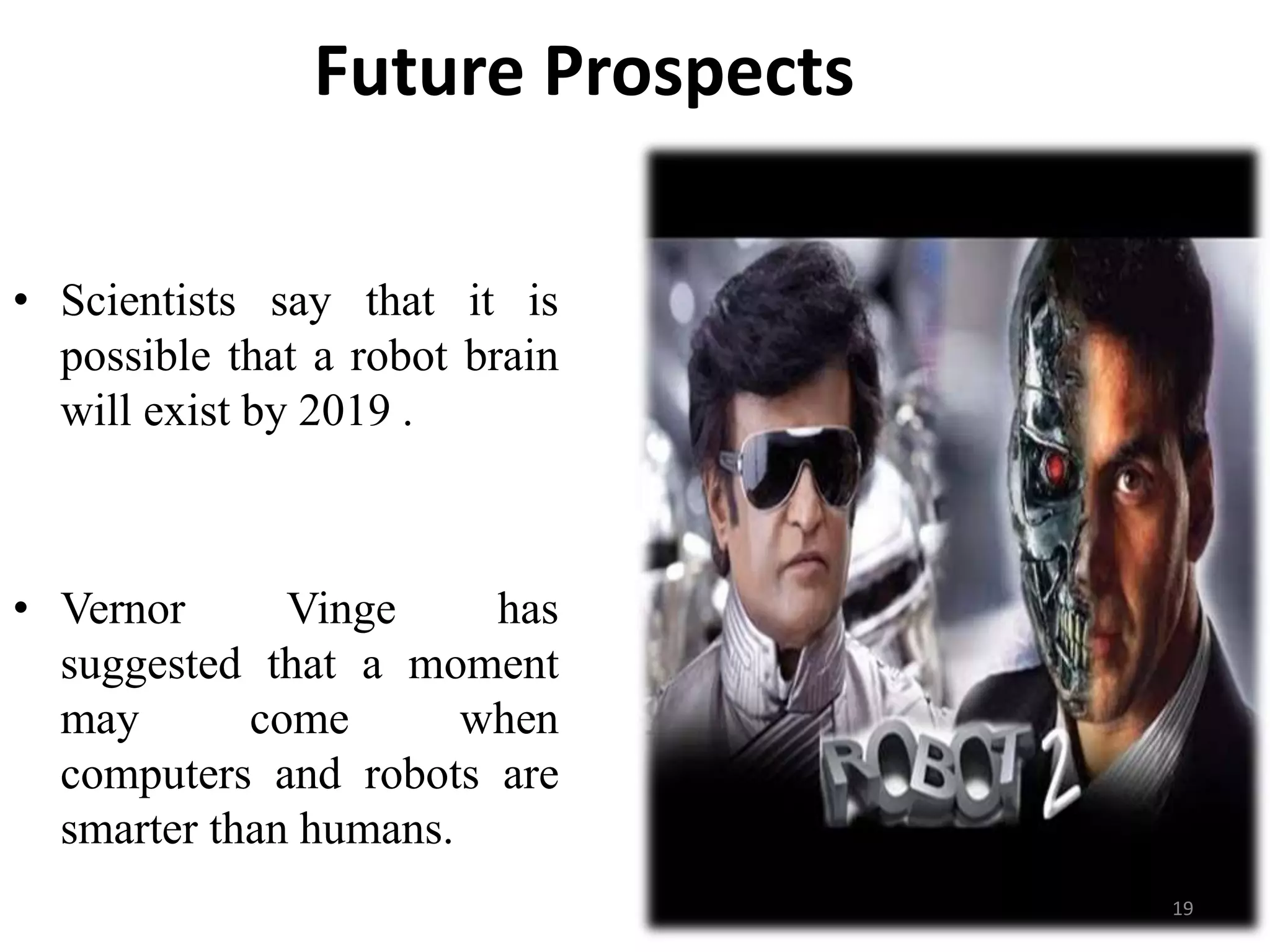
• Scientists say that it is
possible that a robot brain
will exist by 2019 .
• Vernor Vinge has
suggested that a moment
may come when
computers and robots are
smarter than humans.
19
Advantages of Robotics:-
1. Used to do repetitive (boring) actions or
jobs.
2. They performs a variety of tasks.
3. Improve in Quality.
4. Increase in production.
5. They can work Faster and more
Consistently and Accurately.
6. Perform dangerous tasks that humans cant
do.
7. They don’t get sick and can work for long
hours without getting tired.
8. Most of them are automatic so they can
go around by themselves.
9. They can go to unknown and dangerous
places where humans cannot.
20
Disadvantages of Robotics:-
1. People can loose their jobs.
2. It need supply of power.
3. It need money to make or buy
Robots.
4. Employees will require training
for programing and interacting
with new robotic equipment.
5. They cannot do the task that
require creativity and decision
making.
6. Any little error in their operation
can cause huge loss. HOW..???
21
22
Thank You
23
References:-
 http://robotik.dfki-bremen.de/en/research/fields-of-application.html
 http://14hmj.qataracademy.wikispaces.net/Advantages+and+Disadvantages
+of+Robots
 http://www.allonrobots.com/types-of-robots.html
 http://www.wisegeek.com/what-are-robots.html
 http://www.robotiksistem.com/index_en.html
 http://inventors.about.com/od/roboticsrobots/a/RoboTimeline.html
 http://www.paulos.net/other/robot.html
 http://www.robots.com/articles.php?tag=3503
 http://www.robots.com/blog.php
24
Thank You
25
Queries?
26

Robotics ppt

  • 1.
  • 2.
    Content • Introduction • Whatis Robotics • History • The Three Laws Of Robotics • Why Robotics ? • Types of ROBOTS • Components of ROBOTS • Advantages and Disadvantages • Future Prospects • Reference 2
  • 3.
  • 4.
    Robotics is thebranch of mechanical engineering, electrical engineering and computer science that deals with the design, construction, operation, and application of robots, as well as computer systems for their control, sensory feedback, and information processing. 4
  • 5.
    HISTORY OF ROBOTICS Theword robot was introduced to the public by Czech writer Karel Capek(1890-1938) in his play R.U.R. (Rossum's Universal Robots), published in 1920. The word "robotics", used to describe this field of study, was coined by the Russian –born , American scientist and science fiction writer, Isaac Asimov in 1940s. In 1942, he created three “Laws of Robotics” and he later added “zeroth law”. 5
  • 6.
    Zeroth Law :A robot may not injure humanity, or, through inaction, allow humanity to come to harm. First Law : A robot may not injure a human being, or, through inaction, allow a human being to come to harm, unless this would violate a higher order law Second Law: A robot must obey orders given it by human beings, except where such orders would conflict with a higher order law Third Law : A robot must protect its own existence as long as such protection does not conflict with a higher order law. 6
  • 7.
    The First Robot UnimatePuma500 Manipulator  Unimate was the first industrial robot, which worked on a General Motors assembly line at the Inland Fisher Guide Plant, New Jersey, in 1961.  It basically perform spot welding on auto bodies, task being particularly hateful jobs for people  A variety of other tasks were also performed by robots, such as loading and unloading machine tools. 7
  • 8.
    Why Robotics ? •Speed. • It can work hazardous/dangerous environment. • To perform repetitive task. • Efficiency • Accuracy • Adaptability 8 If you’ve seen this Robot then your childhood was awesome!
  • 9.
    Types of Robots •Mobile Robots • Rolling Robots • Walking Robots • Stationary Robots • Autonomous Robots • Remote-control Robots 9
  • 10.
    Types of Robots STATIONARYROBOTS:- These robots are fixed in one place and cannot move. This category includes robotic arms, computerized machine tools, and most other Industrial Robots. Industrial Robots are robots used in mass production e.g. welding robots, CNC plate cutters or CNC drills. 10
  • 11.
    MOBILE ROBOTS Mobile robotsare able to move, usually they perform tasks such as searching. They are of 2 types: - 1. Rolling robots:- Rolling robots have wheels to move around. They can quickly and easily search. However they are only useful in flat areas. 2. Walking robots:- Robots on legs are usually brought in when the terrain is rocky. Most robots have at least 4 legs; usually they have 6 or more. 11
  • 12.
    AUTONOMOUS ROBOTS  Autonomousrobots are self- supporting. They can act of their own independent of any controller  They run a program that gives them the opportunity to decide on the action to perform depending on their surroundings.  At times, these robots even learn new behavior. . 12
  • 13.
    REMOTE CONTROLLED ROBOTS In case a robot needs to perform more complicated yet undetermined tasks an autonomous robot is not the right choice.  Complicated tasks are still best performed by human beings with real brainpower. A person can guide a robot by remote control. A person can perform difficult and usually dangerous tasks without being at the spot where the tasks are performed. 13
  • 14.
    Components of ROBOTS •Structure • Power source • Actuation • Sensing • Manipulation 14
  • 15.
    Structure • The structureof a robot is usually mostly mechanical and can be called a kinematic chain. • The chain is formed of links (its bones), actuators (its muscles), and joints which can allow one or more degrees of freedom. 15
  • 16.
    Power source • Suitablepower supply is needed to run the motors and associated circuitry • Typical power requirement ranges from 3V to 24V DC • Batteries can also be used to run robots 16
  • 17.
    Actuation • Actuators arethe "muscles" of a robot, the parts which convert stored energy into movement. • The most popular actuators are electric motors. 17
  • 18.
    Manipulation • Robots whichmust work in the real world require some way to manipulate objects; pick up, modify, destroy, or otherwise have an effect. 18
  • 19.
    Future Prospects • Scientistssay that it is possible that a robot brain will exist by 2019 . • Vernor Vinge has suggested that a moment may come when computers and robots are smarter than humans. 19
  • 20.
    Advantages of Robotics:- 1.Used to do repetitive (boring) actions or jobs. 2. They performs a variety of tasks. 3. Improve in Quality. 4. Increase in production. 5. They can work Faster and more Consistently and Accurately. 6. Perform dangerous tasks that humans cant do. 7. They don’t get sick and can work for long hours without getting tired. 8. Most of them are automatic so they can go around by themselves. 9. They can go to unknown and dangerous places where humans cannot. 20
  • 21.
    Disadvantages of Robotics:- 1.People can loose their jobs. 2. It need supply of power. 3. It need money to make or buy Robots. 4. Employees will require training for programing and interacting with new robotic equipment. 5. They cannot do the task that require creativity and decision making. 6. Any little error in their operation can cause huge loss. HOW..??? 21
  • 22.
  • 23.
  • 24.
    References:-  http://robotik.dfki-bremen.de/en/research/fields-of-application.html  http://14hmj.qataracademy.wikispaces.net/Advantages+and+Disadvantages +of+Robots http://www.allonrobots.com/types-of-robots.html  http://www.wisegeek.com/what-are-robots.html  http://www.robotiksistem.com/index_en.html  http://inventors.about.com/od/roboticsrobots/a/RoboTimeline.html  http://www.paulos.net/other/robot.html  http://www.robots.com/articles.php?tag=3503  http://www.robots.com/blog.php 24
  • 25.
  • 26.