ROBOTICS
Made By:-
Pooja Prashant Bele
Department of Computer Science and Engineering
AGENDA
 Introduction
 What is Robotics
 History
 Why Robotics ?
 Types of ROBOTS
 Components of ROBOTS
 Human Robot Interaction
 Working of Robots
 Advantages
 Disadvantages
 Applications
 Reference
INTRODUCTION
• Definition of a Robot:
“A reprogrammable, multifunctional manipulator designed to
move materials, parts, tools, or specialized devices through
various programmed motions for the performance of a
variety of tasks ”
• With growing developments in the field of mechatronics and
mathematic modeling, robotics has come a long way.
• From an iron piece that could move only a few inches, there are
now machines capable of jumping from high-rise buildings,
detecting landmines, performing operations and troubleshooting.
• Robotics is a branch of engineering that
involves the conception, design,
manufacture, and operation of machines
assigned for specific high precision and
repetitive tasks.
• The word robotics is used to collectively
define a field in engineering that covers the
mimicking of various human characteristics.
WHAT IS ROBOTICS
HISTORY
• The term ‘robot’ got prominence way back in the
1921s when Karl Capek in his play Rossum’s
Universal Robots denoted the birth of a superior
race that had intelligence similar to that of humans.
• Later on Issac Asimov introduced his laws of
robots and finally Eric Elenberger, who is
considered as the father of robotics, introduced
real time robots to the world.
WHY ROBOTICS?
• Speed.
• It can work hazardous/dangerous environment.
• To perform repetitive task.
• Efficiency
• Accuracy
• Adaptability
TYPES OF ROBOTS
• Mobile Robots
• Rolling Robots
• Stationary Robots
• Remote-control Robots
• Humanoid Robots
MOBILE ROBOTS
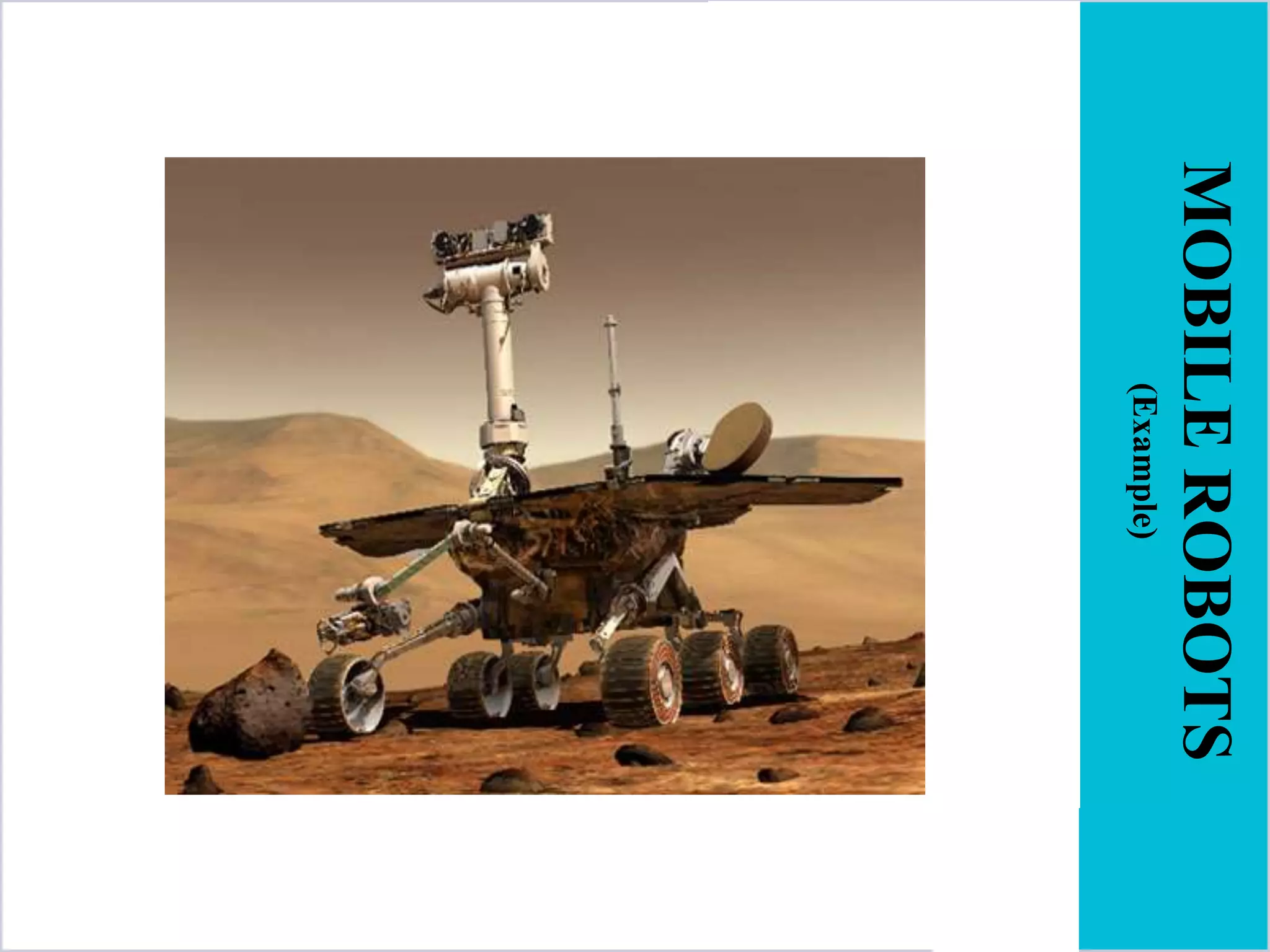
• Mobile robots are able to move, usually they perform
task such as search areas. A prime example is the
Mars Explorer, specifically designed to roam the
mars surface.
• Mobile robots are a great help to such collapsed
building for survivors Mobile robots are used for
task where people cannot go. Either because it is too
dangerous of because people cannot reach the area
that needs to be searched.
MOBILEROBOTS
(Example)
STATIONARY ROBOTS
• Robots are not only used to explore areas or
imitate a human being. Most robots perform
repeating tasks without ever moving an inch.
• Most robots are ‘working’ in industry
settings. Especially dull and repeating tasks
are suitable for robots.
• A robot never grows tired, it will perform its
duty day and night without ever complaining.
• In case the tasks at hand are done, the robots
will be reprogrammed to perform other
tasks..
STATIONARYROBOTS
(Example)
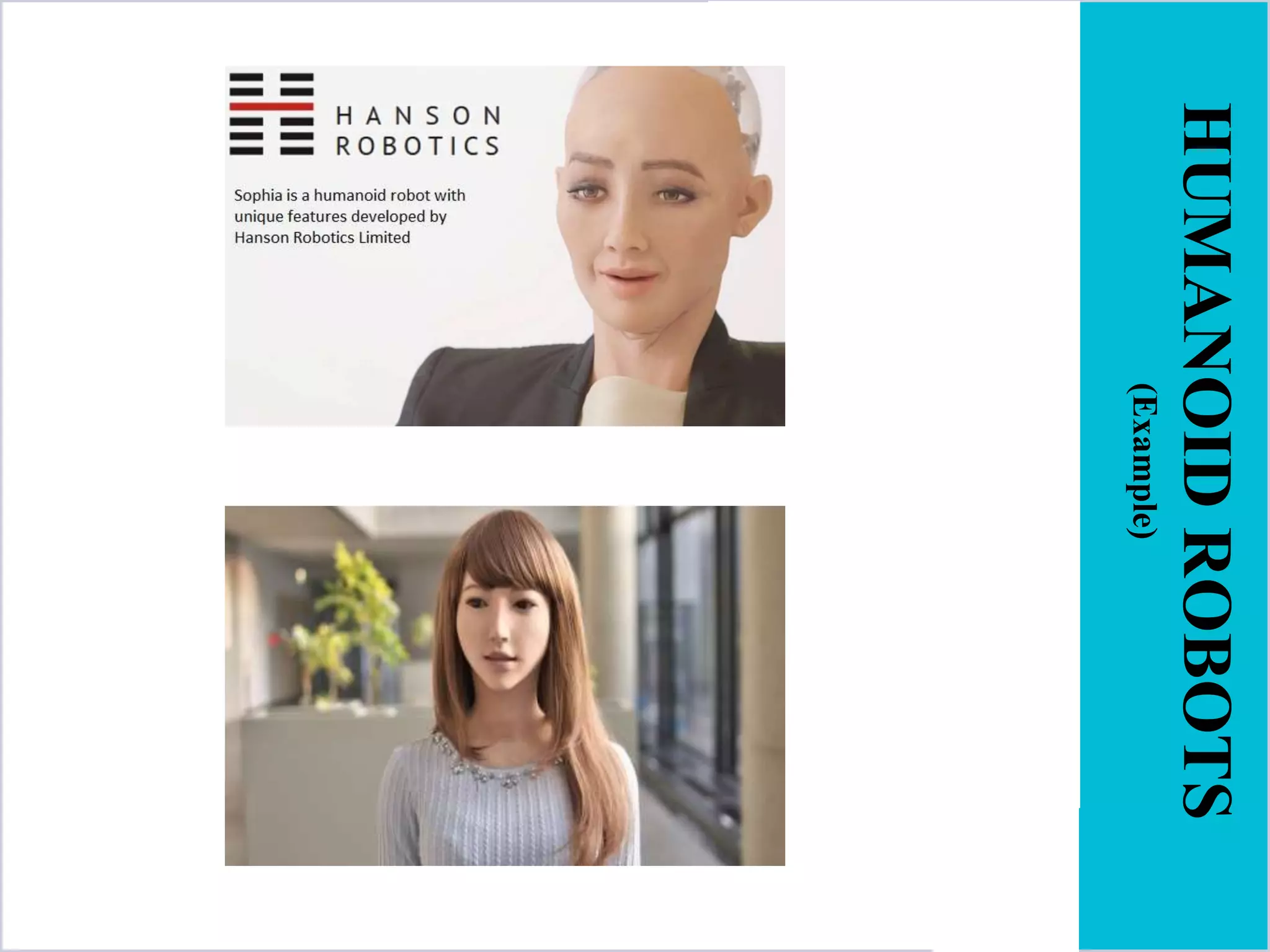
HUMANOID ROBOTS
• Humanoid refers to any being whose body
structure resembles that of a human: head, torso,
legs, arms, hands.
• But it is also a robot made to resemble a human
both in appearance and behavior.
HUMANOIDROBOTS
(Example)
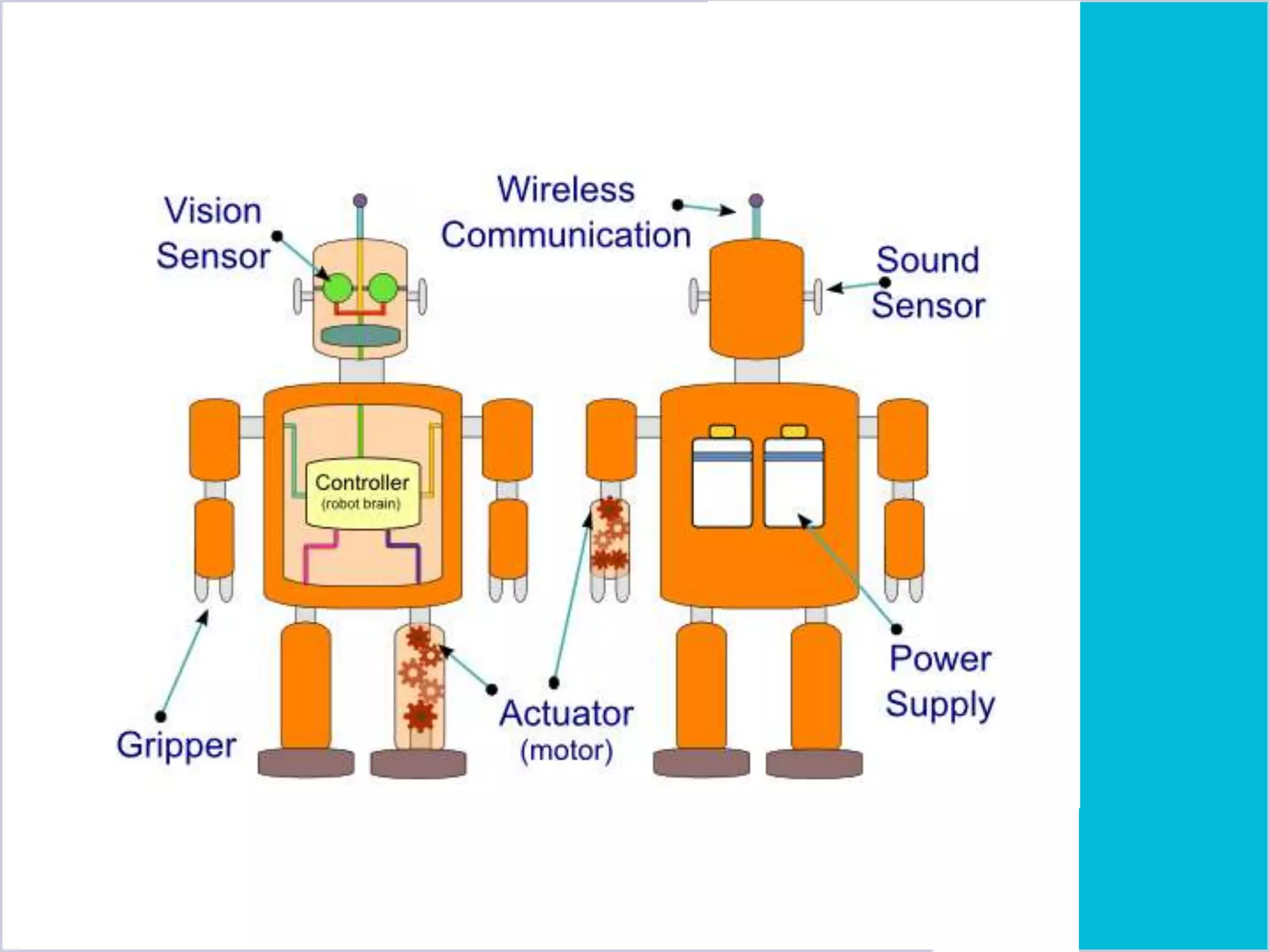
COMPONETS OF ROBOTS
• Structure
• Power source
• Actuation
• Sensing
• Manipulation
• Locomotion
STRUCTURE
• The structure of a robot is usually mostly mechanical
and can be called a kinematic chain.
• The chain is formed of links (its bones), actuators (its
muscles), and joints which can allow one or more
degrees of freedom.
POWER SOURCE
• Suitable power supply is needed to run the motors
and associated circuitry
• At present mostly batteries can be used as a power
source
• Potential power source could be:
1) Pneumatic(compressed gases)
2) Solar power
3) Hydraulics
4) Flywheel energy storage
5) Nuclear
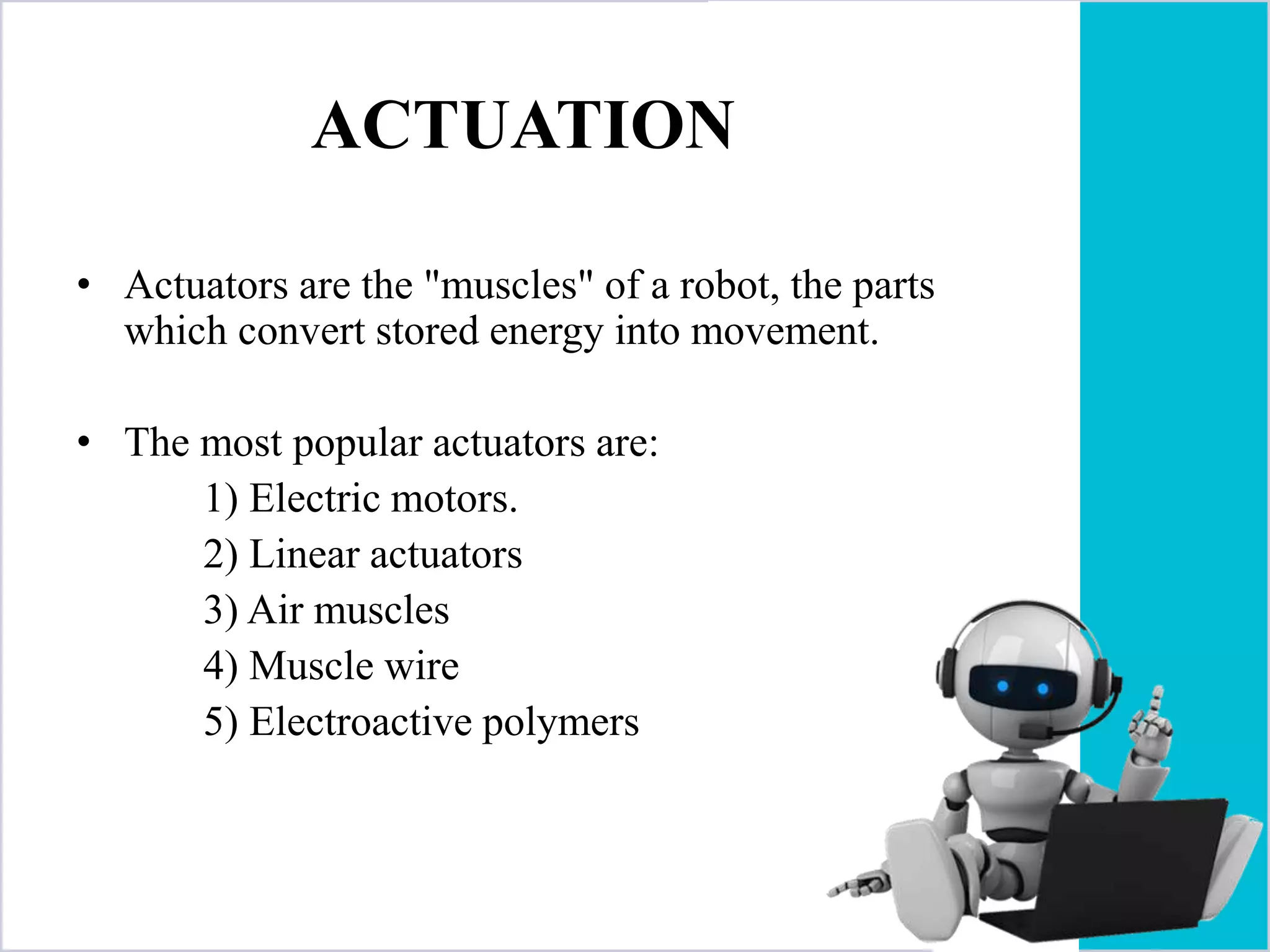
ACTUATION
• Actuators are the "muscles" of a robot, the parts
which convert stored energy into movement.
• The most popular actuators are:
1) Electric motors.
2) Linear actuators
3) Air muscles
4) Muscle wire
5) Electroactive polymers
SENSING
• Sensors allow robots to receive information
about a certain measurement of the
environment, or internal components.
1) Touch
2) Vision
MANIPULATION
• Robots which must work in the real world require
some way to manipulate objects; pick up, modify,
destroy, or otherwise have an effect.
• Thus the 'hands' of a robot are often referred to as end
effectors, while the arm is referred to as a
manipulator.
• Some manipulators are:
oMechanical Grippers
oVacuum Grippers
oGeneral purpose effectors
LOCOMOTION
• It is concerned with the motion of the robot.
• Robot contains different types of drives:-
1) Rolling robots
2) Two-wheeled balancing robots
3) One-wheeled balancing robots
4) Spherical orb robots
5) Walking applied robots
6) ZMP technique
7) Hopping
8) Dynamic Balancing
9) Passive Dynamics
HUMAN ROBOT INTERACTION
• The people who interact with them may have
little or no training in robotics, and so any
interface will need to be extremely intuitive
• Easy ways for humans to communicate with
robots are:
1) Speech
2) Gestures
3) Facial Expressions
WORKING
• The control of a robot involves three distinct
phases:
1) Perception
2) Processing
3) Action
ADVANTAGES
• You can send them to very dangerous places
• You can make them do you're job for you
• They are more accurate than humans Eg no
shaking when in a very important surgery,
puts every screw in fabricating a car etc.
• Can do jobs 24/7
• Can guard without being tired just keep
doing the same thing 24/7
• They can lift very heavy things
DISADVANTAGES
• You need to get people trained to fix them if
anything wrong happens
• Need a very intelligent crew
• They are very expensive to make
• You need the right materials to make them, that
could be very rare
• They can reproduce but it could cost money for
the materials
APPLICATIONS
• Rob Surgery
• Robots in danger zone
• Assisting disabled individuals
• Underwater, space and remote
locations
• Machine loading
• Industries
CONCLUSION
Today we find most robots working for people in industries, factories,
warehouses, and laboratories. Robots are useful in many ways.
For instance, it boosts economy because businesses need to be efficient
to keep up with the industry competition.
Therefore, having robots helps business owners to be competitive,
because robots can do jobs better and faster than humans can, e.g.
robot can built, assemble a car. Yet robots cannot perform every job;
today robots roles include assisting research and industry.
Finally, as the technology improves, there will be new ways to use
robots which will bring new hopes and new potentials.
REFERENCES
• www.wikipedia.com
• www.google.com
THANK YOU
Any Queries?

Robotics

  • 1.
    ROBOTICS Made By:- Pooja PrashantBele Department of Computer Science and Engineering
  • 2.
    AGENDA  Introduction  Whatis Robotics  History  Why Robotics ?  Types of ROBOTS  Components of ROBOTS  Human Robot Interaction  Working of Robots  Advantages  Disadvantages  Applications  Reference
  • 3.
    INTRODUCTION • Definition ofa Robot: “A reprogrammable, multifunctional manipulator designed to move materials, parts, tools, or specialized devices through various programmed motions for the performance of a variety of tasks ” • With growing developments in the field of mechatronics and mathematic modeling, robotics has come a long way. • From an iron piece that could move only a few inches, there are now machines capable of jumping from high-rise buildings, detecting landmines, performing operations and troubleshooting.
  • 4.
    • Robotics isa branch of engineering that involves the conception, design, manufacture, and operation of machines assigned for specific high precision and repetitive tasks. • The word robotics is used to collectively define a field in engineering that covers the mimicking of various human characteristics. WHAT IS ROBOTICS
  • 5.
    HISTORY • The term‘robot’ got prominence way back in the 1921s when Karl Capek in his play Rossum’s Universal Robots denoted the birth of a superior race that had intelligence similar to that of humans. • Later on Issac Asimov introduced his laws of robots and finally Eric Elenberger, who is considered as the father of robotics, introduced real time robots to the world.
  • 6.
    WHY ROBOTICS? • Speed. •It can work hazardous/dangerous environment. • To perform repetitive task. • Efficiency • Accuracy • Adaptability
  • 7.
    TYPES OF ROBOTS •Mobile Robots • Rolling Robots • Stationary Robots • Remote-control Robots • Humanoid Robots
  • 8.
    MOBILE ROBOTS • Mobilerobots are able to move, usually they perform task such as search areas. A prime example is the Mars Explorer, specifically designed to roam the mars surface. • Mobile robots are a great help to such collapsed building for survivors Mobile robots are used for task where people cannot go. Either because it is too dangerous of because people cannot reach the area that needs to be searched.
  • 9.
  • 10.
    STATIONARY ROBOTS • Robotsare not only used to explore areas or imitate a human being. Most robots perform repeating tasks without ever moving an inch. • Most robots are ‘working’ in industry settings. Especially dull and repeating tasks are suitable for robots. • A robot never grows tired, it will perform its duty day and night without ever complaining. • In case the tasks at hand are done, the robots will be reprogrammed to perform other tasks..
  • 11.
  • 12.
    HUMANOID ROBOTS • Humanoidrefers to any being whose body structure resembles that of a human: head, torso, legs, arms, hands. • But it is also a robot made to resemble a human both in appearance and behavior.
  • 13.
  • 14.
    COMPONETS OF ROBOTS •Structure • Power source • Actuation • Sensing • Manipulation • Locomotion
  • 15.
    STRUCTURE • The structureof a robot is usually mostly mechanical and can be called a kinematic chain. • The chain is formed of links (its bones), actuators (its muscles), and joints which can allow one or more degrees of freedom.
  • 17.
    POWER SOURCE • Suitablepower supply is needed to run the motors and associated circuitry • At present mostly batteries can be used as a power source • Potential power source could be: 1) Pneumatic(compressed gases) 2) Solar power 3) Hydraulics 4) Flywheel energy storage 5) Nuclear
  • 18.
    ACTUATION • Actuators arethe "muscles" of a robot, the parts which convert stored energy into movement. • The most popular actuators are: 1) Electric motors. 2) Linear actuators 3) Air muscles 4) Muscle wire 5) Electroactive polymers
  • 19.
    SENSING • Sensors allowrobots to receive information about a certain measurement of the environment, or internal components. 1) Touch 2) Vision
  • 20.
    MANIPULATION • Robots whichmust work in the real world require some way to manipulate objects; pick up, modify, destroy, or otherwise have an effect. • Thus the 'hands' of a robot are often referred to as end effectors, while the arm is referred to as a manipulator. • Some manipulators are: oMechanical Grippers oVacuum Grippers oGeneral purpose effectors
  • 21.
    LOCOMOTION • It isconcerned with the motion of the robot. • Robot contains different types of drives:- 1) Rolling robots 2) Two-wheeled balancing robots 3) One-wheeled balancing robots 4) Spherical orb robots 5) Walking applied robots 6) ZMP technique 7) Hopping 8) Dynamic Balancing 9) Passive Dynamics
  • 22.
    HUMAN ROBOT INTERACTION •The people who interact with them may have little or no training in robotics, and so any interface will need to be extremely intuitive • Easy ways for humans to communicate with robots are: 1) Speech 2) Gestures 3) Facial Expressions
  • 23.
    WORKING • The controlof a robot involves three distinct phases: 1) Perception 2) Processing 3) Action
  • 24.
    ADVANTAGES • You cansend them to very dangerous places • You can make them do you're job for you • They are more accurate than humans Eg no shaking when in a very important surgery, puts every screw in fabricating a car etc. • Can do jobs 24/7 • Can guard without being tired just keep doing the same thing 24/7 • They can lift very heavy things
  • 25.
    DISADVANTAGES • You needto get people trained to fix them if anything wrong happens • Need a very intelligent crew • They are very expensive to make • You need the right materials to make them, that could be very rare • They can reproduce but it could cost money for the materials
  • 26.
    APPLICATIONS • Rob Surgery •Robots in danger zone • Assisting disabled individuals • Underwater, space and remote locations • Machine loading • Industries
  • 27.
    CONCLUSION Today we findmost robots working for people in industries, factories, warehouses, and laboratories. Robots are useful in many ways. For instance, it boosts economy because businesses need to be efficient to keep up with the industry competition. Therefore, having robots helps business owners to be competitive, because robots can do jobs better and faster than humans can, e.g. robot can built, assemble a car. Yet robots cannot perform every job; today robots roles include assisting research and industry. Finally, as the technology improves, there will be new ways to use robots which will bring new hopes and new potentials.
  • 28.
  • 29.