ROBOTICS
ROBOTICS
• Robotic History
• Robotic Technology
• Types of Robots
• Advantages & Disadvantages
WHAT IS A ROBOT…?
A re-programmable, multifunctional, automatic
Industrial machine designed to replace human in
hazardous work. It can be used as :-
• An automatic machine sweeper
• An automatic car for a child to play with
• A machine removing mines in a war field
• In space
• In military , and many more…
WHAT IS ROBOTICS…?
ROBOTICS IS THE SCIENCE OF DESIGNING OR BUILDING AN
APPLICATION OF ROBOTS. SIMPLY, ROBOTICS MAY BE DEFINES AS
“THE STUDY OF ROBOTS”. THE AIM OF ROBOTICS IS TO DESIGN AN
EFFICIENT ROBOT.
WHY IS ROBOTICS NEEDED…?
Robotics is needed because :-
• Speed
• Can work in hazardous/dangerous temperature
• Can do repetitive tasks
• Can do work with accuracy
ROBOTIC HISTORY
First use of the word “Robotics”
4 R’s Of Robotics
The First robot “Ultimate”
FIRST USE OF THE WORD
“ROBOTICS”
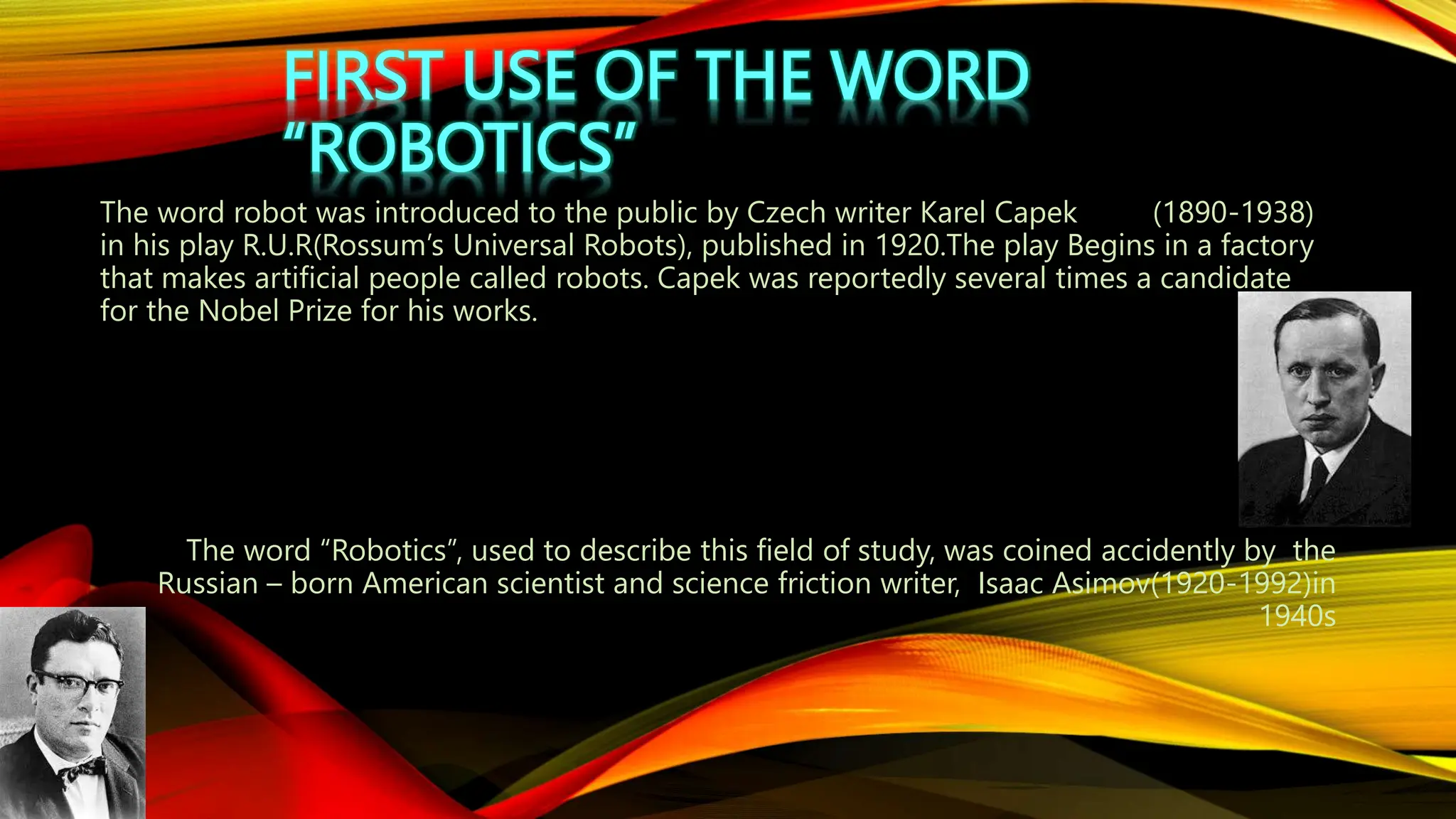
The word robot was introduced to the public by Czech writer Karel Capek (1890-1938)
in his play R.U.R(Rossum’s Universal Robots), published in 1920.The play Begins in a factory
that makes artificial people called robots. Capek was reportedly several times a candidate
for the Nobel Prize for his works.
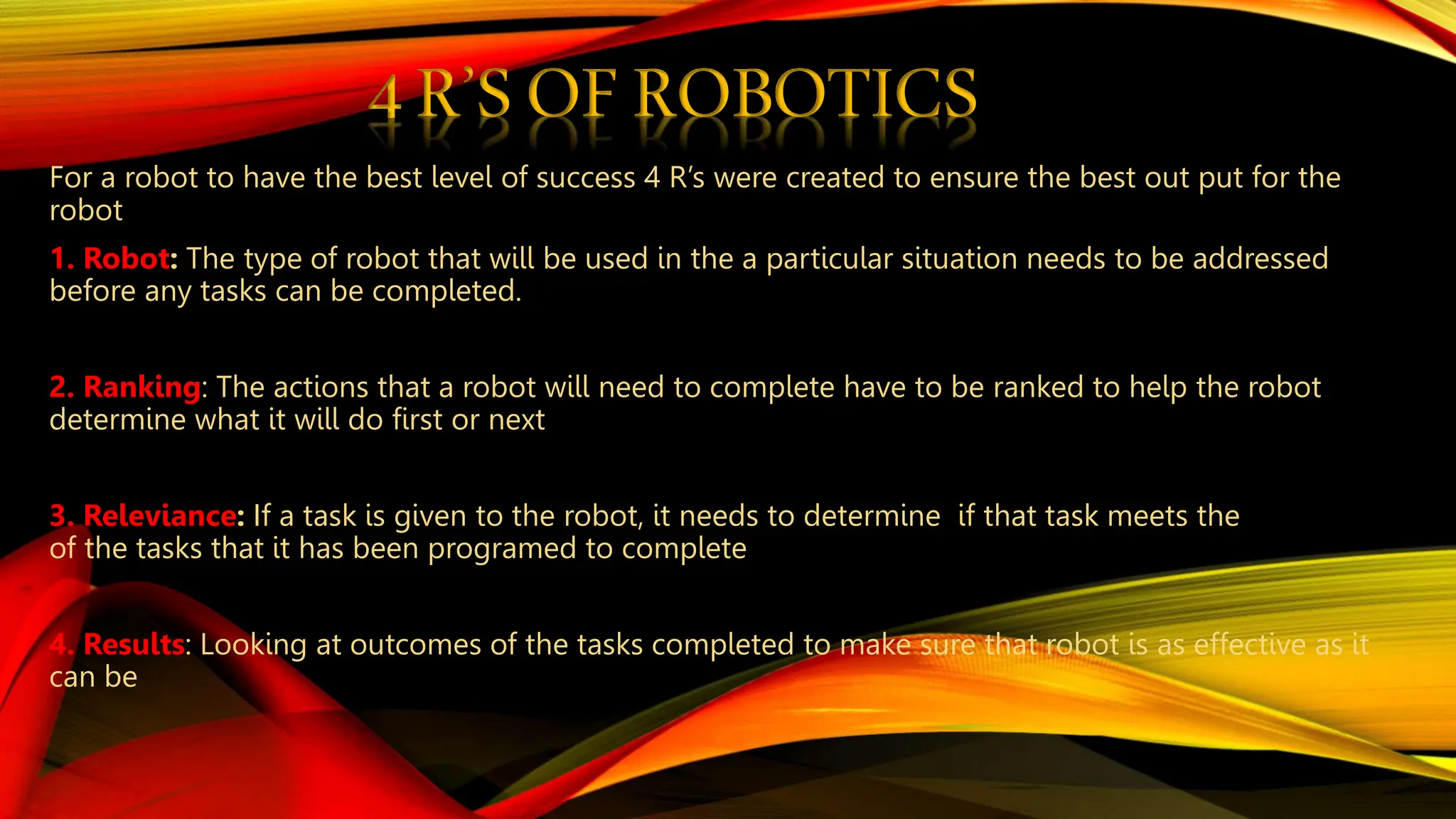
The word “Robotics”, used to describe this field of study, was coined accidently by the
Russian – born American scientist and science friction writer, Isaac Asimov(1920-1992)in
1940s
4R’SOFROBOTICS
For a robot to have the best level of success 4 R’s were created to ensure the best out put for the
robot
1. Robot: The type of robot that will be used in the a particular situation needs to be addressed
before any tasks can be completed.
2. Ranking: The actions that a robot will need to complete have to be ranked to help the robot
determine what it will do first or next
3. Releviance: If a task is given to the robot, it needs to determine if that task meets the
of the tasks that it has been programed to complete
4. Results: Looking at outcomes of the tasks completed to make sure that robot is as effective as it
can be
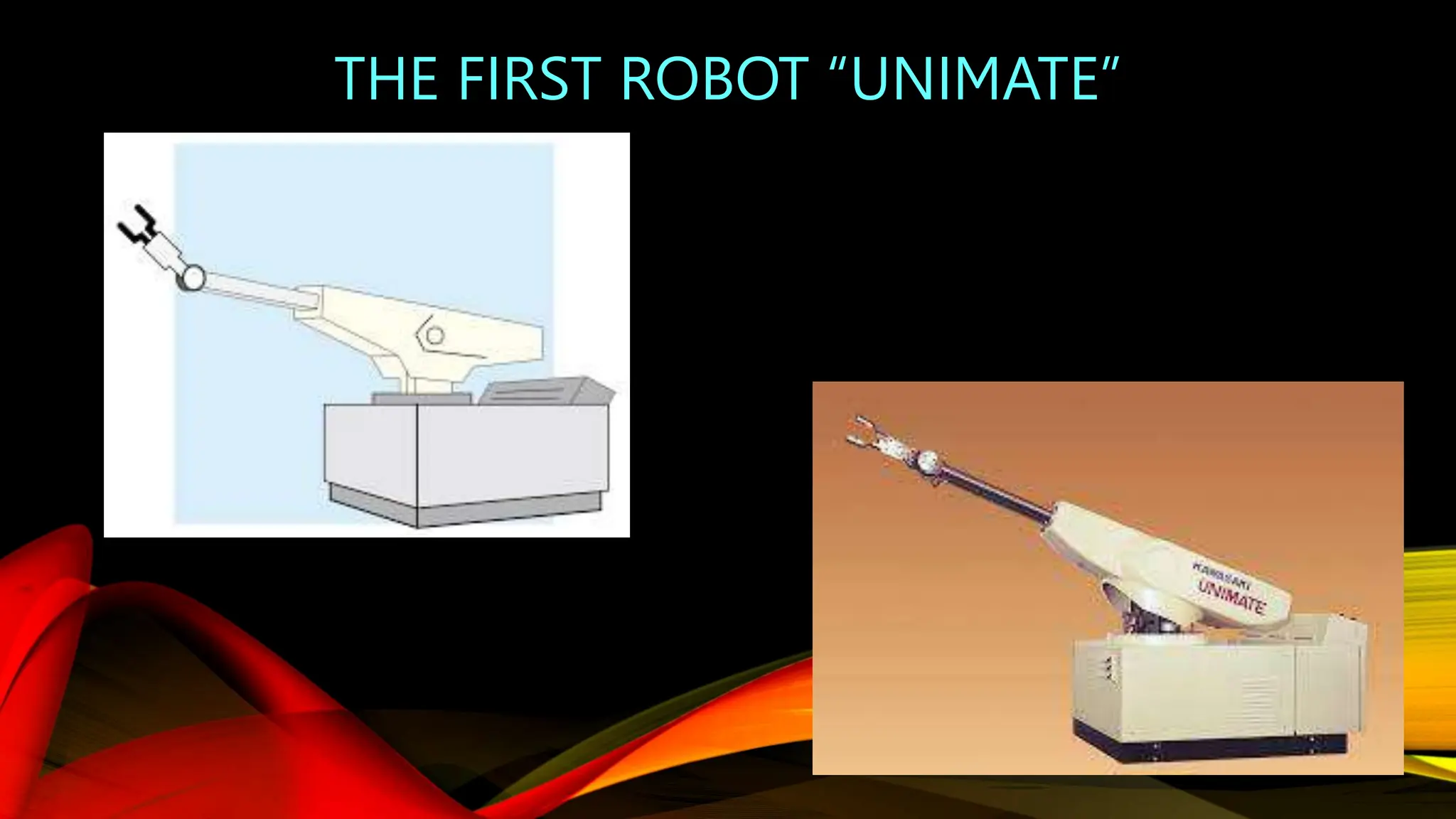
THE FIRST ROBOT “UNIMATE”
ROBOTICSTECHNOLOGY
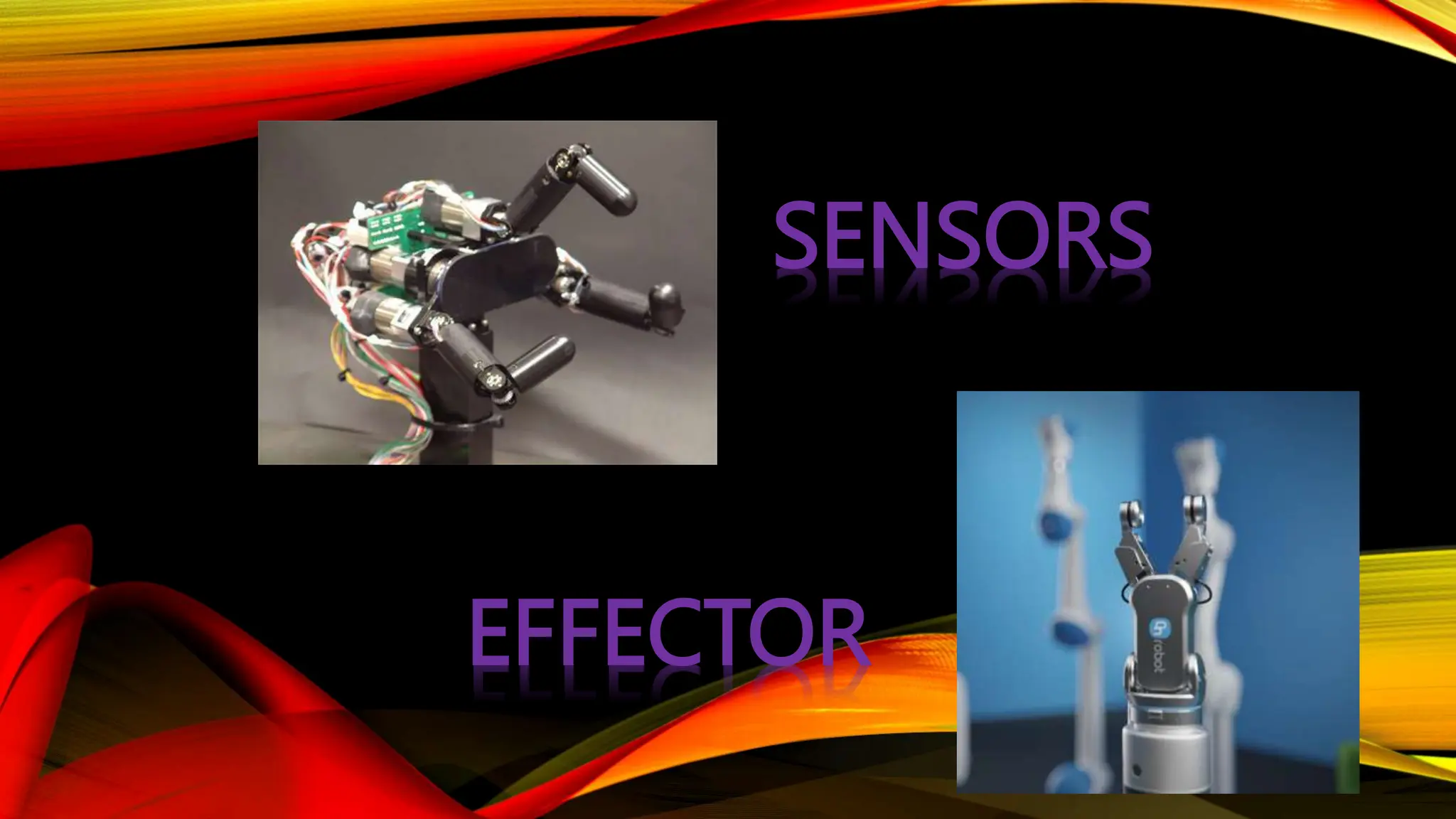
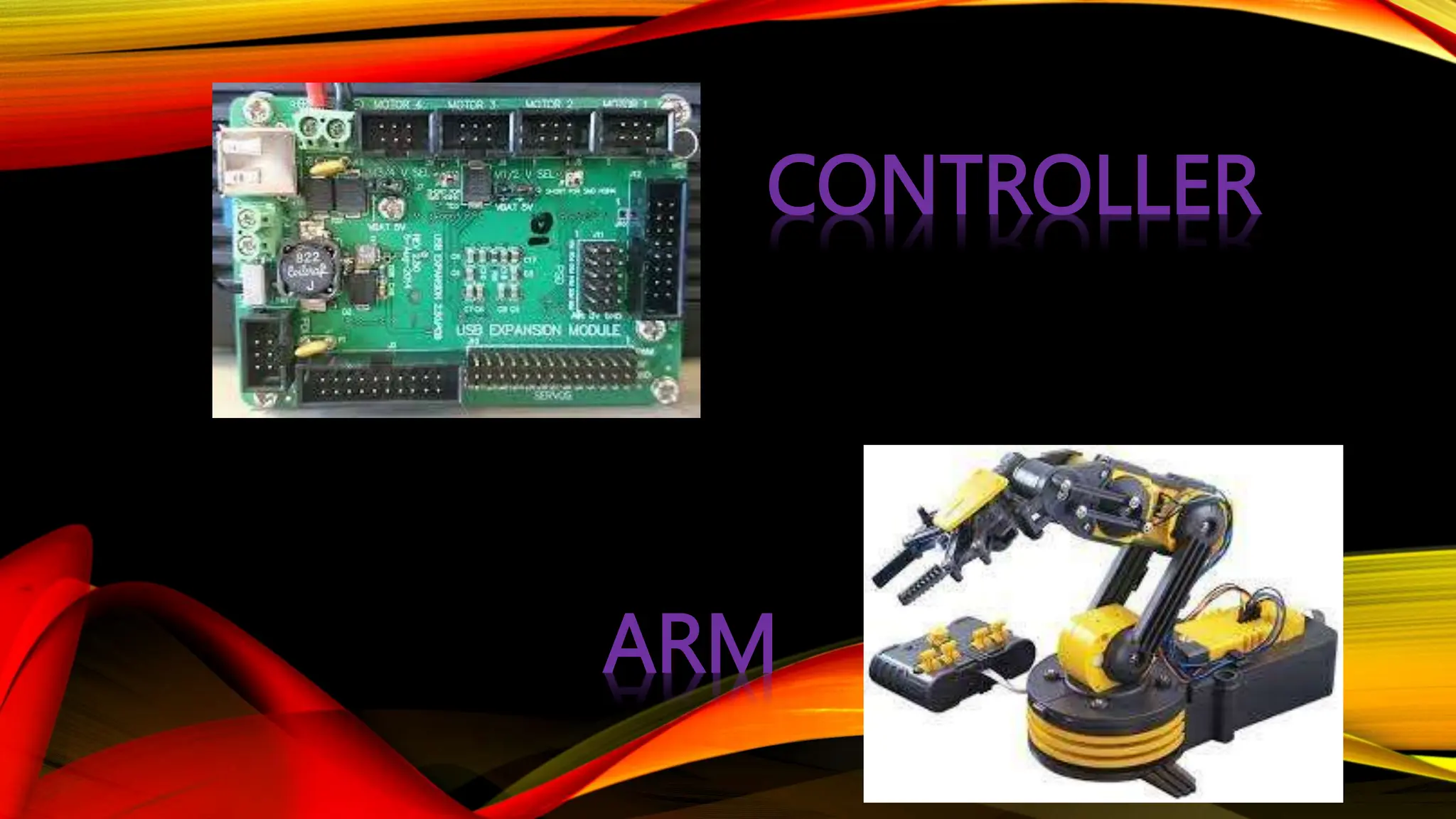
Most industrial robots have at least the following five parts:
Sensors
Effectors
Actuators
Controllers
Arms
SENSORS
EFFECTOR
CONTROLLER
ARM
TYPES OF ROBOTS
The most common types of Robots are…
Mobile Robots
Stationary Robots
Autonomous Robots
Remote-Controlled Robots
Virtual Robots
MOBILE
ROBOTS
Mobile Robots are of two types……
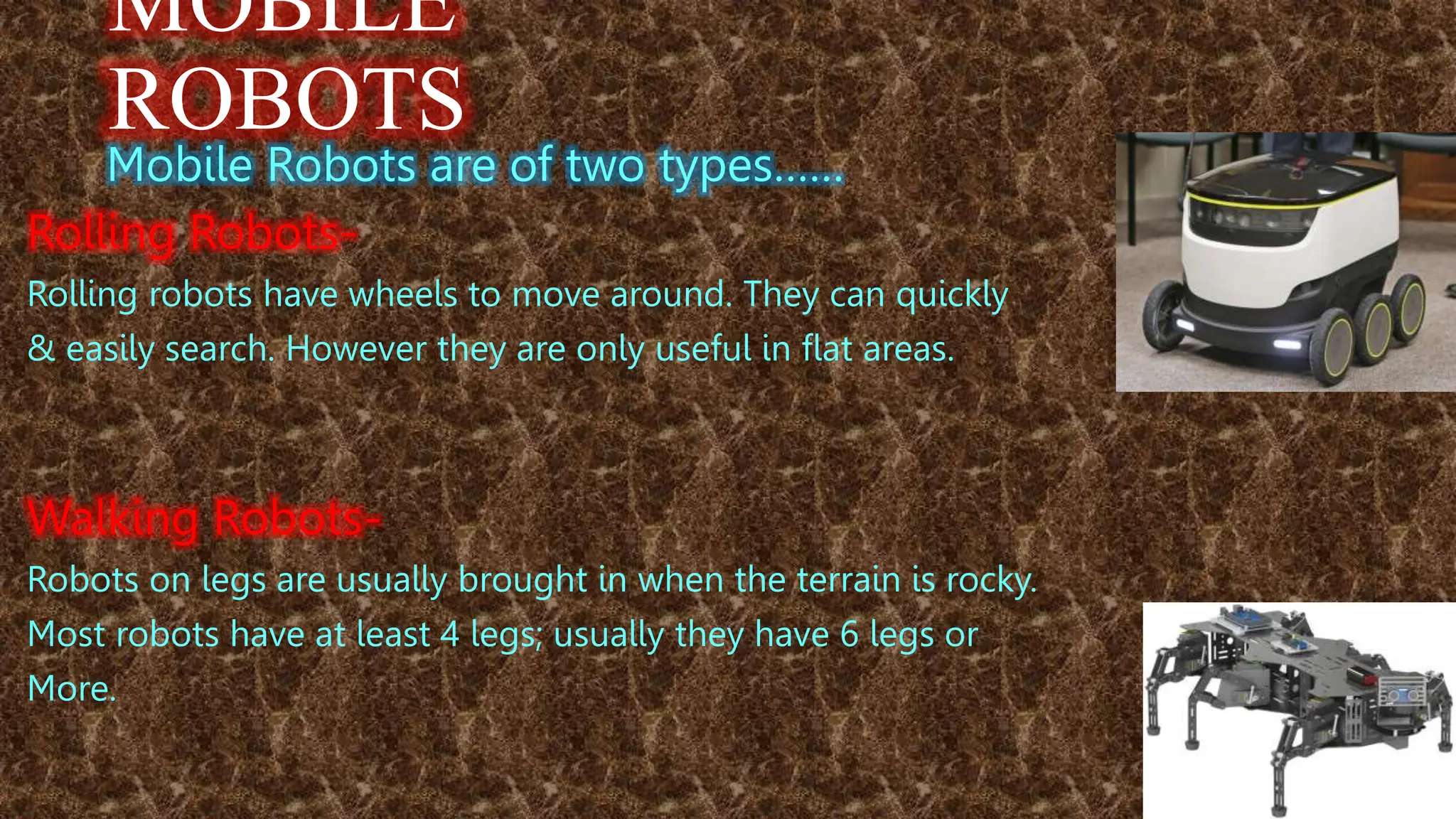
Rolling Robots-
Rolling robots have wheels to move around. They can quickly
& easily search. However they are only useful in flat areas.
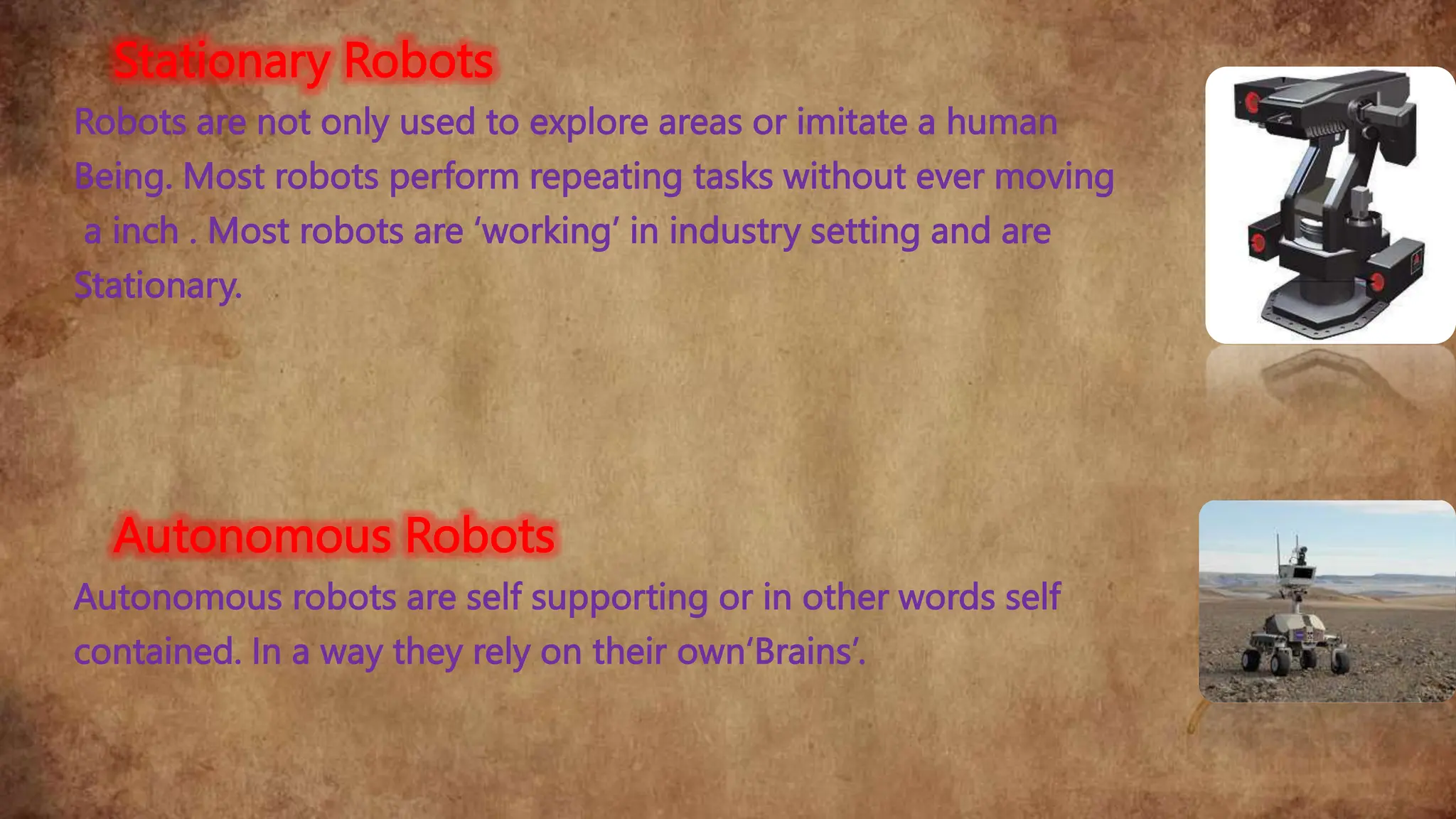
Walking Robots-
Robots on legs are usually brought in when the terrain is rocky.
Most robots have at least 4 legs; usually they have 6 legs or
More.
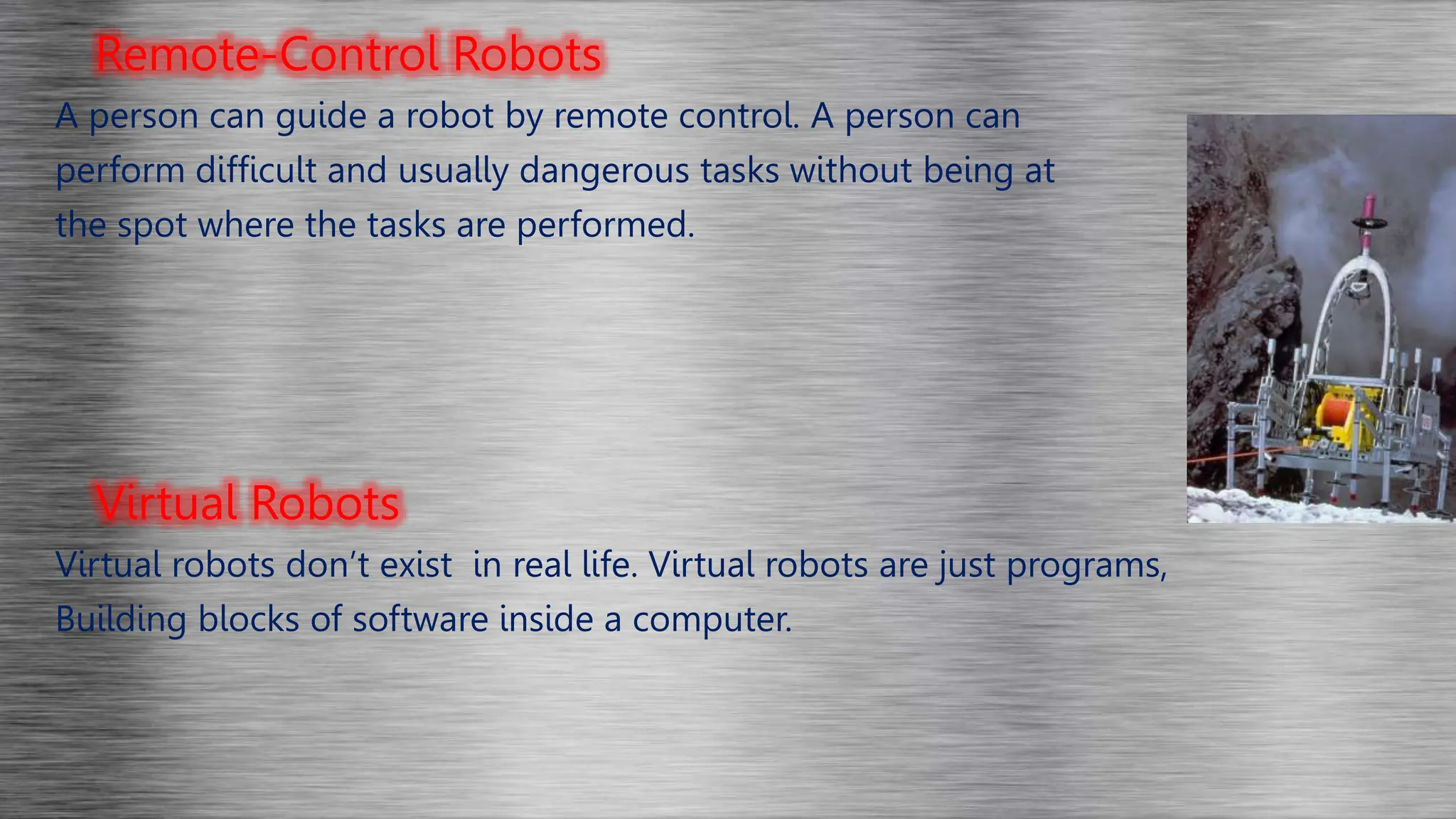
Stationary Robots
Robots are not only used to explore areas or imitate a human
Being. Most robots perform repeating tasks without ever moving
a inch . Most robots are ‘working’ in industry setting and are
Stationary.
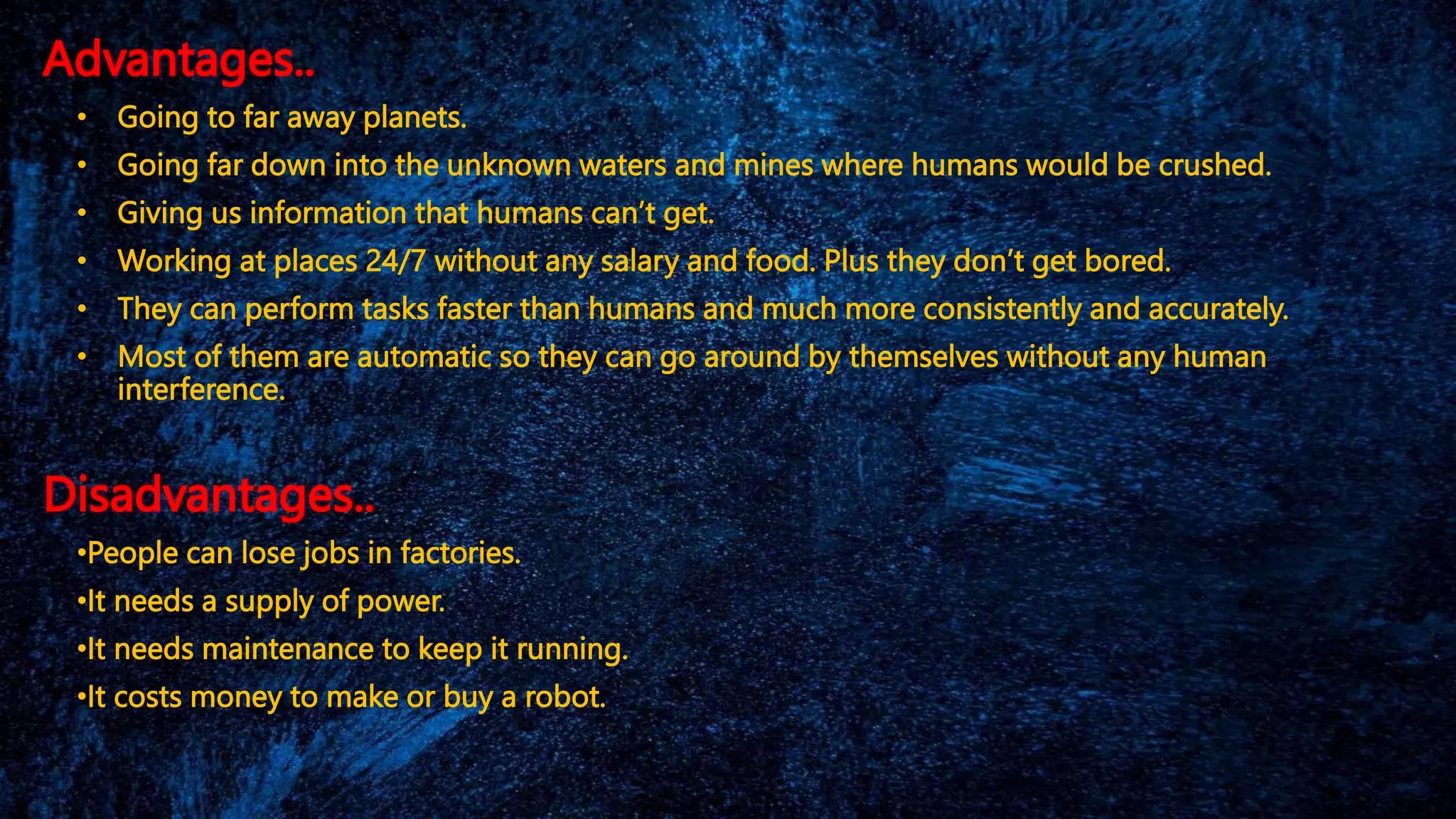
Autonomous Robots
Autonomous robots are self supporting or in other words self
contained. In a way they rely on their own‘Brains’.
Remote-Control Robots
A person can guide a robot by remote control. A person can
perform difficult and usually dangerous tasks without being at
the spot where the tasks are performed.
Virtual Robots
Virtual robots don’t exist in real life. Virtual robots are just programs,
Building blocks of software inside a computer.
Advantages..
• Going to far away planets.
• Going far down into the unknown waters and mines where humans would be crushed.
• Giving us information that humans can’t get.
• Working at places 24/7 without any salary and food. Plus they don’t get bored.
• They can perform tasks faster than humans and much more consistently and accurately.
• Most of them are automatic so they can go around by themselves without any human
interference.
Disadvantages..
•People can lose jobs in factories.
•It needs a supply of power.
•It needs maintenance to keep it running.
•It costs money to make or buy a robot.
PROJECT BY-
ATHARVA PARATE
BHARTI KRISHNA VIDYA VIHAR

Basics Of Robotics by Atharva Parate.pptx

  • 1.
  • 2.
    ROBOTICS • Robotic History •Robotic Technology • Types of Robots • Advantages & Disadvantages
  • 3.
    WHAT IS AROBOT…? A re-programmable, multifunctional, automatic Industrial machine designed to replace human in hazardous work. It can be used as :- • An automatic machine sweeper • An automatic car for a child to play with • A machine removing mines in a war field • In space • In military , and many more…
  • 4.
    WHAT IS ROBOTICS…? ROBOTICSIS THE SCIENCE OF DESIGNING OR BUILDING AN APPLICATION OF ROBOTS. SIMPLY, ROBOTICS MAY BE DEFINES AS “THE STUDY OF ROBOTS”. THE AIM OF ROBOTICS IS TO DESIGN AN EFFICIENT ROBOT. WHY IS ROBOTICS NEEDED…? Robotics is needed because :- • Speed • Can work in hazardous/dangerous temperature • Can do repetitive tasks • Can do work with accuracy
  • 5.
    ROBOTIC HISTORY First useof the word “Robotics” 4 R’s Of Robotics The First robot “Ultimate”
  • 6.
    FIRST USE OFTHE WORD “ROBOTICS” The word robot was introduced to the public by Czech writer Karel Capek (1890-1938) in his play R.U.R(Rossum’s Universal Robots), published in 1920.The play Begins in a factory that makes artificial people called robots. Capek was reportedly several times a candidate for the Nobel Prize for his works. The word “Robotics”, used to describe this field of study, was coined accidently by the Russian – born American scientist and science friction writer, Isaac Asimov(1920-1992)in 1940s
  • 7.
    4R’SOFROBOTICS For a robotto have the best level of success 4 R’s were created to ensure the best out put for the robot 1. Robot: The type of robot that will be used in the a particular situation needs to be addressed before any tasks can be completed. 2. Ranking: The actions that a robot will need to complete have to be ranked to help the robot determine what it will do first or next 3. Releviance: If a task is given to the robot, it needs to determine if that task meets the of the tasks that it has been programed to complete 4. Results: Looking at outcomes of the tasks completed to make sure that robot is as effective as it can be
  • 8.
    THE FIRST ROBOT“UNIMATE”
  • 9.
    ROBOTICSTECHNOLOGY Most industrial robotshave at least the following five parts: Sensors Effectors Actuators Controllers Arms
  • 10.
  • 11.
  • 12.
    TYPES OF ROBOTS Themost common types of Robots are… Mobile Robots Stationary Robots Autonomous Robots Remote-Controlled Robots Virtual Robots
  • 13.
    MOBILE ROBOTS Mobile Robots areof two types…… Rolling Robots- Rolling robots have wheels to move around. They can quickly & easily search. However they are only useful in flat areas. Walking Robots- Robots on legs are usually brought in when the terrain is rocky. Most robots have at least 4 legs; usually they have 6 legs or More.
  • 14.
    Stationary Robots Robots arenot only used to explore areas or imitate a human Being. Most robots perform repeating tasks without ever moving a inch . Most robots are ‘working’ in industry setting and are Stationary. Autonomous Robots Autonomous robots are self supporting or in other words self contained. In a way they rely on their own‘Brains’.
  • 15.
    Remote-Control Robots A personcan guide a robot by remote control. A person can perform difficult and usually dangerous tasks without being at the spot where the tasks are performed. Virtual Robots Virtual robots don’t exist in real life. Virtual robots are just programs, Building blocks of software inside a computer.
  • 16.
    Advantages.. • Going tofar away planets. • Going far down into the unknown waters and mines where humans would be crushed. • Giving us information that humans can’t get. • Working at places 24/7 without any salary and food. Plus they don’t get bored. • They can perform tasks faster than humans and much more consistently and accurately. • Most of them are automatic so they can go around by themselves without any human interference. Disadvantages.. •People can lose jobs in factories. •It needs a supply of power. •It needs maintenance to keep it running. •It costs money to make or buy a robot.
  • 17.