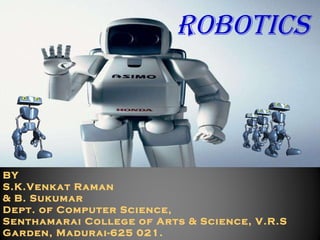
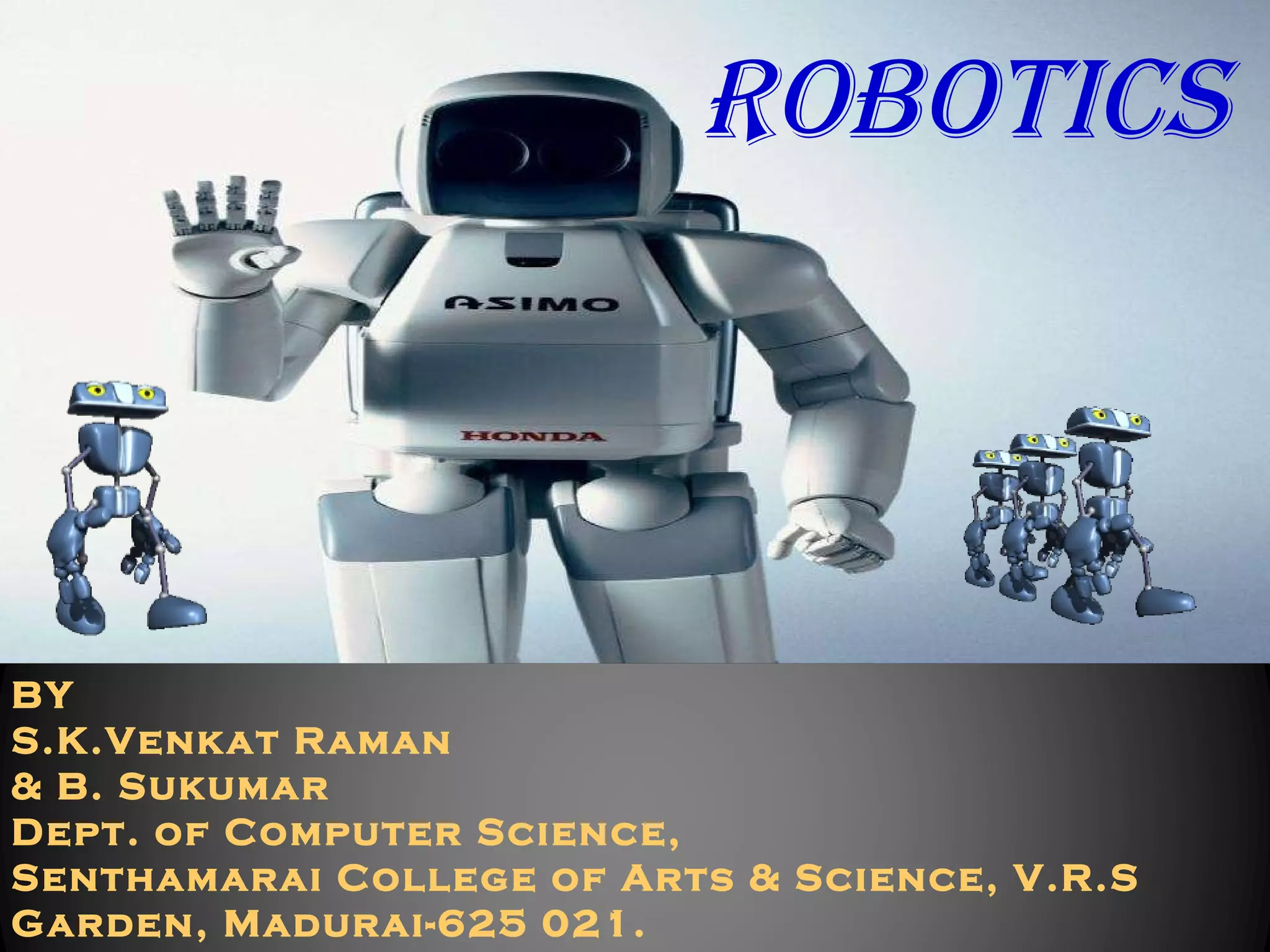
ROBOTICS BY S.K.Venkat Raman & B. Sukumar Dept. of Computer Science, Senthamarai College of Arts & Science, V.R.S Garden, Madurai-625 021.
CONTENTS Robotics What is Robotics ?  Laws of Robotics Types of robots Why Robotics is Needed? Components of robots Industries Using Robotics Advantages Future prospects Conclusion
ROBOTICS It is a field of Engineering that covers the mimicking of human behavior. Robotics includes the knowledge of Mechanical, Electronics, Electrical & Computer Science Engineering.
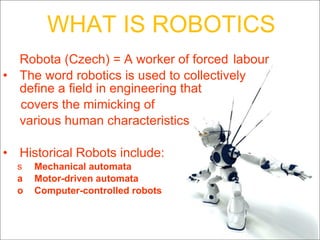
Robota (Czech) = A worker of forced  labour The word robotics is used to collectively define a field in engineering that covers the mimicking of  various human characteristics   Historical Robots include: Mechanical automata  Motor-driven automata  Computer-controlled robots   WHAT IS ROBOTICS
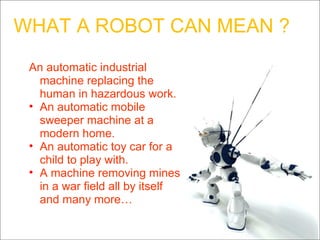
WHAT A ROBOT CAN MEAN ? An automatic industrial machine replacing the human in hazardous work. An automatic mobile sweeper machine at a modern home. An automatic toy car for a child to play with. A machine removing mines in a war field all by itself and many more…
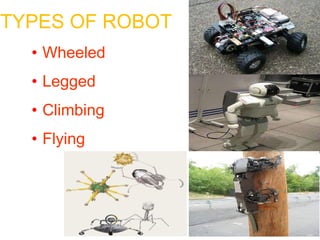
TYPES OF ROBOT  Wheeled Legged Climbing Flying
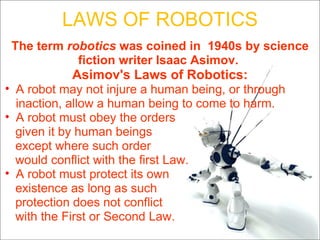
LAWS OF ROBOTICS The term  robotics  was coined in  1940s by science fiction writer Isaac Asimov.  Asimov's Laws of Robotics: A robot may not injure a human being, or through inaction, allow a human being to come to harm. A robot must obey the orders  given it by human beings  except where such order would conflict with the first Law.  A robot must protect its own  existence as long as such protection does not conflict with the First or Second Law.
WHY ROBOTICS IS NEEDED ?   Because Of Speed. It can work hazardous/dangerous environment. To perform repetitive task. Of efficiency Of accuracy Of adaptability
COMPONENTS OF ROBOTS Structure Power source Actuation  Sensing  Manipulation  Locomotion
STRUCTURE The structure of a robot is usually mostly mechanical and can be called a kinematic chain. The chain is formed  of links (its bones),  actuators (its muscles),  and joints which can  allow one or more  degrees of freedom.
POWER SUPPLY Suitable power supply is needed to run the motors and associated circuitry Typical power requirement ranges from 3V to 24V DC 220V AC supply must be modified to suit the needs of our machine Batteries can also be used to run robots Robots are driven by different motors :- DC Motors Stepper Motors  Servo Motors
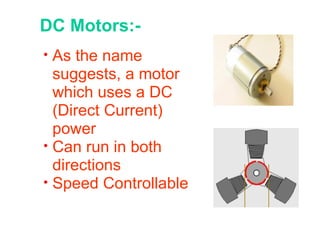
DC Motors:- As the name suggests, a motor which uses a DC (Direct Current) power Can run in both directions Speed Controllable
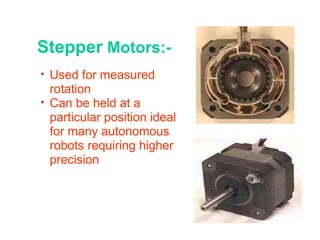
Stepper  Motors:- Used for measured rotation Can be held at a particular position ideal  for many autonomous robots requiring higher precision
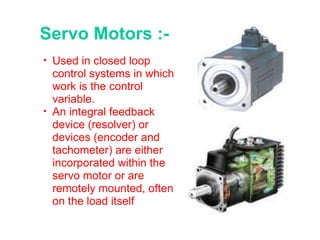
Servo Motors :- Used in closed loop control systems in which work is the control variable. An integral feedback device (resolver) or devices (encoder and tachometer) are either incorporated within the servo motor or are remotely mounted, often on the load itself
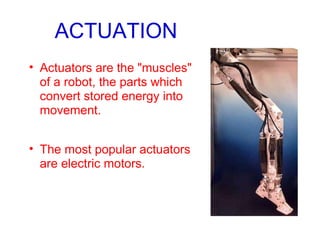
ACTUATION Actuators are the "muscles" of a robot, the parts which convert stored energy into movement. The most popular actuators are electric motors.
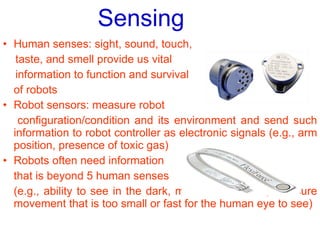
Sensing   Human senses: sight, sound, touch, taste, and smell provide us vital  information to function and survival of robots Robot sensors: measure robot  configuration/condition and its environment and send such information to robot controller as electronic signals (e.g., arm position, presence of toxic gas) Robots often need information  that is beyond 5 human senses  (e.g., ability to see in the dark, measure radiation, measure movement that is too small or fast for the human eye to see)
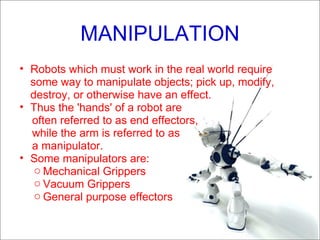
MANIPULATION Robots which must work in the real world require some way to manipulate objects; pick up, modify, destroy, or otherwise have an effect. Thus the 'hands' of a robot are  often referred to as end effectors,  while the arm is referred to as  a manipulator. Some manipulators are: Mechanical Grippers Vacuum Grippers  General purpose effectors
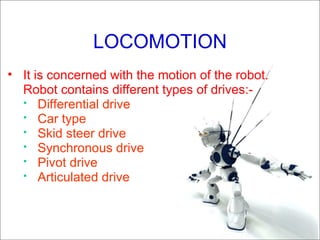
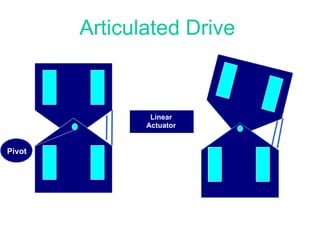
LOCOMOTION It is concerned with the motion of the robot. Robot contains different types of drives:-  Differential drive Car type Skid steer drive Synchronous drive Pivot drive Articulated drive
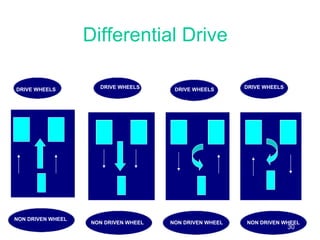
DRIVE WHEELS DRIVE WHEELS DRIVE WHEELS DRIVE WHEELS NON DRIVEN WHEEL NON DRIVEN WHEEL NON DRIVEN WHEEL NON DRIVEN WHEEL Differential Drive 30
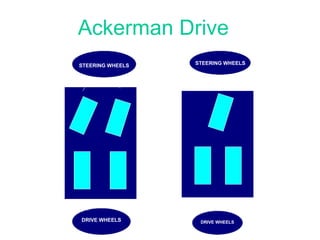
STEERING WHEELS STEERING WHEELS DRIVE WHEELS DRIVE WHEELS Ackerman Drive
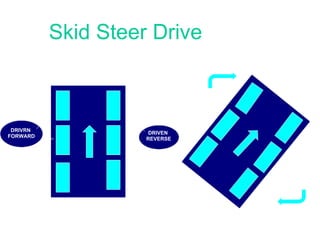
DRIVRN  FORWARD DRIVEN  REVERSE Skid Steer Drive
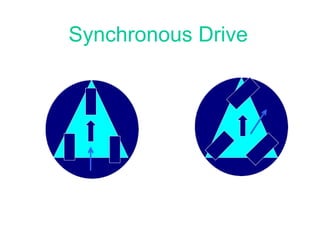
Synchronous Drive
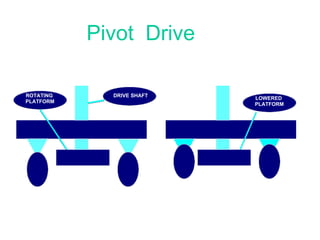
DRIVE SHAFT ROTATING  PLATFORM LOWERED  PLATFORM Pivot  Drive
Pivot Linear Actuator Articulated Drive
Industries Using Robotics Agriculture Construction Transportation: air, ground, rail, space, etc. Military, surveillance, attack, etc. Entertainment Health care Manufacturing Mining Automobile Warehouses
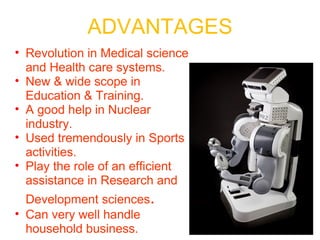
ADVANTAGES Revolution in Medical science and Health care systems.  New & wide scope in Education & Training. A good help in Nuclear industry. Used tremendously in Sports activities. Play the role of an efficient assistance in Research and Development sciences . Can very well handle household business.
FUTURE PROSPECTS Scientists say that it is possible that a robot brain will exist by 2019 . In 2009, some robots acquired various forms of semi-autonomy, including being able to find power sources on their own. The  Association for the  Advancement of Artificial  Intelligence  has researched on this problem.
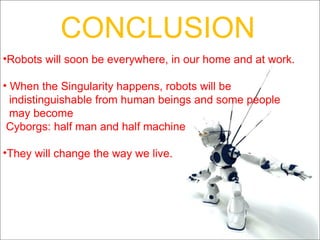
CONCLUSION Robots will soon be everywhere, in our home and at work. When the Singularity happens, robots will be  indistinguishable from human beings and some people  may become Cyborgs: half man and half machine They will change the way we live.
Thank you

Robotics.fair

  • 1.
    ROBOTICS BY S.K.VenkatRaman & B. Sukumar Dept. of Computer Science, Senthamarai College of Arts & Science, V.R.S Garden, Madurai-625 021.
  • 2.
    CONTENTS Robotics Whatis Robotics ? Laws of Robotics Types of robots Why Robotics is Needed? Components of robots Industries Using Robotics Advantages Future prospects Conclusion
  • 3.
    ROBOTICS It isa field of Engineering that covers the mimicking of human behavior. Robotics includes the knowledge of Mechanical, Electronics, Electrical & Computer Science Engineering.
  • 4.
    Robota (Czech) =A worker of forced labour The word robotics is used to collectively define a field in engineering that covers the mimicking of various human characteristics Historical Robots include: Mechanical automata Motor-driven automata Computer-controlled robots WHAT IS ROBOTICS
  • 5.
    WHAT A ROBOTCAN MEAN ? An automatic industrial machine replacing the human in hazardous work. An automatic mobile sweeper machine at a modern home. An automatic toy car for a child to play with. A machine removing mines in a war field all by itself and many more…
  • 6.
    TYPES OF ROBOT Wheeled Legged Climbing Flying
  • 7.
    LAWS OF ROBOTICSThe term robotics was coined in 1940s by science fiction writer Isaac Asimov. Asimov's Laws of Robotics: A robot may not injure a human being, or through inaction, allow a human being to come to harm. A robot must obey the orders given it by human beings except where such order would conflict with the first Law. A robot must protect its own existence as long as such protection does not conflict with the First or Second Law.
  • 8.
    WHY ROBOTICS ISNEEDED ? Because Of Speed. It can work hazardous/dangerous environment. To perform repetitive task. Of efficiency Of accuracy Of adaptability
  • 9.
    COMPONENTS OF ROBOTSStructure Power source Actuation Sensing Manipulation Locomotion
  • 10.
    STRUCTURE The structureof a robot is usually mostly mechanical and can be called a kinematic chain. The chain is formed of links (its bones), actuators (its muscles), and joints which can allow one or more degrees of freedom.
  • 11.
    POWER SUPPLY Suitablepower supply is needed to run the motors and associated circuitry Typical power requirement ranges from 3V to 24V DC 220V AC supply must be modified to suit the needs of our machine Batteries can also be used to run robots Robots are driven by different motors :- DC Motors Stepper Motors Servo Motors
  • 12.
    DC Motors:- Asthe name suggests, a motor which uses a DC (Direct Current) power Can run in both directions Speed Controllable
  • 13.
    Stepper Motors:-Used for measured rotation Can be held at a particular position ideal for many autonomous robots requiring higher precision
  • 14.
    Servo Motors :-Used in closed loop control systems in which work is the control variable. An integral feedback device (resolver) or devices (encoder and tachometer) are either incorporated within the servo motor or are remotely mounted, often on the load itself
  • 15.
    ACTUATION Actuators arethe "muscles" of a robot, the parts which convert stored energy into movement. The most popular actuators are electric motors.
  • 16.
    Sensing Human senses: sight, sound, touch, taste, and smell provide us vital information to function and survival of robots Robot sensors: measure robot configuration/condition and its environment and send such information to robot controller as electronic signals (e.g., arm position, presence of toxic gas) Robots often need information that is beyond 5 human senses (e.g., ability to see in the dark, measure radiation, measure movement that is too small or fast for the human eye to see)
  • 17.
    MANIPULATION Robots whichmust work in the real world require some way to manipulate objects; pick up, modify, destroy, or otherwise have an effect. Thus the 'hands' of a robot are often referred to as end effectors, while the arm is referred to as a manipulator. Some manipulators are: Mechanical Grippers Vacuum Grippers General purpose effectors
  • 18.
    LOCOMOTION It isconcerned with the motion of the robot. Robot contains different types of drives:- Differential drive Car type Skid steer drive Synchronous drive Pivot drive Articulated drive
  • 19.
    DRIVE WHEELS DRIVEWHEELS DRIVE WHEELS DRIVE WHEELS NON DRIVEN WHEEL NON DRIVEN WHEEL NON DRIVEN WHEEL NON DRIVEN WHEEL Differential Drive 30
  • 20.
    STEERING WHEELS STEERINGWHEELS DRIVE WHEELS DRIVE WHEELS Ackerman Drive
  • 21.
    DRIVRN FORWARDDRIVEN REVERSE Skid Steer Drive
  • 22.
  • 23.
    DRIVE SHAFT ROTATING PLATFORM LOWERED PLATFORM Pivot Drive
  • 24.
    Pivot Linear ActuatorArticulated Drive
  • 25.
    Industries Using RoboticsAgriculture Construction Transportation: air, ground, rail, space, etc. Military, surveillance, attack, etc. Entertainment Health care Manufacturing Mining Automobile Warehouses
  • 26.
    ADVANTAGES Revolution inMedical science and Health care systems. New & wide scope in Education & Training. A good help in Nuclear industry. Used tremendously in Sports activities. Play the role of an efficient assistance in Research and Development sciences . Can very well handle household business.
  • 27.
    FUTURE PROSPECTS Scientistssay that it is possible that a robot brain will exist by 2019 . In 2009, some robots acquired various forms of semi-autonomy, including being able to find power sources on their own. The Association for the Advancement of Artificial Intelligence has researched on this problem.
  • 28.
    CONCLUSION Robots willsoon be everywhere, in our home and at work. When the Singularity happens, robots will be indistinguishable from human beings and some people may become Cyborgs: half man and half machine They will change the way we live.
  • 29.