THE WORLD OF
ROBOTICS & ROBOTS
by
M.RAMKI
X
ROBOTICS
The word robotics is used to collectively define a field
in engineering that covers the mimicking of various
human characteristics.
Robotics includes the knowledge of Mechanical,
Electronics, Electrical & Computer Science
Engineering.
It may be human controlled or automatic.
It must be able to perform certain tasks we set for it.
The desired task must be achieved within some given
limitations.
LAWS OF ROBOTICS
The term Robotics was coined in the 1940s
by science fiction writer Isaac Asimov.
Asimov's Laws of Robotics:
• First Law A robot may not injure a human being, or,
through inaction, allow a human being to come to
harm.
• Second Law A robot must obey orders given it by
human beings, except where such orders would
conflict with the First Law.
• Third Law A robot must protect its own existence as
long as such protection does not conflict with the
First or Second Law.
ROBOTS
A Robot is a “Re-programmable, multifunctional
manipulator designed to move material, parts,
tools, or specialized devices through various
programmed motions for the performance of a
variety of tasks.”
A Robot can also be an automatic industrial machine
replacing the human in hazardous work.
The meaning of the word Robot is:
Robota (Czech) = A worker of forced labour
The Japanese Industrial Robot Association(JIRA) states:
A robot is a device with degrees of freedom that can
be controlled.
The Robots can be classified in two
categories:
Autonomous : This kind of Robot
works totally by
itself(programmable). This type of
Robot is the major king of Robot in
the present day world.
Manual : This kind Robot is
programmed first, then the sensors
are fixed to it, then when humans
command it, it receives command
through the sensors. This type of
Robots are used while teaching
Robotics.
HISTORICAL ROBOTS INCLUDE:
Mechanical automata
The Robot moves or does the work mechanically without any
programming.
Motor-driven automata
The Robot moves or does the work with the help of motors.
Some are programmed and some are not programmed.
Computer-controlled robots
The Robot is totally programmable and is controlled by
computers.
LANGUAGES USED BY A ROBOT
RoboML (Robotic Markup Language)
ROSSUM
XRCL (Extensible Robot Control Language)
Robot Ants
James McLurkin invented micro robots that work together as
a community and were known as Robot Ants.
CAPABILITIES OF A ROBOT
A robot must have the following essential characteristics:
• Mobility: A Robot should possess some form of mobility.
• Programmability: A Robot should imply computational or symbol-
manipulative capabilities that a designer can combine as desired(a
robot is a form of computer). It should be able to be programmed
to accomplish a large variety of tasks. After being programmed, it
should operate automatically or manually.
• Sensors: A Robot should be to sense the environment and give
useful feedback to any device or human.
• Mechanical capability: A Robot should be able to enable it to act
on its environment rather than just merely function as a data
processing or computational device.
• Flexibility: A Robot must be able to be operated using a range of
programs and manipulate and transport materials in a variety of
ways.
EXAMPLES OF ROBOTS
— Automatic Toy Car
An automatic toy car for a child to play with.
— Mobile Sweeper Machine
An automatic mobile sweeper machine at a modern
home.
— Machines removing mines
A machine removing mines in a war field all by itself.
— Escape Robot
— Solar Beam Robot
An Example
Line Follower
• A line follower is a robot capable of tracking a
line drawn on a surface.
• Optical sensors capture the line position at the
front end of the robot.
• The robot is steered to keep it always over the
line.
TYPES OF ROBOTS
Wheeled Robots
Legged Robots
Climbing Robots
Flying Robots
BODY OF ROBOTS
Structure
– The structure of a robot is usually mostly mechanical
and can be called a kinematic chain.
– The chain is formed of links (its bones), actuators (its
muscles), and joints which can allow one or more
degrees of freedom.
Power source
– Suitable power supply is needed to run the motors
and associated circuitry
– Typical power requirement ranges from 3V to 24V DC
– Batteries can also be used to run robots
– Robots are driven by different motors :-
DC Motors
Stepper Motors
Servo Motors
DC Motors
Servo Motors
Stepper Motors
Actuation
Actuators are like the "muscles" of a robot, they
are the parts which convert stored energy into
movement. The most popular actuators are
electric motors that spin a wheel or gear, and
linear actuators that control industrial robots in
factories. But there are some recent advances in
alternative types of actuators, powered by
electricity, chemicals, or compressed air.
These are the things or parts which provide
movement to a robot.
• Electric motors
• Linear actuators
• Series elastic actuators
• Air muscles
• Muscle wire
• Electro active polymers
• Piezo motors
• Elastic nano tubes
Sensors
Sensors are the parts that act like senses and can
detect objects or things like heat and light and
convert the object information into symbols or
digital form so that computers understand. Then
Robots react according to information provided by
the sensory system.
Some types of sensors are:
• Vision Sensor
• Proximity Sensors
• Proprioceptive Sensors
• Logical Sensors
Manipulation
Robots which must work in the real world require
some way to manipulate objects:
pick up,
modify,
destroy, or
otherwise have an effect.
Thus the 'hands' of a robot are often referred to as end
effectors, while the arm is referred to as a
manipulator.
Some manipulators are:
• Mechanical Grippers
• Vacuum Grippers
• General purpose effectors
Locomotion
As the name suggests a mobile robot must have a
system to make it move.
This system gives a machine the ability to move
forward, backward and take turns.
It may also provide the ability for climbing up and
down any object.
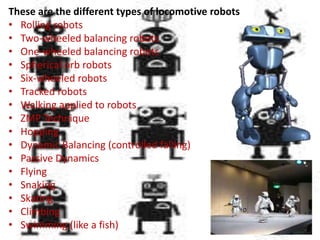
These are the different types of locomotive robots
• Rolling robots
• Two-wheeled balancing robots
• One-wheeled balancing robots
• Spherical orb robots
• Six-wheeled robots
• Tracked robots
• Walking applied to robots
• ZMP Technique
• Hopping
• Dynamic Balancing (controlled falling)
• Passive Dynamics
• Flying
• Snaking
• Skating
• Climbing
• Swimming (like a fish)
W F S ROBOTS
iCub robot, designed by the Robot Cub
Consortium
RQ-4 Global Hawk unmanned aerial vehicle
Two robot snakes. Left one has 64 motors
(with 2 degrees of freedom per segment),
the right one has 10 motors.
WHERE CAN ROBOTS BE USED
HOME
House cleaning
Lawn mowing
Assistance to the elderly and
handicapped
INDUSTRY
Office assistants
Repetitive tasks
High speed
Few sensing operations
High precision movements
Pre-planned trajectories and
task policies
No interaction with humans
ROBOTS AT WORK
House cleaning robots. Car industry robots.
Robots in school Robots in medicine
Robots at war Robots as
entertainment
WHY ROBOTICS
These are some reasons why we need a Robot or why we need Robotics.
Speed
It can work in hazardous/dangerous environment.
To perform repetitive task.
Efficiency
Accuracy
Adaptability
These are the things which the Robots can do if we create them.
– Robots can make ‘Revolution in Medical science and Health care systems’.
– Robots can be useful for ‘New & wide scope in Education & Training’.
– Robots can be ‘a good help in Nuclear industry’.
– Robots can be ‘Used tremendously in Sports activities’.
– Robots can ‘Play the role of an efficient assistance in Research and
Development sciences’.
– Robots ‘Can very well handle household business’.
ROBOTS LEARNING HOW TO WALK
CURRENT ROBOTS IN THE GROWING WORLD
– Sensor-rich
The whole Robots works with sensors to act according to
the situation and environment.
– Flexible
Robots make sure that no part of their body falls.
– Versatile
– Controllable
The Robots can control their body and they can also
control their functions.
HYTECH ROBOTS
PROBLEMS OF ROBOTS
These are some of the problems that we can see in robots.
Basically
◦ No sensing
◦ Can not handle uncertainty
◦ No interaction with humans
◦ Reliance on perfect task information
◦ Complete re-programming for new tasks
Scientifically
Sensor Uncertainty:
◦ Sensor readings are imprecise and unreliable
Non-observing:
◦ Various aspects of the environment can not be observed
◦ The environment is initially unknown
Action Uncertainty:
◦ Actions can fail
◦ Actions have nondeterministic outcomes
FUTURE PROSPECTS OF ROBOTS
 Scientists say that it is possible that a robot
brain will exist by 2019 .
 Vernor Vinge has suggested that a moment
may come when computers and robots are
smarter than humans.
 In 2009, some robots acquired various forms
of semi-autonomy, including being able to
find power sources on their own. The
Association for the Advancement of Artificial
Intelligence(AAAI) has researched on this
problem.
Future Home Robots
© Peter Menzel / MIT AI Lab
© Honda Corp
How Does NASA Use Robots?
NASA uses robots in many different ways.
Robotic arms on spacecraft can move large objects
in space.
Robotic spacecraft can visit other worlds.
Robotic airplanes can fly without a pilot aboard.
NASA is studying more new types of robots.
What is a Robonaut?
A Robonaut is a dexterous humanoid robot built and
designed at NASA Johnson Space Center in Houston,
Texas. NASA’s challenge is to build machines that can
help humans work and explore in space. Working side
by side with humans, or going where the risks are too
great for people, Robonauts will expand NASA’s ability
for construction and discovery. NASA’s challenge has
been to build machines with dexterity that exceeds
that of a suited astronaut.
Robonauts allow NASA to study various types of
mobility, control methods, and task applications. The
value of a humanoid over other designs is the ability to
use the same workspace and tools Robonauts are
essential to NASA's future as NASA goes beyond low
earth orbit and continues to explore the vast wonder
SPHERES
Another robot idea is called SPHERES. These
small robots look a little like soccer balls.
SPHERES are being used on the space
station to test how well they can move there.
Someday, robots could fly around the
station helping astronauts – ASPECT OF
NASA.
SPHERES robots have been and are being
tested on the International Space Station.
NASA ROBOTS
Robonaut sent its first tweet on July 26, 2010,
with the help of its team.
NASA and General Motors have come
together to develop the next-generation
dexterous humanoid robot.
Robonaut could perform tasks that astronauts otherwise would have to do.
The R2 the new humanoid robot of NASA
Dextre is attached to the end of the
International Space Station's robotic arm.
Image Credit: NASA
Spirit is one of a group of robots that have
explored Mars from the surface or from
orbit. Image Credit: NASA
TOPIO, a humanoid robot, played ping pong at
Tokyo International Robot Exhibition (IREX) 2009.
HUMANOID ROBOTS
MOVIES ON ROBOTS & ROBOTICS
Scary robot movies - Death Machine, Screamers, Deadly Friend.
Action packed robot movies - Solo, Transformers: Revenge of the
Fallen, Enthiran.
Funny robot movies - WALL-E, Space balls, Robots.
Classic robot movies - Metropolis, Forbidden Planet, Alpha ville.
Scientific robot movies - The Terminator, West world, I, Robot.
Robots and Technology

Robots and Technology

  • 1.
    THE WORLD OF ROBOTICS& ROBOTS by M.RAMKI X
  • 3.
    ROBOTICS The word roboticsis used to collectively define a field in engineering that covers the mimicking of various human characteristics. Robotics includes the knowledge of Mechanical, Electronics, Electrical & Computer Science Engineering. It may be human controlled or automatic. It must be able to perform certain tasks we set for it. The desired task must be achieved within some given limitations.
  • 4.
    LAWS OF ROBOTICS Theterm Robotics was coined in the 1940s by science fiction writer Isaac Asimov. Asimov's Laws of Robotics: • First Law A robot may not injure a human being, or, through inaction, allow a human being to come to harm. • Second Law A robot must obey orders given it by human beings, except where such orders would conflict with the First Law. • Third Law A robot must protect its own existence as long as such protection does not conflict with the First or Second Law.
  • 6.
    ROBOTS A Robot isa “Re-programmable, multifunctional manipulator designed to move material, parts, tools, or specialized devices through various programmed motions for the performance of a variety of tasks.” A Robot can also be an automatic industrial machine replacing the human in hazardous work. The meaning of the word Robot is: Robota (Czech) = A worker of forced labour The Japanese Industrial Robot Association(JIRA) states: A robot is a device with degrees of freedom that can be controlled.
  • 7.
    The Robots canbe classified in two categories: Autonomous : This kind of Robot works totally by itself(programmable). This type of Robot is the major king of Robot in the present day world. Manual : This kind Robot is programmed first, then the sensors are fixed to it, then when humans command it, it receives command through the sensors. This type of Robots are used while teaching Robotics.
  • 8.
    HISTORICAL ROBOTS INCLUDE: Mechanicalautomata The Robot moves or does the work mechanically without any programming. Motor-driven automata The Robot moves or does the work with the help of motors. Some are programmed and some are not programmed. Computer-controlled robots The Robot is totally programmable and is controlled by computers. LANGUAGES USED BY A ROBOT RoboML (Robotic Markup Language) ROSSUM XRCL (Extensible Robot Control Language) Robot Ants James McLurkin invented micro robots that work together as a community and were known as Robot Ants.
  • 9.
    CAPABILITIES OF AROBOT A robot must have the following essential characteristics: • Mobility: A Robot should possess some form of mobility. • Programmability: A Robot should imply computational or symbol- manipulative capabilities that a designer can combine as desired(a robot is a form of computer). It should be able to be programmed to accomplish a large variety of tasks. After being programmed, it should operate automatically or manually. • Sensors: A Robot should be to sense the environment and give useful feedback to any device or human. • Mechanical capability: A Robot should be able to enable it to act on its environment rather than just merely function as a data processing or computational device. • Flexibility: A Robot must be able to be operated using a range of programs and manipulate and transport materials in a variety of ways.
  • 10.
    EXAMPLES OF ROBOTS —Automatic Toy Car An automatic toy car for a child to play with. — Mobile Sweeper Machine An automatic mobile sweeper machine at a modern home. — Machines removing mines A machine removing mines in a war field all by itself. — Escape Robot — Solar Beam Robot
  • 11.
    An Example Line Follower •A line follower is a robot capable of tracking a line drawn on a surface. • Optical sensors capture the line position at the front end of the robot. • The robot is steered to keep it always over the line.
  • 12.
  • 13.
  • 14.
  • 15.
  • 16.
    BODY OF ROBOTS Structure –The structure of a robot is usually mostly mechanical and can be called a kinematic chain. – The chain is formed of links (its bones), actuators (its muscles), and joints which can allow one or more degrees of freedom.
  • 17.
    Power source – Suitablepower supply is needed to run the motors and associated circuitry – Typical power requirement ranges from 3V to 24V DC – Batteries can also be used to run robots – Robots are driven by different motors :- DC Motors Stepper Motors Servo Motors
  • 18.
  • 19.
    Actuation Actuators are likethe "muscles" of a robot, they are the parts which convert stored energy into movement. The most popular actuators are electric motors that spin a wheel or gear, and linear actuators that control industrial robots in factories. But there are some recent advances in alternative types of actuators, powered by electricity, chemicals, or compressed air.
  • 20.
    These are thethings or parts which provide movement to a robot. • Electric motors • Linear actuators • Series elastic actuators • Air muscles • Muscle wire • Electro active polymers • Piezo motors • Elastic nano tubes
  • 21.
    Sensors Sensors are theparts that act like senses and can detect objects or things like heat and light and convert the object information into symbols or digital form so that computers understand. Then Robots react according to information provided by the sensory system. Some types of sensors are: • Vision Sensor • Proximity Sensors • Proprioceptive Sensors • Logical Sensors
  • 22.
    Manipulation Robots which mustwork in the real world require some way to manipulate objects: pick up, modify, destroy, or otherwise have an effect. Thus the 'hands' of a robot are often referred to as end effectors, while the arm is referred to as a manipulator. Some manipulators are: • Mechanical Grippers • Vacuum Grippers • General purpose effectors
  • 23.
    Locomotion As the namesuggests a mobile robot must have a system to make it move. This system gives a machine the ability to move forward, backward and take turns. It may also provide the ability for climbing up and down any object.
  • 24.
    These are thedifferent types of locomotive robots • Rolling robots • Two-wheeled balancing robots • One-wheeled balancing robots • Spherical orb robots • Six-wheeled robots • Tracked robots • Walking applied to robots • ZMP Technique • Hopping • Dynamic Balancing (controlled falling) • Passive Dynamics • Flying • Snaking • Skating • Climbing • Swimming (like a fish)
  • 25.
    W F SROBOTS iCub robot, designed by the Robot Cub Consortium RQ-4 Global Hawk unmanned aerial vehicle Two robot snakes. Left one has 64 motors (with 2 degrees of freedom per segment), the right one has 10 motors.
  • 26.
    WHERE CAN ROBOTSBE USED HOME House cleaning Lawn mowing Assistance to the elderly and handicapped INDUSTRY Office assistants Repetitive tasks High speed Few sensing operations High precision movements Pre-planned trajectories and task policies No interaction with humans
  • 27.
    ROBOTS AT WORK Housecleaning robots. Car industry robots.
  • 28.
    Robots in schoolRobots in medicine
  • 29.
    Robots at warRobots as entertainment
  • 30.
    WHY ROBOTICS These aresome reasons why we need a Robot or why we need Robotics. Speed It can work in hazardous/dangerous environment. To perform repetitive task. Efficiency Accuracy Adaptability These are the things which the Robots can do if we create them. – Robots can make ‘Revolution in Medical science and Health care systems’. – Robots can be useful for ‘New & wide scope in Education & Training’. – Robots can be ‘a good help in Nuclear industry’. – Robots can be ‘Used tremendously in Sports activities’. – Robots can ‘Play the role of an efficient assistance in Research and Development sciences’. – Robots ‘Can very well handle household business’.
  • 31.
  • 32.
    CURRENT ROBOTS INTHE GROWING WORLD – Sensor-rich The whole Robots works with sensors to act according to the situation and environment. – Flexible Robots make sure that no part of their body falls. – Versatile – Controllable The Robots can control their body and they can also control their functions.
  • 33.
  • 34.
    PROBLEMS OF ROBOTS Theseare some of the problems that we can see in robots. Basically ◦ No sensing ◦ Can not handle uncertainty ◦ No interaction with humans ◦ Reliance on perfect task information ◦ Complete re-programming for new tasks Scientifically Sensor Uncertainty: ◦ Sensor readings are imprecise and unreliable Non-observing: ◦ Various aspects of the environment can not be observed ◦ The environment is initially unknown Action Uncertainty: ◦ Actions can fail ◦ Actions have nondeterministic outcomes
  • 36.
    FUTURE PROSPECTS OFROBOTS  Scientists say that it is possible that a robot brain will exist by 2019 .  Vernor Vinge has suggested that a moment may come when computers and robots are smarter than humans.  In 2009, some robots acquired various forms of semi-autonomy, including being able to find power sources on their own. The Association for the Advancement of Artificial Intelligence(AAAI) has researched on this problem.
  • 37.
    Future Home Robots ©Peter Menzel / MIT AI Lab © Honda Corp
  • 38.
    How Does NASAUse Robots? NASA uses robots in many different ways. Robotic arms on spacecraft can move large objects in space. Robotic spacecraft can visit other worlds. Robotic airplanes can fly without a pilot aboard. NASA is studying more new types of robots.
  • 39.
    What is aRobonaut? A Robonaut is a dexterous humanoid robot built and designed at NASA Johnson Space Center in Houston, Texas. NASA’s challenge is to build machines that can help humans work and explore in space. Working side by side with humans, or going where the risks are too great for people, Robonauts will expand NASA’s ability for construction and discovery. NASA’s challenge has been to build machines with dexterity that exceeds that of a suited astronaut. Robonauts allow NASA to study various types of mobility, control methods, and task applications. The value of a humanoid over other designs is the ability to use the same workspace and tools Robonauts are essential to NASA's future as NASA goes beyond low earth orbit and continues to explore the vast wonder
  • 40.
    SPHERES Another robot ideais called SPHERES. These small robots look a little like soccer balls. SPHERES are being used on the space station to test how well they can move there. Someday, robots could fly around the station helping astronauts – ASPECT OF NASA. SPHERES robots have been and are being tested on the International Space Station.
  • 41.
    NASA ROBOTS Robonaut sentits first tweet on July 26, 2010, with the help of its team. NASA and General Motors have come together to develop the next-generation dexterous humanoid robot.
  • 42.
    Robonaut could performtasks that astronauts otherwise would have to do. The R2 the new humanoid robot of NASA
  • 43.
    Dextre is attachedto the end of the International Space Station's robotic arm. Image Credit: NASA Spirit is one of a group of robots that have explored Mars from the surface or from orbit. Image Credit: NASA
  • 44.
    TOPIO, a humanoidrobot, played ping pong at Tokyo International Robot Exhibition (IREX) 2009.
  • 45.
  • 46.
    MOVIES ON ROBOTS& ROBOTICS Scary robot movies - Death Machine, Screamers, Deadly Friend. Action packed robot movies - Solo, Transformers: Revenge of the Fallen, Enthiran. Funny robot movies - WALL-E, Space balls, Robots. Classic robot movies - Metropolis, Forbidden Planet, Alpha ville. Scientific robot movies - The Terminator, West world, I, Robot.