SBE 403 B: Bioelectronic Systems (Biomedical Robotics)
Lecture 06
Navigation
Muhammad Rushdi
mrushdi@eng1.cu.edu.eg
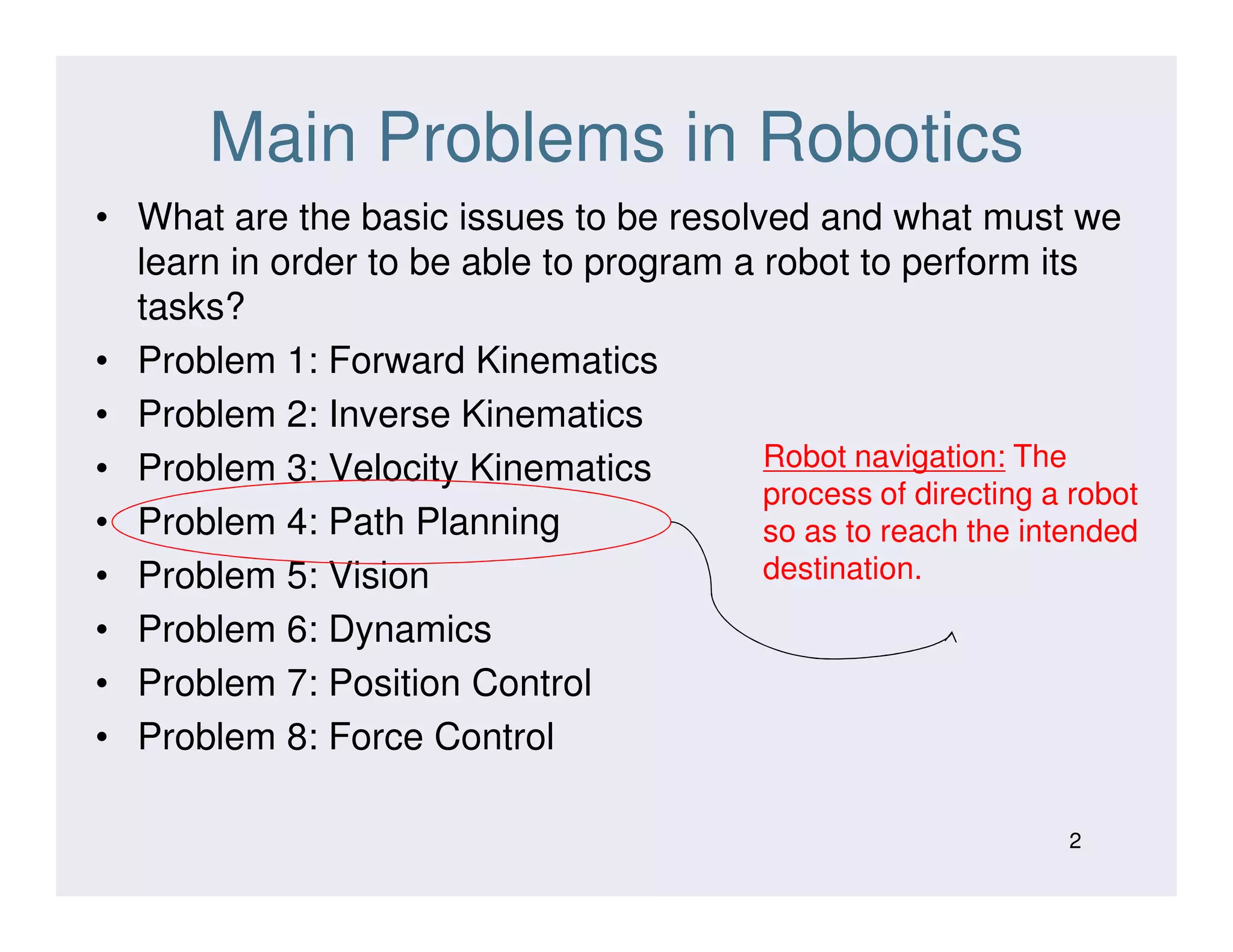
Main Problems in Robotics
• What are the basic issues to be resolved and what must we
learn in order to be able to program a robot to perform its
tasks?
• Problem 1: Forward Kinematics
• Problem 2: Inverse Kinematics
• Problem 3: Velocity Kinematics Robot navigation: The• Problem 3: Velocity Kinematics
• Problem 4: Path Planning
• Problem 5: Vision
• Problem 6: Dynamics
• Problem 7: Position Control
• Problem 8: Force Control
2
process of directing a robot
so as to reach the intended
destination.
Textbook
• Ch. 5 Navigation
Peter Corke:
Robotics, Vision andRobotics, Vision and
Control - Fundamental
Algorithms in MATLAB®.
http://www.petercorke.com/R
VC/
3
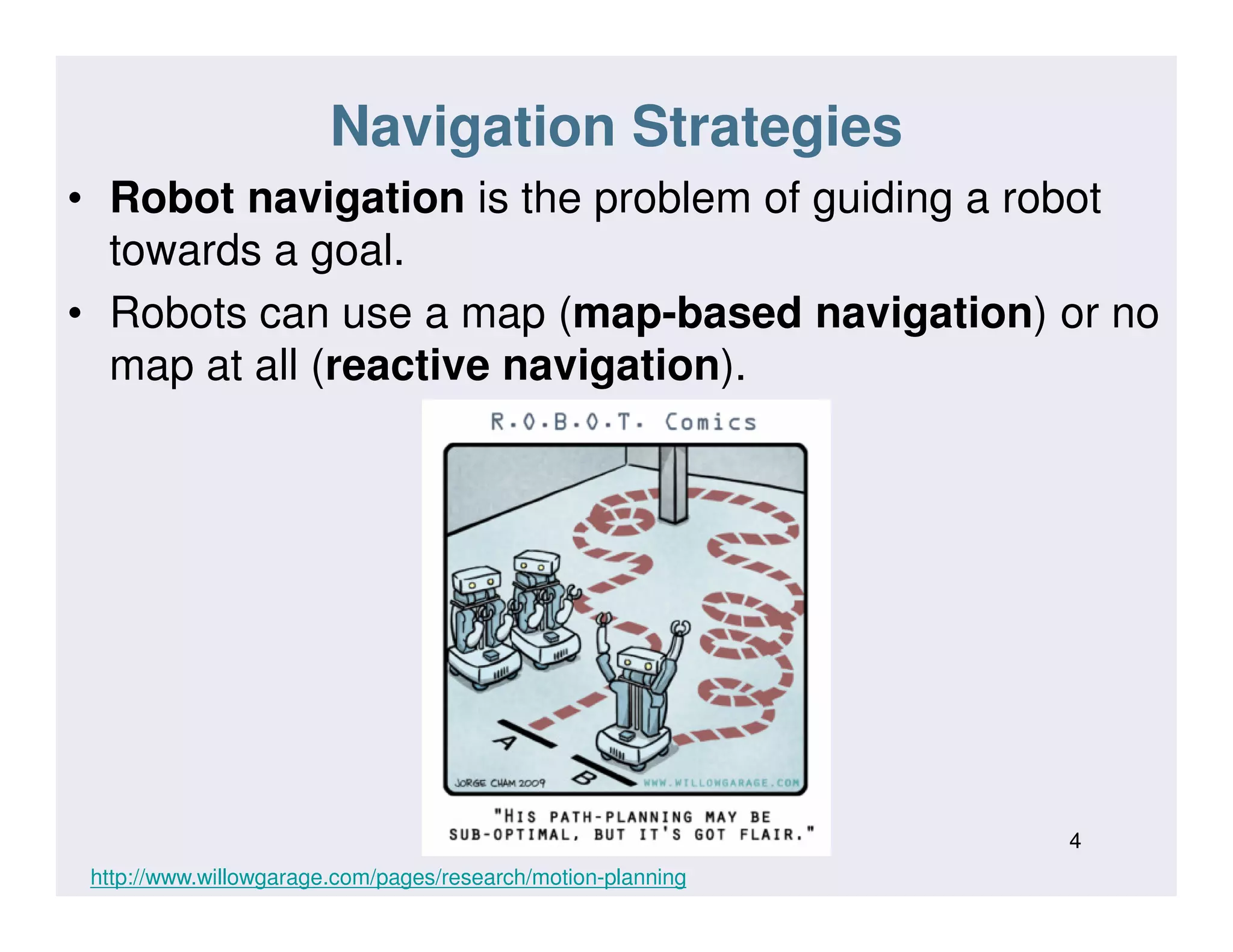
Navigation Strategies
• Robot navigation is the problem of guiding a robot
towards a goal.
• Robots can use a map (map-based navigation) or no
map at all (reactive navigation).
4
http://www.willowgarage.com/pages/research/motion-planning
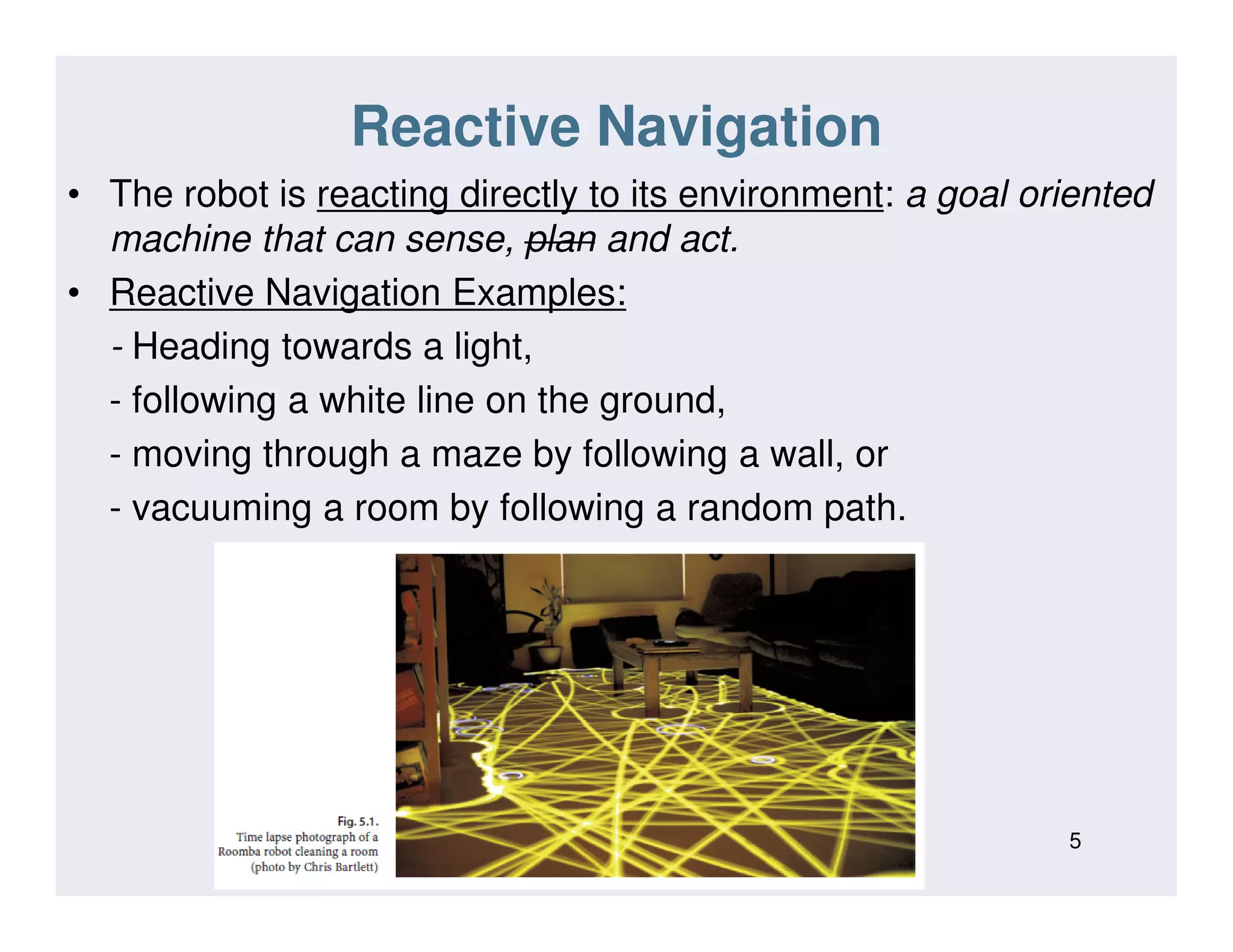
Reactive Navigation
• The robot is reacting directly to its environment: a goal oriented
machine that can sense, plan and act.
• Reactive Navigation Examples:
- Heading towards a light,
- following a white line on the ground,
- moving through a maze by following a wall, or
- vacuuming a room by following a random path.
5
Reactive Navigation: Braitenberg Vehicles
• A very simple class of goal achieving robots are known as
Braitenberg vehicles and are characterized by direct
connection between sensors and motors.
• They have no explicit internal representation of the environment
in which they operates and nor do they make explicit plans.
6Braitenberg Vehicles explore Reality
https://www.ini.uzh.ch/~conradt/research/BraitenbergVehicle/
Reactive Navigation: Braitenberg Vehicles
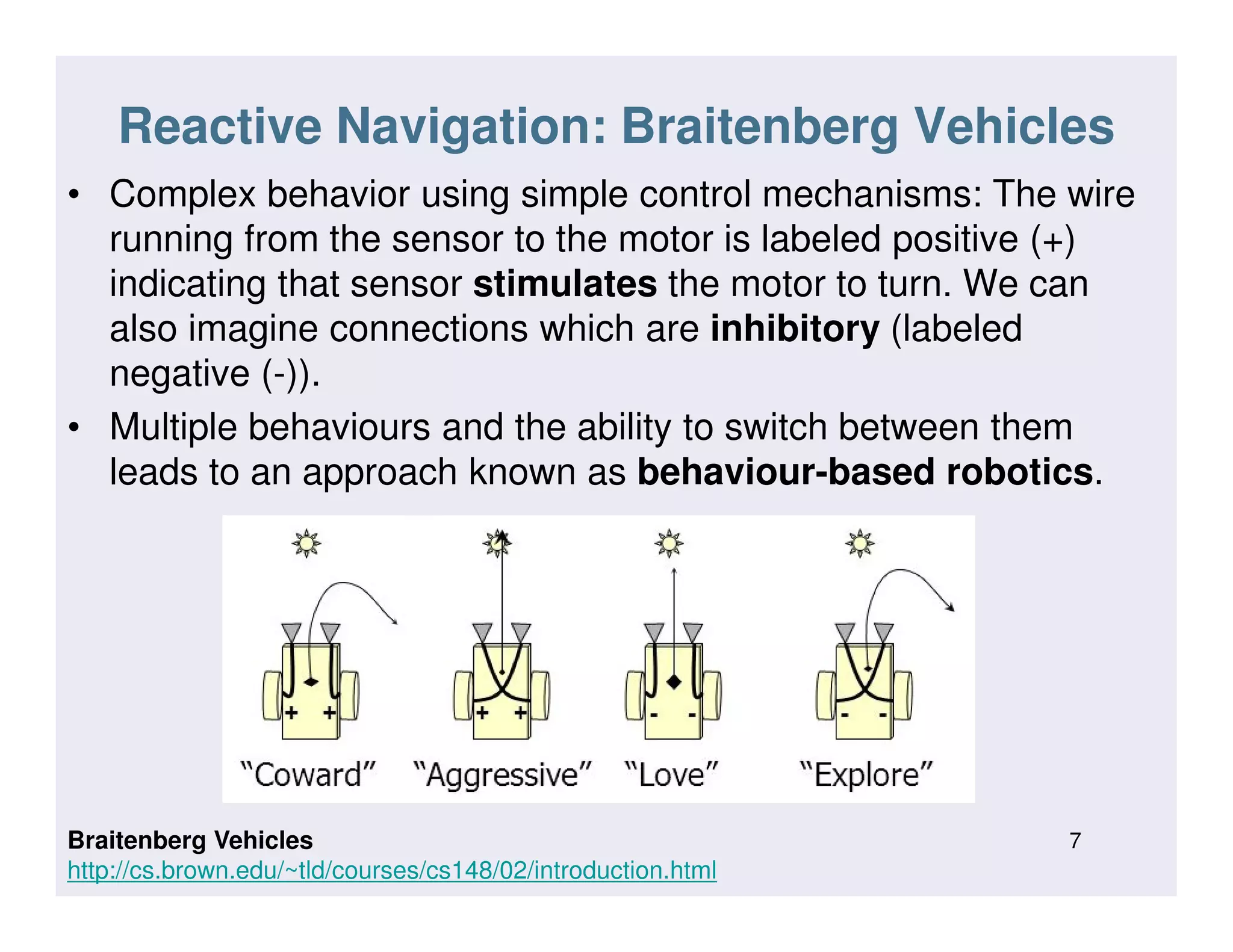
• Complex behavior using simple control mechanisms: The wire
running from the sensor to the motor is labeled positive (+)
indicating that sensor stimulates the motor to turn. We can
also imagine connections which are inhibitory (labeled
negative (-)).
• Multiple behaviours and the ability to switch between them
leads to an approach known as behaviour-based robotics.leads to an approach known as behaviour-based robotics.
7Braitenberg Vehicles
http://cs.brown.edu/~tld/courses/cs148/02/introduction.html
Braitenberg Vehicles: Simulink Model
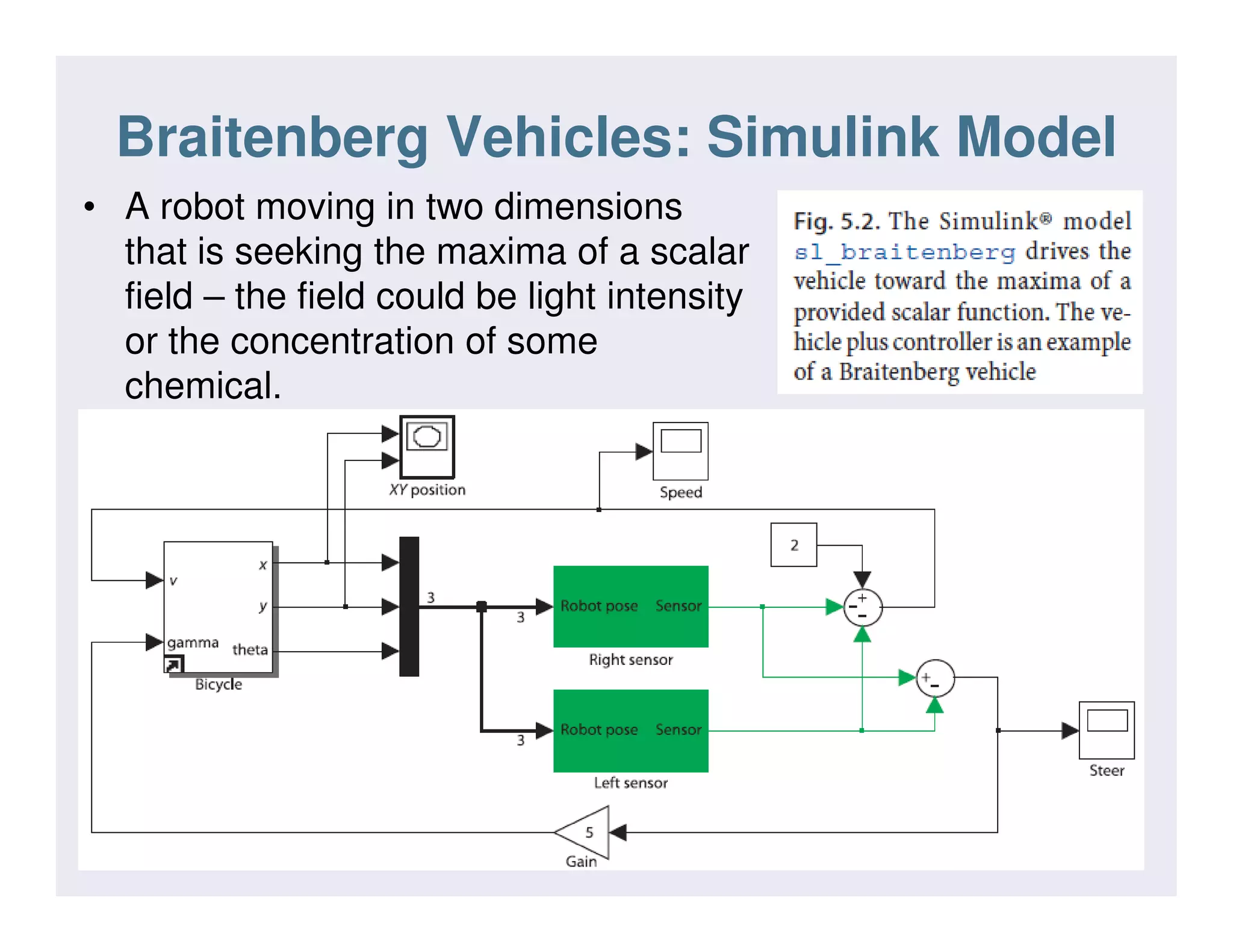
• A robot moving in two dimensions
that is seeking the maxima of a scalar
field – the field could be light intensity
or the concentration of some
chemical.
8
Braitenberg Vehicles: Simulink Model
• To ascend the gradient we need to estimate the
gradient direction at the current location and this
requires at least two measurements of the field.
• Use bilateral sensing: two sensors with one on
each side of the robot’s body. The sensors are
parameterized by the position of the sensor withparameterized by the position of the sensor with
respect to the robot’s body, and the sensing
function.
• In this example the sensors are at ±2 units in the
vehicle’s lateral or y-direction.
9
Braitenberg Vehicles: Simulink Model
• The field to be sensed is a simple inverse square field
defined by
∈which returns the sensor value s(x, y) ∈ [0, 1] which is a
function of the sensor’s position in the plane. This
particular function has a peak value at the point (60, 90).
10
Braitenberg Vehicles: Simulink Model
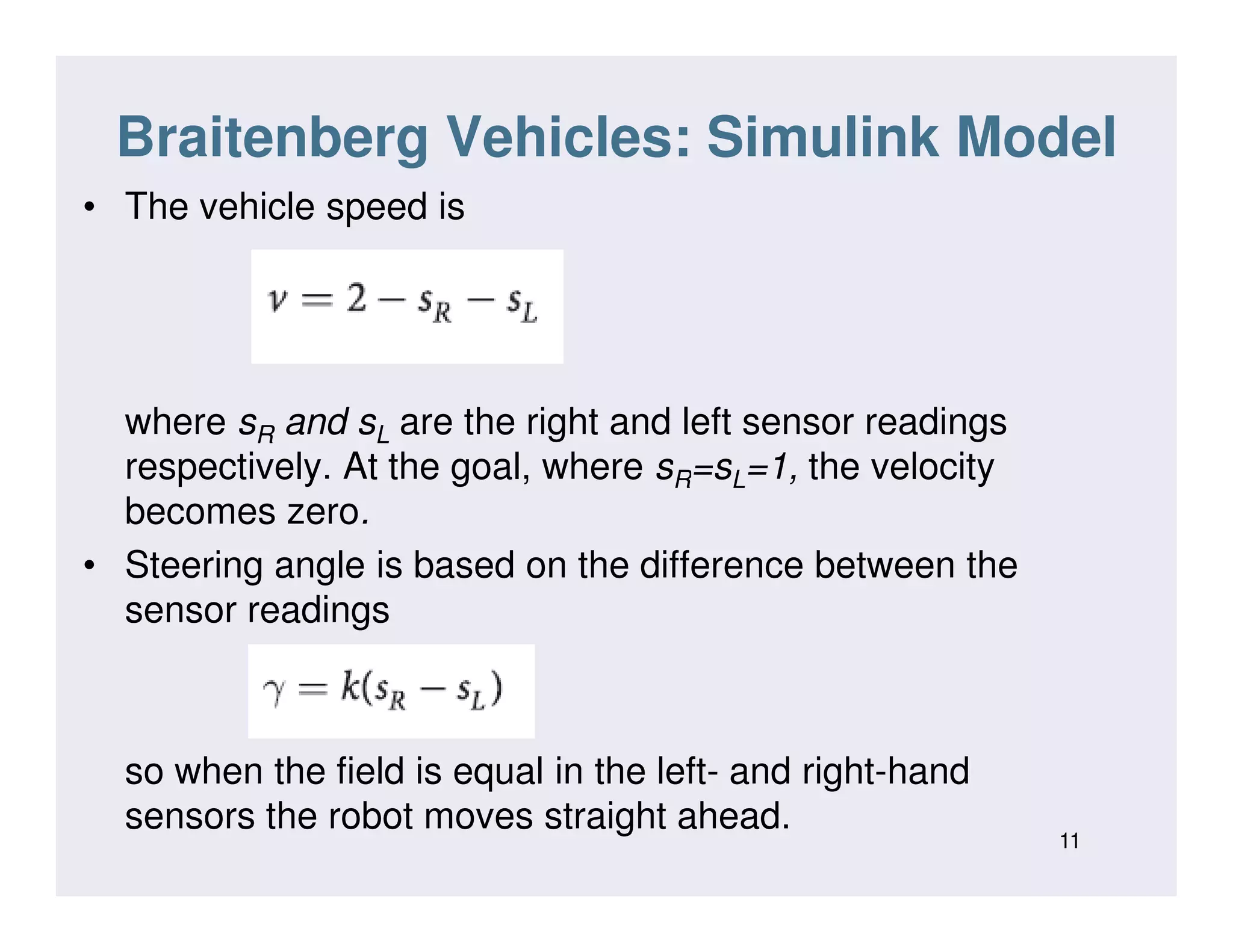
• The vehicle speed is
where sR and sL are the right and left sensor readings
respectively. At the goal, where sR=sL=1, the velocityrespectively. At the goal, where sR=sL=1, the velocity
becomes zero.
• Steering angle is based on the difference between the
sensor readings
so when the field is equal in the left- and right-hand
sensors the robot moves straight ahead.
11
Braitenberg Vehicles: Simulink Model
12
Reactive Navigation: Simple Automata
• Another class of reactive robots are known as bugs
– simple automata that perform goal seeking in the
presence of non-driveable areas or obstacles.
• There are a large number of bug algorithms and
they share the ability to sense when they are inthey share the ability to sense when they are in
proximity to an obstacle. In this respect they are
similar to the Braitenberg class vehicle, but the bug
includes a state machine and other logic in
between the sensor and the motors.
• The automata have memory which our earlier
Braitenberg vehicle lacked.
13
Reactive Navigation: Simple Automata
• Example: bug2 Robot
• Assumptions:
The robot operates in a grid world and occupies
one grid cell.
The robot does not have any non-holonomicThe robot does not have any non-holonomic
constraints and can move to any neighboring grid
cell.
The robot can determine its position on the plane (a
non-trivial problem!)
The robot can only sense its immediate locale and
the goal.
14
Reactive Navigation: Simple Automata
• Example: bug2 Robot
• The strategy of the bug2 algorithm is quite simple. It moves along a
straight line towards its goal. If it encounters an obstacle it moves
around the obstacle (always counter-clockwise) until it encounters a
point that lies along its original line that is closer to the goal than
where it first encountered the obstacle.
15
Reactive Navigation: Simple Automata
• Example: bug2 Robot
• The bug2 algorithms has taken a path that is clearly not
optimal. It has wasted time by continuing to follow the perimeter
of the obstacle until it rejoined its original line.
• It would also have been quicker in this case to go clockwise
around the obstacle.
• Many variants of the bug algorithm have been developed, but• Many variants of the bug algorithm have been developed, but
while they improve the performance for one type of
environment they can degrade performance in others.
Fundamentally the robot is limited by not using a map. It
cannot see the big picture and therefore takes paths that
are locally, rather than globally, optimal.
16
Map-Based Planning
• The key to achieving the best path between points A and B,
as we know from everyday life, is to use a map. Typically best
means the shortest distance but it may also include some
penalty term or cost related to traversability which is how
easy the terrain is to drive over – it might be quicker to travel
further but over better roads. A more sophisticated planner
might also consider the kinematics and dynamics of themight also consider the kinematics and dynamics of the
vehicle.
• Remember, a robot can be defined as a
goal oriented machine that can sense, plan and act.
17
Map Representations
• There are many ways to represent a map and the position of
the vehicle within the map:
1- Polygonal Representation: Represent the vehicle position
as (x, y) ∈ R2 and the driveable regions or obstacles as
polygons, each comprising lists of vertices or edges.
Pros: Compact, Cons: Costly to compute collisions
∈
Pros: Compact, Cons: Costly to compute collisions
2- Occupancy Grid: The world is treated as a grid of cells
and each cell is marked as occupied or unoccupied. We use
zero to indicate an unoccupied cell or free space where the
robot can drive.
18
Assumptions of Map-based Planning
The robot operates in a grid world and occupies
one grid cell.
The robot does not have any non-holonomic
constraints and can move to any neighboring grid
cell.cell.
The robot is able to determine its position on the
plane.
The robot is able to use the map to compute the
path it will take.
19
Map-Based Planning Algorithms
• Distance Transform
• D*
• Voronoi Roadmap Method
• Probabilistic Roadmap Method• Probabilistic Roadmap Method
• Rapidly-exploring Random Tree
(RRT)
20
Map-based Planning: Distance Transform
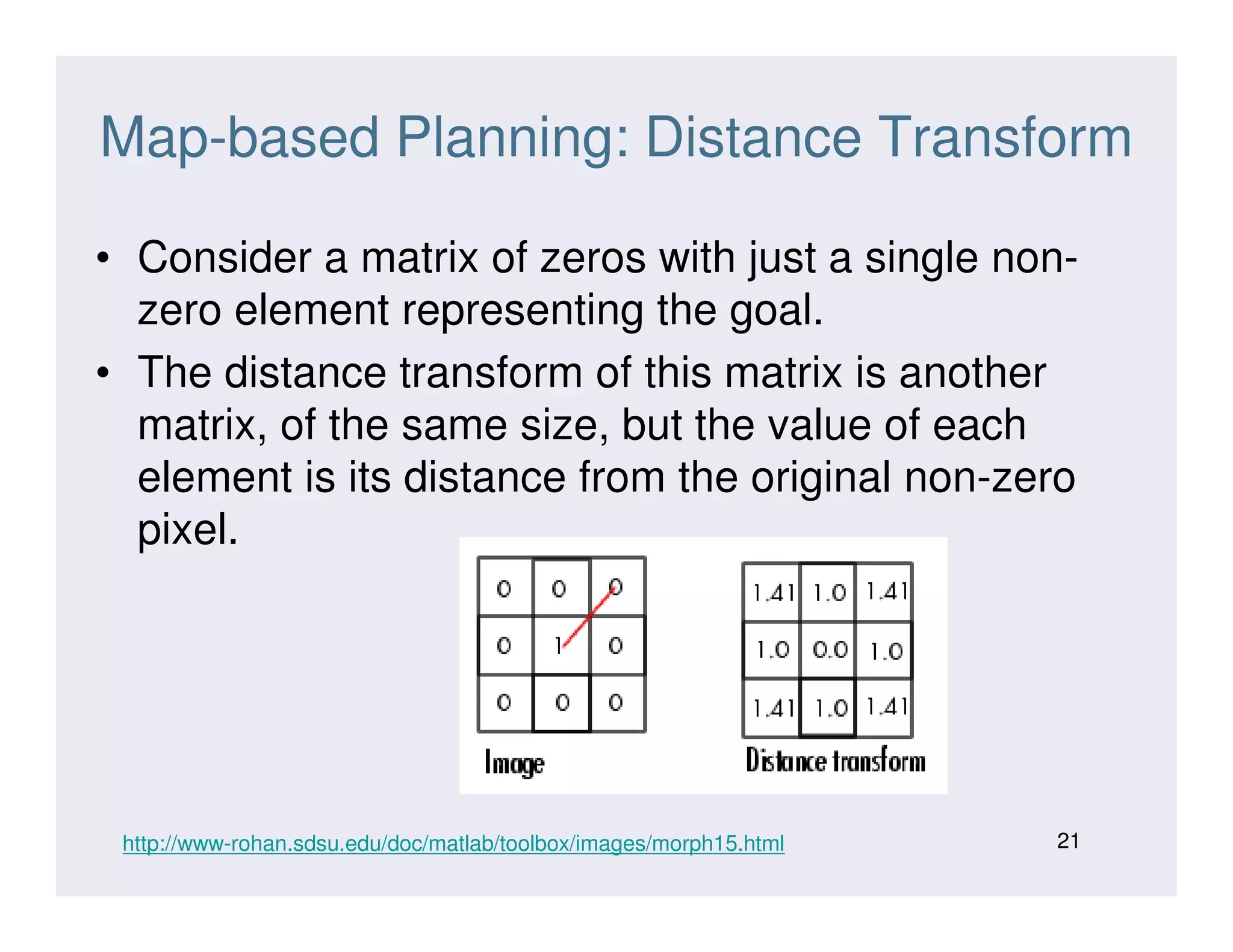
• Consider a matrix of zeros with just a single non-
zero element representing the goal.
• The distance transform of this matrix is another
matrix, of the same size, but the value of each
element is its distance from the original non-zeroelement is its distance from the original non-zero
pixel.
21http://www-rohan.sdsu.edu/doc/matlab/toolbox/images/morph15.html
Map-based Planning: Distance Transform
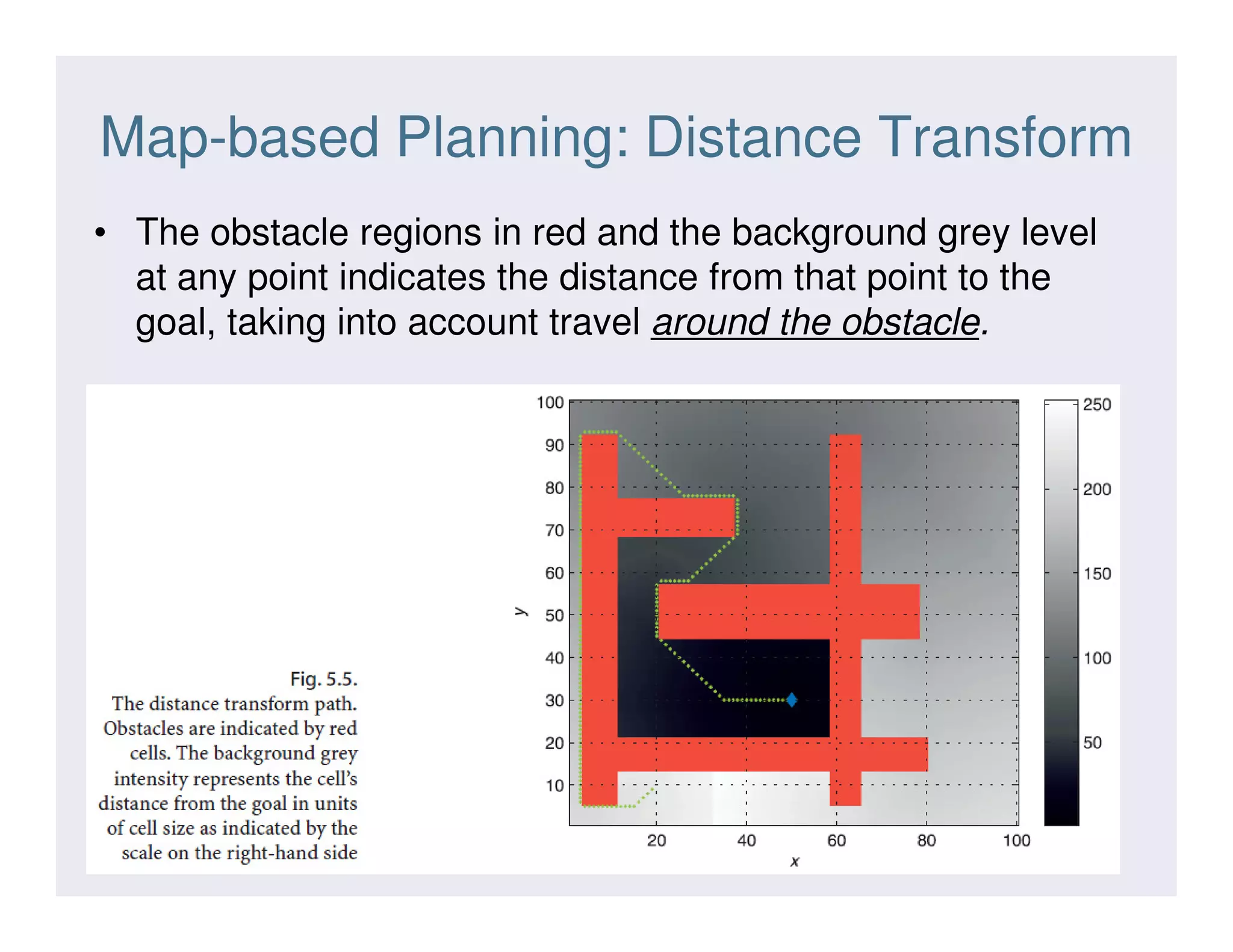
• The obstacle regions in red and the background grey level
at any point indicates the distance from that point to the
goal, taking into account travel around the obstacle.
22http://www-rohan.sdsu.edu/doc/matlab/toolbox/images/morph15.html
Map-based Planning: Distance Transform
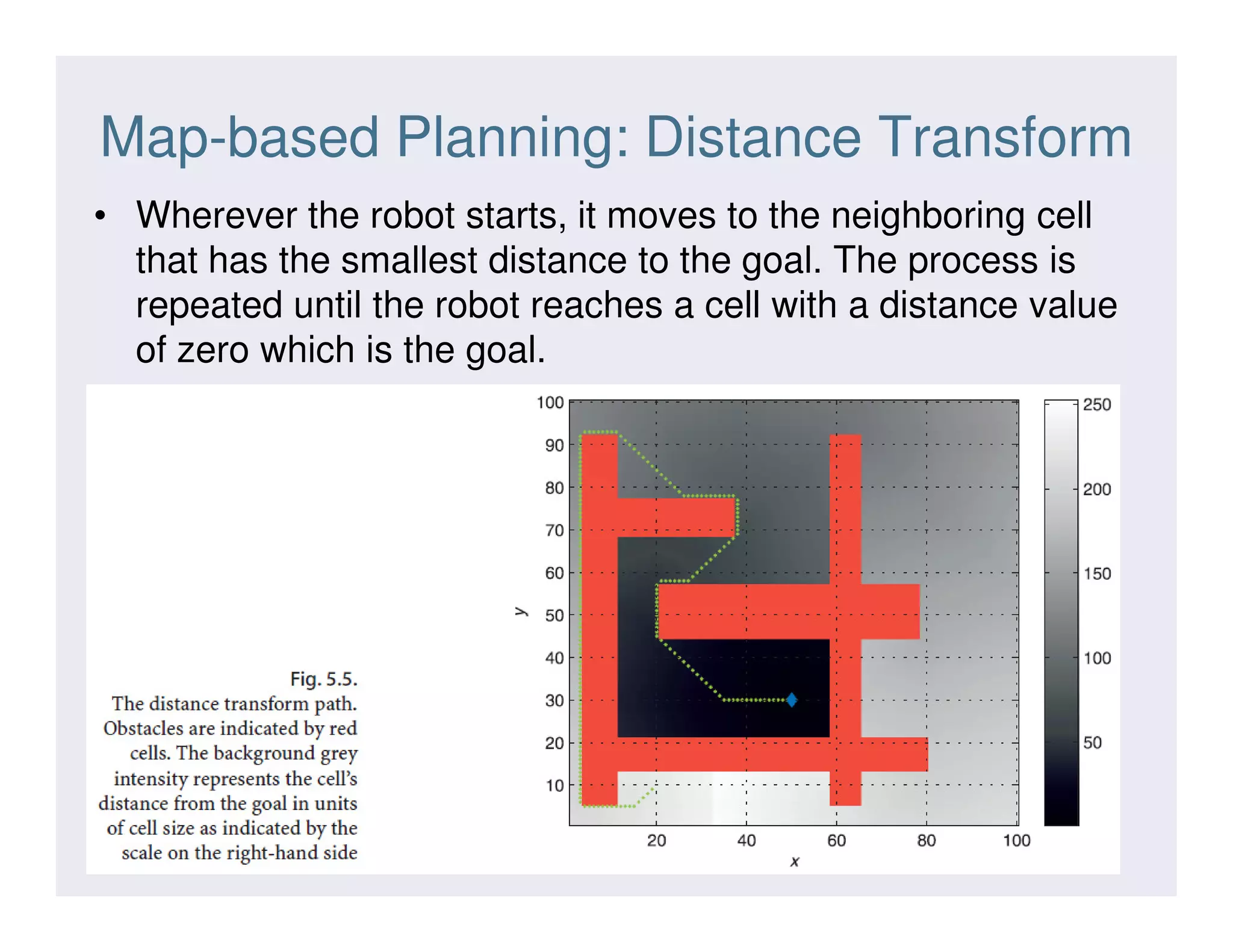
• Wherever the robot starts, it moves to the neighboring cell
that has the smallest distance to the goal. The process is
repeated until the robot reaches a cell with a distance value
of zero which is the goal.
23http://www-rohan.sdsu.edu/doc/matlab/toolbox/images/morph15.html
Map-based Planning: Distance Transform
• Creating the map has a large computational cost.
• Effectively the robot is rolling downhill on the distance
function which we can plot as a 3D surface.
24http://www-rohan.sdsu.edu/doc/matlab/toolbox/images/morph15.html
Map-Based Planning Algorithms
• Distance Transform
• D*
• Voronoi Roadmap Method
• Probabilistic Roadmap Method• Probabilistic Roadmap Method
• Rapidly-exploring Random Tree
(RRT)
25
D* Planning Algorithm
• A popular algorithm for robot path planning is
called D*, and it has a number of features that
are useful for real-world applications.
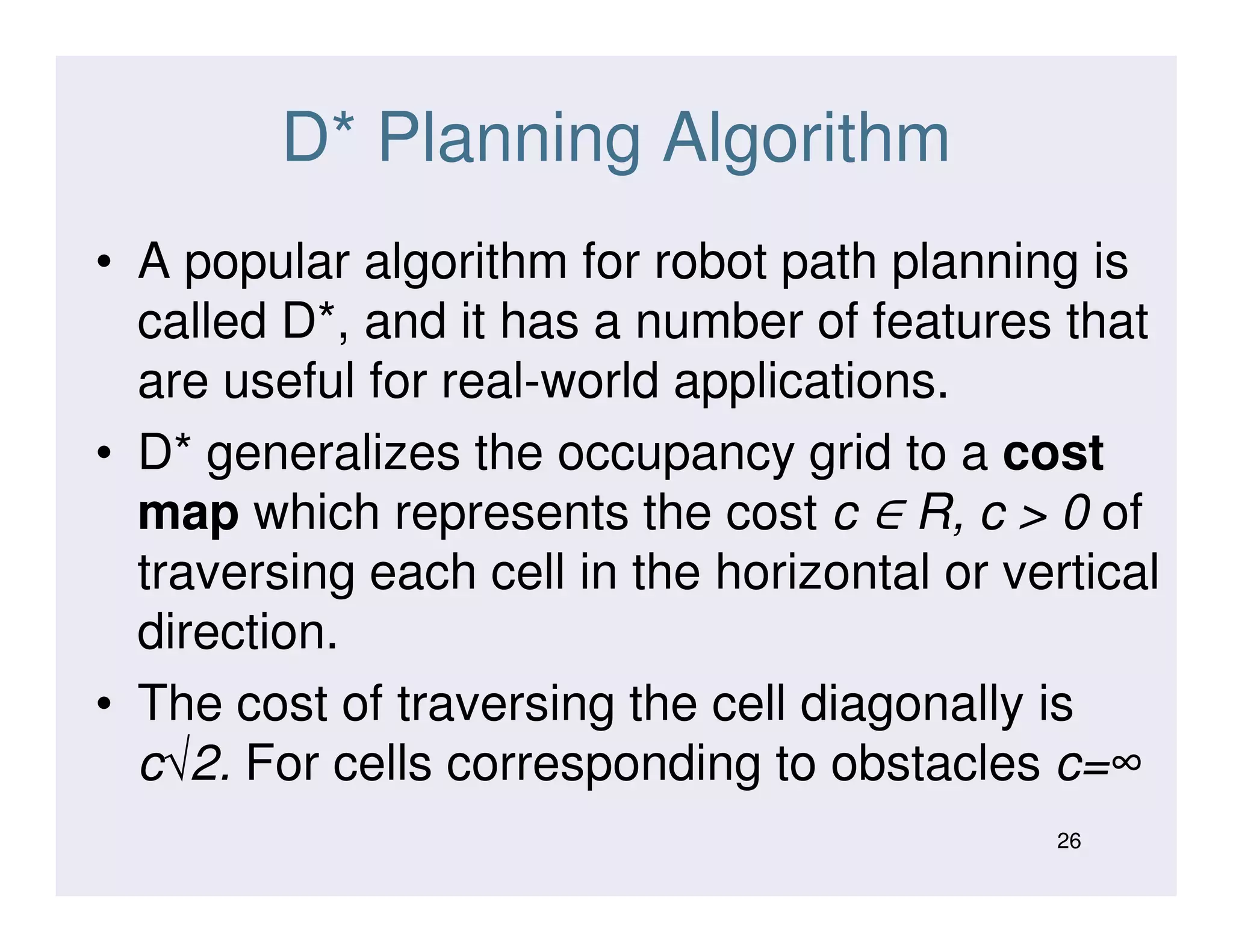
• D* generalizes the occupancy grid to a cost
∈
• D* generalizes the occupancy grid to a cost
map which represents the cost c ∈ R, c > 0 of
traversing each cell in the horizontal or vertical
direction.
• The cost of traversing the cell diagonally is
c√2. For cells corresponding to obstacles c=∞
26
D* Planning Algorithm
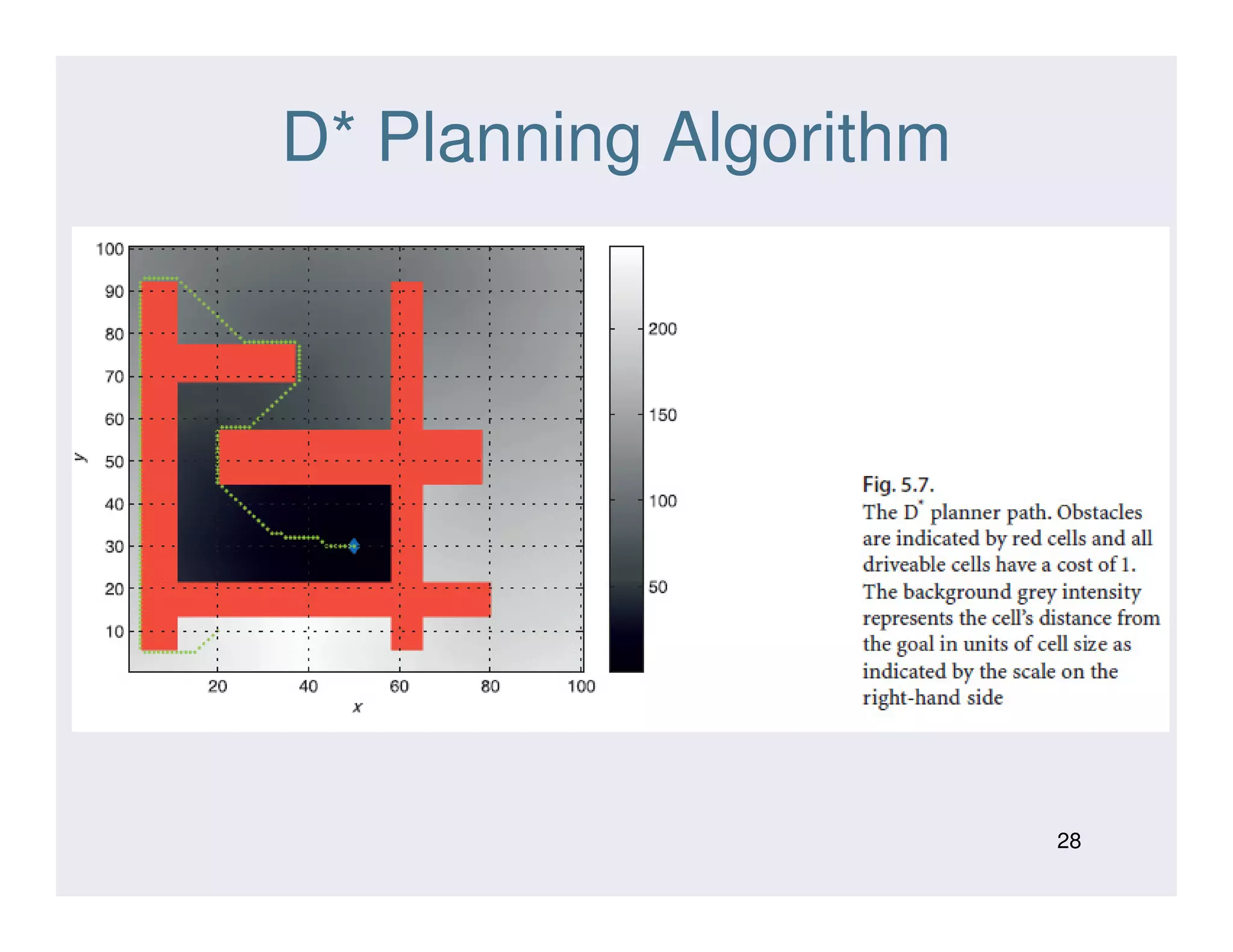
• D* finds the path which minimizes the total cost of travel.
• If we are interested in the shortest time to reach the goal
then cost is the time to drive across the cell and is
inversely related to traversability.
• If we are interested in minimizing damage to the vehicle• If we are interested in minimizing damage to the vehicle
or maximizing passenger comfort then cost might be
related to the roughness of the terrain within the cell.
• The costs assigned to cells will depend on the
characteristics of the vehicle: a large 4-wheel drive
vehicle may have a finite cost to cross a rough area
whereas for a small car that cost might be infinite.
27
D* Planning Algorithm
28
D* Planning Algorithm
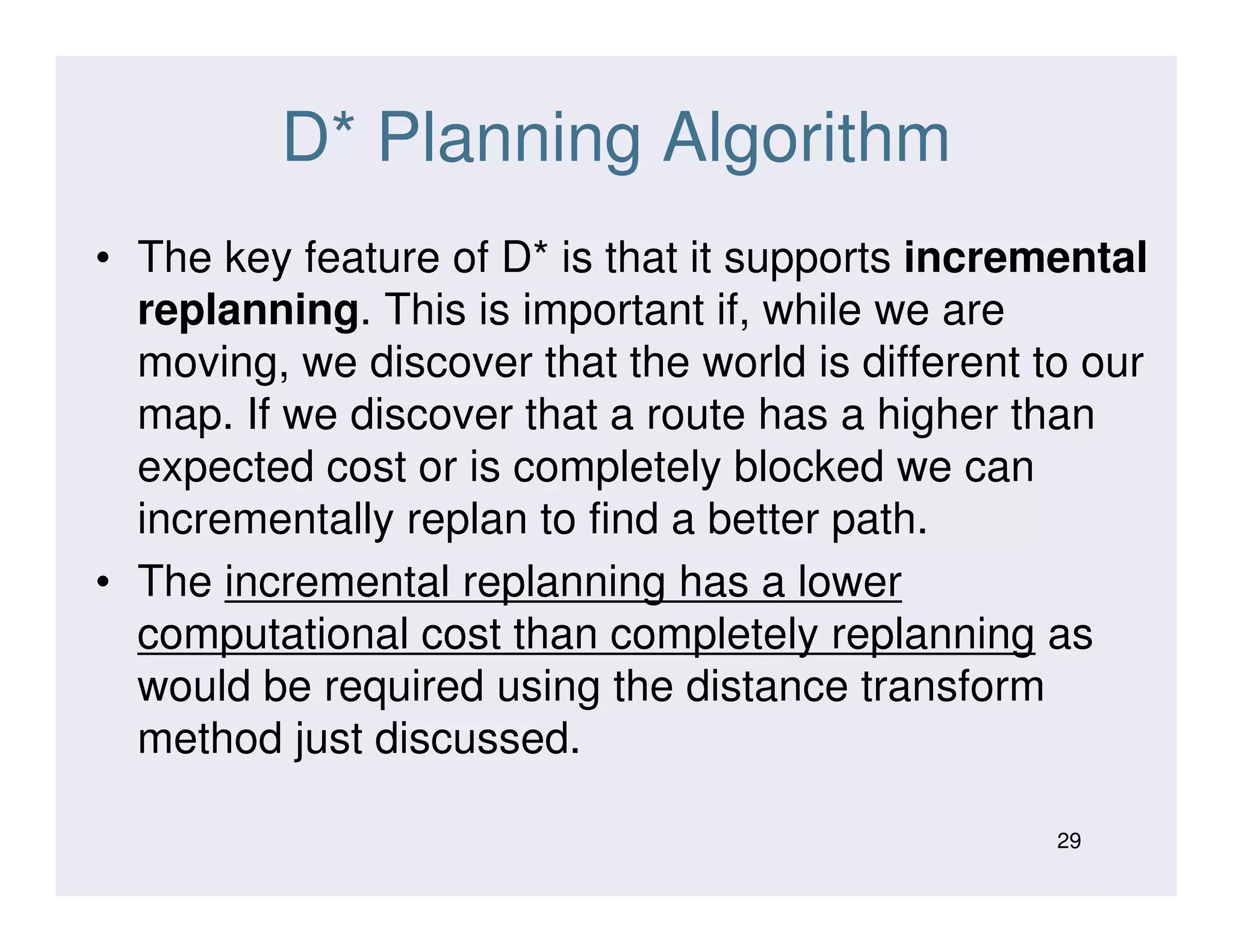
• The key feature of D* is that it supports incremental
replanning. This is important if, while we are
moving, we discover that the world is different to our
map. If we discover that a route has a higher than
expected cost or is completely blocked we canexpected cost or is completely blocked we can
incrementally replan to find a better path.
• The incremental replanning has a lower
computational cost than completely replanning as
would be required using the distance transform
method just discussed.
29
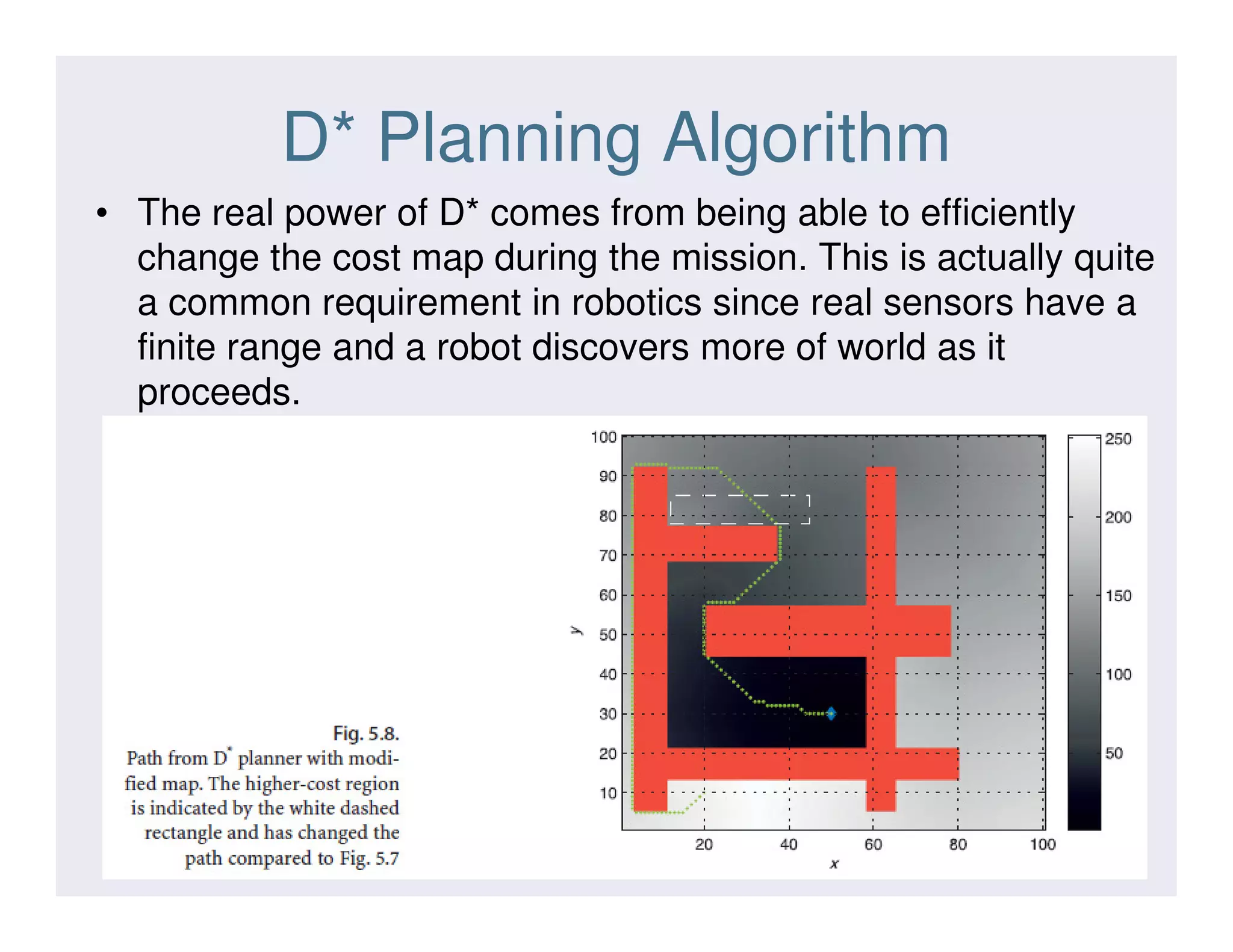
D* Planning Algorithm
• The real power of D* comes from being able to efficiently
change the cost map during the mission. This is actually quite
a common requirement in robotics since real sensors have a
finite range and a robot discovers more of world as it
proceeds.
30
Map-Based Planning Algorithms
• Distance Transform
• D*
• Voronoi Roadmap Method
• Probabilistic Roadmap Method• Probabilistic Roadmap Method
• Rapidly-exploring Random Tree
(RRT)
31
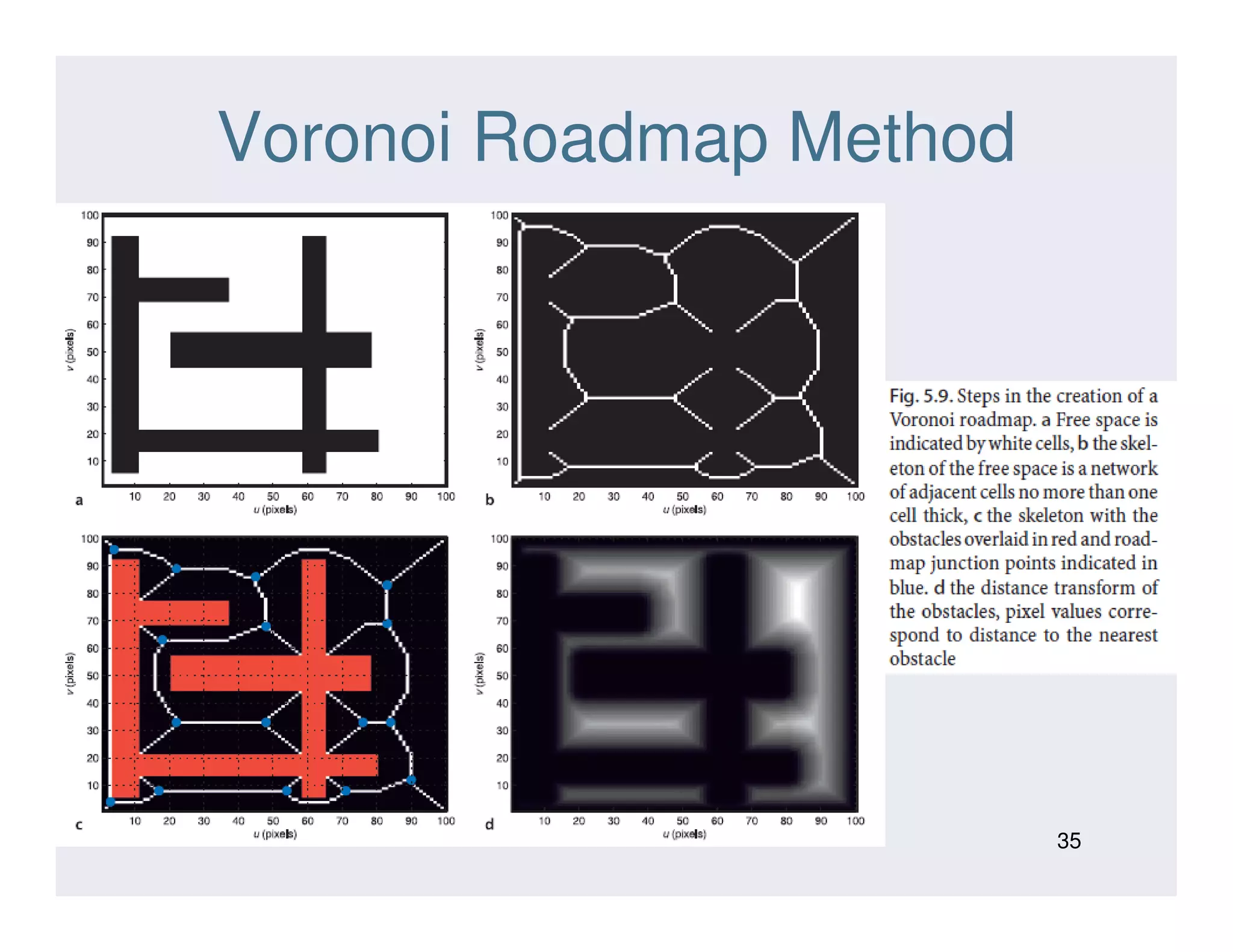
Voronoi Roadmap Method
• In planning terminology the creation of a plan is
referred to as the planning phase. The query
phase uses the result of the planning phase to find
a path from A to B. The two previous planning
algorithms, distance transform and D*, require aalgorithms, distance transform and D*, require a
significant amount of computation for the planning
phase, but the query phase is very cheap.
• However the plan depends on the goal. If the goal
changes the expensive planning phase must be re-
executed. Even though D* allows the path to be
recomputed as the costmap changes it does not
support a changing goal. 32
Voronoi Roadmap Method
• The disparity in planning and query costs has led to
the development of roadmap methods where the
query can include both the start and goal positions.
The planning phase provides analysis that supports
changing starting points and changing goals.changing starting points and changing goals.
• Analogy: Making a journey by train (First find a
local path to the nearest train station, travel through
the train network, get off at the station closest to
our goal, and then take a local path to the goal. The
train network is invariant.)
33
Voronoi Roadmap Method
• The robot navigation problem then becomes one of
building a network of obstacle free paths through
the environment which serve the function of the
train network.
• In the literature such a network is referred to as a• In the literature such a network is referred to as a
roadmap. The roadmap need only be computed
once and can then be used like the train network to
get us from any start location to any goal location.
34
Voronoi Roadmap Method
35
Map-Based Planning Algorithms
• Distance Transform
• D*
• Voronoi Roadmap Method
• Probabilistic Roadmap Method• Probabilistic Roadmap Method
• Rapidly-exploring Random Tree
(RRT)
36
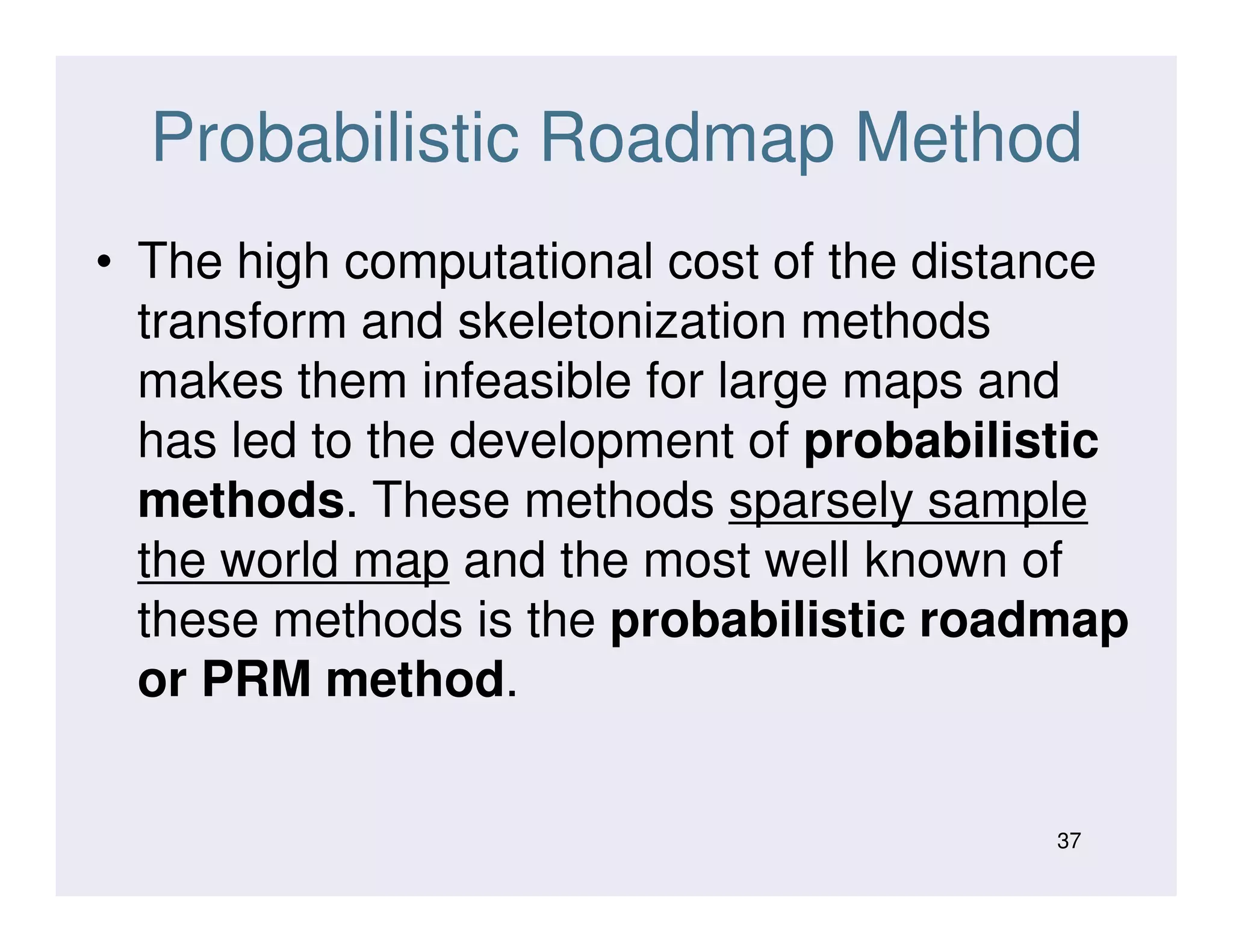
Probabilistic Roadmap Method
• The high computational cost of the distance
transform and skeletonization methods
makes them infeasible for large maps and
has led to the development of probabilistic
methods. These methods sparsely samplemethods. These methods sparsely sample
the world map and the most well known of
these methods is the probabilistic roadmap
or PRM method.
37
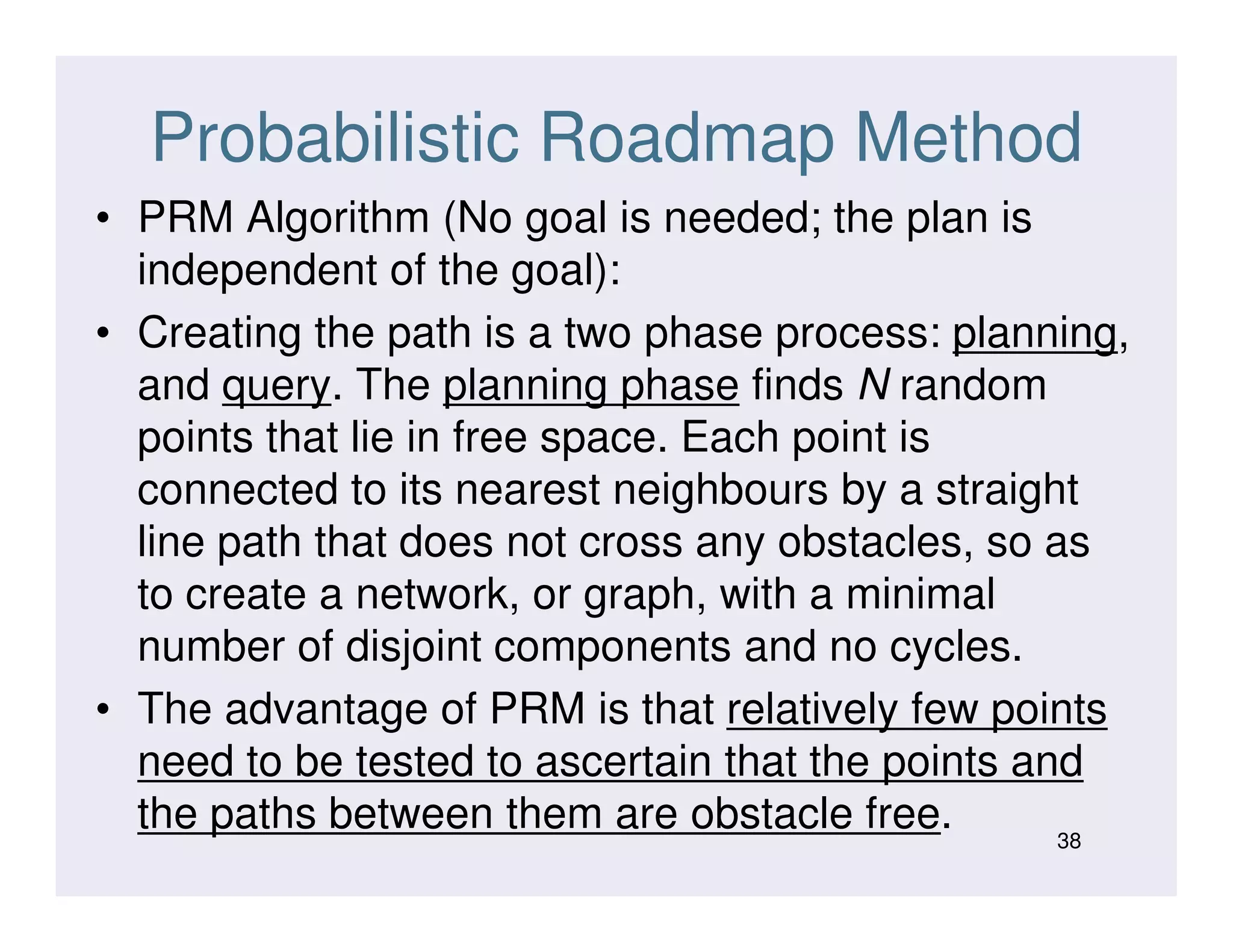
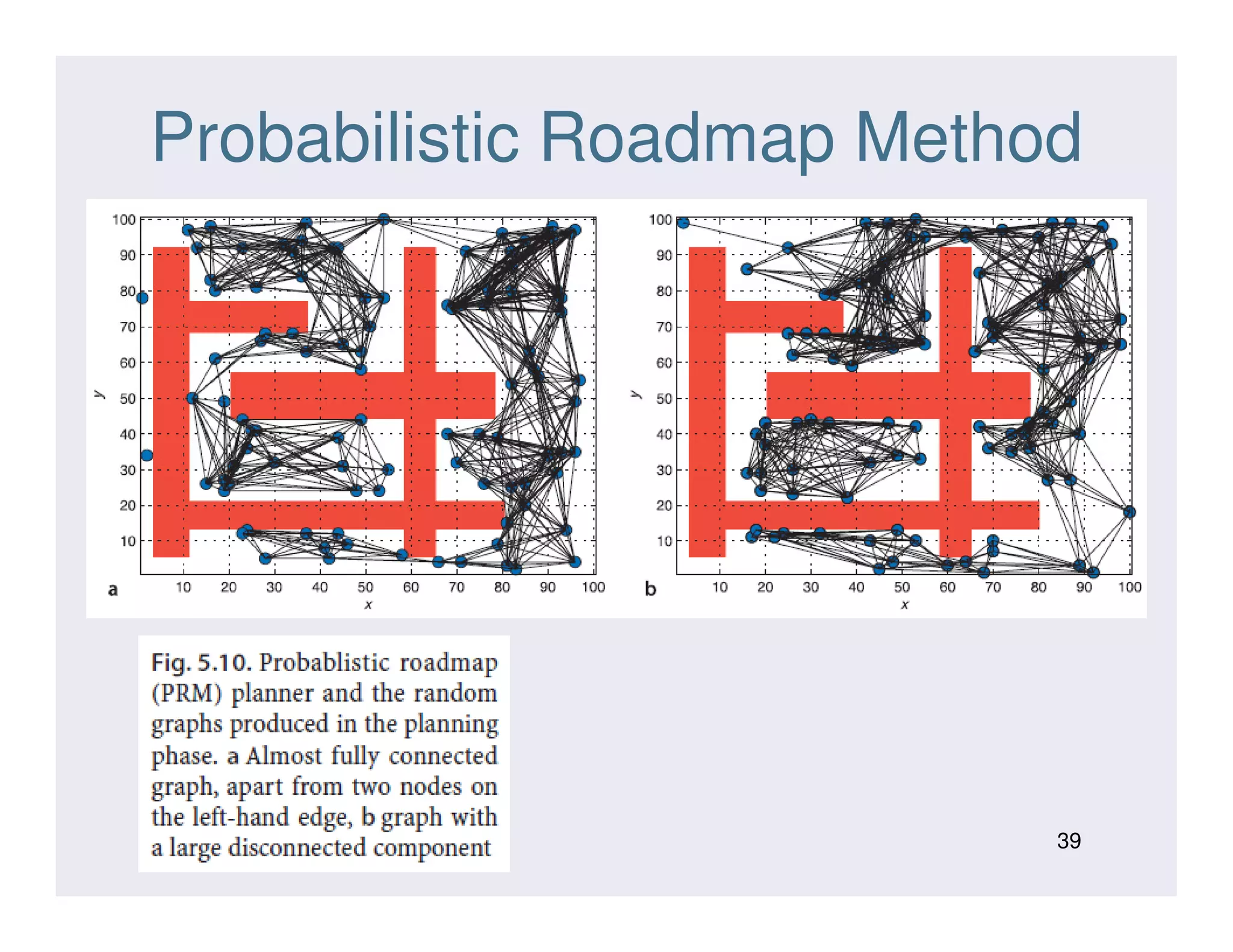
Probabilistic Roadmap Method
• PRM Algorithm (No goal is needed; the plan is
independent of the goal):
• Creating the path is a two phase process: planning,
and query. The planning phase finds N random
points that lie in free space. Each point is
connected to its nearest neighbours by a straightconnected to its nearest neighbours by a straight
line path that does not cross any obstacles, so as
to create a network, or graph, with a minimal
number of disjoint components and no cycles.
• The advantage of PRM is that relatively few points
need to be tested to ascertain that the points and
the paths between them are obstacle free. 38
Probabilistic Roadmap Method
39
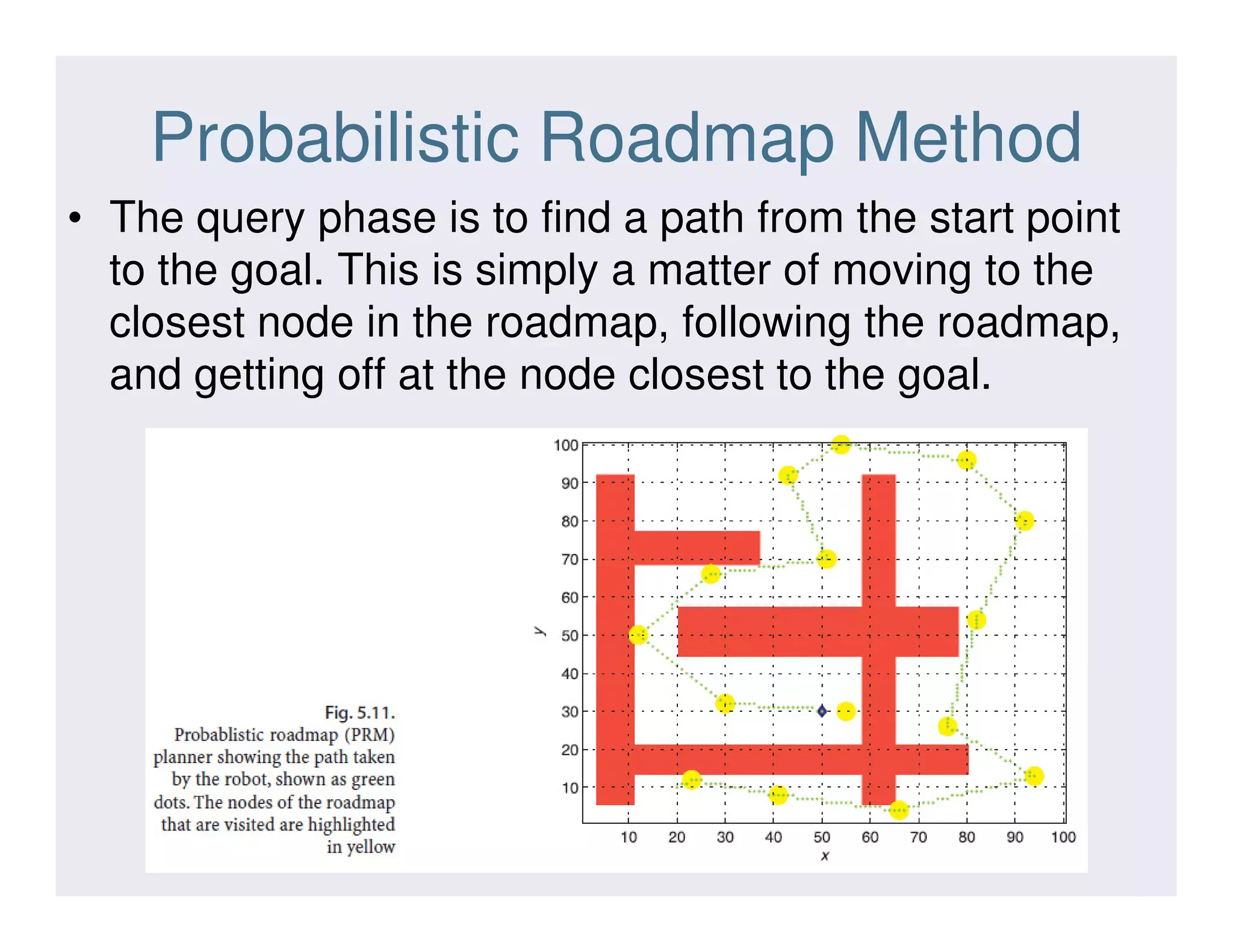
Probabilistic Roadmap Method
• The query phase is to find a path from the start point
to the goal. This is simply a matter of moving to the
closest node in the roadmap, following the roadmap,
and getting off at the node closest to the goal.
40
Probabilistic Roadmap Method
• Travel along the roadmap involves moving toward the
neighbouring node which has the lowest cost, that is,
closest to the goal. We repeat the process until we
arrive at the node in the graph closest to the goal, and
from there we move directly to the goal.
☺An advantage of this planner is that once the roadmap☺An advantage of this planner is that once the roadmap
is created by the planning phase we can change the
goal and starting points very cheaply, only the query
phase needs to be repeated.
41
Probabilistic Roadmap Method
The path is not optimal.
A different graph is created every time the planner is
run.
The planner can fail by creating a network consistingThe planner can fail by creating a network consisting
of disjoint components.
Long narrow gaps between obstacles are unlikely to
be exploited since the probability of randomly
choosing points that lie along such gaps is very low.
42
Map-Based Planning Algorithms
• Distance Transform
• D*
• Voronoi Roadmap Method
• Probabilistic Roadmap Method• Probabilistic Roadmap Method
• Rapidly-exploring Random Tree
(RRT)
43
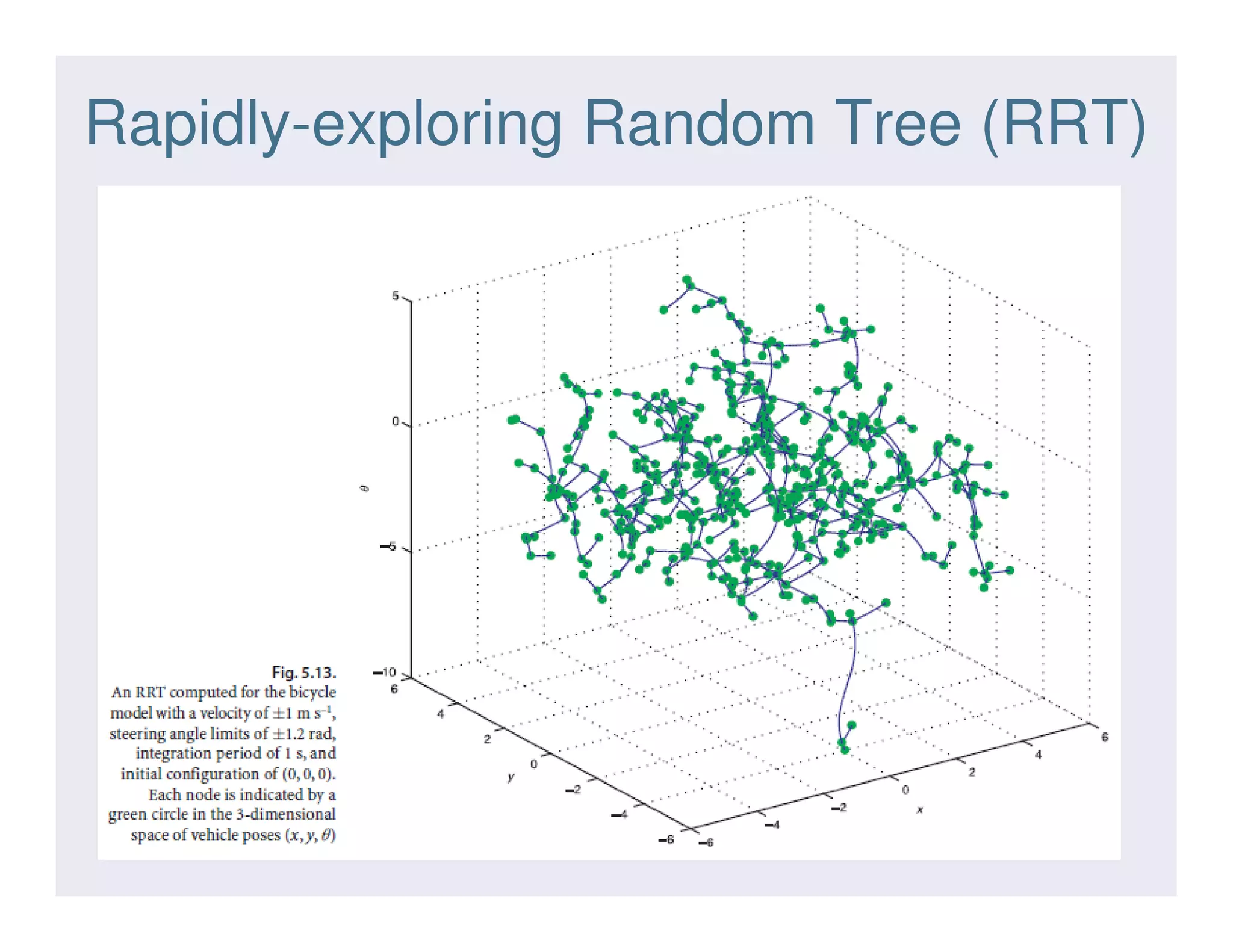
Rapidly-exploring Random Tree (RRT)
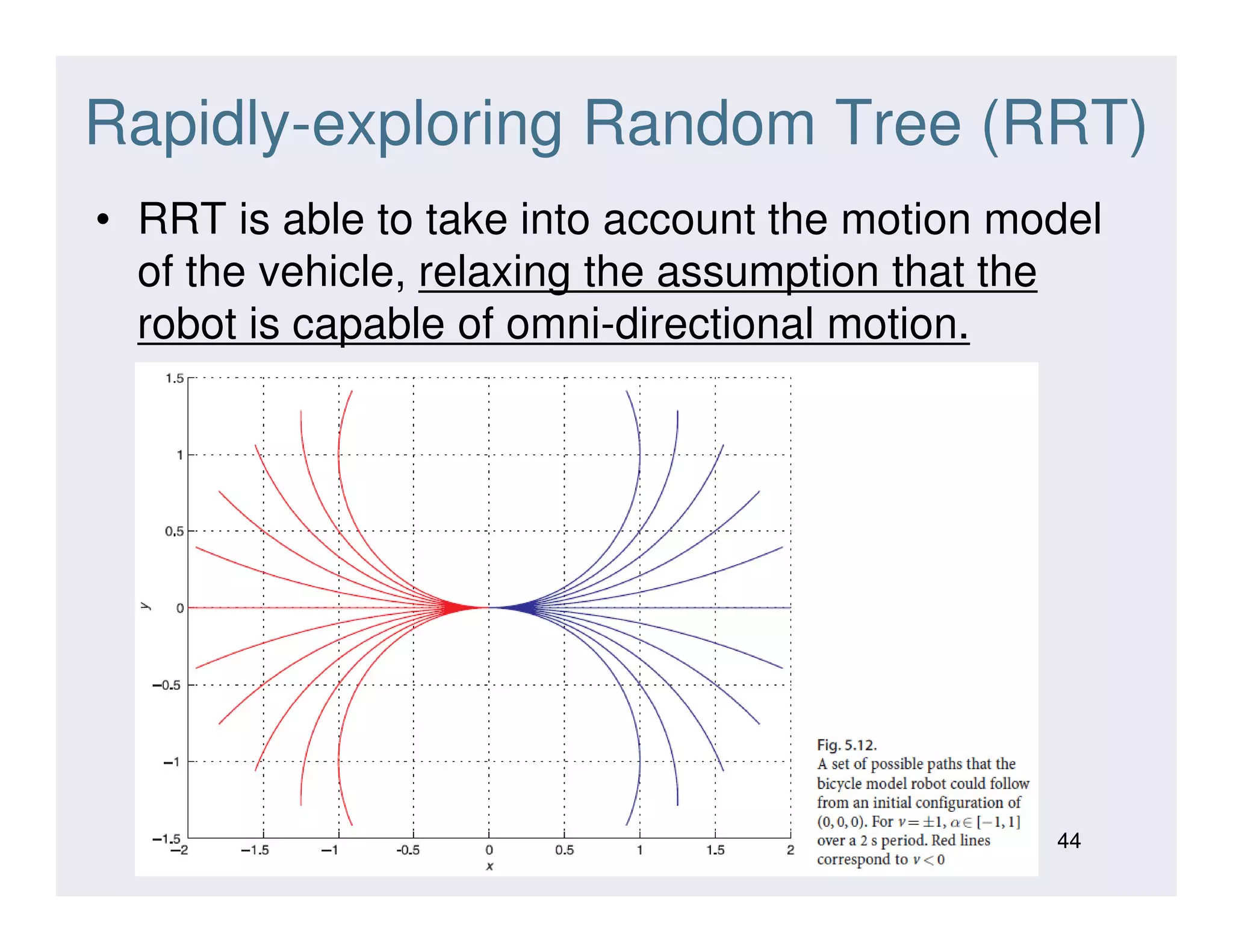
• RRT is able to take into account the motion model
of the vehicle, relaxing the assumption that the
robot is capable of omni-directional motion.
44
Rapidly-exploring Random Tree (RRT)
• For any desired goal pose we could find the closest
precomputed pose, and working backward toward
the starting pose we could determine the sequence
of steering angles and velocities needed to move
from initial to the goal pose. This has some
similarities to the roadmap methods discussedsimilarities to the roadmap methods discussed
previously, but the limiting factor is the
combinatorial explosion in the number of possible
poses.
• Like PRM, RRT is a probabilistic algorithm.
45
Rapidly-exploring Random Tree (RRT)
• RRT Algorithm:
• A graph of robot configurations is maintained and each node
is a configuration ξ ∈ SE(2) which is represented by a 3-
vector ξ ∼(x, y, θ).
• The first node in the graph is some initial configuration of the
robot. A random configuration ξrand is chosen, and the noderobot. A random configuration ξrand is chosen, and the node
with the closest configuration ξnear is found – this point is
near in terms of a cost function that includes distance and
orientation.
• A control is computed (using a random sampling strategy) to
move the robot from ξnear toward ξrand over a fixed period of
time. The point that it reaches is ξnew and this is added to the
graph.
46
Rapidly-exploring Random Tree (RRT)
47

Robotics Navigation

  • 1.
    SBE 403 B:Bioelectronic Systems (Biomedical Robotics) Lecture 06 Navigation Muhammad Rushdi mrushdi@eng1.cu.edu.eg
  • 2.
    Main Problems inRobotics • What are the basic issues to be resolved and what must we learn in order to be able to program a robot to perform its tasks? • Problem 1: Forward Kinematics • Problem 2: Inverse Kinematics • Problem 3: Velocity Kinematics Robot navigation: The• Problem 3: Velocity Kinematics • Problem 4: Path Planning • Problem 5: Vision • Problem 6: Dynamics • Problem 7: Position Control • Problem 8: Force Control 2 process of directing a robot so as to reach the intended destination.
  • 3.
    Textbook • Ch. 5Navigation Peter Corke: Robotics, Vision andRobotics, Vision and Control - Fundamental Algorithms in MATLAB®. http://www.petercorke.com/R VC/ 3
  • 4.
    Navigation Strategies • Robotnavigation is the problem of guiding a robot towards a goal. • Robots can use a map (map-based navigation) or no map at all (reactive navigation). 4 http://www.willowgarage.com/pages/research/motion-planning
  • 5.
    Reactive Navigation • Therobot is reacting directly to its environment: a goal oriented machine that can sense, plan and act. • Reactive Navigation Examples: - Heading towards a light, - following a white line on the ground, - moving through a maze by following a wall, or - vacuuming a room by following a random path. 5
  • 6.
    Reactive Navigation: BraitenbergVehicles • A very simple class of goal achieving robots are known as Braitenberg vehicles and are characterized by direct connection between sensors and motors. • They have no explicit internal representation of the environment in which they operates and nor do they make explicit plans. 6Braitenberg Vehicles explore Reality https://www.ini.uzh.ch/~conradt/research/BraitenbergVehicle/
  • 7.
    Reactive Navigation: BraitenbergVehicles • Complex behavior using simple control mechanisms: The wire running from the sensor to the motor is labeled positive (+) indicating that sensor stimulates the motor to turn. We can also imagine connections which are inhibitory (labeled negative (-)). • Multiple behaviours and the ability to switch between them leads to an approach known as behaviour-based robotics.leads to an approach known as behaviour-based robotics. 7Braitenberg Vehicles http://cs.brown.edu/~tld/courses/cs148/02/introduction.html
  • 8.
    Braitenberg Vehicles: SimulinkModel • A robot moving in two dimensions that is seeking the maxima of a scalar field – the field could be light intensity or the concentration of some chemical. 8
  • 9.
    Braitenberg Vehicles: SimulinkModel • To ascend the gradient we need to estimate the gradient direction at the current location and this requires at least two measurements of the field. • Use bilateral sensing: two sensors with one on each side of the robot’s body. The sensors are parameterized by the position of the sensor withparameterized by the position of the sensor with respect to the robot’s body, and the sensing function. • In this example the sensors are at ±2 units in the vehicle’s lateral or y-direction. 9
  • 10.
    Braitenberg Vehicles: SimulinkModel • The field to be sensed is a simple inverse square field defined by ∈which returns the sensor value s(x, y) ∈ [0, 1] which is a function of the sensor’s position in the plane. This particular function has a peak value at the point (60, 90). 10
  • 11.
    Braitenberg Vehicles: SimulinkModel • The vehicle speed is where sR and sL are the right and left sensor readings respectively. At the goal, where sR=sL=1, the velocityrespectively. At the goal, where sR=sL=1, the velocity becomes zero. • Steering angle is based on the difference between the sensor readings so when the field is equal in the left- and right-hand sensors the robot moves straight ahead. 11
  • 12.
  • 13.
    Reactive Navigation: SimpleAutomata • Another class of reactive robots are known as bugs – simple automata that perform goal seeking in the presence of non-driveable areas or obstacles. • There are a large number of bug algorithms and they share the ability to sense when they are inthey share the ability to sense when they are in proximity to an obstacle. In this respect they are similar to the Braitenberg class vehicle, but the bug includes a state machine and other logic in between the sensor and the motors. • The automata have memory which our earlier Braitenberg vehicle lacked. 13
  • 14.
    Reactive Navigation: SimpleAutomata • Example: bug2 Robot • Assumptions: The robot operates in a grid world and occupies one grid cell. The robot does not have any non-holonomicThe robot does not have any non-holonomic constraints and can move to any neighboring grid cell. The robot can determine its position on the plane (a non-trivial problem!) The robot can only sense its immediate locale and the goal. 14
  • 15.
    Reactive Navigation: SimpleAutomata • Example: bug2 Robot • The strategy of the bug2 algorithm is quite simple. It moves along a straight line towards its goal. If it encounters an obstacle it moves around the obstacle (always counter-clockwise) until it encounters a point that lies along its original line that is closer to the goal than where it first encountered the obstacle. 15
  • 16.
    Reactive Navigation: SimpleAutomata • Example: bug2 Robot • The bug2 algorithms has taken a path that is clearly not optimal. It has wasted time by continuing to follow the perimeter of the obstacle until it rejoined its original line. • It would also have been quicker in this case to go clockwise around the obstacle. • Many variants of the bug algorithm have been developed, but• Many variants of the bug algorithm have been developed, but while they improve the performance for one type of environment they can degrade performance in others. Fundamentally the robot is limited by not using a map. It cannot see the big picture and therefore takes paths that are locally, rather than globally, optimal. 16
  • 17.
    Map-Based Planning • Thekey to achieving the best path between points A and B, as we know from everyday life, is to use a map. Typically best means the shortest distance but it may also include some penalty term or cost related to traversability which is how easy the terrain is to drive over – it might be quicker to travel further but over better roads. A more sophisticated planner might also consider the kinematics and dynamics of themight also consider the kinematics and dynamics of the vehicle. • Remember, a robot can be defined as a goal oriented machine that can sense, plan and act. 17
  • 18.
    Map Representations • Thereare many ways to represent a map and the position of the vehicle within the map: 1- Polygonal Representation: Represent the vehicle position as (x, y) ∈ R2 and the driveable regions or obstacles as polygons, each comprising lists of vertices or edges. Pros: Compact, Cons: Costly to compute collisions ∈ Pros: Compact, Cons: Costly to compute collisions 2- Occupancy Grid: The world is treated as a grid of cells and each cell is marked as occupied or unoccupied. We use zero to indicate an unoccupied cell or free space where the robot can drive. 18
  • 19.
    Assumptions of Map-basedPlanning The robot operates in a grid world and occupies one grid cell. The robot does not have any non-holonomic constraints and can move to any neighboring grid cell.cell. The robot is able to determine its position on the plane. The robot is able to use the map to compute the path it will take. 19
  • 20.
    Map-Based Planning Algorithms •Distance Transform • D* • Voronoi Roadmap Method • Probabilistic Roadmap Method• Probabilistic Roadmap Method • Rapidly-exploring Random Tree (RRT) 20
  • 21.
    Map-based Planning: DistanceTransform • Consider a matrix of zeros with just a single non- zero element representing the goal. • The distance transform of this matrix is another matrix, of the same size, but the value of each element is its distance from the original non-zeroelement is its distance from the original non-zero pixel. 21http://www-rohan.sdsu.edu/doc/matlab/toolbox/images/morph15.html
  • 22.
    Map-based Planning: DistanceTransform • The obstacle regions in red and the background grey level at any point indicates the distance from that point to the goal, taking into account travel around the obstacle. 22http://www-rohan.sdsu.edu/doc/matlab/toolbox/images/morph15.html
  • 23.
    Map-based Planning: DistanceTransform • Wherever the robot starts, it moves to the neighboring cell that has the smallest distance to the goal. The process is repeated until the robot reaches a cell with a distance value of zero which is the goal. 23http://www-rohan.sdsu.edu/doc/matlab/toolbox/images/morph15.html
  • 24.
    Map-based Planning: DistanceTransform • Creating the map has a large computational cost. • Effectively the robot is rolling downhill on the distance function which we can plot as a 3D surface. 24http://www-rohan.sdsu.edu/doc/matlab/toolbox/images/morph15.html
  • 25.
    Map-Based Planning Algorithms •Distance Transform • D* • Voronoi Roadmap Method • Probabilistic Roadmap Method• Probabilistic Roadmap Method • Rapidly-exploring Random Tree (RRT) 25
  • 26.
    D* Planning Algorithm •A popular algorithm for robot path planning is called D*, and it has a number of features that are useful for real-world applications. • D* generalizes the occupancy grid to a cost ∈ • D* generalizes the occupancy grid to a cost map which represents the cost c ∈ R, c > 0 of traversing each cell in the horizontal or vertical direction. • The cost of traversing the cell diagonally is c√2. For cells corresponding to obstacles c=∞ 26
  • 27.
    D* Planning Algorithm •D* finds the path which minimizes the total cost of travel. • If we are interested in the shortest time to reach the goal then cost is the time to drive across the cell and is inversely related to traversability. • If we are interested in minimizing damage to the vehicle• If we are interested in minimizing damage to the vehicle or maximizing passenger comfort then cost might be related to the roughness of the terrain within the cell. • The costs assigned to cells will depend on the characteristics of the vehicle: a large 4-wheel drive vehicle may have a finite cost to cross a rough area whereas for a small car that cost might be infinite. 27
  • 28.
  • 29.
    D* Planning Algorithm •The key feature of D* is that it supports incremental replanning. This is important if, while we are moving, we discover that the world is different to our map. If we discover that a route has a higher than expected cost or is completely blocked we canexpected cost or is completely blocked we can incrementally replan to find a better path. • The incremental replanning has a lower computational cost than completely replanning as would be required using the distance transform method just discussed. 29
  • 30.
    D* Planning Algorithm •The real power of D* comes from being able to efficiently change the cost map during the mission. This is actually quite a common requirement in robotics since real sensors have a finite range and a robot discovers more of world as it proceeds. 30
  • 31.
    Map-Based Planning Algorithms •Distance Transform • D* • Voronoi Roadmap Method • Probabilistic Roadmap Method• Probabilistic Roadmap Method • Rapidly-exploring Random Tree (RRT) 31
  • 32.
    Voronoi Roadmap Method •In planning terminology the creation of a plan is referred to as the planning phase. The query phase uses the result of the planning phase to find a path from A to B. The two previous planning algorithms, distance transform and D*, require aalgorithms, distance transform and D*, require a significant amount of computation for the planning phase, but the query phase is very cheap. • However the plan depends on the goal. If the goal changes the expensive planning phase must be re- executed. Even though D* allows the path to be recomputed as the costmap changes it does not support a changing goal. 32
  • 33.
    Voronoi Roadmap Method •The disparity in planning and query costs has led to the development of roadmap methods where the query can include both the start and goal positions. The planning phase provides analysis that supports changing starting points and changing goals.changing starting points and changing goals. • Analogy: Making a journey by train (First find a local path to the nearest train station, travel through the train network, get off at the station closest to our goal, and then take a local path to the goal. The train network is invariant.) 33
  • 34.
    Voronoi Roadmap Method •The robot navigation problem then becomes one of building a network of obstacle free paths through the environment which serve the function of the train network. • In the literature such a network is referred to as a• In the literature such a network is referred to as a roadmap. The roadmap need only be computed once and can then be used like the train network to get us from any start location to any goal location. 34
  • 35.
  • 36.
    Map-Based Planning Algorithms •Distance Transform • D* • Voronoi Roadmap Method • Probabilistic Roadmap Method• Probabilistic Roadmap Method • Rapidly-exploring Random Tree (RRT) 36
  • 37.
    Probabilistic Roadmap Method •The high computational cost of the distance transform and skeletonization methods makes them infeasible for large maps and has led to the development of probabilistic methods. These methods sparsely samplemethods. These methods sparsely sample the world map and the most well known of these methods is the probabilistic roadmap or PRM method. 37
  • 38.
    Probabilistic Roadmap Method •PRM Algorithm (No goal is needed; the plan is independent of the goal): • Creating the path is a two phase process: planning, and query. The planning phase finds N random points that lie in free space. Each point is connected to its nearest neighbours by a straightconnected to its nearest neighbours by a straight line path that does not cross any obstacles, so as to create a network, or graph, with a minimal number of disjoint components and no cycles. • The advantage of PRM is that relatively few points need to be tested to ascertain that the points and the paths between them are obstacle free. 38
  • 39.
  • 40.
    Probabilistic Roadmap Method •The query phase is to find a path from the start point to the goal. This is simply a matter of moving to the closest node in the roadmap, following the roadmap, and getting off at the node closest to the goal. 40
  • 41.
    Probabilistic Roadmap Method •Travel along the roadmap involves moving toward the neighbouring node which has the lowest cost, that is, closest to the goal. We repeat the process until we arrive at the node in the graph closest to the goal, and from there we move directly to the goal. ☺An advantage of this planner is that once the roadmap☺An advantage of this planner is that once the roadmap is created by the planning phase we can change the goal and starting points very cheaply, only the query phase needs to be repeated. 41
  • 42.
    Probabilistic Roadmap Method Thepath is not optimal. A different graph is created every time the planner is run. The planner can fail by creating a network consistingThe planner can fail by creating a network consisting of disjoint components. Long narrow gaps between obstacles are unlikely to be exploited since the probability of randomly choosing points that lie along such gaps is very low. 42
  • 43.
    Map-Based Planning Algorithms •Distance Transform • D* • Voronoi Roadmap Method • Probabilistic Roadmap Method• Probabilistic Roadmap Method • Rapidly-exploring Random Tree (RRT) 43
  • 44.
    Rapidly-exploring Random Tree(RRT) • RRT is able to take into account the motion model of the vehicle, relaxing the assumption that the robot is capable of omni-directional motion. 44
  • 45.
    Rapidly-exploring Random Tree(RRT) • For any desired goal pose we could find the closest precomputed pose, and working backward toward the starting pose we could determine the sequence of steering angles and velocities needed to move from initial to the goal pose. This has some similarities to the roadmap methods discussedsimilarities to the roadmap methods discussed previously, but the limiting factor is the combinatorial explosion in the number of possible poses. • Like PRM, RRT is a probabilistic algorithm. 45
  • 46.
    Rapidly-exploring Random Tree(RRT) • RRT Algorithm: • A graph of robot configurations is maintained and each node is a configuration ξ ∈ SE(2) which is represented by a 3- vector ξ ∼(x, y, θ). • The first node in the graph is some initial configuration of the robot. A random configuration ξrand is chosen, and the noderobot. A random configuration ξrand is chosen, and the node with the closest configuration ξnear is found – this point is near in terms of a cost function that includes distance and orientation. • A control is computed (using a random sampling strategy) to move the robot from ξnear toward ξrand over a fixed period of time. The point that it reaches is ξnew and this is added to the graph. 46
  • 47.