VEMU INSTITUTE OF TECHNOLOGY
TOPIC:Robotics
submitted by
C.Uday kumar
154M1A0417[ECE]
1
Content:-
o Introduction to robotics
o Types of robots
o Sensors used in robots
o Introduction to humanoid robots
o Applications
o Advantages
o Disadvantages
o Future scope of robotics
o Conclusion
“
“It seems to me that only someone who
wishes for freedom can be free. I wish for
freedom.”
― Isaac Asimov
3
Introduction
◇ Robotics is an interdisciplinary branch
of engineering and science that includes mechanic
engineering, electronic engineering, information
engineering, computer science, artificial
intelligence, mechatronics, nanotechnology
and bioengineering and others.
◇ Robotics deals with the design, construction,
operation, and use of robots, as well as computer
systems for their control, sensory feedback,
and information processing.4
History
◇ Word robot was coined by a Czech novelist Karel
Capek in a 1920 play titled Rassum’s Universal
Robots (RUR).Robot in Czech is a word for worker
or servant In 1948, Norbert Wiener formulated the
principles of cybernetics, the basis of practical
robotics.
◇ The first digitally operated and programmable robot,
the Unimate, was installed in 1961 to lift hot pieces
of metal from a die casting machine and stack them.
5
Definition of robot:
◇ Any machine made by one of our members:
Robot Institute of America.
◇ A robot is a reprogrammable, multifunctional
manipulator designed to move material, parts,
tools or specialized devices through variable
programmed motions for the performance of a
variety of tasks.
6
Three laws of robotics
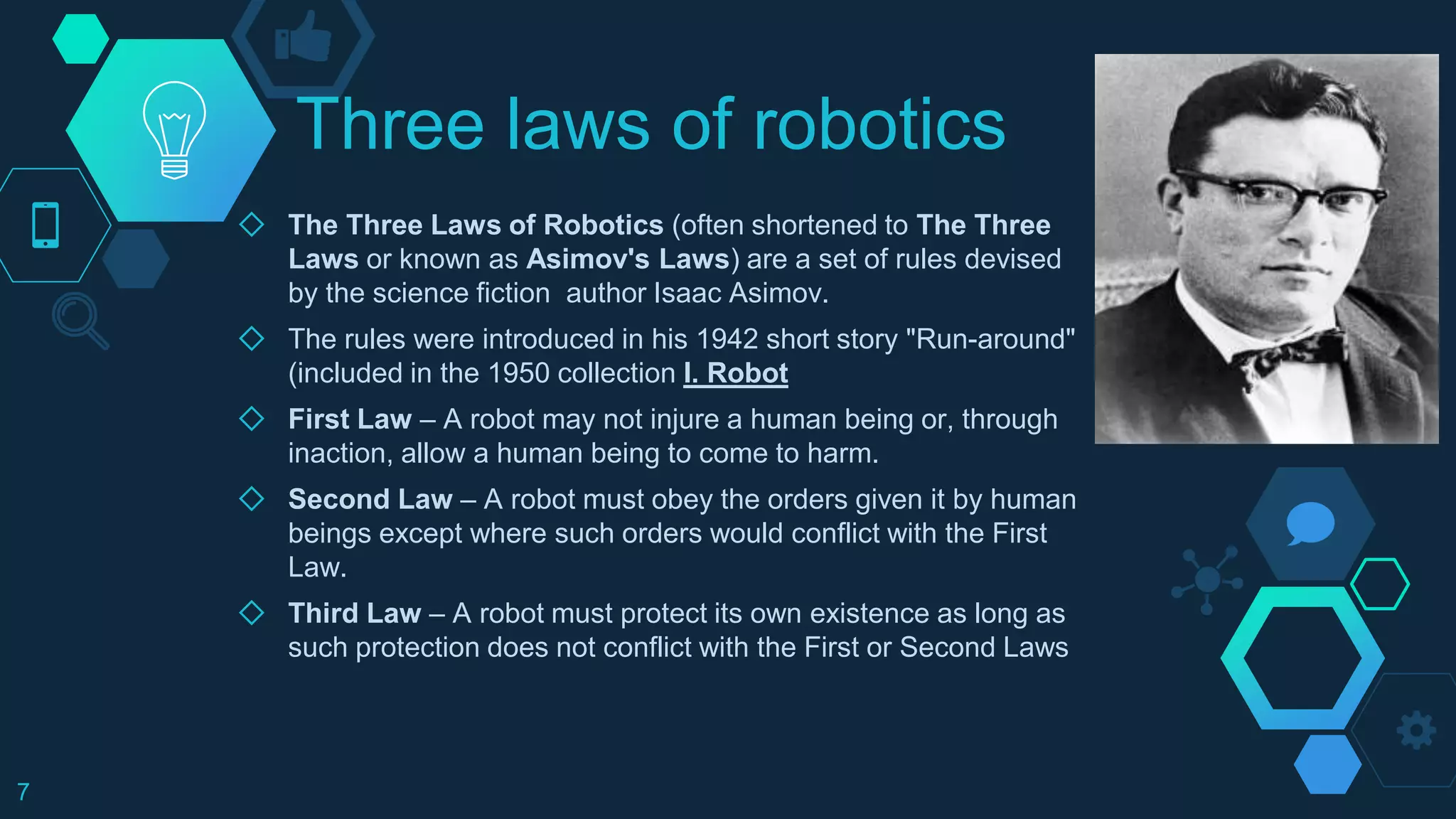
◇ The Three Laws of Robotics (often shortened to The Three
Laws or known as Asimov's Laws) are a set of rules devised
by the science fiction author Isaac Asimov.
◇ The rules were introduced in his 1942 short story "Run-around"
(included in the 1950 collection I. Robot
◇ First Law – A robot may not injure a human being or, through
inaction, allow a human being to come to harm.
◇ Second Law – A robot must obey the orders given it by human
beings except where such orders would conflict with the First
Law.
◇ Third Law – A robot must protect its own existence as long as
such protection does not conflict with the First or Second Laws
7
Types of robots
◇ Robot Manipulators
◇ Mobile Robots
◇ Humanoid Robots
◇ Wheeled Robots
◇ Legged Robot
◇ Autonomous Underwater Vehicle.
◇ Unmanned Aerial Vehicle.
8
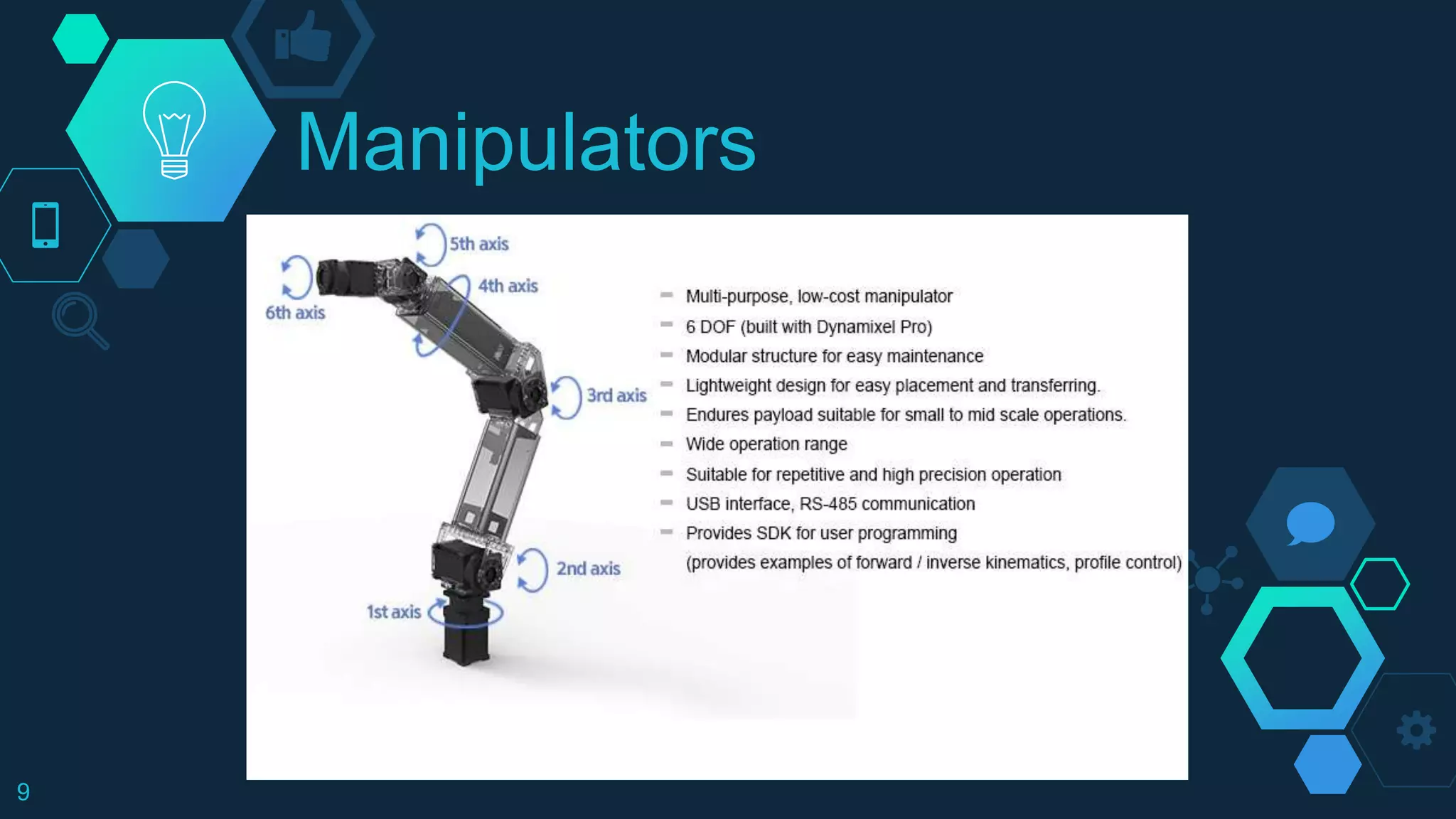
Manipulators
9
Mobile robots
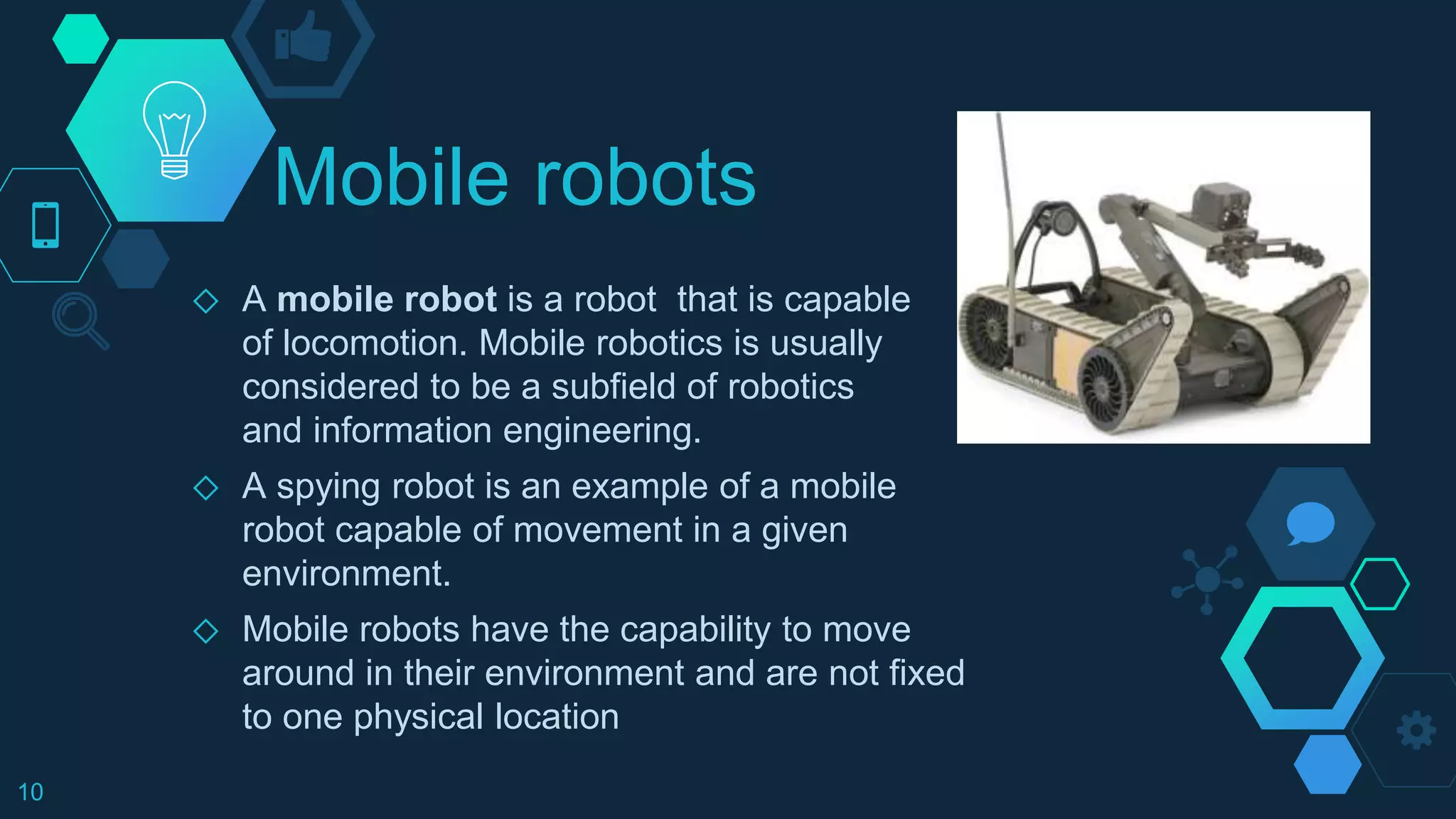
◇ A mobile robot is a robot that is capable
of locomotion. Mobile robotics is usually
considered to be a subfield of robotics
and information engineering.
◇ A spying robot is an example of a mobile
robot capable of movement in a given
environment.
◇ Mobile robots have the capability to move
around in their environment and are not fixed
to one physical location
10
Legged robots
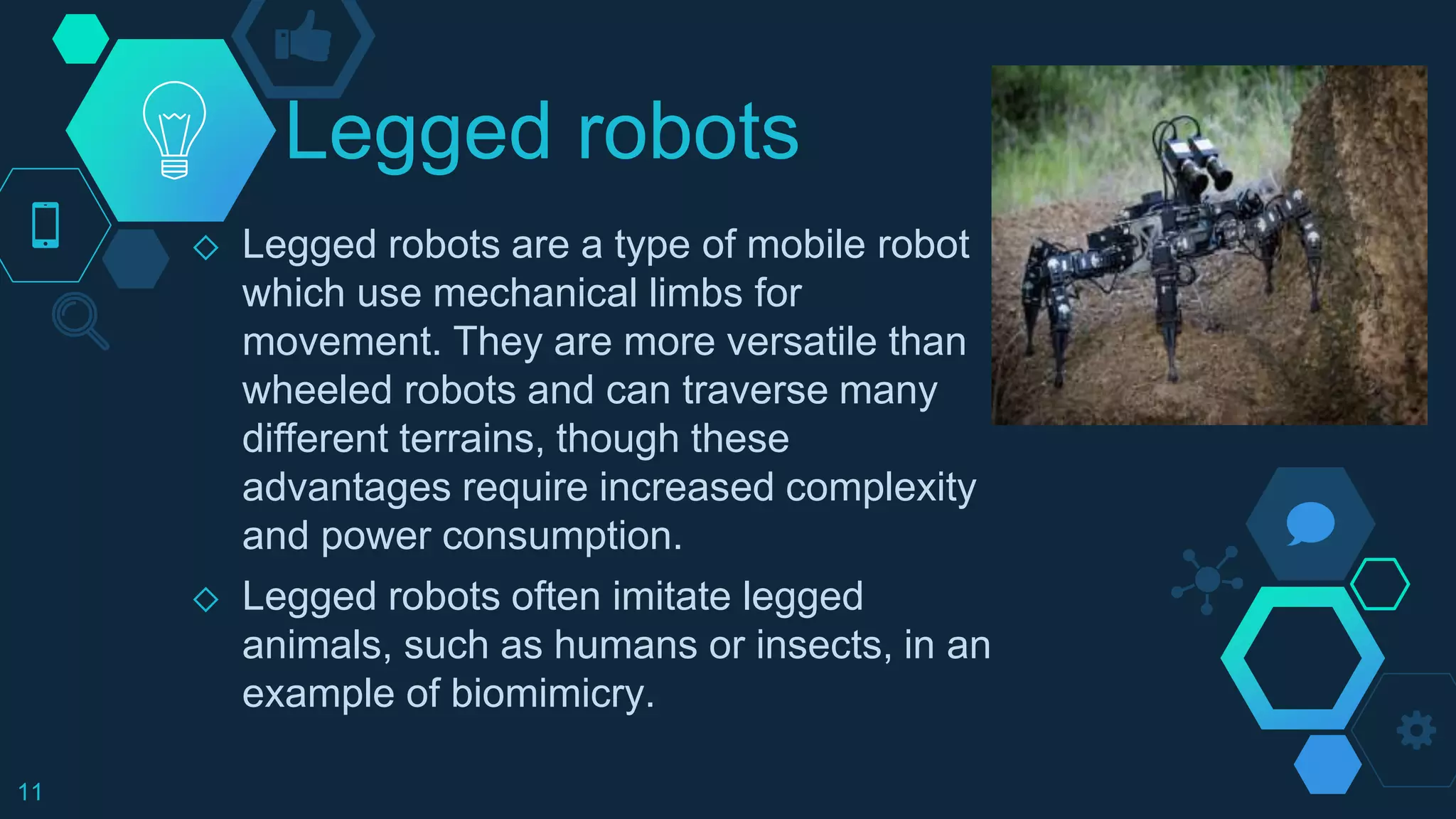
◇ Legged robots are a type of mobile robot
which use mechanical limbs for
movement. They are more versatile than
wheeled robots and can traverse many
different terrains, though these
advantages require increased complexity
and power consumption.
◇ Legged robots often imitate legged
animals, such as humans or insects, in an
example of biomimicry.
11
Autonomous under
water vehicle
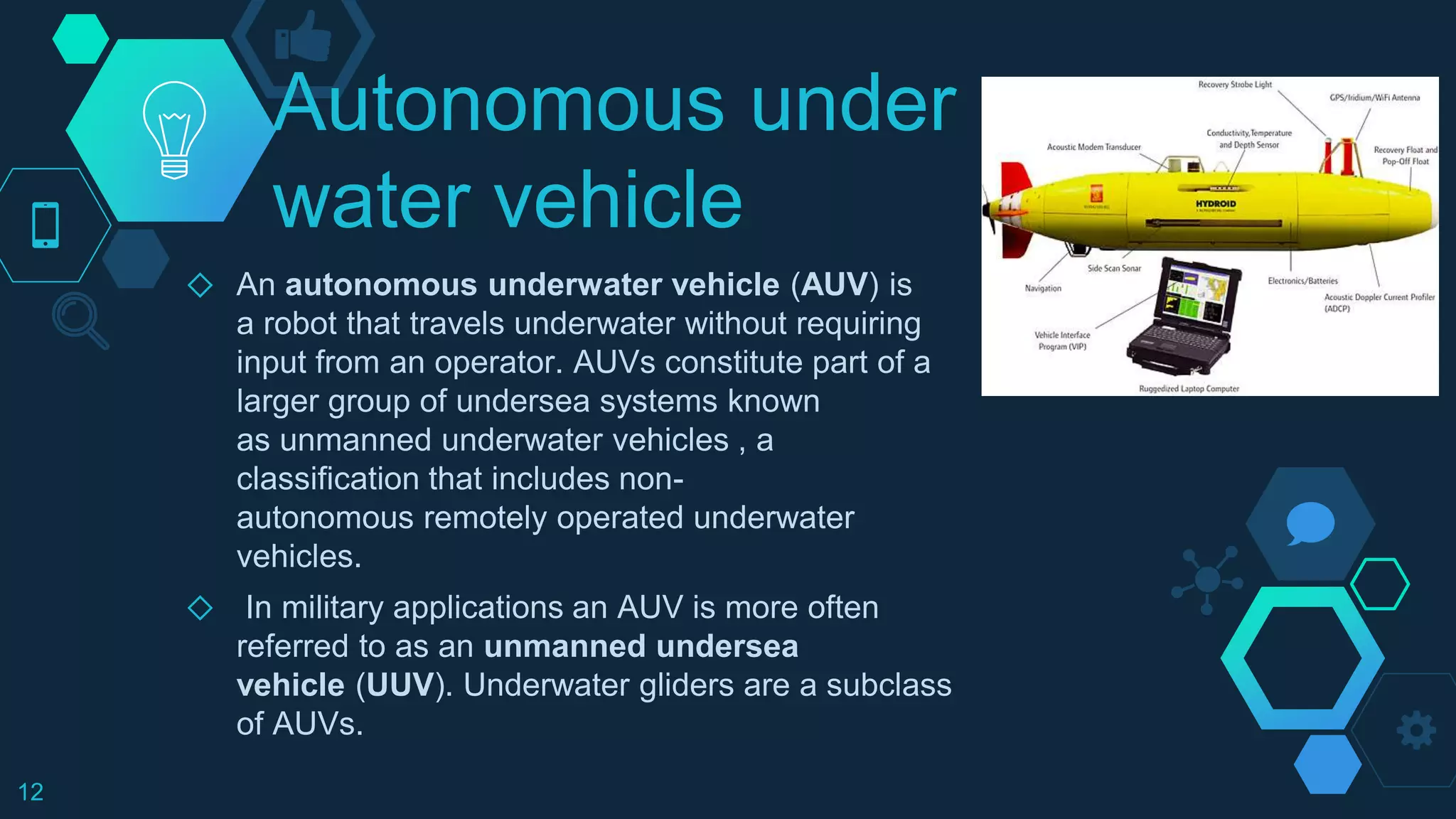
◇ An autonomous underwater vehicle (AUV) is
a robot that travels underwater without requiring
input from an operator. AUVs constitute part of a
larger group of undersea systems known
as unmanned underwater vehicles , a
classification that includes non-
autonomous remotely operated underwater
vehicles.
◇ In military applications an AUV is more often
referred to as an unmanned undersea
vehicle (UUV). Underwater gliders are a subclass
of AUVs.
12
Unmanned aerial
vehicle
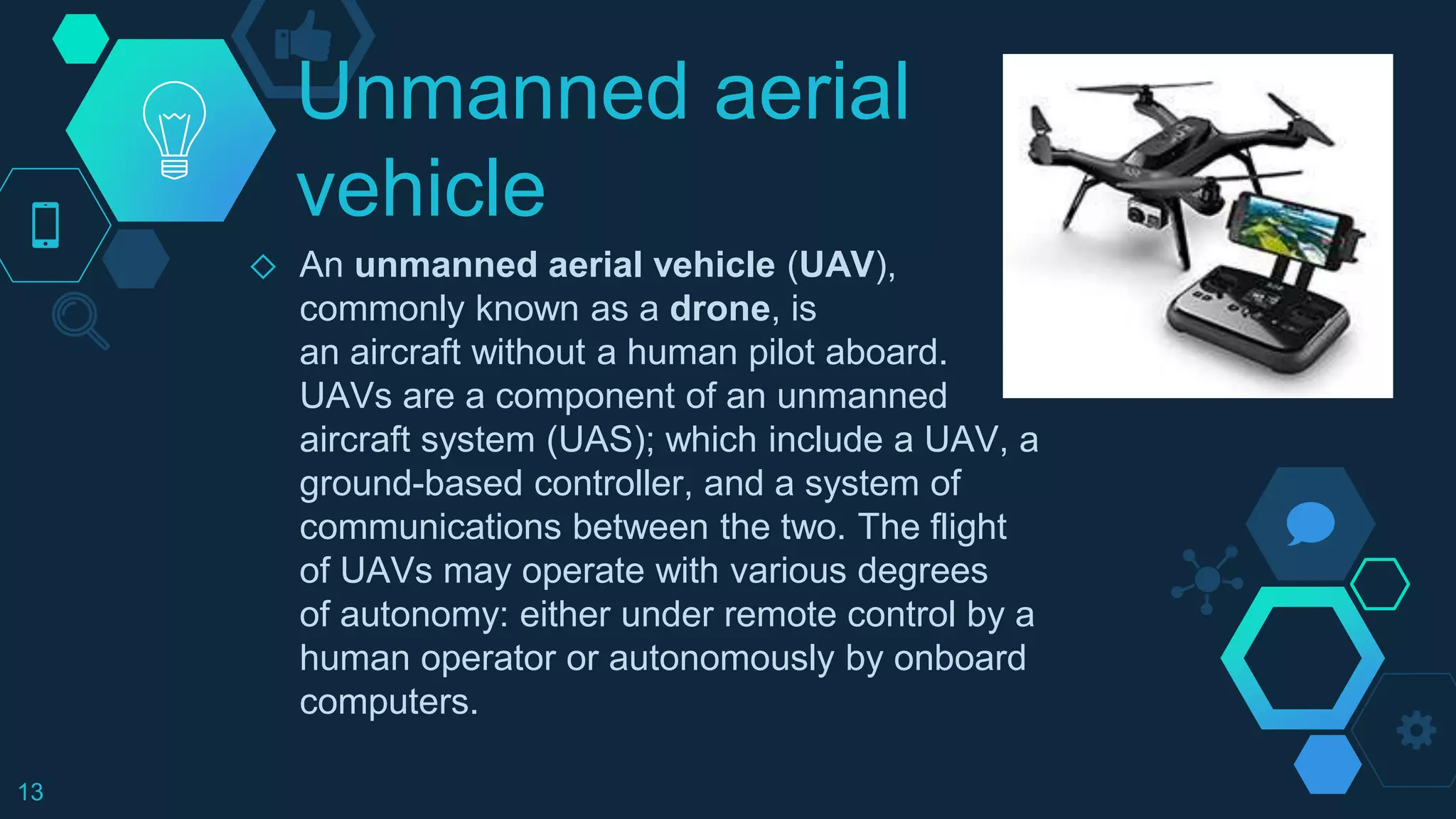
◇ An unmanned aerial vehicle (UAV),
commonly known as a drone, is
an aircraft without a human pilot aboard.
UAVs are a component of an unmanned
aircraft system (UAS); which include a UAV, a
ground-based controller, and a system of
communications between the two. The flight
of UAVs may operate with various degrees
of autonomy: either under remote control by a
human operator or autonomously by onboard
computers.
13
Sensors and electronic
components used in robots
◇ Light Sensor
◇ Proximity Sensor
◇ Sound Sensor
◇ Temperature Sensor
◇ Acceleration Sensor
◇ Radar
◇ Camera sensor
◇ Voltage sensor
◇ Current sensor
14
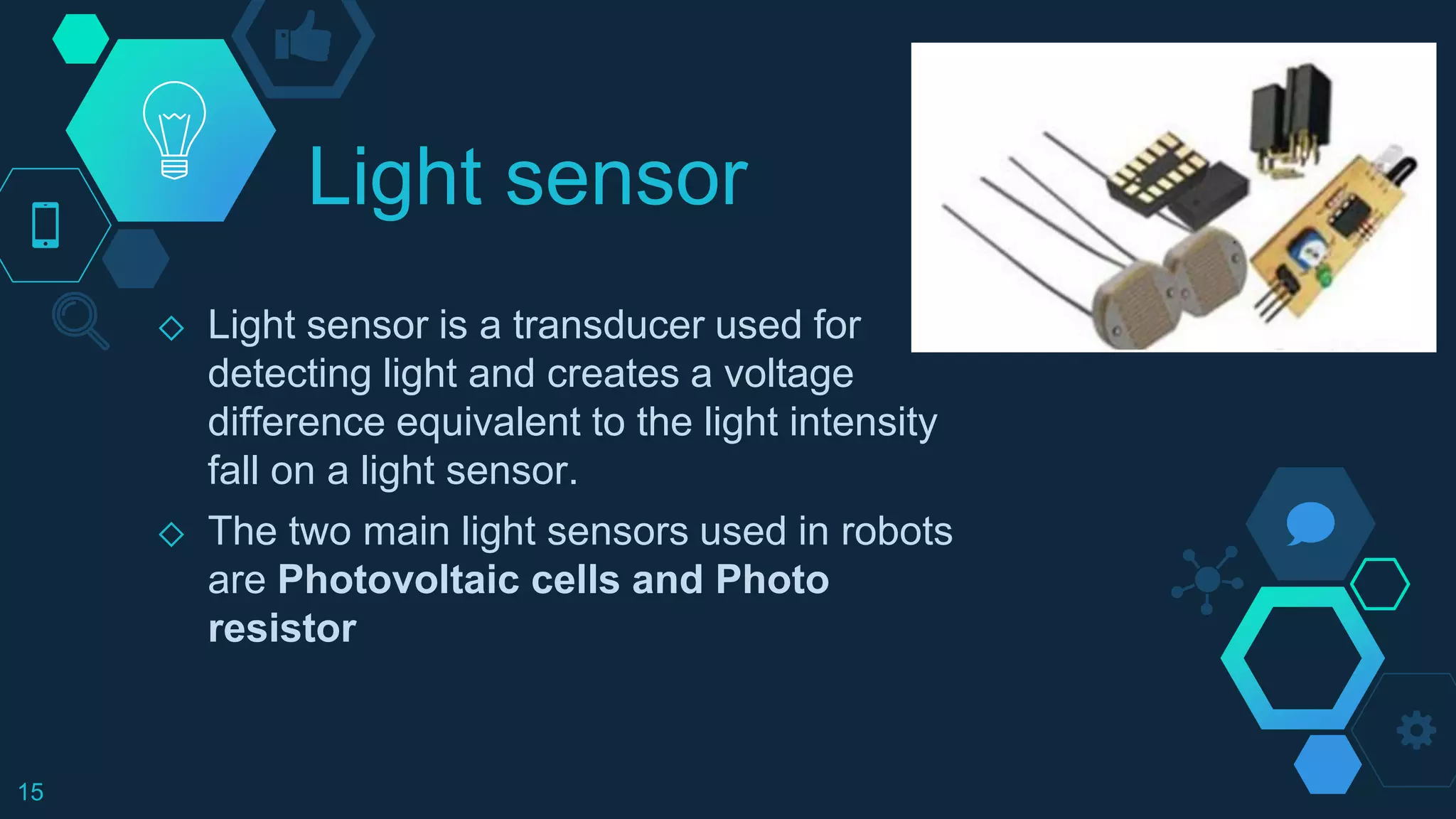
Light sensor
◇ Light sensor is a transducer used for
detecting light and creates a voltage
difference equivalent to the light intensity
fall on a light sensor.
◇ The two main light sensors used in robots
are Photovoltaic cells and Photo
resistor
15
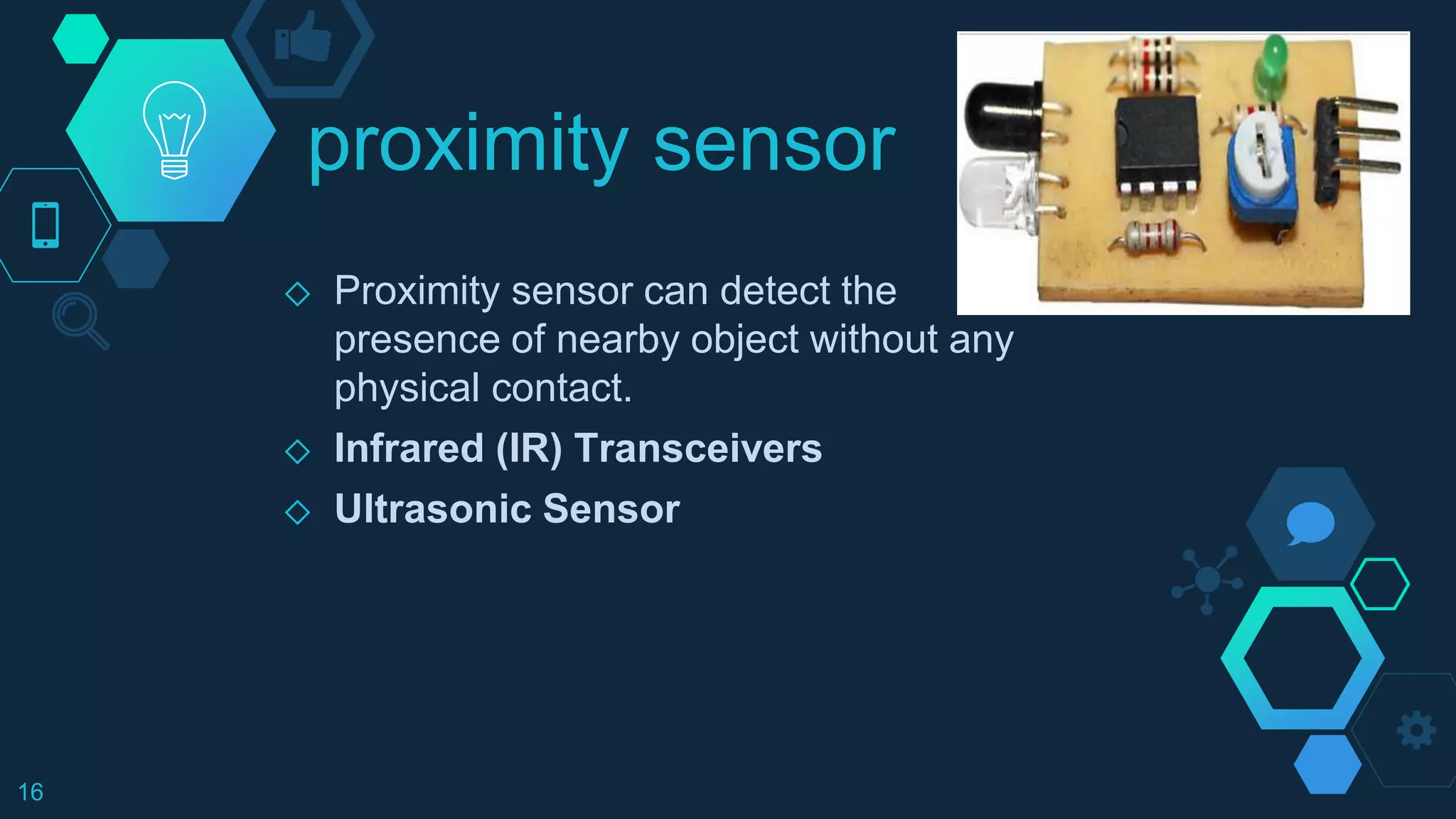
proximity sensor
◇ Proximity sensor can detect the
presence of nearby object without any
physical contact.
◇ Infrared (IR) Transceivers
◇ Ultrasonic Sensor
16
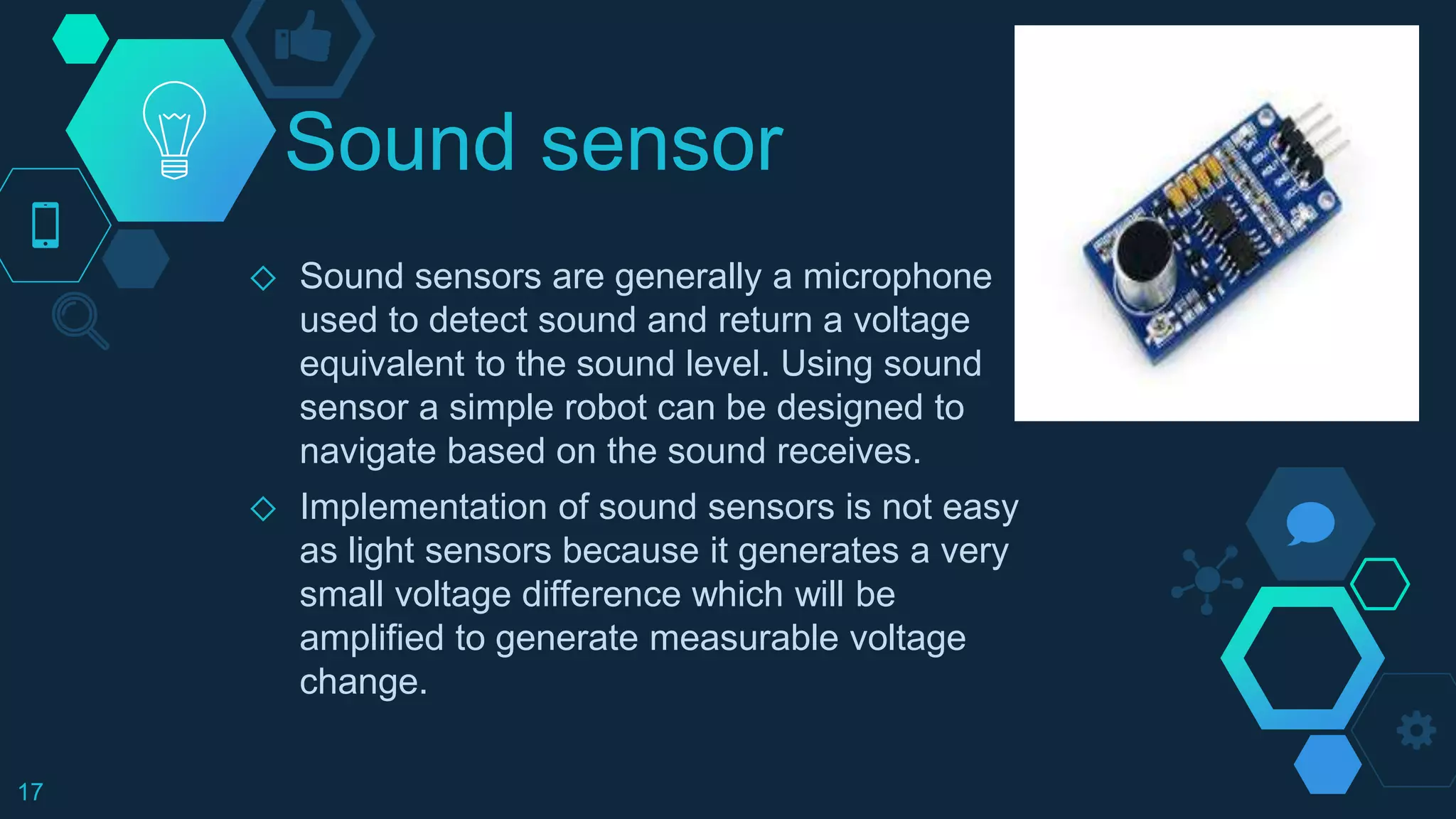
Sound sensor
◇ Sound sensors are generally a microphone
used to detect sound and return a voltage
equivalent to the sound level. Using sound
sensor a simple robot can be designed to
navigate based on the sound receives.
◇ Implementation of sound sensors is not easy
as light sensors because it generates a very
small voltage difference which will be
amplified to generate measurable voltage
change.
17
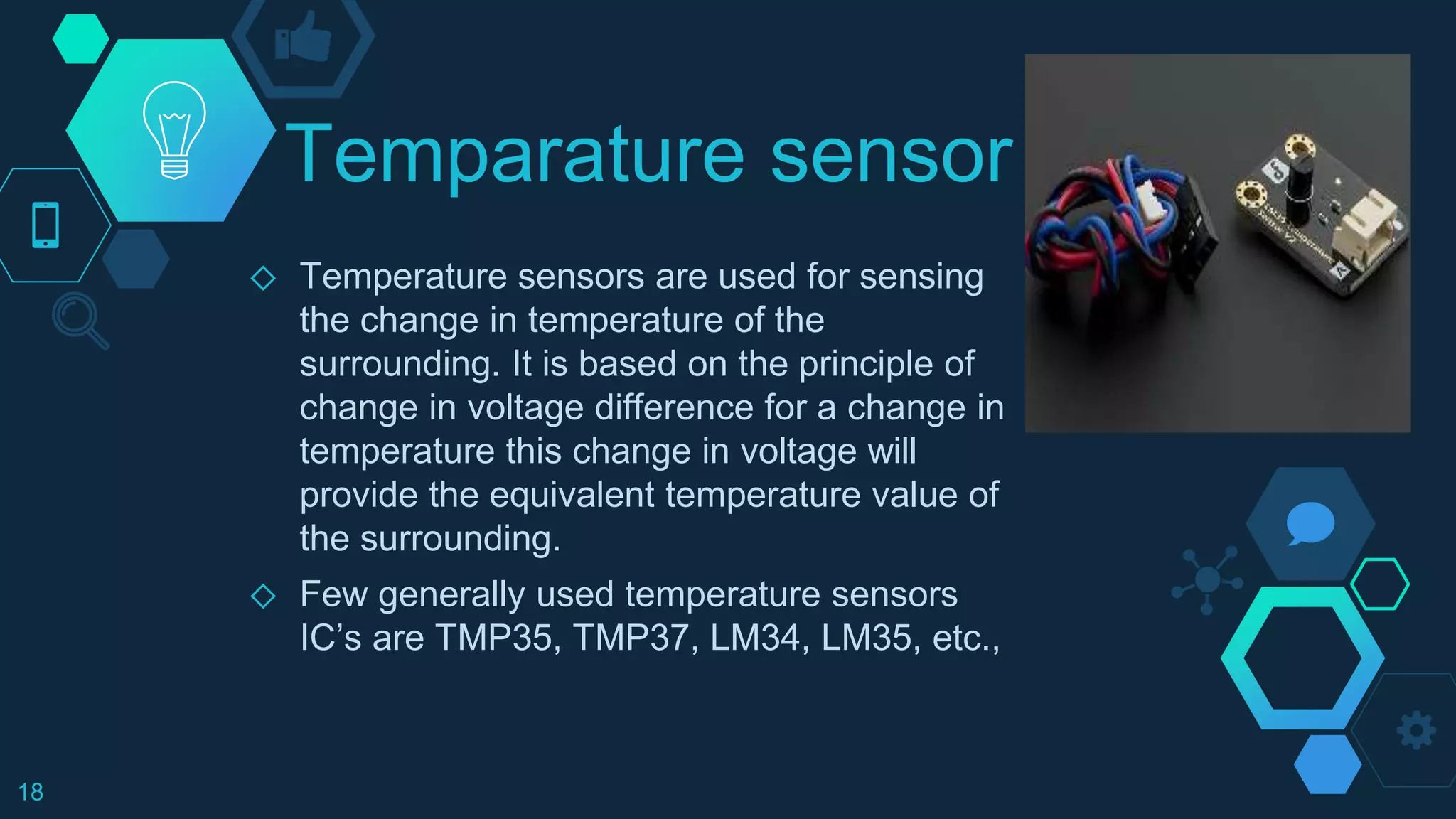
Temparature sensor
◇ Temperature sensors are used for sensing
the change in temperature of the
surrounding. It is based on the principle of
change in voltage difference for a change in
temperature this change in voltage will
provide the equivalent temperature value of
the surrounding.
◇ Few generally used temperature sensors
IC’s are TMP35, TMP37, LM34, LM35, etc.,
18
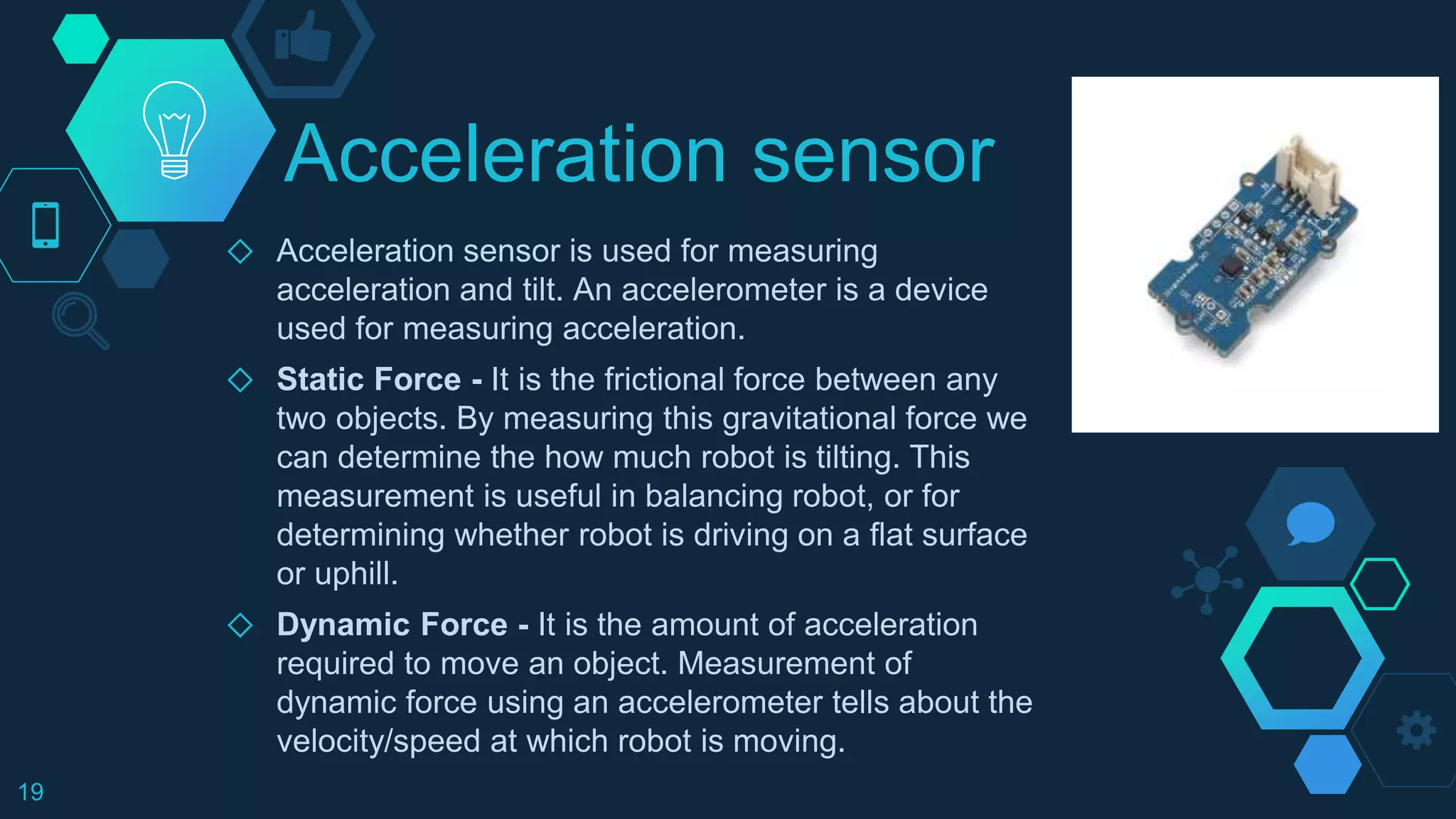
Acceleration sensor
◇ Acceleration sensor is used for measuring
acceleration and tilt. An accelerometer is a device
used for measuring acceleration.
◇ Static Force - It is the frictional force between any
two objects. By measuring this gravitational force we
can determine the how much robot is tilting. This
measurement is useful in balancing robot, or for
determining whether robot is driving on a flat surface
or uphill.
◇ Dynamic Force - It is the amount of acceleration
required to move an object. Measurement of
dynamic force using an accelerometer tells about the
velocity/speed at which robot is moving.
19
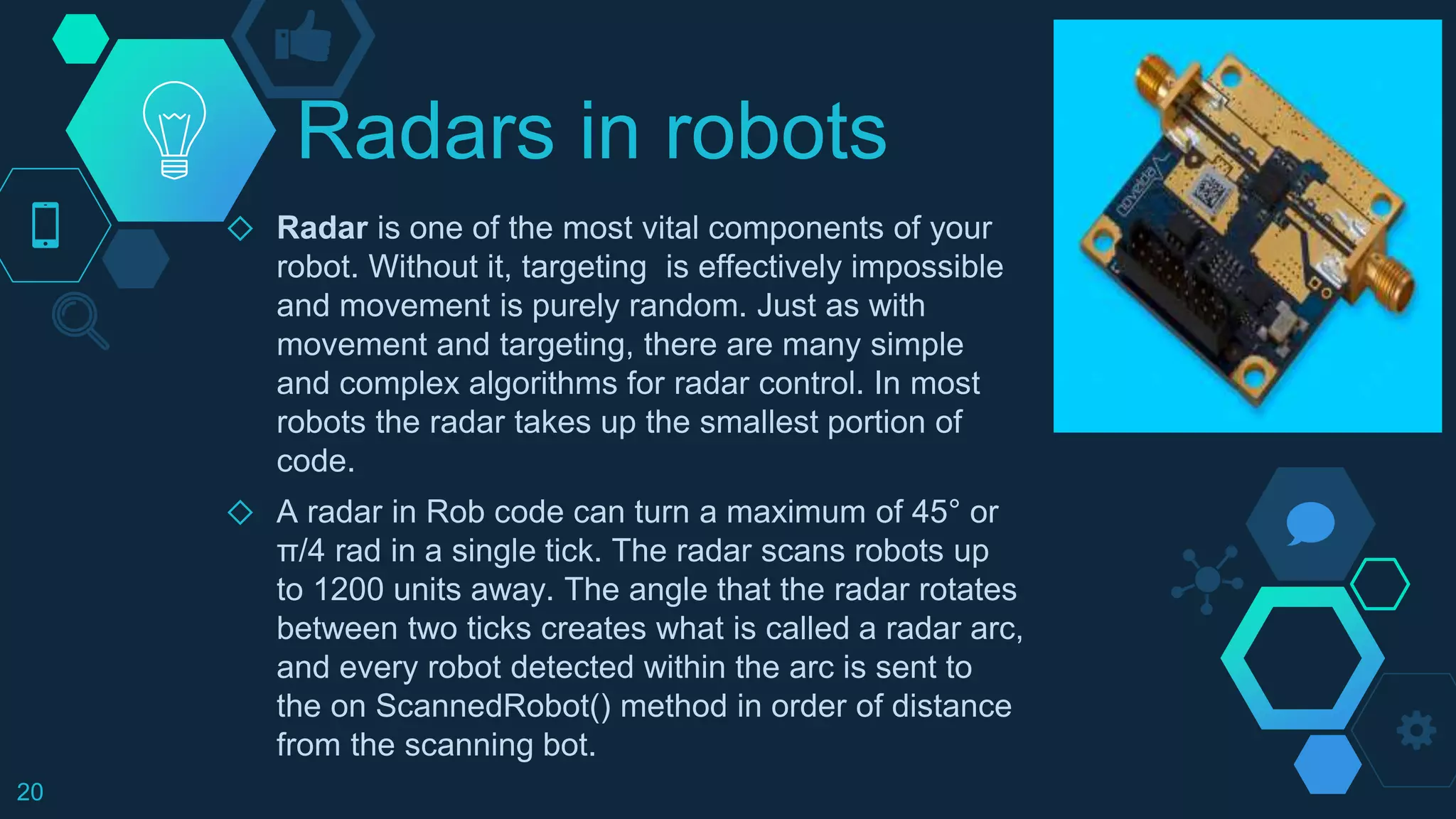
Radars in robots
◇ Radar is one of the most vital components of your
robot. Without it, targeting is effectively impossible
and movement is purely random. Just as with
movement and targeting, there are many simple
and complex algorithms for radar control. In most
robots the radar takes up the smallest portion of
code.
◇ A radar in Rob code can turn a maximum of 45° or
π/4 rad in a single tick. The radar scans robots up
to 1200 units away. The angle that the radar rotates
between two ticks creates what is called a radar arc,
and every robot detected within the arc is sent to
the on ScannedRobot() method in order of distance
from the scanning bot.
20
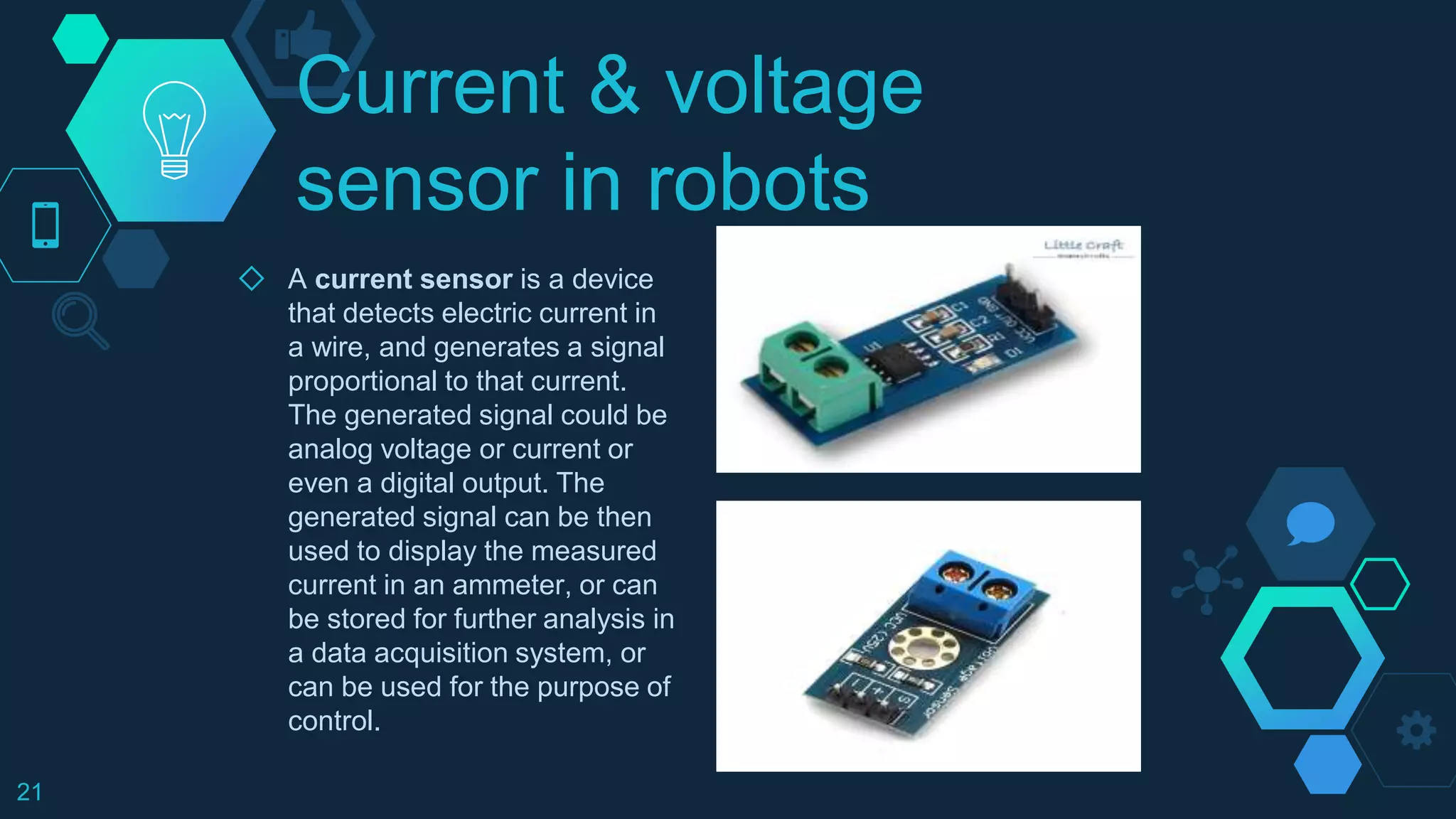
Current & voltage
sensor in robots
◇ A current sensor is a device
that detects electric current in
a wire, and generates a signal
proportional to that current.
The generated signal could be
analog voltage or current or
even a digital output. The
generated signal can be then
used to display the measured
current in an ammeter, or can
be stored for further analysis in
a data acquisition system, or
can be used for the purpose of
control.
21
Introduction to
humanoid robots
◇ A humanoid robot is a robot with its body shape built
to resemble the human body. The design may be for
functional purposes, such as interacting with human
tools and environments, for experimental purposes,
such as the study of bipedal locomotion, or for other
purposes.
◇ In general, humanoid robots have a torso, a head, two
arms, and two legs, though some forms of humanoid
robots may model only part of the body, for example,
from the waist up. Some humanoid robots also have
heads designed to replicate human facial features such
as eyes and mouths.
22
Why humanoid
robots
◇ Human cognition is a field of study which is focused on how
humans learn from sensory information in order to acquire
perceptual and motor skills. This knowledge is used to
develop computational models of human behaviour and it
has been improving over time.
◇ Humanoids are also suitable for some procedurally-based
vocations, such as reception-desk administrators and
automotive manufacturing line workers. In essence, since
they can use tools and operate equipment and vehicles
designed for the human form, humanoids could theoretically
perform any task a human being can, so long as they have
the proper software. However, the complexity of doing so is
immense.
23
History
◇ In 1973, in Waseda University, Tokyo, WABOT-1 was
developed, which was capable to communicate with a
person in Japanese, could do distance and direction
measurements using sensors, artificial ears and eyes and
an artificial mouth.
◇ More developments in 20th century include Greenman in
1983, WABOT-2 in 1984, WHL-11 in 1985, the musician
robot- WASUBOT in 1985, series of seven biped robots
called E0-E6 by Honda in 1986, the full scale
anthromorphic robot- MANNY in 1989, with 42 degrees of
freedom, Honda’s P1 through P3 in
1993, HADALY and WAIBAN in 1995, SAIKA in 1996
and ASIMO by Honda in 2000.
24
Sensor
◇ The two most important components of Humanoid Robots are
Sensors and Actuators.
◇ Sensors are the devices which sense something, like
environmental parameters (heat, sound, light, temperature,
etc.,) physical and physiological parameters (like movement,
orientation, etc.).
◇ Actuators are nothing but the motors which are responsible for
the motion and movement of the robots
◇ Actuators are used to perform like joints and muscles. Mostly
humanoid robots use rotator actuators to achieve the effect as
human motion. The actuators can be pneumatic, hydraulic,
electric or ultrasonic
25
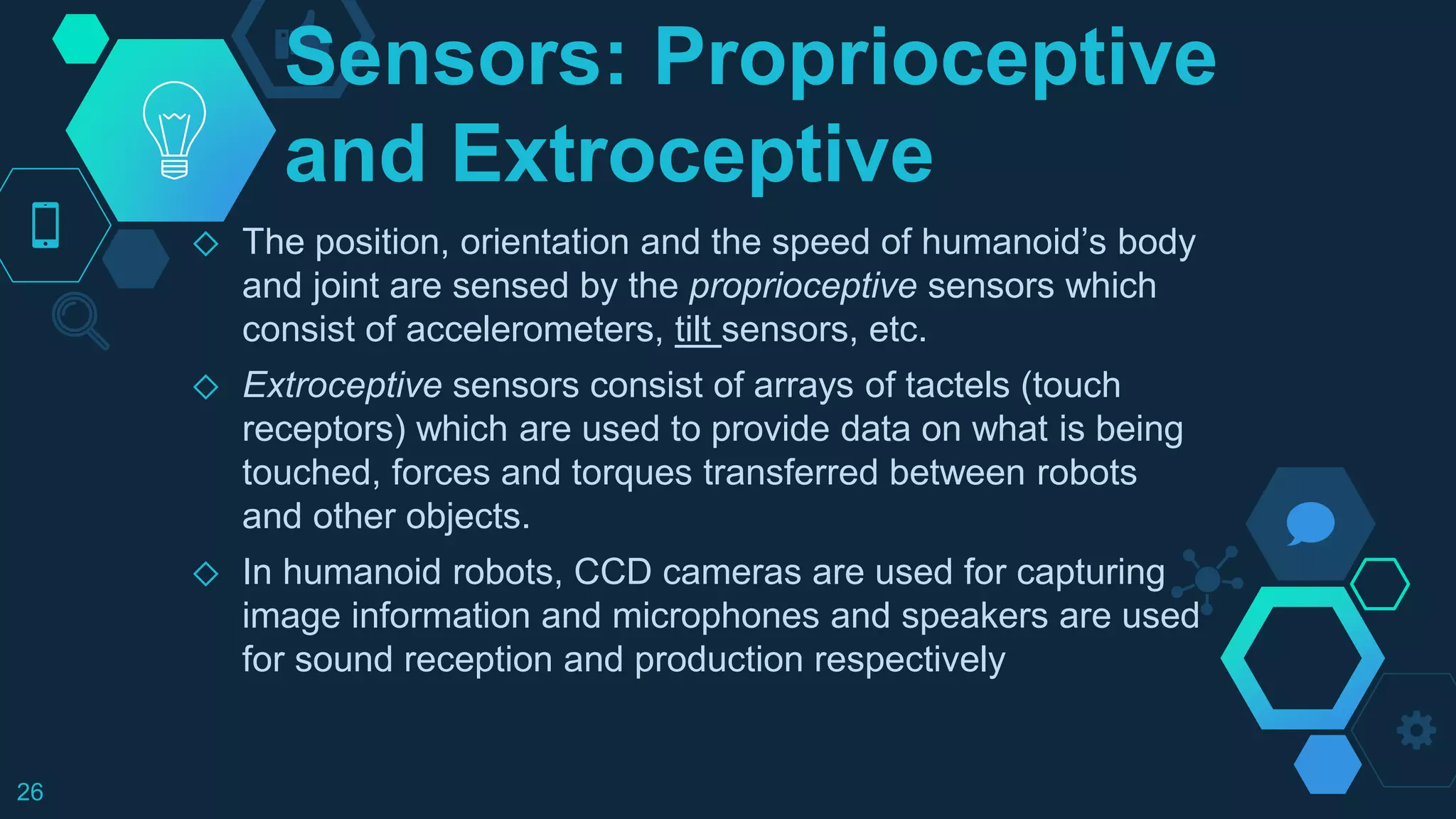
Sensors: Proprioceptive
and Extroceptive
◇ The position, orientation and the speed of humanoid’s body
and joint are sensed by the proprioceptive sensors which
consist of accelerometers, tilt sensors, etc.
◇ Extroceptive sensors consist of arrays of tactels (touch
receptors) which are used to provide data on what is being
touched, forces and torques transferred between robots
and other objects.
◇ In humanoid robots, CCD cameras are used for capturing
image information and microphones and speakers are used
for sound reception and production respectively
26
Working & Control
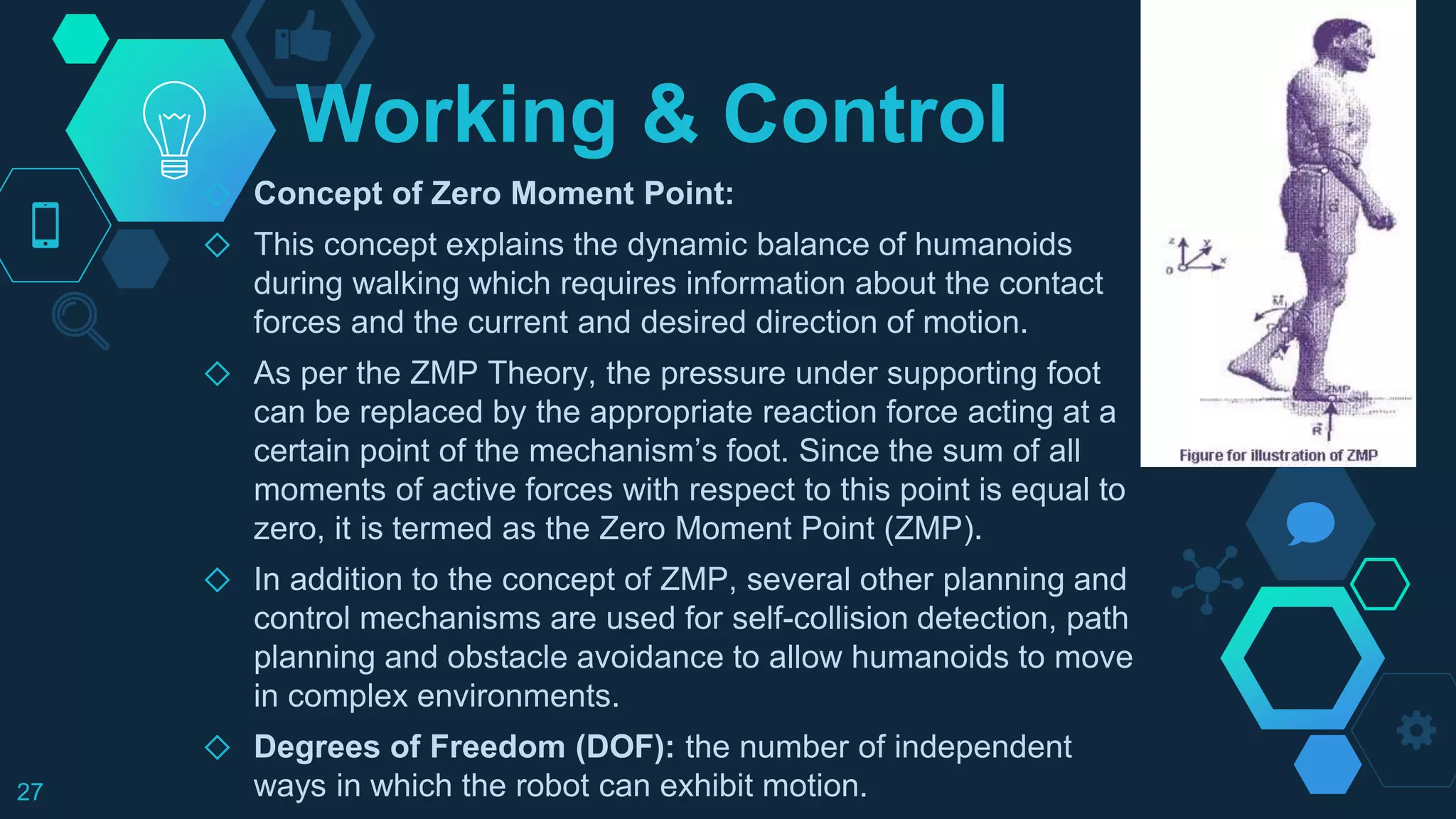
◇ Concept of Zero Moment Point:
◇ This concept explains the dynamic balance of humanoids
during walking which requires information about the contact
forces and the current and desired direction of motion.
◇ As per the ZMP Theory, the pressure under supporting foot
can be replaced by the appropriate reaction force acting at a
certain point of the mechanism’s foot. Since the sum of all
moments of active forces with respect to this point is equal to
zero, it is termed as the Zero Moment Point (ZMP).
◇ In addition to the concept of ZMP, several other planning and
control mechanisms are used for self-collision detection, path
planning and obstacle avoidance to allow humanoids to move
in complex environments.
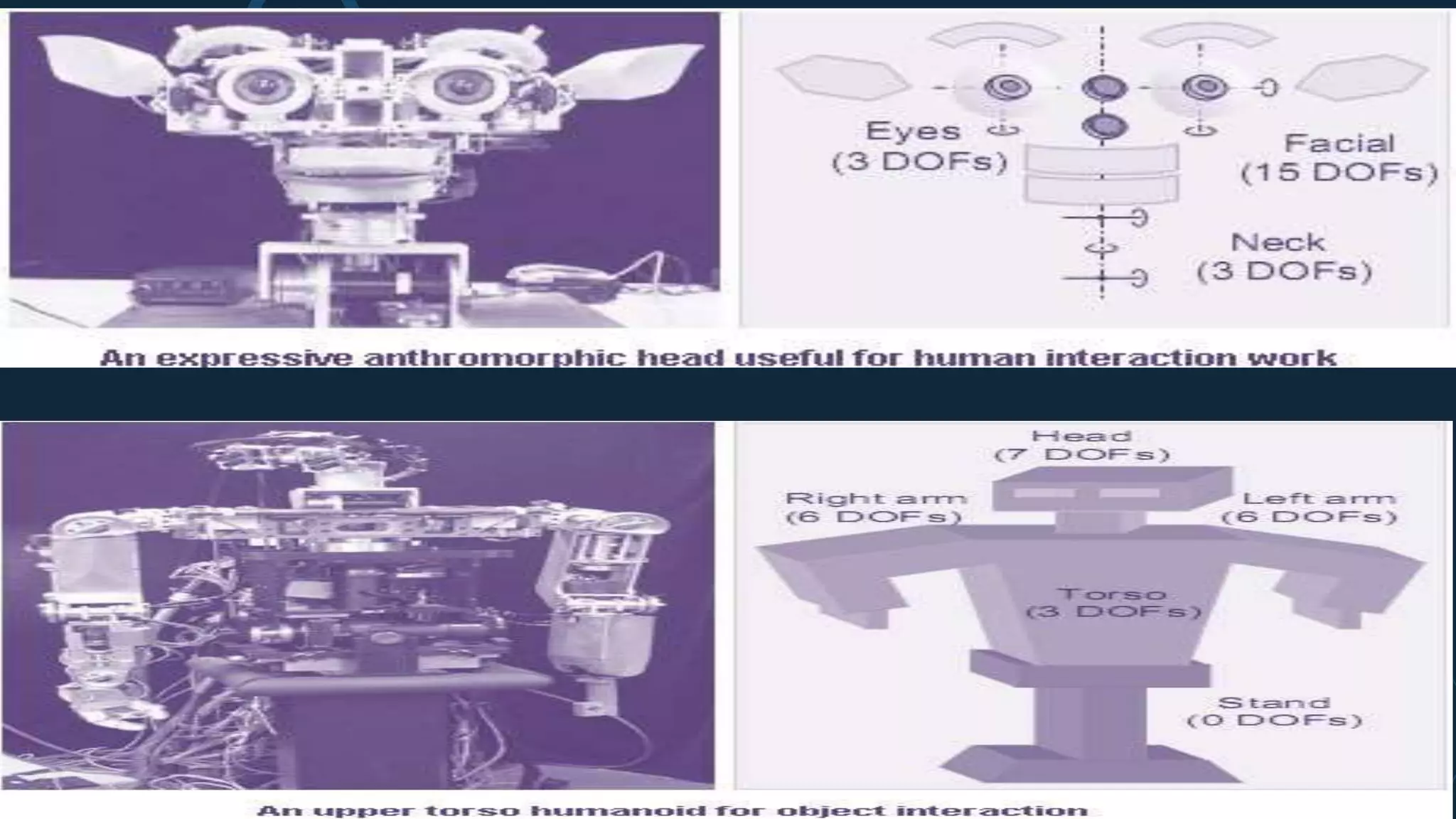
◇ Degrees of Freedom (DOF): the number of independent
ways in which the robot can exhibit motion.27
Development
Psychology:
◇ Developmental psychology is most typically employed in
robotics research as a source of inspiration. Models from
developmental psychology often offer behavioural
decomposition and observations about task performance
which may provide an outline for a software architecture.
◇ However, a developmental approach to robot construction
also provides practical benefits. Human development
exploits a gradual increase in both internal complexities to
optimize the acquisition of new skills.
28
29
Challenges
◇ Challenges before Humanoid Robotics
◇ The prime problems facing Humanoid research can
be given as following four questions:
◇ 1. How does the robot know when to imitate?
◇ 2. How does the robot know what to imitate?
◇ 3. How does the robot map observed actions into
behavioural responses?
◇ 4. How does the robot evaluate its actions, correct
errors, and recognize when it has achieved its goal?
30
◇ A socially intelligent robot should be able to use imitation for
the variety of purposes that humans do. Imitation can be a
mechanism for developing social attachments through imitative
play and for gaining an understanding of people. Imitation can
also be used to explore and expand the range of possible
actions. Finally, imitation can be a mechanism for establishing
personal identity and discovering distinctions between self and
other. A social robot should selectively use imitation to achieve
many of these goals.
◇ Faced with an incoming stream of sensory data, the robot must
make a number of decisions to determine what actions in the
world are appropriate to imitate. The robot must not only be
able to distinguish the class of stimuli (including humans and
perhaps other robots) which might be a good model but also
determine if the current actions of that agent are worthy of
imitation.
31
Types of humanoid
robots
◇ ASIMO
◇ PETMAN
◇ NAO
◇ ATLAS
◇ ICUB
◇ PEPPER
◇ SOPHIA
32
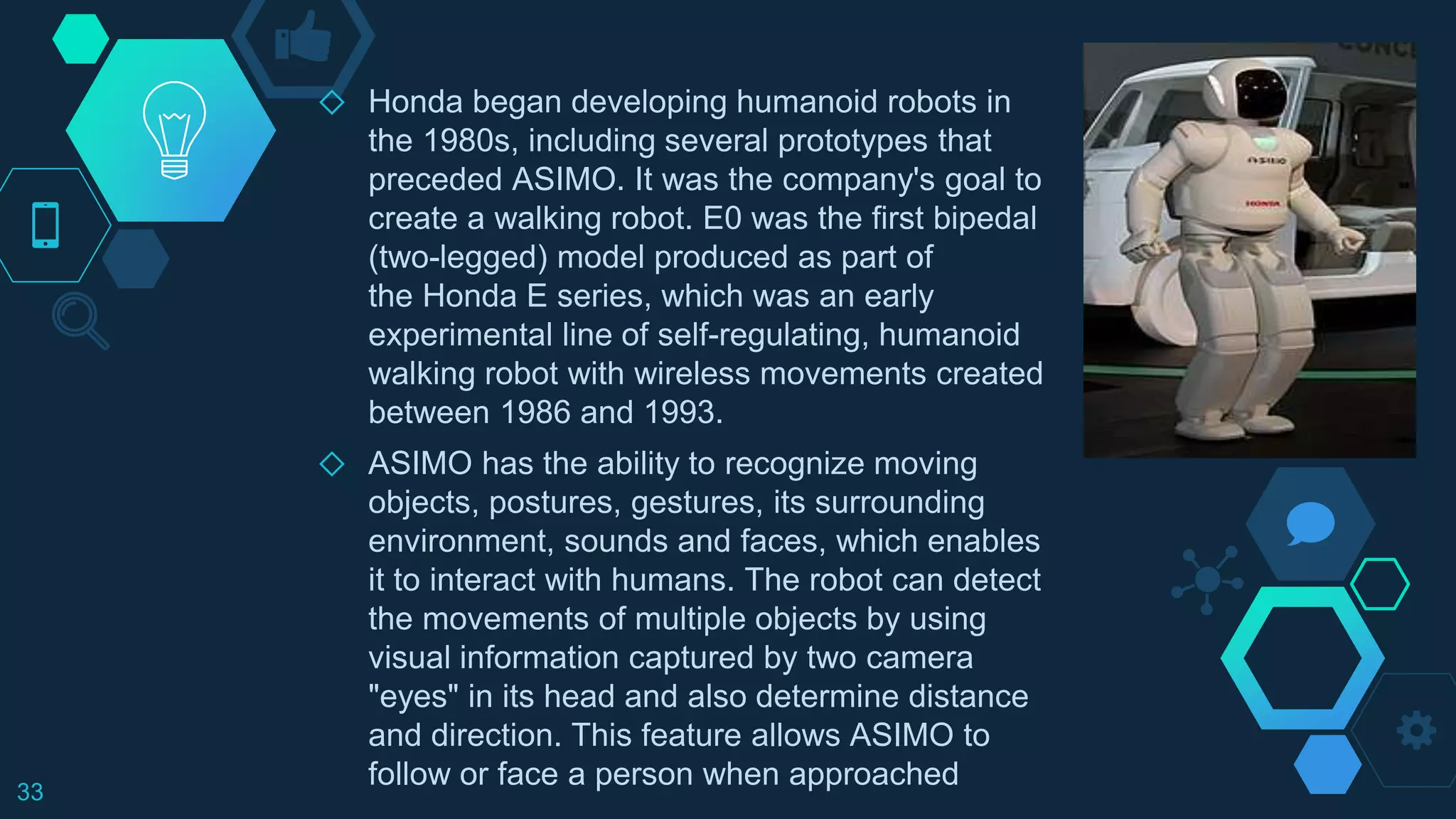
◇ Honda began developing humanoid robots in
the 1980s, including several prototypes that
preceded ASIMO. It was the company's goal to
create a walking robot. E0 was the first bipedal
(two-legged) model produced as part of
the Honda E series, which was an early
experimental line of self-regulating, humanoid
walking robot with wireless movements created
between 1986 and 1993.
◇ ASIMO has the ability to recognize moving
objects, postures, gestures, its surrounding
environment, sounds and faces, which enables
it to interact with humans. The robot can detect
the movements of multiple objects by using
visual information captured by two camera
"eyes" in its head and also determine distance
and direction. This feature allows ASIMO to
follow or face a person when approached33
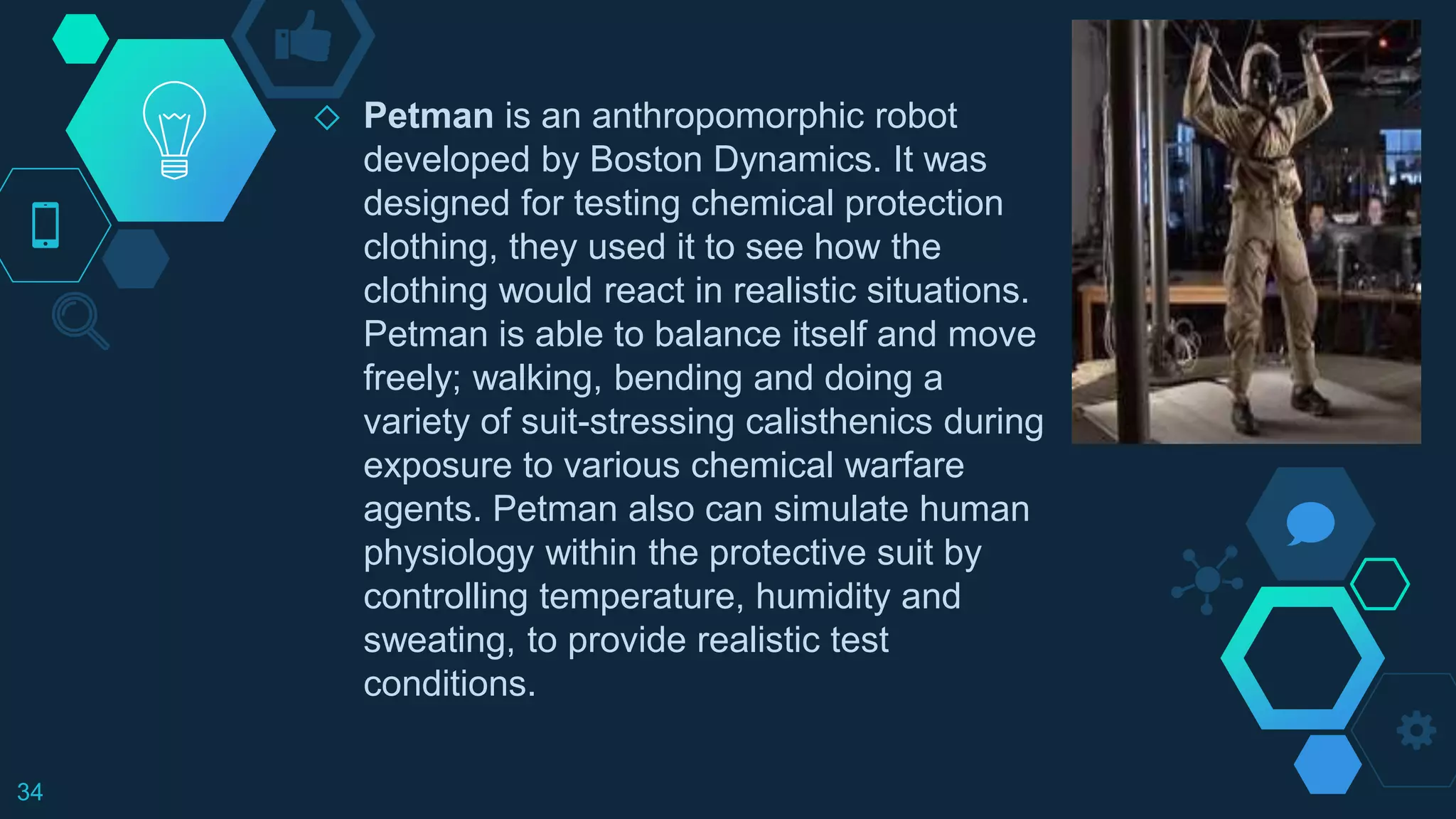
◇ Petman is an anthropomorphic robot
developed by Boston Dynamics. It was
designed for testing chemical protection
clothing, they used it to see how the
clothing would react in realistic situations.
Petman is able to balance itself and move
freely; walking, bending and doing a
variety of suit-stressing calisthenics during
exposure to various chemical warfare
agents. Petman also can simulate human
physiology within the protective suit by
controlling temperature, humidity and
sweating, to provide realistic test
conditions.
34
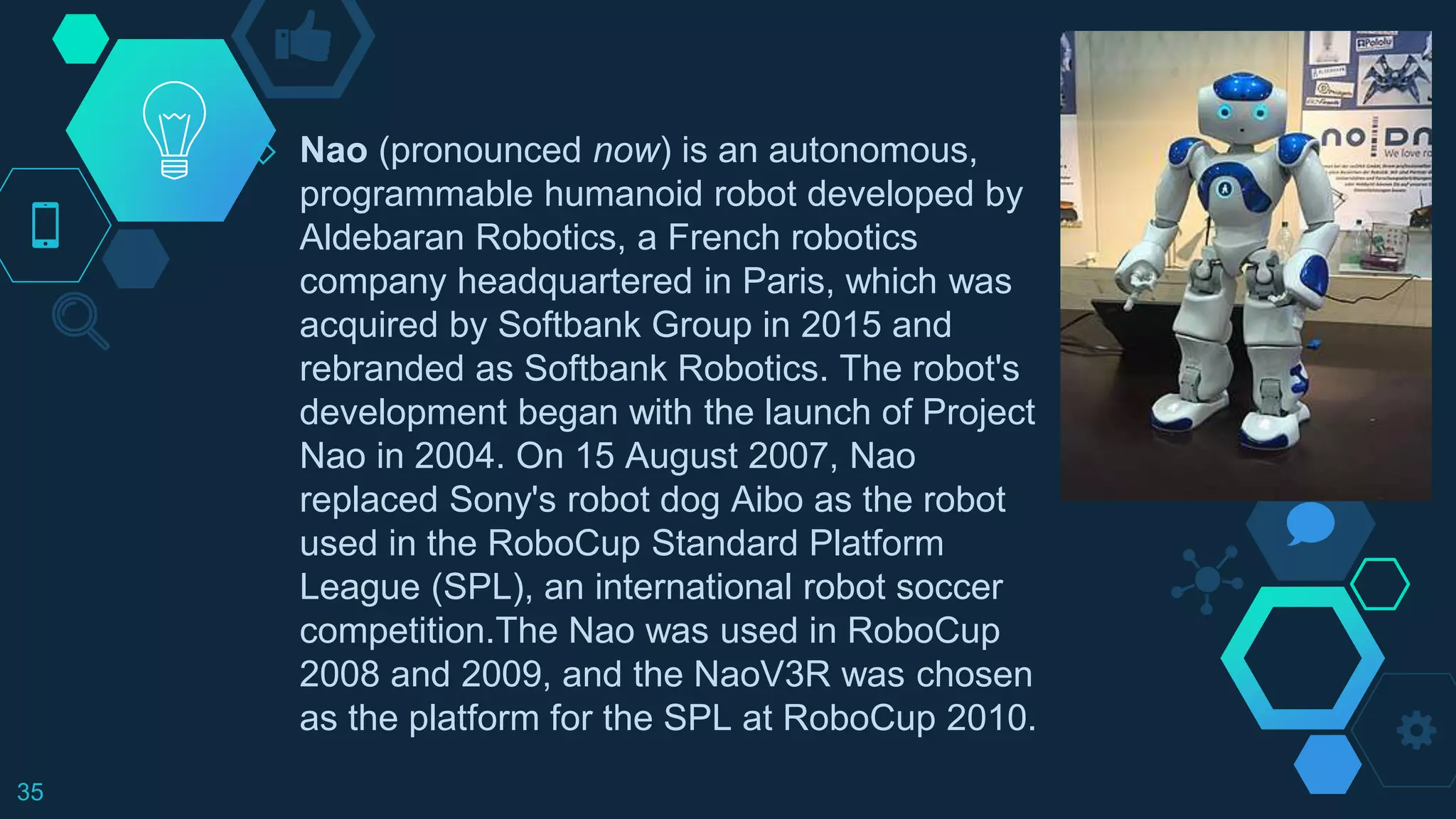
◇ Nao (pronounced now) is an autonomous,
programmable humanoid robot developed by
Aldebaran Robotics, a French robotics
company headquartered in Paris, which was
acquired by Softbank Group in 2015 and
rebranded as Softbank Robotics. The robot's
development began with the launch of Project
Nao in 2004. On 15 August 2007, Nao
replaced Sony's robot dog Aibo as the robot
used in the RoboCup Standard Platform
League (SPL), an international robot soccer
competition.The Nao was used in RoboCup
2008 and 2009, and the NaoV3R was chosen
as the platform for the SPL at RoboCup 2010.
35
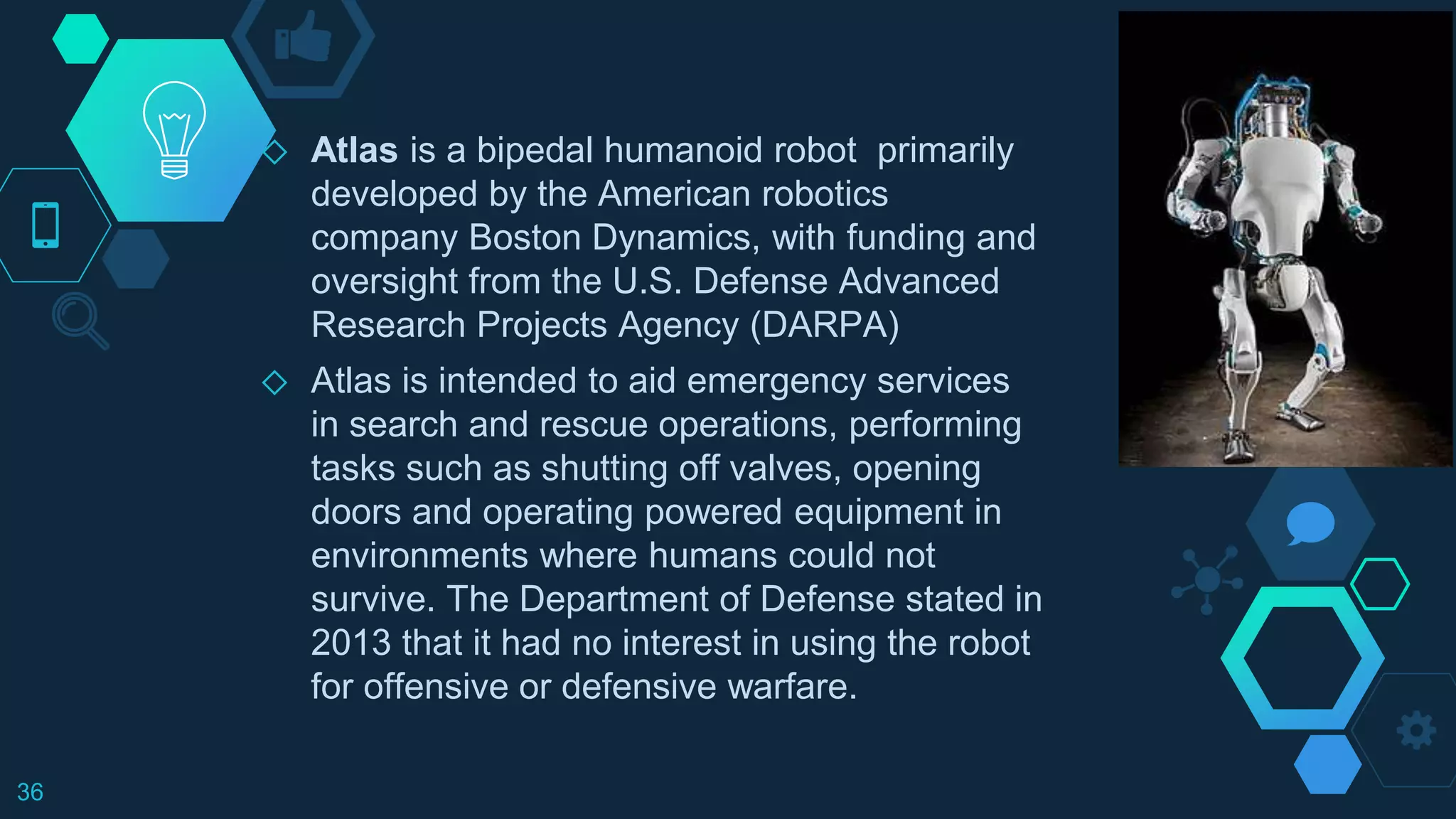
◇ Atlas is a bipedal humanoid robot primarily
developed by the American robotics
company Boston Dynamics, with funding and
oversight from the U.S. Defense Advanced
Research Projects Agency (DARPA)
◇ Atlas is intended to aid emergency services
in search and rescue operations, performing
tasks such as shutting off valves, opening
doors and operating powered equipment in
environments where humans could not
survive. The Department of Defense stated in
2013 that it had no interest in using the robot
for offensive or defensive warfare.
36
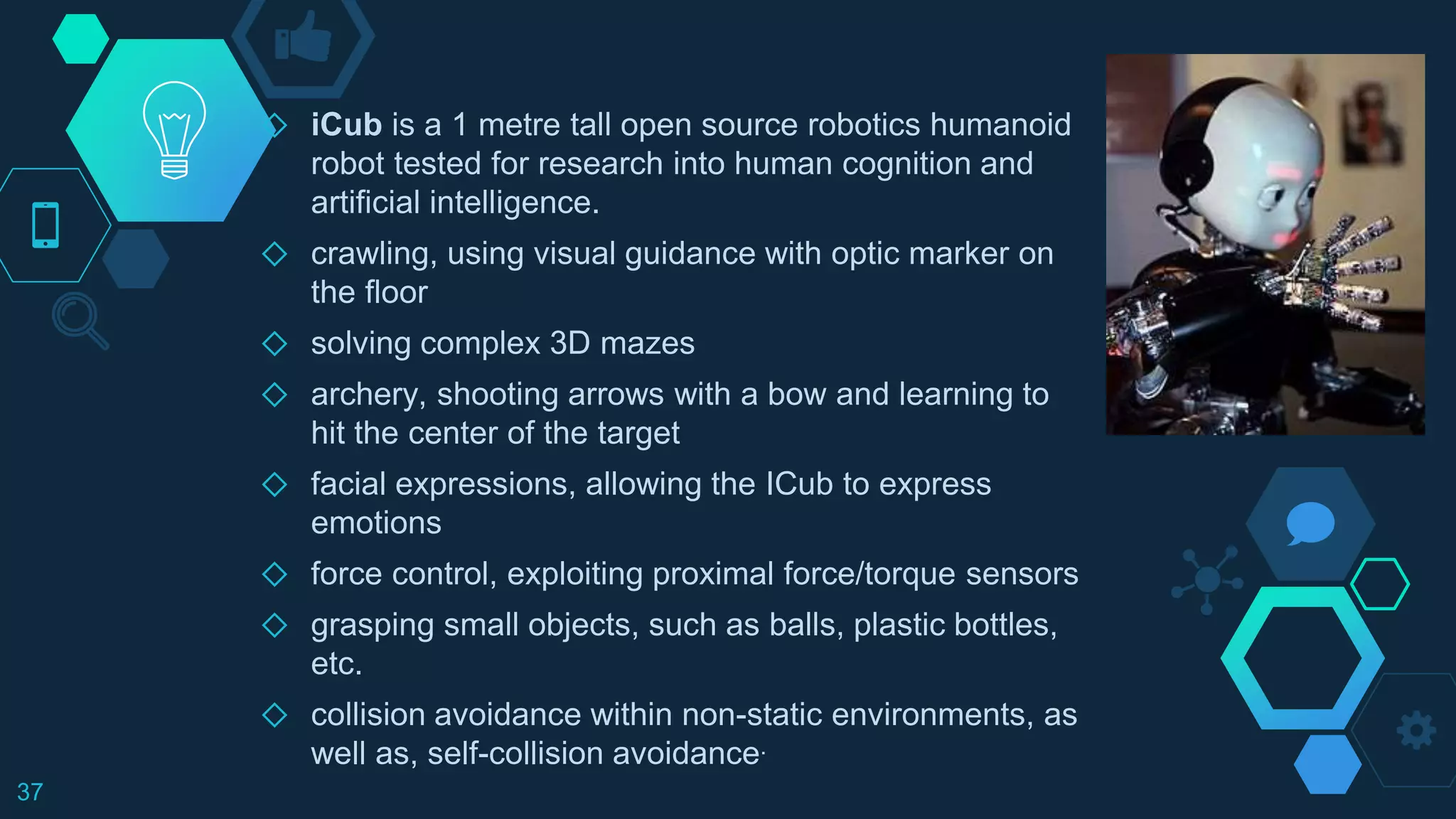
◇ iCub is a 1 metre tall open source robotics humanoid
robot tested for research into human cognition and
artificial intelligence.
◇ crawling, using visual guidance with optic marker on
the floor
◇ solving complex 3D mazes
◇ archery, shooting arrows with a bow and learning to
hit the center of the target
◇ facial expressions, allowing the ICub to express
emotions
◇ force control, exploiting proximal force/torque sensors
◇ grasping small objects, such as balls, plastic bottles,
etc.
◇ collision avoidance within non-static environments, as
well as, self-collision avoidance.
37
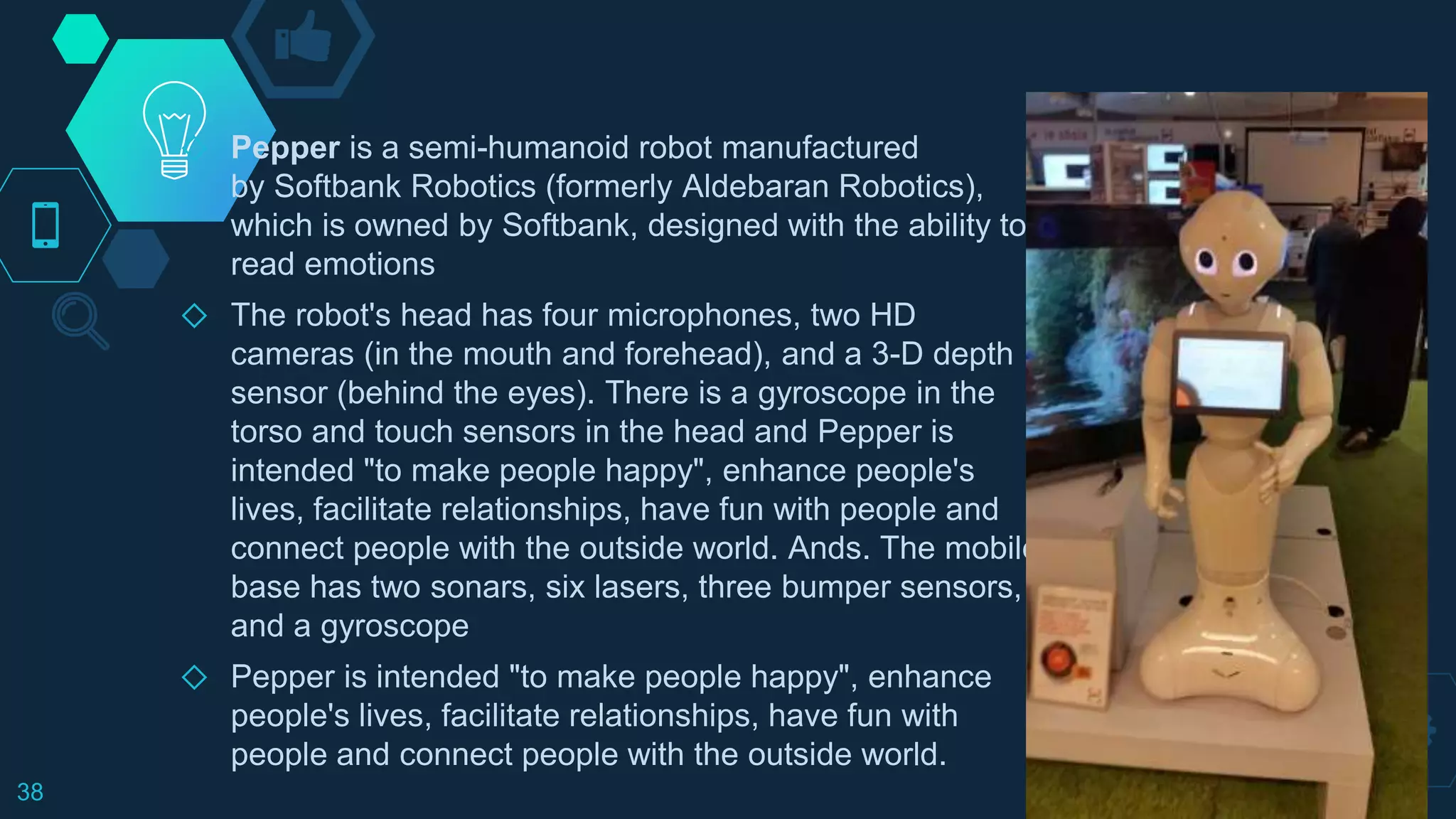
◇ Pepper is a semi-humanoid robot manufactured
by Softbank Robotics (formerly Aldebaran Robotics),
which is owned by Softbank, designed with the ability to
read emotions
◇ The robot's head has four microphones, two HD
cameras (in the mouth and forehead), and a 3-D depth
sensor (behind the eyes). There is a gyroscope in the
torso and touch sensors in the head and Pepper is
intended "to make people happy", enhance people's
lives, facilitate relationships, have fun with people and
connect people with the outside world. Ands. The mobile
base has two sonars, six lasers, three bumper sensors,
and a gyroscope
◇ Pepper is intended "to make people happy", enhance
people's lives, facilitate relationships, have fun with
people and connect people with the outside world.
38
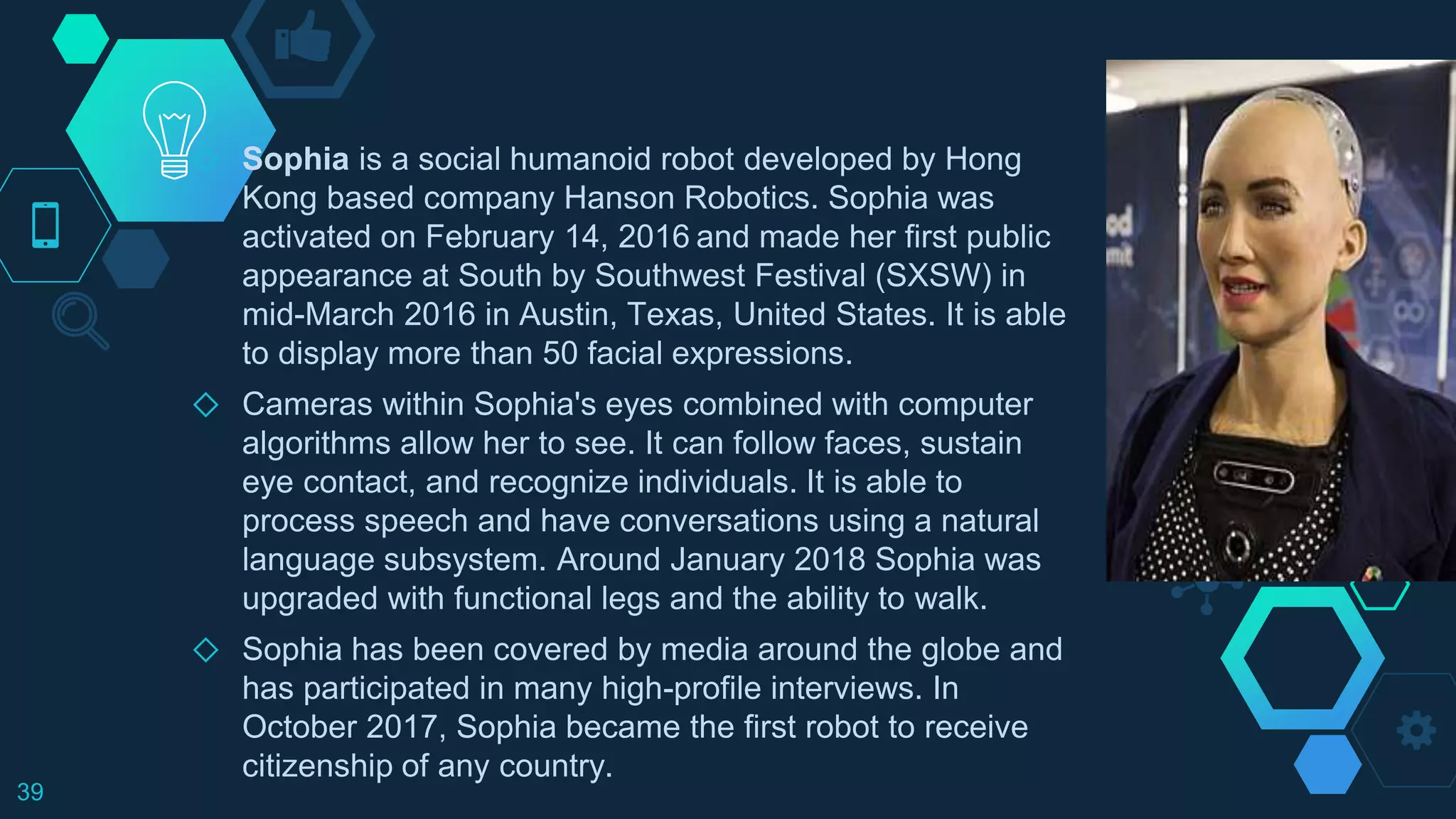
◇ Sophia is a social humanoid robot developed by Hong
Kong based company Hanson Robotics. Sophia was
activated on February 14, 2016 and made her first public
appearance at South by Southwest Festival (SXSW) in
mid-March 2016 in Austin, Texas, United States. It is able
to display more than 50 facial expressions.
◇ Cameras within Sophia's eyes combined with computer
algorithms allow her to see. It can follow faces, sustain
eye contact, and recognize individuals. It is able to
process speech and have conversations using a natural
language subsystem. Around January 2018 Sophia was
upgraded with functional legs and the ability to walk.
◇ Sophia has been covered by media around the globe and
has participated in many high-profile interviews. In
October 2017, Sophia became the first robot to receive
citizenship of any country.
39
Applications of robotics
in industry◇ Agriculture
◇ Automobile
◇ Construction
◇ Entertainment
◇ Health care: hospitals, patient-care, surgery , research, etc.
Laboratories: science, engineering , etc.
◇ Law enforcement: surveillance, patrol, etc.
◇ Manufacturing, Military: demining, surveillance, attack, etc. Mining,
excavation, and exploration
◇ Transportation: air, ground, rail, space, etc. •Utilities: gas, water,
and electric •Warehouses
40
Applications
◇ Robots in Military:
◇ PREDATOR
◇ ISTAR
◇ GLOBAL HAWK
◇ GOLDENEYE
◇ Robots at Home:
◇ Aibo(The Sony robot
dog)
◇ Poo-Chi
◇ iDog(Sega's robot iPod
music speaker)
◇ Space Dog, the remote
control dog
41
Advantages
◇ Recent developments in the robotics world has made robots
more user friendly, intelligent, and most importantly
affordable.
◇ The benefits of robots has increased their flexibility with
being capable of performing a variety of tasks and
applications.
◇ They are more precise and consistent than human workers.
◇ Robots have the ability to work around the clock since they
do not require vacations, sick days, or breaks. They also
make fewer mistakes than humans, saving companies time.
42
Dis-advantages
◇ Robots cannot respond in times of danger as humans
can.
◇ Production and purchasing of robots is very expensive.
◇ We cannot invest our entire trust in robots to care and
give companionship to our family members.
◇ Robotics is currently being used in factories across the
world and people have been increasingly losing their
jobs as robots become more efficient and precise than
humans
43
Future scope of robotics
◇ Across the world, labour-intensive industries are facing
challenges of rising labour cost and lack of skilled
workforce. This has pushed companies to adopt robotic
technology to automate operations. The automotive,
healthcare, and aerospace industries, for instance, are
facing major challenges of lack of skilled workforce, and
are thus incorporating robots into their process. Industrial
robots are capable of performing a variety of programmed
tasks in manufacturing and production settings that are
often dangerous for human workers. Service robots, on
the other hand, assist human beings for jobs that are
typically repetitive and are dangerous.
44
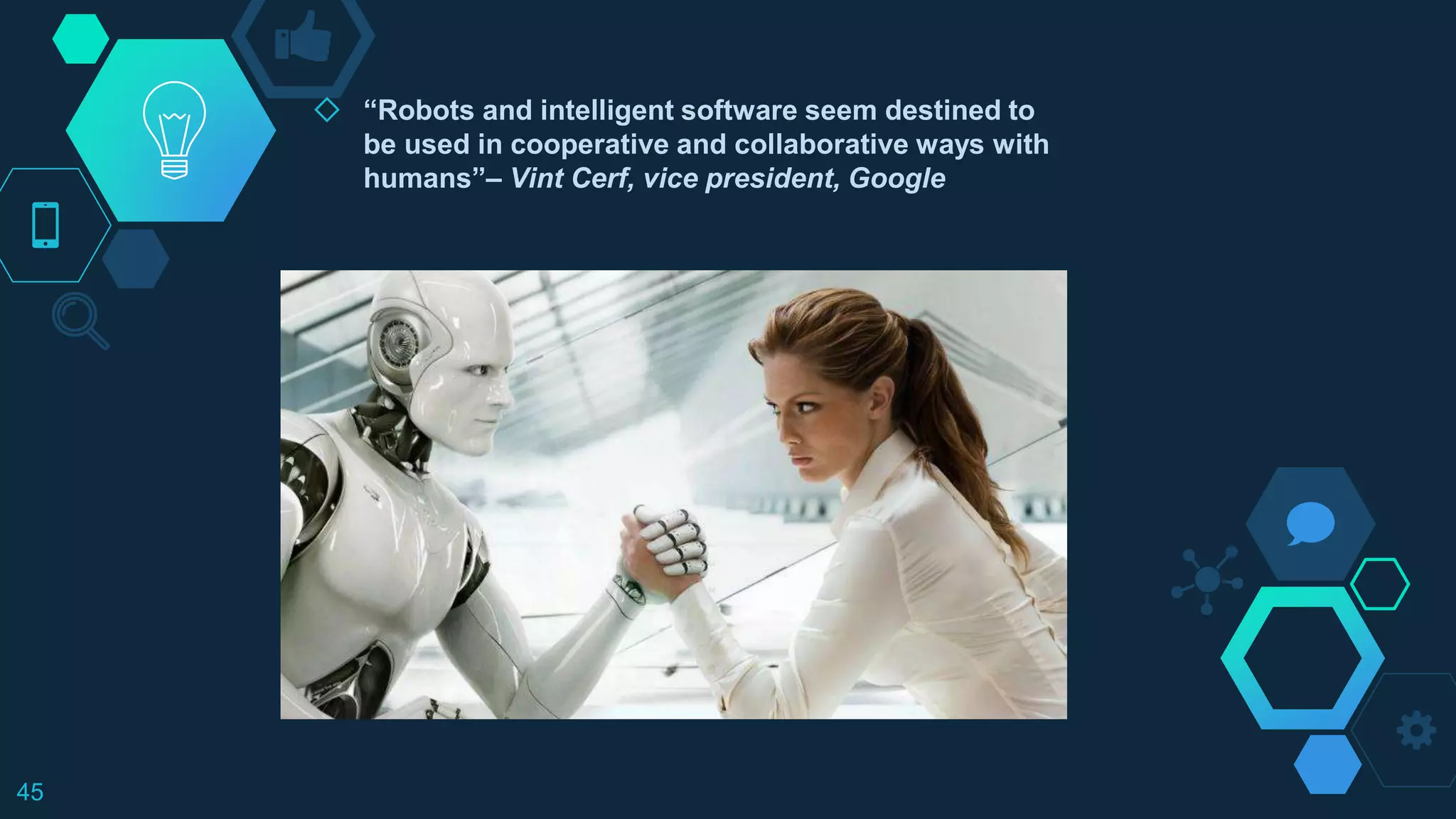
◇ “Robots and intelligent software seem destined to
be used in cooperative and collaborative ways with
humans”– Vint Cerf, vice president, Google
45
Conclusion
◇ Today we find most robots working for people in industries,
factories, warehouses, and laboratories. Robots are useful
in many ways. For instance, it boosts economy because
businesses need to be efficient to keep up with the industry
competition. Therefore, having robots helps business
owners to be competitive, because robots can do jobs
better and faster than humans can, e.g. robot can built,
assemble a car. Yet robots cannot perform every job; today
robots roles include assisting research and industry. Finally,
as the technology improves, there will be new ways to use
robots which will bring new hopes and new potentials.
46
References
◇ "Robotics sensors (Active)"Active Robots. Retrieved 23 January 2015.
◇ "Google Adds to Its Menagerie of Robots", New York Times, December
14, 2013.
◇ Konstantin, Phil. "An Interview with Isaac Asimov". americanindian.net.
Retrieved March 3, 2015.
◇ Hanlon, Mike. "Twenty years in the making – ASIMO the humanoid
robot". Gizmag. Retrieved 29 September 2011.
◇ "Nao robot replaces AIBO in RoboCup Standard Platform
League". Engadget. 16 August 2007. Retrieved 4 October 2012.
◇ "An open source cognitive humanoid robotic platform". Official iCub
website. Retrieved 2010-07-30.
◇ "Meet Sophia, the female humanoid robot and newest SXSW
celebrity". PCWorld. Retrieved 2018-01-04.
47
Thanks!
Any questions?
You can find me at:
◇ @Uday kumar
◇ udaykumarkodakolla@gmail.com
48

Robotics ppt

  • 1.
    VEMU INSTITUTE OFTECHNOLOGY TOPIC:Robotics submitted by C.Uday kumar 154M1A0417[ECE] 1
  • 2.
    Content:- o Introduction torobotics o Types of robots o Sensors used in robots o Introduction to humanoid robots o Applications o Advantages o Disadvantages o Future scope of robotics o Conclusion
  • 3.
    “ “It seems tome that only someone who wishes for freedom can be free. I wish for freedom.” ― Isaac Asimov 3
  • 4.
    Introduction ◇ Robotics isan interdisciplinary branch of engineering and science that includes mechanic engineering, electronic engineering, information engineering, computer science, artificial intelligence, mechatronics, nanotechnology and bioengineering and others. ◇ Robotics deals with the design, construction, operation, and use of robots, as well as computer systems for their control, sensory feedback, and information processing.4
  • 5.
    History ◇ Word robotwas coined by a Czech novelist Karel Capek in a 1920 play titled Rassum’s Universal Robots (RUR).Robot in Czech is a word for worker or servant In 1948, Norbert Wiener formulated the principles of cybernetics, the basis of practical robotics. ◇ The first digitally operated and programmable robot, the Unimate, was installed in 1961 to lift hot pieces of metal from a die casting machine and stack them. 5
  • 6.
    Definition of robot: ◇Any machine made by one of our members: Robot Institute of America. ◇ A robot is a reprogrammable, multifunctional manipulator designed to move material, parts, tools or specialized devices through variable programmed motions for the performance of a variety of tasks. 6
  • 7.
    Three laws ofrobotics ◇ The Three Laws of Robotics (often shortened to The Three Laws or known as Asimov's Laws) are a set of rules devised by the science fiction author Isaac Asimov. ◇ The rules were introduced in his 1942 short story "Run-around" (included in the 1950 collection I. Robot ◇ First Law – A robot may not injure a human being or, through inaction, allow a human being to come to harm. ◇ Second Law – A robot must obey the orders given it by human beings except where such orders would conflict with the First Law. ◇ Third Law – A robot must protect its own existence as long as such protection does not conflict with the First or Second Laws 7
  • 8.
    Types of robots ◇Robot Manipulators ◇ Mobile Robots ◇ Humanoid Robots ◇ Wheeled Robots ◇ Legged Robot ◇ Autonomous Underwater Vehicle. ◇ Unmanned Aerial Vehicle. 8
  • 9.
  • 10.
    Mobile robots ◇ Amobile robot is a robot that is capable of locomotion. Mobile robotics is usually considered to be a subfield of robotics and information engineering. ◇ A spying robot is an example of a mobile robot capable of movement in a given environment. ◇ Mobile robots have the capability to move around in their environment and are not fixed to one physical location 10
  • 11.
    Legged robots ◇ Leggedrobots are a type of mobile robot which use mechanical limbs for movement. They are more versatile than wheeled robots and can traverse many different terrains, though these advantages require increased complexity and power consumption. ◇ Legged robots often imitate legged animals, such as humans or insects, in an example of biomimicry. 11
  • 12.
    Autonomous under water vehicle ◇An autonomous underwater vehicle (AUV) is a robot that travels underwater without requiring input from an operator. AUVs constitute part of a larger group of undersea systems known as unmanned underwater vehicles , a classification that includes non- autonomous remotely operated underwater vehicles. ◇ In military applications an AUV is more often referred to as an unmanned undersea vehicle (UUV). Underwater gliders are a subclass of AUVs. 12
  • 13.
    Unmanned aerial vehicle ◇ Anunmanned aerial vehicle (UAV), commonly known as a drone, is an aircraft without a human pilot aboard. UAVs are a component of an unmanned aircraft system (UAS); which include a UAV, a ground-based controller, and a system of communications between the two. The flight of UAVs may operate with various degrees of autonomy: either under remote control by a human operator or autonomously by onboard computers. 13
  • 14.
    Sensors and electronic componentsused in robots ◇ Light Sensor ◇ Proximity Sensor ◇ Sound Sensor ◇ Temperature Sensor ◇ Acceleration Sensor ◇ Radar ◇ Camera sensor ◇ Voltage sensor ◇ Current sensor 14
  • 15.
    Light sensor ◇ Lightsensor is a transducer used for detecting light and creates a voltage difference equivalent to the light intensity fall on a light sensor. ◇ The two main light sensors used in robots are Photovoltaic cells and Photo resistor 15
  • 16.
    proximity sensor ◇ Proximitysensor can detect the presence of nearby object without any physical contact. ◇ Infrared (IR) Transceivers ◇ Ultrasonic Sensor 16
  • 17.
    Sound sensor ◇ Soundsensors are generally a microphone used to detect sound and return a voltage equivalent to the sound level. Using sound sensor a simple robot can be designed to navigate based on the sound receives. ◇ Implementation of sound sensors is not easy as light sensors because it generates a very small voltage difference which will be amplified to generate measurable voltage change. 17
  • 18.
    Temparature sensor ◇ Temperaturesensors are used for sensing the change in temperature of the surrounding. It is based on the principle of change in voltage difference for a change in temperature this change in voltage will provide the equivalent temperature value of the surrounding. ◇ Few generally used temperature sensors IC’s are TMP35, TMP37, LM34, LM35, etc., 18
  • 19.
    Acceleration sensor ◇ Accelerationsensor is used for measuring acceleration and tilt. An accelerometer is a device used for measuring acceleration. ◇ Static Force - It is the frictional force between any two objects. By measuring this gravitational force we can determine the how much robot is tilting. This measurement is useful in balancing robot, or for determining whether robot is driving on a flat surface or uphill. ◇ Dynamic Force - It is the amount of acceleration required to move an object. Measurement of dynamic force using an accelerometer tells about the velocity/speed at which robot is moving. 19
  • 20.
    Radars in robots ◇Radar is one of the most vital components of your robot. Without it, targeting is effectively impossible and movement is purely random. Just as with movement and targeting, there are many simple and complex algorithms for radar control. In most robots the radar takes up the smallest portion of code. ◇ A radar in Rob code can turn a maximum of 45° or π/4 rad in a single tick. The radar scans robots up to 1200 units away. The angle that the radar rotates between two ticks creates what is called a radar arc, and every robot detected within the arc is sent to the on ScannedRobot() method in order of distance from the scanning bot. 20
  • 21.
    Current & voltage sensorin robots ◇ A current sensor is a device that detects electric current in a wire, and generates a signal proportional to that current. The generated signal could be analog voltage or current or even a digital output. The generated signal can be then used to display the measured current in an ammeter, or can be stored for further analysis in a data acquisition system, or can be used for the purpose of control. 21
  • 22.
    Introduction to humanoid robots ◇A humanoid robot is a robot with its body shape built to resemble the human body. The design may be for functional purposes, such as interacting with human tools and environments, for experimental purposes, such as the study of bipedal locomotion, or for other purposes. ◇ In general, humanoid robots have a torso, a head, two arms, and two legs, though some forms of humanoid robots may model only part of the body, for example, from the waist up. Some humanoid robots also have heads designed to replicate human facial features such as eyes and mouths. 22
  • 23.
    Why humanoid robots ◇ Humancognition is a field of study which is focused on how humans learn from sensory information in order to acquire perceptual and motor skills. This knowledge is used to develop computational models of human behaviour and it has been improving over time. ◇ Humanoids are also suitable for some procedurally-based vocations, such as reception-desk administrators and automotive manufacturing line workers. In essence, since they can use tools and operate equipment and vehicles designed for the human form, humanoids could theoretically perform any task a human being can, so long as they have the proper software. However, the complexity of doing so is immense. 23
  • 24.
    History ◇ In 1973,in Waseda University, Tokyo, WABOT-1 was developed, which was capable to communicate with a person in Japanese, could do distance and direction measurements using sensors, artificial ears and eyes and an artificial mouth. ◇ More developments in 20th century include Greenman in 1983, WABOT-2 in 1984, WHL-11 in 1985, the musician robot- WASUBOT in 1985, series of seven biped robots called E0-E6 by Honda in 1986, the full scale anthromorphic robot- MANNY in 1989, with 42 degrees of freedom, Honda’s P1 through P3 in 1993, HADALY and WAIBAN in 1995, SAIKA in 1996 and ASIMO by Honda in 2000. 24
  • 25.
    Sensor ◇ The twomost important components of Humanoid Robots are Sensors and Actuators. ◇ Sensors are the devices which sense something, like environmental parameters (heat, sound, light, temperature, etc.,) physical and physiological parameters (like movement, orientation, etc.). ◇ Actuators are nothing but the motors which are responsible for the motion and movement of the robots ◇ Actuators are used to perform like joints and muscles. Mostly humanoid robots use rotator actuators to achieve the effect as human motion. The actuators can be pneumatic, hydraulic, electric or ultrasonic 25
  • 26.
    Sensors: Proprioceptive and Extroceptive ◇The position, orientation and the speed of humanoid’s body and joint are sensed by the proprioceptive sensors which consist of accelerometers, tilt sensors, etc. ◇ Extroceptive sensors consist of arrays of tactels (touch receptors) which are used to provide data on what is being touched, forces and torques transferred between robots and other objects. ◇ In humanoid robots, CCD cameras are used for capturing image information and microphones and speakers are used for sound reception and production respectively 26
  • 27.
    Working & Control ◇Concept of Zero Moment Point: ◇ This concept explains the dynamic balance of humanoids during walking which requires information about the contact forces and the current and desired direction of motion. ◇ As per the ZMP Theory, the pressure under supporting foot can be replaced by the appropriate reaction force acting at a certain point of the mechanism’s foot. Since the sum of all moments of active forces with respect to this point is equal to zero, it is termed as the Zero Moment Point (ZMP). ◇ In addition to the concept of ZMP, several other planning and control mechanisms are used for self-collision detection, path planning and obstacle avoidance to allow humanoids to move in complex environments. ◇ Degrees of Freedom (DOF): the number of independent ways in which the robot can exhibit motion.27
  • 28.
    Development Psychology: ◇ Developmental psychologyis most typically employed in robotics research as a source of inspiration. Models from developmental psychology often offer behavioural decomposition and observations about task performance which may provide an outline for a software architecture. ◇ However, a developmental approach to robot construction also provides practical benefits. Human development exploits a gradual increase in both internal complexities to optimize the acquisition of new skills. 28
  • 29.
  • 30.
    Challenges ◇ Challenges beforeHumanoid Robotics ◇ The prime problems facing Humanoid research can be given as following four questions: ◇ 1. How does the robot know when to imitate? ◇ 2. How does the robot know what to imitate? ◇ 3. How does the robot map observed actions into behavioural responses? ◇ 4. How does the robot evaluate its actions, correct errors, and recognize when it has achieved its goal? 30
  • 31.
    ◇ A sociallyintelligent robot should be able to use imitation for the variety of purposes that humans do. Imitation can be a mechanism for developing social attachments through imitative play and for gaining an understanding of people. Imitation can also be used to explore and expand the range of possible actions. Finally, imitation can be a mechanism for establishing personal identity and discovering distinctions between self and other. A social robot should selectively use imitation to achieve many of these goals. ◇ Faced with an incoming stream of sensory data, the robot must make a number of decisions to determine what actions in the world are appropriate to imitate. The robot must not only be able to distinguish the class of stimuli (including humans and perhaps other robots) which might be a good model but also determine if the current actions of that agent are worthy of imitation. 31
  • 32.
    Types of humanoid robots ◇ASIMO ◇ PETMAN ◇ NAO ◇ ATLAS ◇ ICUB ◇ PEPPER ◇ SOPHIA 32
  • 33.
    ◇ Honda begandeveloping humanoid robots in the 1980s, including several prototypes that preceded ASIMO. It was the company's goal to create a walking robot. E0 was the first bipedal (two-legged) model produced as part of the Honda E series, which was an early experimental line of self-regulating, humanoid walking robot with wireless movements created between 1986 and 1993. ◇ ASIMO has the ability to recognize moving objects, postures, gestures, its surrounding environment, sounds and faces, which enables it to interact with humans. The robot can detect the movements of multiple objects by using visual information captured by two camera "eyes" in its head and also determine distance and direction. This feature allows ASIMO to follow or face a person when approached33
  • 34.
    ◇ Petman isan anthropomorphic robot developed by Boston Dynamics. It was designed for testing chemical protection clothing, they used it to see how the clothing would react in realistic situations. Petman is able to balance itself and move freely; walking, bending and doing a variety of suit-stressing calisthenics during exposure to various chemical warfare agents. Petman also can simulate human physiology within the protective suit by controlling temperature, humidity and sweating, to provide realistic test conditions. 34
  • 35.
    ◇ Nao (pronouncednow) is an autonomous, programmable humanoid robot developed by Aldebaran Robotics, a French robotics company headquartered in Paris, which was acquired by Softbank Group in 2015 and rebranded as Softbank Robotics. The robot's development began with the launch of Project Nao in 2004. On 15 August 2007, Nao replaced Sony's robot dog Aibo as the robot used in the RoboCup Standard Platform League (SPL), an international robot soccer competition.The Nao was used in RoboCup 2008 and 2009, and the NaoV3R was chosen as the platform for the SPL at RoboCup 2010. 35
  • 36.
    ◇ Atlas isa bipedal humanoid robot primarily developed by the American robotics company Boston Dynamics, with funding and oversight from the U.S. Defense Advanced Research Projects Agency (DARPA) ◇ Atlas is intended to aid emergency services in search and rescue operations, performing tasks such as shutting off valves, opening doors and operating powered equipment in environments where humans could not survive. The Department of Defense stated in 2013 that it had no interest in using the robot for offensive or defensive warfare. 36
  • 37.
    ◇ iCub isa 1 metre tall open source robotics humanoid robot tested for research into human cognition and artificial intelligence. ◇ crawling, using visual guidance with optic marker on the floor ◇ solving complex 3D mazes ◇ archery, shooting arrows with a bow and learning to hit the center of the target ◇ facial expressions, allowing the ICub to express emotions ◇ force control, exploiting proximal force/torque sensors ◇ grasping small objects, such as balls, plastic bottles, etc. ◇ collision avoidance within non-static environments, as well as, self-collision avoidance. 37
  • 38.
    ◇ Pepper isa semi-humanoid robot manufactured by Softbank Robotics (formerly Aldebaran Robotics), which is owned by Softbank, designed with the ability to read emotions ◇ The robot's head has four microphones, two HD cameras (in the mouth and forehead), and a 3-D depth sensor (behind the eyes). There is a gyroscope in the torso and touch sensors in the head and Pepper is intended "to make people happy", enhance people's lives, facilitate relationships, have fun with people and connect people with the outside world. Ands. The mobile base has two sonars, six lasers, three bumper sensors, and a gyroscope ◇ Pepper is intended "to make people happy", enhance people's lives, facilitate relationships, have fun with people and connect people with the outside world. 38
  • 39.
    ◇ Sophia isa social humanoid robot developed by Hong Kong based company Hanson Robotics. Sophia was activated on February 14, 2016 and made her first public appearance at South by Southwest Festival (SXSW) in mid-March 2016 in Austin, Texas, United States. It is able to display more than 50 facial expressions. ◇ Cameras within Sophia's eyes combined with computer algorithms allow her to see. It can follow faces, sustain eye contact, and recognize individuals. It is able to process speech and have conversations using a natural language subsystem. Around January 2018 Sophia was upgraded with functional legs and the ability to walk. ◇ Sophia has been covered by media around the globe and has participated in many high-profile interviews. In October 2017, Sophia became the first robot to receive citizenship of any country. 39
  • 40.
    Applications of robotics inindustry◇ Agriculture ◇ Automobile ◇ Construction ◇ Entertainment ◇ Health care: hospitals, patient-care, surgery , research, etc. Laboratories: science, engineering , etc. ◇ Law enforcement: surveillance, patrol, etc. ◇ Manufacturing, Military: demining, surveillance, attack, etc. Mining, excavation, and exploration ◇ Transportation: air, ground, rail, space, etc. •Utilities: gas, water, and electric •Warehouses 40
  • 41.
    Applications ◇ Robots inMilitary: ◇ PREDATOR ◇ ISTAR ◇ GLOBAL HAWK ◇ GOLDENEYE ◇ Robots at Home: ◇ Aibo(The Sony robot dog) ◇ Poo-Chi ◇ iDog(Sega's robot iPod music speaker) ◇ Space Dog, the remote control dog 41
  • 42.
    Advantages ◇ Recent developmentsin the robotics world has made robots more user friendly, intelligent, and most importantly affordable. ◇ The benefits of robots has increased their flexibility with being capable of performing a variety of tasks and applications. ◇ They are more precise and consistent than human workers. ◇ Robots have the ability to work around the clock since they do not require vacations, sick days, or breaks. They also make fewer mistakes than humans, saving companies time. 42
  • 43.
    Dis-advantages ◇ Robots cannotrespond in times of danger as humans can. ◇ Production and purchasing of robots is very expensive. ◇ We cannot invest our entire trust in robots to care and give companionship to our family members. ◇ Robotics is currently being used in factories across the world and people have been increasingly losing their jobs as robots become more efficient and precise than humans 43
  • 44.
    Future scope ofrobotics ◇ Across the world, labour-intensive industries are facing challenges of rising labour cost and lack of skilled workforce. This has pushed companies to adopt robotic technology to automate operations. The automotive, healthcare, and aerospace industries, for instance, are facing major challenges of lack of skilled workforce, and are thus incorporating robots into their process. Industrial robots are capable of performing a variety of programmed tasks in manufacturing and production settings that are often dangerous for human workers. Service robots, on the other hand, assist human beings for jobs that are typically repetitive and are dangerous. 44
  • 45.
    ◇ “Robots andintelligent software seem destined to be used in cooperative and collaborative ways with humans”– Vint Cerf, vice president, Google 45
  • 46.
    Conclusion ◇ Today wefind most robots working for people in industries, factories, warehouses, and laboratories. Robots are useful in many ways. For instance, it boosts economy because businesses need to be efficient to keep up with the industry competition. Therefore, having robots helps business owners to be competitive, because robots can do jobs better and faster than humans can, e.g. robot can built, assemble a car. Yet robots cannot perform every job; today robots roles include assisting research and industry. Finally, as the technology improves, there will be new ways to use robots which will bring new hopes and new potentials. 46
  • 47.
    References ◇ "Robotics sensors(Active)"Active Robots. Retrieved 23 January 2015. ◇ "Google Adds to Its Menagerie of Robots", New York Times, December 14, 2013. ◇ Konstantin, Phil. "An Interview with Isaac Asimov". americanindian.net. Retrieved March 3, 2015. ◇ Hanlon, Mike. "Twenty years in the making – ASIMO the humanoid robot". Gizmag. Retrieved 29 September 2011. ◇ "Nao robot replaces AIBO in RoboCup Standard Platform League". Engadget. 16 August 2007. Retrieved 4 October 2012. ◇ "An open source cognitive humanoid robotic platform". Official iCub website. Retrieved 2010-07-30. ◇ "Meet Sophia, the female humanoid robot and newest SXSW celebrity". PCWorld. Retrieved 2018-01-04. 47
  • 48.
    Thanks! Any questions? You canfind me at: ◇ @Uday kumar ◇ udaykumarkodakolla@gmail.com 48