Smart Home Technologies
Automation and Robotics
Motivation
 Intelligent Environments are aimed at improving
the inhabitants’ experience and task
performance
 Automate functions in the home
 Provide services to the inhabitants
 Decisions coming from the decision maker(s) in
the environment have to be executed.
 Decisions require actions to be performed on devices
 Decisions are frequently not elementary device
interactions but rather relatively complex commands
 Decisions define set points or results that have to be
achieved
 Decisions can require entire tasks to be performed
Automation and Robotics in
Intelligent Environments
 Control of the physical environment
 Automated blinds
 Thermostats and heating ducts
 Automatic doors
 Automatic room partitioning
 Personal service robots
 House cleaning
 Lawn mowing
 Assistance to the elderly and handicapped
 Office assistants
 Security services
Robots
 Robota (Czech) = A worker of forced labor
From Czech playwright Karel Capek's 1921 play “R.U.R”
(“Rossum's Universal Robots”)
 Japanese Industrial Robot Association (JIRA) :
“A device with degrees of freedom that can be
controlled.”
 Class 1 : Manual handling device
 Class 2 : Fixed sequence robot
 Class 3 : Variable sequence robot
 Class 4 : Playback robot
 Class 5 : Numerical control robot
 Class 6 : Intelligent robot
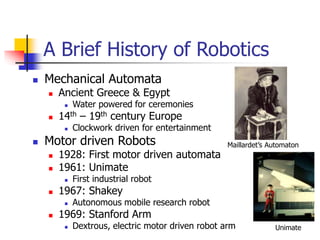
A Brief History of Robotics
 Mechanical Automata
 Ancient Greece & Egypt
 Water powered for ceremonies
 14th – 19th century Europe
 Clockwork driven for entertainment
 Motor driven Robots
 1928: First motor driven automata
 1961: Unimate
 First industrial robot
 1967: Shakey
 Autonomous mobile research robot
 1969: Stanford Arm
 Dextrous, electric motor driven robot arm
Maillardet’s Automaton
Unimate
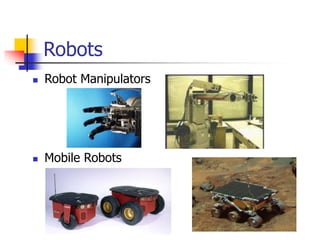
Robots
 Robot Manipulators
 Mobile Robots
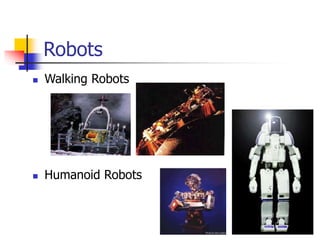
Robots
 Walking Robots
 Humanoid Robots
Autonomous Robots
 The control of autonomous robots involves a
number of subtasks
 Understanding and modeling of the mechanism
 Kinematics, Dynamics, and Odometry
 Reliable control of the actuators
 Closed-loop control
 Generation of task-specific motions
 Path planning
 Integration of sensors
 Selection and interfacing of various types of sensors
 Coping with noise and uncertainty
 Filtering of sensor noise and actuator uncertainty
 Creation of flexible control policies
 Control has to deal with new situations
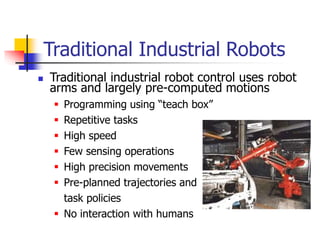
Traditional Industrial Robots
 Traditional industrial robot control uses robot
arms and largely pre-computed motions
 Programming using “teach box”
 Repetitive tasks
 High speed
 Few sensing operations
 High precision movements
 Pre-planned trajectories and
task policies
 No interaction with humans
Problems
 Traditional programming techniques for
industrial robots lack key capabilities necessary
in intelligent environments
 Only limited on-line sensing
 No incorporation of uncertainty
 No interaction with humans
 Reliance on perfect task information
 Complete re-programming for new tasks
Requirements for Robots in
Intelligent Environments
 Autonomy
 Robots have to be capable of achieving task
objectives without human input
 Robots have to be able to make and execute their
own decisions based on sensor information
 Intuitive Human-Robot Interfaces
 Use of robots in smart homes can not require
extensive user training
 Commands to robots should be natural for
inhabitants
 Adaptation
 Robots have to be able to adjust to changes in the
environment
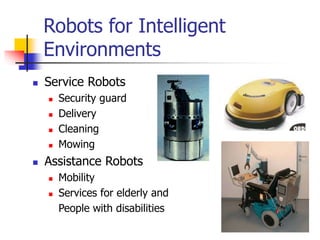
Robots for Intelligent
Environments
 Service Robots
 Security guard
 Delivery
 Cleaning
 Mowing
 Assistance Robots
 Mobility
 Services for elderly and
People with disabilities
Autonomous Robot Control
 To control robots to perform tasks
autonomously a number of tasks have to be
addressed:
 Modeling of robot mechanisms
 Kinematics, Dynamics
 Robot sensor selection
 Active and passive proximity sensors
 Low-level control of actuators
 Closed-loop control
 Control architectures
 Traditional planning architectures
 Behavior-based control architectures
 Hybrid architectures
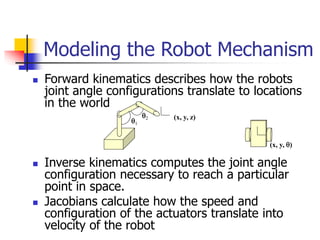
 Forward kinematics describes how the robots
joint angle configurations translate to locations
in the world
 Inverse kinematics computes the joint angle
configuration necessary to reach a particular
point in space.
 Jacobians calculate how the speed and
configuration of the actuators translate into
velocity of the robot
Modeling the Robot Mechanism
(x, y, z)
1
2
(x, y, )
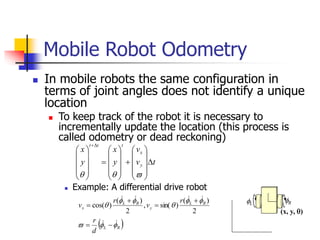
 In mobile robots the same configuration in
terms of joint angles does not identify a unique
location
 To keep track of the robot it is necessary to
incrementally update the location (this process is
called odometry or dead reckoning)
 Example: A differential drive robot
Mobile Robot Odometry
(x, y, )
t
v
v
y
x
y
x
y
x
t
t
t






































 
R
L
R
L
y
R
L
x
d
r
r
v
r
v





















2
)
(
)
sin(
,
2
)
(
)
cos(
R
L
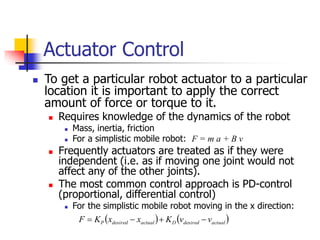
Actuator Control
 To get a particular robot actuator to a particular
location it is important to apply the correct
amount of force or torque to it.
 Requires knowledge of the dynamics of the robot
 Mass, inertia, friction
 For a simplistic mobile robot: F = m a + B v
 Frequently actuators are treated as if they were
independent (i.e. as if moving one joint would not
affect any of the other joints).
 The most common control approach is PD-control
(proportional, differential control)
 For the simplistic mobile robot moving in the x direction:
   
actual
desired
D
actual
desired
P v
v
K
x
x
K
F 



Robot Navigation
 Path planning addresses the task of computing
a trajectory for the robot such that it reaches
the desired goal without colliding with obstacles
 Optimal paths are hard to compute in particular for
robots that can not move in arbitrary directions (i.e.
nonholonomic robots)
 Shortest distance paths can be dangerous since they
always graze obstacles
 Paths for robot arms have to take into account the
entire robot (not only the endeffector)
Sensor-Driven Robot Control
 To accurately achieve a task in an intelligent
environment, a robot has to be able to react
dynamically to changes ion its surrounding
 Robots need sensors to perceive the environment
 Most robots use a set of different sensors
 Different sensors serve different purposes
 Information from sensors has to be integrated into
the control of the robot
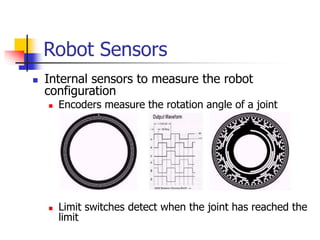
Robot Sensors
 Internal sensors to measure the robot
configuration
 Encoders measure the rotation angle of a joint
 Limit switches detect when the joint has reached the
limit
Robot Sensors
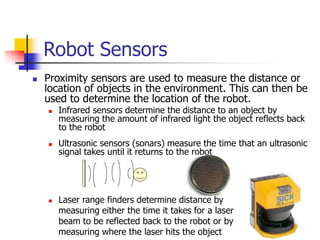
 Proximity sensors are used to measure the distance or
location of objects in the environment. This can then be
used to determine the location of the robot.
 Infrared sensors determine the distance to an object by
measuring the amount of infrared light the object reflects back
to the robot
 Ultrasonic sensors (sonars) measure the time that an ultrasonic
signal takes until it returns to the robot
 Laser range finders determine distance by
measuring either the time it takes for a laser
beam to be reflected back to the robot or by
measuring where the laser hits the object
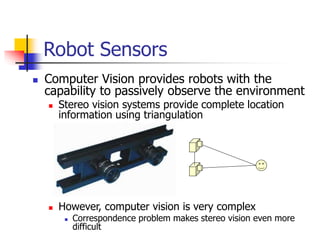
 Computer Vision provides robots with the
capability to passively observe the environment
 Stereo vision systems provide complete location
information using triangulation
 However, computer vision is very complex
 Correspondence problem makes stereo vision even more
difficult
Robot Sensors
Uncertainty in Robot Systems
Robot systems in intelligent environments have to
deal with sensor noise and uncertainty
 Sensor uncertainty
Sensor readings are imprecise and unreliable
 Non-observability
Various aspects of the environment can not be observed
The environment is initially unknown
 Action uncertainty
Actions can fail
Actions have nondeterministic outcomes
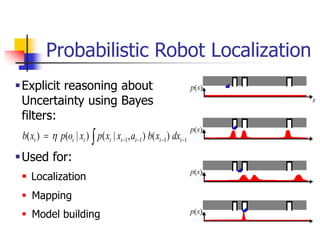
Probabilistic Robot Localization
Explicit reasoning about
Uncertainty using Bayes
filters:
Used for:
 Localization
 Mapping
 Model building
1
1
1
1 )
(
)
,
|
(
)
|
(
)
( 




 t
t
t
t
t
t
t
t dx
x
b
a
x
x
p
x
o
p
x
b 
Deliberative
Robot Control Architectures
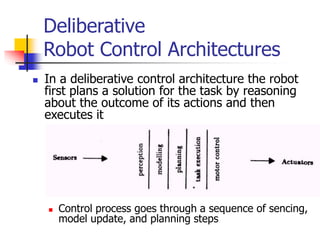
 In a deliberative control architecture the robot
first plans a solution for the task by reasoning
about the outcome of its actions and then
executes it
 Control process goes through a sequence of sencing,
model update, and planning steps
Deliberative
Control Architectures
 Advantages
 Reasons about contingencies
 Computes solutions to the given task
 Goal-directed strategies
 Problems
 Solutions tend to be fragile in the presence of
uncertainty
 Requires frequent replanning
 Reacts relatively slowly to changes and unexpected
occurrences
Behavior-Based
Robot Control Architectures
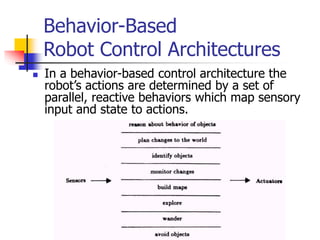
 In a behavior-based control architecture the
robot’s actions are determined by a set of
parallel, reactive behaviors which map sensory
input and state to actions.
Behavior-Based
Robot Control Architectures
 Reactive, behavior-based control combines
relatively simple behaviors, each of which
achieves a particular subtask, to achieve the
overall task.
 Robot can react fast to changes
 System does not depend on complete knowledge of
the environment
 Emergent behavior (resulting from combining initial
behaviors) can make it difficult to predict exact
behavior
 Difficult to assure that the overall task is achieved
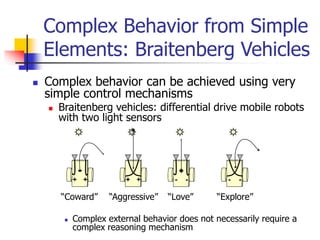
 Complex behavior can be achieved using very
simple control mechanisms
 Braitenberg vehicles: differential drive mobile robots
with two light sensors
 Complex external behavior does not necessarily require a
complex reasoning mechanism
Complex Behavior from Simple
Elements: Braitenberg Vehicles
+ +
“Coward” “Aggressive”
+ + - -
“Love” “Explore”
- -
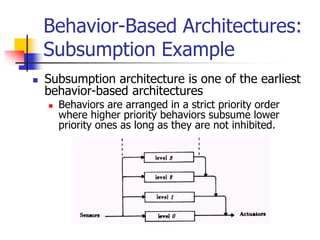
Behavior-Based Architectures:
Subsumption Example
 Subsumption architecture is one of the earliest
behavior-based architectures
 Behaviors are arranged in a strict priority order
where higher priority behaviors subsume lower
priority ones as long as they are not inhibited.
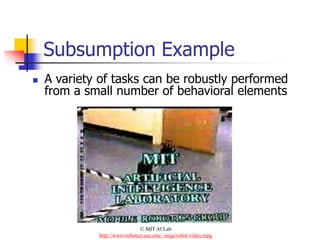
Subsumption Example
 A variety of tasks can be robustly performed
from a small number of behavioral elements
© MIT AI Lab
http://www-robotics.usc.edu/~maja/robot-video.mpg
Reactive, Behavior-Based
Control Architectures
 Advantages
 Reacts fast to changes
 Does not rely on accurate models
 “The world is its own best model”
 No need for replanning
 Problems
 Difficult to anticipate what effect combinations of
behaviors will have
 Difficult to construct strategies that will achieve
complex, novel tasks
 Requires redesign of control system for new tasks
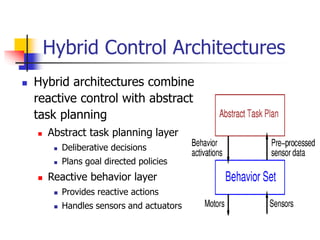
Hybrid Control Architectures
 Hybrid architectures combine
reactive control with abstract
task planning
 Abstract task planning layer
 Deliberative decisions
 Plans goal directed policies
 Reactive behavior layer
 Provides reactive actions
 Handles sensors and actuators
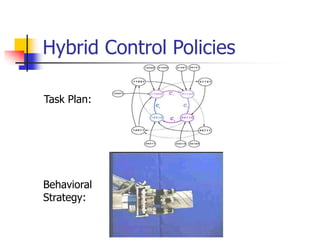
Hybrid Control Policies
Task Plan:
Behavioral
Strategy:
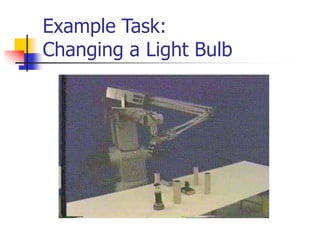
Example Task:
Changing a Light Bulb
Hybrid Control Architectures
 Advantages
 Permits goal-based strategies
 Ensures fast reactions to unexpected changes
 Reduces complexity of planning
 Problems
 Choice of behaviors limits range of possible tasks
 Behavior interactions have to be well modeled to be
able to form plans
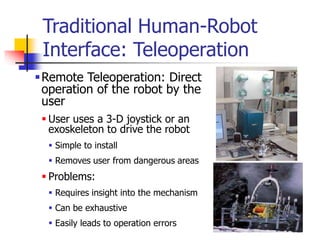
Traditional Human-Robot
Interface: Teleoperation
Remote Teleoperation: Direct
operation of the robot by the
user
 User uses a 3-D joystick or an
exoskeleton to drive the robot
 Simple to install
 Removes user from dangerous areas
 Problems:
 Requires insight into the mechanism
 Can be exhaustive
 Easily leads to operation errors
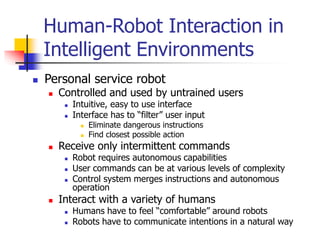
Human-Robot Interaction in
Intelligent Environments
 Personal service robot
 Controlled and used by untrained users
 Intuitive, easy to use interface
 Interface has to “filter” user input
 Eliminate dangerous instructions
 Find closest possible action
 Receive only intermittent commands
 Robot requires autonomous capabilities
 User commands can be at various levels of complexity
 Control system merges instructions and autonomous
operation
 Interact with a variety of humans
 Humans have to feel “comfortable” around robots
 Robots have to communicate intentions in a natural way
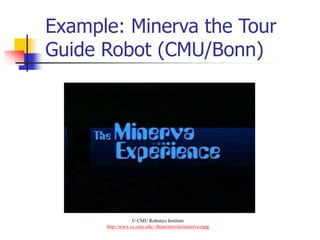
Example: Minerva the Tour
Guide Robot (CMU/Bonn)
© CMU Robotics Institute
http://www.cs.cmu.edu/~thrun/movies/minerva.mpg
Intuitive Robot Interfaces:
Command Input
 Graphical programming interfaces
 Users construct policies form elemental blocks
 Problems:
 Requires substantial understanding of the robot
 Deictic (pointing) interfaces
 Humans point at desired targets in the world or
 Target specification on a computer screen
 Problems:
 How to interpret human gestures ?
 Voice recognition
 Humans instruct the robot verbally
 Problems:
 Speech recognition is very difficult
 Robot actions corresponding to words has to be defined
Intuitive Robot Interfaces:
Robot-Human Interaction
 He robot has to be able to communicate its
intentions to the human
 Output has to be easy to understand by humans
 Robot has to be able to encode its intention
 Interface has to keep human’s attention without
annoying her
 Robot communication devices:
 Easy to understand computer screens
 Speech synthesis
 Robot “gestures”
Example: The Nursebot Project
© CMU Robotics Institute
http://www/cs/cmu.edu/~thrun/movies/pearl_assist.mpg
Human-Robot Interfaces
 Existing technologies
 Simple voice recognition and speech synthesis
 Gesture recognition systems
 On-screen, text-based interaction
 Research challenges
 How to convey robot intentions ?
 How to infer user intent from visual observation (how
can a robot imitate a human) ?
 How to keep the attention of a human on the robot ?
 How to integrate human input with autonomous
operation ?
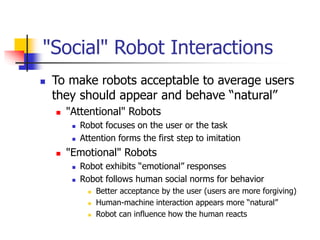
Integration of Commands and
Autonomous Operation
 Adjustable Autonomy
 The robot can operate at
varying levels of autonomy
 Operational modes:
 Autonomous operation
 User operation / teleoperation
 Behavioral programming
 Following user instructions
 Imitation
 Types of user commands:
 Continuous, low-level
instructions (teleoperation)
 Goal specifications
 Task demonstrations
Example System
"Social" Robot Interactions
 To make robots acceptable to average users
they should appear and behave “natural”
 "Attentional" Robots
 Robot focuses on the user or the task
 Attention forms the first step to imitation
 "Emotional" Robots
 Robot exhibits “emotional” responses
 Robot follows human social norms for behavior
 Better acceptance by the user (users are more forgiving)
 Human-machine interaction appears more “natural”
 Robot can influence how the human reacts
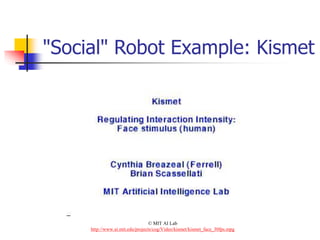
"Social" Robot Example: Kismet
© MIT AI Lab
http://www.ai.mit.edu/projects/cog/Video/kismet/kismet_face_30fps.mpg
"Social" Robot Interactions
 Advantages:
 Robots that look human and that show “emotions”
can make interactions more “natural”
 Humans tend to focus more attention on people than on
objects
 Humans tend to be more forgiving when a mistake is
made if it looks “human”
 Robots showing “emotions” can modify the way in
which humans interact with them
 Problems:
 How can robots determine the right emotion ?
 How can “emotions” be expressed by a robot ?
Human-Robot Interfaces for
Intelligent Environments
 Robot Interfaces have to be easy to use
 Robots have to be controllable by untrained users
 Robots have to be able to interact not only with their
owner but also with other people
 Robot interfaces have to be usable at the
human’s discretion
 Human-robot interaction occurs on an irregular basis
 Frequently the robot has to operate autonomously
 Whenever user input is provided the robot has to react to it
 Interfaces have to be designed human-centric
 The role of the robot is it to make the human’s life
easier and more comfortable (it is not just a tech toy)
 Intelligent Environments are non-stationary and
change frequently, requiring robots to adapt
 Adaptation to changes in the environment
 Learning to address changes in inhabitant preferences
 Robots in intelligent environments can frequently
not be pre-programmed
 The environment is unknown
 The list of tasks that the robot should perform might
not be known beforehand
 No proliferation of robots in the home
 Different users have different preferences
Adaptation and Learning for
Robots in Smart Homes
Adaptation and Learning
In Autonomous Robots
 Learning to interpret sensor information
 Recognizing objects in the environment is difficult
 Sensors provide prohibitively large amounts of data
 Programming of all required objects is generally not
possible
 Learning new strategies and tasks
 New tasks have to be learned on-line in the home
 Different inhabitants require new strategies even for
existing tasks
 Adaptation of existing control policies
 User preferences can change dynamically
 Changes in the environment have to be reflected
Learning Approaches for
Robot Systems
 Supervised learning by teaching
 Robots can learn from direct feedback from the
user that indicates the correct strategy
 The robot learns the exact strategy provided by the user
 Learning from demonstration (Imitation)
 Robots learn by observing a human or a robot
perform the required task
 The robot has to be able to “understand” what it observes
and map it onto its own capabilities
 Learning by exploration
 Robots can learn autonomously by trying different
actions and observing their results
 The robot learns a strategy that optimizes reward
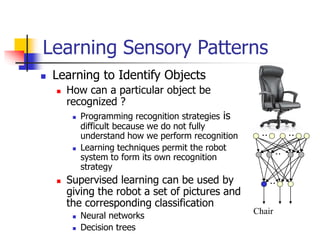
Learning Sensory Patterns
Chair
 Learning to Identify Objects
 How can a particular object be
recognized ?
 Programming recognition strategies is
difficult because we do not fully
understand how we perform recognition
 Learning techniques permit the robot
system to form its own recognition
strategy
 Supervised learning can be used by
giving the robot a set of pictures and
the corresponding classification
 Neural networks
 Decision trees
:
:
:
:
Learning Task Strategies by
Experimentation
 Autonomous robots have to be able to learn
new tasks even without input from the user
 Learning to perform a task in order to optimize the
reward the robot obtains (Reinforcement Learning)
 Reward has to be provided either by the user or the
environment
 Intermittent user feedback
 Generic rewards indicating unsafe or inconvenient actions or
occurrences
 The robot has to explore its actions to determine what
their effects are
 Actions change the state of the environment
 Actions achieve different amounts of reward
 During learning the robot has to maintain a level of safety
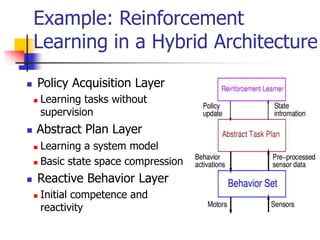
Example: Reinforcement
Learning in a Hybrid Architecture
 Policy Acquisition Layer
 Learning tasks without
supervision
 Abstract Plan Layer
 Learning a system model
 Basic state space compression
 Reactive Behavior Layer
 Initial competence and
reactivity
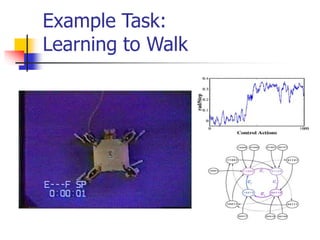
Example Task:
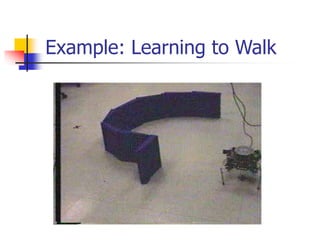
Learning to Walk
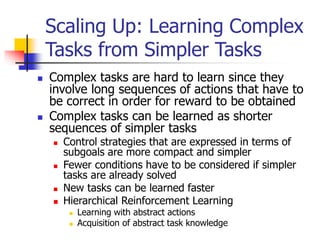
Scaling Up: Learning Complex
Tasks from Simpler Tasks
 Complex tasks are hard to learn since they
involve long sequences of actions that have to
be correct in order for reward to be obtained
 Complex tasks can be learned as shorter
sequences of simpler tasks
 Control strategies that are expressed in terms of
subgoals are more compact and simpler
 Fewer conditions have to be considered if simpler
tasks are already solved
 New tasks can be learned faster
 Hierarchical Reinforcement Learning
 Learning with abstract actions
 Acquisition of abstract task knowledge
Example: Learning to Walk
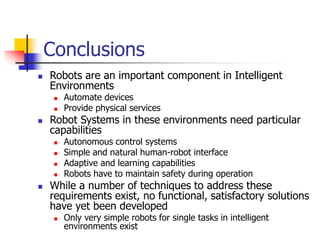
Conclusions
 Robots are an important component in Intelligent
Environments
 Automate devices
 Provide physical services
 Robot Systems in these environments need particular
capabilities
 Autonomous control systems
 Simple and natural human-robot interface
 Adaptive and learning capabilities
 Robots have to maintain safety during operation
 While a number of techniques to address these
requirements exist, no functional, satisfactory solutions
have yet been developed
 Only very simple robots for single tasks in intelligent
environments exist

Robotics.ppt

  • 1.
  • 2.
    Motivation  Intelligent Environmentsare aimed at improving the inhabitants’ experience and task performance  Automate functions in the home  Provide services to the inhabitants  Decisions coming from the decision maker(s) in the environment have to be executed.  Decisions require actions to be performed on devices  Decisions are frequently not elementary device interactions but rather relatively complex commands  Decisions define set points or results that have to be achieved  Decisions can require entire tasks to be performed
  • 3.
    Automation and Roboticsin Intelligent Environments  Control of the physical environment  Automated blinds  Thermostats and heating ducts  Automatic doors  Automatic room partitioning  Personal service robots  House cleaning  Lawn mowing  Assistance to the elderly and handicapped  Office assistants  Security services
  • 4.
    Robots  Robota (Czech)= A worker of forced labor From Czech playwright Karel Capek's 1921 play “R.U.R” (“Rossum's Universal Robots”)  Japanese Industrial Robot Association (JIRA) : “A device with degrees of freedom that can be controlled.”  Class 1 : Manual handling device  Class 2 : Fixed sequence robot  Class 3 : Variable sequence robot  Class 4 : Playback robot  Class 5 : Numerical control robot  Class 6 : Intelligent robot
  • 5.
    A Brief Historyof Robotics  Mechanical Automata  Ancient Greece & Egypt  Water powered for ceremonies  14th – 19th century Europe  Clockwork driven for entertainment  Motor driven Robots  1928: First motor driven automata  1961: Unimate  First industrial robot  1967: Shakey  Autonomous mobile research robot  1969: Stanford Arm  Dextrous, electric motor driven robot arm Maillardet’s Automaton Unimate
  • 6.
  • 7.
  • 8.
    Autonomous Robots  Thecontrol of autonomous robots involves a number of subtasks  Understanding and modeling of the mechanism  Kinematics, Dynamics, and Odometry  Reliable control of the actuators  Closed-loop control  Generation of task-specific motions  Path planning  Integration of sensors  Selection and interfacing of various types of sensors  Coping with noise and uncertainty  Filtering of sensor noise and actuator uncertainty  Creation of flexible control policies  Control has to deal with new situations
  • 9.
    Traditional Industrial Robots Traditional industrial robot control uses robot arms and largely pre-computed motions  Programming using “teach box”  Repetitive tasks  High speed  Few sensing operations  High precision movements  Pre-planned trajectories and task policies  No interaction with humans
  • 10.
    Problems  Traditional programmingtechniques for industrial robots lack key capabilities necessary in intelligent environments  Only limited on-line sensing  No incorporation of uncertainty  No interaction with humans  Reliance on perfect task information  Complete re-programming for new tasks
  • 11.
    Requirements for Robotsin Intelligent Environments  Autonomy  Robots have to be capable of achieving task objectives without human input  Robots have to be able to make and execute their own decisions based on sensor information  Intuitive Human-Robot Interfaces  Use of robots in smart homes can not require extensive user training  Commands to robots should be natural for inhabitants  Adaptation  Robots have to be able to adjust to changes in the environment
  • 12.
    Robots for Intelligent Environments Service Robots  Security guard  Delivery  Cleaning  Mowing  Assistance Robots  Mobility  Services for elderly and People with disabilities
  • 13.
    Autonomous Robot Control To control robots to perform tasks autonomously a number of tasks have to be addressed:  Modeling of robot mechanisms  Kinematics, Dynamics  Robot sensor selection  Active and passive proximity sensors  Low-level control of actuators  Closed-loop control  Control architectures  Traditional planning architectures  Behavior-based control architectures  Hybrid architectures
  • 14.
     Forward kinematicsdescribes how the robots joint angle configurations translate to locations in the world  Inverse kinematics computes the joint angle configuration necessary to reach a particular point in space.  Jacobians calculate how the speed and configuration of the actuators translate into velocity of the robot Modeling the Robot Mechanism (x, y, z) 1 2 (x, y, )
  • 15.
     In mobilerobots the same configuration in terms of joint angles does not identify a unique location  To keep track of the robot it is necessary to incrementally update the location (this process is called odometry or dead reckoning)  Example: A differential drive robot Mobile Robot Odometry (x, y, ) t v v y x y x y x t t t                                         R L R L y R L x d r r v r v                      2 ) ( ) sin( , 2 ) ( ) cos( R L
  • 16.
    Actuator Control  Toget a particular robot actuator to a particular location it is important to apply the correct amount of force or torque to it.  Requires knowledge of the dynamics of the robot  Mass, inertia, friction  For a simplistic mobile robot: F = m a + B v  Frequently actuators are treated as if they were independent (i.e. as if moving one joint would not affect any of the other joints).  The most common control approach is PD-control (proportional, differential control)  For the simplistic mobile robot moving in the x direction:     actual desired D actual desired P v v K x x K F    
  • 17.
    Robot Navigation  Pathplanning addresses the task of computing a trajectory for the robot such that it reaches the desired goal without colliding with obstacles  Optimal paths are hard to compute in particular for robots that can not move in arbitrary directions (i.e. nonholonomic robots)  Shortest distance paths can be dangerous since they always graze obstacles  Paths for robot arms have to take into account the entire robot (not only the endeffector)
  • 18.
    Sensor-Driven Robot Control To accurately achieve a task in an intelligent environment, a robot has to be able to react dynamically to changes ion its surrounding  Robots need sensors to perceive the environment  Most robots use a set of different sensors  Different sensors serve different purposes  Information from sensors has to be integrated into the control of the robot
  • 19.
    Robot Sensors  Internalsensors to measure the robot configuration  Encoders measure the rotation angle of a joint  Limit switches detect when the joint has reached the limit
  • 20.
    Robot Sensors  Proximitysensors are used to measure the distance or location of objects in the environment. This can then be used to determine the location of the robot.  Infrared sensors determine the distance to an object by measuring the amount of infrared light the object reflects back to the robot  Ultrasonic sensors (sonars) measure the time that an ultrasonic signal takes until it returns to the robot  Laser range finders determine distance by measuring either the time it takes for a laser beam to be reflected back to the robot or by measuring where the laser hits the object
  • 21.
     Computer Visionprovides robots with the capability to passively observe the environment  Stereo vision systems provide complete location information using triangulation  However, computer vision is very complex  Correspondence problem makes stereo vision even more difficult Robot Sensors
  • 22.
    Uncertainty in RobotSystems Robot systems in intelligent environments have to deal with sensor noise and uncertainty  Sensor uncertainty Sensor readings are imprecise and unreliable  Non-observability Various aspects of the environment can not be observed The environment is initially unknown  Action uncertainty Actions can fail Actions have nondeterministic outcomes
  • 23.
    Probabilistic Robot Localization Explicitreasoning about Uncertainty using Bayes filters: Used for:  Localization  Mapping  Model building 1 1 1 1 ) ( ) , | ( ) | ( ) (       t t t t t t t t dx x b a x x p x o p x b 
  • 24.
    Deliberative Robot Control Architectures In a deliberative control architecture the robot first plans a solution for the task by reasoning about the outcome of its actions and then executes it  Control process goes through a sequence of sencing, model update, and planning steps
  • 25.
    Deliberative Control Architectures  Advantages Reasons about contingencies  Computes solutions to the given task  Goal-directed strategies  Problems  Solutions tend to be fragile in the presence of uncertainty  Requires frequent replanning  Reacts relatively slowly to changes and unexpected occurrences
  • 26.
    Behavior-Based Robot Control Architectures In a behavior-based control architecture the robot’s actions are determined by a set of parallel, reactive behaviors which map sensory input and state to actions.
  • 27.
    Behavior-Based Robot Control Architectures Reactive, behavior-based control combines relatively simple behaviors, each of which achieves a particular subtask, to achieve the overall task.  Robot can react fast to changes  System does not depend on complete knowledge of the environment  Emergent behavior (resulting from combining initial behaviors) can make it difficult to predict exact behavior  Difficult to assure that the overall task is achieved
  • 28.
     Complex behaviorcan be achieved using very simple control mechanisms  Braitenberg vehicles: differential drive mobile robots with two light sensors  Complex external behavior does not necessarily require a complex reasoning mechanism Complex Behavior from Simple Elements: Braitenberg Vehicles + + “Coward” “Aggressive” + + - - “Love” “Explore” - -
  • 29.
    Behavior-Based Architectures: Subsumption Example Subsumption architecture is one of the earliest behavior-based architectures  Behaviors are arranged in a strict priority order where higher priority behaviors subsume lower priority ones as long as they are not inhibited.
  • 30.
    Subsumption Example  Avariety of tasks can be robustly performed from a small number of behavioral elements © MIT AI Lab http://www-robotics.usc.edu/~maja/robot-video.mpg
  • 31.
    Reactive, Behavior-Based Control Architectures Advantages  Reacts fast to changes  Does not rely on accurate models  “The world is its own best model”  No need for replanning  Problems  Difficult to anticipate what effect combinations of behaviors will have  Difficult to construct strategies that will achieve complex, novel tasks  Requires redesign of control system for new tasks
  • 32.
    Hybrid Control Architectures Hybrid architectures combine reactive control with abstract task planning  Abstract task planning layer  Deliberative decisions  Plans goal directed policies  Reactive behavior layer  Provides reactive actions  Handles sensors and actuators
  • 33.
    Hybrid Control Policies TaskPlan: Behavioral Strategy:
  • 34.
  • 35.
    Hybrid Control Architectures Advantages  Permits goal-based strategies  Ensures fast reactions to unexpected changes  Reduces complexity of planning  Problems  Choice of behaviors limits range of possible tasks  Behavior interactions have to be well modeled to be able to form plans
  • 36.
    Traditional Human-Robot Interface: Teleoperation RemoteTeleoperation: Direct operation of the robot by the user  User uses a 3-D joystick or an exoskeleton to drive the robot  Simple to install  Removes user from dangerous areas  Problems:  Requires insight into the mechanism  Can be exhaustive  Easily leads to operation errors
  • 37.
    Human-Robot Interaction in IntelligentEnvironments  Personal service robot  Controlled and used by untrained users  Intuitive, easy to use interface  Interface has to “filter” user input  Eliminate dangerous instructions  Find closest possible action  Receive only intermittent commands  Robot requires autonomous capabilities  User commands can be at various levels of complexity  Control system merges instructions and autonomous operation  Interact with a variety of humans  Humans have to feel “comfortable” around robots  Robots have to communicate intentions in a natural way
  • 38.
    Example: Minerva theTour Guide Robot (CMU/Bonn) © CMU Robotics Institute http://www.cs.cmu.edu/~thrun/movies/minerva.mpg
  • 39.
    Intuitive Robot Interfaces: CommandInput  Graphical programming interfaces  Users construct policies form elemental blocks  Problems:  Requires substantial understanding of the robot  Deictic (pointing) interfaces  Humans point at desired targets in the world or  Target specification on a computer screen  Problems:  How to interpret human gestures ?  Voice recognition  Humans instruct the robot verbally  Problems:  Speech recognition is very difficult  Robot actions corresponding to words has to be defined
  • 40.
    Intuitive Robot Interfaces: Robot-HumanInteraction  He robot has to be able to communicate its intentions to the human  Output has to be easy to understand by humans  Robot has to be able to encode its intention  Interface has to keep human’s attention without annoying her  Robot communication devices:  Easy to understand computer screens  Speech synthesis  Robot “gestures”
  • 41.
    Example: The NursebotProject © CMU Robotics Institute http://www/cs/cmu.edu/~thrun/movies/pearl_assist.mpg
  • 42.
    Human-Robot Interfaces  Existingtechnologies  Simple voice recognition and speech synthesis  Gesture recognition systems  On-screen, text-based interaction  Research challenges  How to convey robot intentions ?  How to infer user intent from visual observation (how can a robot imitate a human) ?  How to keep the attention of a human on the robot ?  How to integrate human input with autonomous operation ?
  • 43.
    Integration of Commandsand Autonomous Operation  Adjustable Autonomy  The robot can operate at varying levels of autonomy  Operational modes:  Autonomous operation  User operation / teleoperation  Behavioral programming  Following user instructions  Imitation  Types of user commands:  Continuous, low-level instructions (teleoperation)  Goal specifications  Task demonstrations Example System
  • 44.
    "Social" Robot Interactions To make robots acceptable to average users they should appear and behave “natural”  "Attentional" Robots  Robot focuses on the user or the task  Attention forms the first step to imitation  "Emotional" Robots  Robot exhibits “emotional” responses  Robot follows human social norms for behavior  Better acceptance by the user (users are more forgiving)  Human-machine interaction appears more “natural”  Robot can influence how the human reacts
  • 45.
    "Social" Robot Example:Kismet © MIT AI Lab http://www.ai.mit.edu/projects/cog/Video/kismet/kismet_face_30fps.mpg
  • 46.
    "Social" Robot Interactions Advantages:  Robots that look human and that show “emotions” can make interactions more “natural”  Humans tend to focus more attention on people than on objects  Humans tend to be more forgiving when a mistake is made if it looks “human”  Robots showing “emotions” can modify the way in which humans interact with them  Problems:  How can robots determine the right emotion ?  How can “emotions” be expressed by a robot ?
  • 47.
    Human-Robot Interfaces for IntelligentEnvironments  Robot Interfaces have to be easy to use  Robots have to be controllable by untrained users  Robots have to be able to interact not only with their owner but also with other people  Robot interfaces have to be usable at the human’s discretion  Human-robot interaction occurs on an irregular basis  Frequently the robot has to operate autonomously  Whenever user input is provided the robot has to react to it  Interfaces have to be designed human-centric  The role of the robot is it to make the human’s life easier and more comfortable (it is not just a tech toy)
  • 48.
     Intelligent Environmentsare non-stationary and change frequently, requiring robots to adapt  Adaptation to changes in the environment  Learning to address changes in inhabitant preferences  Robots in intelligent environments can frequently not be pre-programmed  The environment is unknown  The list of tasks that the robot should perform might not be known beforehand  No proliferation of robots in the home  Different users have different preferences Adaptation and Learning for Robots in Smart Homes
  • 49.
    Adaptation and Learning InAutonomous Robots  Learning to interpret sensor information  Recognizing objects in the environment is difficult  Sensors provide prohibitively large amounts of data  Programming of all required objects is generally not possible  Learning new strategies and tasks  New tasks have to be learned on-line in the home  Different inhabitants require new strategies even for existing tasks  Adaptation of existing control policies  User preferences can change dynamically  Changes in the environment have to be reflected
  • 50.
    Learning Approaches for RobotSystems  Supervised learning by teaching  Robots can learn from direct feedback from the user that indicates the correct strategy  The robot learns the exact strategy provided by the user  Learning from demonstration (Imitation)  Robots learn by observing a human or a robot perform the required task  The robot has to be able to “understand” what it observes and map it onto its own capabilities  Learning by exploration  Robots can learn autonomously by trying different actions and observing their results  The robot learns a strategy that optimizes reward
  • 51.
    Learning Sensory Patterns Chair Learning to Identify Objects  How can a particular object be recognized ?  Programming recognition strategies is difficult because we do not fully understand how we perform recognition  Learning techniques permit the robot system to form its own recognition strategy  Supervised learning can be used by giving the robot a set of pictures and the corresponding classification  Neural networks  Decision trees : : : :
  • 52.
    Learning Task Strategiesby Experimentation  Autonomous robots have to be able to learn new tasks even without input from the user  Learning to perform a task in order to optimize the reward the robot obtains (Reinforcement Learning)  Reward has to be provided either by the user or the environment  Intermittent user feedback  Generic rewards indicating unsafe or inconvenient actions or occurrences  The robot has to explore its actions to determine what their effects are  Actions change the state of the environment  Actions achieve different amounts of reward  During learning the robot has to maintain a level of safety
  • 53.
    Example: Reinforcement Learning ina Hybrid Architecture  Policy Acquisition Layer  Learning tasks without supervision  Abstract Plan Layer  Learning a system model  Basic state space compression  Reactive Behavior Layer  Initial competence and reactivity
  • 54.
  • 55.
    Scaling Up: LearningComplex Tasks from Simpler Tasks  Complex tasks are hard to learn since they involve long sequences of actions that have to be correct in order for reward to be obtained  Complex tasks can be learned as shorter sequences of simpler tasks  Control strategies that are expressed in terms of subgoals are more compact and simpler  Fewer conditions have to be considered if simpler tasks are already solved  New tasks can be learned faster  Hierarchical Reinforcement Learning  Learning with abstract actions  Acquisition of abstract task knowledge
  • 56.
  • 57.
    Conclusions  Robots arean important component in Intelligent Environments  Automate devices  Provide physical services  Robot Systems in these environments need particular capabilities  Autonomous control systems  Simple and natural human-robot interface  Adaptive and learning capabilities  Robots have to maintain safety during operation  While a number of techniques to address these requirements exist, no functional, satisfactory solutions have yet been developed  Only very simple robots for single tasks in intelligent environments exist