Source of recruitment
Recruitment
 "Recruitment is the development and
maintenance of adequate manpower resources."
 It involves creation of pool of available labour
upon whom an organization can depend when it
needs additional employees.
Internal resources
 This refers to the recruitment from within the
company. The various internal sources are
promotion, transfer, past employees and internal
advertisements.
External resources
 External sources refers to the practice of getting
suitable persons from outside.
 The various external sources are advertisement,
employment exchange, past employees, private
placement agencies and consultants, walks-ins,
campus recruitment, trade unions, etc.
 Employment at factory level:
 Application for vacancies are presented on the bulletin
boards outside the factory or at factory gate
 Used for filling casual vacancies such as of workers
 Labor contractors:
 Workers are recruited through labour contractors who are
themselves employees of the organisation.
 The disadvantage of this system is that if the contractor
leaves the organisation , all the workers ,employed
through him will also leave the organization.
 Advertisement:
 Advertisement through different mediums such as
newspaper, television, websites, etc
 Covers wide area of market, chances of having larger
number of applicants.
 Educational institutes:
 Certain professional institutes which serves as an external
source for recruiting fresh graduates from these institutes
 Known as campus recruitment
 Employment exchanges:
 There are certain employment exchanges which are run
by government. Most of the government undertakings and
concerns employ people through such exchanges,
 Now-a-days recruitment in government agencies has
become compulsory through employment exchanges.
 Employment agencies:
 Public and private agencies play a vital role in making
available suitable employees for different positions in the
organizations.
 Besides public agencies, private agencies have developed
markedly in large cities in the form of consultancy
services. Usually ,these agencies facilitate recruitment of
technical and professional personnel.
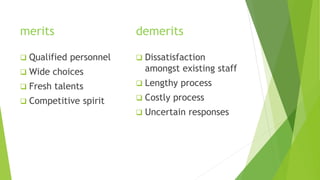
merits
 Qualified personnel
 Wide choices
 Fresh talents
 Competitive spirit
demerits
 Dissatisfaction
amongst existing staff
 Lengthy process
 Costly process
 Uncertain responses
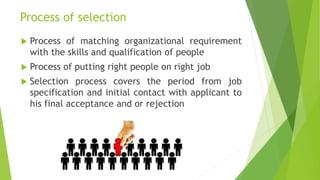
Process of selection
 Process of matching organizational requirement
with the skills and qualification of people
 Process of putting right people on right job
 Selection process covers the period from job
specification and initial contact with applicant to
his final acceptance and or rejection
Steps in selection process
 Notification:
 Process Starts when boss or manager asks for filling new or
vacant positions
 It gives all info about requirement of new employee to HRD
such as education, job experience and all other relevant
skills, then HRD places advertisement
 Preliminary interviews:
 Applicant are received at organization
 Skills, academic and family background, competencies and
interest, candidate’s knowledge about company are
examined.
 Candidates are given brief up about company and job profile
 Written test:
 Tests are conducted during selection procedure such as
aptitude test, intelligence test, reasoning test, personality
test, etc. depending upon level.
 Tests are used to objectively assess the potential candidate.
They should not be biased.
 Employment interviews:
 one of the most important facets of the employment
selection process is face-to-face interview
 Companies have different procedure for personal interviews
 Some companies prefer to have all-day interviewing
sessions, where candidates meet with different person each
hour
 Another option is having candidate meet with key personnel
one day, then inviting back for second to meet with some
executives.
 This process used to find out whether the candidate is best
suited for required job or not.
 Such interviews must me unbiased and should be conducted
properly.
 Selection:
 The hiring manager will usually ask for feedback from human
resources and other employee who interview the job
candidates.
 The hiring managers may also review her notes, or decide which
candidate would fit best in open position.
 The hiring manager will usually select someone with whom she
can work, whether it is candidate’s personality or work ethic.
 Medical examination:
 These tests are conducted to ensure physical fitness of
potential employee.
 It will reduce chances of employee absenteeism.
 Appointment letter:
 A reference check is made about the candidate selected
and then finally he is appointed by giving a formal
appointment letter.

Source of Recruitment

  • 1.
  • 2.
    Recruitment  "Recruitment isthe development and maintenance of adequate manpower resources."  It involves creation of pool of available labour upon whom an organization can depend when it needs additional employees.
  • 3.
    Internal resources  Thisrefers to the recruitment from within the company. The various internal sources are promotion, transfer, past employees and internal advertisements.
  • 4.
    External resources  Externalsources refers to the practice of getting suitable persons from outside.  The various external sources are advertisement, employment exchange, past employees, private placement agencies and consultants, walks-ins, campus recruitment, trade unions, etc.
  • 5.
     Employment atfactory level:  Application for vacancies are presented on the bulletin boards outside the factory or at factory gate  Used for filling casual vacancies such as of workers  Labor contractors:  Workers are recruited through labour contractors who are themselves employees of the organisation.  The disadvantage of this system is that if the contractor leaves the organisation , all the workers ,employed through him will also leave the organization.
  • 6.
     Advertisement:  Advertisementthrough different mediums such as newspaper, television, websites, etc  Covers wide area of market, chances of having larger number of applicants.  Educational institutes:  Certain professional institutes which serves as an external source for recruiting fresh graduates from these institutes  Known as campus recruitment
  • 7.
     Employment exchanges: There are certain employment exchanges which are run by government. Most of the government undertakings and concerns employ people through such exchanges,  Now-a-days recruitment in government agencies has become compulsory through employment exchanges.  Employment agencies:  Public and private agencies play a vital role in making available suitable employees for different positions in the organizations.  Besides public agencies, private agencies have developed markedly in large cities in the form of consultancy services. Usually ,these agencies facilitate recruitment of technical and professional personnel.
  • 8.
    merits  Qualified personnel Wide choices  Fresh talents  Competitive spirit demerits  Dissatisfaction amongst existing staff  Lengthy process  Costly process  Uncertain responses
  • 9.
    Process of selection Process of matching organizational requirement with the skills and qualification of people  Process of putting right people on right job  Selection process covers the period from job specification and initial contact with applicant to his final acceptance and or rejection
  • 10.
    Steps in selectionprocess  Notification:  Process Starts when boss or manager asks for filling new or vacant positions  It gives all info about requirement of new employee to HRD such as education, job experience and all other relevant skills, then HRD places advertisement  Preliminary interviews:  Applicant are received at organization  Skills, academic and family background, competencies and interest, candidate’s knowledge about company are examined.  Candidates are given brief up about company and job profile
  • 11.
     Written test: Tests are conducted during selection procedure such as aptitude test, intelligence test, reasoning test, personality test, etc. depending upon level.  Tests are used to objectively assess the potential candidate. They should not be biased.  Employment interviews:  one of the most important facets of the employment selection process is face-to-face interview  Companies have different procedure for personal interviews  Some companies prefer to have all-day interviewing sessions, where candidates meet with different person each hour
  • 12.
     Another optionis having candidate meet with key personnel one day, then inviting back for second to meet with some executives.  This process used to find out whether the candidate is best suited for required job or not.  Such interviews must me unbiased and should be conducted properly.  Selection:  The hiring manager will usually ask for feedback from human resources and other employee who interview the job candidates.  The hiring managers may also review her notes, or decide which candidate would fit best in open position.  The hiring manager will usually select someone with whom she can work, whether it is candidate’s personality or work ethic.
  • 13.
     Medical examination: These tests are conducted to ensure physical fitness of potential employee.  It will reduce chances of employee absenteeism.  Appointment letter:  A reference check is made about the candidate selected and then finally he is appointed by giving a formal appointment letter.