Module-III (CO3)
Kinematics-Manipulators Kinematics, Rotation Matrix, Homogenous Transformation
Matrix, Direct and Inverse Kinematics for industrial robots for Position and orientation. (8hrs)
Kinematics:
Kinematics is the branch of mechanics that deals with the motion of objects without
considering the forces that cause this motion. In robotics and engineering, kinematics is
essential for understanding how robotic arms and mechanisms move. It helps in modeling and
predicting the position, velocity, and acceleration of robotic systems.
Key Concepts in Kinematics
1. Position:
o The location of a point or a robot in a specified coordinate system (e.g.,
Cartesian, polar).
2. Displacement:
o The change in position of an object, usually represented as a vector that points
from the initial position to the final position.
3. Velocity:
o The rate of change of position with respect to time. It can be linear (along a
straight path) or angular (rotation around an axis).
4. Acceleration:
o The rate of change of velocity with respect to time. It can also be linear or
angular, depending on the type of motion.
Types of Kinematics
1. Forward Kinematics:
o This involves calculating the position and orientation of the end effector of a
robotic arm based on the joint parameters (angles, lengths). Given the angles of
each joint, forward kinematics provides the Cartesian coordinates of the end
effector.
o Applications: Used to determine the position of the end effector when the joint
configurations are known.
2. Inverse Kinematics:
o The process of determining the joint parameters needed to place the end effector
in a desired position and orientation. This is often more complex than forward
kinematics, as it can involve multiple solutions or no solutions.
o Applications: Essential for controlling robotic arms in tasks like picking objects
or welding, where the desired position is known but the joint angles are not.
Kinematic Chains
• A kinematic chain is a series of interconnected links and joints that create a
mechanism. It can be open (having two free ends) or closed (forming a loop). Each joint
allows for a specific type of movement (e.g., rotation, translation).
Types of Joints in Kinematics
1. Revolute Joint:
o Allows rotation about a fixed axis. Commonly used in robotic arms.
2. Prismatic Joint:
o Allows linear movement along a single axis. Often used in sliding mechanisms.
3. Spherical Joint:
o Allows rotation in multiple directions, providing three degrees of freedom.
4. Cylindrical Joint:
o Allows both rotation and translation along a single axis.
Kinematic Equations
The motion of robotic systems can often be described using kinematic equations. For example,
in a simple linear motion scenario:
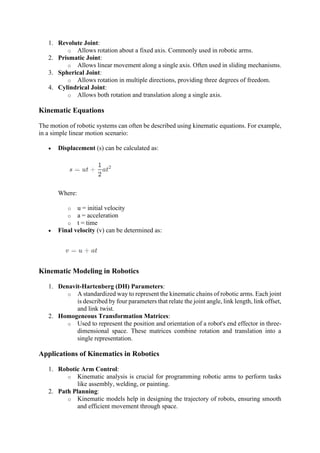
• Displacement (s) can be calculated as:
Where:
o u = initial velocity
o a = acceleration
o t = time
• Final velocity (v) can be determined as:
Kinematic Modeling in Robotics
1. Denavit-Hartenberg (DH) Parameters:
o A standardized way to represent the kinematic chains of robotic arms. Each joint
is described by four parameters that relate the joint angle, link length, link offset,
and link twist.
2. Homogeneous Transformation Matrices:
o Used to represent the position and orientation of a robot's end effector in three-
dimensional space. These matrices combine rotation and translation into a
single representation.
Applications of Kinematics in Robotics
1. Robotic Arm Control:
o Kinematic analysis is crucial for programming robotic arms to perform tasks
like assembly, welding, or painting.
2. Path Planning:
o Kinematic models help in designing the trajectory of robots, ensuring smooth
and efficient movement through space.
3. Simulation:
o Kinematic modeling allows for the simulation of robotic motion in virtual
environments, enabling testing and optimization before physical deployment.
4. Collision Detection:
o Kinematic analysis helps in predicting potential collisions between robotic arms
and their environment, ensuring safe operation.
Kinematics is fundamental in robotics, providing the necessary framework to understand and
control the motion of robotic systems. By mastering kinematic principles, engineers and
roboticists can design more effective, precise, and capable robotic solutions for a wide range
of applications.
Manipulators Kinematics:
Manipulator kinematics is a specific area of kinematics focused on analyzing and controlling
the motion of robotic manipulators (robotic arms). It involves understanding how the joints and
links of a manipulator contribute to the movement of its end effector (the tool or gripper) in
three-dimensional space.
Key Concepts in Manipulator Kinematics
1. Degrees of Freedom (DOF):
o Refers to the number of independent movements a manipulator can make. For
a manipulator to achieve a full range of motion, it typically requires six degrees
of freedom: three for position (X, Y, Z) and three for orientation (roll, pitch,
yaw).
2. Kinematic Chains:
o A manipulator consists of links connected by joints, forming a kinematic chain.
Each joint can allow specific types of movement (revolute or prismatic).
Forward Kinematics
• Definition: Forward kinematics calculates the position and orientation of the end
effector based on given joint parameters (angles or lengths).
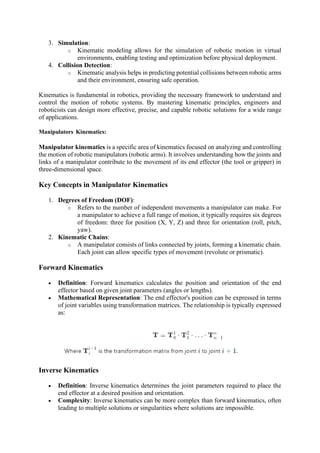
• Mathematical Representation: The end effector's position can be expressed in terms
of joint variables using transformation matrices. The relationship is typically expressed
as:
Inverse Kinematics
• Definition: Inverse kinematics determines the joint parameters required to place the
end effector at a desired position and orientation.
• Complexity: Inverse kinematics can be more complex than forward kinematics, often
leading to multiple solutions or singularities where solutions are impossible.
• Methods: Various methods exist for solving inverse kinematics, including:
o Analytical Solutions: Directly solving the equations geometrically or
algebraically.
o Numerical Methods: Using iterative algorithms (e.g., Newton-Raphson) to
converge on a solution.
Denavit-Hartenberg (DH) Parameters
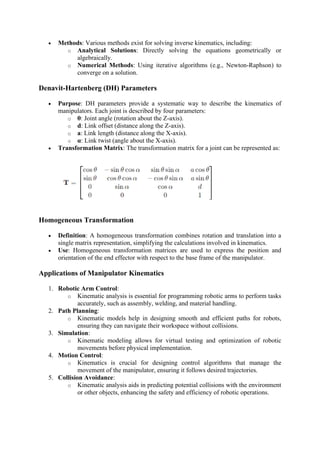
• Purpose: DH parameters provide a systematic way to describe the kinematics of
manipulators. Each joint is described by four parameters:
o θ: Joint angle (rotation about the Z-axis).
o d: Link offset (distance along the Z-axis).
o a: Link length (distance along the X-axis).
o α: Link twist (angle about the X-axis).
• Transformation Matrix: The transformation matrix for a joint can be represented as:
Homogeneous Transformation
• Definition: A homogeneous transformation combines rotation and translation into a
single matrix representation, simplifying the calculations involved in kinematics.
• Use: Homogeneous transformation matrices are used to express the position and
orientation of the end effector with respect to the base frame of the manipulator.
Applications of Manipulator Kinematics
1. Robotic Arm Control:
o Kinematic analysis is essential for programming robotic arms to perform tasks
accurately, such as assembly, welding, and material handling.
2. Path Planning:
o Kinematic models help in designing smooth and efficient paths for robots,
ensuring they can navigate their workspace without collisions.
3. Simulation:
o Kinematic modeling allows for virtual testing and optimization of robotic
movements before physical implementation.
4. Motion Control:
o Kinematics is crucial for designing control algorithms that manage the
movement of the manipulator, ensuring it follows desired trajectories.
5. Collision Avoidance:
o Kinematic analysis aids in predicting potential collisions with the environment
or other objects, enhancing the safety and efficiency of robotic operations.
Manipulator kinematics is a fundamental aspect of robotics, essential for understanding and
controlling the movement of robotic arms. By applying kinematic principles, engineers and
roboticists can design efficient and precise robotic systems capable of performing a wide range
of tasks in various applications.
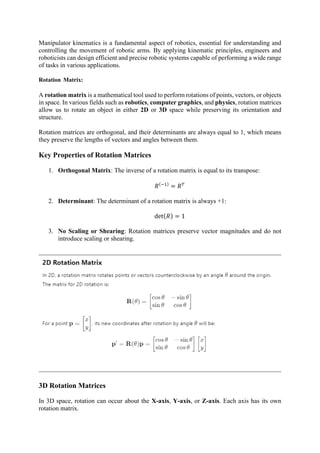
Rotation Matrix:
A rotation matrix is a mathematical tool used to perform rotations of points, vectors, or objects
in space. In various fields such as robotics, computer graphics, and physics, rotation matrices
allow us to rotate an object in either 2D or 3D space while preserving its orientation and
structure.
Rotation matrices are orthogonal, and their determinants are always equal to 1, which means
they preserve the lengths of vectors and angles between them.
Key Properties of Rotation Matrices
1. Orthogonal Matrix: The inverse of a rotation matrix is equal to its transpose:
𝑅(−1)
= 𝑅𝑇
2. Determinant: The determinant of a rotation matrix is always +1:
det(𝑅) = 1
3. No Scaling or Shearing: Rotation matrices preserve vector magnitudes and do not
introduce scaling or shearing.
3D Rotation Matrices
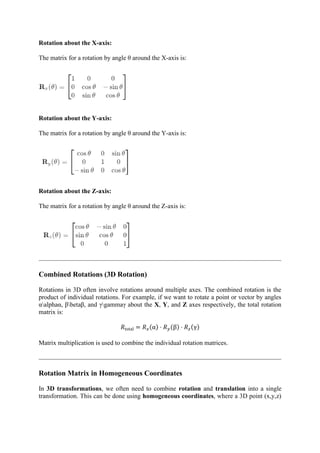
In 3D space, rotation can occur about the X-axis, Y-axis, or Z-axis. Each axis has its own
rotation matrix.
Rotation about the X-axis:
The matrix for a rotation by angle θ around the X-axis is:
Rotation about the Y-axis:
The matrix for a rotation by angle θ around the Y-axis is:
Rotation about the Z-axis:
The matrix for a rotation by angle θ around the Z-axis is:
Combined Rotations (3D Rotation)
Rotations in 3D often involve rotations around multiple axes. The combined rotation is the
product of individual rotations. For example, if we want to rotate a point or vector by angles
αalphaα, βbetaβ, and γgammaγ about the X, Y, and Z axes respectively, the total rotation
matrix is:
𝑅total = 𝑅𝑥(α) ⋅ 𝑅𝑦(β) ⋅ 𝑅𝑧(γ)
Matrix multiplication is used to combine the individual rotation matrices.
Rotation Matrix in Homogeneous Coordinates
In 3D transformations, we often need to combine rotation and translation into a single
transformation. This can be done using homogeneous coordinates, where a 3D point (x,y,z)
is represented as (x,y,z,1). A homogeneous transformation matrix combines rotation and
translation like so:
Where:
• R is a 3x3 rotation matrix,
• t is a 3x1 translation vector,
• The last row is [0 0 0 1].
Applications of Rotation Matrices
1. Robotics: Used to control the orientation of robot arms, manipulators, and joints.
2. Computer Graphics: To rotate 3D models, cameras, and objects in virtual
environments.
3. Physics: To describe the rotational motion of rigid bodies.
4. Mechanical Engineering: Analyzing the orientation of components in systems such as
linkages, cranes, and gyroscopic devices.
• Rotation matrices are used to perform rotations in both 2D and 3D space.
• They are orthogonal, meaning their transpose equals their inverse, and their determinant
is always 1.
• In 2D, the rotation matrix is a 2x2 matrix, while in 3D, it can rotate about the X, Y, or
Z axes using specific 3x3 matrices.
• Combined rotations can be represented as the product of multiple rotation matrices.
• Homogeneous coordinates extend rotation matrices to handle both rotation and
translation in 3D space.
Rotation matrices play a crucial role in manipulating objects in a precise, mathematically sound
way in many fields, including robotics, animation, and mechanics.
Homogenous Transformation Matrix:
Homogeneous Transformation Matrix: An Overview
A homogeneous transformation matrix is a mathematical tool used to combine both rotation
and translation in a single matrix. This matrix is widely used in robotics, computer graphics,
and 3D geometry to describe the position and orientation of objects in space.
In 3D space, the transformation of a point or object typically involves:
1. Rotation: Changing the orientation.
2. Translation: Changing the position.
The homogeneous transformation matrix allows both operations to be performed
simultaneously. The matrix is 4x4 in size, which enables the inclusion of both rotation and
translation in one operation, and works with homogeneous coordinates, where a 3D point
(x,y,z) is represented as (x,y,z,1).
Structure of a Homogeneous Transformation Matrix
The general form of a 3D homogeneous transformation matrix T is as follows:
𝐓 = [
𝐑 𝐭
0 1
]
Where:
• R is a 3x3 rotation matrix.
• t is a 3x1 translation vector.
• The last row [0 0 0 1] is used to maintain the matrix's homogeneous form.
This matrix operates on a 4x1 vector, where a 3D point is augmented by an additional 1 to
make it a homogeneous coordinate.
Components of the Homogeneous Transformation Matrix
1. Rotation Component (R):
o This is a 3x3 matrix representing the rotation of the object. It defines how an
object or point is rotated around the X, Y, and Z axes.
Example of a rotation matrix:
𝐑𝑧(𝜃) = [
cos𝜃 −sin𝜃 0
sin𝜃 cos𝜃 0
0 0 1
]
2. Translation Component (t):
o This is a 3x1 vector representing the translation (position shift) of the object in
3D space.
𝐭 = [
𝑡𝑥
𝑡𝑦
𝑡𝑧
]
3. Homogeneous Component:
o The last row of the transformation matrix is [0 0 0 1], which allows for both
rotation and translation to be combined into a single transformation.
Homogeneous Transformation Matrix for Rotation and Translation
A homogeneous transformation matrix combines rotation and translation in one operation. If
we have:
• A rotation matrix R (3x3),
• A translation vector 𝐭 = [𝑡𝑥 𝑡𝑦 𝑡𝑧]
𝑇
The resulting homogeneous transformation matrix is:
𝐓 = [
𝑟11 𝑟12 𝑟13 𝑡𝑥
𝑟21 𝑟22 𝑟23 𝑡𝑦
𝑟31 𝑟32 𝑟33 𝑡𝑧
0 0 0 1
]
where 𝑟𝑖𝑗 represents the elements of the rotation matrix 𝐑
Example: Applying a Homogeneous Transformation
Suppose we want to rotate a point around the Z-axis by an angle θ and then translate it by
(tx,ty,tz).
1. Rotation around the Z-axis is represented by the matrix:
𝐑𝑧(𝜃) = [
cos𝜃 −sin𝜃 0
sin𝜃 cos𝜃 0
0 0 1
]
2. Translation is given by:
𝐭 = [
𝑡𝑥
𝑡𝑦
𝑡𝑧
]
3. Homogeneous Transformation Matrix T:
𝐓 = [
cos𝜃 −sin𝜃 0 𝑡𝑥
sin𝜃 cos𝜃 0 𝑡𝑦
0 0 1 𝑡𝑧
0 0 0 1
]
If you have a point 𝐩 = [
𝑥
𝑦
𝑧
1
], then the transformed point p′ is:
𝐩′ = 𝐓 · 𝐩
Applications of the Homogeneous Transformation Matrix
1. Robotics: It is used to describe the position and orientation of robot arms
(manipulators) in space. For example, in the Denavit-Hartenberg (D-H) Convention,
homogeneous transformation matrices are used to compute forward and inverse
kinematics.
2. Computer Graphics: Homogeneous matrices allow objects to be transformed, rotated,
and moved in 3D environments. Cameras and models are manipulated using these
matrices.
3. Kinematics and Dynamics: In mechanical engineering and physics, these matrices
describe the motion and orientation of rigid bodies.
Summary
• The homogeneous transformation matrix combines rotation and translation in 3D
space into a single 4x4 matrix.
• The matrix consists of a 3x3 rotation matrix and a 3x1 translation vector, with a
homogeneous component to handle both operations in one matrix multiplication.
• These matrices are essential in robotics, computer graphics, and 3D geometry for
transforming points, vectors, and objects in space.
This matrix allows for powerful and efficient calculations for manipulating objects in a wide
variety of fields.
Direct and Inverse Kinematics for industrial robots for Position and orientation:
Direct Kinematics (Forward Kinematics): 𝐓 = 𝐓0
1
· 𝐓1
2
· 𝐓2
3
⋯ 𝐓𝑛−1
𝑛
𝐩 = [
𝑥
𝑦
𝑧
] = [
𝑡𝑥
𝑡𝑦
𝑡𝑧
] = 𝐓3×1
Inverse Kinematics: 𝐓 = [
𝑅 𝑡
0 1
] 𝐪 = 𝑓−1(𝐓)
Direct and Inverse Kinematics for Industrial Robots
In industrial robotics, kinematics is the study of motion without considering the forces that
cause it. Kinematics focuses on the relationships between the position, orientation, velocity,
and acceleration of robot arms or manipulators.
There are two primary types of kinematics: Direct Kinematics (Forward Kinematics) and
Inverse Kinematics.
1. Direct Kinematics (Forward Kinematics)
Direct Kinematics refers to the process of determining the position and orientation of the end
effector (the tool or device at the end of the robotic arm) based on given joint parameters
(angles, distances, etc.).
Mathematical Representation:
For a robotic manipulator with nnn joints, the position of the end effector p can be calculated
using the joint variables q (which can be angles for revolute joints or distances for prismatic
joints) and a series of transformation matrices.
The overall transformation from the base frame to the end effector frame can be represented
as:
𝐓 = 𝐓0
1
· 𝐓1
2
· 𝐓2
3
⋯ 𝐓𝑛−1
𝑛
Where:
• Tij is the transformation matrix from frame i to frame j.
• T is the overall transformation matrix.
The position and orientation of the end effector can be extracted from the transformation matrix
T:
𝐩 = [
𝑥
𝑦
𝑧
] = [
𝑡𝑥
𝑡𝑦
𝑡𝑧
] = 𝐓3×1
Where 𝑡𝑥, 𝑡𝑦, 𝑡𝑧 are the translation components of the transformation matrix.
2. Inverse Kinematics
Inverse Kinematics is the process of calculating the joint parameters needed to place the end
effector in a desired position and orientation. This is often more complex than direct kinematics
due to the multiple configurations (or solutions) that can achieve the same end effector pose.
Mathematical Representation:
To find the joint parameters q given the desired position p and orientation, we can use the
transformation matrix T:
𝐓 = [
𝐑 𝐭
0 1
]
Where:
• R is the rotation matrix describing the orientation.
• t is the translation vector.
To solve for joint parameters, we need to establish the relationship between T and the joint
variables q:
𝐪 = 𝑓−1(𝐓)
This involves solving for 𝜃1, 𝜃2, … , 𝜃𝑛based on the desired pose p and the specific geometry of
the manipulator, which may involve algebraic equations or numerical methods.
Summary
• Direct Kinematics determines the end effector's position and orientation given the joint
parameters, typically using transformation matrices.
• Inverse Kinematics calculates the required joint parameters to achieve a specific end
effector position and orientation, often involving complex geometric or algebraic
solutions.
• Both concepts are fundamental in programming and controlling industrial robots for
precise movements and tasks.

B.Tech 5th Semester Industrial Robotics Notes Module- III

  • 1.
    Module-III (CO3) Kinematics-Manipulators Kinematics,Rotation Matrix, Homogenous Transformation Matrix, Direct and Inverse Kinematics for industrial robots for Position and orientation. (8hrs) Kinematics: Kinematics is the branch of mechanics that deals with the motion of objects without considering the forces that cause this motion. In robotics and engineering, kinematics is essential for understanding how robotic arms and mechanisms move. It helps in modeling and predicting the position, velocity, and acceleration of robotic systems. Key Concepts in Kinematics 1. Position: o The location of a point or a robot in a specified coordinate system (e.g., Cartesian, polar). 2. Displacement: o The change in position of an object, usually represented as a vector that points from the initial position to the final position. 3. Velocity: o The rate of change of position with respect to time. It can be linear (along a straight path) or angular (rotation around an axis). 4. Acceleration: o The rate of change of velocity with respect to time. It can also be linear or angular, depending on the type of motion. Types of Kinematics 1. Forward Kinematics: o This involves calculating the position and orientation of the end effector of a robotic arm based on the joint parameters (angles, lengths). Given the angles of each joint, forward kinematics provides the Cartesian coordinates of the end effector. o Applications: Used to determine the position of the end effector when the joint configurations are known. 2. Inverse Kinematics: o The process of determining the joint parameters needed to place the end effector in a desired position and orientation. This is often more complex than forward kinematics, as it can involve multiple solutions or no solutions. o Applications: Essential for controlling robotic arms in tasks like picking objects or welding, where the desired position is known but the joint angles are not. Kinematic Chains • A kinematic chain is a series of interconnected links and joints that create a mechanism. It can be open (having two free ends) or closed (forming a loop). Each joint allows for a specific type of movement (e.g., rotation, translation). Types of Joints in Kinematics
  • 2.
    1. Revolute Joint: oAllows rotation about a fixed axis. Commonly used in robotic arms. 2. Prismatic Joint: o Allows linear movement along a single axis. Often used in sliding mechanisms. 3. Spherical Joint: o Allows rotation in multiple directions, providing three degrees of freedom. 4. Cylindrical Joint: o Allows both rotation and translation along a single axis. Kinematic Equations The motion of robotic systems can often be described using kinematic equations. For example, in a simple linear motion scenario: • Displacement (s) can be calculated as: Where: o u = initial velocity o a = acceleration o t = time • Final velocity (v) can be determined as: Kinematic Modeling in Robotics 1. Denavit-Hartenberg (DH) Parameters: o A standardized way to represent the kinematic chains of robotic arms. Each joint is described by four parameters that relate the joint angle, link length, link offset, and link twist. 2. Homogeneous Transformation Matrices: o Used to represent the position and orientation of a robot's end effector in three- dimensional space. These matrices combine rotation and translation into a single representation. Applications of Kinematics in Robotics 1. Robotic Arm Control: o Kinematic analysis is crucial for programming robotic arms to perform tasks like assembly, welding, or painting. 2. Path Planning: o Kinematic models help in designing the trajectory of robots, ensuring smooth and efficient movement through space.
  • 3.
    3. Simulation: o Kinematicmodeling allows for the simulation of robotic motion in virtual environments, enabling testing and optimization before physical deployment. 4. Collision Detection: o Kinematic analysis helps in predicting potential collisions between robotic arms and their environment, ensuring safe operation. Kinematics is fundamental in robotics, providing the necessary framework to understand and control the motion of robotic systems. By mastering kinematic principles, engineers and roboticists can design more effective, precise, and capable robotic solutions for a wide range of applications. Manipulators Kinematics: Manipulator kinematics is a specific area of kinematics focused on analyzing and controlling the motion of robotic manipulators (robotic arms). It involves understanding how the joints and links of a manipulator contribute to the movement of its end effector (the tool or gripper) in three-dimensional space. Key Concepts in Manipulator Kinematics 1. Degrees of Freedom (DOF): o Refers to the number of independent movements a manipulator can make. For a manipulator to achieve a full range of motion, it typically requires six degrees of freedom: three for position (X, Y, Z) and three for orientation (roll, pitch, yaw). 2. Kinematic Chains: o A manipulator consists of links connected by joints, forming a kinematic chain. Each joint can allow specific types of movement (revolute or prismatic). Forward Kinematics • Definition: Forward kinematics calculates the position and orientation of the end effector based on given joint parameters (angles or lengths). • Mathematical Representation: The end effector's position can be expressed in terms of joint variables using transformation matrices. The relationship is typically expressed as: Inverse Kinematics • Definition: Inverse kinematics determines the joint parameters required to place the end effector at a desired position and orientation. • Complexity: Inverse kinematics can be more complex than forward kinematics, often leading to multiple solutions or singularities where solutions are impossible.
  • 4.
    • Methods: Variousmethods exist for solving inverse kinematics, including: o Analytical Solutions: Directly solving the equations geometrically or algebraically. o Numerical Methods: Using iterative algorithms (e.g., Newton-Raphson) to converge on a solution. Denavit-Hartenberg (DH) Parameters • Purpose: DH parameters provide a systematic way to describe the kinematics of manipulators. Each joint is described by four parameters: o θ: Joint angle (rotation about the Z-axis). o d: Link offset (distance along the Z-axis). o a: Link length (distance along the X-axis). o α: Link twist (angle about the X-axis). • Transformation Matrix: The transformation matrix for a joint can be represented as: Homogeneous Transformation • Definition: A homogeneous transformation combines rotation and translation into a single matrix representation, simplifying the calculations involved in kinematics. • Use: Homogeneous transformation matrices are used to express the position and orientation of the end effector with respect to the base frame of the manipulator. Applications of Manipulator Kinematics 1. Robotic Arm Control: o Kinematic analysis is essential for programming robotic arms to perform tasks accurately, such as assembly, welding, and material handling. 2. Path Planning: o Kinematic models help in designing smooth and efficient paths for robots, ensuring they can navigate their workspace without collisions. 3. Simulation: o Kinematic modeling allows for virtual testing and optimization of robotic movements before physical implementation. 4. Motion Control: o Kinematics is crucial for designing control algorithms that manage the movement of the manipulator, ensuring it follows desired trajectories. 5. Collision Avoidance: o Kinematic analysis aids in predicting potential collisions with the environment or other objects, enhancing the safety and efficiency of robotic operations.
  • 5.
    Manipulator kinematics isa fundamental aspect of robotics, essential for understanding and controlling the movement of robotic arms. By applying kinematic principles, engineers and roboticists can design efficient and precise robotic systems capable of performing a wide range of tasks in various applications. Rotation Matrix: A rotation matrix is a mathematical tool used to perform rotations of points, vectors, or objects in space. In various fields such as robotics, computer graphics, and physics, rotation matrices allow us to rotate an object in either 2D or 3D space while preserving its orientation and structure. Rotation matrices are orthogonal, and their determinants are always equal to 1, which means they preserve the lengths of vectors and angles between them. Key Properties of Rotation Matrices 1. Orthogonal Matrix: The inverse of a rotation matrix is equal to its transpose: 𝑅(−1) = 𝑅𝑇 2. Determinant: The determinant of a rotation matrix is always +1: det(𝑅) = 1 3. No Scaling or Shearing: Rotation matrices preserve vector magnitudes and do not introduce scaling or shearing. 3D Rotation Matrices In 3D space, rotation can occur about the X-axis, Y-axis, or Z-axis. Each axis has its own rotation matrix.
  • 6.
    Rotation about theX-axis: The matrix for a rotation by angle θ around the X-axis is: Rotation about the Y-axis: The matrix for a rotation by angle θ around the Y-axis is: Rotation about the Z-axis: The matrix for a rotation by angle θ around the Z-axis is: Combined Rotations (3D Rotation) Rotations in 3D often involve rotations around multiple axes. The combined rotation is the product of individual rotations. For example, if we want to rotate a point or vector by angles αalphaα, βbetaβ, and γgammaγ about the X, Y, and Z axes respectively, the total rotation matrix is: 𝑅total = 𝑅𝑥(α) ⋅ 𝑅𝑦(β) ⋅ 𝑅𝑧(γ) Matrix multiplication is used to combine the individual rotation matrices. Rotation Matrix in Homogeneous Coordinates In 3D transformations, we often need to combine rotation and translation into a single transformation. This can be done using homogeneous coordinates, where a 3D point (x,y,z)
  • 7.
    is represented as(x,y,z,1). A homogeneous transformation matrix combines rotation and translation like so: Where: • R is a 3x3 rotation matrix, • t is a 3x1 translation vector, • The last row is [0 0 0 1]. Applications of Rotation Matrices 1. Robotics: Used to control the orientation of robot arms, manipulators, and joints. 2. Computer Graphics: To rotate 3D models, cameras, and objects in virtual environments. 3. Physics: To describe the rotational motion of rigid bodies. 4. Mechanical Engineering: Analyzing the orientation of components in systems such as linkages, cranes, and gyroscopic devices. • Rotation matrices are used to perform rotations in both 2D and 3D space. • They are orthogonal, meaning their transpose equals their inverse, and their determinant is always 1. • In 2D, the rotation matrix is a 2x2 matrix, while in 3D, it can rotate about the X, Y, or Z axes using specific 3x3 matrices. • Combined rotations can be represented as the product of multiple rotation matrices. • Homogeneous coordinates extend rotation matrices to handle both rotation and translation in 3D space. Rotation matrices play a crucial role in manipulating objects in a precise, mathematically sound way in many fields, including robotics, animation, and mechanics. Homogenous Transformation Matrix: Homogeneous Transformation Matrix: An Overview A homogeneous transformation matrix is a mathematical tool used to combine both rotation and translation in a single matrix. This matrix is widely used in robotics, computer graphics, and 3D geometry to describe the position and orientation of objects in space. In 3D space, the transformation of a point or object typically involves: 1. Rotation: Changing the orientation.
  • 8.
    2. Translation: Changingthe position. The homogeneous transformation matrix allows both operations to be performed simultaneously. The matrix is 4x4 in size, which enables the inclusion of both rotation and translation in one operation, and works with homogeneous coordinates, where a 3D point (x,y,z) is represented as (x,y,z,1). Structure of a Homogeneous Transformation Matrix The general form of a 3D homogeneous transformation matrix T is as follows: 𝐓 = [ 𝐑 𝐭 0 1 ] Where: • R is a 3x3 rotation matrix. • t is a 3x1 translation vector. • The last row [0 0 0 1] is used to maintain the matrix's homogeneous form. This matrix operates on a 4x1 vector, where a 3D point is augmented by an additional 1 to make it a homogeneous coordinate. Components of the Homogeneous Transformation Matrix 1. Rotation Component (R): o This is a 3x3 matrix representing the rotation of the object. It defines how an object or point is rotated around the X, Y, and Z axes. Example of a rotation matrix: 𝐑𝑧(𝜃) = [ cos𝜃 −sin𝜃 0 sin𝜃 cos𝜃 0 0 0 1 ] 2. Translation Component (t): o This is a 3x1 vector representing the translation (position shift) of the object in 3D space. 𝐭 = [ 𝑡𝑥 𝑡𝑦 𝑡𝑧 ] 3. Homogeneous Component: o The last row of the transformation matrix is [0 0 0 1], which allows for both rotation and translation to be combined into a single transformation.
  • 9.
    Homogeneous Transformation Matrixfor Rotation and Translation A homogeneous transformation matrix combines rotation and translation in one operation. If we have: • A rotation matrix R (3x3), • A translation vector 𝐭 = [𝑡𝑥 𝑡𝑦 𝑡𝑧] 𝑇 The resulting homogeneous transformation matrix is: 𝐓 = [ 𝑟11 𝑟12 𝑟13 𝑡𝑥 𝑟21 𝑟22 𝑟23 𝑡𝑦 𝑟31 𝑟32 𝑟33 𝑡𝑧 0 0 0 1 ] where 𝑟𝑖𝑗 represents the elements of the rotation matrix 𝐑 Example: Applying a Homogeneous Transformation Suppose we want to rotate a point around the Z-axis by an angle θ and then translate it by (tx,ty,tz). 1. Rotation around the Z-axis is represented by the matrix: 𝐑𝑧(𝜃) = [ cos𝜃 −sin𝜃 0 sin𝜃 cos𝜃 0 0 0 1 ] 2. Translation is given by: 𝐭 = [ 𝑡𝑥 𝑡𝑦 𝑡𝑧 ] 3. Homogeneous Transformation Matrix T: 𝐓 = [ cos𝜃 −sin𝜃 0 𝑡𝑥 sin𝜃 cos𝜃 0 𝑡𝑦 0 0 1 𝑡𝑧 0 0 0 1 ] If you have a point 𝐩 = [ 𝑥 𝑦 𝑧 1 ], then the transformed point p′ is: 𝐩′ = 𝐓 · 𝐩 Applications of the Homogeneous Transformation Matrix
  • 10.
    1. Robotics: Itis used to describe the position and orientation of robot arms (manipulators) in space. For example, in the Denavit-Hartenberg (D-H) Convention, homogeneous transformation matrices are used to compute forward and inverse kinematics. 2. Computer Graphics: Homogeneous matrices allow objects to be transformed, rotated, and moved in 3D environments. Cameras and models are manipulated using these matrices. 3. Kinematics and Dynamics: In mechanical engineering and physics, these matrices describe the motion and orientation of rigid bodies. Summary • The homogeneous transformation matrix combines rotation and translation in 3D space into a single 4x4 matrix. • The matrix consists of a 3x3 rotation matrix and a 3x1 translation vector, with a homogeneous component to handle both operations in one matrix multiplication. • These matrices are essential in robotics, computer graphics, and 3D geometry for transforming points, vectors, and objects in space. This matrix allows for powerful and efficient calculations for manipulating objects in a wide variety of fields. Direct and Inverse Kinematics for industrial robots for Position and orientation: Direct Kinematics (Forward Kinematics): 𝐓 = 𝐓0 1 · 𝐓1 2 · 𝐓2 3 ⋯ 𝐓𝑛−1 𝑛 𝐩 = [ 𝑥 𝑦 𝑧 ] = [ 𝑡𝑥 𝑡𝑦 𝑡𝑧 ] = 𝐓3×1 Inverse Kinematics: 𝐓 = [ 𝑅 𝑡 0 1 ] 𝐪 = 𝑓−1(𝐓) Direct and Inverse Kinematics for Industrial Robots In industrial robotics, kinematics is the study of motion without considering the forces that cause it. Kinematics focuses on the relationships between the position, orientation, velocity, and acceleration of robot arms or manipulators. There are two primary types of kinematics: Direct Kinematics (Forward Kinematics) and Inverse Kinematics. 1. Direct Kinematics (Forward Kinematics) Direct Kinematics refers to the process of determining the position and orientation of the end effector (the tool or device at the end of the robotic arm) based on given joint parameters (angles, distances, etc.). Mathematical Representation:
  • 11.
    For a roboticmanipulator with nnn joints, the position of the end effector p can be calculated using the joint variables q (which can be angles for revolute joints or distances for prismatic joints) and a series of transformation matrices. The overall transformation from the base frame to the end effector frame can be represented as: 𝐓 = 𝐓0 1 · 𝐓1 2 · 𝐓2 3 ⋯ 𝐓𝑛−1 𝑛 Where: • Tij is the transformation matrix from frame i to frame j. • T is the overall transformation matrix. The position and orientation of the end effector can be extracted from the transformation matrix T: 𝐩 = [ 𝑥 𝑦 𝑧 ] = [ 𝑡𝑥 𝑡𝑦 𝑡𝑧 ] = 𝐓3×1 Where 𝑡𝑥, 𝑡𝑦, 𝑡𝑧 are the translation components of the transformation matrix. 2. Inverse Kinematics Inverse Kinematics is the process of calculating the joint parameters needed to place the end effector in a desired position and orientation. This is often more complex than direct kinematics due to the multiple configurations (or solutions) that can achieve the same end effector pose. Mathematical Representation: To find the joint parameters q given the desired position p and orientation, we can use the transformation matrix T: 𝐓 = [ 𝐑 𝐭 0 1 ] Where: • R is the rotation matrix describing the orientation. • t is the translation vector. To solve for joint parameters, we need to establish the relationship between T and the joint variables q: 𝐪 = 𝑓−1(𝐓)
  • 12.
    This involves solvingfor 𝜃1, 𝜃2, … , 𝜃𝑛based on the desired pose p and the specific geometry of the manipulator, which may involve algebraic equations or numerical methods. Summary • Direct Kinematics determines the end effector's position and orientation given the joint parameters, typically using transformation matrices. • Inverse Kinematics calculates the required joint parameters to achieve a specific end effector position and orientation, often involving complex geometric or algebraic solutions. • Both concepts are fundamental in programming and controlling industrial robots for precise movements and tasks.