PRESENTATION BY:
Conversation not
consultation
Building collaborative communities
JULY 2015
Rob Francis,
OPM
Change ‘in
here’ can’t
succeed in a
vacuum
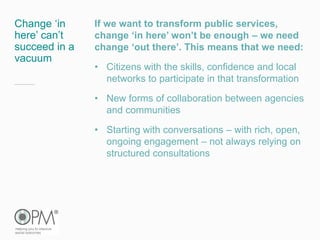
If we want to transform public services,
change ‘in here’ won’t be enough – we need
change ‘out there’. This means that we need:
• Citizens with the skills, confidence and local
networks to participate in that transformation
• New forms of collaboration between agencies
and communities
• Starting with conversations – with rich, open,
ongoing engagement – not always relying on
structured consultations
Engagement
or
consultation?
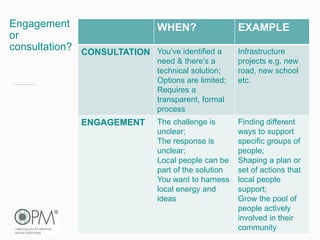
WHEN? EXAMPLE
CONSULTATION You’ve identified a
need & there’s a
technical solution;
Options are limited;
Requires a
transparent, formal
process
Infrastructure
projects e.g. new
road, new school
etc.
ENGAGEMENT The challenge is
unclear;
The response is
unclear;
Local people can be
part of the solution
You want to harness
local energy and
ideas
Finding different
ways to support
specific groups of
people;
Shaping a plan or
set of actions that
local people
support;
Grow the pool of
people actively
involved in their
community
Good
engagement
should…
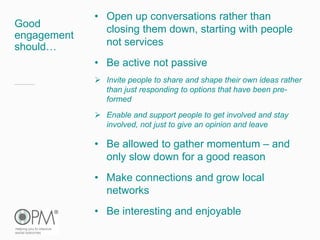
• Open up conversations rather than
closing them down, starting with people
not services
• Be active not passive
 Invite people to share and shape their own ideas rather
than just responding to options that have been pre-
formed
 Enable and support people to get involved and stay
involved, not just to give an opinion and leave
• Be allowed to gather momentum – and
only slow down for a good reason
• Make connections and grow local
networks
• Be interesting and enjoyable
Getting stuck There’s a risk that we keep relying on the
same approaches to engagement that we’ve
always taken, and that can mean:
• The same people turning up
• The same points being raised
• The same council-led response to addressing
those points
• Everything getting sucked into the same
agenda items in the same cycle of meetings
…And if we’re not careful, we tell ourselves
we’ve tried to engage people, we slip back into
our comfort zone and nothing much really
changes.
ENGAGEMENT
APPROACHES
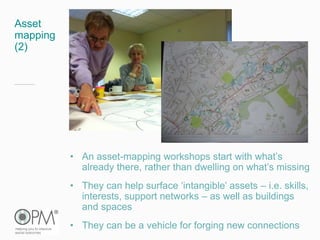
Asset
mapping
(2)
• An asset-mapping workshops start with what’s
already there, rather than dwelling on what’s missing
• They can help surface ‘intangible’ assets – i.e. skills,
interests, support networks – as well as buildings
and spaces
• They can be a vehicle for forging new connections
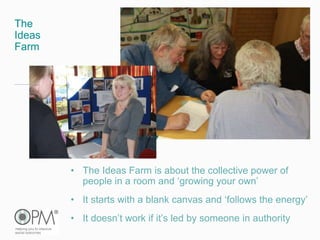
The
Ideas
Farm
• The Ideas Farm is about the collective power of
people in a room and ‘growing your own’
• It starts with a blank canvas and ‘follows the energy’
• It doesn’t work if it’s led by someone in authority
When
engagement
works, are we
ready for it?
These can be useful formats for generating
good engagement – but that’s the easy part.
• Even if you run a good event, organisational
cultures and norms of working that can get in
the way.
So what we do with the ideas that emerge
and the contacts we forge – that matters too.
• Important role for elected members and
senior managers here – help your staff break
out of the usual processes if they need to
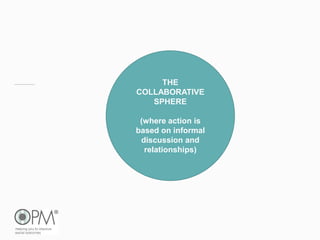
THE
COLLABORATIVE
SPHERE
(where action is
based on informal
discussion and
relationships)
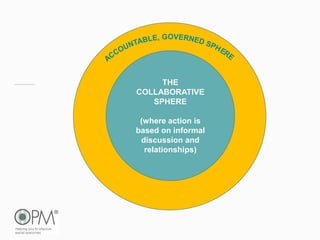
THE
COLLABORATIVE
SPHERE
(where action is
based on informal
discussion and
relationships)
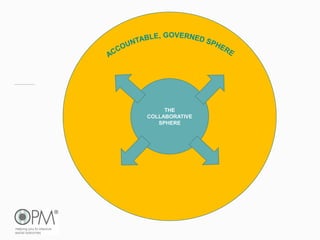
THE
COLLABORATIVE
SPHERE
THE END
Rob Francis, OPM
www.opm.co.uk
@ThinkingRob

Rob Francis - “Conversation not consultation – building collaborative communities”

  • 1.
    PRESENTATION BY: Conversation not consultation Buildingcollaborative communities JULY 2015 Rob Francis, OPM
  • 2.
    Change ‘in here’ can’t succeedin a vacuum If we want to transform public services, change ‘in here’ won’t be enough – we need change ‘out there’. This means that we need: • Citizens with the skills, confidence and local networks to participate in that transformation • New forms of collaboration between agencies and communities • Starting with conversations – with rich, open, ongoing engagement – not always relying on structured consultations
  • 3.
    Engagement or consultation? WHEN? EXAMPLE CONSULTATION You’veidentified a need & there’s a technical solution; Options are limited; Requires a transparent, formal process Infrastructure projects e.g. new road, new school etc. ENGAGEMENT The challenge is unclear; The response is unclear; Local people can be part of the solution You want to harness local energy and ideas Finding different ways to support specific groups of people; Shaping a plan or set of actions that local people support; Grow the pool of people actively involved in their community
  • 4.
    Good engagement should… • Open upconversations rather than closing them down, starting with people not services • Be active not passive  Invite people to share and shape their own ideas rather than just responding to options that have been pre- formed  Enable and support people to get involved and stay involved, not just to give an opinion and leave • Be allowed to gather momentum – and only slow down for a good reason • Make connections and grow local networks • Be interesting and enjoyable
  • 5.
    Getting stuck There’sa risk that we keep relying on the same approaches to engagement that we’ve always taken, and that can mean: • The same people turning up • The same points being raised • The same council-led response to addressing those points • Everything getting sucked into the same agenda items in the same cycle of meetings …And if we’re not careful, we tell ourselves we’ve tried to engage people, we slip back into our comfort zone and nothing much really changes.
  • 6.
  • 7.
    Asset mapping (2) • An asset-mappingworkshops start with what’s already there, rather than dwelling on what’s missing • They can help surface ‘intangible’ assets – i.e. skills, interests, support networks – as well as buildings and spaces • They can be a vehicle for forging new connections
  • 8.
    The Ideas Farm • The IdeasFarm is about the collective power of people in a room and ‘growing your own’ • It starts with a blank canvas and ‘follows the energy’ • It doesn’t work if it’s led by someone in authority
  • 9.
    When engagement works, are we readyfor it? These can be useful formats for generating good engagement – but that’s the easy part. • Even if you run a good event, organisational cultures and norms of working that can get in the way. So what we do with the ideas that emerge and the contacts we forge – that matters too. • Important role for elected members and senior managers here – help your staff break out of the usual processes if they need to
  • 10.
    THE COLLABORATIVE SPHERE (where action is basedon informal discussion and relationships)
  • 11.
    THE COLLABORATIVE SPHERE (where action is basedon informal discussion and relationships)
  • 12.
  • 13.
    THE END Rob Francis,OPM www.opm.co.uk @ThinkingRob

Editor's Notes

  • #11 This is a community getting on with things based on relationships, discussion, and action.
  • #12 This is all a bit hap-hazard, it could mean that only a few people get to spend community money and take community decisions. So, we frame these informal interactions with governance and accountability which makes sure we know WHY we’re supporting a particular type of activity above another – this is very important for ensuring as best we can that resources are used well and should give confidence to our communities
  • #13 The problem I think we’ve created is that more and more we have come to rely on the outer-circle, so that more of what we try to achieve in communities has migrated across from the green space to the yellow space, where it’s governed and overseen and monitored – BUT at the expense of energy and enthusiasm and mass participation – the things we’ve said are good for communities and good for achieving sustained outcomes. So the yellow space has become our default – and rather than resorting to this only when we need to make those transparent, fair decisions, we START in this space from day one when we organise that public meeting, or The more emphasis we put on the governed circle, the harder it will be to keep most people engaged and enthused. So more of the interactions, more of the meetings take place in the formal, governed space when maybe they don’t need to We slow things down unnecessarily because too much gets sucked into the monthly meeting cycle or the steering group or the committee We start to drain the life and the energy out of things The 50 people who turned up to a lively workshop to share ideas gets boiled down into a steering group of 5 – we expect to lose a few along the way, and only a small number can be part of a core team driving things forward, but we need ways to keep those other 45 – or as many as possible – interested and involved in some way, beyond that first event.