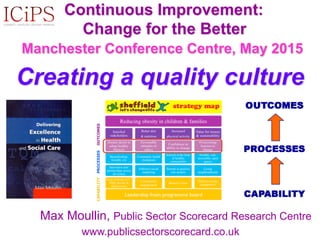
Continuous Improvement:
Change for the Better
Manchester Conference Centre, May 2015
Creating a quality culture
Max Moullin, Public Sector Scorecard Research Centre
www.publicsectorscorecard.co.uk
Quality - have we
lost the plot?
What definition of quality do most
organisations use in practice ?
Conforming to the specifications of
head office (or central government)
A.
Q.
So what is Quality in
the public sector ...
“Meeting the requirements and
expectations of service users
and other stakeholders while
keeping costs to a minimum”
Moullin, 2002
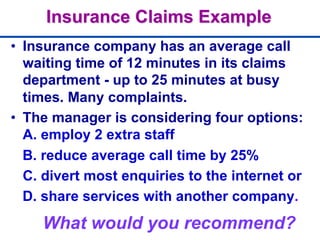
Insurance Claims Example
•  Insurance company has an average call
waiting time of 12 minutes in its claims
department - up to 25 minutes at busy
times. Many complaints.
•  The manager is considering four options:
A. employ 2 extra staff
B. reduce average call time by 25%
C. divert most enquiries to the internet or
D. share services with another company.
What would you recommend?
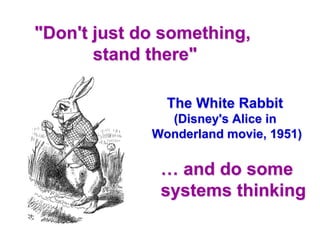
"Don't just do something,
stand there"
The White Rabbit
(Disney's Alice in
Wonderland movie, 1951)
… and do some
systems thinking
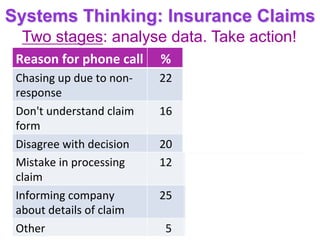
Systems Thinking: Insurance Claims
Reason	
  for	
  phone	
  call	
   %	
   How	
  to	
  address	
  
Chasing	
  up	
  due	
  to	
  non-­‐
response	
  
22	
   Process	
  claims	
  on	
  6me	
  
Don't	
  understand	
  claim	
  
form	
  
16	
   Produce	
  clearer	
  form.	
  
Help	
  on	
  web	
  site.	
  
Disagree	
  with	
  decision	
   20	
   Give	
  clear	
  reasons	
  	
  
Mistake	
  in	
  processing	
  
claim	
  
12	
   BeFer	
  training	
  to	
  
prevent	
  errors	
  
Informing	
  company	
  
about	
  details	
  of	
  claim	
  
25	
   Adds	
  value.	
  But	
  check	
  
that	
  all	
  stages	
  needed.	
  
Other	
   	
  	
  5	
   Inves6gate	
  further	
  
Two stages: analyse data. Take action!
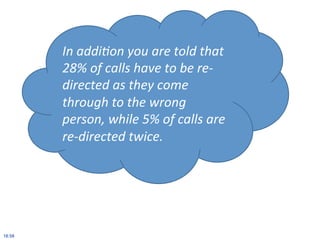
In	
  addi'on	
  you	
  are	
  told	
  that	
  
28%	
  of	
  calls	
  have	
  to	
  be	
  re-­‐
directed	
  as	
  they	
  come	
  
through	
  to	
  the	
  wrong	
  
person,	
  while	
  5%	
  of	
  calls	
  are	
  
re-­‐directed	
  twice.	
  	
  
18:58
Developing a quality
culture - some pointers …
©Max Moullin 9
Pointer 1: Focus on outcomes, not activity
"Effective commissioning must
focus on outcomes. Only then
will we achieve the high quality,
value for money public services
that people deserve"
Sir Stuart Etherington,
Chief Executive, UK National
Council for Voluntary Organisations
Pointer 2. Manage performance
across organisational boundaries
•  For example, research on teenage pregnancy
showed that 71% of young women between
16 and 18 who were NEET* for > 6 months
were parents by 21
•  Therefore if you run a team aimed at
addressing teenage pregnancy, working
together with local colleges and employers is
absolutely vital.
* Not in education,
employment or training
Moullin, 2006
©Max Moullin 11
Pointer 3: Integrate risk management
'identifying and addressing key risks
are essential for any high-performing
organisation and therefore any
evaluation of performance without
considering risk is incomplete'
4. Take account of the cost of measurement
"Public sector organisations spend up to
20% of time on form-filling, auditing,
measuring and reporting performance
but only a fraction of this is ever used to
gain relevant and new insights or lead
to performance improvements."
Professor John Baillie
Chair of Audit Scotland
5.  Develop a performance
management culture focussed
on continuous improvement,
innovation, and learning - and
not a top-down blame culture …
©Max Moullin 13
Pointer 5: Focus on CI
"All performance
targets are flawed,
some are useful"
Max Moullin, "What's the Score",
Public Finance, 22 May 2009
with due acknowledgment to the quality
management guru Deming who said:
"all models are flawed, some are useful"
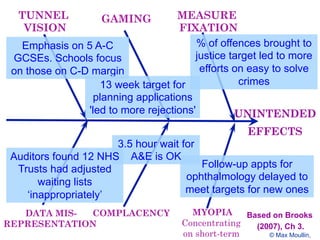
COMPLACENCY
TUNNEL
VISION
DATA MIS-
REPRESENTATION
MEASURE
FIXATION
GAMING
MYOPIA
Concentrating
on short-term
Emphasis on 5 A-C
GCSEs. Schools focus
on those on C-D margin
13 week target for
planning applications
'led to more rejections'
% of offences brought to
justice target led to more
efforts on easy to solve
crimes
Follow-up appts for
ophthalmology delayed to
meet targets for new ones
3.5 hour wait for
A&E is OK
Based on Brooks
(2007), Ch 3.
UNINTENDED
EFFECTS
Auditors found 12 NHS
Trusts had adjusted
waiting lists
‘inappropriately’
© Max Moullin,
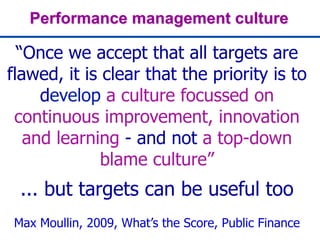
Performance management culture
“Once we accept that all targets are
flawed, it is clear that the priority is to
develop a culture focussed on
continuous improvement, innovation
and learning - and not a top-down
blame culture”
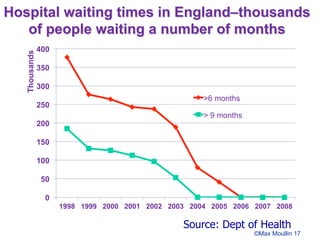
... but targets can be useful too
Max Moullin, 2009, What’s the Score, Public Finance
Hospital waiting times in England–thousands
of people waiting a number of months
©Max Moullin 17
Source: Dept of Health
0
50
100
150
200
250
300
350
400
1998 1999 2000 2001 2002 2003 2004 2005 2006 2007 2008
Thousands
>6 months
> 9 months
Pointers for creating a quality culture …
6.  Use the Public Sector
Scorecard to help you ...
©Max Moullin 19
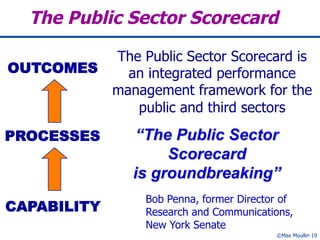
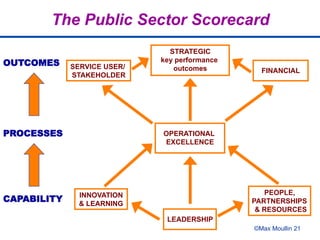
The Public Sector Scorecard
OUTCOMES
PROCESSES
CAPABILITY
The Public Sector Scorecard is
an integrated performance
management framework for the
public and third sectors
“The Public Sector
Scorecard
is groundbreaking”
Bob Penna, former Director of
Research and Communications,
New York Senate
©Max Moullin 20
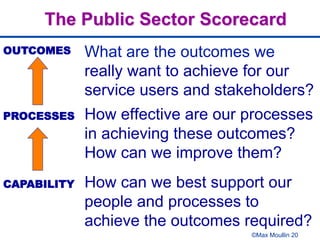
The Public Sector Scorecard
What are the outcomes we
really want to achieve for our
service users and stakeholders?
How effective are our processes
in achieving these outcomes?
How can we improve them?
How can we best support our
people and processes to
achieve the outcomes required?
OUTCOMES
PROCESSES
CAPABILITY
©Max Moullin 21
SERVICE USER/
STAKEHOLDER
FINANCIAL
OPERATIONAL
EXCELLENCE
INNOVATION
& LEARNING
STRATEGIC
key performance
outcomes
The Public Sector Scorecard
OUTCOMES
LEADERSHIP
PEOPLE,
PARTNERSHIPS
& RESOURCES
PROCESSES
CAPABILITY
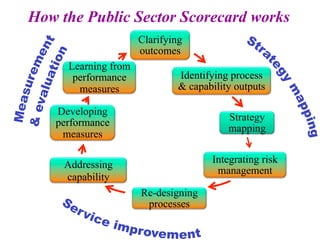
Clarifying
outcomes
Identifying process
& capability outputs
Strategy
mapping
Integrating risk
management
Re-designing
processes
Addressing
capability
Developing
performance
measures
Learning from
performance
measures
How the Public Sector Scorecard works
©Max Moullin 23
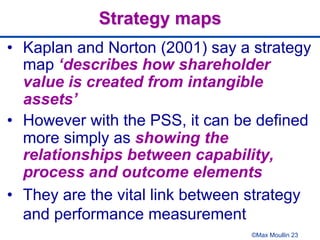
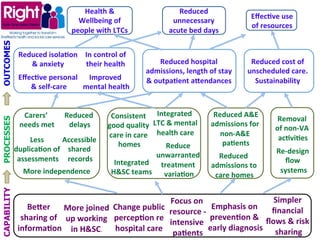
Strategy maps
•  Kaplan and Norton (2001) say a strategy
map ‘describes how shareholder
value is created from intangible
assets’
•  However with the PSS, it can be defined
more simply as showing the
relationships between capability,
process and outcome elements
•  They are the vital link between strategy
and performance measurement
Health	
  &	
  
Wellbeing	
  of	
  
people	
  with	
  LTCs	
  
Effec=ve	
  use	
  	
  
of	
  resources	
  
Reduced	
  
unnecessary	
  
acute	
  bed	
  days	
  
In	
  control	
  of	
  
their	
  health	
  
Reduced	
  isola=on	
  
&	
  anxiety	
   Reduced	
  cost	
  of	
  	
  
unscheduled	
  care.	
  
Sustainability	
  
Effec=ve	
  personal	
  
	
  &	
  self-­‐care	
  
Improved	
  	
  
mental	
  health	
  
Reduced	
  A&E	
  
admissions	
  for	
  
non-­‐A&E	
  
pa=ents	
  
Integrated	
  
LTC	
  &	
  mental	
  
health	
  care	
  
Reduced	
  
admissions	
  to	
  
care	
  homes	
  
Consistent	
  	
  
good	
  quality	
  	
  
care	
  in	
  care	
  
homes	
  
Accessible	
  
shared	
  
records	
  
Reduced	
  	
  
delays	
  
Carers’	
  
needs	
  met	
  
Removal	
  
of	
  non-­‐VA	
  
ac=vi=es	
  
Re-­‐design	
  
flow	
  
systems	
  
Reduce	
  	
  
unwarranted	
  
treatment	
  
varia=on	
  
Focus	
  on	
  	
  
resource	
  -­‐
intensive	
  	
  
pa=ents	
  
BeNer	
  
sharing	
  of	
  
informa=on	
  
Emphasis	
  on	
  
preven=on	
  &	
  
early	
  diagnosis	
  
More	
  joined	
  
up	
  working	
  
in	
  H&SC.	
  	
  
Change	
  public	
  
percep=on	
  re	
  
hospital	
  care	
  	
  
Simpler	
  
financial	
  	
  
flows	
  &	
  risk	
  
sharing	
  
Less	
  
duplica=on	
  of	
  
assessments	
   Integrated	
  
H&SC	
  teams	
  More	
  independence	
  
Reduced	
  hospital	
  
admissions,	
  length	
  of	
  stay	
  
&	
  outpa=ent	
  aNendances	
  
OUTCOMESPROCESSESCAPABILITY
Feedback on the PSS
'The strategy map is really useful as it
simplifies a complex issue with a
complex response into an orderly
understandable approach'
Executive Director for Children, Young
People, and Families, Sheffield City Council
©Max Moullin 25
'The SLC4L Strategy Map visually told
the story of SLC4L, what we were trying
to achieve and how.
It helped all those involved understand
the outcome and process measures the
programme was trying to achieve, and
therefore being evaluated against.'
Programme director
Sheffield Let’s Change4Life
©Max Moullin 26
How the PSS reduces the impact
of perverse incentives
•  Measures user satisfaction
•  Focus on outcomes, not activity
•  Works across organisational boundaries
•  Involves staff, users and other
stakeholders in developing measures
•  Much more selective approach to targets,
not top down
•  No blame culture – appraisal model
©Max Moullin 27
Key features of the PSS
•  Focuses on outcomes and evidence-based
drivers of outcomes
•  Provides a link between strategy, service
improvement and performance measurement
•  Incorporates service re-design, organisational
culture and resource issues
•  Ideal for use across organisational
boundaries
•  Integrates risk management
•  Culture of improvement, innovation &
learning, not a blame culture
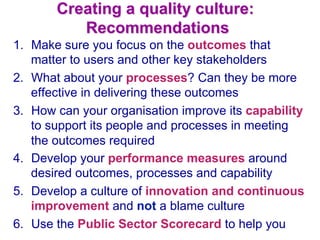
Creating a quality culture:
Recommendations
1.  Make sure you focus on the outcomes that
matter to users and other key stakeholders
2.  What about your processes? Can they be more
effective in delivering these outcomes
3.  How can your organisation improve its capability
to support its people and processes in meeting
the outcomes required
4.  Develop your performance measures around
desired outcomes, processes and capability
5.  Develop a culture of innovation and continuous
improvement and not a blame culture
6.  Use the Public Sector Scorecard to help you
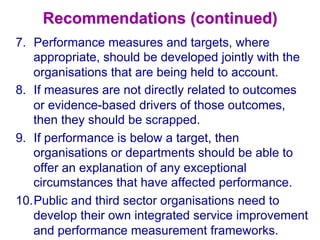
Recommendations (continued)
7.  Performance measures and targets, where
appropriate, should be developed jointly with the
organisations that are being held to account.
8.  If measures are not directly related to outcomes
or evidence-based drivers of those outcomes,
then they should be scrapped.
9.  If performance is below a target, then
organisations or departments should be able to
offer an explanation of any exceptional
circumstances that have affected performance.
10. Public and third sector organisations need to
develop their own integrated service improvement
and performance measurement frameworks.
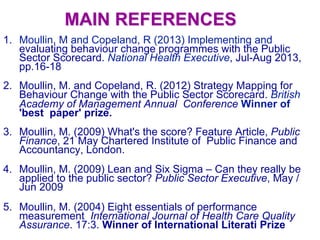
MAIN REFERENCES
1.  Moullin, M and Copeland, R (2013) Implementing and
evaluating behaviour change programmes with the Public
Sector Scorecard. National Health Executive, Jul-Aug 2013,
pp.16-18
2.  Moullin, M. and Copeland, R. (2012) Strategy Mapping for
Behaviour Change with the Public Sector Scorecard. British
Academy of Management Annual Conference Winner of
'best paper' prize.
3.  Moullin, M. (2009) What's the score? Feature Article, Public
Finance, 21 May Chartered Institute of Public Finance and
Accountancy, London.
4.  Moullin, M. (2009) Lean and Six Sigma – Can they really be
applied to the public sector? Public Sector Executive, May /
Jun 2009
5.  Moullin, M. (2004) Eight essentials of performance
measurement International Journal of Health Care Quality
Assurance. 17:3. Winner of International Literati Prize
Contact details:
Max Moullin, BSc (Soc.Sc.), MSc, FORS, FCQI, CQP
Director, Public Sector Scorecard
Research Centre
Visiting Fellow, Sheffield Business School
e-mail: max@publicsectorscorecard.co.uk
Web site: www.publicsectorscorecard.co.uk

Max Moullin - “Realising the potential benefits of CI”

  • 1.
    Continuous Improvement: Change forthe Better Manchester Conference Centre, May 2015 Creating a quality culture Max Moullin, Public Sector Scorecard Research Centre www.publicsectorscorecard.co.uk
  • 2.
    Quality - havewe lost the plot? What definition of quality do most organisations use in practice ? Conforming to the specifications of head office (or central government) A. Q.
  • 3.
    So what isQuality in the public sector ... “Meeting the requirements and expectations of service users and other stakeholders while keeping costs to a minimum” Moullin, 2002
  • 4.
    Insurance Claims Example • Insurance company has an average call waiting time of 12 minutes in its claims department - up to 25 minutes at busy times. Many complaints. •  The manager is considering four options: A. employ 2 extra staff B. reduce average call time by 25% C. divert most enquiries to the internet or D. share services with another company. What would you recommend?
  • 5.
    "Don't just dosomething, stand there" The White Rabbit (Disney's Alice in Wonderland movie, 1951) … and do some systems thinking
  • 6.
    Systems Thinking: InsuranceClaims Reason  for  phone  call   %   How  to  address   Chasing  up  due  to  non-­‐ response   22   Process  claims  on  6me   Don't  understand  claim   form   16   Produce  clearer  form.   Help  on  web  site.   Disagree  with  decision   20   Give  clear  reasons     Mistake  in  processing   claim   12   BeFer  training  to   prevent  errors   Informing  company   about  details  of  claim   25   Adds  value.  But  check   that  all  stages  needed.   Other      5   Inves6gate  further   Two stages: analyse data. Take action!
  • 7.
    In  addi'on  you  are  told  that   28%  of  calls  have  to  be  re-­‐ directed  as  they  come   through  to  the  wrong   person,  while  5%  of  calls  are   re-­‐directed  twice.     18:58
  • 8.
    Developing a quality culture- some pointers …
  • 9.
    ©Max Moullin 9 Pointer1: Focus on outcomes, not activity "Effective commissioning must focus on outcomes. Only then will we achieve the high quality, value for money public services that people deserve" Sir Stuart Etherington, Chief Executive, UK National Council for Voluntary Organisations
  • 10.
    Pointer 2. Manageperformance across organisational boundaries •  For example, research on teenage pregnancy showed that 71% of young women between 16 and 18 who were NEET* for > 6 months were parents by 21 •  Therefore if you run a team aimed at addressing teenage pregnancy, working together with local colleges and employers is absolutely vital. * Not in education, employment or training
  • 11.
    Moullin, 2006 ©Max Moullin11 Pointer 3: Integrate risk management 'identifying and addressing key risks are essential for any high-performing organisation and therefore any evaluation of performance without considering risk is incomplete'
  • 12.
    4. Take accountof the cost of measurement "Public sector organisations spend up to 20% of time on form-filling, auditing, measuring and reporting performance but only a fraction of this is ever used to gain relevant and new insights or lead to performance improvements." Professor John Baillie Chair of Audit Scotland
  • 13.
    5.  Develop aperformance management culture focussed on continuous improvement, innovation, and learning - and not a top-down blame culture … ©Max Moullin 13 Pointer 5: Focus on CI
  • 14.
    "All performance targets areflawed, some are useful" Max Moullin, "What's the Score", Public Finance, 22 May 2009 with due acknowledgment to the quality management guru Deming who said: "all models are flawed, some are useful"
  • 15.
    COMPLACENCY TUNNEL VISION DATA MIS- REPRESENTATION MEASURE FIXATION GAMING MYOPIA Concentrating on short-term Emphasison 5 A-C GCSEs. Schools focus on those on C-D margin 13 week target for planning applications 'led to more rejections' % of offences brought to justice target led to more efforts on easy to solve crimes Follow-up appts for ophthalmology delayed to meet targets for new ones 3.5 hour wait for A&E is OK Based on Brooks (2007), Ch 3. UNINTENDED EFFECTS Auditors found 12 NHS Trusts had adjusted waiting lists ‘inappropriately’ © Max Moullin,
  • 16.
    Performance management culture “Oncewe accept that all targets are flawed, it is clear that the priority is to develop a culture focussed on continuous improvement, innovation and learning - and not a top-down blame culture” ... but targets can be useful too Max Moullin, 2009, What’s the Score, Public Finance
  • 17.
    Hospital waiting timesin England–thousands of people waiting a number of months ©Max Moullin 17 Source: Dept of Health 0 50 100 150 200 250 300 350 400 1998 1999 2000 2001 2002 2003 2004 2005 2006 2007 2008 Thousands >6 months > 9 months
  • 18.
    Pointers for creatinga quality culture … 6.  Use the Public Sector Scorecard to help you ...
  • 19.
    ©Max Moullin 19 ThePublic Sector Scorecard OUTCOMES PROCESSES CAPABILITY The Public Sector Scorecard is an integrated performance management framework for the public and third sectors “The Public Sector Scorecard is groundbreaking” Bob Penna, former Director of Research and Communications, New York Senate
  • 20.
    ©Max Moullin 20 ThePublic Sector Scorecard What are the outcomes we really want to achieve for our service users and stakeholders? How effective are our processes in achieving these outcomes? How can we improve them? How can we best support our people and processes to achieve the outcomes required? OUTCOMES PROCESSES CAPABILITY
  • 21.
    ©Max Moullin 21 SERVICEUSER/ STAKEHOLDER FINANCIAL OPERATIONAL EXCELLENCE INNOVATION & LEARNING STRATEGIC key performance outcomes The Public Sector Scorecard OUTCOMES LEADERSHIP PEOPLE, PARTNERSHIPS & RESOURCES PROCESSES CAPABILITY
  • 22.
    Clarifying outcomes Identifying process & capabilityoutputs Strategy mapping Integrating risk management Re-designing processes Addressing capability Developing performance measures Learning from performance measures How the Public Sector Scorecard works
  • 23.
    ©Max Moullin 23 Strategymaps •  Kaplan and Norton (2001) say a strategy map ‘describes how shareholder value is created from intangible assets’ •  However with the PSS, it can be defined more simply as showing the relationships between capability, process and outcome elements •  They are the vital link between strategy and performance measurement
  • 24.
    Health  &   Wellbeing  of   people  with  LTCs   Effec=ve  use     of  resources   Reduced   unnecessary   acute  bed  days   In  control  of   their  health   Reduced  isola=on   &  anxiety   Reduced  cost  of     unscheduled  care.   Sustainability   Effec=ve  personal    &  self-­‐care   Improved     mental  health   Reduced  A&E   admissions  for   non-­‐A&E   pa=ents   Integrated   LTC  &  mental   health  care   Reduced   admissions  to   care  homes   Consistent     good  quality     care  in  care   homes   Accessible   shared   records   Reduced     delays   Carers’   needs  met   Removal   of  non-­‐VA   ac=vi=es   Re-­‐design   flow   systems   Reduce     unwarranted   treatment   varia=on   Focus  on     resource  -­‐ intensive     pa=ents   BeNer   sharing  of   informa=on   Emphasis  on   preven=on  &   early  diagnosis   More  joined   up  working   in  H&SC.     Change  public   percep=on  re   hospital  care     Simpler   financial     flows  &  risk   sharing   Less   duplica=on  of   assessments   Integrated   H&SC  teams  More  independence   Reduced  hospital   admissions,  length  of  stay   &  outpa=ent  aNendances   OUTCOMESPROCESSESCAPABILITY
  • 25.
    Feedback on thePSS 'The strategy map is really useful as it simplifies a complex issue with a complex response into an orderly understandable approach' Executive Director for Children, Young People, and Families, Sheffield City Council ©Max Moullin 25
  • 26.
    'The SLC4L StrategyMap visually told the story of SLC4L, what we were trying to achieve and how. It helped all those involved understand the outcome and process measures the programme was trying to achieve, and therefore being evaluated against.' Programme director Sheffield Let’s Change4Life ©Max Moullin 26
  • 27.
    How the PSSreduces the impact of perverse incentives •  Measures user satisfaction •  Focus on outcomes, not activity •  Works across organisational boundaries •  Involves staff, users and other stakeholders in developing measures •  Much more selective approach to targets, not top down •  No blame culture – appraisal model ©Max Moullin 27
  • 28.
    Key features ofthe PSS •  Focuses on outcomes and evidence-based drivers of outcomes •  Provides a link between strategy, service improvement and performance measurement •  Incorporates service re-design, organisational culture and resource issues •  Ideal for use across organisational boundaries •  Integrates risk management •  Culture of improvement, innovation & learning, not a blame culture
  • 29.
    Creating a qualityculture: Recommendations 1.  Make sure you focus on the outcomes that matter to users and other key stakeholders 2.  What about your processes? Can they be more effective in delivering these outcomes 3.  How can your organisation improve its capability to support its people and processes in meeting the outcomes required 4.  Develop your performance measures around desired outcomes, processes and capability 5.  Develop a culture of innovation and continuous improvement and not a blame culture 6.  Use the Public Sector Scorecard to help you
  • 30.
    Recommendations (continued) 7.  Performancemeasures and targets, where appropriate, should be developed jointly with the organisations that are being held to account. 8.  If measures are not directly related to outcomes or evidence-based drivers of those outcomes, then they should be scrapped. 9.  If performance is below a target, then organisations or departments should be able to offer an explanation of any exceptional circumstances that have affected performance. 10. Public and third sector organisations need to develop their own integrated service improvement and performance measurement frameworks.
  • 31.
    MAIN REFERENCES 1.  Moullin,M and Copeland, R (2013) Implementing and evaluating behaviour change programmes with the Public Sector Scorecard. National Health Executive, Jul-Aug 2013, pp.16-18 2.  Moullin, M. and Copeland, R. (2012) Strategy Mapping for Behaviour Change with the Public Sector Scorecard. British Academy of Management Annual Conference Winner of 'best paper' prize. 3.  Moullin, M. (2009) What's the score? Feature Article, Public Finance, 21 May Chartered Institute of Public Finance and Accountancy, London. 4.  Moullin, M. (2009) Lean and Six Sigma – Can they really be applied to the public sector? Public Sector Executive, May / Jun 2009 5.  Moullin, M. (2004) Eight essentials of performance measurement International Journal of Health Care Quality Assurance. 17:3. Winner of International Literati Prize
  • 32.
    Contact details: Max Moullin,BSc (Soc.Sc.), MSc, FORS, FCQI, CQP Director, Public Sector Scorecard Research Centre Visiting Fellow, Sheffield Business School e-mail: max@publicsectorscorecard.co.uk Web site: www.publicsectorscorecard.co.uk