CITIZEN PARTICIPATION
  IN THE UNITED STATES


Workshop: How to Make Citizen Participation
       Relevant in European Regions
 Stuttgart, Baden-Wuerttemberg, Germany
             December 5, 2012
THE DELIBERATIVE DEMOCRACY CONSORTIUM
THE CONTEXT:
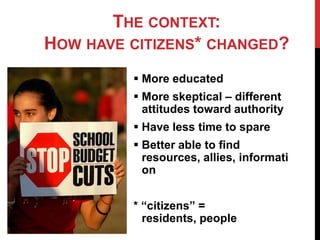
HOW HAVE CITIZENS* CHANGED?
          More educated
          More skeptical – different
           attitudes toward authority
          Have less time to spare
          Better able to find
           resources, allies, informati
           on


         * “citizens” =
           residents, people
THREE MINUTES AT THE MICROPHONE


Retrieved from Cincinnati.com, July 27, 2012
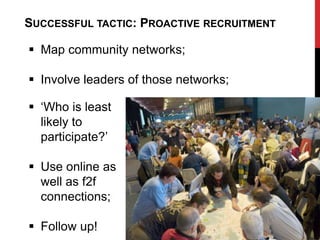
SUCCESSFUL TACTIC: PROACTIVE RECRUITMENT

 Map community networks;

 Involve leaders of those networks;

 „Who is least
  likely to
  participate?‟

 Use online as
  well as f2f
  connections;

 Follow up!
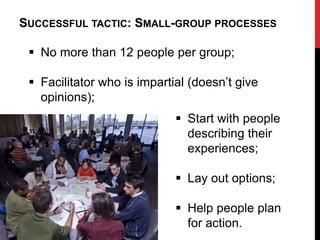
SUCCESSFUL TACTIC: SMALL-GROUP PROCESSES

  No more than 12 people per group;

  Facilitator who is impartial (doesn‟t give
   opinions);
                              Start with people
                               describing their
                               experiences;

                              Lay out options;

                              Help people plan
                               for action.
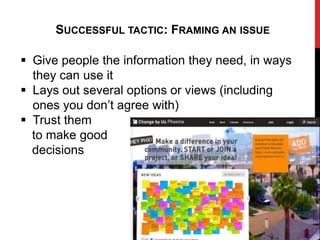
SUCCESSFUL TACTIC: FRAMING AN ISSUE

 Give people the information they need, in ways
  they can use it
 Lays out several options or views (including
  ones you don‟t agree with)
 Trust them
  to make good
  decisions
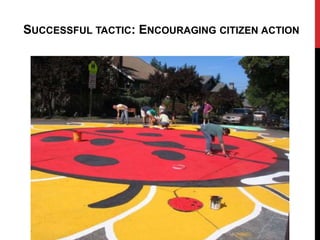
SUCCESSFUL TACTIC: ENCOURAGING CITIZEN ACTION
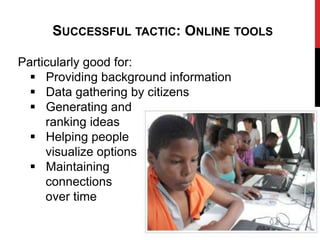
SUCCESSFUL TACTIC: ONLINE TOOLS

Particularly good for:
   Providing background information
   Data gathering by citizens
   Generating and
     ranking ideas
   Helping people
     visualize options
   Maintaining
     connections
     over time
STRENGTHS OF        PUBLIC PARTICIPATION

   Making policy decisions, plans, budgets
   Catalyzing citizen action
   Building trust, fostering new leadership
   Connections = disaster preparedness
   Attachment = economic vitality
LIMITATIONS OF     PUBLIC PARTICIPATION (AS
     WE PRACTICE IT TODAY)

   Lots of work for temporary gain
   Inefficient – every organization on its own
   Community moves back to „politics as usual‟
   „Engagers‟ set the agenda, not the „engaged‟
   Limited impact on equity
   Laws on participation out
    of step with practices
WHAT IS CIVIC INFRASTRUCTURE?

The regular
opportunities, activities, and arenas
that allow people to connect with
each other, solve problems, make
decisions, and be part of a
community.
NEW MODEL ORDINANCE ON PUBLIC
              PARTICIPATION


Available at www.deliberative-democracy.net
Developed as a collaboration of:
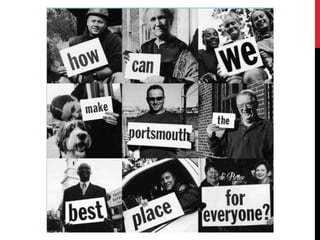
“PORTSMOUTH LISTENS”
PORTSMOUTH, NH
 Ongoing process since 2000
 Several hundred participants each time
 Addressed a number of major policy
  decisions: bullying in schools, school
  redistricting, city‟s master plan, balancing city
  budget, whether to build new middle school
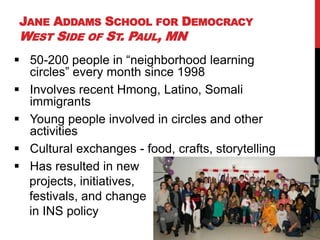
JANE ADDAMS SCHOOL FOR DEMOCRACY
WEST SIDE OF ST. PAUL, MN
 50-200 people in “neighborhood learning
  circles” every month since 1998
 Involves recent Hmong, Latino, Somali
  immigrants
 Young people involved in circles and other
  activities
 Cultural exchanges - food, crafts, storytelling
 Has resulted in new
  projects, initiatives,
  festivals, and change
  in INS policy
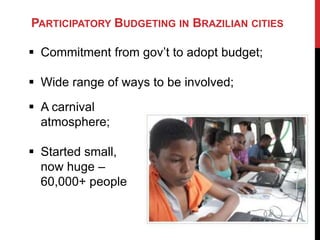
PARTICIPATORY BUDGETING IN BRAZILIAN CITIES

 Commitment from gov‟t to adopt budget;

 Wide range of ways to be involved;
 A carnival
  atmosphere;

 Started small,
  now huge –
  60,000+ people
SLIDES AVAILABLE AT:
WWW.SLIDESHARE.NET/MATTLEIGHNINGER


GUIDES:
HTTP://BIT.LY/M1PVMP
HTTP://BIT.LY/IWJGQN
RESOURCES

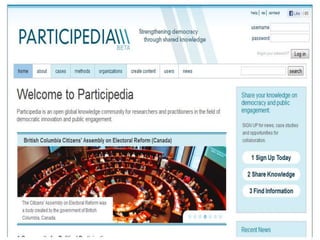
 www.participedia.net
 www.deliberative-democracy.net
 www.soulofthecommunity.org
 www.everydaydemocracy.org
 www.publicagenda.org
 www.kettering.org
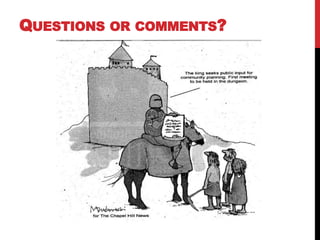
QUESTIONS OR COMMENTS?
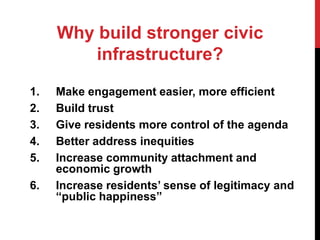
Why build stronger civic
         infrastructure?
1.   Make engagement easier, more efficient
2.   Build trust
3.   Give residents more control of the agenda
4.   Better address inequities
5.   Increase community attachment and
     economic growth
6.   Increase residents’ sense of legitimacy and
     “public happiness”

Leighninger slides for stuttgart presentation

  • 1.
    CITIZEN PARTICIPATION IN THE UNITED STATES Workshop: How to Make Citizen Participation Relevant in European Regions Stuttgart, Baden-Wuerttemberg, Germany December 5, 2012
  • 2.
  • 3.
    THE CONTEXT: HOW HAVECITIZENS* CHANGED?  More educated  More skeptical – different attitudes toward authority  Have less time to spare  Better able to find resources, allies, informati on * “citizens” = residents, people
  • 4.
    THREE MINUTES ATTHE MICROPHONE Retrieved from Cincinnati.com, July 27, 2012
  • 5.
    SUCCESSFUL TACTIC: PROACTIVERECRUITMENT  Map community networks;  Involve leaders of those networks;  „Who is least likely to participate?‟  Use online as well as f2f connections;  Follow up!
  • 6.
    SUCCESSFUL TACTIC: SMALL-GROUPPROCESSES  No more than 12 people per group;  Facilitator who is impartial (doesn‟t give opinions);  Start with people describing their experiences;  Lay out options;  Help people plan for action.
  • 7.
    SUCCESSFUL TACTIC: FRAMINGAN ISSUE  Give people the information they need, in ways they can use it  Lays out several options or views (including ones you don‟t agree with)  Trust them to make good decisions
  • 8.
  • 11.
    SUCCESSFUL TACTIC: ONLINETOOLS Particularly good for:  Providing background information  Data gathering by citizens  Generating and ranking ideas  Helping people visualize options  Maintaining connections over time
  • 12.
    STRENGTHS OF PUBLIC PARTICIPATION  Making policy decisions, plans, budgets  Catalyzing citizen action  Building trust, fostering new leadership  Connections = disaster preparedness  Attachment = economic vitality
  • 13.
    LIMITATIONS OF PUBLIC PARTICIPATION (AS WE PRACTICE IT TODAY)  Lots of work for temporary gain  Inefficient – every organization on its own  Community moves back to „politics as usual‟  „Engagers‟ set the agenda, not the „engaged‟  Limited impact on equity  Laws on participation out of step with practices
  • 14.
    WHAT IS CIVICINFRASTRUCTURE? The regular opportunities, activities, and arenas that allow people to connect with each other, solve problems, make decisions, and be part of a community.
  • 15.
    NEW MODEL ORDINANCEON PUBLIC PARTICIPATION Available at www.deliberative-democracy.net Developed as a collaboration of:
  • 17.
    “PORTSMOUTH LISTENS” PORTSMOUTH, NH Ongoing process since 2000  Several hundred participants each time  Addressed a number of major policy decisions: bullying in schools, school redistricting, city‟s master plan, balancing city budget, whether to build new middle school
  • 18.
    JANE ADDAMS SCHOOLFOR DEMOCRACY WEST SIDE OF ST. PAUL, MN  50-200 people in “neighborhood learning circles” every month since 1998  Involves recent Hmong, Latino, Somali immigrants  Young people involved in circles and other activities  Cultural exchanges - food, crafts, storytelling  Has resulted in new projects, initiatives, festivals, and change in INS policy
  • 19.
    PARTICIPATORY BUDGETING INBRAZILIAN CITIES  Commitment from gov‟t to adopt budget;  Wide range of ways to be involved;  A carnival atmosphere;  Started small, now huge – 60,000+ people
  • 21.
  • 22.
    RESOURCES www.participedia.net www.deliberative-democracy.net www.soulofthecommunity.org www.everydaydemocracy.org www.publicagenda.org www.kettering.org
  • 23.
  • 24.
    Why build strongercivic infrastructure? 1. Make engagement easier, more efficient 2. Build trust 3. Give residents more control of the agenda 4. Better address inequities 5. Increase community attachment and economic growth 6. Increase residents’ sense of legitimacy and “public happiness”

Editor's Notes

  • #9 Sometimes this means action by citizens that is seeded by gov’t with small grants
  • #12 Refer to Using Online Tools guide
  • #13 Change slide
  • #14 Change slide
  • #20 Rio Grande do Sol - http://blogs.worldbank.org/publicsphere/node/5998