Why Haven’t We
Changed the World Yet?
Addressing the system conditions.
@ruthkennedy ThePublicOffice
Perrie Ballantyne ThePublicOffice
@sophialooney Essex County Council
ThePublicOffice
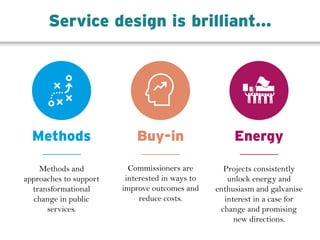
Methods and
approaches to support
transformational
change in public
services.
Methods Buy-in
Commissioners are
interested in ways to
improve outcomes and
reduce costs.
Energy
Projects consistently
unlock energy and
enthusiasm and galvanise
interest in a case for
change and promising
new directions.
Service design is brilliant...
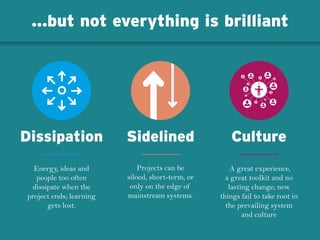
Energy, ideas and
people too often
dissipate when the
project ends; learning
gets lost.
Dissipation
Projects can be
siloed, short-term, or
only on the edge of
mainstream systems.
Culture
A great experience,
a great toolkit and no
lasting change; new
things fail to take root in
the prevailing system
and culture
Sidelined
...but not everything is brilliant
How do we stop the prevailing
conditions (culture, leadership,
governance, capabilities,
measurements) squishing the
energy and ideas that service
design methods can unlock?
What else do we need (skills,
methods and approaches)
to enable service design to
really support sustained
transformational change in
public services and for citizens?
Unlocking
the system
Supporting
transformation
Key challenges to our work
Describe work we’ve done with Essex County Council (ECC) as an
Innovation and Learning Partner, drawing out learning for service
designers and those who commission design-led innovation.
1. Work
2. Challenges
3. Ideas
Share common issues from across the work; things that are getting in
the way of embedding efforts to create change (with commissioners
and providers and citizens/communities themselves).
Share ideas and thinking for how to support a more explicit
conversation that exposes and addresses system conditions.
In this session we’ll share...
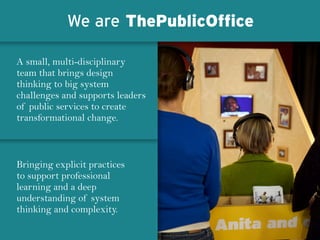
A small, multi-disciplinary
team that brings design
thinking to big system
challenges and supports leaders
of public services to create
transformational change.
Bringing explicit practices
to support professional
learning and a deep
understanding of system
thinking and complexity.
We are ThePublicOffice
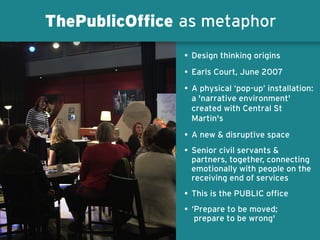
ThePublicOffice as metaphor						
• Design thinking origins
• Earls Court, June 2007
• Physical ‘pop-up’ installation:
a 'narrative environment'
created with Central St
Martin's
• A new  disruptive space
• Senior civil servants 
partners, together, connecting
emotionally with people on the
receiving end of services
• This is the PUBLIC office
• ‘Prepare to be moved; prepare
to be wrong'
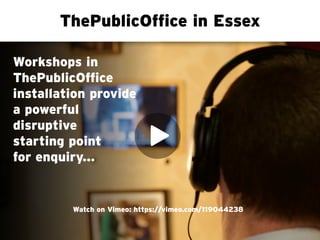
Workshops in
ThePublicOffice
installation provide
a powerful
disruptive
starting point
for enquiry...
ThePublicOffice in Essex
Watch on Vimeo: https://vimeo.com/119044238
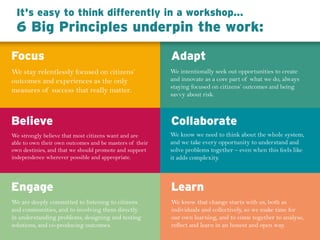
It's easy to think differently in a workshop...
6 Big Principles underpin the work:
Focus Adapt
Believe Collaborate
Engage Learn
We stay relentlessly focused on citizens’
outcomes and experiences as the only
measures of success that really matter.
We intentionally seek out opportunities to create
and innovate as a core part of what we do, always
staying focused on citizens’ outcomes and being
savvy about risk.
We know we need to think about the whole system,
and we take every opportunity to understand and
solve problems together – even when this feels like
it adds complexity.
We strongly believe that most citizens want and are
able to own their own outcomes and be masters of their
own destinies, and that we should promote and support
independence wherever possible and appropriate.
We are deeply committed to listening to citizens
and communities, and to involving them directly
in understanding problems, designing and testing
solutions, and co-producing outcomes.
We know that change starts with us, both as
individuals and collectively, so we make time for
our own learning, and to come together to analyse,
reflect and learn in an honest and open way.
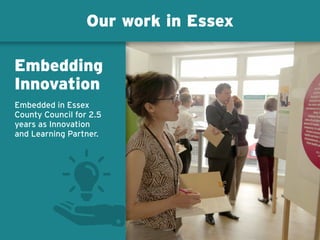
Our work in Essex
Embedding
Innovation
Embedded in Essex
County Council for 2.5
years as Innovation
and Learning Partner.
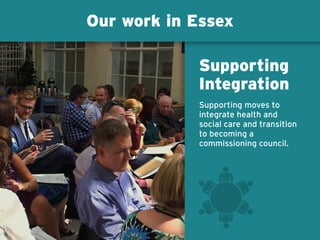
Our work in Essex
Supporting moves to
integrate health and
social care and transition
to becoming a
commissioning council.
Supporting
Integration
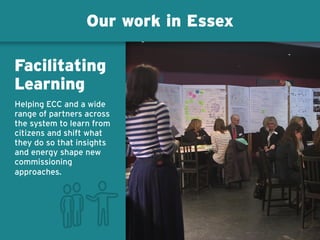
Our work in Essex
Helping ECC and a wide
range of partners across
the system to learn from
citizens and shift what
they do so that insights
and energy shape new
commissioning
approaches.
Facilitating
Learning
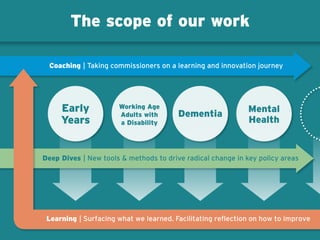
Early
Years
Dementia Mental
Health
Working Age
Adults with
a Disability
The scope of our work
Coaching | Taking commissioners on a learning and innovation journey
Deep Dives | New tools  methods to drive radical change in key policy areas
Learning | Surfacing what we learned. Facilitating reflection on how to improve
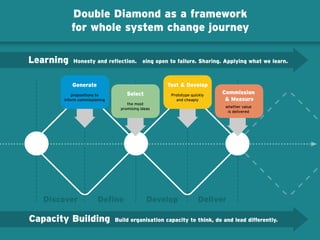
Double Diamond as a framework
for whole system change journey
Learning Honesty and reflection. eing open to failure. Sharing. Applying what we learn.
Capacity Building Build organisation capacity to think, do and lead differently.
Generate
propositions to
inform commissioning
Discover DevelopDefine Deliver
Test  Develop
Prototype quickly
and cheaply
Select
the most
promising ideas
Commission
 Measure
whether value
is delivered
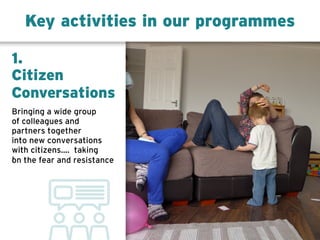
Key activities in our programmes
1.
Citizen
Conversations
Bringing a wide group
of colleagues and
partners together
into new conversations
with citizenswith citizens.... taking
on the fear and resistance
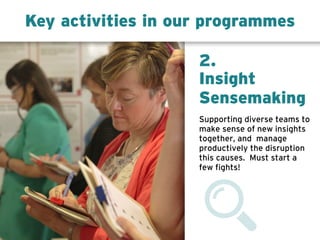
2.
Insight
Sensemaking
Supporting diverse teams to
make sense of new insights
together, and manage
productively the disruption
this causes. Must start a
few fights!
Key activities in our programmes
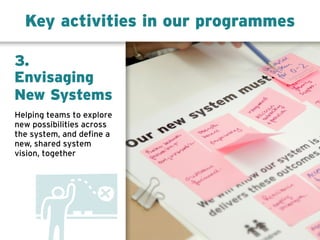
3.
Envisaging
New Systems
Helping teams to explore
new possibilities across
the system, and define a
new, shared system
vision, together
Key activities in our programmes
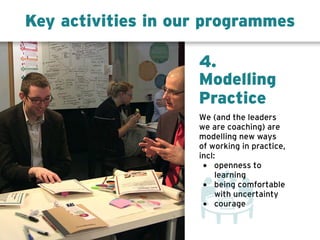
4.
Modelling
Practice
We (and the leaders
we are coaching) are
modelling new ways
of working in practice,
incl:
• openness to
learning
• being comfortable
with uncertainty
• courage
Key activities in our programmes
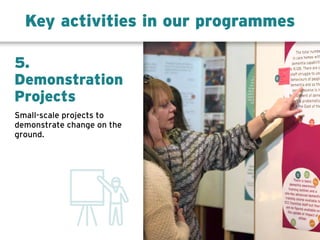
5.
Demonstration
Projects
Small-scale projects to
demonstrate change on the
ground.
Key activities in our programmes
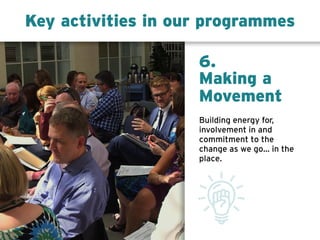
6.
Making a
Movement
Building energy for,
involvement in and
commitment to the
change as we go... in the
place.
Key activities in our programmes
Case Study:
Rethinking Early Years
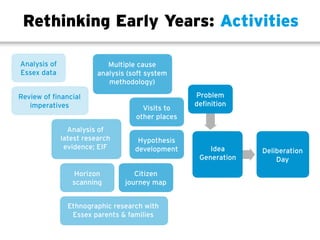
Analysis of
Essex data
Horizon
scanning
Citizen
journey map
Visits to
other places
Problem
definition
Idea
Generation
Deliberation
Day
Hypothesis
development
Ethnographic research with
Essex parents  families
Review of financial
imperatives
Analysis of
latest research
evidence; EIF
Multiple cause
analysis (soft system
methodology)
Rethinking Early Years: Activities
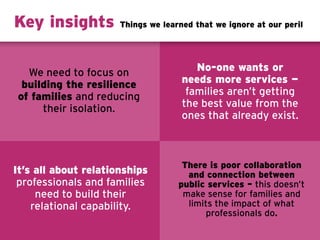
Key insights Things we learned that we ignore at our peril
We need to focus on
building the resilience
of families and reducing
their isolation.
There is poor collaboration
and connection between
public services – this doesn’t
make sense for families and
limits the impact of what
professionals do.
It’s all about relationships
professionals and families
need to build their
relational capability.
No-one wants or
needs more services —
families aren’t getting
the best value from the
ones that already exist.
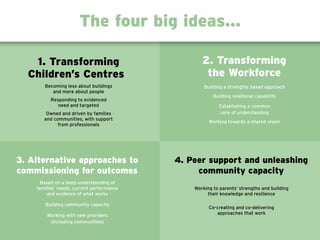
4. Peer support and unleashing
community capacity
2. Transforming
the Workforce
3. Alternative approaches to
commissioning for outcomes
1. Transforming
Children’s Centres
Becoming less about buildings
and more about people
Responding to evidenced
need and targeted
Owned and driven by families
and communities, with support
from professionals
Working to parents’ strengths and building
their knowledge and resilience
Co-creating and co-delivering
approaches that work	
Building a strengths based approach
Building relational capability
Establishing a common
core of understanding
Working towards a shared vision
Based on a deep understanding of
families’ needs, current performance
and evidence of what works
Building community capacity
Working with new providers
(including communities)
The four big ideas...
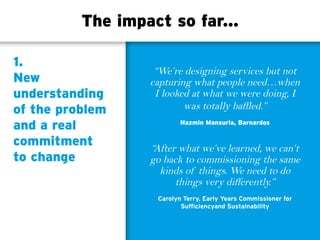
The impact so far...
1.
New
understanding
of the problem
and a real
commitment
to change
“We’re designing services but not
capturing what people need…when
I looked at what we were doing, I
was totally baffled.”
Nazmin Mansuria, Barnardos
“After what we’ve learned, we can’t
go back to commissioning the same
kinds of things. We need to do
things very differently.”
Carolyn Terry, Early Years Commissioner for
Sufficiencyand Sustainability
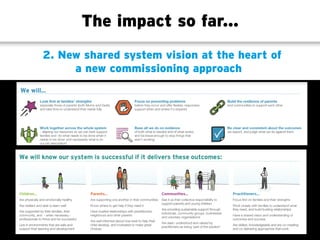
2. New shared system vision at the heart of
a new commissioning approach
The impact so far...
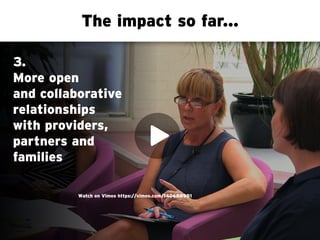
3.
More open
and collaborative
relationships
with providers,
partners and
families
The impact so far...
Watch on Vimeo https://vimeo.com/140688981
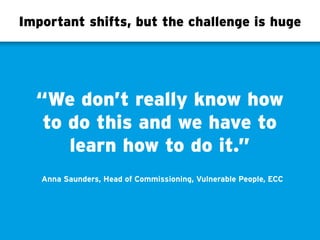
Important shifts, but the challenge is huge
“We don’t really know how
to do this and we have to
learn how to do it.”
Anna Saunders, Head of Commissioning, Vulnerable People, ECC
Reflection..
Why is it so hard?
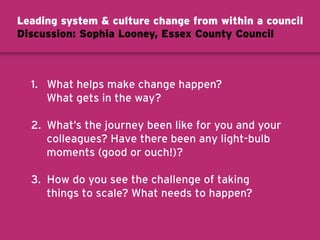
1. What helps make change happen?
What gets in the way?
2. What’s the journey been like for you and your
colleagues? Have there been any light-bulb
moments (good or ouch!)?
3. How do you see the challenge of taking
things to scale? What needs to happen?
Leading system  culture change from within a council
Discussion: Sophia Looney, Essex County Council
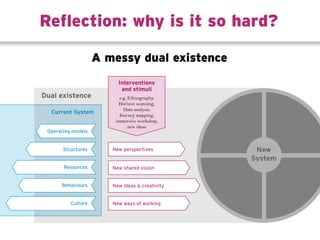
Reflection: why is it so hard?
A messy dual existence
Operating models
Current System
Structures New perspectives
New shared vision
New ideas  creativity
New ways of working
Resources
Behaviours
Culture
Interventions
and stimuli
e.g. Ethnography,
Horizon scanning,
Data analysis,
Journey mapping,
immersive workshop,
new ideas
Dual existence
New
System
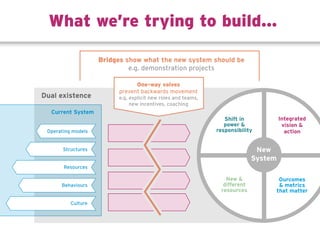
What we’re trying to build...
Operating models
Current System
One-way valves
prevent backwards movement
e.g. explicit new roles and teams,
new incentives, coaching
Structures
Resources
Behaviours
Culture
Dual existence
New
System
Integrated
vision 
action
Ourcomes
 metrics
that matter
Shift in
power 
responsibility
New 
different
resources
Bridges show what the new system should be
e.g. demonstration projects
What works?
Making things stick
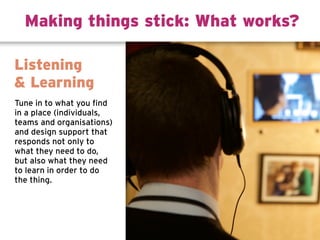
Listening
 Learning
Tune in to what you find
in a place (individuals,
teams and organisations)
and design support that
responds not only to
what they need to do,
but also what they need
to learn in order to do
the thing.
Making things stick: What works?
Tell compelling stories and
help other people to tell
them (about an insight,
vision, change, learning)
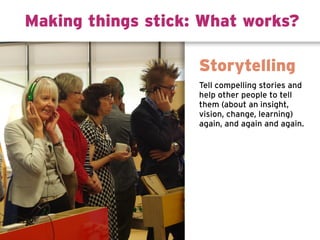
again, and again and again.
Storytelling
Making things stick: What works?
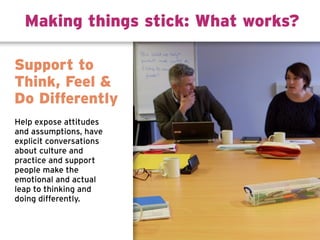
Support to
Think, Feel 
Do Differently
Help expose attitudes
and assumptions, have
explicit conversations
about culture and
practice and support
people make the
emotional and actual
leap to thinking and
doing differently.
Making things stick: What works?
Be prepared to lead
tough conversations!
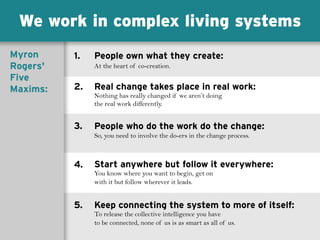
We work in complex living systems
People own what they create:
At the heart of co-creation.
Real change takes place in real work:
Nothing has really changed if we aren’t doing
the real work differently.
People who do the work do the change:
So, you need to involve the do-ers in the change process.
Start anywhere but follow it everywhere:
You know where you want to begin, get on
with it but follow wherever it leads.
Keep connecting the system to more of itself:
To release the collective intelligence you have
to be connected, none of us is as smart as all of us.
1.
2.
3.
4.
5.
Myron
Rogers'
Five
Maxims:
1. 	What else can you tell us
about the challenge of
making change stick?
2. 	What else can you tell us
about what works?
Discussion: Sharing your own reflection
So: Why Haven't We
Changed the World Yet?
We need to keep addressing the system conditions,
and our own behaviours and practices.
@thepublicoffice
www.wearethepublicoffice.com
Design by Sam Dunne @thedunnething
With thanks to Noun Project contributors: Andrey Vasiliev; Simple Icons; Gerald Wilmoser; Till Teenck; Baruch Moskovits; Iris
Roijakkers; Krisada; Joe Pictos; Gregor Cresnar; Edward Boatman; Jessica Lock; Gillbert Bages; FORMGUT

Service design: why haven't we changed the world yet?

  • 1.
    Why Haven’t We Changedthe World Yet? Addressing the system conditions. @ruthkennedy ThePublicOffice Perrie Ballantyne ThePublicOffice @sophialooney Essex County Council ThePublicOffice
  • 2.
    Methods and approaches tosupport transformational change in public services. Methods Buy-in Commissioners are interested in ways to improve outcomes and reduce costs. Energy Projects consistently unlock energy and enthusiasm and galvanise interest in a case for change and promising new directions. Service design is brilliant...
  • 3.
    Energy, ideas and peopletoo often dissipate when the project ends; learning gets lost. Dissipation Projects can be siloed, short-term, or only on the edge of mainstream systems. Culture A great experience, a great toolkit and no lasting change; new things fail to take root in the prevailing system and culture Sidelined ...but not everything is brilliant
  • 4.
    How do westop the prevailing conditions (culture, leadership, governance, capabilities, measurements) squishing the energy and ideas that service design methods can unlock? What else do we need (skills, methods and approaches) to enable service design to really support sustained transformational change in public services and for citizens? Unlocking the system Supporting transformation Key challenges to our work
  • 5.
    Describe work we’vedone with Essex County Council (ECC) as an Innovation and Learning Partner, drawing out learning for service designers and those who commission design-led innovation. 1. Work 2. Challenges 3. Ideas Share common issues from across the work; things that are getting in the way of embedding efforts to create change (with commissioners and providers and citizens/communities themselves). Share ideas and thinking for how to support a more explicit conversation that exposes and addresses system conditions. In this session we’ll share...
  • 6.
    A small, multi-disciplinary teamthat brings design thinking to big system challenges and supports leaders of public services to create transformational change. Bringing explicit practices to support professional learning and a deep understanding of system thinking and complexity. We are ThePublicOffice
  • 7.
    ThePublicOffice as metaphor •Design thinking origins • Earls Court, June 2007 • Physical ‘pop-up’ installation: a 'narrative environment' created with Central St Martin's • A new disruptive space • Senior civil servants partners, together, connecting emotionally with people on the receiving end of services • This is the PUBLIC office • ‘Prepare to be moved; prepare to be wrong'
  • 8.
    Workshops in ThePublicOffice installation provide apowerful disruptive starting point for enquiry... ThePublicOffice in Essex Watch on Vimeo: https://vimeo.com/119044238
  • 9.
    It's easy tothink differently in a workshop... 6 Big Principles underpin the work: Focus Adapt Believe Collaborate Engage Learn We stay relentlessly focused on citizens’ outcomes and experiences as the only measures of success that really matter. We intentionally seek out opportunities to create and innovate as a core part of what we do, always staying focused on citizens’ outcomes and being savvy about risk. We know we need to think about the whole system, and we take every opportunity to understand and solve problems together – even when this feels like it adds complexity. We strongly believe that most citizens want and are able to own their own outcomes and be masters of their own destinies, and that we should promote and support independence wherever possible and appropriate. We are deeply committed to listening to citizens and communities, and to involving them directly in understanding problems, designing and testing solutions, and co-producing outcomes. We know that change starts with us, both as individuals and collectively, so we make time for our own learning, and to come together to analyse, reflect and learn in an honest and open way.
  • 10.
    Our work inEssex Embedding Innovation Embedded in Essex County Council for 2.5 years as Innovation and Learning Partner.
  • 11.
    Our work inEssex Supporting moves to integrate health and social care and transition to becoming a commissioning council. Supporting Integration
  • 12.
    Our work inEssex Helping ECC and a wide range of partners across the system to learn from citizens and shift what they do so that insights and energy shape new commissioning approaches. Facilitating Learning
  • 13.
    Early Years Dementia Mental Health Working Age Adultswith a Disability The scope of our work Coaching | Taking commissioners on a learning and innovation journey Deep Dives | New tools methods to drive radical change in key policy areas Learning | Surfacing what we learned. Facilitating reflection on how to improve
  • 14.
    Double Diamond asa framework for whole system change journey Learning Honesty and reflection. eing open to failure. Sharing. Applying what we learn. Capacity Building Build organisation capacity to think, do and lead differently. Generate propositions to inform commissioning Discover DevelopDefine Deliver Test Develop Prototype quickly and cheaply Select the most promising ideas Commission Measure whether value is delivered
  • 15.
    Key activities inour programmes 1. Citizen Conversations Bringing a wide group of colleagues and partners together into new conversations with citizenswith citizens.... taking on the fear and resistance
  • 16.
    2. Insight Sensemaking Supporting diverse teamsto make sense of new insights together, and manage productively the disruption this causes. Must start a few fights! Key activities in our programmes
  • 17.
    3. Envisaging New Systems Helping teamsto explore new possibilities across the system, and define a new, shared system vision, together Key activities in our programmes
  • 18.
    4. Modelling Practice We (and theleaders we are coaching) are modelling new ways of working in practice, incl: • openness to learning • being comfortable with uncertainty • courage Key activities in our programmes
  • 19.
    5. Demonstration Projects Small-scale projects to demonstratechange on the ground. Key activities in our programmes
  • 20.
    6. Making a Movement Building energyfor, involvement in and commitment to the change as we go... in the place. Key activities in our programmes
  • 21.
  • 22.
    Analysis of Essex data Horizon scanning Citizen journeymap Visits to other places Problem definition Idea Generation Deliberation Day Hypothesis development Ethnographic research with Essex parents families Review of financial imperatives Analysis of latest research evidence; EIF Multiple cause analysis (soft system methodology) Rethinking Early Years: Activities
  • 23.
    Key insights Thingswe learned that we ignore at our peril We need to focus on building the resilience of families and reducing their isolation. There is poor collaboration and connection between public services – this doesn’t make sense for families and limits the impact of what professionals do. It’s all about relationships professionals and families need to build their relational capability. No-one wants or needs more services — families aren’t getting the best value from the ones that already exist.
  • 24.
    4. Peer supportand unleashing community capacity 2. Transforming the Workforce 3. Alternative approaches to commissioning for outcomes 1. Transforming Children’s Centres Becoming less about buildings and more about people Responding to evidenced need and targeted Owned and driven by families and communities, with support from professionals Working to parents’ strengths and building their knowledge and resilience Co-creating and co-delivering approaches that work Building a strengths based approach Building relational capability Establishing a common core of understanding Working towards a shared vision Based on a deep understanding of families’ needs, current performance and evidence of what works Building community capacity Working with new providers (including communities) The four big ideas...
  • 25.
    The impact sofar... 1. New understanding of the problem and a real commitment to change “We’re designing services but not capturing what people need…when I looked at what we were doing, I was totally baffled.” Nazmin Mansuria, Barnardos “After what we’ve learned, we can’t go back to commissioning the same kinds of things. We need to do things very differently.” Carolyn Terry, Early Years Commissioner for Sufficiencyand Sustainability
  • 26.
    2. New sharedsystem vision at the heart of a new commissioning approach The impact so far...
  • 27.
    3. More open and collaborative relationships withproviders, partners and families The impact so far... Watch on Vimeo https://vimeo.com/140688981
  • 28.
    Important shifts, butthe challenge is huge “We don’t really know how to do this and we have to learn how to do it.” Anna Saunders, Head of Commissioning, Vulnerable People, ECC
  • 29.
  • 30.
    1. What helpsmake change happen? What gets in the way? 2. What’s the journey been like for you and your colleagues? Have there been any light-bulb moments (good or ouch!)? 3. How do you see the challenge of taking things to scale? What needs to happen? Leading system culture change from within a council Discussion: Sophia Looney, Essex County Council
  • 31.
    Reflection: why isit so hard? A messy dual existence Operating models Current System Structures New perspectives New shared vision New ideas creativity New ways of working Resources Behaviours Culture Interventions and stimuli e.g. Ethnography, Horizon scanning, Data analysis, Journey mapping, immersive workshop, new ideas Dual existence New System
  • 32.
    What we’re tryingto build... Operating models Current System One-way valves prevent backwards movement e.g. explicit new roles and teams, new incentives, coaching Structures Resources Behaviours Culture Dual existence New System Integrated vision action Ourcomes metrics that matter Shift in power responsibility New different resources Bridges show what the new system should be e.g. demonstration projects
  • 33.
  • 34.
    Listening Learning Tune into what you find in a place (individuals, teams and organisations) and design support that responds not only to what they need to do, but also what they need to learn in order to do the thing. Making things stick: What works?
  • 35.
    Tell compelling storiesand help other people to tell them (about an insight, vision, change, learning) again, and again and again. Storytelling Making things stick: What works?
  • 36.
    Support to Think, Feel Do Differently Help expose attitudes and assumptions, have explicit conversations about culture and practice and support people make the emotional and actual leap to thinking and doing differently. Making things stick: What works?
  • 37.
    Be prepared tolead tough conversations!
  • 38.
    We work incomplex living systems People own what they create: At the heart of co-creation. Real change takes place in real work: Nothing has really changed if we aren’t doing the real work differently. People who do the work do the change: So, you need to involve the do-ers in the change process. Start anywhere but follow it everywhere: You know where you want to begin, get on with it but follow wherever it leads. Keep connecting the system to more of itself: To release the collective intelligence you have to be connected, none of us is as smart as all of us. 1. 2. 3. 4. 5. Myron Rogers' Five Maxims:
  • 39.
    1. What elsecan you tell us about the challenge of making change stick? 2. What else can you tell us about what works? Discussion: Sharing your own reflection
  • 40.
    So: Why Haven'tWe Changed the World Yet? We need to keep addressing the system conditions, and our own behaviours and practices. @thepublicoffice www.wearethepublicoffice.com Design by Sam Dunne @thedunnething With thanks to Noun Project contributors: Andrey Vasiliev; Simple Icons; Gerald Wilmoser; Till Teenck; Baruch Moskovits; Iris Roijakkers; Krisada; Joe Pictos; Gregor Cresnar; Edward Boatman; Jessica Lock; Gillbert Bages; FORMGUT