Keys to Community Collaboration
Gathering the Power of People
1
About Us
At K2OHSolutions we are passionate about
helping our clients and their organizations
achieve the transformation they can only
imagine.
• Insights and skills fully applicable in scope to any
company’s needs and requirements.
• Client focused, holistic approach to successfully coach
people and organizations to unsurpassed results.
2
• How to form networks
• Document a common vision
• Identify success indicators
• Establish immediate goals and activities
• Commitment to evidence-based decision making and
implementation
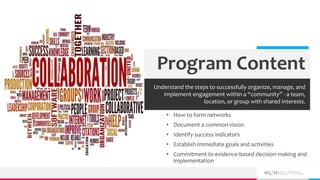
Program Content
Understand the steps to successfully organize, manage, and
implement engagement within a “community” - a team,
location, or group with shared interests.
FORM NETWORKS AROUND A COMMON NEED OR ISSUE
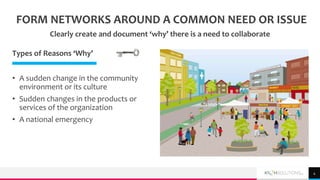
Types of Reasons ‘Why’
• A sudden change in the community
environment or its culture
• Sudden changes in the products or
services of the organization
• A national emergency
4
Clearly create and document ‘why’ there is a need to collaborate
WHO SHOULD BE INVITED TO THE NETWORK
AND HOW WILL WE GET TOGETHER?
LogisticsWho To Invited?
• Is the meeting virtual?
• Will presentations or documents be
shared? And, how will participants
provide comments?
• Are there time zone issues?
• If in person, reserve a meeting room
and provide food for meetings longer
than 2 hours, if needed.
• Consider those groups who use or
could use your products or services
in your community
• Which groups are in a position to
collaborate and pay it forward?
• Think about:
o Who can you support?
o Who can you partner with to
make a difference in the
community?
o Key stakeholders
5
A COMMON VISION
Jointly create, document and share a ‘vision for transformation’ that indicates a common
understanding of the problem and a joint approach to solving it with agreed upon actions
Why a Vision
The vision inspires and focuses
people’s energies and the
community’s attention. It is
motivating, doable, and
observable.
What it looks like
• Begin by asking each team member to write
down a keyword that indicates what the
future would look like if this problem/issue
were solved. No Judgement. No one has to
explain themselves.
• Collect these words, combine, and synthesize
to collaboratively create a vision statement.
• Create and communicate the vision to expand
the network’s direction and excite other
community energy and assets.
6
IDENTIFY INDICATORS OF SUCCESS
Ask the group ‘what would success look like’? Develop a short list of indicators at the
community level and across participating organizations that guide data collection.
Balanced Score Card
• Customers: What would their value proposition
look like, currently, for our community and their
customers?
• Learning and Growth: How do we align our
intangible assets---people, systems, and
culture—to maximize our results?
• Internal Processes: What key processes must
we excel at to best support our community?
• Financial: What are our joint expectations for
resource sharing?
Document Short Term Measures
(Examples)
• Each Network group has a channel where they can
voice their preferences.
• Each Network group supplies at least one asset in
people and product/process/service.
• Each Network group identifies one process to
improve the collaboration and how they will
implement it.
• Each Network group shares specific resources.
7
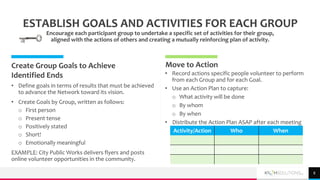
ESTABLISH GOALS AND ACTIVITIES FOR EACH GROUP
Encourage each participant group to undertake a specific set of activities for their group,
aligned with the actions of others and creating a mutually reinforcing plan of activity.
Create Group Goals to Achieve
Identified Ends
• Define goals in terms of results that must be achieved
to advance the Network toward its vision.
• Create Goals by Group, written as follows:
o First person
o Present tense
o Positively stated
o Short!
o Emotionally meaningful
EXAMPLE: City Public Works delivers flyers and posts
online volunteer opportunities in the community.
Move to Action
• Record actions specific people volunteer to perform
from each Group and for each Goal.
• Use an Action Plan to capture:
o What activity will be done
o By whom
o By when
• Distribute the Action Plan ASAP after each meeting
8
Activity/Action Who When
COMMITMENT TO EVIDENCE-BASED
DECISION MAKING AND IMPLEMENTATION
Review Goals and Actions and determine short term, mid-term and long term actions
Implementing our Community Goals
• Intentionally align the vision, goals
and actions and assure that the
planning is completed from the
‘big picture’ to the ‘grassroots’
and vice versa.
• Acknowledge contributions of
Group members throughout each
meeting.
Communicate the Vision, Goals & Actions
• Continuously communicate the results of
meetings.
• Communication Plans help avoid people making
up stories. Proactive communication is important.
• Communication Plans are charts that document:
o What needs to be said
o Who needs to hear it
o Who needs to say it
o How to say it (medium)
o When to say it
9
Thank You
Kristyn Davis
+2088708310
kristyn.davis@k2ohsolutions.com
www.k2ohsolutions.com
10
We hope this short course on
Keys to Community
Collaboration helps you tap into
gathering the power of people.
The K2OHSolutions team are
seasoned professionals able to
assist developing groups,
organizations and leaders.
Contact us today to learn more
about our services and training
solutions. Let’s Work Together.

Keys to successful community collaboration (1)

  • 1.
    Keys to CommunityCollaboration Gathering the Power of People 1
  • 2.
    About Us At K2OHSolutionswe are passionate about helping our clients and their organizations achieve the transformation they can only imagine. • Insights and skills fully applicable in scope to any company’s needs and requirements. • Client focused, holistic approach to successfully coach people and organizations to unsurpassed results. 2
  • 3.
    • How toform networks • Document a common vision • Identify success indicators • Establish immediate goals and activities • Commitment to evidence-based decision making and implementation Program Content Understand the steps to successfully organize, manage, and implement engagement within a “community” - a team, location, or group with shared interests.
  • 4.
    FORM NETWORKS AROUNDA COMMON NEED OR ISSUE Types of Reasons ‘Why’ • A sudden change in the community environment or its culture • Sudden changes in the products or services of the organization • A national emergency 4 Clearly create and document ‘why’ there is a need to collaborate
  • 5.
    WHO SHOULD BEINVITED TO THE NETWORK AND HOW WILL WE GET TOGETHER? LogisticsWho To Invited? • Is the meeting virtual? • Will presentations or documents be shared? And, how will participants provide comments? • Are there time zone issues? • If in person, reserve a meeting room and provide food for meetings longer than 2 hours, if needed. • Consider those groups who use or could use your products or services in your community • Which groups are in a position to collaborate and pay it forward? • Think about: o Who can you support? o Who can you partner with to make a difference in the community? o Key stakeholders 5
  • 6.
    A COMMON VISION Jointlycreate, document and share a ‘vision for transformation’ that indicates a common understanding of the problem and a joint approach to solving it with agreed upon actions Why a Vision The vision inspires and focuses people’s energies and the community’s attention. It is motivating, doable, and observable. What it looks like • Begin by asking each team member to write down a keyword that indicates what the future would look like if this problem/issue were solved. No Judgement. No one has to explain themselves. • Collect these words, combine, and synthesize to collaboratively create a vision statement. • Create and communicate the vision to expand the network’s direction and excite other community energy and assets. 6
  • 7.
    IDENTIFY INDICATORS OFSUCCESS Ask the group ‘what would success look like’? Develop a short list of indicators at the community level and across participating organizations that guide data collection. Balanced Score Card • Customers: What would their value proposition look like, currently, for our community and their customers? • Learning and Growth: How do we align our intangible assets---people, systems, and culture—to maximize our results? • Internal Processes: What key processes must we excel at to best support our community? • Financial: What are our joint expectations for resource sharing? Document Short Term Measures (Examples) • Each Network group has a channel where they can voice their preferences. • Each Network group supplies at least one asset in people and product/process/service. • Each Network group identifies one process to improve the collaboration and how they will implement it. • Each Network group shares specific resources. 7
  • 8.
    ESTABLISH GOALS ANDACTIVITIES FOR EACH GROUP Encourage each participant group to undertake a specific set of activities for their group, aligned with the actions of others and creating a mutually reinforcing plan of activity. Create Group Goals to Achieve Identified Ends • Define goals in terms of results that must be achieved to advance the Network toward its vision. • Create Goals by Group, written as follows: o First person o Present tense o Positively stated o Short! o Emotionally meaningful EXAMPLE: City Public Works delivers flyers and posts online volunteer opportunities in the community. Move to Action • Record actions specific people volunteer to perform from each Group and for each Goal. • Use an Action Plan to capture: o What activity will be done o By whom o By when • Distribute the Action Plan ASAP after each meeting 8 Activity/Action Who When
  • 9.
    COMMITMENT TO EVIDENCE-BASED DECISIONMAKING AND IMPLEMENTATION Review Goals and Actions and determine short term, mid-term and long term actions Implementing our Community Goals • Intentionally align the vision, goals and actions and assure that the planning is completed from the ‘big picture’ to the ‘grassroots’ and vice versa. • Acknowledge contributions of Group members throughout each meeting. Communicate the Vision, Goals & Actions • Continuously communicate the results of meetings. • Communication Plans help avoid people making up stories. Proactive communication is important. • Communication Plans are charts that document: o What needs to be said o Who needs to hear it o Who needs to say it o How to say it (medium) o When to say it 9
  • 10.
    Thank You Kristyn Davis +2088708310 kristyn.davis@k2ohsolutions.com www.k2ohsolutions.com 10 Wehope this short course on Keys to Community Collaboration helps you tap into gathering the power of people. The K2OHSolutions team are seasoned professionals able to assist developing groups, organizations and leaders. Contact us today to learn more about our services and training solutions. Let’s Work Together.