The f Word

Naomi Jones
Angela Paine
Amanda Prosser
Natalie Low
Stephen M K
St h     McKay
What difference do we make?
Evaluating v and v projects
Overview

• Who are we?
• Why bother with evaluation?
• Wh t diff
  What difference do you
                  d
  make?
• How do we all go about
  proving it?
Who we are

• A consortium of four organisations
• U d t ki
  Undertaking an independent
                   i d     d t
  evaluation for v
• Working with v over the next two
  years
• Using a variety of evaluation
  methods
• Constantly feeding back findings
           y         g           g
• Shaping the future development of
  v
Turn to the person on your right
and introduce yourself and say
two words to sum up your view
of evaluation
 f     l ti
Why bother with evaluation?
• For accountability and learning
• Evidence funders - what difference their
  money makes
         y
• Evidence for trustee - strategic decision
  making
• Evidence for volunteers - what
  difference their time makes
• Attracting new volunteers – what they
  will get out of it
• Organisational learning - what works;
  what can b iimproved
    h t      be         d
Less about
     about…
More about
     about…
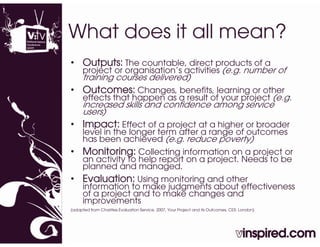
What does it all mean?
• Outputs: The countable direct products of a
               countable,
      project or organisation’s activities (e.g. number of
      training courses delivered)
• Outcomes: Changes, benefits, learning or other
                g ,          ,        g
      effects that happen as a result of your project (e.g.
      increased skills and confidence among service
      users)
• Impact: Effect of a project at a higher or broader
      level in the longer term after a range of outcomes
      has been achieved (e.g. reduce poverty)
• Monitoring: Collecting information on a project or
      an activity to help report on a project. Needs to be
      planned and managed.
• Evaluation: Using monitoring and other
                  g          g
      iinformation to make judgments about effectiveness
         f     ti  t     k j d     t b t ff ti
       of a project and to make changes and
       improvements
(adapted from Charities Evaluation Service, 2007, Your Project and its Outcomes, CES: London)
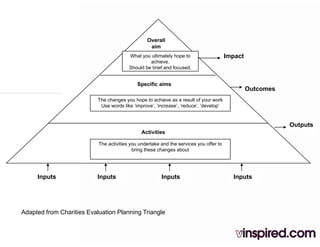
Overall
                                                  aim
                                         What you ultimately hope to                    Impact
                                                  achieve.
                                         Should be brief and focused.


                                             Specific aims
                                                                                                 Outcomes
                           The changes you hope to achieve as a result of your work
                            Use words like ‘improve’, ‘increase’, ‘reduce’, ‘develop’


                                                                                                            Outputs
                                                                                                            O t t
                                               Activities

                           The activities you undertake and the services you offer to
                                           bring these changes about


     Inputs               Inputs                        Inputs                            Inputs


Adapted from Charities Evaluation Planning Triangle
What difference does your
       project make?

• Your project will make a difference
  to lots of different people:
   – Volunteers
   – Service users
   – Your organisation as a whole
     Your organisation as a whole
   – The community in which you work
What difference does
 y
 your p j
      project make?
• It will make a difference in a number of
  ways:

• Things [aka ‘physical capital’]:
   – The things produced by volunteering 
      • Number of training courses delivered or people
         Number of training courses delivered or people 
         mentored
   – Need to consider not just quantity but also quality

• People [
         [aka ‘human capital’]
                             ]
   – Personal development 
      • Changes in levels of confidence, self‐esteem, 
         wellbeing
   – Gaining new skills or enhancing existing ones
      • Soft skills – e.g. team work, communication, inter‐
         personal
      • Hard skills – e.g. IT skills, construction, horticulture
• Money [aka ‘economic capital’]:
              economic capital ]:
  – The monetary value of volunteering and its 
    outcomes on all stakeholders, e.g. value of 
    training received, changes in employability, 
    training received changes in employability
    value of work done by volunteers

• Relationships [
                [aka ‘social capital’]:
                                     ]
  – Relationships, networks, bonds of trust 
    between people and reciprocity 
    between people and reciprocity

• Attitudes [aka ‘cultural capital’]:
            [                p     ]
  – Shared sense of cultural and religious identity
  – Awareness and understanding of other peoples 
    cultures
How do we go about
      proving it?
• You can collect evidence to evaluate
  your project in a number of ways:
  – Monitoring information
  – Surveys of volunteers or staff members
  – Focus groups of volunteers or service users
  – Interviews with service users and key 
    stakeholders
  – Photograph projects before, during and after
  – Video diaries by volunteers or service users
How do we go about
      proving it?
• You don’t have to do it all yourself:
   – The evaluation website will include guidance 
   – You can get others involved: volunteers or students from 
     a local university might be able to help
     a local university might be able to help
   – You could make use of the questions within IVR’s 
     Volunteering Impact Assessment Toolkit
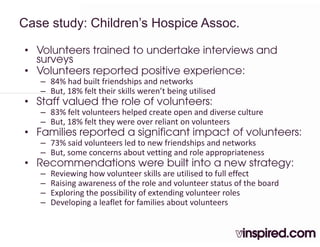
Case study: Children’s Hospice Assoc.

• Volunteers trained to undertake interviews and
  surveys
       y
• Volunteers reported positive experience:
   – 84% had built friendships and networks 
   – But, 18% felt their skills weren’t being utilised
     But, 18% felt their skills weren t being utilised
• Staff valued the role of volunteers:
   – 83% felt volunteers helped create open and diverse culture
   – But 18% felt they were over reliant on volunteers
     But, 18% felt they were over reliant on volunteers
• Families reported a significant impact of volunteers:
   – 73% said volunteers led to new friendships and networks
   – But some concerns about vetting and role appropriateness
     But, some concerns about vetting and role appropriateness
• Recommendations were built into a new strategy:
   –   Reviewing how volunteer skills are utilised to full effect
   –   Raising awareness of the role and volunteer status of the board
       Raising awareness of the role and volunteer status of the board
   –   Exploring the possibility of extending volunteer roles 
   –   Developing a leaflet for families about volunteers
On your table work to
complete the planning
and evaluation triangle
                    g
How will we go about
      evaluating v?
                g
• Analysing national data from the Citizenship
  Survey
• Analysing monitoring data collected by v
• Speaking to key national stakeholders
• Undertaking a survey of young people
• D i
  Doing telephone iinterviews with grant
         t l h       t    i     ith     t
  recipients
• Undertaking a series of case studies
How can you get
              involved?
•   Answer our phone calls and surveys!
•   Become a case study
•   Participate in pilot initiatives
•   Provide good quality monitoring information
•   Visit our website
    – Launching in July
      Launching in July
    – Housed on vinspired.com/evaluation
    – Purpose is to:
        • Share any insights we’re picking up
          Share any insights we re picking up
        • Enable you to share experiences and best practice
        • Enable you to feed into evaluation
        • Provide guidance on self evaluation
               d     d           lf    l

The F Word - Evaluation.

  • 1.
    The f Word NaomiJones Angela Paine Amanda Prosser Natalie Low Stephen M K St h McKay
  • 2.
    What difference dowe make? Evaluating v and v projects
  • 3.
    Overview • Who arewe? • Why bother with evaluation? • Wh t diff What difference do you d make? • How do we all go about proving it?
  • 4.
    Who we are •A consortium of four organisations • U d t ki Undertaking an independent i d d t evaluation for v • Working with v over the next two years • Using a variety of evaluation methods • Constantly feeding back findings y g g • Shaping the future development of v
  • 5.
    Turn to theperson on your right and introduce yourself and say two words to sum up your view of evaluation f l ti
  • 6.
    Why bother withevaluation? • For accountability and learning • Evidence funders - what difference their money makes y • Evidence for trustee - strategic decision making • Evidence for volunteers - what difference their time makes • Attracting new volunteers – what they will get out of it • Organisational learning - what works; what can b iimproved h t be d
  • 7.
    Less about about…
  • 8.
    More about about…
  • 9.
    What does itall mean? • Outputs: The countable direct products of a countable, project or organisation’s activities (e.g. number of training courses delivered) • Outcomes: Changes, benefits, learning or other g , , g effects that happen as a result of your project (e.g. increased skills and confidence among service users) • Impact: Effect of a project at a higher or broader level in the longer term after a range of outcomes has been achieved (e.g. reduce poverty) • Monitoring: Collecting information on a project or an activity to help report on a project. Needs to be planned and managed. • Evaluation: Using monitoring and other g g iinformation to make judgments about effectiveness f ti t k j d t b t ff ti of a project and to make changes and improvements (adapted from Charities Evaluation Service, 2007, Your Project and its Outcomes, CES: London)
  • 10.
    Overall aim What you ultimately hope to Impact achieve. Should be brief and focused. Specific aims Outcomes The changes you hope to achieve as a result of your work Use words like ‘improve’, ‘increase’, ‘reduce’, ‘develop’ Outputs O t t Activities The activities you undertake and the services you offer to bring these changes about Inputs Inputs Inputs Inputs Adapted from Charities Evaluation Planning Triangle
  • 11.
    What difference doesyour project make? • Your project will make a difference to lots of different people: – Volunteers – Service users – Your organisation as a whole Your organisation as a whole – The community in which you work
  • 12.
    What difference does y your p j project make? • It will make a difference in a number of ways: • Things [aka ‘physical capital’]: – The things produced by volunteering  • Number of training courses delivered or people Number of training courses delivered or people  mentored – Need to consider not just quantity but also quality • People [ [aka ‘human capital’] ] – Personal development  • Changes in levels of confidence, self‐esteem,  wellbeing – Gaining new skills or enhancing existing ones • Soft skills – e.g. team work, communication, inter‐ personal • Hard skills – e.g. IT skills, construction, horticulture
  • 13.
    • Money [aka‘economic capital’]: economic capital ]: – The monetary value of volunteering and its  outcomes on all stakeholders, e.g. value of  training received, changes in employability,  training received changes in employability value of work done by volunteers • Relationships [ [aka ‘social capital’]: ] – Relationships, networks, bonds of trust  between people and reciprocity  between people and reciprocity • Attitudes [aka ‘cultural capital’]: [ p ] – Shared sense of cultural and religious identity – Awareness and understanding of other peoples  cultures
  • 14.
    How do wego about proving it? • You can collect evidence to evaluate your project in a number of ways: – Monitoring information – Surveys of volunteers or staff members – Focus groups of volunteers or service users – Interviews with service users and key  stakeholders – Photograph projects before, during and after – Video diaries by volunteers or service users
  • 16.
    How do wego about proving it? • You don’t have to do it all yourself: – The evaluation website will include guidance  – You can get others involved: volunteers or students from  a local university might be able to help a local university might be able to help – You could make use of the questions within IVR’s  Volunteering Impact Assessment Toolkit
  • 17.
    Case study: Children’sHospice Assoc. • Volunteers trained to undertake interviews and surveys y • Volunteers reported positive experience: – 84% had built friendships and networks  – But, 18% felt their skills weren’t being utilised But, 18% felt their skills weren t being utilised • Staff valued the role of volunteers: – 83% felt volunteers helped create open and diverse culture – But 18% felt they were over reliant on volunteers But, 18% felt they were over reliant on volunteers • Families reported a significant impact of volunteers: – 73% said volunteers led to new friendships and networks – But some concerns about vetting and role appropriateness But, some concerns about vetting and role appropriateness • Recommendations were built into a new strategy: – Reviewing how volunteer skills are utilised to full effect – Raising awareness of the role and volunteer status of the board Raising awareness of the role and volunteer status of the board – Exploring the possibility of extending volunteer roles  – Developing a leaflet for families about volunteers
  • 18.
    On your tablework to complete the planning and evaluation triangle g
  • 19.
    How will wego about evaluating v? g • Analysing national data from the Citizenship Survey • Analysing monitoring data collected by v • Speaking to key national stakeholders • Undertaking a survey of young people • D i Doing telephone iinterviews with grant t l h t i ith t recipients • Undertaking a series of case studies
  • 20.
    How can youget involved? • Answer our phone calls and surveys! • Become a case study • Participate in pilot initiatives • Provide good quality monitoring information • Visit our website – Launching in July Launching in July – Housed on vinspired.com/evaluation – Purpose is to: • Share any insights we’re picking up Share any insights we re picking up • Enable you to share experiences and best practice • Enable you to feed into evaluation • Provide guidance on self evaluation d d lf l