

Stakeholder Involvement
        The Magic of Timing

                 Your presenter is:
         Alison Sigmon, M.Ed., LPC, PMP
1
What’s on tap for our time together today…
     Getting the right people involved at the right time and doing the right work for your
     projects comes down to defining what you need, who can support it, and when you
     need them. Sounds easy but it’s not when you consider project stakeholder schedules,
     competing projects, and uncertain attitudes.

     Before you can do any of this, it’s important to understand who the highest priority
     stakeholders at key points in the project, their expectations and attitudes about the
     project, and role they need to play. Today we’re going to look at Stakeholder Mapping as
     a tool to help you determine these things.

     Agenda
      Revolving door…reality of today’s project stakeholder

      Collaboration: Power of purpose & recognition

      Stakeholder Mapping: Let the tool work for you

      Wrap it up!


 2
Revolving door: Reality of today’s project stakeholder


                                         Ebb & Flow of
                                          Stakeholders
 3
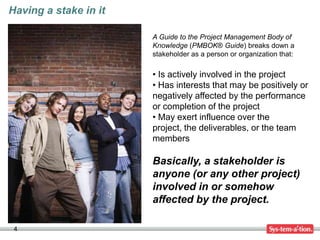
Having a stake in it

                       A Guide to the Project Management Body of
                       Knowledge (PMBOK® Guide) breaks down a
                       stakeholder as a person or organization that:

                       • Is actively involved in the project
                       • Has interests that may be positively or
                       negatively affected by the performance
                       or completion of the project
                       • May exert influence over the
                       project, the deliverables, or the team
                       members

                       Basically, a stakeholder is
                       anyone (or any other project)
                       involved in or somehow
                       affected by the project.

 4
Skipping across the circles…
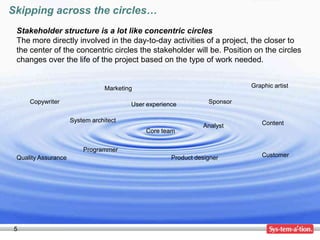
 Stakeholder structure is a lot like concentric circles
 The more directly involved in the day-to-day activities of a project, the closer to
 the center of the concentric circles the stakeholder will be. Position on the circles
 changes over the life of the project based on the type of work needed.


                                 Marketing                                  Graphic artist

     Copywriter                          User experience          Sponsor

                     System architect                                           Content
                                                                Analyst
                                             Core team


                         Programmer
 Quality Assurance                                    Product designer          Customer


 5
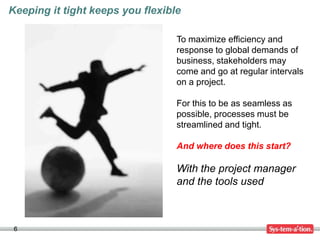
Keeping it tight keeps you flexible

                                  To maximize efficiency and
                                  response to global demands of
                                  business, stakeholders may
                                  come and go at regular intervals
                                  on a project.

                                  For this to be as seamless as
                                  possible, processes must be
                                  streamlined and tight.

                                  And where does this start?

                                  With the project manager
                                  and the tools used


 6
Working together- it’s our nature


                                  Collaboration:
                              Power of Purpose &
                                     Recognition
 7
Cooperation is in our nature
                               Given some of the unscrupulous, self-
                               centered activities in business over the years,
                               might be hard to believe that it’s actually
                               human nature to work together.

                               Study noted in a recent edition of Scientific
                               Americanmagazine found that of all species
                               humans can be considered “super-
                               cooperators.” It’s this cooperation that has
                               perpetuated the human race. For example:

                               While we compete to “climb the corporate
                               ladder,” we still work together to make sure
                               the company succeeds against competitors.

                               While we work to provide for our families, we
                               are still very philanthropic.

                               When a crisis occurs, we think nothing of
                               dropping our priorities and even sacrificing
                               our personal well-being to help others.
 8
Credibility and reputation rule


                                  Research shows our
                                  cooperative tendencies stem
                                  primarily from two things:

                                  • Receiving credible
                                  information about a problem
                                  or issue

                                  • Being generous in an effort
                                  and desire to preserve
                                  reputation


 9
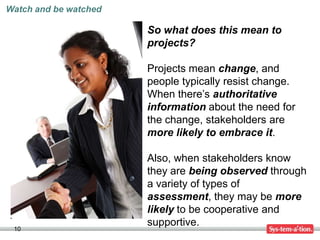
Watch and be watched

                       So what does this mean to
                       projects?

                       Projects mean change, and
                       people typically resist change.
                       When there’s authoritative
                       information about the need for
                       the change, stakeholders are
                       more likely to embrace it.

                       Also, when stakeholders know
                       they are being observed through
                       a variety of types of
                       assessment, they may be more
                       likely to be cooperative and
                       supportive.
 10
Cue the tool to engage and influence
                                 Using tools such as Stakeholder Mapping
                                 throughout the project gives project teams
                                 an opportunity to assess and validate the
                                 scope and assumptions of the project to
                                 date.

                                 It also gives project teams a chance to
                                 assess stakeholder
                                 expectations, assumptions, and attitudes
                                 about the project. It’s that analysis that
                                 project managers can use to open (or
                                 reopen in some cases) dialogue with
                                 stakeholders about the project objectives
                                 and deliverables.

                                 It lets stakeholders know you’ve given
                                 consideration for what they are thinking
                                 and care enough to explore their thoughts
                                 with them which creates an opportunity for
                                 cooperation over authoritarian direction.

 11
Right place, right time, right work


                       Stakeholder Mapping:
                  Strategy gets the job done
 12
Getting collective action is tricky

                                      Just as a politician pays close
                                      attention to the opinions of
                                      constituents, so must you as a
                                      project manager.

                                      Project politics is about getting
                                      collective action from a group of
                                      people who may have quite different
                                      interests.

                                      Being willing to use conflict
                                      creatively is important to influencing
                                      others. But don’t do it empty-handed.

                                      Take the time to understand the
                                      formal and informal structure and
                                      positions of key groups and
                                      individuals.

  13
Navigating the politics of projects


                                      A big part of navigating project
                                      politics is to get a handle on who
                                      the stakeholders are, what the
                                      stakeholders think the project is,
                                      aligning the project needs with
                                      stakeholder expectations, and
                                      getting clear on project roles.

                                      What’s tough about this is that it’s
                                      fluid. Stakeholders change.
                                      Expectations change. Opinions
                                      about objectives for your project
                                      vary among stakeholders.

                                      An effective way to respond to this
                                      complexity is to use the
                                      Stakeholder Mapping Tool.

 14
What is Stakeholder Mapping?


                               •   Formalizes how you think about
                                   stakeholders at a particular
                                   point in time. It also prioritizes
                                   stakeholders.
                               •   Identifies the web of groups and
                                   individuals whose expectations
                                   and attitudes will determine
                                   whether or not the deliverables
                                   get completed and accepted.
                               •   It also serves as an “early
                                   warning system” by identifying
                                   thosestakeholderswho have
                                   special communication needs.
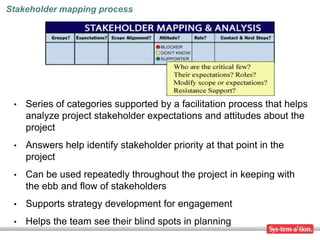
Stakeholder mapping process


 •   Series of categories supported by a facilitation process that helps
     analyze project stakeholder expectations and attitudes about the
     project
 •   Answers help identify stakeholder priority at that point in the
     project
 •   Can be used repeatedly throughout the project in keeping with
     the ebb and flow of stakeholders
 •   Supports strategy development for engagement
 •   Helps the team see their blind spots in planning
How does it work?


                          Stakeholder Mapping:
                    Assessment and engagement
                                        magic
 17
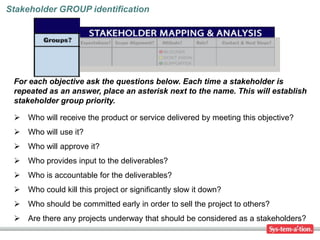
Stakeholder GROUP identification


 For each objective ask the questions below. Each time a stakeholder is
 repeated as an answer, place an asterisk next to the name. This will establish
 stakeholder group priority.

  Who will receive the product or service delivered by meeting this objective?
  Who will use it?
  Who will approve it?
  Who provides input to the deliverables?
  Who is accountable for the deliverables?
  Who could kill this project or significantly slow it down?
  Who should be committed early in order to sell the project to others?
  Are there any projects underway that should be considered as a stakeholders?
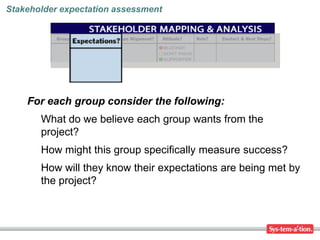
Stakeholder expectation assessment


    For each group consider the following:
       What do we believe each group wants from the
       project?
       How might this group specifically measure success?
       How will they know their expectations are being met by
       the project?
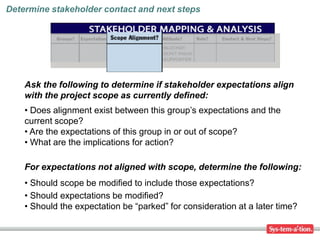
Determine stakeholder contact and next steps


    Ask the following to determine if stakeholder expectations align
    with the project scope as currently defined:
    • Does alignment exist between this group’s expectations and the
    current scope?
    • Are the expectations of this group in or out of scope?
    • What are the implications for action?

    For expectations not aligned with scope, determine the following:
    • Should scope be modified to include those expectations?
    • Should expectations be modified?
    • Should the expectation be “parked” for consideration at a later time?
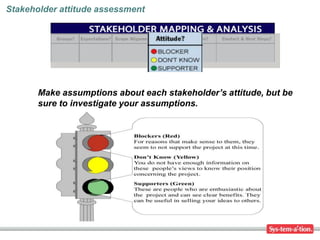
Stakeholder attitude assessment


       Make assumptions about each stakeholder’s attitude, but be
       sure to investigate your assumptions.
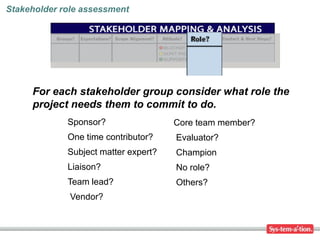
Stakeholder role assessment


     For each stakeholder group consider what role the
     project needs them to commit to do.
             Sponsor?                 Core team member?
             One time contributor?    Evaluator?
             Subject matter expert?   Champion
             Liaison?                 No role?
             Team lead?               Others?
              Vendor?
Determine stakeholder contact and next steps


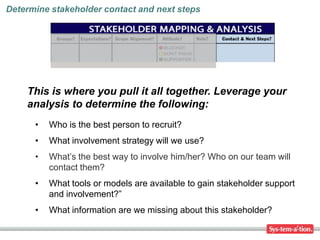
    This is where you pull it all together. Leverage your
    analysis to determine the following:
      •   Who is the best person to recruit?
      •   What involvement strategy will we use?
      •   What’s the best way to involve him/her? Who on our team will
          contact them?
      •   What tools or models are available to gain stakeholder support
          and involvement?”
      •   What information are we missing about this stakeholder?
When can Stakeholder Mapping be used?


                             Stakeholder Mapping can be used
                             throughout the project and for a
                             variety of project activities.

                             • Develop a project charter
                             • Create a project plan
                             • Develop a communications plan
                             • Establish support when
                             implementing a change
                             • Consider who should be involved
                             in the project
                             • Address expectations and consider
                             possible areas of conflict
                             • Identify project
                             assumptions, constraints, and risks

 24
Wrap up…
  Getting the right people involved at the right time and doing the right work for your
  projects comes down to defining what you need, who can support it, and when you
  need them. Sounds easy but it’s not when you consider project stakeholder schedules,
  competing projects, and uncertain attitudes.

  Before you can do any of this, it’s important to understand who the highest priority
  stakeholders at key points in the project, their expectations and attitudes about the
  project, and role they need to play. Stakeholder Mapping is a tool to help you determine
  these things.

  What we considered:
   Revolving door…reality of today’s project stakeholder

   Collaboration: Power of purpose & recognition

   Stakeholder Mapping: Let the tool work for you


                                                  Questions???
 25
Thank you!
     www.systemation.com

     Alison Sigmon, M.Ed, LPC, PMP
       asigmon@systemation.com
         Twitter @alisonsigmon
      www.slideshare.net/ahsigmon
         www.mindscraping.com


26

Stakeholder involvement: The magic of timing

  • 1.
    Stakeholder Involvement The Magic of Timing Your presenter is: Alison Sigmon, M.Ed., LPC, PMP 1
  • 2.
    What’s on tapfor our time together today… Getting the right people involved at the right time and doing the right work for your projects comes down to defining what you need, who can support it, and when you need them. Sounds easy but it’s not when you consider project stakeholder schedules, competing projects, and uncertain attitudes. Before you can do any of this, it’s important to understand who the highest priority stakeholders at key points in the project, their expectations and attitudes about the project, and role they need to play. Today we’re going to look at Stakeholder Mapping as a tool to help you determine these things. Agenda  Revolving door…reality of today’s project stakeholder  Collaboration: Power of purpose & recognition  Stakeholder Mapping: Let the tool work for you  Wrap it up! 2
  • 3.
    Revolving door: Realityof today’s project stakeholder Ebb & Flow of Stakeholders 3
  • 4.
    Having a stakein it A Guide to the Project Management Body of Knowledge (PMBOK® Guide) breaks down a stakeholder as a person or organization that: • Is actively involved in the project • Has interests that may be positively or negatively affected by the performance or completion of the project • May exert influence over the project, the deliverables, or the team members Basically, a stakeholder is anyone (or any other project) involved in or somehow affected by the project. 4
  • 5.
    Skipping across thecircles… Stakeholder structure is a lot like concentric circles The more directly involved in the day-to-day activities of a project, the closer to the center of the concentric circles the stakeholder will be. Position on the circles changes over the life of the project based on the type of work needed. Marketing Graphic artist Copywriter User experience Sponsor System architect Content Analyst Core team Programmer Quality Assurance Product designer Customer 5
  • 6.
    Keeping it tightkeeps you flexible To maximize efficiency and response to global demands of business, stakeholders may come and go at regular intervals on a project. For this to be as seamless as possible, processes must be streamlined and tight. And where does this start? With the project manager and the tools used 6
  • 7.
    Working together- it’sour nature Collaboration: Power of Purpose & Recognition 7
  • 8.
    Cooperation is inour nature Given some of the unscrupulous, self- centered activities in business over the years, might be hard to believe that it’s actually human nature to work together. Study noted in a recent edition of Scientific Americanmagazine found that of all species humans can be considered “super- cooperators.” It’s this cooperation that has perpetuated the human race. For example: While we compete to “climb the corporate ladder,” we still work together to make sure the company succeeds against competitors. While we work to provide for our families, we are still very philanthropic. When a crisis occurs, we think nothing of dropping our priorities and even sacrificing our personal well-being to help others. 8
  • 9.
    Credibility and reputationrule Research shows our cooperative tendencies stem primarily from two things: • Receiving credible information about a problem or issue • Being generous in an effort and desire to preserve reputation 9
  • 10.
    Watch and bewatched So what does this mean to projects? Projects mean change, and people typically resist change. When there’s authoritative information about the need for the change, stakeholders are more likely to embrace it. Also, when stakeholders know they are being observed through a variety of types of assessment, they may be more likely to be cooperative and supportive. 10
  • 11.
    Cue the toolto engage and influence Using tools such as Stakeholder Mapping throughout the project gives project teams an opportunity to assess and validate the scope and assumptions of the project to date. It also gives project teams a chance to assess stakeholder expectations, assumptions, and attitudes about the project. It’s that analysis that project managers can use to open (or reopen in some cases) dialogue with stakeholders about the project objectives and deliverables. It lets stakeholders know you’ve given consideration for what they are thinking and care enough to explore their thoughts with them which creates an opportunity for cooperation over authoritarian direction. 11
  • 12.
    Right place, righttime, right work Stakeholder Mapping: Strategy gets the job done 12
  • 13.
    Getting collective actionis tricky Just as a politician pays close attention to the opinions of constituents, so must you as a project manager. Project politics is about getting collective action from a group of people who may have quite different interests. Being willing to use conflict creatively is important to influencing others. But don’t do it empty-handed. Take the time to understand the formal and informal structure and positions of key groups and individuals. 13
  • 14.
    Navigating the politicsof projects A big part of navigating project politics is to get a handle on who the stakeholders are, what the stakeholders think the project is, aligning the project needs with stakeholder expectations, and getting clear on project roles. What’s tough about this is that it’s fluid. Stakeholders change. Expectations change. Opinions about objectives for your project vary among stakeholders. An effective way to respond to this complexity is to use the Stakeholder Mapping Tool. 14
  • 15.
    What is StakeholderMapping? • Formalizes how you think about stakeholders at a particular point in time. It also prioritizes stakeholders. • Identifies the web of groups and individuals whose expectations and attitudes will determine whether or not the deliverables get completed and accepted. • It also serves as an “early warning system” by identifying thosestakeholderswho have special communication needs.
  • 16.
    Stakeholder mapping process • Series of categories supported by a facilitation process that helps analyze project stakeholder expectations and attitudes about the project • Answers help identify stakeholder priority at that point in the project • Can be used repeatedly throughout the project in keeping with the ebb and flow of stakeholders • Supports strategy development for engagement • Helps the team see their blind spots in planning
  • 17.
    How does itwork? Stakeholder Mapping: Assessment and engagement magic 17
  • 18.
    Stakeholder GROUP identification For each objective ask the questions below. Each time a stakeholder is repeated as an answer, place an asterisk next to the name. This will establish stakeholder group priority.  Who will receive the product or service delivered by meeting this objective?  Who will use it?  Who will approve it?  Who provides input to the deliverables?  Who is accountable for the deliverables?  Who could kill this project or significantly slow it down?  Who should be committed early in order to sell the project to others?  Are there any projects underway that should be considered as a stakeholders?
  • 19.
    Stakeholder expectation assessment For each group consider the following: What do we believe each group wants from the project? How might this group specifically measure success? How will they know their expectations are being met by the project?
  • 20.
    Determine stakeholder contactand next steps Ask the following to determine if stakeholder expectations align with the project scope as currently defined: • Does alignment exist between this group’s expectations and the current scope? • Are the expectations of this group in or out of scope? • What are the implications for action? For expectations not aligned with scope, determine the following: • Should scope be modified to include those expectations? • Should expectations be modified? • Should the expectation be “parked” for consideration at a later time?
  • 21.
    Stakeholder attitude assessment Make assumptions about each stakeholder’s attitude, but be sure to investigate your assumptions.
  • 22.
    Stakeholder role assessment For each stakeholder group consider what role the project needs them to commit to do. Sponsor? Core team member? One time contributor? Evaluator? Subject matter expert? Champion Liaison? No role? Team lead? Others? Vendor?
  • 23.
    Determine stakeholder contactand next steps This is where you pull it all together. Leverage your analysis to determine the following: • Who is the best person to recruit? • What involvement strategy will we use? • What’s the best way to involve him/her? Who on our team will contact them? • What tools or models are available to gain stakeholder support and involvement?” • What information are we missing about this stakeholder?
  • 24.
    When can StakeholderMapping be used? Stakeholder Mapping can be used throughout the project and for a variety of project activities. • Develop a project charter • Create a project plan • Develop a communications plan • Establish support when implementing a change • Consider who should be involved in the project • Address expectations and consider possible areas of conflict • Identify project assumptions, constraints, and risks 24
  • 25.
    Wrap up… Getting the right people involved at the right time and doing the right work for your projects comes down to defining what you need, who can support it, and when you need them. Sounds easy but it’s not when you consider project stakeholder schedules, competing projects, and uncertain attitudes. Before you can do any of this, it’s important to understand who the highest priority stakeholders at key points in the project, their expectations and attitudes about the project, and role they need to play. Stakeholder Mapping is a tool to help you determine these things. What we considered:  Revolving door…reality of today’s project stakeholder  Collaboration: Power of purpose & recognition  Stakeholder Mapping: Let the tool work for you Questions??? 25
  • 26.
    Thank you! www.systemation.com Alison Sigmon, M.Ed, LPC, PMP asigmon@systemation.com Twitter @alisonsigmon www.slideshare.net/ahsigmon www.mindscraping.com 26