(Original PDF) Working with Communities by Judy Taylor
(Original PDF) Working with Communities by Judy Taylor
(Original PDF) Working with Communities by Judy Taylor
(Original PDF) Working with Communities by Judy Taylor
(Original PDF) Working with Communities by Judy Taylor
1.
(Original PDF) Workingwith Communities by Judy
Taylor download
https://ebookluna.com/product/original-pdf-working-with-
communities-by-judy-taylor/
Download more ebook from https://ebookluna.com
Contents
vi
Chapter 2 ContemporaryContextual Influences on Community
Work Practice in Australia 27
The context of community work in contemporary Australia 28
Key contextual influences 30
Globalisation 30
Neoliberal political ideology 32
Deficit policy approaches 36
The availability of on-line technology in community work and the rise of on-line advocacy 42
Chapter 3 What is Community? Elements of Community Structure and
Functioning 46
Understanding community: A sociological perspective 47
Post-place community 48
Community as locality and interactions 49
Community of place 50
Community of interest 50
Community as a social system 52
On-line communities 53
Elements of structure and functioning of communities 54
A local society 57
The community field 57
Community structures 63
Community power structures 63
Strong and weak ties 64
Community narrative structures 65
Chapter 4 Community: Aboriginal and Torres Strait Islander Perspectives 68
Introduction 69
White constructions of ‘community’ 69
Failure to understand how Aboriginal society works 70
An Aboriginal concept of community 70
New ways of working with Aboriginal and Torres Strait Islander communities 78
Chapter 5 Why Do Communities Act? 83
Communities taking action 84
Community action in response to a threat 84
Norms of civic participation 88
4.
Contents vii
A communitarianperspective; participating on behalf of the community 89
Community attachment 92
Factors that might lead to communities taking effective action 93
An inclusive community field 93
Communities assuming power and agency 96
The role of social capital in effective community action 97
Background to the theory of social capital 97
Bonding and bridging social capital 99
High levels of social capital in rural and remote Australia 101
PART 2: Conceptual Approaches and Practice Frameworks 105
Chapter 6 Conceptual Approaches to Community Work 107
Conceptual approaches for community work practice 108
A typology of four conceptual approaches to community work 108
Purposive developmental relationships 109
The contributions approach 112
Reciprocity and mutual benefits from contributions 114
Critiques of the contributions approach 114
The instrumental approach 115
Critiques of the instrumental approach 117
The community empowerment approach 118
Critiques of the empowerment approach 120
The developmental approach to community work 121
Critiques of the developmental approach 128
Chapter 7 Practice Frameworks for Working with Communities 131
Reflexive practice and ethical issues in working with communities 132
Interactional community development practice framework 136
Theoretical base 136
The stages of community development 137
Strengths and limitations of the framework 138
Building capable communities for health promotion 140
Theoretical base 140
The nine domains for capacity-building 140
5.
Contents
viii
The stages forcapacity building 141
Strengths and limitations of the framework 141
The assets-based community development approach (ABCD) 142
Theoretical base 142
The stages of ABCD 143
Strengths and limitations of the framework 143
Culturally dynamic partnerships (CDP) 145
Theoretical base 147
Strengths and limitations of CDP 147
Chapter 8 Government Roles in Working with Communities 151
Government roles in community work 152
Government practice in supporting community sustainability 152
Place-based development 153
Government social policy agendas: Social inclusion 157
Role of government in program and service development 159
Community service development 160
Government-led community engagement 163
Community engagement practice 165
Principles of effective practice in community engagement 167
Challenges in community engagement 169
Chapter 9 Roles of the Non-Government Sector in Working
with Communities 173
The roles of the non-government sector 174
Service and program provision 176
Advocacy 179
Governance activities 181
Types of non-government organisations 182
Aboriginal community-controlled health services (ACCHSs) 182
Peak advocacy organisations 185
Social enterprises 187
The government–NGOs relationship in service provision 190
Deciding who should provide services and programs 191
The future of volunteers in the non-government sector in community work 193
6.
Contents ix
Chapter 10Community Decision-Making 199
Participative community decision-making 200
Key principles of participative decision-making 202
Understanding community contextual and structural factors 205
Reducing the power differential in decision-making 207
Handling community conflict 210
Extending involvement through networking 211
Being clear about the area in which communities can make decisions 212
Structures for decision-making 213
Community advisory groups 213
Boards of management 216
On-line structures 218
Techniques for community involvement in decision-making 218
Citizens’ juries 218
Charrette 220
Chapter 11 Partnerships in Working with Communities 223
Defining our terms 224
The rationale for partnerships 224
Key principles for effective partnership working 226
Building sound working relationships 227
Effective communication 231
Achieving synergy in approach and objectives 234
Achieving collective efficacy 235
Negotiation for a supportive organisational and policy context 238
Within sector, across sector, and bridging community partnerships 238
Within-sector ties 238
Across-sector ties 239
Bridging ties 240
Partnership beginnings and endings 241
The formation phase 241
Ending partnerships 244
Partnership strengthening 245
PART 3: Practical Applications and Processes 197
7.
Contents
x
Chapter 12 CommunityParticipation: A Global Perspective 248
Background to community participation practice 249
Revitalising community participation 249
Who is mobilising whom? 252
Who is defining what the project looks like? 252
Community participation: A global perspective 255
Community participation in service delivery 255
Community participation as citizen action 260
Practising community participation: Key principles 263
Considering context in community participation 263
Focusing on and assessing the process 263
Learning how to cope with being an outsider 264
Understanding motivations for participation 264
Making decisions 264
Maintaining the process of community participation 265
Chapter 13 Understanding and Assessing Community Capacity 268
Defining community capacity 269
Community capacity and community capability 270
‘Hard’ capacities and ‘soft’ capacities 271
‘Social’ and ‘private’ capacities 271
Community capacity as generic or purpose-specific? 272
Community strength 274
Indigenous understandings of community capacity 275
Methods of assessing and developing community capacity 276
Community Capacity Assessment Tool (Rural Solutions, South Australia) 277
The community capitals framework 282
Community capitals and community sustainability 283
Strategies to develop entrepreneurial social infrastructure 283
Chapter 14 Community Leadership 286
What is community leadership? 287
The relational approach to community leadership 287
Four elements of relational leadership 290
Types of influence relationships 293
Shared leadership 293
Gender and community leadership 294
8.
Contents xi
Some challengesof community leadership 295
A spread of leadership 296
Making leadership sustainable 296
Community leadership skills 297
Creating a common purpose 297
Aligning personal interests with community interests 298
Developing the community field 299
Balancing task and group maintenance functions 300
Developing community leadership 300
Chapter 15 Community Planning 305
What do we mean by community planning? 306
Key activities in community planning 307
Three examples of community planning 309
Rapid appraisal (RA) 309
A community health profile 312
Community recovery planning 314
Planning for community recovery following a disaster 316
The community recovery plan 317
Needs assessment 317
Providing information 317
Emergency service provision 317
Techniques for gathering information for community planning 319
Delphi technique 319
Surveys 321
Telephone hotlines 321
Focused group discussion 322
Public meeting 322
Service and facility audit 323
Chapter 16 Building Knowledge about Working with Communities 326
Developing informed practice 327
Areas in which research and evaluation are valuable 329
Ethical research practice 331
Research partnerships 332
Participatory action research (PAR) 333
Designing participatory action research 339
Using PAR with qualitative and quantitative methodologies 340
xiii
LIST OF FIGURES,TABLES AND PHOTOS
FIGURES
3.1 Typology of community structures (power networks) 64
8.1 Levels and types of engagement 166
16.1 The spidergram 328
TABLES
6.1 Typology of conceptual approaches to community work 111
7.1 Practice frameworks for community work 133
15.1 Community plan content 306
16.1 The evaluation steps 343
16.2 Evaluation timeline planner 346
PHOTOS
Use of the term ‘community’ in Fremantle, Western Australia, outside a politician’s
office 13
Women take on rice planting in Nepal while their menfolk are outside the country 29
The heritage narrative on the water tank—Charters Towers has been affectionately
known as ‘The World’, reflecting citizens’ views that the town had everything 65
The park action: ‘We didn’t save the park but we gained a community’ 88
Through the work of the Mt Theo Program, Warlpiri children now grow up in an
environment where petrol sniffing no longer dominates youth culture. They are the
Petrol Free Generation 125
Advocacy to save our reef 181
Here is a community garden, established in a city suburb, that involves
a number of partnerships operating effectively 226
In Nepal, community participation blends with work, family, relationships,
and getting things done 250
The Kora Cycle Challenge, Patan Durbar Square, Kathmandu 262
This building, an old police station, is now known as The Station, a
community mental health centre, the members of which became expert
in participatory action research 336
11.
xiv
LIST OF CASESTUDIES
Case study 1.1 Three perspectives on community work 7
Case study 1.2 Different perspectives on community: An urban neighbourhood 14
Case study 1.3 Aboriginal health is not just the domain of the health care system 17
Case study 1.4 Community development as mental health promotion:
The Braunstone example 19
Case study 2.1 Nepal’s migrant workforce 28
Case study 2.2 Health promotion at the Neighbourhood Centre 31
Case study 2.3 A neoliberal aid paradigm in international development 33
Case study 2.4 Independent advocacy organisations using on-line technology 43
Case study 3.1 A community of interest: Bfriend 51
Case study 4.1 Interconnections between kinship, responsibilities, and land:
A traditional owner organisation 74
Case study 5.1 Saving our park: ‘Even if we lose [the court case], I win.
I have a community’ 85
Case study 5.2 Communitarianism in action 89
Case study 5.3 The culture fest planning 94
Case study 5.4 Social capital in Brownvale, a suburban neighbourhood 100
Case study 6.1 Different conceptual approaches: The family support project 109
Case study 6.2 Sera’s Women’s Shelter 112
Case study 6.3 The state community inclusion forum 116
Case study 6.4 Lobbying government about changes to legislation 118
Case study 6.5 Neighbourhood development 126
Case study 8.1 A social inclusion agenda in South Australia 158
Case study 8.2 Queensland Government community services development 161
Case study 8.3 Community engagement with women in the
market garden industry 168
Case study 9.1 Levels at which non-government organisations operate 174
Case study 9.2 Community enterprise: Yackandandah Community
Development Company (YCDCo) 187
Case study 9.3 In Our Hands Health Centre, Whyalla, South Australia 194
Case study 10.1 Setting up a social enterprise—A community general practice 201
Case study 10.2 The Disability Forum 215
Case study 10.3 The Social Care Board 216
Case study 10.4 The health priorities citizens’ jury 220
Case study 10.5 Using the charrette method in planning for urban renewal 221
Case study 11.1 The community garden 225
12.
xv
List of CaseStudies
Case study 11.2 Gerard Ryan and Om Krishna Shrestha, ‘I tried to
forget what I know’ 232
Case study 11.3 Partnerships addressing drug and alcohol
misuse in the community 236
Case study 11.4 The Southern Suburbs Sports Carnival 239
Case study 11.5 The Domestic Violence Coalition 240
Case study 12.1 Community participation in an accessible water scheme 250
Case study 12.2 Community participation in caring for the walking track 254
Case study 12.3 Female Community Health Volunteers (FCHV) in Nepal 255
Case study 12.4 ‘No child born to die’: The Kora Cycling
Challenge in Kathmandu 260
Case study 13.1 Regionaltown’s capacities 269
Case study 13.2 Community capacity assessment of the long-term community
on Christmas Island 273
Case study 14.1 Community leadership in a community of interest 291
Case study 14.2 Gender-based networks for community health 295
Case study 15.1 Bushfires on the Lower Eyre Peninsula 2005 315
Case study 15.2 Disaster recovery committee 318
Case study 15.3 Natural Resource Management (NRM) in Australia 320
Cast study 16.1 Participatory action research with The Station 334
Case study 16.2 Creating a new youth employment initiative 339
Case study 16.3 Evaluating information provision at the neighbourhood centre 341
13.
xvi
Practice exercise 1.1Membership of a community 12
Practice exercise 2.1 Deficit policy approaches and how they play out in practice 41
Practice exercise 3.1 Studytown: A culturally diverse community 55
Practice exercise 5.1 Including minority groups in planning for health 95
Practice exercise 5.2 Can everyone benefit from high levels of social capital? 98
Practice exercise 7.1 Interactional community work in Airtown 138
Practice exercise 7.2 Working for a brighter future in Mining Town 144
Practice exercise 8.1 Community engagement in planning 164
Practice exercise 9.1 Advocacy for the prevention of homelessness 180
Practice exercise 9.2 National Community Controlled Health Organisation
(NACCHO): ‘Investing in NACCHO makes
economic sense’ 184
Practice exercise 9.3 Peak organisation: Homelessness Australia 186
Practice exercise 9.4 Who should provide mental health
promotion and prevention? 192
Practice exercise 10.1 Assessing community structures: Men’s mental health 206
Practice exercise 10.2 Seeking and giving information about the Community
Technology Centre 207
Practice exercise 10.3 Framing and reframing issues 209
Practice exercise 10.4 Creating a safe public space for decision-making 210
Practice exercise 10.5 Handling conflict with the Community
Technology Centre proposal 211
Practice exercise 10.6 Making decisions about child care services 212
Practice exercise 10.7 Establishing community advisory groups 213
Practice exercise 10.8 Checklist for decision-making
with boards of management 217
Practice exercise 11.1 Purpose, partnership and power 234
Practice exercise 11.2 Are there mutual benefits for potential partners? 237
Practice exercise 11.3 Partnership formation stage 241
Practice exercise 11.4 Writing a partnership agreement 242
Practice exercise 11.5 Informality or a written agreement? 243
Practice exercise 11.6 Ending partnerships 244
Practice exercise 14.1 Joining together to lobby local government 292
Practice exercise 14.2 Should the neighbourhood centre
sponsor a child care centre? 298
Practice exercise 14.3 Building a community common purpose 301
LIST OF PRACTICE EXERCISES
14.
xvii
List of PracticeExercises
Practice exercise 14.4 Building the community field:
A community leadership roundtable 302
Practice exercise 14.5 Task and group maintenance functions 303
Practice exercise 15.1 Community planning in Citytown 308
Practice exercise 15.2 Collecting views about the local park 324
Practice exercise 16.1 Measuring community participation: The spidergram 328
Practice exercise 16.2 Three types of research in community work practice 329
Practice exercise 16.3 Whether or not to continue the internet program 333
Practice exercise 16.4 The family support program logic model 344
15.
xviii
Carl Meinig—Community workand child protection 21
Priscilla Page, Waanyi Kalkadoon woman 38
Meg Davis: Developing a community field: A network to assist settlement issues 58
Andrew Stojanovski, Program Coordinator—Mt Theo Petrol
Sniffing Prevention Program 122
Caro Mader: ‘Carrots and community building’ 134
Narayan Gopalkrishnan: Culturally dynamic partnerships 145
Michelle Mitolo: An urban renewal project: Playford Alive 154
Cherie Miller: Bringing change in the NGS 177
Community Development Unit (CDU), Central Land Council (CLC) 203
Nawaraj Upadhaya: Working in partnership with communities in Afghanistan 227
Shrijana Shrestha: Working with the Female Community Health Volunteers
(FCHV) in Nepal 257
Sylvia Roughan: Assessing community capacity 279
Lee Martinez: ‘Be persistent, passionate, and wise’ 288
Jen Cleary: No one size fits all for community planning 310
Janet Kelly: Using PAR: Time + Respect = Trust 337
LIST OF PRACTITIONER PERSPECTIVES
16.
xix
Introduction
This book isbased on my practice and that of my friends working in communities
in all parts of Australia and in Nepal. The experience I have had in working with
Aboriginal and Torres Strait Islander friends in Western Australia, Queensland, and
South Australia has been illuminating and the more I learnt the more I knew I didn’t
know. The same goes for my experience as an Australian Volunteer for International
Development in the Ministry of Health and Population in Nepal in 2013 and 2014. As
I write this I am listening to the devastating impact of the earthquake in Nepal. This is
a resilient country and humble in the face of adversity and I am hoping that resilience
will overcome.
Long and vigorous debates with Queensland government colleagues in community
services development in the 1990s helped develop some of the concepts on which
this book is built. We asked questions about why some programs worked in some
communities and not in others and why some communities took action and others
didn’t. I think we are still looking for answers, but some of the ideas about community
structure and functioning are helpful. As an academic, I have had the luxury of trying to
refine concepts about community work, such as community participation, community
sustainability, and community partnerships, through research with communities and
that too has been enlightening.
This book explores the space between practising community work and
conceptualising it—what we do and the theory and concepts that we use in doing
it. This space is a little bit tricky because some of the concepts we use are ephemeral
and our practice is sometimes tenuous and cautious. So uncovering the space
is important as it releases our energy and passion. For example, discovering what
‘purposive developmental relationships’ (Owen & Westoby, 2012, p. 309) might
mean in practice takes us to central Australia. We explore Andrew Stojanovski’s
purposive developmental relationships with Warlpiri elders to establish the Mt Theo
Petrol Sniffing Prevention Program in the remote desert Aboriginal community of
Yuendumu. Learning about why some communities take action leads us to suburban
Adelaide and we examine the community work residents undertook fighting to protect
their neighbourhood. They didn’t win the fight, but as it turned out, other things were
important—like relationships.
In writing this book I have used ‘we’ instead of ‘I’ and in doing this I am hoping
that the reader will be coming along with me. We will be exploring, questioning, and
enjoying reading about working with communities.
PREFACE
vouchsafed in visionto her spirit. For, suddenly, as she saw the last
struggles of the aged woman who was tied on somewhat lower
ground, and knew that a few minutes more would see the end of
her own young life, she first broke into words of psalm and holy writ,
and then suddenly exclaimed:
"The King! the King! the poor misguided King! May God bless and
pardon him and open his eyes!"
"She recants! she recants!" cried a multitude of voices from the bank
—the voices of those who believed that in this prayer for the
monarch Margaret was making a recantation of faith.
"Bring her out! bring her out!" shouted the crowd, in frenzy; and the
magistrates, not daring to withstand this public clamour, gave orders
for Margaret to be loosed and carried ashore.
"Will you retract your errors, foolish girl, and renounce the
Covenant?" they asked when, astonished, but calm and steadfast as
ever, she was brought to them.
"I will not!" she answered, with quiet steadfastness. "As I have lived
so let me die! I have nothing to recant. I am Christ's—let me go to
Him."
"Throw her into the water, for a pestilent Covenanter" cried the
magistrates; and in another moment the deep swirling waters closed
over the slight heroic frame of Margaret Wilson. Another Christian
martyr had gone fearlessly to her death.
19.
AGOSTINA OF ZARAGOZA
Thebeautiful young Countess Burita was the first to set the example
of heroism and humanity.
Cowering behind their insufficient walls, and hearing the terrible roar
and crash of artillery about them, seeing the French take up a firm
position on the Torrero, from whence they could shell the devoted
city of Zaragoza at their ease, what wonder that the Spaniards—the
women and children at any rate—shrank in terror from the thought
of a protracted siege, and cried aloud that nothing could save them?
But the old fighting spirit of the past was arousing and awakening in
the souls of the men. The tyrannical temper of Napoleon, and his
aggressive disposition of the Spanish crown to his own brother, had
inflamed the ire of the Spaniards from the nobles to the peasants;
and, though a long period of misgovernment had weakened the
country, destroyed the vigour of the nation, and rendered the
soldiers of little use in the open field, yet it had not killed the old
stubborn fighting spirit within them, and when their passions were
aroused, the flames had still the power to spring forth from the
ashes of the past, and there were moments when all the old chivalry
of former ages seemed to awake within them.
It was this spirit that animated the defenders of Zaragoza when
Aragon revolted against the rule of the French, and they resolved at
least to hold the ancient capital against the foe.
Hopeless the task seemed; for the defences were of the most
meagre description; the only strong part of the wall being the
ancient Roman portion, the high brick houses within having no
shelter or means of defence from the shells and bombs that came
screaming and rattling over them.
20.
But there wereheroic spirits within those frail walls, and one of the
first to show an example of high-hearted bravery was the beautiful
young Countess. Whilst her husband gave what aid he could to the
military defenders of the city, she organised her band of women and
girls for the work which was only a little less urgent.
She ordered them to get together from the houses those awnings
which defended the rooms from the fierce heat of the sun, and
under her skilful direction these were sewn into huge bags that were
filled with sand and earth and used with great advantage to stay the
effects of shot and shell continually bursting over them.
The houses actually built upon the walls were pulled down, and all
the beams were employed in strengthening the defences in other
parts, barricading exposed windows, and making covered ways
along the streets where the townsfolk could walk in comparative
safety, despite the rain of bullets dropping round them.
But these things were not done without terrible scenes in the
streets, brave men falling at their posts, horrible explosions tearing
up the ground and scattering destruction all around.
Small wonder was it, if at first the hearts of the women had failed
them, and they had been ready to give way to a sense of despair.
But quickly they rallied their courage, and the spirit of their
ancestors entered into them. Although there were so few soldiers in
the town—only between two and three hundred in the garrison—yet
the townsmen offered their services and banded themselves
together for the defence of their ancient city, and after the first panic
had subsided, the women were eager to render every assistance
that lay in their power, some even offering to serve in the ranks like
men, if they could be taken on in that capacity.
There was, however, one way in which they could serve the men
almost as well as by fighting beside them, and that was in bringing
them food and water when they were mounted on the walls at their
perilous posts.
21.
This was rathera fearful task. The shells rushed screaming through
the air from the height above, where the enemy's batteries were
placed, and none knew where the deadly missile might explode.
Bullets rained about the gallant defenders at their guns. It was like
walking into the very mouth of hell, as many a woman shudderingly
observed; and yet there were always volunteers for this perilous
task. The noble Countess was the leader in every difficult enterprise,
and she organised a devoted band who should carry on the work
with order and system, avoiding needless exposure, but gallantly
prosecuting the necessary and most perilous office.
Amongst the most ardent and devoted of this band of women and
girls the Countess noted one very beautiful, strongly built, dark-eyed
maiden, who seemed endowed with strength and courage beyond
that of her compatriots.
Wherever the fire was fiercest and hottest, wherever the strife was
direst and most deadly, there this girl was sure to be seen, waiting
with her water-cans to make a dash towards the thirsty, smoke-
begrimed soldiers, when a moment's respite allowed them to step
back for the sorely needed drink. For the fierce heat of June was in
the air, and the sunshine lay blinding upon the hot walls and
ramparts, save where it was blotted out by the smoke wreaths from
cannon and musket.
But there was one particular corner upon the old wall where the
fight was often fiercely raging, and where this girl seemed oftenest
to linger, and the Countess, observing her with more and more
attention as the dire siege went forward, took the opportunity one
day, when there was a little lull in the firing, to speak to her and ask
her of herself.
"I am called Agostina," answered the girl, "and it is my father who
serves yonder gun. He has the post of the greatest danger. I dare
not tear myself away. Every day I fear to see him fall. Many have
fallen at his side, but the blessed Mother of God and the holy saints
have watched over him, and he has not as yet received so much as
a scratch. Alas! if he should be taken, what will become of the little
22.
ones at home?"And over the girl's handsome, resolute face there
swept an expression of pain and anguish that was sorrowful to see.
The Countess walked beside her to the spot where her father stood
beside his gun, taking this moment of lull to clean it well, for often it
became so hot that he was afraid it would burst. His dark, smoke-
grimed face, handsome like Agostina's in spite of its black veil,
brightened at her approach, and on seeing the lovely, high-born
lady, he doffed his cap with the instinctive grace and courtesy that
the humble Spaniard has never lost.
Agostina handed him the water-can, from which he took a deep,
refreshing draught, sighing with satisfaction as he handed it back to
the girl. The lady regarded the pair, and thought they looked more
like husband and wife than father and daughter. He seemed not old
enough for her father, though there was such a bond of affection
and familiarity between them.
"Take it yonder to Ruy Gomez," said the man, pointing towards a
fellow-gunner a little distance off. "He is parched with thirst, and has
one of the hottest places on the wall."
Agostina moved forward towards the man—she knew the names of
all the gunners in this corner of the fortifications—and the Countess
remained and entered into conversation with the father.
"You have a good daughter, my brave fellow. I have watched her
these many days amongst the rest. She seems to know not fear—
not for herself; though she spoke but now as though she lived in
daily and hourly fear for her father's life!"
"Ah, poor child, poor child! It would be a sad thing for her were I to
be taken. You see there are the little ones at home; she is like a
mother to them, and to her it would be like being left a widow were
I to fall."
"You have other children too, then? Yet Agostina is always alone in
her tasks."
23.
"Ah, yes; theothers are too little, too tender. You see it was so: I
married almost as a boy, I was little more when Agostina was born,
and my wife died in giving her life. She grew up my comrade and
plaything. I soon ceased to regret she was not a boy. She was as
brave, as hardy, as skilful at games and exercises, as free from fear,
as bold to brave toil and fatigue. Ah, I should weary you, Señora,
were I to try and tell you of Agostina's childhood and youth! We
have been more like brother and sister, comrades, lovers, than father
and daughter; and yet, with all that, no daughter was ever more
dutiful and loving and obedient than my Agostina!"
The man's face had kindled into a great enthusiasm as he talked of
his beautiful daughter; that she was the very apple of his eye none
could doubt who heard him speak. The lady almost marvelled that
he had taken to himself another wife, but in his own simple fashion
he explained the matter.
"It was the year when that great sickness came. I was smitten down
with it, and Agostina nursed me back to health. Indeed, I was never
very ill; my life was not in danger, but she almost broke her heart in
fear lest she might lose me; and when I was well she was taken,
and lay for long at the very gates of death. And I, what could I do?
A man is a helpless creature in such times; and many of the
neighbours fled from us. But there was one who came to us in our
troubles, a gentle creature who had lost father and mother in the
sickness. She had always loved Agostina, and Agostina had loved
her. She came and watched beside her day and night. She brought
her back to health and strength. She was quite alone in the world;
she had no one to look to; and so I married her, and Agostina was
like a sister and a daughter in one."
"And is she living yet within the city?"
"Alas, no! She was taken to her rest last year; and at home are the
three little ones, to whom Agostina is more mother than sister. A
neighbour takes care of them now, for Agostina must do her duty
with the brave daughters of the city. You, gentle lady, have taught
24.
them this. Ithank the saints and our Blessed Lady that my Agostina
has been one to answer to the call of duty. She has a heart of gold."
"I have seen it," answered the Countess; "a heart of gold and arms
of steel. I have watched her often with wonder and envy. She has
the strength of a strong man in that light frame of hers!"
"Has she not!" answered the proud father, his eyes shining; "and not
only has she strength, but she has skill and dauntless courage. She
can fire this gun as well as I can myself. She has stood at my side
many times helping me to load and fire it. When I have been blinded
by smoke and lack of sleep, she has crept up to me and whispered
in the confusion and din, 'Let me take a turn for you, father, I can do
it as well as you. Sit down a moment and breathe. I will serve the
gun.' Ay, and she has done it, too—my brave little Agostina."
The man's pride in his daughter was almost as touching as her
devotion to him. After that day the Countess watched Agostina with
affectionate interest; and, indeed, others began to note her too; for
in the many fearful casualties that befell the besieged, the explosion
of the powder magazine, the firing of the convent, which had been
turned into a hospital for sick and wounded, Agostina was ever
foremost in the work of rescue, animating by her courage and
example even the most faint-hearted, and performing miraculous
feats of strength and courage and devotion.
In a city and at a time when all were heroines, Agostina began to be
pointed out as the heroine of the siege; but she neither knew nor
heeded. All she thought of was the safety of her father and the
saving of her city. A passionate patriotism burned within her; she
could face any personal peril if only the holy saints would grant them
victory over their foes!
The gate near which her father served his gun was called the
Portillo; and fearful was the fighting that raged round that spot one
never-to-be-forgotten day of this memorable siege. The whole place
seemed to shake and rock with the explosions of shells from the
Torrero; fires were bursting out in many parts of the city. The sand-
25.
bags heaped upin defence of wall and building were igniting and
dropping away. And around this special corner the fire was so fierce
and furious that it seemed as though every living creature must be
swept away, leaving the French a clear passage into the devoted
town.
Indeed, so terrible was the bombardment here that the devoted
band of women, ready with water-cans and fresh sand-bags to rush
forward to aid their fathers and brothers, were for once driven back,
and forced away by the smoke and heat and thick rain of bullets.
Agostina stood her ground alone, peering into the smoke with
anguished eyes; standing amid the leaden hail as though she bore a
charmed life; wringing her hands together sometimes, when a cry or
a groan seemed to bespeak the fact that another bullet had done its
fatal work.
At last she could stand it no longer. With a cry like that of a wild
creature in fury and distress, she leaped through the smoke and
reek to the very wall itself; and what did her eyes see then? What
sight was it that caused every drop of blood to ebb from her face,
whilst the fire seemed to flash from her eyes and reflect back the
sullen glow from the Torrero?
Every man amongst the besieged had fallen! Heaps of dead and
dying lay at her feet. Her father—where was he? A cry of anguish
broke from her as she stopped to look. From amid the heap at her
feet a head was raised—a head and a hand—a hand holding a
match.
"Agostina—fire—the gun."
It was his last word ere his head fell back in death. But the girl had
heard, and every nerve in her body tingled in response to that dying
appeal.
Through the lessening smoke wreaths she saw an appalling sight—
she saw the rapid approach of the French towards the now
undefended gate. It rested with Agostina alone whether or not they
should win an entrance into the city.
26.
With steady handshe adjusted the great gun that she had fired so
often before. With perfect coolness and dexterity she applied her
match. There was a crash, a roar, followed by the shrieks of
wounded men, the oaths of their comrades. The French had believed
the guns silenced; they had believed themselves secure of victory;
and now their ranks were torn and mown by a well-aimed twenty-
six-pounder. The officer in charge called a halt. The city was not as
defenceless as they had thought.
Within the walls there was the sound of hurrying feet, as the
Commander, with some troops, came hastening to the rescue. It had
been told him how fearful was the peril here. Word had been
brought that all the guns were silent now, and he knew but too well
what that meant. Hastening to the spot in anxious fear, he had
heard the booming roar of a city gun, had heard the cry of the
advancing French; and now he pressed forward to the spot to find a
girl seated upon the gun, which was still smoking, waving her arms
above her head, and crying:
"Death or victory! Death or victory! Father, I accept your dying
charge. I leave not your gun again till Zaragoza be saved! I claim it
as my due!"
The next moment Agostina had sprung to her feet, for she was no
longer alone with the dying and the dead. The Commander himself,
Don José Palafox, a nobleman, who in this emergency had come
forward and placed himself at the head of the troops of the garrison
in the besieged city, was standing beside her, regarding her
steadfastly; and, though perfectly fearless in the moment of danger,
Agostina felt abashed before his fixed gaze, and dropped her eyes.
"Maiden," he asked gently, "whose hand was it fired that last shot,
after the guns had long been silent?"
A wounded man half rose from the ground at their feet, and he
pointed his finger at Agostina.
27.
A wounded manhalf rose from the
ground at their feet.
Page 270.
"It was she who did it, Señor; she is the daughter of one of those
who lie dead beneath your feet. He had fallen. We had all fallen.
Help did not come, but the foe was coming. We could hear the
tramp of their approaching feet. Then Agostina was in our midst.
Her father's last charge was given, 'fire the gun.' She obeyed. She
28.
checked the oncomingtide. She routed the advancing foe. Agostina
did that."
But Agostina had not stayed to hear her praises sung; she was on
her knees beside a mangled form. The tears were raining from her
eyes. She was no longer the heroine of the gun. She was a daughter
weeping for the loss of a loved and loving father.
"They loved each other so well—so well," murmured the wounded
man, as his head sank back. "Poor Agostina!"
Don José would have said more to Agostina, but his kind heart told
him that the moment was not yet come; and he merely ordered his
men to lift up the body of the dead gunner, and to give it decent
burial in any spot that Agostina should direct. It was some salve to
her great grief that her father should lie in consecrated ground. So
many heaps of slain had to be buried where they fell. The besieged
had not time or strength to carry them away.
The following day Don José, making his rounds and instituting a
more detailed survey of the wall which had been indeed terribly
shaken and shattered by the firing of yesterday, was surprised to
find Agostina hard at work cleaning the gun which had been her
father's up till now, and to which, as yet, no fresh gunner had been
appointed, for, indeed, the Commander was getting very short of
men with skill enough to take charge of the guns. He stood for a few
seconds watching her attentively; and when after loading the piece
with the precision and skill which showed a thorough understanding
of the task in hand, she raised her sad eyes, she coloured very
slightly, and saluted exactly as a soldier would have done at sight of
his commanding officer.
Don José returned the salute, and came up to the girl's side.
"I have been hearing of you, my brave child," he said. "What can I
do for you in return for what you did yesterday for this city?"
"Señor," she replied, "I have but one boon to crave. Give me my
father's place here at this gun. Let me serve it as he served it, so
long as the siege lasts. He has taught me how. You shall not find me
29.
remiss. I thinkI am not unskilful. Yesterday, in the presence of the
dead, I vowed a vow—I vowed not to leave my post here till the
French should retreat from Zaragoza. Let me but keep that vow.
Give me here the right to hold my father's place, the right to draw
his pay, and that portion of food for the helpless babes at home that
every soldier's family may claim. I ask nothing else!" She spoke very
simply; there was no thought in her heart of playing the hero's part.
She asked bread for the children, and the right to earn it for them. If
deep down in her heart the fire of patriotism was burning fiercely,
she never thought of posing as a heroine sacrificing herself for her
country. No, hers was a simple nature. She loved her father with
passionate devotion. She longed to accomplish the work which had
been his. She yearned after the little helpless children, and felt she
must earn for them the necessities of life. Provisions were beginning
to run short. Rations were provided for the soldiers and their
families; but the citizens were face to face with a scarcity that might
become actual famine ere long. The little ones must not starve; such
had been Agostina's leading thought. She would win for them their
daily bread. She had been a mother to them for long; now she
would be a father too.
Don José's face was gravely tender as he replied:
"My child, your petition is granted. No more noble or courageous
custodian of that gun could I find within these walls. I appoint you
its gunner, with double pay. When peace has been restored, and I
can tell to the world the story of the Maid of Zaragoza, it will go hard
if the nation do not provide a pension too for so brave a daughter of
her soil!"
Agostina's cheek glowed; she bent her knee for a moment, and ere
Don José quite knew what she was about to do, she had pressed her
lips upon his hand.
"Our Blessed Lady guard and keep you, Señor," she said. "You have
granted me my heart's desire!"
30.
It was astrange heart's desire, in truth! To stand upon that battered
wall in the teeth of the enemy's guns; to be a target for the shot and
shell of those terrible batteries; to serve that smoking gun, and send
its fierce answers forth into the hostile camp of the invaders. Others
fell about and around Agostina, but no shot touched her. They came
to say that she bore a charmed life; and it, at least, was plain that
the thought of fear could never find a lodging place within her
breast.
Then came a desperate day when it seemed indeed as though all
were lost. A new battery was being built over against a convent,
whose walls were weak already, and almost ready to fall. Strengthen
them as they might, the garrison was helpless to effect any real
improvement in their condition. They fell almost at the first shock
when the new battery opened fire, and the French, rushing in
through the breaches made, took possession of one quarter of the
city, and sent a haughty summons to Don José to surrender.
The situation was tragic enough. They were now between two fires,
and only a wide space like a boulevard separated the hostile camps.
Don José had long been expecting succour from his brother, Don
Francisco, who had sent word that he was marching to his relief with
three thousand men and stores of food and ammunition. But there
was no sign of his near approach as yet; and the city was in pitiful
plight.
"Surrender! By capitulation alone can Zaragoza be saved."
Such was the haughty message from the French General Lefèbre,
brought to Don José and his exhausted men after the fall of the
quarter of the city called St. Engracia.
The Commander looked around upon the ring of gaunt men about
him, and over at the shattered buildings of the town. What answer
was it his duty to return? Was he justified in sacrificing all these
brave lives? What did the people of Zaragoza think of it themselves?
They had at least a right to be asked. It was they upon whom the
brunt of these fearful days fell.
31.
"What answer shallwe return to General Lefèbre?" he asked, looking
from one to the other; and the men themselves seemed scarce to
know what answer to make.
Then a voice from the crowd shouted out the words:
"Let us ask the Maid of Zaragoza!"
Don José's face lighted at the suggestion. He turned in the direction
of the speaker, and cried aloud:
"Go—ask the Maid of the Gun what answer we shall send back. By
her word we will abide!"
A strange thrill of enthusiasm ran through the whole city as the
messenger sped forth to the farther wall to ask of Agostina what the
Commander should answer. Strange as was the choice of such an
umpire, there was something fitting and dramatic about it that fired
the Spaniards, and wrought a strange kind of exultation among
them.
Soon a gathering murmur in the distance, which increased to a
perfect roar as the crowd surged onwards, showed that the answer
was being brought back, and that it had stirred to the depths the
impulsive and excitable populace.
"War to the knife! War to the knife!" The words detached themselves
at last from the general clangour, and the soldiers, flashing out their
swords, took up the answer of the Maid of Zaragoza, and the welkin
rang with the shout—"War to the knife!"
A few days after those four words had been sent by Don José to
General Lefèbre, the longed-for help came; and the eyes of Agostina
shone and glowed as she watched from her gun upon the wall the
French soldiers in full retreat blocking the road to Pamplona. The
siege of Zaragoza was at an end; and the Commander came himself
and fastened a medal of honour upon the heroine's breast.
32.
AGNES BEAUMONT
"Thou shaltnever listen to the rogue again!"
"But, father——"
"Silence, girl! Have I not said it? Thou shalt never go to hear him
preach again! He is a pestilent knave. He will bring all who hear him
to trouble. Dost hear me, girl? Thou shalt not go!"
"Nay, but, sweet father!"
"Silence!" thundered the angry man. "I have spoken; let that be
enough. Thou shalt have no more of this preaching dinned into thine
ears, and neither will I. Thou shalt never hear Mr. Bunyan again. He
has done harm enough already."
Agnes was absolutely aghast at this sudden outbreak, for which she
was totally unprepared. She and her father had for some while been
attending with great interest and profit the teachings and preachings
of the notable Puritan, John Bunyan, whose wonderful personal
experiences brought home to his hearers a sense of reality which
was often lacking in other teachers.
Farmer Beaumont had, however, of late been strangely silent and
morose, so that his daughter had been rather afraid to speak to him.
She had noted that he had not mentioned the approaching
preaching, which she was most anxious to attend; but she had no
idea that any great change had come over him till he suddenly burst
forth in this manner, as they were sitting together at supper, after his
return from the neighbouring town, where he had spent the previous
night.
Of course, Agnes was well aware that by many people this John
Bunyan was regarded as a dangerous man, and that these inveighed
against him as a preacher and teacher of strange new doctrines.
33.
Sometimes, she knew,it was dangerous to attend these meetings.
She had heard it whispered before now that persons were often
brought up before the authorities and fined or otherwise punished
for offences of this sort, but it never occurred to her that her sturdy
father would be frightened. She had no fear for herself. She believed
she heard Heaven-sent gospel from this preacher, and she longed to
hear him again.
It was plain to her that somebody had got hold of her father during
his absence from home, and had worked upon the fears that were
beginning to agitate him before. She knew that there was a lawyer
there—a man she especially disliked and distrusted. Once he had
been suitor for her hand; for Farmer Beaumont was reputed to be a
warm man, and Agnes was likely to come into the bulk of his
property and savings at his death. But the girl had repelled his
advances with energy; having an intense dislike to the sly, fox-faced
man of the quill, and he now repaid her dislike in kind, and she
believed that on more than one occasion he had sought to poison
her father's mind against her.
She suspected that this was the case now. It was plain that the old
man was in a very angry mood.
After sitting awhile in glowering silence, he broke out again even
more fiercely than before.
"I'll have a promise from thee, girl; thou shalt promise me here and
now that thou wilt never go and hear one of his preachings more.
Say the words and have done with it."
"Oh, father, do not ask me to make such a promise as that!"
"Ay, but I will. I'll have no disobedient daughter in my house. I've
had a talk to Farry about it. Thou first will not have him for a
husband at my bidding; now thou art taking up with this pestilent
preacher Bunyan——"
"But, father, thou didst take me thyself to hear him, and said he was
a godly man. It is Farry's evil tongue that hath wrought this change
34.
in thee. Prithee,pardon my boldness, but I dare not promise what is
against my conscience!"
"It is against thy conscience to obey thy father, girl?" raved the
angry farmer. "A pretty conscience in all sooth. I'll have that promise
from thee to-night, or else I'll drive thee from my doors, and disown
thee for my daughter!"
Agnes was in great distress, for she loved her father, and had always
been an obedient daughter; but the stern tenets of the Puritan
divines had penetrated deeply into her soul; and she was sorely
afraid that by obeying her father she would be trifling with her soul's
salvation. Most sincerely did she desire to do right; but it was so
hard for her to know what was most right.
At last after much deliberation and some silent prayer Agnes brought
herself to say, whilst her father had spent much of his energy in
railing and threats:
"Dear father, I will promise you this, that so long as you live I will
not go to one of these preachings without your consent; and I beg
of you not to ask me more than that."
On hearing these words spoken whilst the tears ran down her
cheeks, the father's rage suddenly abated. He kissed Agnes and told
her that she was a good girl after all; and the storm in the house
died down to a calm.
But poor Agnes was very unhappy. It seemed to her as though in
obeying her father she had in some sort violated her conscience and
betrayed her Lord. When she consulted her married sister and
brother-in-law on the subject (all ardent admirers of Mr. Bunyan),
she found that they also took this view of the matter, and her
trouble became very great.
It was now her chief aim and object to gain her father's consent to
her attending the approaching meeting, where John Bunyan was to
preach and afterwards to administer the Sacrament. It seemed to
her equally impossible to remain away or to break her word to her
35.
father; and heronly hope of real peace of mind lay in winning his
consent to her going there.
During the last two days he had been much kinder to her; but still
she was in great fear lest he was in the same mind with regard to
Bunyan and the preaching. She got her sister to come over to the
farm the evening before, and by talking and a certain amount of
coaxing and argument, they at last won the old man's permission
that Agnes should accompany her relatives to the meeting at
Gamlinhay, they promising to get her taken and returned, as the
farmer had no mind to assist her by sparing one of his own horses
to carry her, and the distance was too far for her to walk.
It was a great joy to Agnes to win this permission; and she was
more sure than ever that it was Lawyer Farry's jeering words and
overbearing arguments that had caused her father so to turn against
her and the preacher; for since he had been at home with her again,
he had become quiet and reasonable.
But she thought it would be wise to be off and away early upon the
morrow, lest he should in any wise change his mind; and so she rose
with the sun, set about her morning tasks with great energy, and
had taken her own breakfast and left everything in readiness for her
father before she slipped into her riding dress, and made her way
across the fields to her brother-in-law's house, without having
caught a glimpse of the farmer. Indeed, she had left the house
before he was astir.
Her sister received her kindly, and told her that they had arranged
for her to ride behind Mr. Wilson, the minister of Hitchin, who would
call on his way at the house. But time went on, and there was no
sign of him, and poor Agnes's face grew pale with anxiety. Her
brother had only one horse and would take his wife behind him.
Agnes could not burden them; no horse could carry three riders.
Strong as she was, she could not walk the whole distance in the
time, since they had waited now so long. It seemed for a moment as
though after all she must be left behind, when suddenly her sister,
who had been gazing down the road, cried out eagerly:
36.
"He is coming!—Heis coming!—Surely, husband, that is Mr. Wilson
on his nag?"
For a few minutes all thought this; but Agnes suddenly gave a little
cry, and exclaimed:
Bunyan looked down at her with rather a
grim smile upon his face.
Page 283.
37.
"It is notMr. Wilson—it is Mr. John Bunyan himself!"
"Then he shall carry you, Agnes!" cried her sister, "and you will have
the pleasure of his godly conversation on the road."
The heart of Agnes was full of joy at the bare thought of such an
honour; but when her brother ran out to the gate to make the
request, they heard Mr. Bunyan's voice say quite roughly:
"No; I will not take her."
Sudden tears rushed to the eyes of Agnes; she hid behind her sister
that he might not see her weep, and again she heard the tones of
his voice—the voice she had come to love so well.
"If I do, her father will be grievously angry. I have heard how he has
changed towards me. I will not set a man at variance with his
children. Children are an heritage from the Lord."
At that Agnes ran forward, and told him what had happened, and
how her father had consented that she should go to the preaching.
Bunyan looked down at her with rather a grim smile upon his face.
"Ay, child; but did he say you might ride pillion behind the
preacher?"
Agnes made no reply; but her sister pleaded for her, and in the end
Bunyan consented to carry her, though he told her plainly:
"If I were you, maiden, I would go home to my old father, and seek
to soften his heart by childlike obedience and submission, rather
than urge him vehemently to gain mine own way."
They had not proceeded far on the road before they met a man on
horseback riding in an opposite direction. To her dismay and
annoyance Agnes saw that it was Lawyer Farry, and she felt certain
he was on his way to her father's house. She knew well how he
would stir up the old man against the preacher, and it could not be
but that her father would be very angry to hear that she had been
seen riding behind Mr. Bunyan to the preaching. Probably he would
38.
think this thinghad been arranged beforehand, and no doubt Farry
would do his best to encourage that idea.
Bunyan, however, not knowing the lawyer, paid no heed to the
stranger, though he continued to give Agnes much good advice as to
her relations with her father, advice that the girl promised faithfully
to follow.
"For, indeed, I have always loved him dutifully; and till lately he has
been a tender father to me. But he has been embittered against
those things which I hold so needful for my soul's salvation, and I
am torn in twain betwixt my duty to him and to God."
"Ay, ay, my child, thy path may be sometimes a difficult one; but
remember that faith in Christ is enough for salvation, and thou wilt
never imperil thy soul by abstaining from hearing some godly
preaching, albeit such preaching may strengthen and sustain thee.
God gave thee thy father and bade thee reverence and obey him.
There is no doubt about that duty, so look to it in the future."
This gentle counsel set Agnes thinking deeply; and since it came
from Mr. Bunyan himself, she could not but believe it good. Greatly
as she delighted in the preaching and meeting which she had made
so great a point of attending, she was possessed by a longing to be
at home again, to ask her father's pardon if she had thought too
little of his wishes, and to show him in the future a greater patience
and affection than had been possible of late.
At the close of the meeting she was in some perplexity how to get
home, since Mr. Bunyan was not going back that way; but at last she
found a young woman who gave her a mount behind her on her
horse, and in this way she reached her father's house, although it
was now late, and her sister counselled her to come home with her
for the night.
But Agnes thought her duty was to go home, as perhaps her father
would be waiting for her. When she saw the house all dark and
closed, her heart sank somewhat; but she would not be daunted.
Going up she knocked at the door and then called aloud under the
39.
window of herfather's room, asking him to throw her down the key,
which he always took up to bed with him.
Suddenly a fierce voice came thundering from the lattice:
"Thou shalt never enter my house again. Thou art no daughter of
mine. Where thou hast been all day thou mayest go at night."
"But, father, father, you did give me leave to go," she pleaded.
"Did I give thee leave to ride behind Mr. Bunyan? Go to him, thou
disobedient girl; thou art no child of mine."
And so saying he banged to the lattice very fiercely, and Agnes was
left standing without in the cold and damp.
For a moment she thought she would go to her sister's house, but
then the memory of Bunyan's words came over her, and she
resolved not to be driven away by her father's harshness, but to
pass her night in the barn praying for him, and to seek on the
morrow to soften him by her prayers and to tell him of the advice
Mr. Bunyan had given her. She longed to be reconciled to him, and
lead him back to the old paths by her filial gentleness. And as she
made her way to the barn, she said in her heart:
"That is the work of wicked Farry. He has been with father again,
poisoning his mind; but I will pray for him, and perchance on the
morrow he will hear me, and let me come to him once more."
But upon the morrow the old man seemed more implacable than
ever. He was rather startled at finding his daughter in the barn in her
riding-dress; but he would not hear a word from her. He poured out
his fury upon her in such ungoverned language that it was all the
poor girl could do to keep from turning and fleeing from him. Yet,
mindful of her resolve to bear all meekly, she continued to follow
him about and plead to be taken in; till at last the old man in a fit of
ungovernable fury ran at her with the pitch-fork that he had in his
hand, and Agnes barely escaped receiving a serious injury.
"I will go to Prudence's house for a while, father," she said gently
after this. "I trust by the morrow you will have forgiven me if I did
40.
wrong in ridingwith Mr. Bunyan. Indeed, he was loth to take me;
but I was so anxious to go. Perhaps I was somewhat wrong to urge
it so vehemently; but one day you will forgive, and let me be your
daughter again."
Yet in spite of all the persuasions of the married daughter and son-
in-law, and the dutiful gentleness of Agnes, it was not till the third
day that the old man's fit of passionate fury spent itself, and he
rather sullenly consented that Agnes should come home once more.
When first she began her accustomed duties about the house, he
was very morose, and would scarcely speak to her; but gradually her
gentleness and sweetness seemed to soften him, and upon the day
following he appeared to have forgotten his ill-will, and they spent
the evening peacefully together in cheerful conversation.
But the old man complained of being cold, which, indeed, was
scarcely to be wondered at since the wind had changed and brought
with it a fall of snow. Agnes gave him his supper somewhat earlier
than usual, and he went to bed, she following his example only a
little later.
Towards midnight she was awakened by the sound of dismal
groaning from her father's room, and rushing to him discovered that
he was in sore pain, and could scarcely draw his breath.
"I have been struck to the heart!" he gasped, "I am about to die.
God be merciful to me, a sinner, and forgive me the sins I have
committed towards you, my daughter!"
Agnes, in great alarm, flew about, kindling the fire, and making
something hot for her father to drink, hoping thus to soothe his pain
and restore him; but there was a grey, ashen look upon his face
which frightened her terribly; and she was all alone with him in the
house.
The terrible spasm lasted about half an hour, and then the old man
fell back in a dying state. Agnes, so soon as she saw herself quite
helpless to assist him, rushed forth to her sister's house, and make
known her terrible plight. They all followed her back in great dismay;
41.
but only towitness the last struggle as the old man passed into
eternity.
Agnes was crushed to the earth by this blow; but she was not
suffered to mourn her dead in peace. The next day her brother-in-
law came to her with a very disturbed face, and said that Lawyer
Farry desired speech of her, and when Agnes would have refused to
see him, she was told that it would not be wise to do so, as the
matter on which he had come was of grave moment.
When she saw the lawyer's evil, shifty face, and the gleam of
triumphant malevolence in his eyes she felt her heart sink for a
moment; but then rallying her courage she met his gaze fearlessly,
and asked him what his business was with her.
"I have come to offer you the only hope of escaping the punishment
of your crime. There is one and only one way by which you can save
yourself from the awful doom that awaits you."
"You are speaking in riddles to me, sir," said Agnes; "I pray you say
plainly what you have come to say, and leave me."
His eyes looked more malevolent still as he came a step nearer.
"Girl," he said, in very low and terrible tones, "do you know that the
doom of the parricide is death at the stake?"
Agnes recoiled in horror from the word parricide. The colour forsook
her cheeks; she trembled as she stood. What awful thought had
come into that man's evil mind?
"Yes, guilty woman, you may well tremble and quail, now that your
guilty purpose is known. But listen yet. I am the only person who
can bear testimony against you, and I will save you on one
condition: Be my wife, and I will say nothing. The world will never
know that Agnes Beaumont is a murderess—a parricide!"
Suddenly the girl's righteous wrath blazed up. She saw the man's
motive in making this foul charge, this fearful threat. He knew that
her father had left her a rich woman, that all he died possessed of
was to be hers. To get her and her fortune into his power he was
42.
ready to perjurehimself in the most frightful way; she saw the fell
purpose in his eyes; but her spirit did not desert her. She stood for a
moment in silent prayer, and then said:
"I will never marry you. God knows that I am innocent of the awful
sin you lay at my door. I will trust to Him to save me from the malice
of my persecutors."
It was in vain that the man by every argument and threat in his
power sought to shake the steady courage of the girl, and to bend
her to his will. In vain he painted for her the horrors of the fiery
death of the parricide; in vain he sought to show her how impossible
it would be to prove her innocence. She stood looking fearlessly into
his evil face, and when he would have put out a hand to draw her
nearer, she slipped out of his reach, and with a quiet and lofty mien
walked to the door, turning round at the last to say:
"May God forgive you for the cruel deed you are about to do. Into
His hands I entrust my cause."
Later in the day her sister came to her in deep agitation.
"Agnes, Agnes, why wouldest thou not submit to his will? He is such
a crafty, cruel man. He will obtain thine undoing! Oh, sister, sister,
dost know what he is about to swear before the coroner to-
morrow?"
"That I poisoned my father—he has said as much," answered Agnes
quietly; "but he can prove nothing that he says."
"Nay, but it is more than that. He has got such a story. He says that
Mr. Bunyan did give thee the poison, and that he saw you twain
riding together, and heard you speaking together of our father as he
passed. He says that when he got here poor father told him that he
was sure you meant him ill, and that you would find a way of getting
rid of him, since you only promised obedience to his wishes so long
as he lived. Oh, the story he has made of it! And then he points out
how loth father was to take you back, and that he turned you away
and said you were no daughter of his, and might go back to those
you had come from. He learned so many things from us, ere ever we
43.
knew the hideousthing in his mind. Now he says his case is
complete and that only by marrying him can you escape that awful
death. Oh, Agnes, Agnes, wilt thou not do his bidding to save thyself
from that fate?"
"Take a false vow of love and obedience to a man like that? Oh,
sister, how could I? And what would life be with him afterwards?"
"But they say it will be death at the stake!" wept Prudence.
"And has not the Lord promised 'When thou passest through the fire
I will be with thee'?" asked Agnes calmly. "I dare not be false to
Him; and I know He will not be false to me. Be not afraid; this trial
may be sent for some good purpose. But it cuts me to the heart that
he should bring in Mr. Bunyan's name. That is a needless piece of
wickedness and falsehood."
"It is all false together; but he vows that Mr. Bunyan wished to get
possession of father's money by wedding with you, and that
therefore he gave you the poison and bid you use it upon the first
opportunity."
To the two inexperienced women, clinging together in their hour of
affliction, it seemed to them as though the doom of Agnes had
already well nigh gone forth. They knew how clever and
unscrupulous Lawyer Farry was, and how successful he generally
proved in carrying through the schemes to which he gave his mind.
Already the neighbourhood was ringing with the story that Agnes
had poisoned her father, and although many refused to believe in so
monstrous a charge, yet it was very well known how violent the old
man's rage had been against his daughter, and that he had died also
immediately after Agnes had been taken back to his house. This was
not evidence, but it raised doubts and suspicions in many minds.
The coroner and the jury had assembled, having first viewed the
corpse, and Mr. Hatfield, the surgeon, testified emphatically that he
regarded death as due to natural causes. The old man had long
been suffering from some cardiac derangement, and the excitement
into which he had recently thrown himself would be quite enough to
44.
account for thefatal seizure. Agnes Beaumont, he added, had given
him free leave to make a post-mortem examination, but in his
opinion the thing was not necessary.
Farry was then bidden to state what he knew and what grounds he
had for asserting that his friend had been poisoned. At first he was
very bold and confident in his manner, but he soon found that it was
a very different matter intimidating young and ignorant women and
dealing with a shrewd man of business. Under cross-examination his
tale became confused, contradictory, absurd; his malice flashed out
so unmistakably as to put all the jury on their guard, and when
Agnes's sister stepped forward and asked to be permitted to say that
Mr. Farry had promised to be silent if Agnes would consent to be his
wife, a deep murmur of indignation ran through the room, and the
man knew himself defeated and disgraced.
When Agnes was called, and came forward with her simple and
unvarnished tale, it only needed a look into her calm, sweet face to
know that she spoke the truth. She freely told of the difference she
had had with her father, and how Mr. Bunyan had warned her not to
urge her own desire too much, but to be dutiful and obedient. And
her sister corroborating this statement, and adding all she had seen
of Agnes's gentle submissiveness on her return, and another person
giving testimony that John Bunyan had a wife living, and that the
idea of his wanting Agnes's hand was nonsense, the whole of Farry's
ingenious and malicious tale fell to the ground, and he stood like one
who would never lift up his head again.
"But if there be any doubt," said Agnes, looking at the coroner, "Mr.
Hatfield is here; he will make the needful examination."
"That is a question for the jury to decide," answered the coroner,
with a smile. "Let them retire, and give us their verdict."
A few minutes was all these honest men required before announcing
that death was due to natural causes; and then the coroner turned
upon Farry and with a most scathing reproof dismissed him, warning
45.
him that hehad brought himself perilously near a charge of perjury,
had Agnes been a vindictive foe.
Then when the man had slunk out like a beaten hound, he took
Agnes's hands in his, and said:
"You have been a courageous girl, my dear, in withstanding the
artifices of that wicked man. Hardly another maid so young and
unprotected but would have been intimidated into accepting his
condition. What made you so brave to withstand him?"
"I do not think I was brave," answered Agnes; "but I knew I should
be helped."
The old man smiled and patted her head.
"Perhaps that is the best kind of courage after all."
46.
HANNAH HEWLING
The motherwas stricken down with the load of her grief; it seemed
to her more than she could bear. Her two sons—her only sons—
young men of such promise, such beauty, such piety—lying in that
foul prison of Newgate, of which many horrid tales were told; lying
there waiting a trial, which all believed could only end in one way. It
was well known how fierce was the wrath of the King against all who
had taken any share in the late rebellion, and neither the youth of
the offenders nor their virtuous lives would be likely to have any
effect upon the sentence which they had brought upon themselves
by their recent ill-advised act. The mother buried her face in her
hands and groaned aloud.
Those were sad and anxious days in many homes, particularly in the
West of England, where the Duke of Monmouth's rebellion had
broken out, and had been quickly quenched in fire and bloodshed.
To Mrs. Hewling it seemed a terrible visitation of Providence that her
two promising sons had been in any way mixed up in it.
"If I had only kept them with me here in England, they would have
been safe!" she moaned.
It was not very long since Mrs. Hewling had been left a widow, in
affluent circumstances indeed, but with a large family to bring up.
She had two most promising sons, Benjamin and William, the first
twenty-one and the second close upon nineteen years of age, and
Benjamin's twin-sister Hannah was a beautiful girl of much promise,
who, at this crisis of her mother's life, was acting as her chief
support and helper. There were several little sisters, scarcely more
than children; but the intermediate sons had died in infancy, and the
chords of the mother's heart seemed to twine themselves about
47.
Benjamin and Williamin a fashion which made their present perilous
situation a thing that could hardly be borne by her.
And the bitterest thought of all was that had she only kept the boys
with her in London after their father's death, instead of letting them
go to Holland, to see something of the world and complete their
education, all this misery might have been spared.
Adverse as the citizens of London were to many of the methods and
opinions of the King, still there was no desire at present to get rid of
him by any violent revolution, or to place the crown upon another
head. A few years later, and the whole nation rose in a bloodless
revolt against the man who had broken his pledges and his
coronation vow, and would have plunged England into a fierce
struggle against the trammels of Popery. But at that time things
were not ripe for such a drastic measure, nor was the Duke of
Monmouth such a sovereign as the nation could accept. But here
and there where the Protestant spirit burnt more fiercely than
elsewhere, or over in Holland, where the claim of the Duke had been
more freely allowed, and where he was eagerly recruiting forces to
take with him to England, his cause seemed a righteous cause, and
inspired enthusiasm and devotion. Mrs. Hewling could not altogether
wonder that her two sons, reared in all the most ardent Puritan and
Protestant tenets of the day, should have been fired with a desire to
join the expedition, and to strive to strike a blow for their faith upon
England's shores.
And now, that ill-starred revolt having come to its tragic end, her
boys were amongst those who, having first sought flight, had since
then surrendered themselves to justice. It had been told her by
friends that they were lying in Newgate prison, and would almost
immediately be sent back whence they had come, to stand their trial
at the Western Assizes, over which the fierce and notoriously cruel
Judge Jeffreys was to preside.
So paralysed by horror was the poor mother, whose health had long
been very frail, that she had been unable herself to leave the house
48.
and seek permissionto visit her sons. And Hannah had persuaded
her not to attempt a task so much beyond her powers.
"I will go first, mother," she said. "I will go with my good
grandfather, who will gain me admission, and we will take money
with us. Money will do much within Newgate, they say, to ameliorate
the condition of the prisoners. Another day thou shalt go; but let me
be the first."
So Hannah had gone under the safe-keeping of her grandfather, Mr.
Kiffin, a citizen well known and greatly respected in the town, and
the mother was awaiting their return in a fever of anxiety.
She was turning over in her bewildered brain a thousand schemes
for the preservation of her boys. But the more she pondered, the
more helpless did she become. True, she had many friends, and
several possessed of wealth and influence in the city; but these were
for the most part, from their strong Protestant and dissenting or
Puritan leanings, so obnoxious to the Court party that intervention
by them would do rather harm than good.
Her own father, Mr. Kiffin, was one of these He would have no fear in
presenting a petition; yet if such a movement on his part were fore-
ordained to failure, it would be better it should not be made. Others
more likely to obtain a hearing would probably be afraid to
intermeddle in such a matter. Those were the days in which it was
none too safe to show sympathy towards the King's enemies, or
towards those who had distinguished themselves by opposition to
the Established Church. The penalty for showing kindness to
dissenters was often extraordinarily severe; and what would it be to
take a friendly interest in youths who had been concerned in
treasonable rebellion?
With despair in her heart the mother sat waiting, pondering and
weeping; longing unspeakably for the husband who was no more,
and feeling the desolation of her widowhood as she had never felt it
before.
49.
Then the dooropened quietly, and a tall figure glided in wrapped
from head to foot in a long, dark cloak.
"Hannah!" cried the mother, "have you seen them?—have you seen
my boys? Oh, give me news of them! My heart is hungry!"
The girl threw back the hood which was drawn over her head, and
her face showed pale in the twilight. It was a very beautiful face,
lighted by the enthusiasm of a great love—a love that conquers fear,
and sinks all thought of self in devotion to the object at heart. It was
such a face as we see sometimes on painted window, or in chiselled
marble—a face full of lofty self-abnegation and simple heroism. The
eyes shone like stars, and the mother, looking at her daughter, held
out her arms, and cried:
"Ah, Hannah, Hannah, if any can save them it will be thou."
Hannah knelt at her mother's feet and spoke quietly and rapidly.
"I have seen them, mother. They were together, with many others.
But my grandfather had them taken out and brought into a separate
room, where we could talk. It was a dreadful place, that first,"—she
shivered slightly as she spoke,—"but they will not go back to it.
Grandfather is staying, and he will arrange all that. I saw them. Oh,
mother, you need not fear for them! They have no fear for
themselves. They are ready for the worst that may befall. Their only
fear is lest they were wrong in taking up arms. When they did it, it
seemed a right and holy thing. They have heard other things since
coming to England, and are the less confident of that. But they have
no other fear. If they have done amiss they are willing to die. They
both say that. It is not death that can affright them. They have
made their peace with God."
The mother's tears ran over, although there was something of joy in
hearing such an assurance.
"But we must save them, daughter!—we must save them!"
"We will try," answered Hannah steadily, yet without the brightness
of hope in her eyes. "We will leave no stone unturned. We will
50.
accomplish what canbe accomplished. But——"
The last word was little more than a sigh. It was not meant to reach
her mother's ears, yet it did: and Mrs. Hewling exclaimed:
"But what, daughter, but what? What hast thou heard more?"
"I have heard nought that we have not been told before; only,
mother mine, when the grim walls of a prison are about one, and
grim gaolers are talking with that cool certainty of things they have
grown familiar with, the horrible reality seems to come over one like
a flood; and the awful doom comes ever nearer and nearer. The
boys have heard much—the implacable temper of the King; his
bloodthirsty mood; his choice of the Judge who is to arraign them.
In Newgate it is whispered that there will be such a slaughter in the
West as has not been heard of in this land. I felt myself shaking all
over at the things I heard there. Oh, I fear for my brothers, I fear, I
fear!"
The mother clasped her in her arms, and they mingled their tears
together. Hannah told in broken words of all that she had gleaned
from her brothers, of what they had dared and done, how they
looked, how they had stood the journey and the prison; and how
they were soon to be sent down to the West Country, to be tried at
those places where they had been seen in arms against the King.
"That is the worst of it!" cried the mother. "Had it been here in
London town our friends and the influence of our party might have
had weight. But over yonder—so far away! Ah, if I could but go
there with them!"
"Mother, I will go!" said Hannah, speaking firmly and resolutely. "I
have thought of it all the way home. I have plans of all sorts in my
head. Grandfather will soon be here, and then he will tell you more,
and we will talk it over together. But I must be there. I must go with
them. I must—I must!"
"But, my child, my child, how can I spare thee? They say that the
King is so incensed that even to show pity for the condemned—for
51.
the prisoners—is accountedas a crime. Suppose that hurt were to
befall thee?"
"Mother," she answered gently, "God can protect me, and I think He
will. But be that as it may, I cannot let my brothers go to what may
be their death alone. I must be there to visit them in their prison, to
lighten the rigours of captivity, to provide them with whatever may
be permitted in the way of defence; to cheer and strengthen them
(if so it must be) upon the very scaffold itself. Benjamin is as my
second self. I could not be other than at his side. Oh, my brother—
my brother!"
A rush of tears choked her voice; she sobbed upon her mother's
breast; but the outbreak relieved the overcharged heart, and when
her grandfather appeared she was the same calm, resolute maiden
she had shown herself in the public streets, and in the dim retreats
of the dreadful gaol.
Mr. Kiffin had made arrangements for the better lodging and
treatment of his grandsons during their brief detention in Newgate;
but he had heard that almost immediately they were to be sent west
to be ready to stand their trial with others at the coming Assizes;
and at the very name of these the mother's cheek paled.
"Yes, it is a terrible thought—the power that will be placed in the
hands of one man—and he one noted for ferocity of temper and
gross injustice to those who are brought before him. It is known too
that the King has selected him for these very qualities to fill the
dreadful office which will be his. Yet for our poor lads there may be
this one chance: his cruelty is only rivalled by his greed of money;
and we may appeal to his cupidity where we should appeal in vain to
his clemency."
"Must we then offer him a bribe?" asked Mrs. Hewling, with a faint
distaste in her tone, as though even with her sons' lives at stake, the
thought of buying justice or mercy with gold had in it something
repulsive to her better nature. Hannah's beautiful eyes were likewise
turned upon her grandfather questioningly. It was an age when all
52.
Welcome to ourwebsite – the ideal destination for book lovers and
knowledge seekers. With a mission to inspire endlessly, we offer a
vast collection of books, ranging from classic literary works to
specialized publications, self-development books, and children's
literature. Each book is a new journey of discovery, expanding
knowledge and enriching the soul of the reade
Our website is not just a platform for buying books, but a bridge
connecting readers to the timeless values of culture and wisdom. With
an elegant, user-friendly interface and an intelligent search system,
we are committed to providing a quick and convenient shopping
experience. Additionally, our special promotions and home delivery
services ensure that you save time and fully enjoy the joy of reading.
Let us accompany you on the journey of exploring knowledge and
personal growth!
ebookluna.com


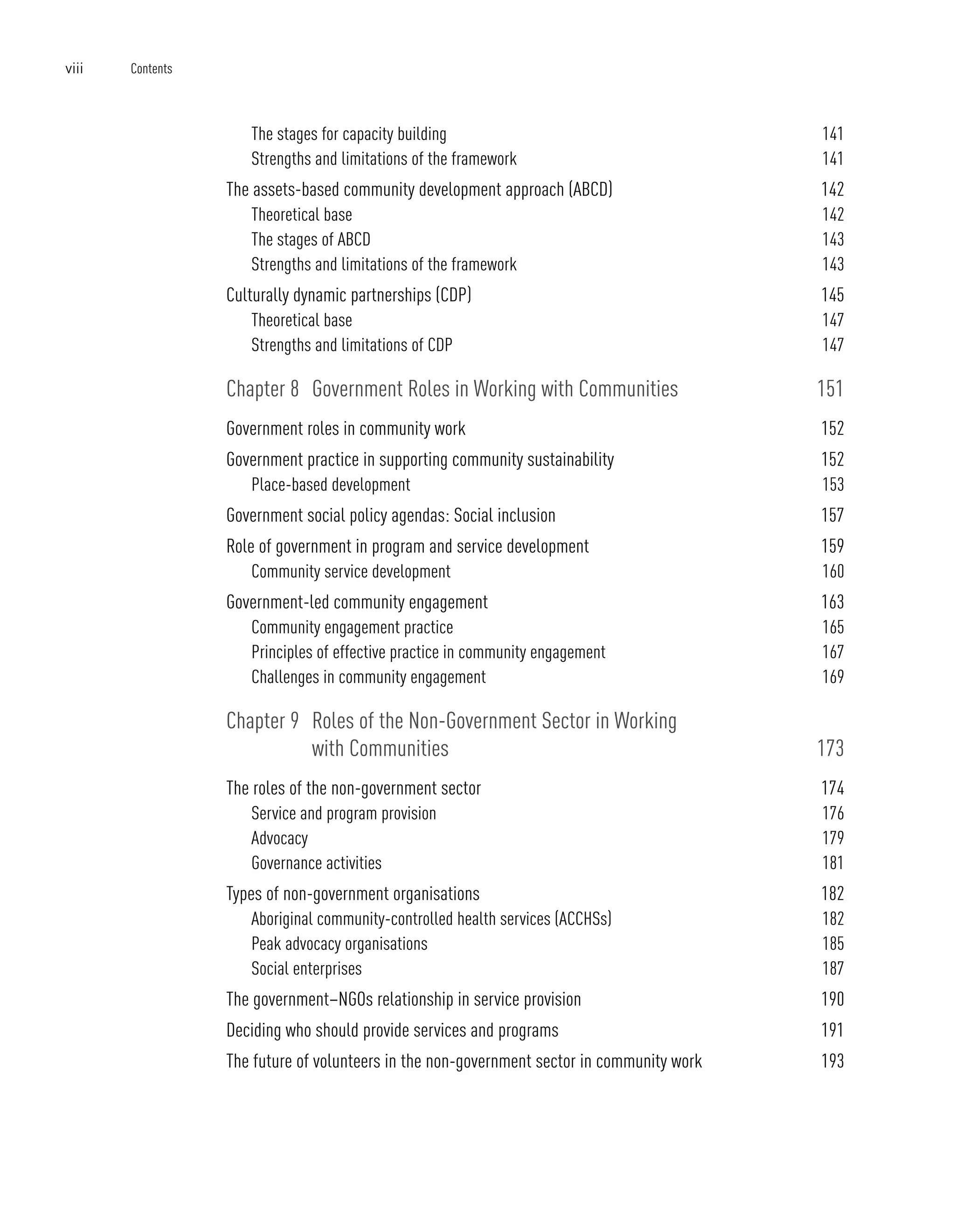


![xiv
LIST OF CASE STUDIES
Case study 1.1 Three perspectives on community work 7
Case study 1.2 Different perspectives on community: An urban neighbourhood 14
Case study 1.3 Aboriginal health is not just the domain of the health care system 17
Case study 1.4 Community development as mental health promotion:
The Braunstone example 19
Case study 2.1 Nepal’s migrant workforce 28
Case study 2.2 Health promotion at the Neighbourhood Centre 31
Case study 2.3 A neoliberal aid paradigm in international development 33
Case study 2.4 Independent advocacy organisations using on-line technology 43
Case study 3.1 A community of interest: Bfriend 51
Case study 4.1 Interconnections between kinship, responsibilities, and land:
A traditional owner organisation 74
Case study 5.1 Saving our park: ‘Even if we lose [the court case], I win.
I have a community’ 85
Case study 5.2 Communitarianism in action 89
Case study 5.3 The culture fest planning 94
Case study 5.4 Social capital in Brownvale, a suburban neighbourhood 100
Case study 6.1 Different conceptual approaches: The family support project 109
Case study 6.2 Sera’s Women’s Shelter 112
Case study 6.3 The state community inclusion forum 116
Case study 6.4 Lobbying government about changes to legislation 118
Case study 6.5 Neighbourhood development 126
Case study 8.1 A social inclusion agenda in South Australia 158
Case study 8.2 Queensland Government community services development 161
Case study 8.3 Community engagement with women in the
market garden industry 168
Case study 9.1 Levels at which non-government organisations operate 174
Case study 9.2 Community enterprise: Yackandandah Community
Development Company (YCDCo) 187
Case study 9.3 In Our Hands Health Centre, Whyalla, South Australia 194
Case study 10.1 Setting up a social enterprise—A community general practice 201
Case study 10.2 The Disability Forum 215
Case study 10.3 The Social Care Board 216
Case study 10.4 The health priorities citizens’ jury 220
Case study 10.5 Using the charrette method in planning for urban renewal 221
Case study 11.1 The community garden 225](https://image.slidesharecdn.com/21115-250411110518-81a838a9/75/Original-PDF-Working-with-Communities-by-Judy-Taylor-11-2048.jpg)


