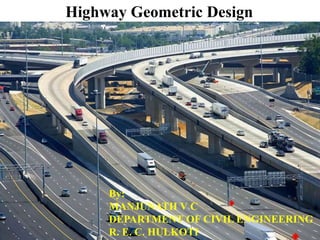
Highway Geometric Design
By:
MANJUNATH V C
DEPARTMENT OF CIVIL ENGINEERING
R. E. C. HULKOTI
Importance of geometric design
• The geometric design of a highway deals with
the dimensions and layout of visible features
of the highway such as alignment, sight distan
ces and intersections. The geometric of
highway should be designed to provide
optimum efficiency in traffic operations with
max. safety at reasonable cost.
Geometric design of highway
deals with following elements :
1) Cross section elements
2) Sight distance considerations
3)Horizontal alignment details
4) Vertical alignment details
5) Intersection elements
• Under cross section elements the consideration for the width
of pavement, formation and land, the surface char. And cross
slope of pavement are included.
• The sight distance or clear distance visible ahead of a driver at
horizontal and vertical curves and at a intersections governs
the safe movement of vehicles.
• Horz. Alignment deals with horizontal curves, superelevation
, extra pavement width etc.
• The gradient and vertical curves are introduced in the vertical
alignment of a highway.
• Design of road intersections with facilities for safe and
efficient traffic movement needs adequate knowledge of traffic
engineering.
Design controls and Criteria
• The geometric design of highways depends on
several design factors such as :
1) Design speed
2) Topography
3) Traffic factors
4) Design hourly volume and capacity
5) Environmental and other factors
• Design speed
Design speed is the single most important factor that
affects the geometric design. It directly affects the sight distance,
horizontal curve, and the length of vertical curves. Since the
speed of vehicles vary with driver, terrain etc, a design speed is
adopted for all the geometric design.
• Topography
The next important factor that affects the geometric
design is the topography. It is easier to construct roads with
required standards for a plain terrain. However, for a given design
speed, the construction cost increases multiform with the gradient
and the terrain. Therefore, geometric design standards are
different for different terrain to keep the cost of construction and
time of construction under control. This is characterized by
sharper curves and steeper gradients.
• In addition to design speed and topography, there are various other factors
that affect the geometric design and they are briefly discussed below:
• Vehicle: :The dimensions, weight of the axle and operating characteristics
of a vehicle influence the design aspects such as width of the pavement,
radii of the curve, clearances, parking geometrics etc. A design
vehicle which has standard weight, dimensions and operating
characteristics are used to establish highway design controls to
accommodate vehicles of a designated type.
• Human: The important human factors that influence geometric design are
the physical, mental and psychological characteristics of the driver and
pedestrians like the reaction time.
• Traffic: It will be uneconomical to design the road for peak traffic flow.
Therefore a reasonable value of traffic volume is selected as the design
hourly volume which is determined from the various traffic data collected.
The geometric design is thus based on this design volume, capacity etc.
• Environmental: Factors like air pollution, noise pollution etc. should be
given due consideration in the geometric design of roads.
• Economy: The design adopted should be economical as far as possible. It
should match with the funds alloted for capital cost and maintenance cost.
• Others: Geometric design should be such that the aesthetics of the region
is not affected.
Highway Cross section elements
1. Pavement surface characteristics
For safe and comfortable driving four aspects of the pavement surface
are important; the friction between the wheels and the pavement surface,
smoothness of the road surface, the light reflection characteristics of the top of
pavement surface, and drainage to water.
2. Friction
• Friction between the wheel and the pavement surface is a crucial factor in
the design of horizontal curves and thus the safe operating speed. Further, it
also affect the acceleration and deceleration ability of vehicles. Lack of
adequate friction can cause skidding or slipping of vehicles.
• Skidding happens when the path traveled along the road surface is more
than the circumferential movement of the wheels due to friction
• Slip occurs when the wheel revolves more than the corresponding
longitudinal movement along the road.
Various factors that affect friction are
• Type of the pavement (like bituminous, concrete, or gravel),
• Condition of the pavement (dry or wet, hot or cold, etc),
• Condition of the tyre (new or old), and
• Speed and load of the vehicle.
• The frictional force that develops between the wheel and the pavement is
the load acting multiplied by a factor called the coefficient of friction and
denoted as f . The choice of the value of f is a very complicated issue
since it depends on many variables. IRC suggests the coefficient of
longitudinal friction as 0.35-0.4depending on the speed and coefficient of
lateral friction as 0.15. The former is useful in sight distance calculation
and the latter in horizontal curve design.
3. Unevenness
• It is always desirable to have an even surface, but it is seldom
possible to have such a one. Even if a road is constructed with high
quality pavers, it is possible to develop unevenness due to pavement
failures. Unevenness affect the vehicle operating cost, speed, riding
comfort, safety, fuel consumption and wear and tear of tyres.
4. Light reflection
• White roads have good visibility at night, but caused glare during day time.
• Black roads has no glare during day, but has poor visibility at night
• Concrete roads has better visibility and less glare
5. Camber
• Camber or cant is the cross slope provided to raise middle of the road
surface in the transverse direction to drain off rain water from road surface.
The objectives of providing camber are:
• Surface protection especially for gravel and bituminous roads
• Sub-grade protection by proper drainage
• Quick drying of pavement which in turn increases safety
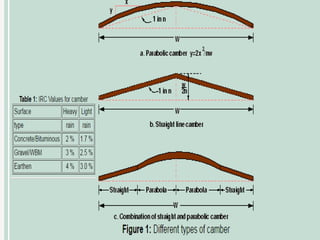
• Too steep slope is undesirable for it will erode the surface. Camber is
measured in 1 in n or n% (Eg. 1 in 50 or 2%) and the value depends on the
type of pavement surface. The values suggested by IRC for various
categories of pavement is given in Table 1. The common types of camber
are parabolic, straight, or combination of them (Figure 1)
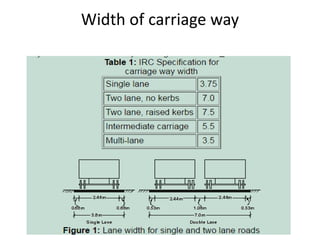
• Width of carriage way
Width of the carriage way or the width of the
pavement depends on the width of the traffic lane and
number of lanes. Width of a traffic lane depends on the
width of the vehicle and the clearance. Side clearance
improves operating speed and safety. The maximum
permissible width of a vehicle is 2.44 M and the desirable
side clearance for single lane traffic is 0.68 m. This
require minimum of lane width of 3.75 m for a single lane
road (Figure 1a). However, the side clearance required is
about 0.53 m, on either side and 1.06 m in the center.
Therefore, a two lane road require minimum of 3.5 meter
for each lane (Figure 1b). The desirable carriage way
width recommended by IRC is given in Table 1
Width of carriage way
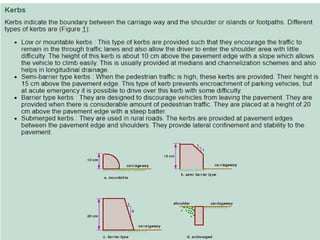
• Kerbs
• Kerbs indicate the boundary between the carriage way and the shoulder
or islands or footpaths. Different types of kerbs are (Figure 1):Low or
mountable kerbs : This type of kerbs are provided such that they
encourage the traffic to remain in the through traffic lanes and also allow
the driver to enter the shoulder area with little difficulty. The height of this
kerb is about 10 cm above the pavement edge with a slope which allows
the vehicle to climb easily. This is usually provided at medians and
channelization schemes and also helps in longitudinal drainage.
• Semi-barrier type kerbs : When the pedestrian traffic is high, these kerbs
are provided. Their height is 15 cm above the pavement edge. This type of
kerb prevents encroachment of parking vehicles, but at acute emergency
it is possible to drive over this kerb with some difficulty.
• Barrier type kerbs : They are designed to discourage vehicles from leaving
the pavement. They are provided when there is considerable amount of
pedestrian traffic. They are placed at a height of 20 cm above the
pavement edge with a steep batter.
• Submerged kerbs : They are used in rural roads. The kerbs are provided at
pavement edges between the pavement edge and shoulders. They provide
lateral confinement and stability to the pavement.
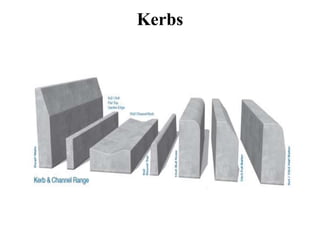
Kerbs
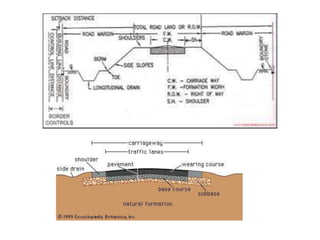
• Road margins
• The portion of the road beyond the carriageway and on the
roadway can be generally called road margin. Various elements that
form the road margins are given below.
• Shoulders
• Shoulders are provided along the road edge and is intended for
accommodation of stopped vehicles, serve as an emergency lane
for vehicles and provide lateral support for base and surface
courses. The shoulder should be strong enough to bear the weight
of a fully loaded truck even in wet conditions. The shoulder width
should be adequate for giving working space around a stopped
vehicle. It is desirable to have a width of 4.6 m for the shoulders. A
minimum width of 2.5 m is recommended for 2-lane rural highways
in India.
• Parking lanes
• Parking lanes are provided in urban lanes for side parking. Parallel
parking is preferred because it is safe for the vehicles moving on the
road. The parking lane should have a minimum of 3.0 m width in
the case of parallel parking.
• Bus-bays
• Bus bays are provided by recessing the kerbs for bus
stops. They are provided so that they do not obstruct
the movement of vehicles in the carriage way. They
should be at least 75 meters away from the
intersection so that the traffic near the intersections is
not affected by the bus-bay.
• Service roads
• Service roads or frontage roads give access to access
controlled highways like freeways and expressways.
They run parallel to the highway and will be usually
isolated by a separator and access to the highway will
be provided only at selected points. These roads are
provided to avoid congestion in the expressways and
also the speed of the traffic in those lanes is not
reduced.
• Cycle track
• Cycle tracks are provided in urban areas when the volume of cycle
traffic is high Minimum width of 2 meter is required, which may be
increased by 1 meter for every additional track.
• Footpath
• Footpaths are exclusive right of way to pedestrians, especially in
urban areas. They are provided for the safety of the pedestrians
when both the pedestrian traffic and vehicular traffic is high.
Minimum width is 1.5 meter and may be increased based on the
traffic. The footpath should be either as smooth as the pavement or
more smoother than that to induce the pedestrian to use the
footpath.
• Guard rails
• They are provided at the edge of the shoulder usually when the
road is on an embankment. They serve to prevent the vehicles from
running off the embankment, especially when the height of the fill
exceeds 3 m. Various designs of guard rails are there. Guard stones
painted in alternate black and white are usually used. They also give
better visibility of curves at night under headlights of vehicles.
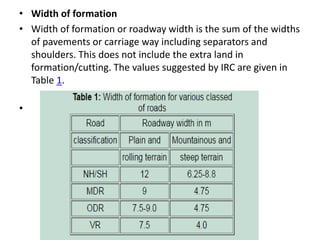
• Width of formation
• Width of formation or roadway width is the sum of the widths
of pavements or carriage way including separators and
shoulders. This does not include the extra land in
formation/cutting. The values suggested by IRC are given in
Table 1.
•
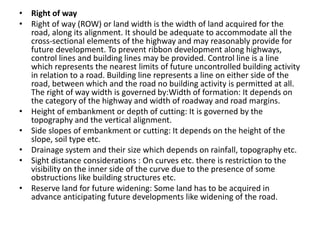
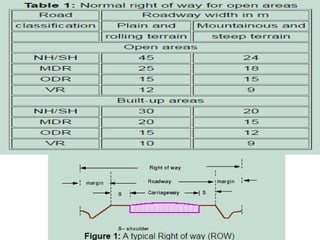
• Right of way
• Right of way (ROW) or land width is the width of land acquired for the
road, along its alignment. It should be adequate to accommodate all the
cross-sectional elements of the highway and may reasonably provide for
future development. To prevent ribbon development along highways,
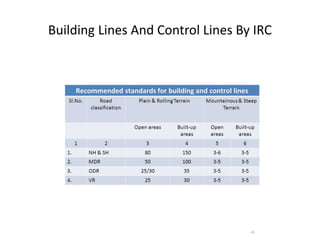
control lines and building lines may be provided. Control line is a line
which represents the nearest limits of future uncontrolled building activity
in relation to a road. Building line represents a line on either side of the
road, between which and the road no building activity is permitted at all.
The right of way width is governed by:Width of formation: It depends on
the category of the highway and width of roadway and road margins.
• Height of embankment or depth of cutting: It is governed by the
topography and the vertical alignment.
• Side slopes of embankment or cutting: It depends on the height of the
slope, soil type etc.
• Drainage system and their size which depends on rainfall, topography etc.
• Sight distance considerations : On curves etc. there is restriction to the
visibility on the inner side of the curve due to the presence of some
obstructions like building structures etc.
• Reserve land for future widening: Some land has to be acquired in
advance anticipating future developments like widening of the road.
Building Lines And Control Lines By IRC
Sight distance
• The safe and efficient operation of vehicles on
the road depends very much on the visibility
of the road ahead of the driver. Thus the
geometric design of the road should be done
such that any obstruction on the road length
could be visible to the driver from some
distance ahead . This distance is said to be the
sight distance.
Types of sight distance
• Sight distance available from a point is the actual distance along the
road surface, over which a driver from a specified height above the
carriage way has visibility of stationary or moving objects. Three
sight distance situations are considered for design:
• Stopping sight distance (SSD) or the absolute minimum sight
distance
• Intermediate sight distance (ISD) is defined as twice SSD
• Overtaking sight distance (OSD) for safe overtaking operation
• Head light sight distance is the distance visible to a driver during
night driving under the illumination of head lights
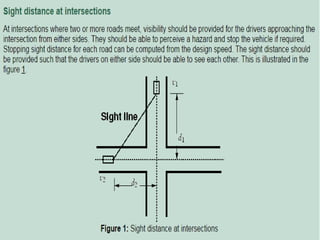
• Safe sight distance to enter into an intersiection.
• The most important consideration in all these is that at all times the
driver traveling at the design speed of the highway must have
sufficient carriageway distance within his line of vision to allow him
to stop his vehicle before colliding with a slowly moving or
stationary object appearing suddenly in his own traffic lane.
• The computation of sight distance depends on:
• Reaction time of the driverReaction time of a driver is the
time taken from the instant the object is visible to the driver
to the instant when the brakes are applied. The total reaction
time may be split up into four components based on PIEV
theory. In practice, all these times are usually combined into a
total perception-reaction time suitable for design purposes as
well as for easy measurement. Many of the studies shows that
drivers require about 1.5 to 2 secs under normal conditions.
However, taking into consideration the variability of driver
characteristics, a higher value is normally used in design. For
example, IRC suggests a reaction time of 2.5 secs.
• Speed of the vehicleThe speed of the vehicle very much
affects the sight distance. Higher the speed, more time will be
required to stop the vehicle. Hence it is evident that, as the
speed increases, sight distance also increases.
• Efficiency of brakesThe efficiency of the brakes depends upon the
age of the vehicle, vehicle characteristics etc. If the brake efficiency
is 100%, the vehicle will stop the moment the brakes are applied.
But practically, it is not possible to achieve 100% brake efficiency.
Therefore the sight distance required will be more when the
efficiency of brakes are less. Also for safe geometric design, we
assume that the vehicles have only 50% brake efficiency.
• Frictional resistance between the tyre and the roadThe frictional
resistance between the tyre and road plays an important role to
bring the vehicle to stop. When the frictional resistance is more, the
vehicles stop immediately. Thus sight required will be less. No
separate provision for brake efficiency is provided while computing
the sight distance. This is taken into account along with the factor of
longitudinal friction. IRC has specified the value of longitudinal
friction in between 0.35 to 0.4.
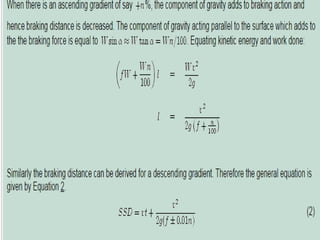
• Gradient of the road.Gradient of the road also affects the sight
distance. While climbing up a gradient, the vehicle can stop
immediately. Therefore sight distance required is less. While
descending a gradient, gravity also comes into action and more
time will be required to stop the vehicle. Sight distance required will
be more in this case.
• Stopping sight distance
Stopping sight distance (SSD) is the minimum
sight distance available on a highway at any spot
having sufficient length to enable the driver to stop
a vehicle traveling at design speed, safely without
collision with any other obstruction. There is a term
called safe stopping distance and is one of the
important measures in traffic engineering. It is the
distance a vehicle travels from the point at which a
situation is first perceived to the time the
deceleration is complete. Drivers must have
adequate time if they are to suddenly respond to a
situation. Thus in highway design, sight distance
atleast equal to the safe stopping distance should
be provided.
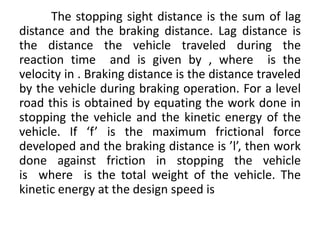
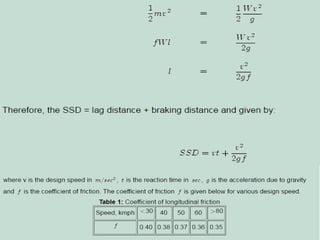
The stopping sight distance is the sum of lag
distance and the braking distance. Lag distance is
the distance the vehicle traveled during the
reaction time and is given by , where is the
velocity in . Braking distance is the distance traveled
by the vehicle during braking operation. For a level
road this is obtained by equating the work done in
stopping the vehicle and the kinetic energy of the
vehicle. If ‘f’ is the maximum frictional force
developed and the braking distance is ’l’, then work
done against friction in stopping the vehicle
is where is the total weight of the vehicle. The
kinetic energy at the design speed is
Overtaking sight distance :
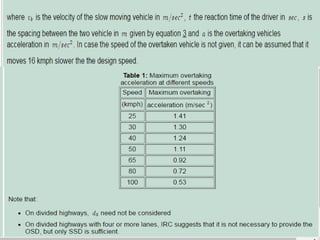
• The overtaking sight distance is the minimum distance
open to the vision of the driver of a vehicle intending to
overtake the slow vehicle ahead safely against the traffic in
the opposite direction. The overtaking sight distance or
passing sight distance is measured along the center line of
the road over which a driver with his eye level 1.2 m above
the road surface can see the top of an object 1.2 m above
the road surface.The factors that affect the OSD are:
• Velocities of the overtaking vehicle, overtaken vehicle and
of the vehicle coming in the opposite direction.
• Spacing between vehicles, which in-turn depends on the
speed
• Skill and reaction time of the driver
• Rate of acceleration of overtaking vehicle
• Gradient of the road
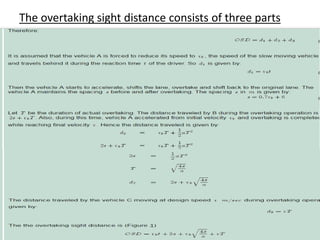
The overtaking sight distance consists of three parts
• Horizontal alignment
• Horizontal alignment is one of the most important
features influencing the efficiency and safety of a
highway. A poor design will result in lower speeds and
resultant reduction in highway performance in terms of
safety and comfort. In addition, it may increase the
cost of vehicle operations and lower the highway
capacity. Horizontal alignment design involves the
understanding on the design aspects such as design
speed and the effect of horizontal curve on the
vehicles. The horizontal curve design elements include
design of super elevation, extra widening at horizontal
curves, design of transition curve, and set back
distance. These will be discussed in this chapter and
the following two chapters.
• Design Speed
• The design speed, as noted earlier, is the single most
important factor in the design of horizontal alignment. The
design speed also depends on the type of the road. For e.g,
the design speed expected from a National highway will be
much higher than a village road, and hence the curve
geometry will vary significantly.
• The design speed also depends on the type of terrain. A plain
terrain can afford to have any geometry, but for the same
standard in a hilly terrain requires substantial cutting and
filling implying exorbitant costs as well as safety concern due
to unstable slopes. Therefore, the design speed is normally
reduced for terrains with steep slopes.
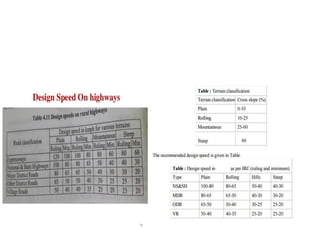
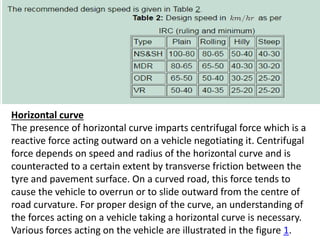
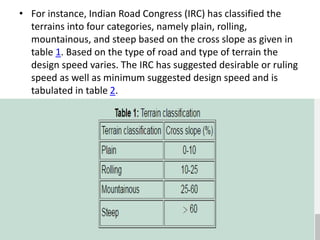
• For instance, Indian Road Congress (IRC) has classified the
terrains into four categories, namely plain, rolling,
mountainous, and steep based on the cross slope as given in
table 1. Based on the type of road and type of terrain the
design speed varies. The IRC has suggested desirable or ruling
speed as well as minimum suggested design speed and is
tabulated in table 2.
Horizontal curve
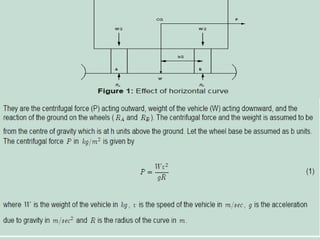
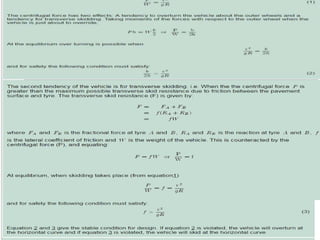
The presence of horizontal curve imparts centrifugal force which is a
reactive force acting outward on a vehicle negotiating it. Centrifugal
force depends on speed and radius of the horizontal curve and is
counteracted to a certain extent by transverse friction between the
tyre and pavement surface. On a curved road, this force tends to
cause the vehicle to overrun or to slide outward from the centre of
road curvature. For proper design of the curve, an understanding of
the forces acting on a vehicle taking a horizontal curve is necessary.
Various forces acting on the vehicle are illustrated in the figure 1.
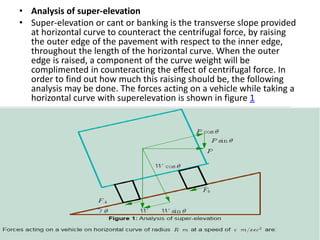
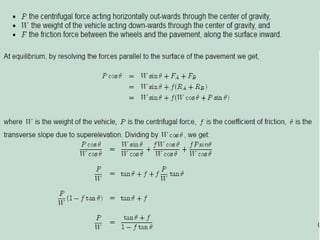
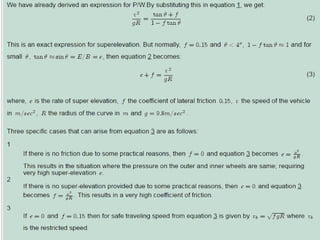
• Analysis of super-elevation
• Super-elevation or cant or banking is the transverse slope provided
at horizontal curve to counteract the centrifugal force, by raising
the outer edge of the pavement with respect to the inner edge,
throughout the length of the horizontal curve. When the outer
edge is raised, a component of the curve weight will be
complimented in counteracting the effect of centrifugal force. In
order to find out how much this raising should be, the following
analysis may be done. The forces acting on a vehicle while taking a
horizontal curve with superelevation is shown in figure 1
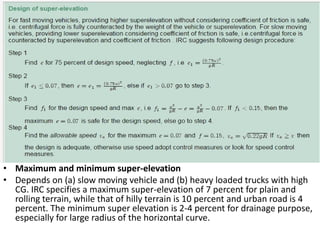
• Maximum and minimum super-elevation
• Depends on (a) slow moving vehicle and (b) heavy loaded trucks with high
CG. IRC specifies a maximum super-elevation of 7 percent for plain and
rolling terrain, while that of hilly terrain is 10 percent and urban road is 4
percent. The minimum super elevation is 2-4 percent for drainage purpose,
especially for large radius of the horizontal curve.
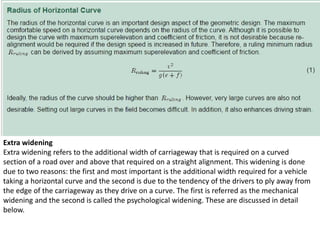
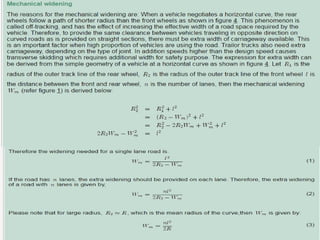
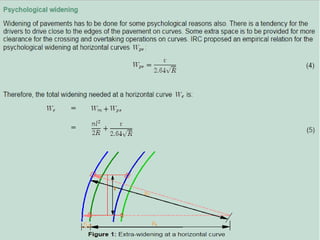
Extra widening
Extra widening refers to the additional width of carriageway that is required on a curved
section of a road over and above that required on a straight alignment. This widening is done
due to two reasons: the first and most important is the additional width required for a vehicle
taking a horizontal curve and the second is due to the tendency of the drivers to ply away from
the edge of the carriageway as they drive on a curve. The first is referred as the mechanical
widening and the second is called the psychological widening. These are discussed in detail
below.
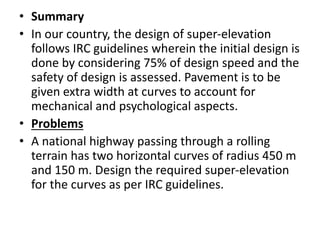
• Summary
• In our country, the design of super-elevation
follows IRC guidelines wherein the initial design is
done by considering 75% of design speed and the
safety of design is assessed. Pavement is to be
given extra width at curves to account for
mechanical and psychological aspects.
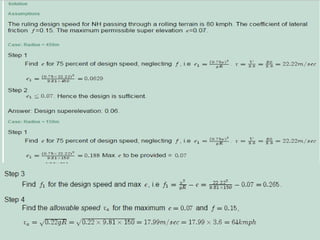
• Problems
• A national highway passing through a rolling
terrain has two horizontal curves of radius 450 m
and 150 m. Design the required super-elevation
for the curves as per IRC guidelines.
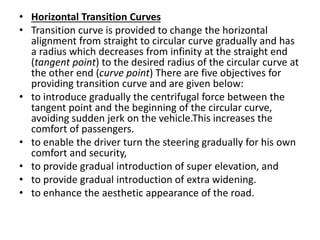
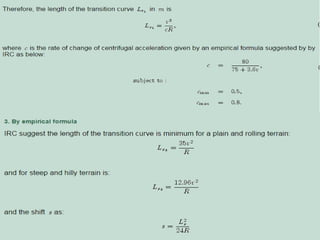
• Horizontal Transition Curves
• Transition curve is provided to change the horizontal
alignment from straight to circular curve gradually and has
a radius which decreases from infinity at the straight end
(tangent point) to the desired radius of the circular curve at
the other end (curve point) There are five objectives for
providing transition curve and are given below:
• to introduce gradually the centrifugal force between the
tangent point and the beginning of the circular curve,
avoiding sudden jerk on the vehicle.This increases the
comfort of passengers.
• to enable the driver turn the steering gradually for his own
comfort and security,
• to provide gradual introduction of super elevation, and
• to provide gradual introduction of extra widening.
• to enhance the aesthetic appearance of the road.
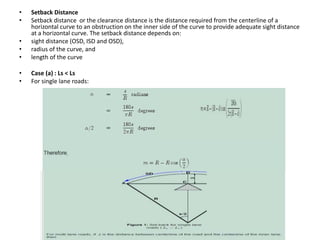
• Setback Distance
• Setback distance or the clearance distance is the distance required from the centerline of a
horizontal curve to an obstruction on the inner side of the curve to provide adequate sight distance
at a horizontal curve. The setback distance depends on:
• sight distance (OSD, ISD and OSD),
• radius of the curve, and
• length of the curve
• Case (a) : Ls < Ls
• For single lane roads:
• Vertical alignment-I
• Overview
• The vertical alignment of a road consists of gradients(straight lines in a vertical plane) and
vertical curves. The vertical alignment is usually drawn as a profile, which is a graph with
elevation as vertical axis and the horizontal distance along the centre line of the road as the
the horizontal axis. Just as a circular curve is used to connect horizontal straight stretches of
road, vertical curves connect two gradients. When these two curves meet, they form either
convex or concave. The former is called a summit curve, while the latter is called a valley
curve. This section covers a discussion on gradient and summit curves.
• Gradient
• Gradient is the rate of rise or fall along the length of the road with respect to the horizontal.
While aligning a highway, the gradient is decided for designing the vertical curve. Before
finalizing the gradients, the construction cost, vehicular operation cost and the practical
problems in the site also has to be considered. Usually steep gradients are avoided as far as
possible because of the difficulty to climb and increase in the construction cost. More about
gradients are discussed below.
• Effect of gradient
• The effect of long steep gradient on the vehicular speed is considerable. This is particularly
important in roads where the proportion of heavy vehicles is significant. Due to restrictive
sight distance at uphill gradients the speed of traffic is often controlled by these heavy
vehicles. As a result, not only the operating costs of the vehicles are increased, but also
capacity of the roads will have to be reduced. Further, due to high differential speed between
heavy and light vehicles, and between uphill and downhill gradients, accidents abound in
gradients.
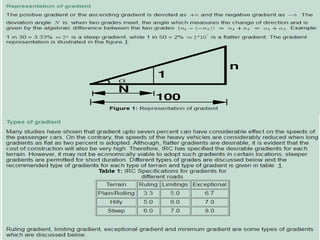
• Ruling gradient
• The ruling gradient or the design gradient is the maximum gradient with which the designer
attempts to design the vertical profile of the road. This depends on the terrain, length of the grade,
speed, pulling power of the vehicle and the presence of the horizontal curve. In flatter terrain, it
may be possible to provide flat gradients, but in hilly terrain it is not economical and sometimes not
possible also. The ruling gradient is adopted by the designer by considering a particular speed as
the design speed and for a design vehicle with standard dimensions. But our country has a
heterogeneous traffic and hence it is not possible to lay down precise standards for the country as a
whole. Hence IRC has recommended some values for ruling gradient for different types of terrain.
• Limiting gradient
• This gradient is adopted when the ruling gradient results in enormous increase in cost of
construction. On rolling terrain and hilly terrain it may be frequently necessary to adopt limiting
gradient. But the length of the limiting gradient stretches should be limited and must be
sandwiched by either straight roads or easier grades.
• Exceptional gradient
• Exceptional gradient are very steeper gradients given at unavoidable situations. They should be
limited for short stretches not exceeding about 100 metres at a stretch. In mountainous and steep
terrain, successive exceptional gradients must be separated by a minimum 100 metre length
gentler gradient. At hairpin bends, the gradient is restricted to 2.5%.
• Critical length of the grade
• The maximum length of the ascending gradient which a loaded truck can operate without undue
reduction in speed is called critical length of the grade. A speed of 25 kmph is a reasonable value.
This value depends on the size, power, load, grad-ability of the truck, initial speed, final desirable
minimum speed etc.
•
Summit curve
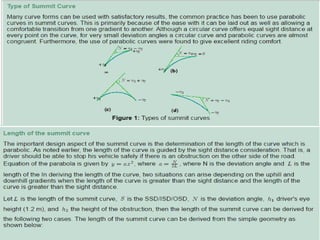
Summit curves are vertical curves with gradient upwards. They are formed when two gradients
meet as illustrated in figure 1 in any of the following four ways:
when a positive gradient meets another positive gradient [figure 1a].
when positive gradient meets a flat gradient [figure 1b]. .
when an ascending gradient meets a descending gradient [figure 1c]. .
when a descending gradient meets another descending gradient [figure 1d].
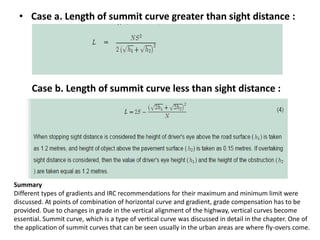
• Case a. Length of summit curve greater than sight distance :
Case b. Length of summit curve less than sight distance :
Summary
Different types of gradients and IRC recommendations for their maximum and minimum limit were
discussed. At points of combination of horizontal curve and gradient, grade compensation has to be
provided. Due to changes in grade in the vertical alignment of the highway, vertical curves become
essential. Summit curve, which is a type of vertical curve was discussed in detail in the chapter. One of
the application of summit curves that can be seen usually in the urban areas are where fly-overs come.
• Vertical alignment -II
• Overview
• As discussed earlier, changes in topography necessitate the introduction of vertical curves. The
second curve of this type is the valley curve. This section deals with the types of valley curve and
their geometrical design.
• Valley curve
• Valley curve or sag curves are vertical curves with convexity downwards. They are formed when
two gradients meet as illustrated in figure 1 in any of the following four ways
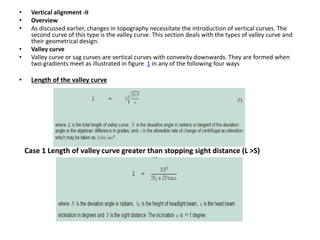
• Length of the valley curve
Case 1 Length of valley curve greater than stopping sight distance (L >S)
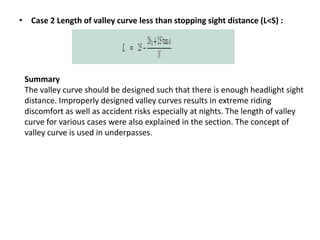
• Case 2 Length of valley curve less than stopping sight distance (L<S) :
Summary
The valley curve should be designed such that there is enough headlight sight
distance. Improperly designed valley curves results in extreme riding
discomfort as well as accident risks especially at nights. The length of valley
curve for various cases were also explained in the section. The concept of
valley curve is used in underpasses.
Transportation engineering module 2 ppt.

Transportation engineering module 2 ppt.

  • 1.
    Highway Geometric Design By: MANJUNATHV C DEPARTMENT OF CIVIL ENGINEERING R. E. C. HULKOTI
  • 2.
    Importance of geometricdesign • The geometric design of a highway deals with the dimensions and layout of visible features of the highway such as alignment, sight distan ces and intersections. The geometric of highway should be designed to provide optimum efficiency in traffic operations with max. safety at reasonable cost.
  • 3.
    Geometric design ofhighway deals with following elements : 1) Cross section elements 2) Sight distance considerations 3)Horizontal alignment details 4) Vertical alignment details 5) Intersection elements
  • 4.
    • Under crosssection elements the consideration for the width of pavement, formation and land, the surface char. And cross slope of pavement are included. • The sight distance or clear distance visible ahead of a driver at horizontal and vertical curves and at a intersections governs the safe movement of vehicles. • Horz. Alignment deals with horizontal curves, superelevation , extra pavement width etc. • The gradient and vertical curves are introduced in the vertical alignment of a highway. • Design of road intersections with facilities for safe and efficient traffic movement needs adequate knowledge of traffic engineering.
  • 5.
    Design controls andCriteria • The geometric design of highways depends on several design factors such as : 1) Design speed 2) Topography 3) Traffic factors 4) Design hourly volume and capacity 5) Environmental and other factors
  • 6.
    • Design speed Designspeed is the single most important factor that affects the geometric design. It directly affects the sight distance, horizontal curve, and the length of vertical curves. Since the speed of vehicles vary with driver, terrain etc, a design speed is adopted for all the geometric design. • Topography The next important factor that affects the geometric design is the topography. It is easier to construct roads with required standards for a plain terrain. However, for a given design speed, the construction cost increases multiform with the gradient and the terrain. Therefore, geometric design standards are different for different terrain to keep the cost of construction and time of construction under control. This is characterized by sharper curves and steeper gradients.
  • 8.
    • In additionto design speed and topography, there are various other factors that affect the geometric design and they are briefly discussed below: • Vehicle: :The dimensions, weight of the axle and operating characteristics of a vehicle influence the design aspects such as width of the pavement, radii of the curve, clearances, parking geometrics etc. A design vehicle which has standard weight, dimensions and operating characteristics are used to establish highway design controls to accommodate vehicles of a designated type. • Human: The important human factors that influence geometric design are the physical, mental and psychological characteristics of the driver and pedestrians like the reaction time. • Traffic: It will be uneconomical to design the road for peak traffic flow. Therefore a reasonable value of traffic volume is selected as the design hourly volume which is determined from the various traffic data collected. The geometric design is thus based on this design volume, capacity etc. • Environmental: Factors like air pollution, noise pollution etc. should be given due consideration in the geometric design of roads. • Economy: The design adopted should be economical as far as possible. It should match with the funds alloted for capital cost and maintenance cost. • Others: Geometric design should be such that the aesthetics of the region is not affected.
  • 9.
    Highway Cross sectionelements 1. Pavement surface characteristics For safe and comfortable driving four aspects of the pavement surface are important; the friction between the wheels and the pavement surface, smoothness of the road surface, the light reflection characteristics of the top of pavement surface, and drainage to water. 2. Friction • Friction between the wheel and the pavement surface is a crucial factor in the design of horizontal curves and thus the safe operating speed. Further, it also affect the acceleration and deceleration ability of vehicles. Lack of adequate friction can cause skidding or slipping of vehicles. • Skidding happens when the path traveled along the road surface is more than the circumferential movement of the wheels due to friction • Slip occurs when the wheel revolves more than the corresponding longitudinal movement along the road.
  • 10.
    Various factors thataffect friction are • Type of the pavement (like bituminous, concrete, or gravel), • Condition of the pavement (dry or wet, hot or cold, etc), • Condition of the tyre (new or old), and • Speed and load of the vehicle. • The frictional force that develops between the wheel and the pavement is the load acting multiplied by a factor called the coefficient of friction and denoted as f . The choice of the value of f is a very complicated issue since it depends on many variables. IRC suggests the coefficient of longitudinal friction as 0.35-0.4depending on the speed and coefficient of lateral friction as 0.15. The former is useful in sight distance calculation and the latter in horizontal curve design. 3. Unevenness • It is always desirable to have an even surface, but it is seldom possible to have such a one. Even if a road is constructed with high quality pavers, it is possible to develop unevenness due to pavement failures. Unevenness affect the vehicle operating cost, speed, riding comfort, safety, fuel consumption and wear and tear of tyres.
  • 11.
    4. Light reflection •White roads have good visibility at night, but caused glare during day time. • Black roads has no glare during day, but has poor visibility at night • Concrete roads has better visibility and less glare 5. Camber • Camber or cant is the cross slope provided to raise middle of the road surface in the transverse direction to drain off rain water from road surface. The objectives of providing camber are: • Surface protection especially for gravel and bituminous roads • Sub-grade protection by proper drainage • Quick drying of pavement which in turn increases safety • Too steep slope is undesirable for it will erode the surface. Camber is measured in 1 in n or n% (Eg. 1 in 50 or 2%) and the value depends on the type of pavement surface. The values suggested by IRC for various categories of pavement is given in Table 1. The common types of camber are parabolic, straight, or combination of them (Figure 1)
  • 13.
    • Width ofcarriage way Width of the carriage way or the width of the pavement depends on the width of the traffic lane and number of lanes. Width of a traffic lane depends on the width of the vehicle and the clearance. Side clearance improves operating speed and safety. The maximum permissible width of a vehicle is 2.44 M and the desirable side clearance for single lane traffic is 0.68 m. This require minimum of lane width of 3.75 m for a single lane road (Figure 1a). However, the side clearance required is about 0.53 m, on either side and 1.06 m in the center. Therefore, a two lane road require minimum of 3.5 meter for each lane (Figure 1b). The desirable carriage way width recommended by IRC is given in Table 1
  • 14.
  • 15.
    • Kerbs • Kerbsindicate the boundary between the carriage way and the shoulder or islands or footpaths. Different types of kerbs are (Figure 1):Low or mountable kerbs : This type of kerbs are provided such that they encourage the traffic to remain in the through traffic lanes and also allow the driver to enter the shoulder area with little difficulty. The height of this kerb is about 10 cm above the pavement edge with a slope which allows the vehicle to climb easily. This is usually provided at medians and channelization schemes and also helps in longitudinal drainage. • Semi-barrier type kerbs : When the pedestrian traffic is high, these kerbs are provided. Their height is 15 cm above the pavement edge. This type of kerb prevents encroachment of parking vehicles, but at acute emergency it is possible to drive over this kerb with some difficulty. • Barrier type kerbs : They are designed to discourage vehicles from leaving the pavement. They are provided when there is considerable amount of pedestrian traffic. They are placed at a height of 20 cm above the pavement edge with a steep batter. • Submerged kerbs : They are used in rural roads. The kerbs are provided at pavement edges between the pavement edge and shoulders. They provide lateral confinement and stability to the pavement.
  • 16.
  • 17.
    • Road margins •The portion of the road beyond the carriageway and on the roadway can be generally called road margin. Various elements that form the road margins are given below. • Shoulders • Shoulders are provided along the road edge and is intended for accommodation of stopped vehicles, serve as an emergency lane for vehicles and provide lateral support for base and surface courses. The shoulder should be strong enough to bear the weight of a fully loaded truck even in wet conditions. The shoulder width should be adequate for giving working space around a stopped vehicle. It is desirable to have a width of 4.6 m for the shoulders. A minimum width of 2.5 m is recommended for 2-lane rural highways in India. • Parking lanes • Parking lanes are provided in urban lanes for side parking. Parallel parking is preferred because it is safe for the vehicles moving on the road. The parking lane should have a minimum of 3.0 m width in the case of parallel parking.
  • 18.
    • Bus-bays • Busbays are provided by recessing the kerbs for bus stops. They are provided so that they do not obstruct the movement of vehicles in the carriage way. They should be at least 75 meters away from the intersection so that the traffic near the intersections is not affected by the bus-bay. • Service roads • Service roads or frontage roads give access to access controlled highways like freeways and expressways. They run parallel to the highway and will be usually isolated by a separator and access to the highway will be provided only at selected points. These roads are provided to avoid congestion in the expressways and also the speed of the traffic in those lanes is not reduced.
  • 19.
    • Cycle track •Cycle tracks are provided in urban areas when the volume of cycle traffic is high Minimum width of 2 meter is required, which may be increased by 1 meter for every additional track. • Footpath • Footpaths are exclusive right of way to pedestrians, especially in urban areas. They are provided for the safety of the pedestrians when both the pedestrian traffic and vehicular traffic is high. Minimum width is 1.5 meter and may be increased based on the traffic. The footpath should be either as smooth as the pavement or more smoother than that to induce the pedestrian to use the footpath. • Guard rails • They are provided at the edge of the shoulder usually when the road is on an embankment. They serve to prevent the vehicles from running off the embankment, especially when the height of the fill exceeds 3 m. Various designs of guard rails are there. Guard stones painted in alternate black and white are usually used. They also give better visibility of curves at night under headlights of vehicles.
  • 21.
    • Width offormation • Width of formation or roadway width is the sum of the widths of pavements or carriage way including separators and shoulders. This does not include the extra land in formation/cutting. The values suggested by IRC are given in Table 1. •
  • 22.
    • Right ofway • Right of way (ROW) or land width is the width of land acquired for the road, along its alignment. It should be adequate to accommodate all the cross-sectional elements of the highway and may reasonably provide for future development. To prevent ribbon development along highways, control lines and building lines may be provided. Control line is a line which represents the nearest limits of future uncontrolled building activity in relation to a road. Building line represents a line on either side of the road, between which and the road no building activity is permitted at all. The right of way width is governed by:Width of formation: It depends on the category of the highway and width of roadway and road margins. • Height of embankment or depth of cutting: It is governed by the topography and the vertical alignment. • Side slopes of embankment or cutting: It depends on the height of the slope, soil type etc. • Drainage system and their size which depends on rainfall, topography etc. • Sight distance considerations : On curves etc. there is restriction to the visibility on the inner side of the curve due to the presence of some obstructions like building structures etc. • Reserve land for future widening: Some land has to be acquired in advance anticipating future developments like widening of the road.
  • 24.
    Building Lines AndControl Lines By IRC
  • 25.
    Sight distance • Thesafe and efficient operation of vehicles on the road depends very much on the visibility of the road ahead of the driver. Thus the geometric design of the road should be done such that any obstruction on the road length could be visible to the driver from some distance ahead . This distance is said to be the sight distance.
  • 26.
    Types of sightdistance • Sight distance available from a point is the actual distance along the road surface, over which a driver from a specified height above the carriage way has visibility of stationary or moving objects. Three sight distance situations are considered for design: • Stopping sight distance (SSD) or the absolute minimum sight distance • Intermediate sight distance (ISD) is defined as twice SSD • Overtaking sight distance (OSD) for safe overtaking operation • Head light sight distance is the distance visible to a driver during night driving under the illumination of head lights • Safe sight distance to enter into an intersiection. • The most important consideration in all these is that at all times the driver traveling at the design speed of the highway must have sufficient carriageway distance within his line of vision to allow him to stop his vehicle before colliding with a slowly moving or stationary object appearing suddenly in his own traffic lane.
  • 27.
    • The computationof sight distance depends on: • Reaction time of the driverReaction time of a driver is the time taken from the instant the object is visible to the driver to the instant when the brakes are applied. The total reaction time may be split up into four components based on PIEV theory. In practice, all these times are usually combined into a total perception-reaction time suitable for design purposes as well as for easy measurement. Many of the studies shows that drivers require about 1.5 to 2 secs under normal conditions. However, taking into consideration the variability of driver characteristics, a higher value is normally used in design. For example, IRC suggests a reaction time of 2.5 secs. • Speed of the vehicleThe speed of the vehicle very much affects the sight distance. Higher the speed, more time will be required to stop the vehicle. Hence it is evident that, as the speed increases, sight distance also increases.
  • 28.
    • Efficiency ofbrakesThe efficiency of the brakes depends upon the age of the vehicle, vehicle characteristics etc. If the brake efficiency is 100%, the vehicle will stop the moment the brakes are applied. But practically, it is not possible to achieve 100% brake efficiency. Therefore the sight distance required will be more when the efficiency of brakes are less. Also for safe geometric design, we assume that the vehicles have only 50% brake efficiency. • Frictional resistance between the tyre and the roadThe frictional resistance between the tyre and road plays an important role to bring the vehicle to stop. When the frictional resistance is more, the vehicles stop immediately. Thus sight required will be less. No separate provision for brake efficiency is provided while computing the sight distance. This is taken into account along with the factor of longitudinal friction. IRC has specified the value of longitudinal friction in between 0.35 to 0.4. • Gradient of the road.Gradient of the road also affects the sight distance. While climbing up a gradient, the vehicle can stop immediately. Therefore sight distance required is less. While descending a gradient, gravity also comes into action and more time will be required to stop the vehicle. Sight distance required will be more in this case.
  • 29.
    • Stopping sightdistance Stopping sight distance (SSD) is the minimum sight distance available on a highway at any spot having sufficient length to enable the driver to stop a vehicle traveling at design speed, safely without collision with any other obstruction. There is a term called safe stopping distance and is one of the important measures in traffic engineering. It is the distance a vehicle travels from the point at which a situation is first perceived to the time the deceleration is complete. Drivers must have adequate time if they are to suddenly respond to a situation. Thus in highway design, sight distance atleast equal to the safe stopping distance should be provided.
  • 30.
    The stopping sightdistance is the sum of lag distance and the braking distance. Lag distance is the distance the vehicle traveled during the reaction time and is given by , where is the velocity in . Braking distance is the distance traveled by the vehicle during braking operation. For a level road this is obtained by equating the work done in stopping the vehicle and the kinetic energy of the vehicle. If ‘f’ is the maximum frictional force developed and the braking distance is ’l’, then work done against friction in stopping the vehicle is where is the total weight of the vehicle. The kinetic energy at the design speed is
  • 33.
    Overtaking sight distance: • The overtaking sight distance is the minimum distance open to the vision of the driver of a vehicle intending to overtake the slow vehicle ahead safely against the traffic in the opposite direction. The overtaking sight distance or passing sight distance is measured along the center line of the road over which a driver with his eye level 1.2 m above the road surface can see the top of an object 1.2 m above the road surface.The factors that affect the OSD are: • Velocities of the overtaking vehicle, overtaken vehicle and of the vehicle coming in the opposite direction. • Spacing between vehicles, which in-turn depends on the speed • Skill and reaction time of the driver • Rate of acceleration of overtaking vehicle • Gradient of the road
  • 34.
    The overtaking sightdistance consists of three parts
  • 37.
    • Horizontal alignment •Horizontal alignment is one of the most important features influencing the efficiency and safety of a highway. A poor design will result in lower speeds and resultant reduction in highway performance in terms of safety and comfort. In addition, it may increase the cost of vehicle operations and lower the highway capacity. Horizontal alignment design involves the understanding on the design aspects such as design speed and the effect of horizontal curve on the vehicles. The horizontal curve design elements include design of super elevation, extra widening at horizontal curves, design of transition curve, and set back distance. These will be discussed in this chapter and the following two chapters.
  • 38.
    • Design Speed •The design speed, as noted earlier, is the single most important factor in the design of horizontal alignment. The design speed also depends on the type of the road. For e.g, the design speed expected from a National highway will be much higher than a village road, and hence the curve geometry will vary significantly. • The design speed also depends on the type of terrain. A plain terrain can afford to have any geometry, but for the same standard in a hilly terrain requires substantial cutting and filling implying exorbitant costs as well as safety concern due to unstable slopes. Therefore, the design speed is normally reduced for terrains with steep slopes.
  • 39.
    • For instance,Indian Road Congress (IRC) has classified the terrains into four categories, namely plain, rolling, mountainous, and steep based on the cross slope as given in table 1. Based on the type of road and type of terrain the design speed varies. The IRC has suggested desirable or ruling speed as well as minimum suggested design speed and is tabulated in table 2.
  • 40.
    Horizontal curve The presenceof horizontal curve imparts centrifugal force which is a reactive force acting outward on a vehicle negotiating it. Centrifugal force depends on speed and radius of the horizontal curve and is counteracted to a certain extent by transverse friction between the tyre and pavement surface. On a curved road, this force tends to cause the vehicle to overrun or to slide outward from the centre of road curvature. For proper design of the curve, an understanding of the forces acting on a vehicle taking a horizontal curve is necessary. Various forces acting on the vehicle are illustrated in the figure 1.
  • 43.
    • Analysis ofsuper-elevation • Super-elevation or cant or banking is the transverse slope provided at horizontal curve to counteract the centrifugal force, by raising the outer edge of the pavement with respect to the inner edge, throughout the length of the horizontal curve. When the outer edge is raised, a component of the curve weight will be complimented in counteracting the effect of centrifugal force. In order to find out how much this raising should be, the following analysis may be done. The forces acting on a vehicle while taking a horizontal curve with superelevation is shown in figure 1
  • 46.
    • Maximum andminimum super-elevation • Depends on (a) slow moving vehicle and (b) heavy loaded trucks with high CG. IRC specifies a maximum super-elevation of 7 percent for plain and rolling terrain, while that of hilly terrain is 10 percent and urban road is 4 percent. The minimum super elevation is 2-4 percent for drainage purpose, especially for large radius of the horizontal curve.
  • 47.
    Extra widening Extra wideningrefers to the additional width of carriageway that is required on a curved section of a road over and above that required on a straight alignment. This widening is done due to two reasons: the first and most important is the additional width required for a vehicle taking a horizontal curve and the second is due to the tendency of the drivers to ply away from the edge of the carriageway as they drive on a curve. The first is referred as the mechanical widening and the second is called the psychological widening. These are discussed in detail below.
  • 50.
    • Summary • Inour country, the design of super-elevation follows IRC guidelines wherein the initial design is done by considering 75% of design speed and the safety of design is assessed. Pavement is to be given extra width at curves to account for mechanical and psychological aspects. • Problems • A national highway passing through a rolling terrain has two horizontal curves of radius 450 m and 150 m. Design the required super-elevation for the curves as per IRC guidelines.
  • 52.
    • Horizontal TransitionCurves • Transition curve is provided to change the horizontal alignment from straight to circular curve gradually and has a radius which decreases from infinity at the straight end (tangent point) to the desired radius of the circular curve at the other end (curve point) There are five objectives for providing transition curve and are given below: • to introduce gradually the centrifugal force between the tangent point and the beginning of the circular curve, avoiding sudden jerk on the vehicle.This increases the comfort of passengers. • to enable the driver turn the steering gradually for his own comfort and security, • to provide gradual introduction of super elevation, and • to provide gradual introduction of extra widening. • to enhance the aesthetic appearance of the road.
  • 54.
    • Setback Distance •Setback distance or the clearance distance is the distance required from the centerline of a horizontal curve to an obstruction on the inner side of the curve to provide adequate sight distance at a horizontal curve. The setback distance depends on: • sight distance (OSD, ISD and OSD), • radius of the curve, and • length of the curve • Case (a) : Ls < Ls • For single lane roads:
  • 55.
    • Vertical alignment-I •Overview • The vertical alignment of a road consists of gradients(straight lines in a vertical plane) and vertical curves. The vertical alignment is usually drawn as a profile, which is a graph with elevation as vertical axis and the horizontal distance along the centre line of the road as the the horizontal axis. Just as a circular curve is used to connect horizontal straight stretches of road, vertical curves connect two gradients. When these two curves meet, they form either convex or concave. The former is called a summit curve, while the latter is called a valley curve. This section covers a discussion on gradient and summit curves. • Gradient • Gradient is the rate of rise or fall along the length of the road with respect to the horizontal. While aligning a highway, the gradient is decided for designing the vertical curve. Before finalizing the gradients, the construction cost, vehicular operation cost and the practical problems in the site also has to be considered. Usually steep gradients are avoided as far as possible because of the difficulty to climb and increase in the construction cost. More about gradients are discussed below. • Effect of gradient • The effect of long steep gradient on the vehicular speed is considerable. This is particularly important in roads where the proportion of heavy vehicles is significant. Due to restrictive sight distance at uphill gradients the speed of traffic is often controlled by these heavy vehicles. As a result, not only the operating costs of the vehicles are increased, but also capacity of the roads will have to be reduced. Further, due to high differential speed between heavy and light vehicles, and between uphill and downhill gradients, accidents abound in gradients.
  • 57.
    • Ruling gradient •The ruling gradient or the design gradient is the maximum gradient with which the designer attempts to design the vertical profile of the road. This depends on the terrain, length of the grade, speed, pulling power of the vehicle and the presence of the horizontal curve. In flatter terrain, it may be possible to provide flat gradients, but in hilly terrain it is not economical and sometimes not possible also. The ruling gradient is adopted by the designer by considering a particular speed as the design speed and for a design vehicle with standard dimensions. But our country has a heterogeneous traffic and hence it is not possible to lay down precise standards for the country as a whole. Hence IRC has recommended some values for ruling gradient for different types of terrain. • Limiting gradient • This gradient is adopted when the ruling gradient results in enormous increase in cost of construction. On rolling terrain and hilly terrain it may be frequently necessary to adopt limiting gradient. But the length of the limiting gradient stretches should be limited and must be sandwiched by either straight roads or easier grades. • Exceptional gradient • Exceptional gradient are very steeper gradients given at unavoidable situations. They should be limited for short stretches not exceeding about 100 metres at a stretch. In mountainous and steep terrain, successive exceptional gradients must be separated by a minimum 100 metre length gentler gradient. At hairpin bends, the gradient is restricted to 2.5%. • Critical length of the grade • The maximum length of the ascending gradient which a loaded truck can operate without undue reduction in speed is called critical length of the grade. A speed of 25 kmph is a reasonable value. This value depends on the size, power, load, grad-ability of the truck, initial speed, final desirable minimum speed etc. •
  • 58.
    Summit curve Summit curvesare vertical curves with gradient upwards. They are formed when two gradients meet as illustrated in figure 1 in any of the following four ways: when a positive gradient meets another positive gradient [figure 1a]. when positive gradient meets a flat gradient [figure 1b]. . when an ascending gradient meets a descending gradient [figure 1c]. . when a descending gradient meets another descending gradient [figure 1d].
  • 60.
    • Case a.Length of summit curve greater than sight distance : Case b. Length of summit curve less than sight distance : Summary Different types of gradients and IRC recommendations for their maximum and minimum limit were discussed. At points of combination of horizontal curve and gradient, grade compensation has to be provided. Due to changes in grade in the vertical alignment of the highway, vertical curves become essential. Summit curve, which is a type of vertical curve was discussed in detail in the chapter. One of the application of summit curves that can be seen usually in the urban areas are where fly-overs come.
  • 61.
    • Vertical alignment-II • Overview • As discussed earlier, changes in topography necessitate the introduction of vertical curves. The second curve of this type is the valley curve. This section deals with the types of valley curve and their geometrical design. • Valley curve • Valley curve or sag curves are vertical curves with convexity downwards. They are formed when two gradients meet as illustrated in figure 1 in any of the following four ways • Length of the valley curve Case 1 Length of valley curve greater than stopping sight distance (L >S)
  • 62.
    • Case 2Length of valley curve less than stopping sight distance (L<S) : Summary The valley curve should be designed such that there is enough headlight sight distance. Improperly designed valley curves results in extreme riding discomfort as well as accident risks especially at nights. The length of valley curve for various cases were also explained in the section. The concept of valley curve is used in underpasses.