Understanding Risk-Aversion through Utility Theory
Ashwin Rao
ICME, Stanford University
November 12, 2018
Ashwin Rao (Stanford) Utility Theory November 12, 2018 1 / 13
Intuition on Risk-Aversion and Risk-Premium
Game where your payoff is based on outcome of a fair coin
You get $100 for HEAD and $0 for TAIL
How much would you pay to play this game?
You immediately say: “Of course, $50”
Then you think a bit, and say: “A little less than $50”
Less because you want to “be compensated for taking the risk”
The word Risk refers to the degree of variation of the outcome
We call this risk-compensation as Risk-Premium
Our personality-based degree of risk fear is known as Risk-Aversion
So, we end up paying $50 minus Risk-Premium to play the game
Risk-Premium grows with Outcome-Variance & Risk-Aversion
Ashwin Rao (Stanford) Utility Theory November 12, 2018 2 / 13
Specifying Risk-Aversion through a Utility function
So the amount we’d pay to consume a random outcome involves
The Mean of the outcome (often called Reward)
The Variance of the outcome (Risk)
Our personal degree of Risk-Aversion
More generally, we want a “valuation formula” that combines:
The entire probability distribution of the random outcome
A function of the outcome that captures our Risk-Aversion
This function of the outcome is called Utility (denoted U)
It relates to a fundamental concept called Utility of Consumption
We will illustrate this economic concept with a real-life example
Ashwin Rao (Stanford) Utility Theory November 12, 2018 3 / 13
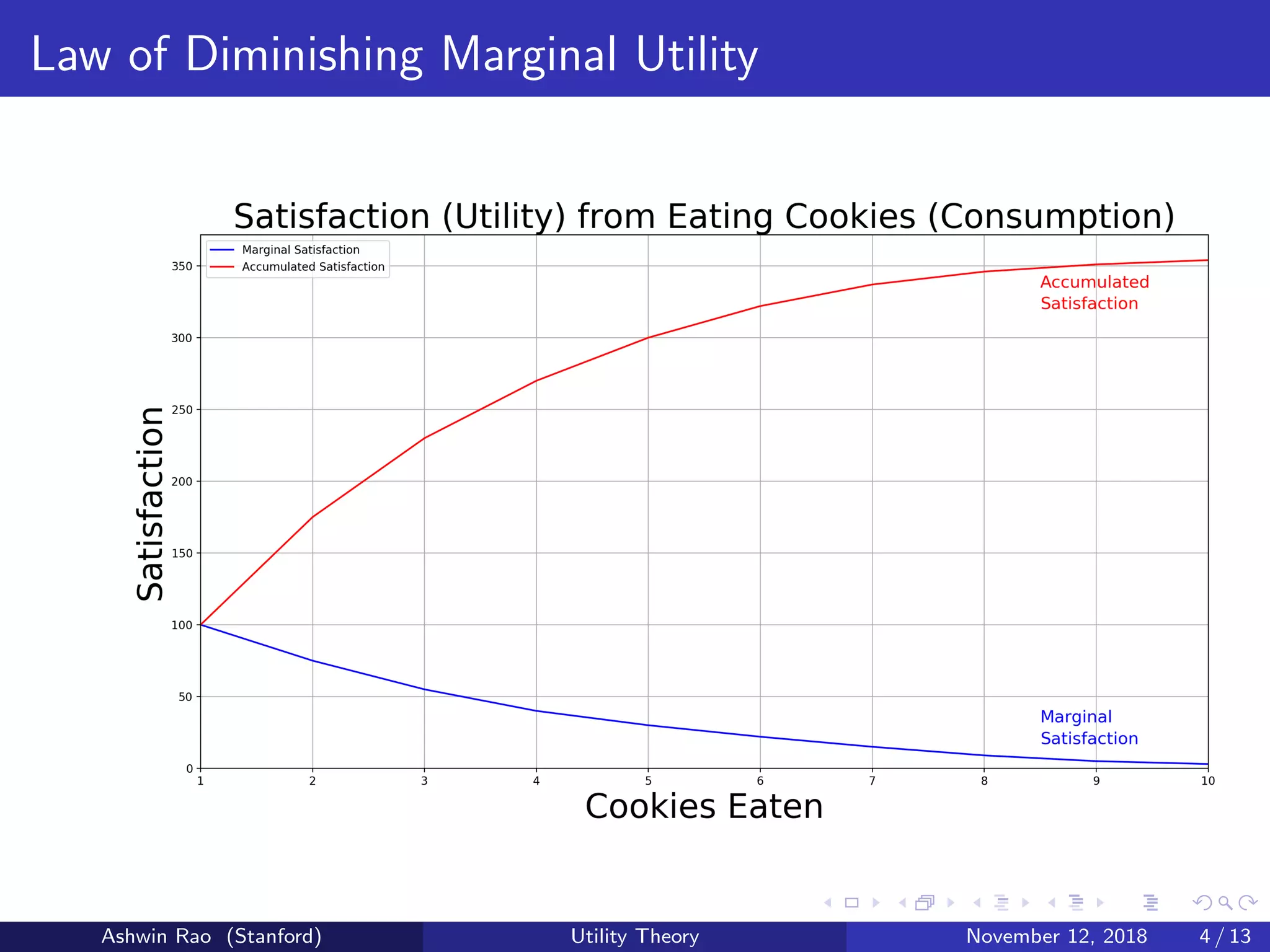
Law of Diminishing Marginal Utility
Ashwin Rao (Stanford) Utility Theory November 12, 2018 4 / 13
Utility of Consumption and Certainty-Equivalent Value
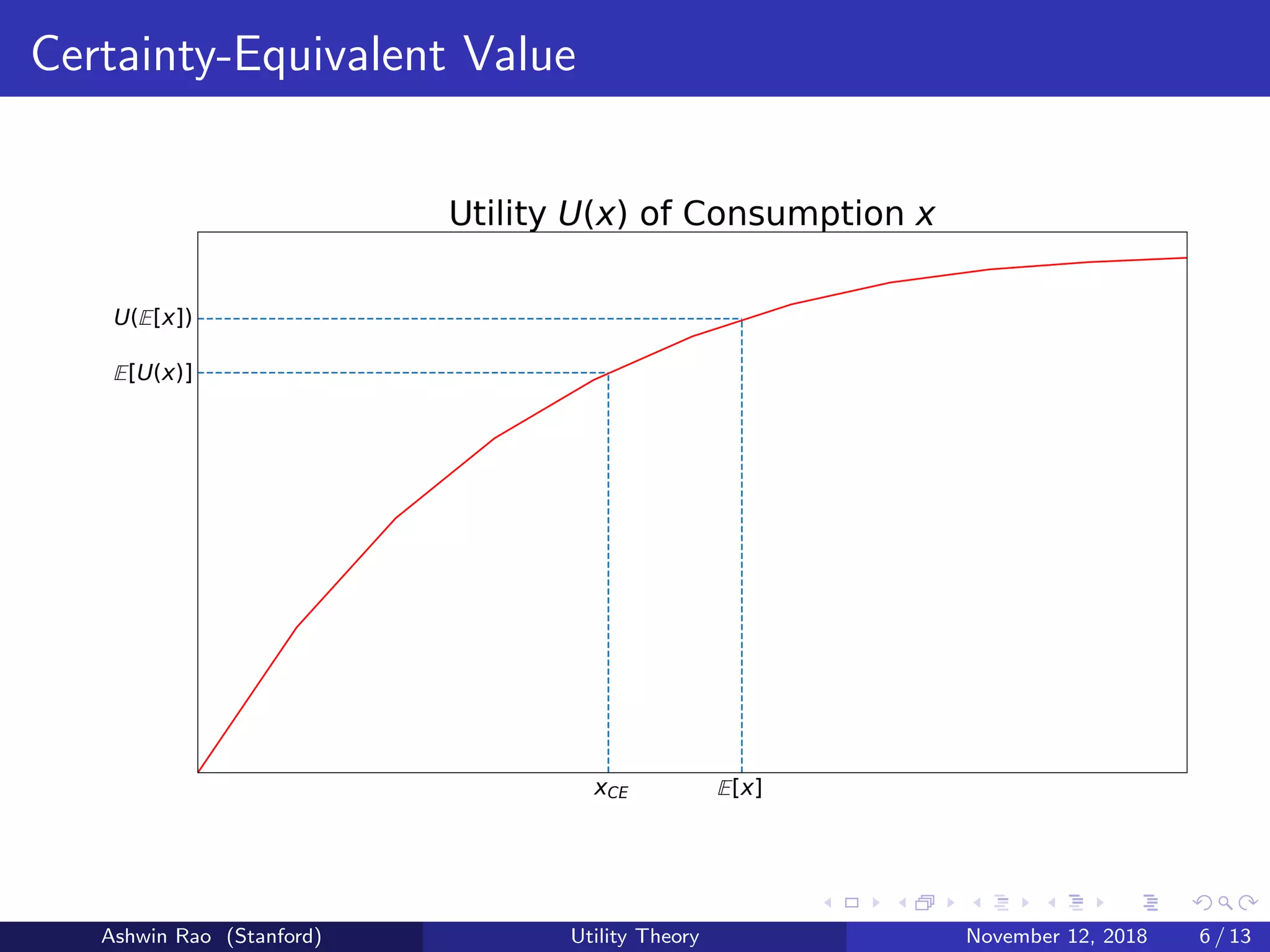
Marginal Satisfaction of eating cookies is a diminishing function
Hence, Accumulated Satisfaction is a concave function
Accumulated Satisfaction represents Utility of Consumption U(x)
Where x represents the uncertain outcome being consumed
Degree of concavity represents extent of our Risk-Aversion
Concave U(·) function ⇒ E[U(x)] < U(E[x])
We define Certainty-Equivalent Value xCE = U−1(E[U(x)])
Denotes certain amount we’d pay to consume an uncertain outcome
Absolute Risk-Premium πA = E[x] − xCE
Relative Risk-Premium πR = πA
E[x] = E[x]−xCE
E[x] = 1 − xCE
E[x]
Ashwin Rao (Stanford) Utility Theory November 12, 2018 5 / 13
Certainty-Equivalent Value
Ashwin Rao (Stanford) Utility Theory November 12, 2018 6 / 13
Calculating the Risk-Premium
We develop mathematical formalism to calculate Risk-Premia πA, πR
To lighten notation, we refer to E[x] as ¯x and Variance of x as σ2
x
Taylor-expand U(x) around ¯x, ignoring terms beyond quadratic
U(x) ≈ U(¯x) + U (¯x) · (x − ¯x) +
1
2
U (¯x) · (x − ¯x)2
Taylor-expand U(xCE ) around ¯x, ignoring terms beyond linear
U(xCE ) ≈ U(¯x) + U (¯x) · (xCE − ¯x)
Taking the expectation of the U(x) expansion, we get:
E[U(x)] ≈ U(¯x) +
1
2
· U (¯x) · σ2
x
Since E[U(x)] = U(xCE ), the above two expressions are equal. Hence,
U (¯x) · (xCE − ¯x) =
1
2
· U (¯x) · σ2
x
Ashwin Rao (Stanford) Utility Theory November 12, 2018 7 / 13
Absolute & Relative Risk-Aversion
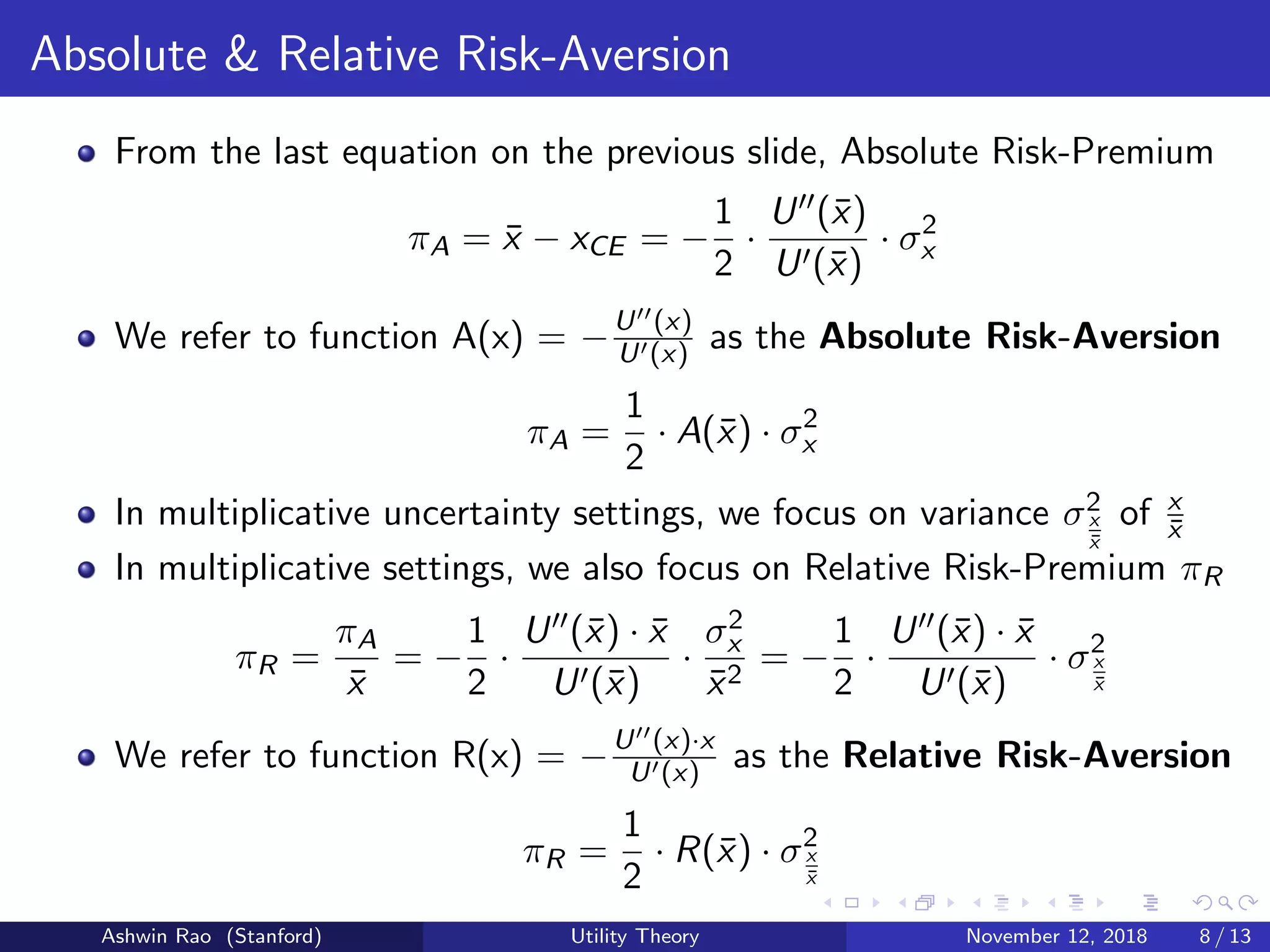
From the last equation on the previous slide, Absolute Risk-Premium
πA = ¯x − xCE = −
1
2
·
U (¯x)
U (¯x)
· σ2
x
We refer to function A(x) = −U (x)
U (x) as the Absolute Risk-Aversion
πA =
1
2
· A(¯x) · σ2
x
In multiplicative uncertainty settings, we focus on variance σ2
x
¯x
of x
¯x
In multiplicative settings, we also focus on Relative Risk-Premium πR
πR =
πA
¯x
= −
1
2
·
U (¯x) · ¯x
U (¯x)
·
σ2
x
¯x2
= −
1
2
·
U (¯x) · ¯x
U (¯x)
· σ2
x
¯x
We refer to function R(x) = −U (x)·x
U (x) as the Relative Risk-Aversion
πR =
1
2
· R(¯x) · σ2
x
¯x
Ashwin Rao (Stanford) Utility Theory November 12, 2018 8 / 13
Taking stock of what we’re learning here
We’ve shown that Risk-Premium can be expressed as the product of:
Extent of Risk-Aversion: either A(¯x) or R(¯x)
Extent of uncertainty of outcome: either σ2
x or σ2
x
¯x
We’ve expressed the extent of Risk-Aversion as the ratio of:
Concavity of the Utility function (at ¯x): −U (¯x)
Slope of the Utility function (at ¯x): U (¯x)
For optimization problems, we ought to maximize E[U(x)] (not E[x])
Linear Utility function U(x) = a + b · x implies Risk-Neutrality
Now we look at typically-used Utility functions U(·) with:
Constant Absolute Risk-Aversion (CARA)
Constant Relative Risk-Aversion (CRRA)
Ashwin Rao (Stanford) Utility Theory November 12, 2018 9 / 13
Constant Absolute Risk-Aversion (CARA)
Consider the Utility function U(x) = −e−ax
Absolute Risk-Aversion A(x) = −U (x)
U (x) = a
a is called Coefficient of Constant Absolute Risk-Aversion (CARA)
If the random outcome x ∼ N(µ, σ2),
E[U(x)] = −e−aµ+a2σ2
2
xCE = µ −
aσ2
2
Absolute Risk Premium πA = µ − xCE =
aσ2
2
For optimization problems where σ2 is a function of µ, we seek the
distribution that maximizes µ − aσ2
2
Ashwin Rao (Stanford) Utility Theory November 12, 2018 10 / 13
Constant Relative Risk-Aversion (CRRA)
Consider the Utility function U(x) = x1−γ
1−γ for γ = 1
Relative Risk-Aversion R(x) = −U (x)·x
U (x) = γ
γ is called Coefficient of Constant Relative Risk-Aversion (CRRA)
For γ = 1, U(x) = log(x) (note: R(x) = −U (x)·x
U (x) = 1)
If the random outcome x is lognormal, with log(x) ∼ N(µ, σ2),
E[U(x)] =



eµ(1−γ)+ σ2
2 (1−γ)2
1−γ for γ = 1
µ for γ = 1
xCE = eµ+σ2
2
(1−γ)
Relative Risk Premium πR = 1 −
xCE
¯x
= 1 − e−σ2γ
2
Ashwin Rao (Stanford) Utility Theory November 12, 2018 11 / 13
A Portfolio application of CRRA (Merton 1969)
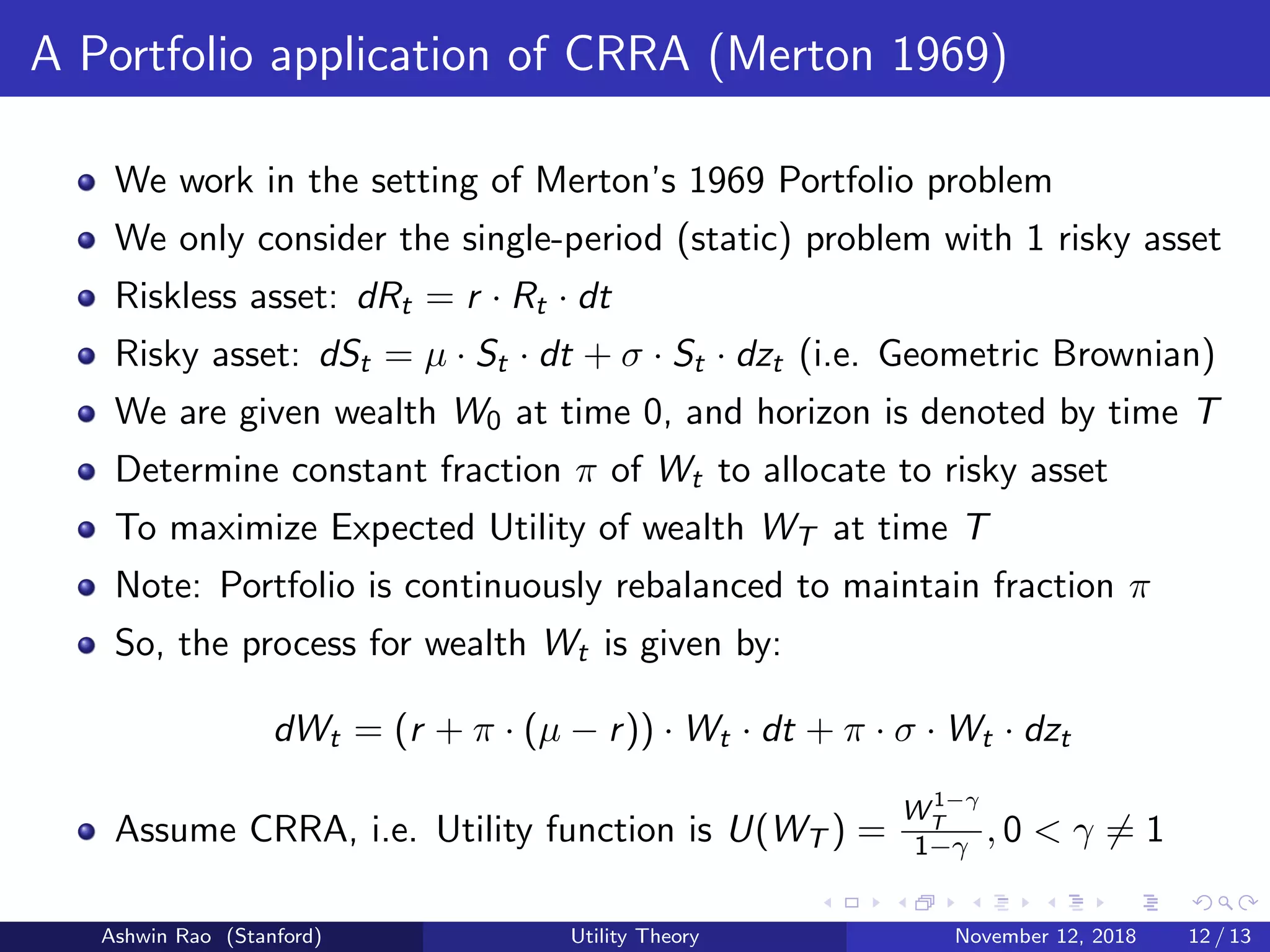
We work in the setting of Merton’s 1969 Portfolio problem
We only consider the single-period (static) problem with 1 risky asset
Riskless asset: dRt = r · Rt · dt
Risky asset: dSt = µ · St · dt + σ · St · dzt (i.e. Geometric Brownian)
We are given wealth W0 at time 0, and horizon is denoted by time T
Determine constant fraction π of Wt to allocate to risky asset
To maximize Expected Utility of wealth WT at time T
Note: Portfolio is continuously rebalanced to maintain fraction π
So, the process for wealth Wt is given by:
dWt = (r + π · (µ − r)) · Wt · dt + π · σ · Wt · dzt
Assume CRRA, i.e. Utility function is U(WT ) =
W 1−γ
T
1−γ , 0 < γ = 1
Ashwin Rao (Stanford) Utility Theory November 12, 2018 12 / 13
Recovering Merton’s solution (for this static case)
Applying Ito’s Lemma on log(Wt) gives us:
WT = W0 · e
T
0 (r+π(µ−r)−π2σ2
2
)·dt+ T
0 π·σ·dzt
We want to maximize log(E[U(WT )]) = log(E[
W 1−γ
T
1−γ ])
E[
W 1−γ
T
1 − γ
] =
W 1−γ
0
1 − γ
· E[e
T
0 (r+π(µ−r)−π2σ2
2
)·(1−γ)·dt+ T
0 π·σ·(1−γ)·dzt
]
=
W 1−γ
0
1 − γ
· e(r+π(µ−r)−π2σ2
2
)(1−γ)T+
π2σ2(1−γ)2T
2
∂{log(E[
W 1−γ
T
1−γ ])}
∂π
= (1 − γ) · T ·
∂{r + π(µ − r) − π2σ2γ
2 }
∂π
= 0
⇒ π =
µ − r
σ2γ
Ashwin Rao (Stanford) Utility Theory November 12, 2018 13 / 13

Risk-Aversion, Risk-Premium and Utility Theory

  • 1.
    Understanding Risk-Aversion throughUtility Theory Ashwin Rao ICME, Stanford University November 12, 2018 Ashwin Rao (Stanford) Utility Theory November 12, 2018 1 / 13
  • 2.
    Intuition on Risk-Aversionand Risk-Premium Game where your payoff is based on outcome of a fair coin You get $100 for HEAD and $0 for TAIL How much would you pay to play this game? You immediately say: “Of course, $50” Then you think a bit, and say: “A little less than $50” Less because you want to “be compensated for taking the risk” The word Risk refers to the degree of variation of the outcome We call this risk-compensation as Risk-Premium Our personality-based degree of risk fear is known as Risk-Aversion So, we end up paying $50 minus Risk-Premium to play the game Risk-Premium grows with Outcome-Variance & Risk-Aversion Ashwin Rao (Stanford) Utility Theory November 12, 2018 2 / 13
  • 3.
    Specifying Risk-Aversion througha Utility function So the amount we’d pay to consume a random outcome involves The Mean of the outcome (often called Reward) The Variance of the outcome (Risk) Our personal degree of Risk-Aversion More generally, we want a “valuation formula” that combines: The entire probability distribution of the random outcome A function of the outcome that captures our Risk-Aversion This function of the outcome is called Utility (denoted U) It relates to a fundamental concept called Utility of Consumption We will illustrate this economic concept with a real-life example Ashwin Rao (Stanford) Utility Theory November 12, 2018 3 / 13
  • 4.
    Law of DiminishingMarginal Utility Ashwin Rao (Stanford) Utility Theory November 12, 2018 4 / 13
  • 5.
    Utility of Consumptionand Certainty-Equivalent Value Marginal Satisfaction of eating cookies is a diminishing function Hence, Accumulated Satisfaction is a concave function Accumulated Satisfaction represents Utility of Consumption U(x) Where x represents the uncertain outcome being consumed Degree of concavity represents extent of our Risk-Aversion Concave U(·) function ⇒ E[U(x)] < U(E[x]) We define Certainty-Equivalent Value xCE = U−1(E[U(x)]) Denotes certain amount we’d pay to consume an uncertain outcome Absolute Risk-Premium πA = E[x] − xCE Relative Risk-Premium πR = πA E[x] = E[x]−xCE E[x] = 1 − xCE E[x] Ashwin Rao (Stanford) Utility Theory November 12, 2018 5 / 13
  • 6.
    Certainty-Equivalent Value Ashwin Rao(Stanford) Utility Theory November 12, 2018 6 / 13
  • 7.
    Calculating the Risk-Premium Wedevelop mathematical formalism to calculate Risk-Premia πA, πR To lighten notation, we refer to E[x] as ¯x and Variance of x as σ2 x Taylor-expand U(x) around ¯x, ignoring terms beyond quadratic U(x) ≈ U(¯x) + U (¯x) · (x − ¯x) + 1 2 U (¯x) · (x − ¯x)2 Taylor-expand U(xCE ) around ¯x, ignoring terms beyond linear U(xCE ) ≈ U(¯x) + U (¯x) · (xCE − ¯x) Taking the expectation of the U(x) expansion, we get: E[U(x)] ≈ U(¯x) + 1 2 · U (¯x) · σ2 x Since E[U(x)] = U(xCE ), the above two expressions are equal. Hence, U (¯x) · (xCE − ¯x) = 1 2 · U (¯x) · σ2 x Ashwin Rao (Stanford) Utility Theory November 12, 2018 7 / 13
  • 8.
    Absolute & RelativeRisk-Aversion From the last equation on the previous slide, Absolute Risk-Premium πA = ¯x − xCE = − 1 2 · U (¯x) U (¯x) · σ2 x We refer to function A(x) = −U (x) U (x) as the Absolute Risk-Aversion πA = 1 2 · A(¯x) · σ2 x In multiplicative uncertainty settings, we focus on variance σ2 x ¯x of x ¯x In multiplicative settings, we also focus on Relative Risk-Premium πR πR = πA ¯x = − 1 2 · U (¯x) · ¯x U (¯x) · σ2 x ¯x2 = − 1 2 · U (¯x) · ¯x U (¯x) · σ2 x ¯x We refer to function R(x) = −U (x)·x U (x) as the Relative Risk-Aversion πR = 1 2 · R(¯x) · σ2 x ¯x Ashwin Rao (Stanford) Utility Theory November 12, 2018 8 / 13
  • 9.
    Taking stock ofwhat we’re learning here We’ve shown that Risk-Premium can be expressed as the product of: Extent of Risk-Aversion: either A(¯x) or R(¯x) Extent of uncertainty of outcome: either σ2 x or σ2 x ¯x We’ve expressed the extent of Risk-Aversion as the ratio of: Concavity of the Utility function (at ¯x): −U (¯x) Slope of the Utility function (at ¯x): U (¯x) For optimization problems, we ought to maximize E[U(x)] (not E[x]) Linear Utility function U(x) = a + b · x implies Risk-Neutrality Now we look at typically-used Utility functions U(·) with: Constant Absolute Risk-Aversion (CARA) Constant Relative Risk-Aversion (CRRA) Ashwin Rao (Stanford) Utility Theory November 12, 2018 9 / 13
  • 10.
    Constant Absolute Risk-Aversion(CARA) Consider the Utility function U(x) = −e−ax Absolute Risk-Aversion A(x) = −U (x) U (x) = a a is called Coefficient of Constant Absolute Risk-Aversion (CARA) If the random outcome x ∼ N(µ, σ2), E[U(x)] = −e−aµ+a2σ2 2 xCE = µ − aσ2 2 Absolute Risk Premium πA = µ − xCE = aσ2 2 For optimization problems where σ2 is a function of µ, we seek the distribution that maximizes µ − aσ2 2 Ashwin Rao (Stanford) Utility Theory November 12, 2018 10 / 13
  • 11.
    Constant Relative Risk-Aversion(CRRA) Consider the Utility function U(x) = x1−γ 1−γ for γ = 1 Relative Risk-Aversion R(x) = −U (x)·x U (x) = γ γ is called Coefficient of Constant Relative Risk-Aversion (CRRA) For γ = 1, U(x) = log(x) (note: R(x) = −U (x)·x U (x) = 1) If the random outcome x is lognormal, with log(x) ∼ N(µ, σ2), E[U(x)] =    eµ(1−γ)+ σ2 2 (1−γ)2 1−γ for γ = 1 µ for γ = 1 xCE = eµ+σ2 2 (1−γ) Relative Risk Premium πR = 1 − xCE ¯x = 1 − e−σ2γ 2 Ashwin Rao (Stanford) Utility Theory November 12, 2018 11 / 13
  • 12.
    A Portfolio applicationof CRRA (Merton 1969) We work in the setting of Merton’s 1969 Portfolio problem We only consider the single-period (static) problem with 1 risky asset Riskless asset: dRt = r · Rt · dt Risky asset: dSt = µ · St · dt + σ · St · dzt (i.e. Geometric Brownian) We are given wealth W0 at time 0, and horizon is denoted by time T Determine constant fraction π of Wt to allocate to risky asset To maximize Expected Utility of wealth WT at time T Note: Portfolio is continuously rebalanced to maintain fraction π So, the process for wealth Wt is given by: dWt = (r + π · (µ − r)) · Wt · dt + π · σ · Wt · dzt Assume CRRA, i.e. Utility function is U(WT ) = W 1−γ T 1−γ , 0 < γ = 1 Ashwin Rao (Stanford) Utility Theory November 12, 2018 12 / 13
  • 13.
    Recovering Merton’s solution(for this static case) Applying Ito’s Lemma on log(Wt) gives us: WT = W0 · e T 0 (r+π(µ−r)−π2σ2 2 )·dt+ T 0 π·σ·dzt We want to maximize log(E[U(WT )]) = log(E[ W 1−γ T 1−γ ]) E[ W 1−γ T 1 − γ ] = W 1−γ 0 1 − γ · E[e T 0 (r+π(µ−r)−π2σ2 2 )·(1−γ)·dt+ T 0 π·σ·(1−γ)·dzt ] = W 1−γ 0 1 − γ · e(r+π(µ−r)−π2σ2 2 )(1−γ)T+ π2σ2(1−γ)2T 2 ∂{log(E[ W 1−γ T 1−γ ])} ∂π = (1 − γ) · T · ∂{r + π(µ − r) − π2σ2γ 2 } ∂π = 0 ⇒ π = µ − r σ2γ Ashwin Rao (Stanford) Utility Theory November 12, 2018 13 / 13