Chapter 3
Introduction
to
Risk Management
Copyright ©2014 Pearson Education, Inc. All rights reserved. 3-2
Agenda
• Meaning of Risk Management
• Objectives of Risk Management
• Steps in the Risk Management Process
• Benefits of Risk Management
• Personal Risk Management
Copyright ©2014 Pearson Education, Inc. All rights reserved. 3-3
Meaning of Risk Management
• Risk Management is a process that
identifies loss exposures faced by an
organization and selects the most
appropriate techniques for treating such
exposures
• A loss exposure is any situation or
circumstance in which a loss is possible,
regardless of whether a loss occurs
– E.g., a plant that may be damaged by an
earthquake, or an automobile that may be
damaged in a collision
Copyright ©2014 Pearson Education, Inc. All rights reserved. 3-4
Objectives of Risk Management
• Risk management has objectives
before and after a loss occurs
• Pre-loss objectives:
– Prepare for potential losses in the most
economical way
– Reduce anxiety
– Meet any legal obligations
Copyright ©2014 Pearson Education, Inc. All rights reserved. 3-5
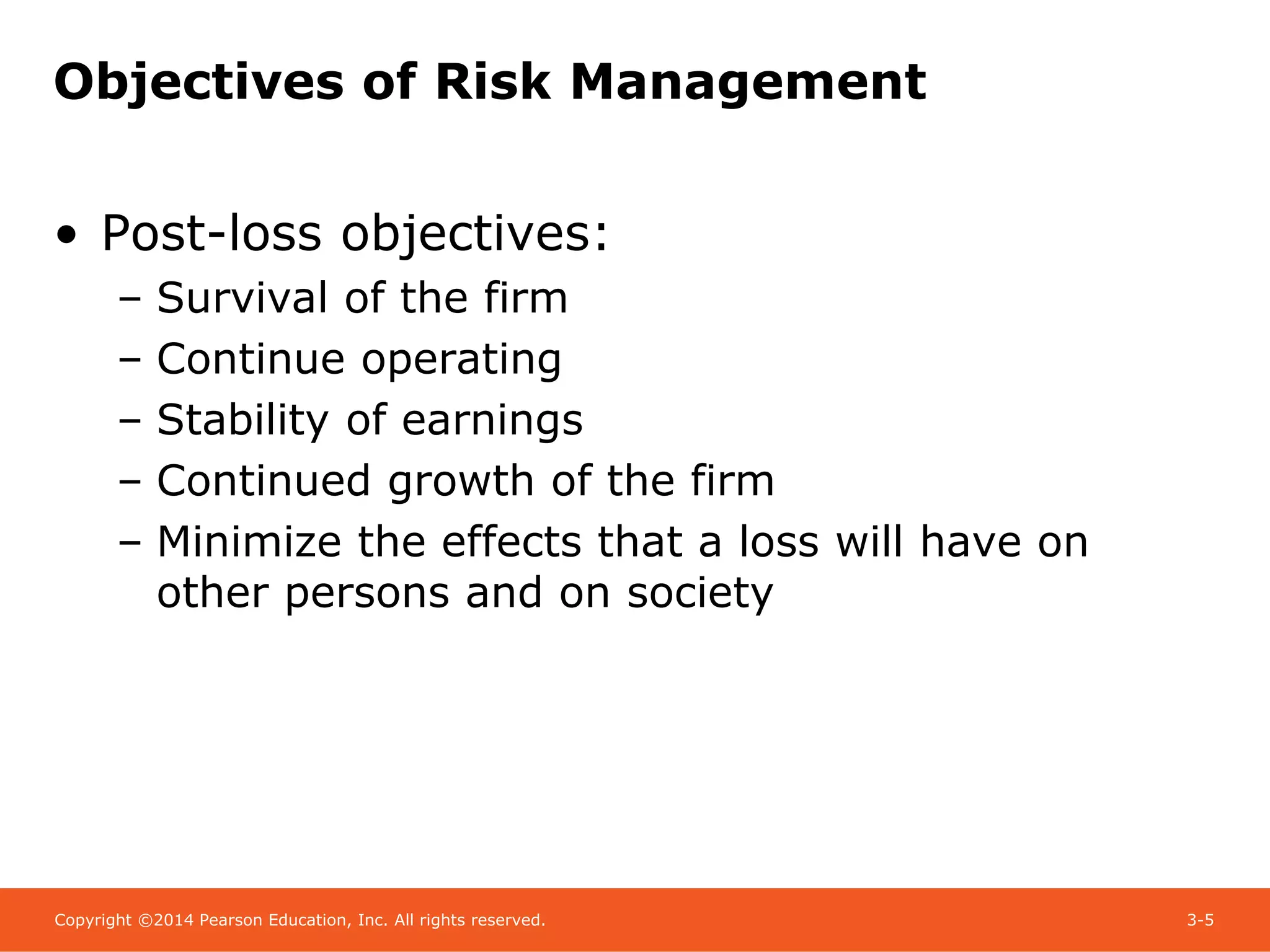
Objectives of Risk Management
• Post-loss objectives:
– Survival of the firm
– Continue operating
– Stability of earnings
– Continued growth of the firm
– Minimize the effects that a loss will have on
other persons and on society
Copyright ©2014 Pearson Education, Inc. All rights reserved. 3-6
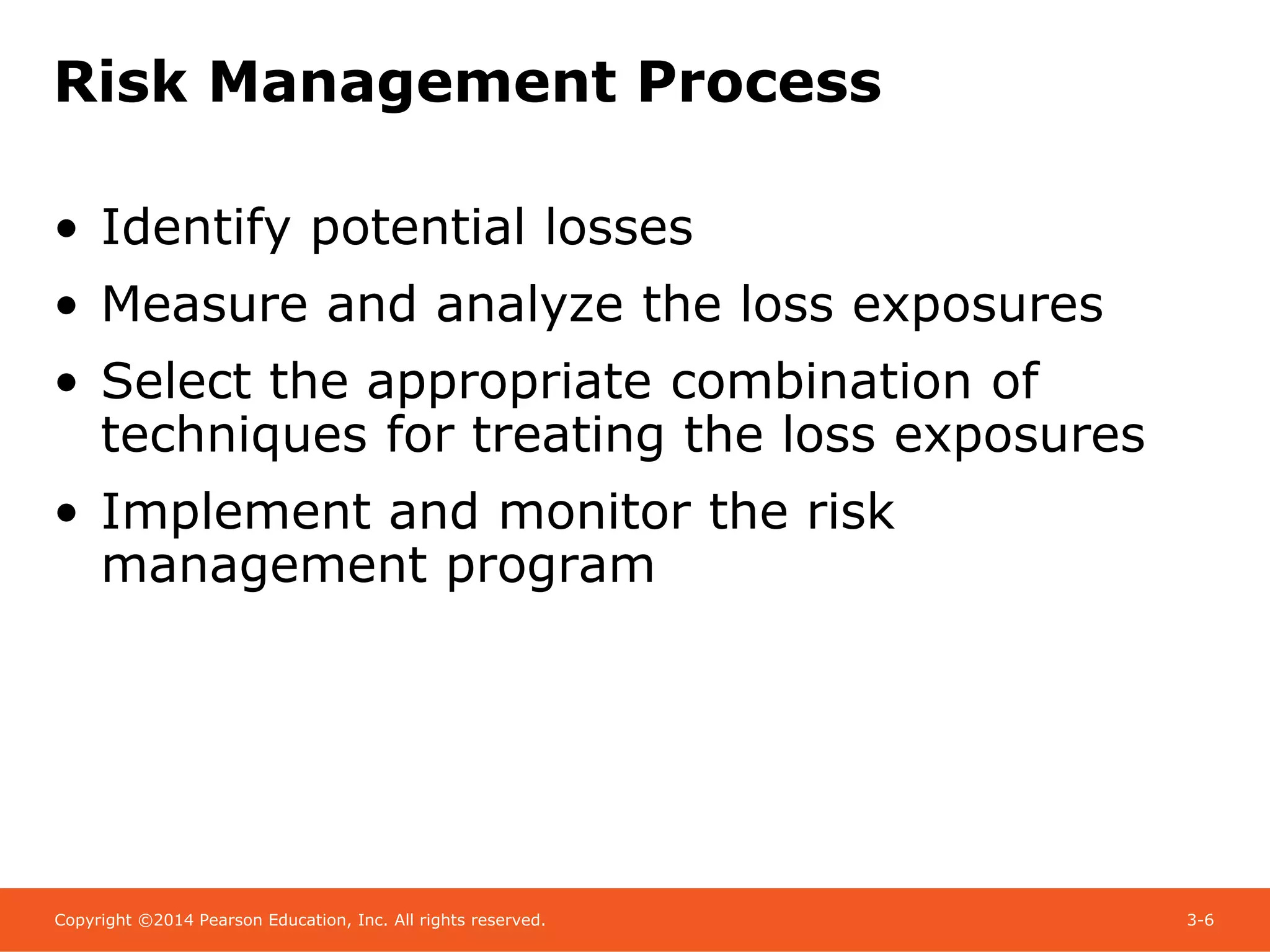
Risk Management Process
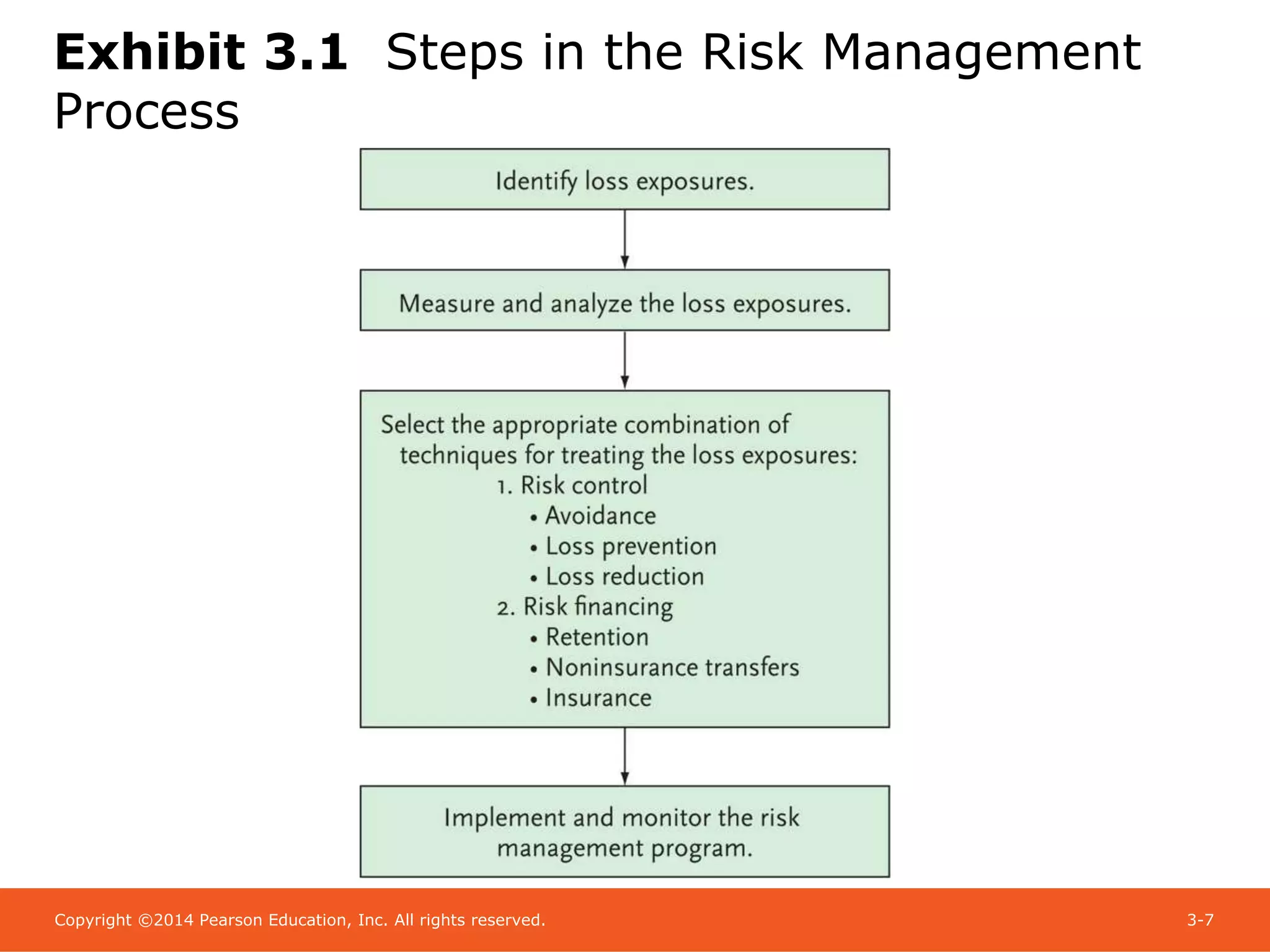
• Identify potential losses
• Measure and analyze the loss exposures
• Select the appropriate combination of
techniques for treating the loss exposures
• Implement and monitor the risk
management program
Copyright ©2014 Pearson Education, Inc. All rights reserved. 3-7
Exhibit 3.1 Steps in the Risk Management
Process
Copyright ©2014 Pearson Education, Inc. All rights reserved. 3-8
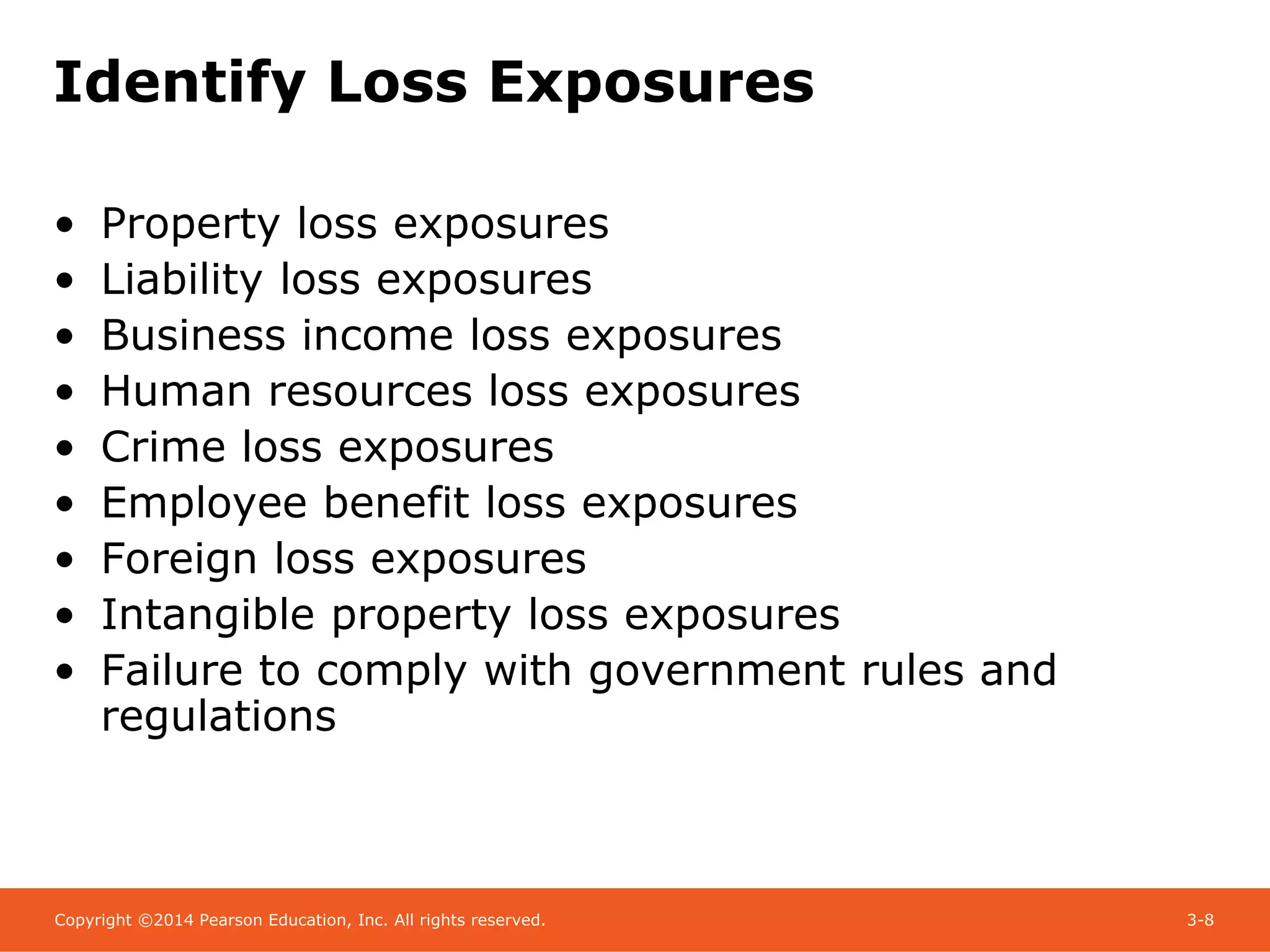
Identify Loss Exposures
• Property loss exposures
• Liability loss exposures
• Business income loss exposures
• Human resources loss exposures
• Crime loss exposures
• Employee benefit loss exposures
• Foreign loss exposures
• Intangible property loss exposures
• Failure to comply with government rules and
regulations
Copyright ©2014 Pearson Education, Inc. All rights reserved. 3-9
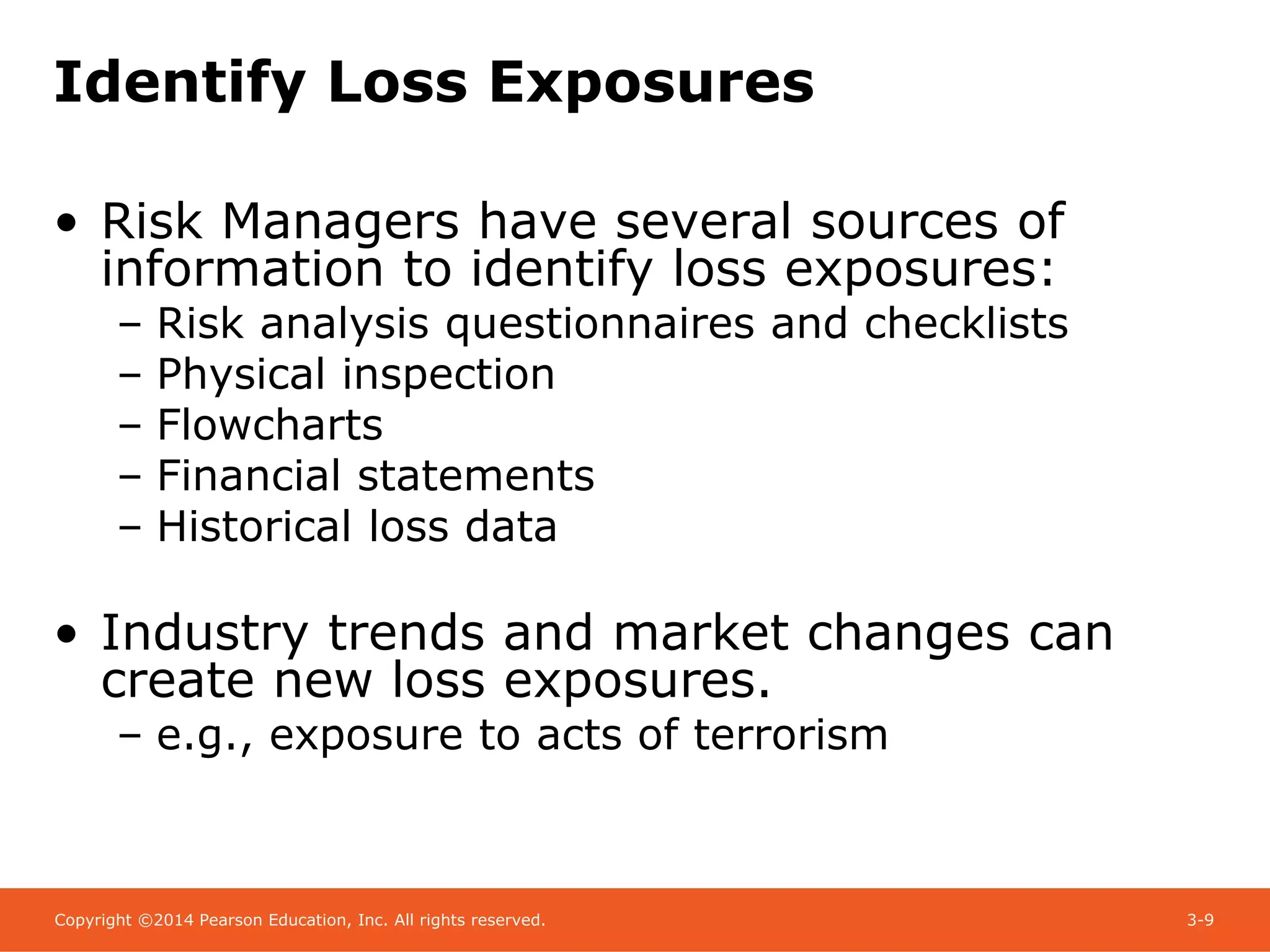
Identify Loss Exposures
• Risk Managers have several sources of
information to identify loss exposures:
– Risk analysis questionnaires and checklists
– Physical inspection
– Flowcharts
– Financial statements
– Historical loss data
• Industry trends and market changes can
create new loss exposures.
– e.g., exposure to acts of terrorism
Copyright ©2014 Pearson Education, Inc. All rights reserved. 3-10
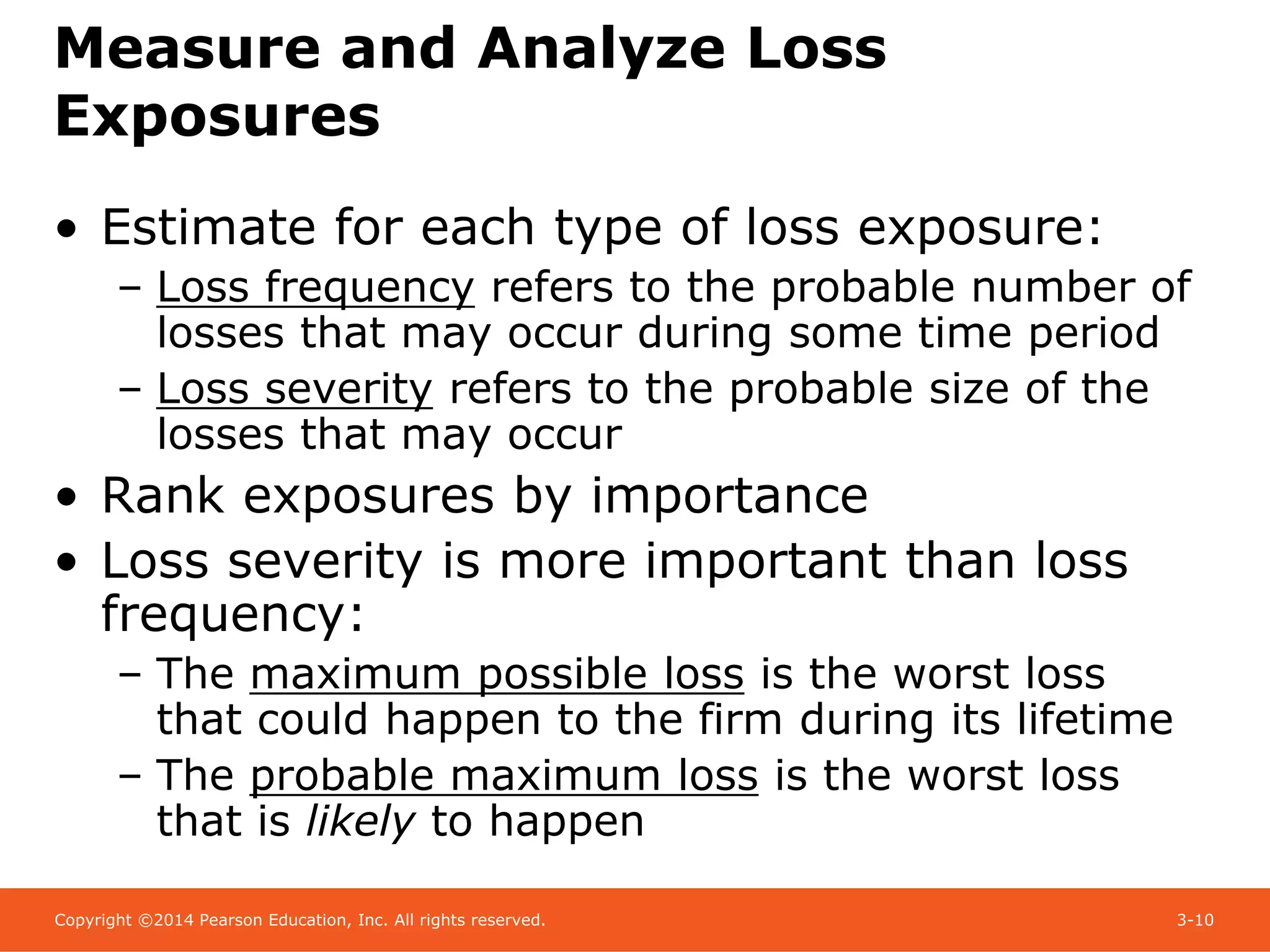
Measure and Analyze Loss
Exposures
• Estimate for each type of loss exposure:
– Loss frequency refers to the probable number of
losses that may occur during some time period
– Loss severity refers to the probable size of the
losses that may occur
• Rank exposures by importance
• Loss severity is more important than loss
frequency:
– The maximum possible loss is the worst loss
that could happen to the firm during its lifetime
– The probable maximum loss is the worst loss
that is likely to happen
Copyright ©2014 Pearson Education, Inc. All rights reserved. 3-11
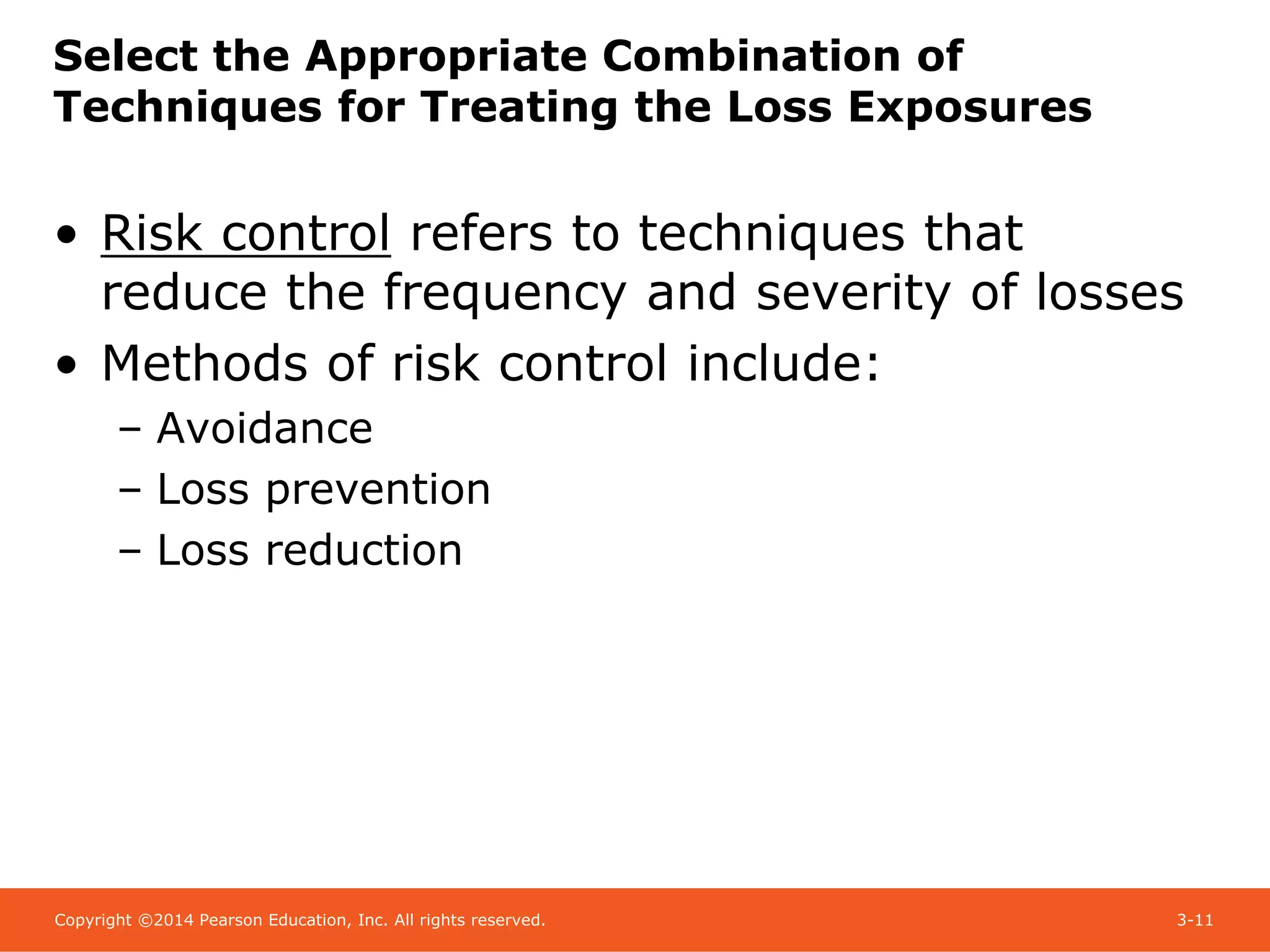
Select the Appropriate Combination of
Techniques for Treating the Loss Exposures
• Risk control refers to techniques that
reduce the frequency and severity of losses
• Methods of risk control include:
– Avoidance
– Loss prevention
– Loss reduction
Copyright ©2014 Pearson Education, Inc. All rights reserved. 3-12
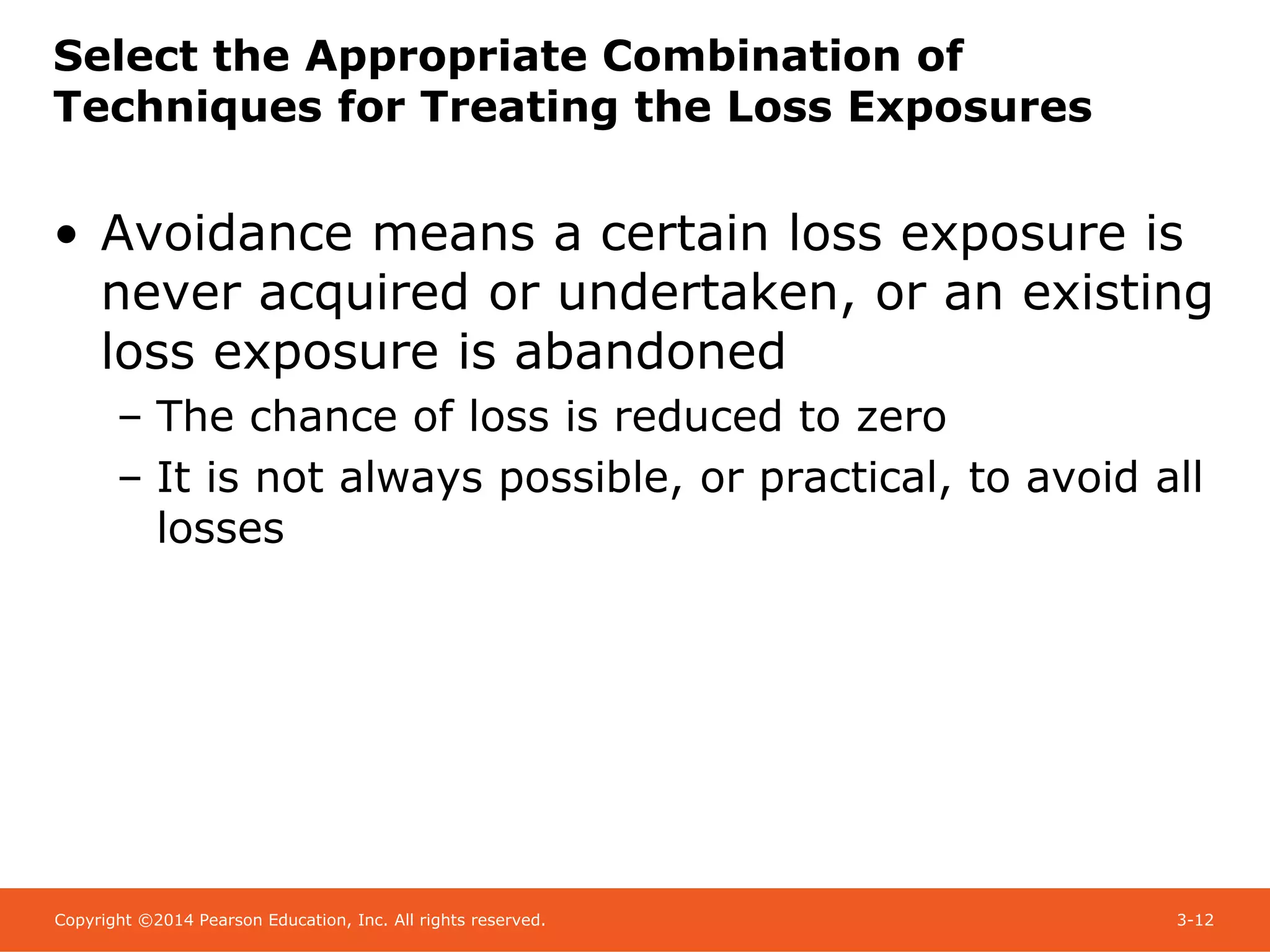
Select the Appropriate Combination of
Techniques for Treating the Loss Exposures
• Avoidance means a certain loss exposure is
never acquired or undertaken, or an existing
loss exposure is abandoned
– The chance of loss is reduced to zero
– It is not always possible, or practical, to avoid all
losses
Copyright ©2014 Pearson Education, Inc. All rights reserved. 3-13
Select the Appropriate Combination of
Techniques for Treating the Loss Exposures
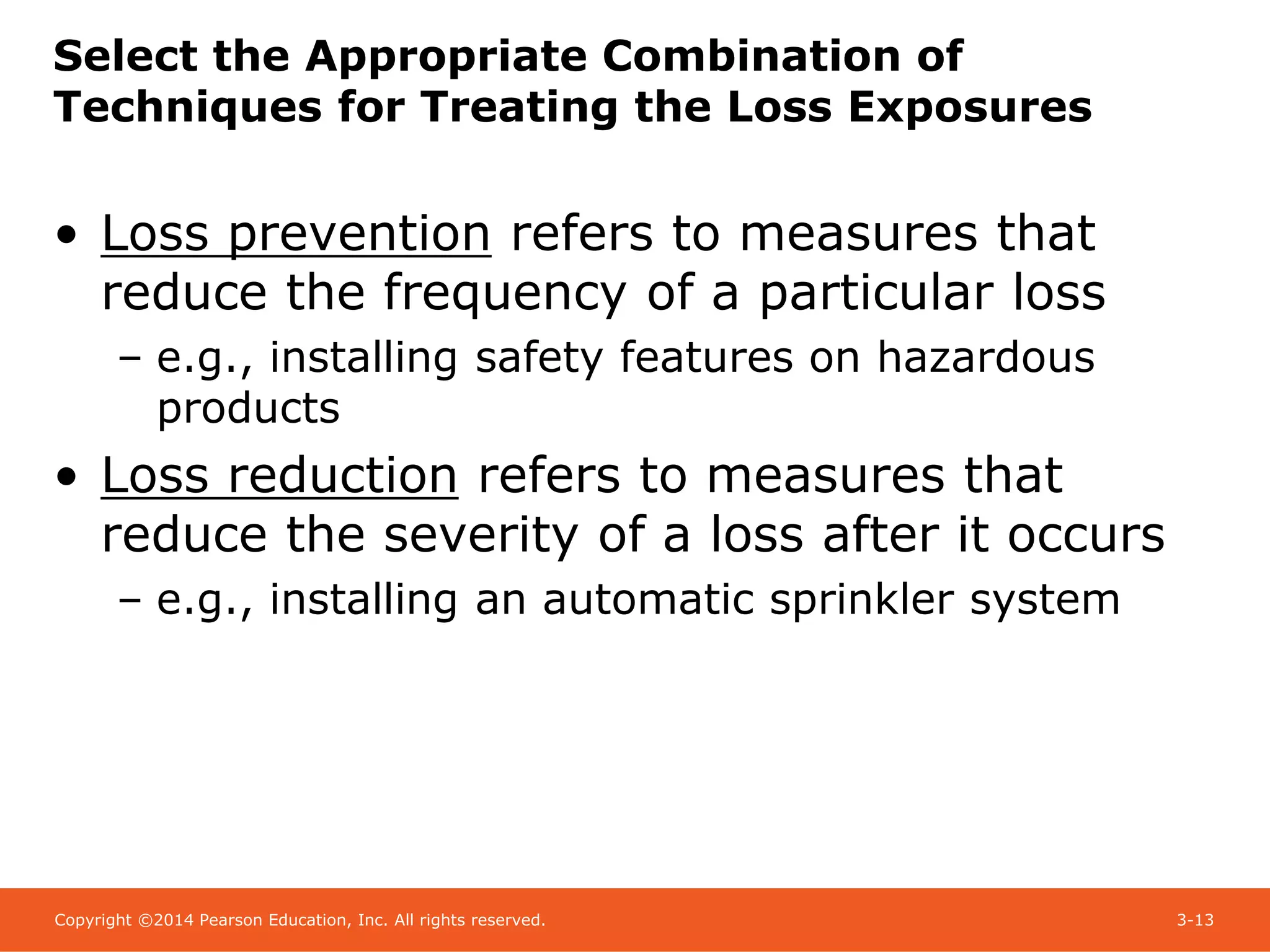
• Loss prevention refers to measures that
reduce the frequency of a particular loss
– e.g., installing safety features on hazardous
products
• Loss reduction refers to measures that
reduce the severity of a loss after it occurs
– e.g., installing an automatic sprinkler system
Copyright ©2014 Pearson Education, Inc. All rights reserved. 3-14
Select the Appropriate Combination of
Techniques for Treating the Loss Exposures
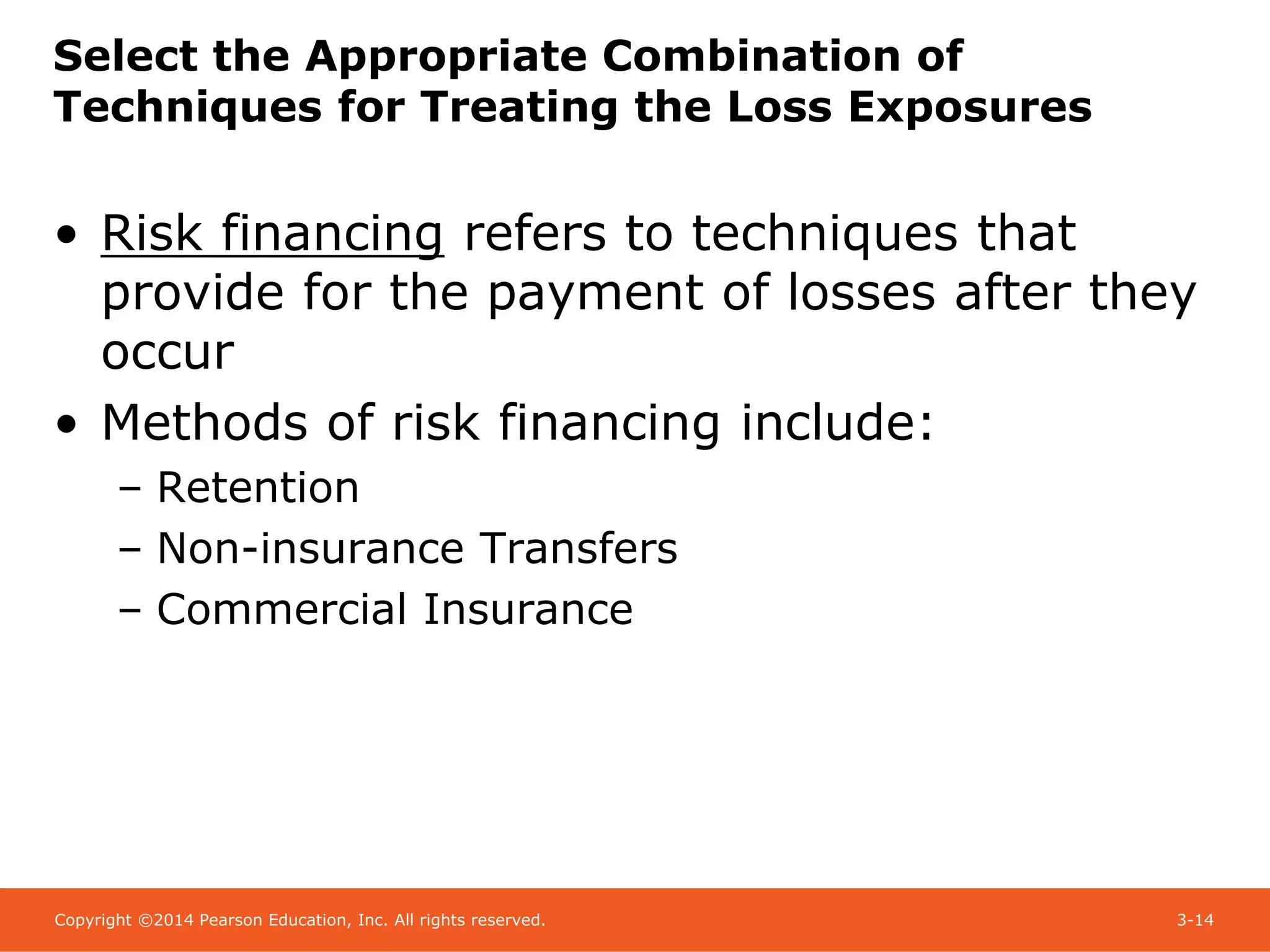
• Risk financing refers to techniques that
provide for the payment of losses after they
occur
• Methods of risk financing include:
– Retention
– Non-insurance Transfers
– Commercial Insurance
Copyright ©2014 Pearson Education, Inc. All rights reserved. 3-15
Risk Financing Methods: Retention
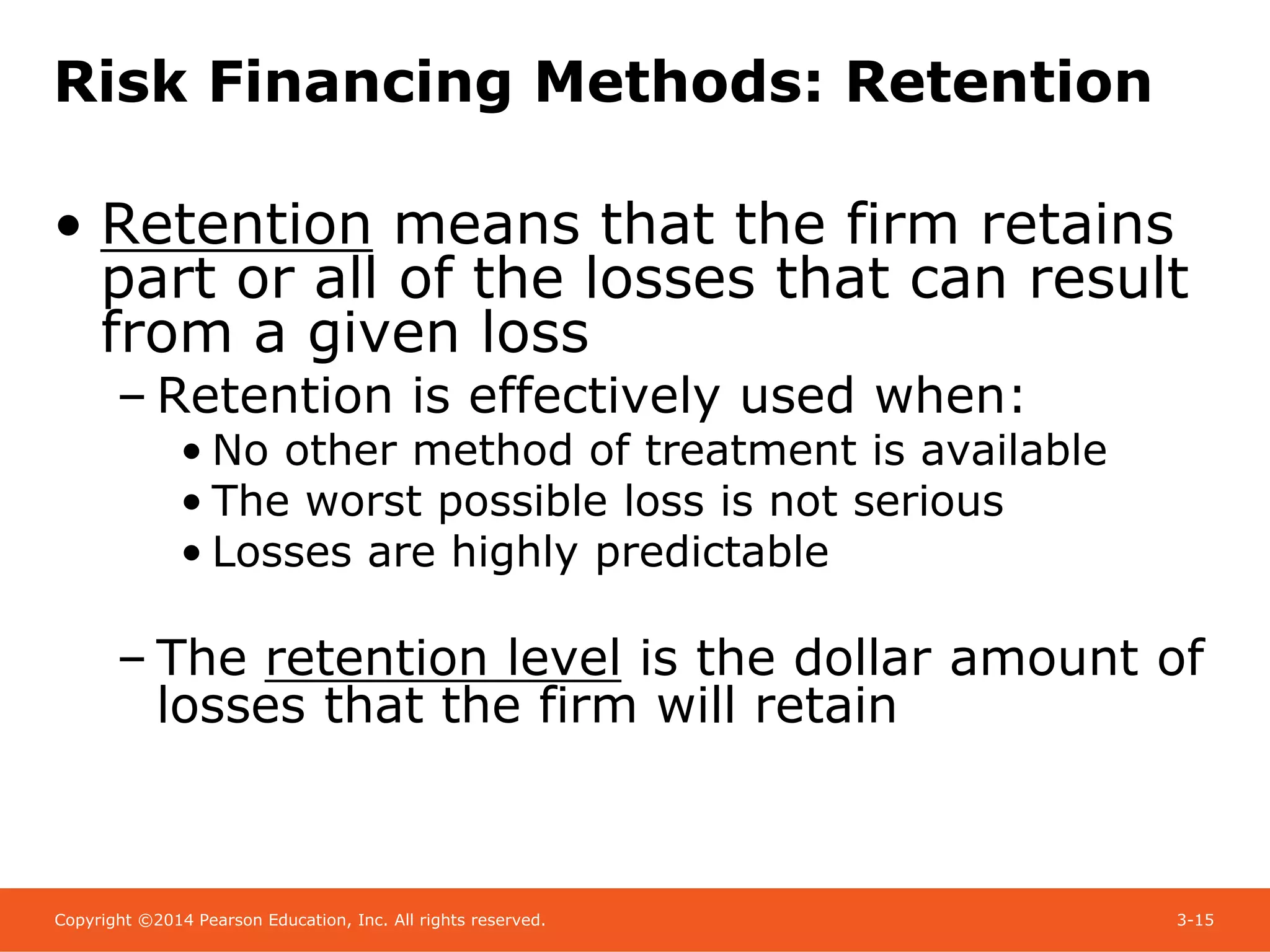
• Retention means that the firm retains
part or all of the losses that can result
from a given loss
– Retention is effectively used when:
• No other method of treatment is available
• The worst possible loss is not serious
• Losses are highly predictable
– The retention level is the dollar amount of
losses that the firm will retain
Copyright ©2014 Pearson Education, Inc. All rights reserved. 3-16
Risk Financing Methods: Retention
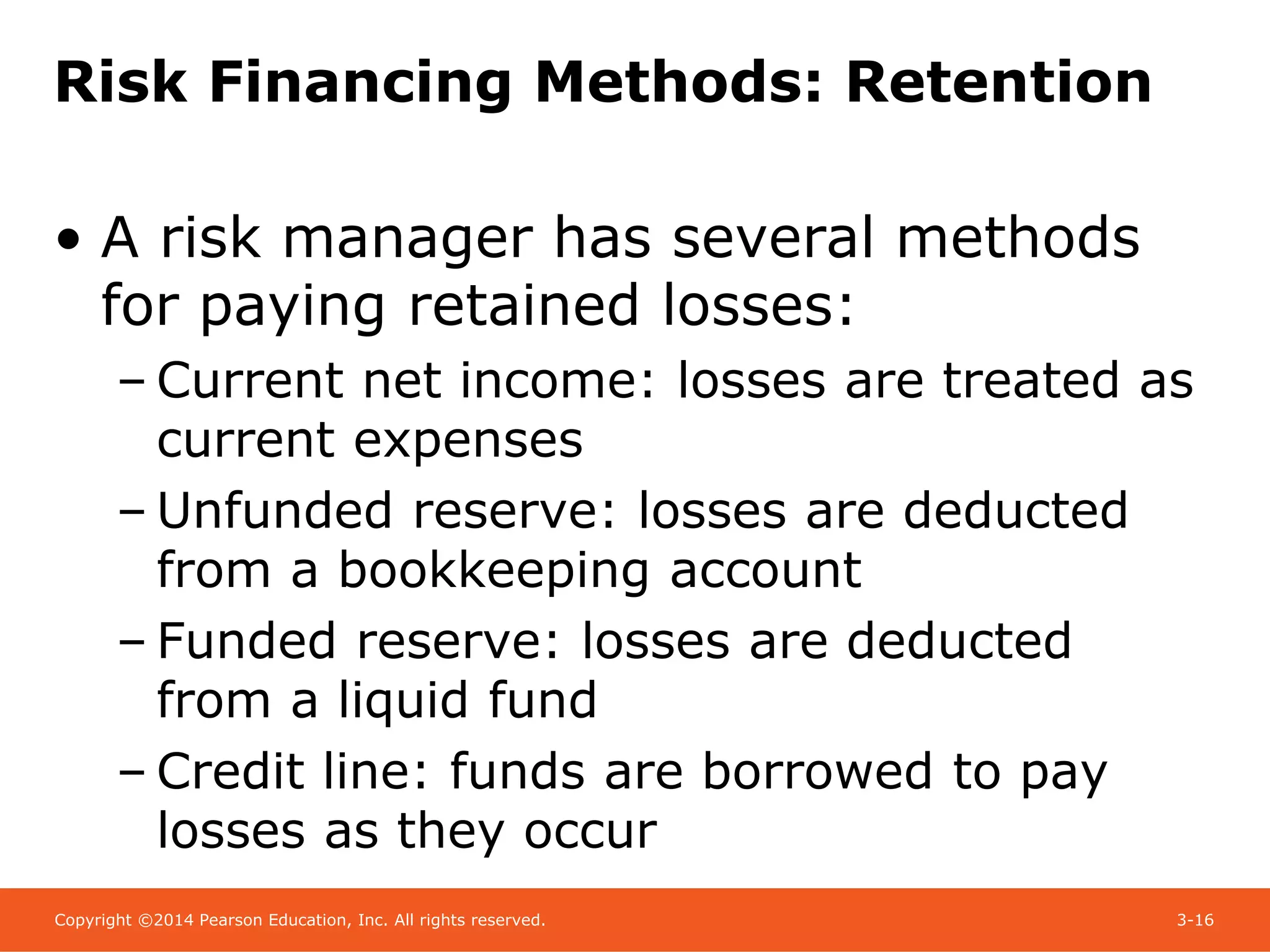
• A risk manager has several methods
for paying retained losses:
– Current net income: losses are treated as
current expenses
– Unfunded reserve: losses are deducted
from a bookkeeping account
– Funded reserve: losses are deducted
from a liquid fund
– Credit line: funds are borrowed to pay
losses as they occur
Copyright ©2014 Pearson Education, Inc. All rights reserved. 3-17
Risk Financing Methods: Retention
• A captive insurer is an insurer owned by a
parent firm for the purpose of insuring the
parent firm’s loss exposures
– A single-parent captive is owned by only one
parent
– An association or group captive is an insurer
owned by several parents
Copyright ©2014 Pearson Education, Inc. All rights reserved. 3-18
Risk Financing Methods: Retention
• Reasons for forming a captive include:
– The parent firm may have difficulty obtaining
insurance
– To take advantage of a favorable regulatory
environment
– Costs may be lower than purchasing commercial
insurance
– A captive insurer has easier access to a reinsurer
– A captive insurer can become a source of profit
Copyright ©2014 Pearson Education, Inc. All rights reserved. 3-19
Risk Financing Methods: Retention
• Premiums paid to a single parent (pure)
captive are generally not income-tax
deductible.
• They may be tax deductible if:
– The transaction is a bona fide insurance
transaction
– A brother-sister relationship exists
– The captive insurer writes a substantial amount
of unrelated business
– The insureds are not the same as the
shareholders of the captive
• Premiums paid to a group captive are
usually income-tax deductible.
Copyright ©2014 Pearson Education, Inc. All rights reserved. 3-20
Risk Financing Methods: Retention
• Self-insurance, or self-funding is a special
form of planned retention by which part or
all of a given loss exposure is retained by
the firm
• A risk retention group (RRG) is a group
captive that can write any type of liability
coverage except employers’ liability,
workers compensation, and personal lines
– They are exempt from many state insurance
laws
Copyright ©2014 Pearson Education, Inc. All rights reserved. 3-21
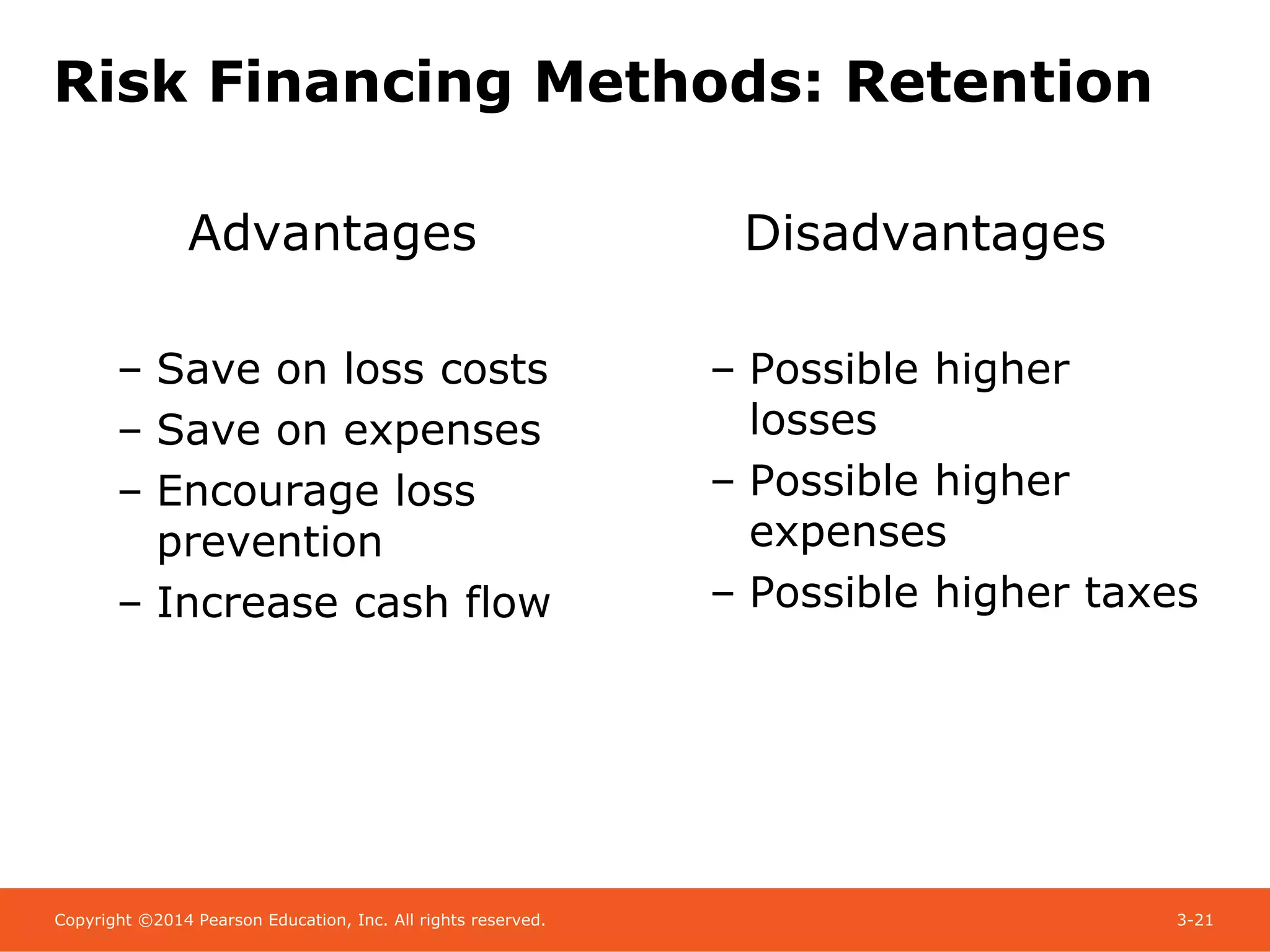
Risk Financing Methods: Retention
Advantages
– Save on loss costs
– Save on expenses
– Encourage loss
prevention
– Increase cash flow
Disadvantages
– Possible higher
losses
– Possible higher
expenses
– Possible higher taxes
Copyright ©2014 Pearson Education, Inc. All rights reserved. 3-22
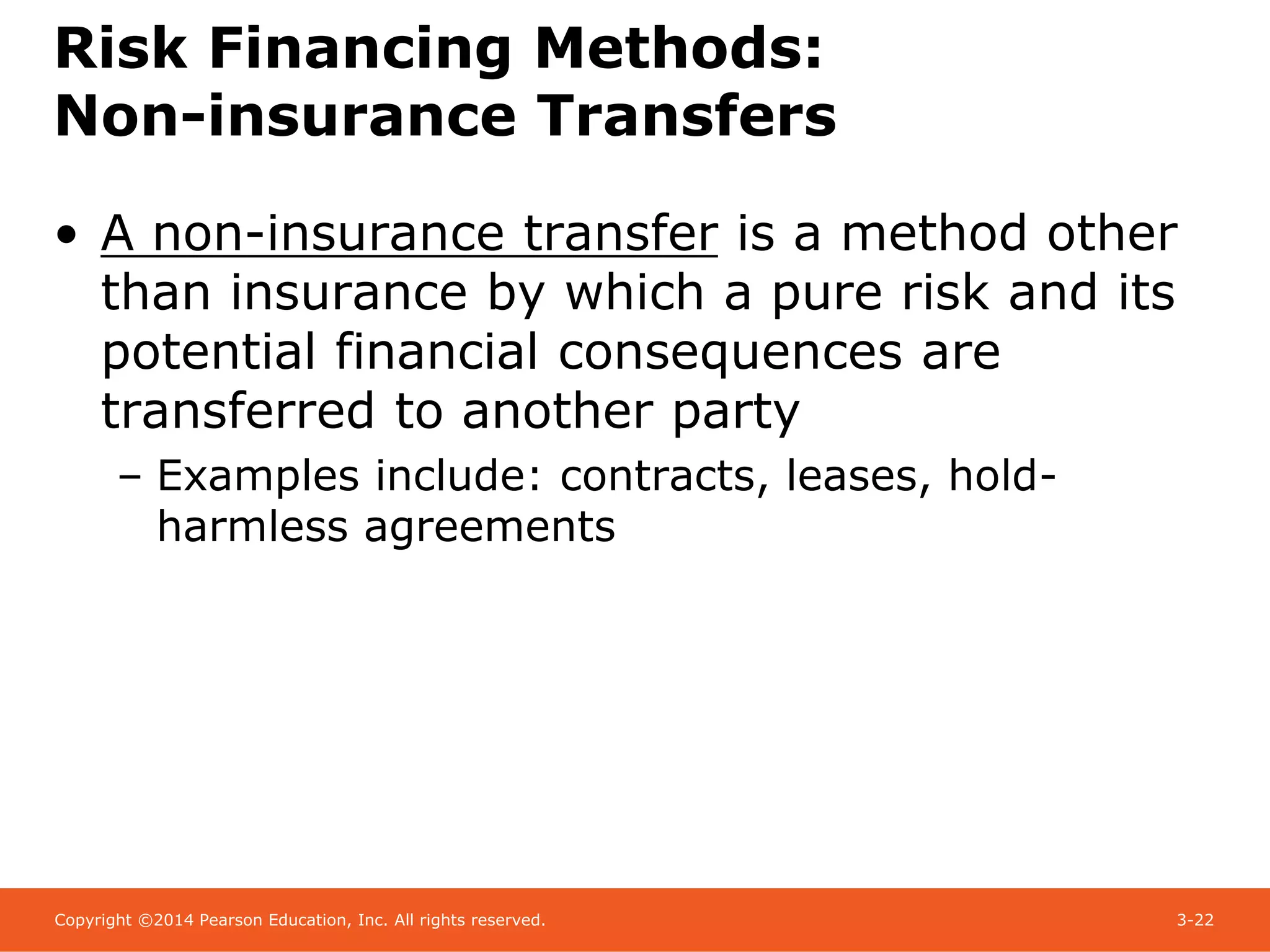
Risk Financing Methods:
Non-insurance Transfers
• A non-insurance transfer is a method other
than insurance by which a pure risk and its
potential financial consequences are
transferred to another party
– Examples include: contracts, leases, hold-
harmless agreements
Copyright ©2014 Pearson Education, Inc. All rights reserved. 3-23
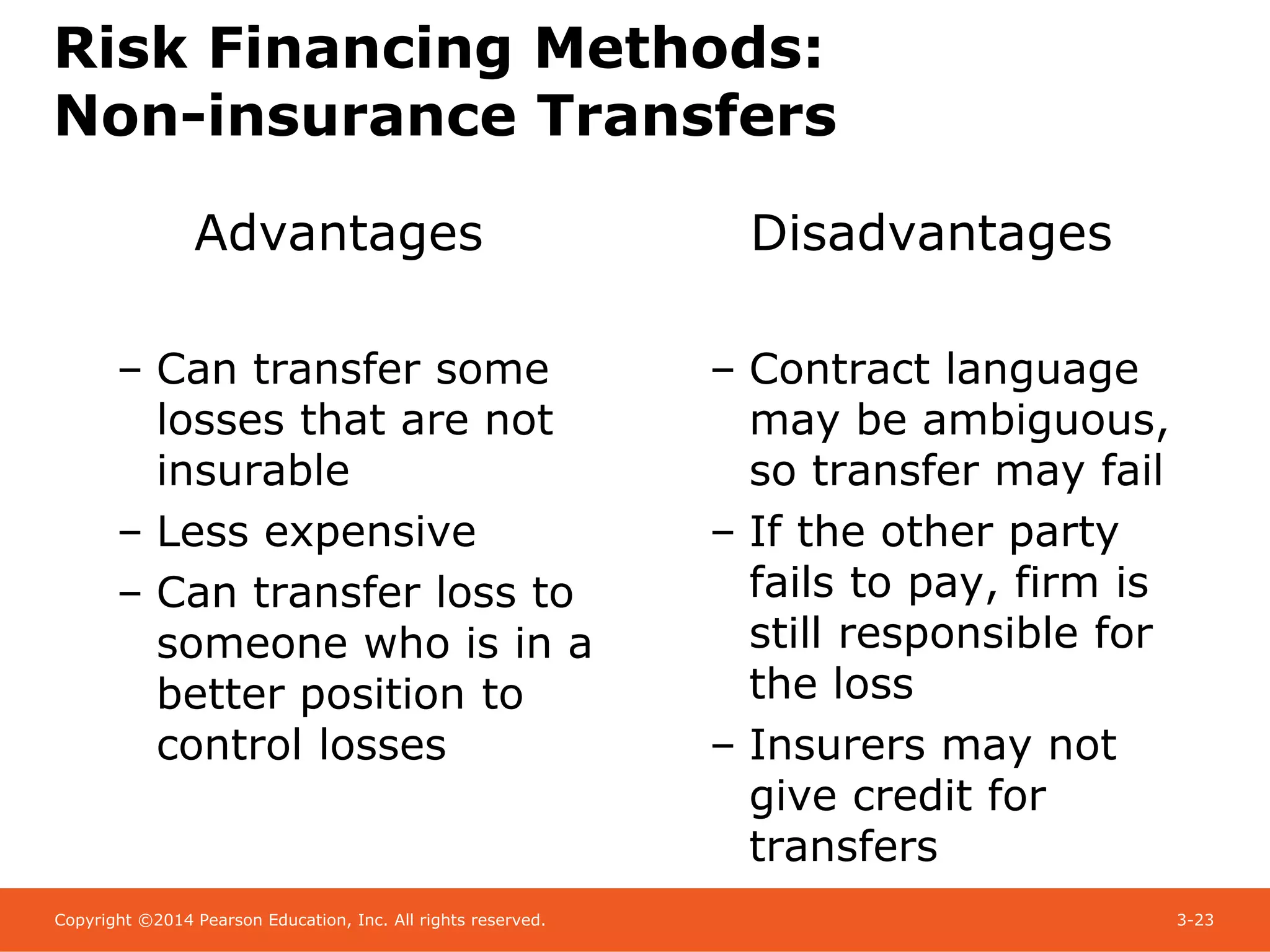
Risk Financing Methods:
Non-insurance Transfers
Advantages
– Can transfer some
losses that are not
insurable
– Less expensive
– Can transfer loss to
someone who is in a
better position to
control losses
Disadvantages
– Contract language
may be ambiguous,
so transfer may fail
– If the other party
fails to pay, firm is
still responsible for
the loss
– Insurers may not
give credit for
transfers
Copyright ©2014 Pearson Education, Inc. All rights reserved. 3-24
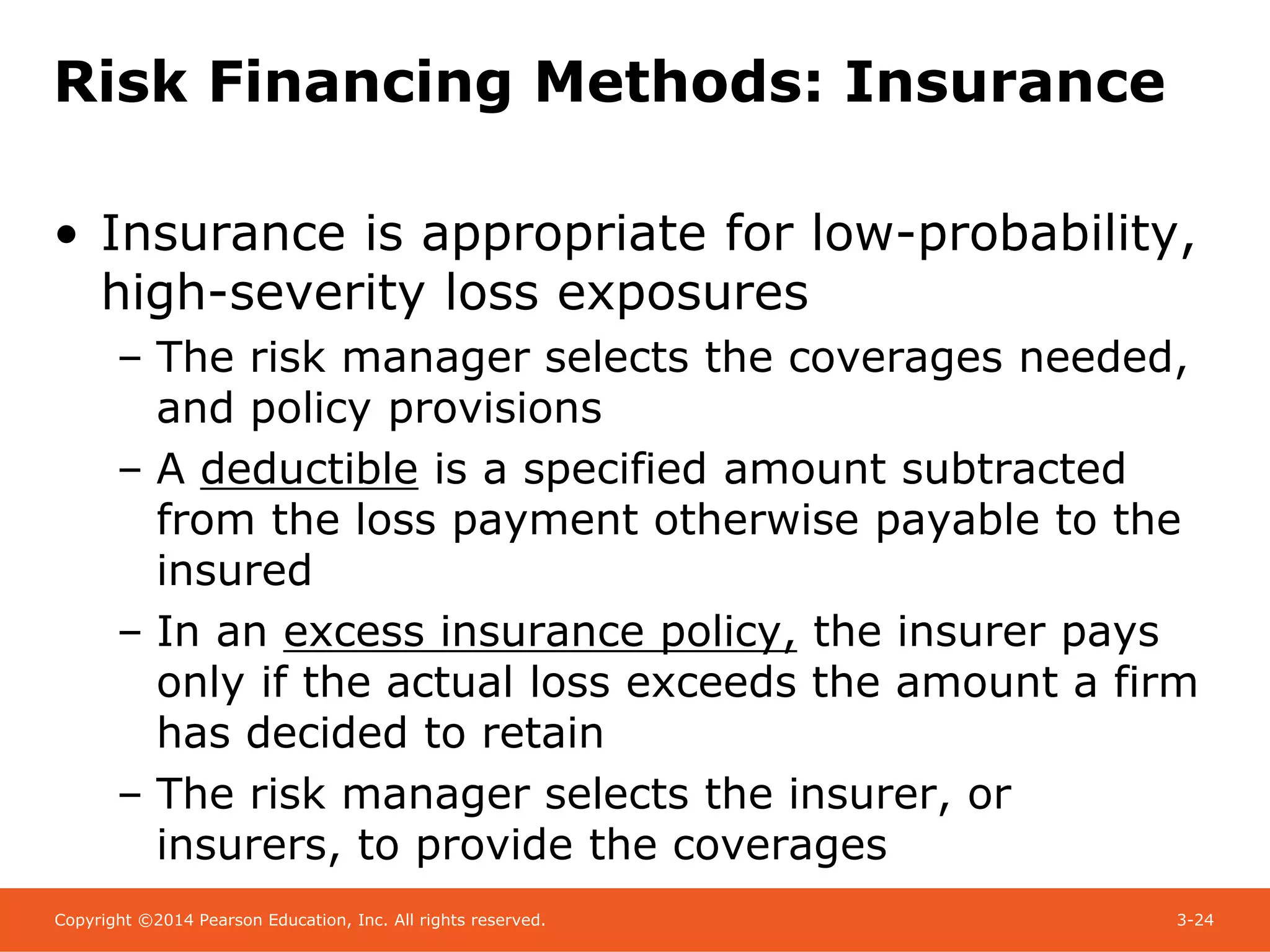
Risk Financing Methods: Insurance
• Insurance is appropriate for low-probability,
high-severity loss exposures
– The risk manager selects the coverages needed,
and policy provisions
– A deductible is a specified amount subtracted
from the loss payment otherwise payable to the
insured
– In an excess insurance policy, the insurer pays
only if the actual loss exceeds the amount a firm
has decided to retain
– The risk manager selects the insurer, or
insurers, to provide the coverages
Copyright ©2014 Pearson Education, Inc. All rights reserved. 3-25
Risk Financing Methods: Insurance
– The risk manager negotiates the terms of the
insurance contract
– A manuscript policy is a policy specially tailored
for the firm
– The parties must agree on the contract
provisions, endorsements, forms, and premiums
– Information concerning insurance coverages
must be disseminated to others in the firm
– The risk manager must periodically review the
insurance program
Copyright ©2014 Pearson Education, Inc. All rights reserved. 3-26
Risk Financing Methods: Insurance
Disadvantages
– Premiums may be
costly
– Negotiation of
contracts takes time
and effort
– The risk manager
may become lax in
exercising loss control
Advantages
– Firm is indemnified
for losses
– Uncertainty is
reduced
– Insurers can provide
valuable risk
management services
– Premiums are
income-tax deductible
Copyright ©2014 Pearson Education, Inc. All rights reserved. 3-27
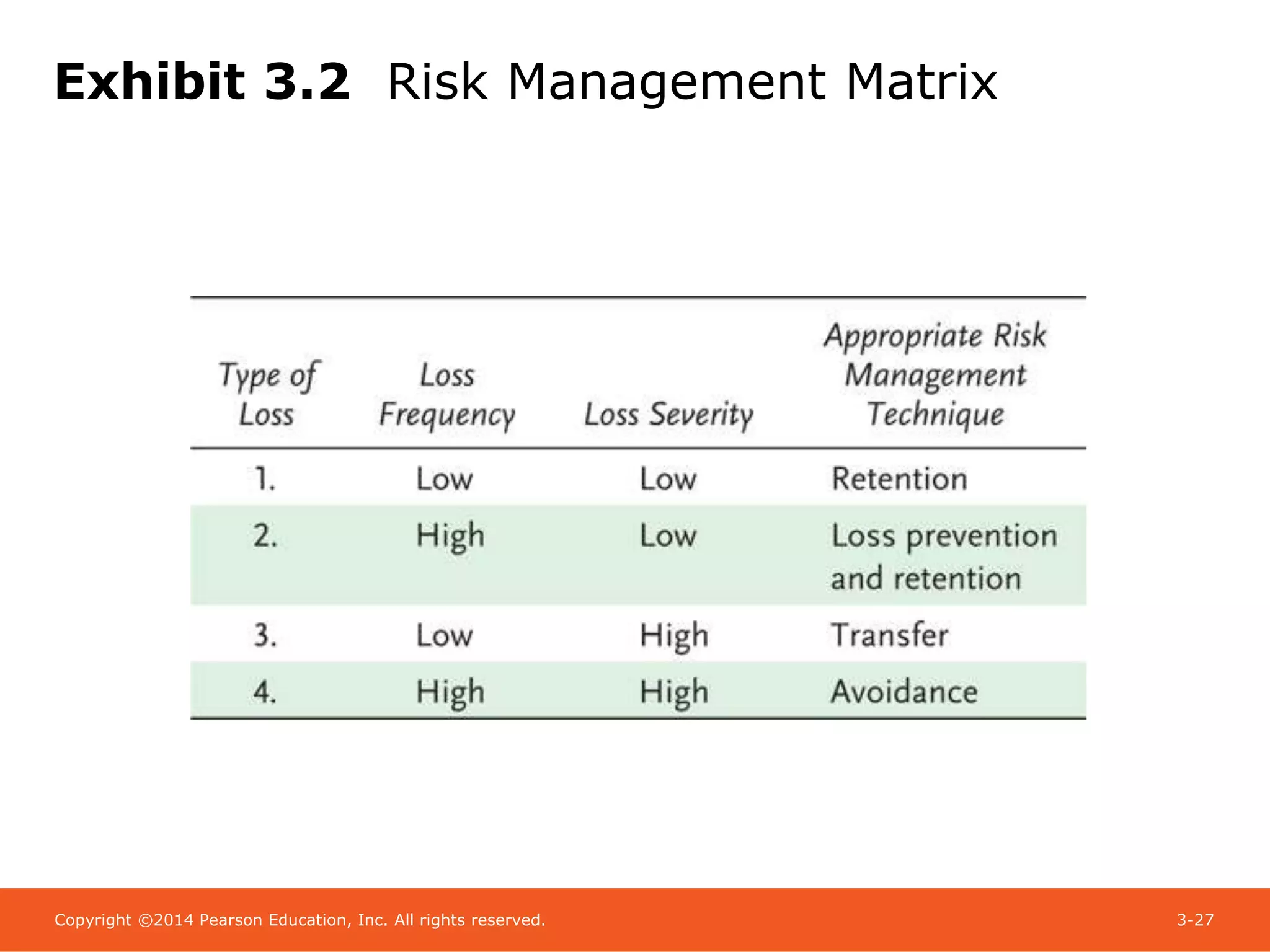
Exhibit 3.2 Risk Management Matrix
Copyright ©2014 Pearson Education, Inc. All rights reserved. 3-28
Market Conditions and the Selection
of Risk Management Techniques
• Risk managers may have to modify their
choice of techniques depending on market
conditions in the insurance markets
• The insurance market experiences an
underwriting cycle
– In a “hard” market, profitability is declining,
underwriting standards are tightened, premiums
increase, and insurance is hard to obtain
– In a “soft” market, profitability is improving,
standards are loosened, premiums decline, and
insurance become easier to obtain
Copyright ©2014 Pearson Education, Inc. All rights reserved. 3-29
Implement and Monitor the Risk
Management Program
• Implementation of a risk management
program begins with a risk management
policy statement that:
– Outlines the firm’s objectives and policies
– Educates top-level executives
– Gives the risk manager greater authority
– Provides standards for judging the risk
manager’s performance
• A risk management manual may be used
to:
– Describe the risk management program
– Train new employees
Copyright ©2014 Pearson Education, Inc. All rights reserved. 3-30
Implement and Monitor the Risk
Management Program
• A successful risk management program
requires active cooperation from other
departments in the firm
• The risk management program should be
periodically reviewed and evaluated to
determine whether the objectives are being
attained
– The risk manager should compare the costs and
benefits of all risk management activities
Copyright ©2014 Pearson Education, Inc. All rights reserved. 3-31
Benefits of Risk Management
• Enables firm to attain its pre-loss and post-
loss objectives more easily
• A risk management program can reduce a
firm’s cost of risk
• Reduction in pure loss exposures allows a
firm to enact an enterprise risk
management program to treat both pure
and speculative loss exposures
• Society benefits because both direct and
indirect losses are reduced
Copyright ©2014 Pearson Education, Inc. All rights reserved. 3-32
Personal Risk Management
• Personal risk management refers to the
identification of pure risks faced by an
individual or family, and to the selection of
the most appropriate technique for treating
such risks
• The same principles applied to corporate
risk management apply to personal risk
management

Chapter 03 - Introduction to Risk Management

  • 1.
  • 2.
    Copyright ©2014 PearsonEducation, Inc. All rights reserved. 3-2 Agenda • Meaning of Risk Management • Objectives of Risk Management • Steps in the Risk Management Process • Benefits of Risk Management • Personal Risk Management
  • 3.
    Copyright ©2014 PearsonEducation, Inc. All rights reserved. 3-3 Meaning of Risk Management • Risk Management is a process that identifies loss exposures faced by an organization and selects the most appropriate techniques for treating such exposures • A loss exposure is any situation or circumstance in which a loss is possible, regardless of whether a loss occurs – E.g., a plant that may be damaged by an earthquake, or an automobile that may be damaged in a collision
  • 4.
    Copyright ©2014 PearsonEducation, Inc. All rights reserved. 3-4 Objectives of Risk Management • Risk management has objectives before and after a loss occurs • Pre-loss objectives: – Prepare for potential losses in the most economical way – Reduce anxiety – Meet any legal obligations
  • 5.
    Copyright ©2014 PearsonEducation, Inc. All rights reserved. 3-5 Objectives of Risk Management • Post-loss objectives: – Survival of the firm – Continue operating – Stability of earnings – Continued growth of the firm – Minimize the effects that a loss will have on other persons and on society
  • 6.
    Copyright ©2014 PearsonEducation, Inc. All rights reserved. 3-6 Risk Management Process • Identify potential losses • Measure and analyze the loss exposures • Select the appropriate combination of techniques for treating the loss exposures • Implement and monitor the risk management program
  • 7.
    Copyright ©2014 PearsonEducation, Inc. All rights reserved. 3-7 Exhibit 3.1 Steps in the Risk Management Process
  • 8.
    Copyright ©2014 PearsonEducation, Inc. All rights reserved. 3-8 Identify Loss Exposures • Property loss exposures • Liability loss exposures • Business income loss exposures • Human resources loss exposures • Crime loss exposures • Employee benefit loss exposures • Foreign loss exposures • Intangible property loss exposures • Failure to comply with government rules and regulations
  • 9.
    Copyright ©2014 PearsonEducation, Inc. All rights reserved. 3-9 Identify Loss Exposures • Risk Managers have several sources of information to identify loss exposures: – Risk analysis questionnaires and checklists – Physical inspection – Flowcharts – Financial statements – Historical loss data • Industry trends and market changes can create new loss exposures. – e.g., exposure to acts of terrorism
  • 10.
    Copyright ©2014 PearsonEducation, Inc. All rights reserved. 3-10 Measure and Analyze Loss Exposures • Estimate for each type of loss exposure: – Loss frequency refers to the probable number of losses that may occur during some time period – Loss severity refers to the probable size of the losses that may occur • Rank exposures by importance • Loss severity is more important than loss frequency: – The maximum possible loss is the worst loss that could happen to the firm during its lifetime – The probable maximum loss is the worst loss that is likely to happen
  • 11.
    Copyright ©2014 PearsonEducation, Inc. All rights reserved. 3-11 Select the Appropriate Combination of Techniques for Treating the Loss Exposures • Risk control refers to techniques that reduce the frequency and severity of losses • Methods of risk control include: – Avoidance – Loss prevention – Loss reduction
  • 12.
    Copyright ©2014 PearsonEducation, Inc. All rights reserved. 3-12 Select the Appropriate Combination of Techniques for Treating the Loss Exposures • Avoidance means a certain loss exposure is never acquired or undertaken, or an existing loss exposure is abandoned – The chance of loss is reduced to zero – It is not always possible, or practical, to avoid all losses
  • 13.
    Copyright ©2014 PearsonEducation, Inc. All rights reserved. 3-13 Select the Appropriate Combination of Techniques for Treating the Loss Exposures • Loss prevention refers to measures that reduce the frequency of a particular loss – e.g., installing safety features on hazardous products • Loss reduction refers to measures that reduce the severity of a loss after it occurs – e.g., installing an automatic sprinkler system
  • 14.
    Copyright ©2014 PearsonEducation, Inc. All rights reserved. 3-14 Select the Appropriate Combination of Techniques for Treating the Loss Exposures • Risk financing refers to techniques that provide for the payment of losses after they occur • Methods of risk financing include: – Retention – Non-insurance Transfers – Commercial Insurance
  • 15.
    Copyright ©2014 PearsonEducation, Inc. All rights reserved. 3-15 Risk Financing Methods: Retention • Retention means that the firm retains part or all of the losses that can result from a given loss – Retention is effectively used when: • No other method of treatment is available • The worst possible loss is not serious • Losses are highly predictable – The retention level is the dollar amount of losses that the firm will retain
  • 16.
    Copyright ©2014 PearsonEducation, Inc. All rights reserved. 3-16 Risk Financing Methods: Retention • A risk manager has several methods for paying retained losses: – Current net income: losses are treated as current expenses – Unfunded reserve: losses are deducted from a bookkeeping account – Funded reserve: losses are deducted from a liquid fund – Credit line: funds are borrowed to pay losses as they occur
  • 17.
    Copyright ©2014 PearsonEducation, Inc. All rights reserved. 3-17 Risk Financing Methods: Retention • A captive insurer is an insurer owned by a parent firm for the purpose of insuring the parent firm’s loss exposures – A single-parent captive is owned by only one parent – An association or group captive is an insurer owned by several parents
  • 18.
    Copyright ©2014 PearsonEducation, Inc. All rights reserved. 3-18 Risk Financing Methods: Retention • Reasons for forming a captive include: – The parent firm may have difficulty obtaining insurance – To take advantage of a favorable regulatory environment – Costs may be lower than purchasing commercial insurance – A captive insurer has easier access to a reinsurer – A captive insurer can become a source of profit
  • 19.
    Copyright ©2014 PearsonEducation, Inc. All rights reserved. 3-19 Risk Financing Methods: Retention • Premiums paid to a single parent (pure) captive are generally not income-tax deductible. • They may be tax deductible if: – The transaction is a bona fide insurance transaction – A brother-sister relationship exists – The captive insurer writes a substantial amount of unrelated business – The insureds are not the same as the shareholders of the captive • Premiums paid to a group captive are usually income-tax deductible.
  • 20.
    Copyright ©2014 PearsonEducation, Inc. All rights reserved. 3-20 Risk Financing Methods: Retention • Self-insurance, or self-funding is a special form of planned retention by which part or all of a given loss exposure is retained by the firm • A risk retention group (RRG) is a group captive that can write any type of liability coverage except employers’ liability, workers compensation, and personal lines – They are exempt from many state insurance laws
  • 21.
    Copyright ©2014 PearsonEducation, Inc. All rights reserved. 3-21 Risk Financing Methods: Retention Advantages – Save on loss costs – Save on expenses – Encourage loss prevention – Increase cash flow Disadvantages – Possible higher losses – Possible higher expenses – Possible higher taxes
  • 22.
    Copyright ©2014 PearsonEducation, Inc. All rights reserved. 3-22 Risk Financing Methods: Non-insurance Transfers • A non-insurance transfer is a method other than insurance by which a pure risk and its potential financial consequences are transferred to another party – Examples include: contracts, leases, hold- harmless agreements
  • 23.
    Copyright ©2014 PearsonEducation, Inc. All rights reserved. 3-23 Risk Financing Methods: Non-insurance Transfers Advantages – Can transfer some losses that are not insurable – Less expensive – Can transfer loss to someone who is in a better position to control losses Disadvantages – Contract language may be ambiguous, so transfer may fail – If the other party fails to pay, firm is still responsible for the loss – Insurers may not give credit for transfers
  • 24.
    Copyright ©2014 PearsonEducation, Inc. All rights reserved. 3-24 Risk Financing Methods: Insurance • Insurance is appropriate for low-probability, high-severity loss exposures – The risk manager selects the coverages needed, and policy provisions – A deductible is a specified amount subtracted from the loss payment otherwise payable to the insured – In an excess insurance policy, the insurer pays only if the actual loss exceeds the amount a firm has decided to retain – The risk manager selects the insurer, or insurers, to provide the coverages
  • 25.
    Copyright ©2014 PearsonEducation, Inc. All rights reserved. 3-25 Risk Financing Methods: Insurance – The risk manager negotiates the terms of the insurance contract – A manuscript policy is a policy specially tailored for the firm – The parties must agree on the contract provisions, endorsements, forms, and premiums – Information concerning insurance coverages must be disseminated to others in the firm – The risk manager must periodically review the insurance program
  • 26.
    Copyright ©2014 PearsonEducation, Inc. All rights reserved. 3-26 Risk Financing Methods: Insurance Disadvantages – Premiums may be costly – Negotiation of contracts takes time and effort – The risk manager may become lax in exercising loss control Advantages – Firm is indemnified for losses – Uncertainty is reduced – Insurers can provide valuable risk management services – Premiums are income-tax deductible
  • 27.
    Copyright ©2014 PearsonEducation, Inc. All rights reserved. 3-27 Exhibit 3.2 Risk Management Matrix
  • 28.
    Copyright ©2014 PearsonEducation, Inc. All rights reserved. 3-28 Market Conditions and the Selection of Risk Management Techniques • Risk managers may have to modify their choice of techniques depending on market conditions in the insurance markets • The insurance market experiences an underwriting cycle – In a “hard” market, profitability is declining, underwriting standards are tightened, premiums increase, and insurance is hard to obtain – In a “soft” market, profitability is improving, standards are loosened, premiums decline, and insurance become easier to obtain
  • 29.
    Copyright ©2014 PearsonEducation, Inc. All rights reserved. 3-29 Implement and Monitor the Risk Management Program • Implementation of a risk management program begins with a risk management policy statement that: – Outlines the firm’s objectives and policies – Educates top-level executives – Gives the risk manager greater authority – Provides standards for judging the risk manager’s performance • A risk management manual may be used to: – Describe the risk management program – Train new employees
  • 30.
    Copyright ©2014 PearsonEducation, Inc. All rights reserved. 3-30 Implement and Monitor the Risk Management Program • A successful risk management program requires active cooperation from other departments in the firm • The risk management program should be periodically reviewed and evaluated to determine whether the objectives are being attained – The risk manager should compare the costs and benefits of all risk management activities
  • 31.
    Copyright ©2014 PearsonEducation, Inc. All rights reserved. 3-31 Benefits of Risk Management • Enables firm to attain its pre-loss and post- loss objectives more easily • A risk management program can reduce a firm’s cost of risk • Reduction in pure loss exposures allows a firm to enact an enterprise risk management program to treat both pure and speculative loss exposures • Society benefits because both direct and indirect losses are reduced
  • 32.
    Copyright ©2014 PearsonEducation, Inc. All rights reserved. 3-32 Personal Risk Management • Personal risk management refers to the identification of pure risks faced by an individual or family, and to the selection of the most appropriate technique for treating such risks • The same principles applied to corporate risk management apply to personal risk management