AMAN AGRAWAL
 Risk is the possibility of loss or injury , the degree or
probability of such loss.
 Actual Return different than Expected.
 Risk is directly related to expected return.
 Risk return-tradeoff
 Wrong decision of what to Invest in
 Wrong timing of Investment
 Nature of instrument invested
 Creditworthiness of issuer
 Maturity period
 National and International factors
 Degree of uncertainty associated with an Investments earnings
and the Investments ability to pay the returns (Interest ,principal,
dividends )owed Investors.
 It is the portion of unsystematic risk caused by the
operating environment of the business.
 Inability to maintain competitive edge & stability of
earnings.
 e.g., changes in tastes, preferences of consumers,
strikes, increased competition, change in government
policy, obsolescence etc .
 Business risks may depends upon the nature and size
of the business.
 Strategic Risk: They are the risks associated with the
operations of that particular industry. These kind of
risks arise from
◦ Business Environment: Buyers and sellers interacting to buy
and sell goods and services, changes in supply and demand,
competitive structures and introduction of new technologies.
◦ Investor Relations: Strategy for communicating with
individuals who have invested in the business.
Research and Development
Fixed cost
Single product
 Financial Risk: These are the risks associated with the
financial structure and transactions of the particular
industry.
 Operational Risk: These are the risks associated with the
operational and administrative procedures of the
particular industry.
"the risk of a change in value caused by the fact that
actual losses, incurred for inadequate or failed internal
processes, people and systems, or from external events
(including legal risk), differ from the expected losses".
 Compliance Risk(Legal Risk): These are risks
associated with the need to comply with the rules
and regulations of the government.
1) socio and regulatory factors
2) Political Risk
3) Business cycle
 Other risks: There would be different risks like
natural disaster(floods) and others depend upon
the nature and scale of the industry.[8]
 Degree of uncertainty of payment resulting from a mix
of debt and equity, the larger the proportion of debt
financing, the greater the risk.
 The use of debt with the owned fund to increase the
return to the shareholder is called Financial Leverage.
 Financial risk is an umbrella term for multiple types
of risk associated with financing, including financial
transactions that include company loans in risk
of default.
 Variance (or standard deviation) of a portfolio is used
as the definition of risk.
CREDIT RISK
 refers to the risk that a borrower will default on a debt by
failing to make required payments. the risk is that of the
lender and includes lost principal and interest, disruption
to cash flows, and increased collection costs. The loss may
be complete or partial and can arise in a number of
circumstances……….
 payment due on a mortgage loan, credit card, line of
credit, or other loan.
 A company is unable to repay asset-secured fixed
or floating charge debt.
 A business does not pay an employee's earned wages when
due.
 A business or government bond issuer does not make a
payment on a coupon
 Insolvent bank won't return funds to a depositor.
 In the United States, a section on market risk is mandated by the SEC.2] in
all annual reports submitted on Form 10-K. The company must detail how
its own results may depend directly on financial markets.
 Significant resources and sophisticated programs are used to analyze and
manage risk. Some companies run a credit risk department whose job is to
assess the financial health of their customers, and extend credit (or not)
accordingly.
 They may use in house programs to advise on avoiding, reducing and
transferring risk. They also use third party provided intelligence.
Companies like Standard & Poor's, Moody's, Fitch Ratings, DBRS, Dun
and Bradstreet, Bureau van Dijk and Rapid Ratings International provide
such information for a fee.
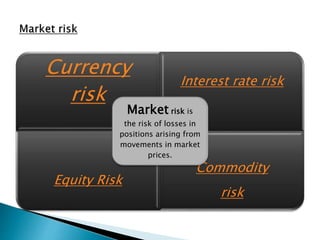
Currency
risk
Interest rate risk
Equity Risk
Commodity
risk
Market risk is
the risk of losses in
positions arising from
movements in market
prices.
 Risk that a given security or asset cannot
be traded quickly enough in the market to
prevent a loss (or make the required profit).
Operational Risk
Risk of a change in value caused by the fact that
actual losses, incurred for inadequate or failed
internal processes, people and systems, or from
external events (including legal risk), different from
the expected losses".
Legal risk is the risk of loss to an institution which
is primarily caused by:
 Defective transaction
 Failing to take appropriate measures to protect
assets (for example, intellectual property) owned
by the institution.
 Change in law.
Volatility Risk
the risk of a change of price of a portfolio as a
result of changes in the volatility of a risk factor. It
usually applies to portfolios of derivatives
instruments, where the volatility of its underlyings
is a major influencer of prices. Examples : Futures
contracts
Political risk
The prospect that government decisions will
damage the value of your investments. Whether it’s
the safety of Social Security, and how it might affect
stocks in your portfolio, tax-law changes or more,
this is the chance that broad policy decisions hit
home.
 Macro political risks affect all participants in a given
country. A common misconception is that macro-
level political risk only looks at country-level political
risk; however, the coupling of local, national, and
regional political events often means that events at
the local level may have follow-on effects for
stakeholders on a macro-level
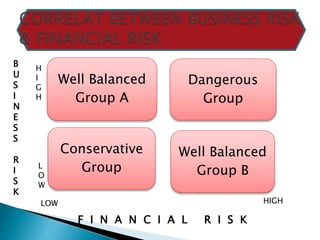
Well Balanced
Group A
Dangerous
Group
Conservative
Group
Well Balanced
Group B
B
U
S
I
N
E
S
S
R
I
S
K
F I N A N C I A L R I S K
LOW HIGH
L
O
W
H
I
G
H
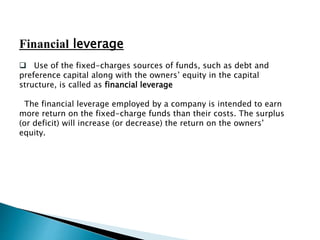
Financial leverage
 Use of the fixed-charges sources of funds, such as debt and
preference capital along with the owners’ equity in the capital
structure, is called as financial leverage
The financial leverage employed by a company is intended to earn
more return on the fixed-charge funds than their costs. The surplus
(or deficit) will increase (or decrease) the return on the owners’
equity.
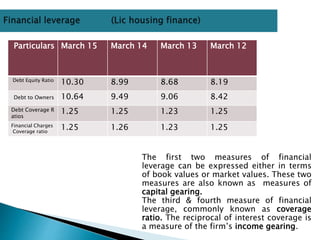
Particulars March 15 March 14 March 13 March 12
Debt Equity Ratio
10.30 8.99 8.68 8.19
Debt to Owners 10.64 9.49 9.06 8.42
Debt Coverage R
atios
1.25 1.25 1.23 1.25
Financial Charges
Coverage ratio
1.25 1.26 1.23 1.25
The first two measures of financial
leverage can be expressed either in terms
of book values or market values. These two
measures are also known as measures of
capital gearing.
The third & fourth measure of financial
leverage, commonly known as coverage
ratio. The reciprocal of interest coverage is
a measure of the firm’s income gearing.
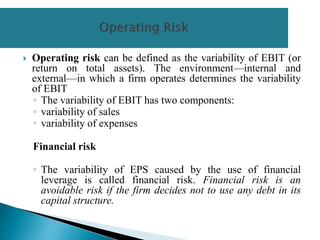
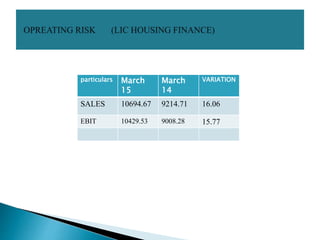
 Operating risk can be defined as the variability of EBIT (or
return on total assets). The environment—internal and
external—in which a firm operates determines the variability
of EBIT
◦ The variability of EBIT has two components:
◦ variability of sales
◦ variability of expenses
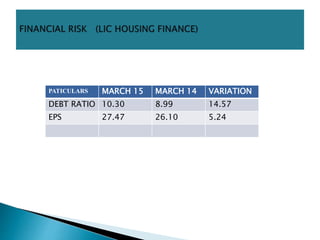
Financial risk
◦ The variability of EPS caused by the use of financial
leverage is called financial risk. Financial risk is an
avoidable risk if the firm decides not to use any debt in its
capital structure.
particulars March
15
March
14
VARIATION
SALES 10694.67 9214.71 16.06
EBIT 10429.53 9008.28 15.77
PATICULARS MARCH 15 MARCH 14 VARIATION
DEBT RATIO 10.30 8.99 14.57
EPS 27.47 26.10 5.24
 Change your business structure from a sole proprietorship to corporation or limited
liability company where you have limited liability.
 Transfer risk to insurance companies by insuring against major risks such as
damage to your facilities, product liability, injuries to customers or suppliers and
death or incapacity of company principals.
 Evaluate the controls and reporting system by comparing actual practice and
performance to the control procedures and the reported information.
 Reduce financial risk by managing your accounts receivable to minimize
outstanding balances and identify poor credit risks. Evaluate customer payments
and ask for advance payment from customers who don't meet the standards.
 Reduce financial risk by keeping outstanding loans and financing needs to a
minimum. Control growth at a rate that the company can finance internally. If the
company can't pay off some loans, replace short-term credit with long-term, fixed-
rate loans
Aman ,FMS BHU

Aman ,FMS BHU

  • 1.
  • 2.
     Risk isthe possibility of loss or injury , the degree or probability of such loss.  Actual Return different than Expected.  Risk is directly related to expected return.  Risk return-tradeoff
  • 3.
     Wrong decisionof what to Invest in  Wrong timing of Investment  Nature of instrument invested  Creditworthiness of issuer  Maturity period  National and International factors
  • 4.
     Degree ofuncertainty associated with an Investments earnings and the Investments ability to pay the returns (Interest ,principal, dividends )owed Investors.  It is the portion of unsystematic risk caused by the operating environment of the business.  Inability to maintain competitive edge & stability of earnings.  e.g., changes in tastes, preferences of consumers, strikes, increased competition, change in government policy, obsolescence etc .  Business risks may depends upon the nature and size of the business.
  • 5.
     Strategic Risk:They are the risks associated with the operations of that particular industry. These kind of risks arise from ◦ Business Environment: Buyers and sellers interacting to buy and sell goods and services, changes in supply and demand, competitive structures and introduction of new technologies. ◦ Investor Relations: Strategy for communicating with individuals who have invested in the business. Research and Development Fixed cost Single product
  • 6.
     Financial Risk:These are the risks associated with the financial structure and transactions of the particular industry.  Operational Risk: These are the risks associated with the operational and administrative procedures of the particular industry. "the risk of a change in value caused by the fact that actual losses, incurred for inadequate or failed internal processes, people and systems, or from external events (including legal risk), differ from the expected losses".
  • 7.
     Compliance Risk(LegalRisk): These are risks associated with the need to comply with the rules and regulations of the government. 1) socio and regulatory factors 2) Political Risk 3) Business cycle  Other risks: There would be different risks like natural disaster(floods) and others depend upon the nature and scale of the industry.[8]
  • 8.
     Degree ofuncertainty of payment resulting from a mix of debt and equity, the larger the proportion of debt financing, the greater the risk.  The use of debt with the owned fund to increase the return to the shareholder is called Financial Leverage.  Financial risk is an umbrella term for multiple types of risk associated with financing, including financial transactions that include company loans in risk of default.  Variance (or standard deviation) of a portfolio is used as the definition of risk.
  • 9.
    CREDIT RISK  refersto the risk that a borrower will default on a debt by failing to make required payments. the risk is that of the lender and includes lost principal and interest, disruption to cash flows, and increased collection costs. The loss may be complete or partial and can arise in a number of circumstances……….  payment due on a mortgage loan, credit card, line of credit, or other loan.  A company is unable to repay asset-secured fixed or floating charge debt.  A business does not pay an employee's earned wages when due.  A business or government bond issuer does not make a payment on a coupon  Insolvent bank won't return funds to a depositor.
  • 10.
     In theUnited States, a section on market risk is mandated by the SEC.2] in all annual reports submitted on Form 10-K. The company must detail how its own results may depend directly on financial markets.  Significant resources and sophisticated programs are used to analyze and manage risk. Some companies run a credit risk department whose job is to assess the financial health of their customers, and extend credit (or not) accordingly.  They may use in house programs to advise on avoiding, reducing and transferring risk. They also use third party provided intelligence. Companies like Standard & Poor's, Moody's, Fitch Ratings, DBRS, Dun and Bradstreet, Bureau van Dijk and Rapid Ratings International provide such information for a fee.
  • 11.
    Currency risk Interest rate risk EquityRisk Commodity risk Market risk is the risk of losses in positions arising from movements in market prices.
  • 12.
     Risk thata given security or asset cannot be traded quickly enough in the market to prevent a loss (or make the required profit). Operational Risk Risk of a change in value caused by the fact that actual losses, incurred for inadequate or failed internal processes, people and systems, or from external events (including legal risk), different from the expected losses".
  • 13.
    Legal risk isthe risk of loss to an institution which is primarily caused by:  Defective transaction  Failing to take appropriate measures to protect assets (for example, intellectual property) owned by the institution.  Change in law. Volatility Risk the risk of a change of price of a portfolio as a result of changes in the volatility of a risk factor. It usually applies to portfolios of derivatives instruments, where the volatility of its underlyings is a major influencer of prices. Examples : Futures contracts
  • 14.
    Political risk The prospectthat government decisions will damage the value of your investments. Whether it’s the safety of Social Security, and how it might affect stocks in your portfolio, tax-law changes or more, this is the chance that broad policy decisions hit home.  Macro political risks affect all participants in a given country. A common misconception is that macro- level political risk only looks at country-level political risk; however, the coupling of local, national, and regional political events often means that events at the local level may have follow-on effects for stakeholders on a macro-level
  • 15.
    Well Balanced Group A Dangerous Group Conservative Group WellBalanced Group B B U S I N E S S R I S K F I N A N C I A L R I S K LOW HIGH L O W H I G H
  • 16.
    Financial leverage  Useof the fixed-charges sources of funds, such as debt and preference capital along with the owners’ equity in the capital structure, is called as financial leverage The financial leverage employed by a company is intended to earn more return on the fixed-charge funds than their costs. The surplus (or deficit) will increase (or decrease) the return on the owners’ equity.
  • 17.
    Particulars March 15March 14 March 13 March 12 Debt Equity Ratio 10.30 8.99 8.68 8.19 Debt to Owners 10.64 9.49 9.06 8.42 Debt Coverage R atios 1.25 1.25 1.23 1.25 Financial Charges Coverage ratio 1.25 1.26 1.23 1.25 The first two measures of financial leverage can be expressed either in terms of book values or market values. These two measures are also known as measures of capital gearing. The third & fourth measure of financial leverage, commonly known as coverage ratio. The reciprocal of interest coverage is a measure of the firm’s income gearing.
  • 18.
     Operating riskcan be defined as the variability of EBIT (or return on total assets). The environment—internal and external—in which a firm operates determines the variability of EBIT ◦ The variability of EBIT has two components: ◦ variability of sales ◦ variability of expenses Financial risk ◦ The variability of EPS caused by the use of financial leverage is called financial risk. Financial risk is an avoidable risk if the firm decides not to use any debt in its capital structure.
  • 19.
    particulars March 15 March 14 VARIATION SALES 10694.679214.71 16.06 EBIT 10429.53 9008.28 15.77
  • 20.
    PATICULARS MARCH 15MARCH 14 VARIATION DEBT RATIO 10.30 8.99 14.57 EPS 27.47 26.10 5.24
  • 22.
     Change yourbusiness structure from a sole proprietorship to corporation or limited liability company where you have limited liability.  Transfer risk to insurance companies by insuring against major risks such as damage to your facilities, product liability, injuries to customers or suppliers and death or incapacity of company principals.  Evaluate the controls and reporting system by comparing actual practice and performance to the control procedures and the reported information.  Reduce financial risk by managing your accounts receivable to minimize outstanding balances and identify poor credit risks. Evaluate customer payments and ask for advance payment from customers who don't meet the standards.  Reduce financial risk by keeping outstanding loans and financing needs to a minimum. Control growth at a rate that the company can finance internally. If the company can't pay off some loans, replace short-term credit with long-term, fixed- rate loans

Editor's Notes

  • #3 LOOSING SOME ALL ACTUAL INVESTMENT
  • #4 3)Such as equity bond are more risky than the bank deposits
  • #5 If the earning of firm s not adequate to meeet Conider an exampe
  • #8 Boom steel industries Small companies closed Political 1977 swadeshi change in govt.policy gold
  • #9 A science has evolved around managing market and financial risk under the general title of modern portfolio theory initiated by Dr.Harry Markowitz in 1952 with his article, "Portfolio Selection"
  • #10 Significant resources and sophisticated programs are used to analyze and manage risk.[4] Some companies run a credit risk department whose job is to assess the financial health of their customers, and extend credit (or not) accordingly. They may use in house programs to advise on avoiding, reducing and transferring risk. They also use third party provided intelligence. Companies like Standard & Poor's, Moody's, Fitch Ratings, DBRS, Dun and Bradstreet, Bureau van Dijk and Rapid Ratings International provide such information for a fee.
  • #12 In the United States, a section on market risk is mandated by the SEC[2] in all annual reports submitted on Form 10-K. The company must detail how its own results may depend directly on financial markets. Equity risk is "the financial risk involved in holding equity in a particular investment." Equity risk often refers to equity in companies through the purchase of stocks, and does not commonly refer to the risk in paying into real estate or building equity in propert . Interest rate risk is the risk that arises for bond owners from fluctuating interest rates How much interest rate risk a bond