RISK MEASUREMENT IN PRACTICE 
Martin Ewen 
15/07/2014
Copyright © Arkus Financial Services - 2014 
Risk Measurement in Practice 
Page 2 
Outline 
►Introduction 
►How is s actually measured in practice? 
►Value at Risk 
►Other types of risk 
►Risk monitoring & Governance 
►Summary
Copyright © Arkus Financial Services - 2014 
Risk Measurement in Practice 
Introduction
Copyright © Arkus Financial Services - 2014 
Risk Measurement in Practice 
Page 4 
Introduction 
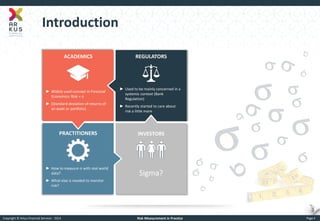
PRACTITIONERS 
ACADEMICS 
REGULATORS 
INVESTORS 
►Widely used concept in Financial Economics: Risk = s 
►(Standard deviation of returns of an asset or portfolio) 
►Used to be mainly concerned in a systemic context (Bank Regulation) 
►Recently started to care about risk a little more 
►How to measure s with real world data? 
►What else is needed to monitor risk? 
Sigma? 
s 
s
Copyright © Arkus Financial Services - 2014 
Risk Measurement in Practice 
How is s actually measured in practice?
Copyright © Arkus Financial Services - 2014 
Risk Measurement in Practice 
Page 6 
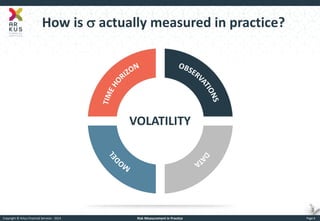
How is s actually measured in practice? 
VOLATILITY
Copyright © Arkus Financial Services - 2014 
Risk Measurement in Practice 
Page 7 
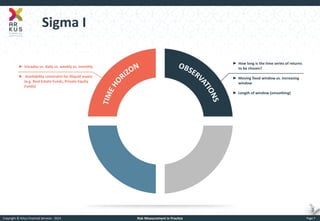
Sigma I 
►Intraday vs. daily vs. weekly vs. monthly 
► Availability constraint for illiquid assets (e.g. Real Estate Funds, Private Equity Funds) 
►How long is the time series of returns to be chosen? 
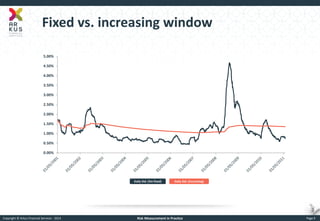
►Moving fixed window vs. increasing window 
►Length of window (smoothing)
Copyright © Arkus Financial Services - 2014 
Risk Measurement in Practice 
Page 8 
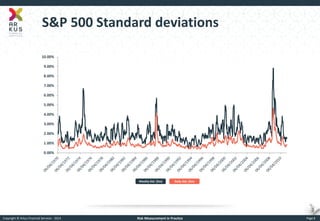
S&P 500 Standard deviations 
0.00% 
1.00% 
2.00% 
3.00% 
4.00% 
5.00% 
6.00% 
7.00% 
8.00% 
9.00% 
10.00% 
Weekly Std. (3m) 
Daily Std. (3m)
Copyright © Arkus Financial Services - 2014 
Risk Measurement in Practice 
Page 9 
Fixed vs. increasing window 
Daily Std. (3m fixed) 
Daily Std. (increasing) 
0.00% 
0.50% 
1.00% 
1.50% 
2.00% 
2.50% 
3.00% 
3.50% 
4.00% 
4.50% 
5.00%
Copyright © Arkus Financial Services - 2014 
Risk Measurement in Practice 
Page 10 
Sigma II 
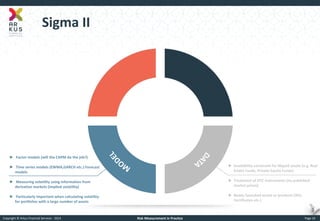
► Factor models (will the CAPM do the job?) 
► Time series models (EWMA,GARCH etc.) Forecast models 
► Measuring volatility using information from derivative markets (implied volatility) 
► Particularly important when calculating volatility for portfolios with a large number of assets 
►Availability constraint for illiquid assets (e.g. Real Estate Funds, Private Equity Funds) 
►Treatment of OTC instruments (no published market prices) 
►Newly launched assets or products (IPO, Certificates etc.)
Copyright © Arkus Financial Services - 2014 
Risk Measurement in Practice 
Page 11 
Observed Facts 
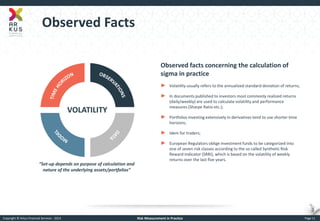
Observed facts concerning the calculation of sigma in practice 
►Volatility usually refers to the annualized standard deviation of returns; 
►In documents published to investors most commonly realized returns (daily/weekly) are used to calculate volatility and performance measures (Sharpe Ratio etc.); 
►Portfolios investing extensively in derivatives tend to use shorter time horizons; 
►Idem for traders; 
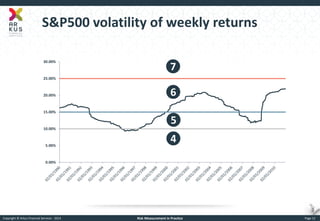
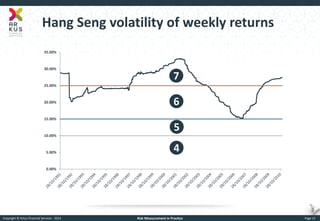
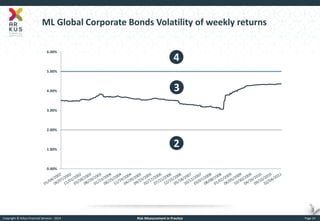
►European Regulators oblige investment funds to be categorized into one of seven risk classes according to the so called Synthetic Risk Reward Indicator (SRRI), which is based on the volatility of weekly returns over the last five years. 
“Set-up depends on purpose of calculation and nature of the underlying assets/portfolios”
Copyright © Arkus Financial Services - 2014 
Risk Measurement in Practice 
Page 12 
S&P500 volatility of weekly returns 
0.00% 
5.00% 
10.00% 
15.00% 
20.00% 
25.00% 
30.00% 
4 
5 
6 
7
Copyright © Arkus Financial Services - 2014 
Risk Measurement in Practice 
Page 13 
Hang Seng volatility of weekly returns 
0.00% 
5.00% 
10.00% 
15.00% 
20.00% 
25.00% 
30.00% 
35.00% 
4 
5 
6 
7
Copyright © Arkus Financial Services - 2014 
Risk Measurement in Practice 
Page 14 
0.00% 
1.00% 
2.00% 
3.00% 
4.00% 
5.00% 
6.00% 
ML Global Corporate Bonds Volatility of weekly returns 
2 
3 
4
Copyright © Arkus Financial Services - 2014 
Risk Measurement in Practice 
Page 15 
Critics 
►Sigma treats positive and negative variations equally ( semi-standard deviation); 
►No clear interpretation with regard to investment decisions; 
►Does not necessarily capture all risks that need to be monitored; 
►Potentially confusing due to different calculation set-ups (opportunistic disclosure of performance measures); 
►Problems dealing with derivatives (e.g. may be gamed by using derivatives).
Copyright © Arkus Financial Services - 2014 
Risk Measurement in Practice 
Value at Risk
Copyright © Arkus Financial Services - 2014 
Risk Measurement in Practice 
Page 17 
Value at Risk 
VaR VaR is the worst loss over a target horizon such that there is a low, pre-specified probability that the actual loss will be larger. P(L<VaR) ≤ 1-α (α=confidence interval) Source: Jorion (2007) 
►VaR is used to measure capital requirements for banks (Basle II and III) 
►Regulatory VaR limit for mutual funds (either absolute or relative to a Benchmark) 
►Used to determine position limits for traders 
►Concept is as well applied by non-financial institutions (e.g. scenarios for business lines)
Copyright © Arkus Financial Services - 2014 
Risk Measurement in Practice 
Page 18 
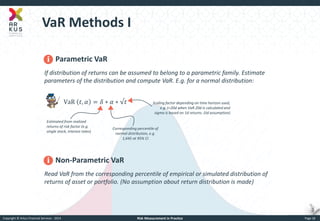
VaR Methods I 
Parametric VaR If distribution of returns can be assumed to belong to a parametric family. Estimate parameters of the distribution and compute VaR. E.g. for a normal distribution: VaR 푡,훼=훿∗훼∗√푡 
Non-Parametric VaR 
Read VaR from the corresponding percentile of empirical or simulated distribution of returns of asset or portfolio. (No assumption about return distribution is made) 
Estimated from realized returns of risk factor (e.g. single stock, interest rates) 
Corresponding percentile of normal distribution, e.g. 1,645 at 95% CI 
Scaling factor depending on time horizon used, e.g. t=20d when VaR 20d is calculated and sigma is based on 1d returns. (iid assumption)
Copyright © Arkus Financial Services - 2014 
Risk Measurement in Practice 
Page 19 
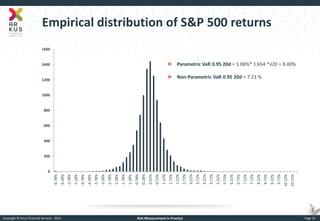
Empirical distribution of S&P 500 returns 
0 
200 
400 
600 
800 
1000 
1200 
1400 
1600 
-6.78% 
-6.28% 
-5.78% 
-5.28% 
-4.78% 
-4.28% 
-3.78% 
-3.28% 
-2.78% 
-2.28% 
-1.78% 
-1.28% 
-0.78% 
-0.28% 
0.22% 
0.72% 
1.22% 
1.72% 
2.22% 
2.72% 
3.22% 
3.72% 
4.22% 
4.72% 
5.22% 
5.72% 
6.22% 
6.72% 
7.22% 
7.72% 
8.22% 
8.72% 
9.22% 
9.72% 
10.22% 
10.72% 
►Parametric VaR 0.95 20d = 1.08%* 1.654 *√20 = 8.00% 
►Non-Parametric VaR 0.95 20d ≈ 7.23 %
Copyright © Arkus Financial Services - 2014 
Risk Measurement in Practice 
Page 20 
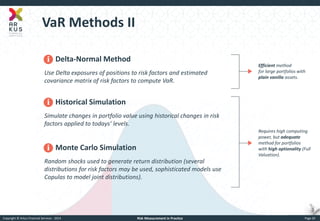
VaR Methods II 
Delta-Normal Method 
Use Delta exposures of positions to risk factors and estimated covariance matrix of risk factors to compute VaR. 
Historical Simulation 
Simulate changes in portfolio value using historical changes in risk factors applied to todays‘ levels. 
Monte Carlo Simulation 
Random shocks used to generate return distribution (several distributions for risk factors may be used, sophisticated models use Copulas to model joint distributions). 
Efficient method 
for large portfolios with plain vanilla assets. 
Requires high computing power, but adequate method for portfolios with high optionality (Full Valuation).
Copyright © Arkus Financial Services - 2014 
Risk Measurement in Practice 
Page 21 
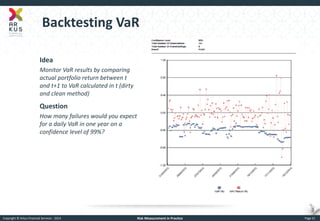
Backtesting VaR 
Idea 
Monitor VaR results by comparing actual portfolio return between t and t+1 to VaR calculated in t (dirty and clean method) 
Question 
How many failures would you expect for a daily VaR in one year on a confidence level of 99%?
Copyright © Arkus Financial Services - 2014 
Risk Measurement in Practice 
Page 22 
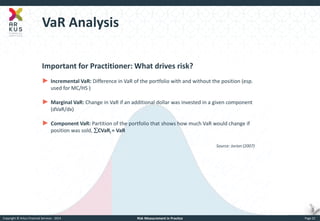
VaR Analysis 
Important for Practitioner: What drives risk? 
►Incremental VaR: Difference in VaR of the portfolio with and without the position (esp. used for MC/HS ) 
►Marginal VaR: Change in VaR if an additional dollar was invested in a given component (dVaR/dx) 
►Component VaR: Partition of the portfolio that shows how much VaR would change if position was sold, CVaRi = VaR 
Source: Jorion (2007)
Copyright © Arkus Financial Services - 2014 
Risk Measurement in Practice 
Page 23 
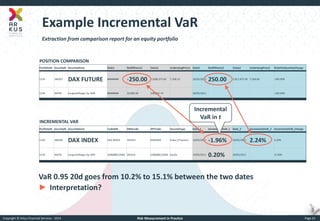
Example Incremental VaR 
Extraction from comparison report for an equity portfolio 
POSITION COMPARISON 
PortfolioID 
SecurityID 
SecurityName 
Date1 
NoOfShares1 
Value1 
UnderlyingPrice1 
Date2 
NoOfShares2 
Value2 
UnderlyingPrice2 
RelatiVeQuantityChange 
1234 
180207 
DAX FUTURE 

######## 
-250.00 
-1,838,375.00 
7,358.23 
20/05/2011 
250.00 
1,817,875.00 
7,266.82 
-200.00% 
1234 
94478 
Surgutneftegaz-Sp ADR 
######## 
16,000.00 
108,002.74 
20/05/2011 
-100.00% 
INCREMENTAL VAR 
PortfolioID 
SecurityID 
SecurityName 
CodeISIN 
EMACode 
APTCode 
SecurityType 
Date_1 
IncrementalVaR_1 
Date_2 
IncrementalVaR_2 
IncrementalVaR_Change 
1234 
180206 
DAX INDEX 
DAX INDEX 
187653 
DAXINDX 
Index (/Tracker) 
19/05/2011 
-1.96% 
20/05/2011 
2.24% 
4.20% 
1234 
94478 
Surgutneftegaz-Sp ADR 
US8688612048 
281014 
US8688612048 
Equity 
19/05/2011 
0.20% 
20/05/2011 
-0.20% 
Incremental VaR in t 
VaR 0.95 20d goes from 10.2% to 15.1% between the two dates 
►Interpretation?
Copyright © Arkus Financial Services - 2014 
Risk Measurement in Practice 
Page 24 
Critics 
►VaR does not consider what happens when it is surpassed Tail Risk (expected shortfall) 
►Focus on VaR can lead to neglecting other sources of risk 
►Introduces substantial Model Risk 
►Nassim Taleb: Black Swans, “Fooled by Randomness“ 
►Non coherent in the sense of Artzner et al. (1999) 
►VaR needs to be supplemented by other metrics (Tail Risk measures, Stress Testing, Scenario Analysis, Derivative measures, etc.) 
►Notional Leverage obligatory for UCITS funds (convert Derivatives into exposure in the Underlying).
Copyright © Arkus Financial Services - 2014 
Risk Measurement in Practice 
Types of risk
Copyright © Arkus Financial Services - 2014 
Risk Measurement in Practice 
Page 26 
Types of Risk 
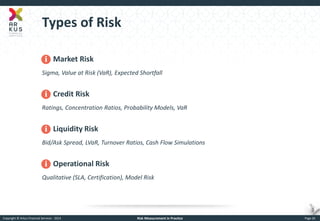
Market Risk Sigma, Value at Risk (VaR), Expected Shortfall 
Credit Risk 
Ratings, Concentration Ratios, Probability Models, VaR 
Liquidity Risk Bid/Ask Spread, LVaR, Turnover Ratios, Cash Flow Simulations 
Operational Risk 
Qualitative (SLA, Certification), Model Risk
Copyright © Arkus Financial Services - 2014 
Risk Measurement in Practice 
Page 27 
Liquidity Risk I 
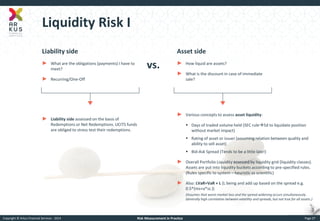
►Various concepts to assess asset liquidity: 
Days of traded volume held (SEC rule5d to liquidate position without market impact) 
Rating of asset or issuer (assuming relation between quality and ability to sell asset) 
Bid-Ask Spread (Tends to be a little late!) 
►Overall Portfolio Liquidity assessed by liquidity grid (liquidity classes). Assets are put into liquidity buckets according to pre-specified rules. (Rules specific to system – heuristic vs scientific) 
►Also: LVaR=VaR + L (L being and add up based on the spread e.g. 0.5*(ms+a*ss )) 
(Assumes that worst market loss and the spread widening occurs simultaneously. Generally high correlation between volatility and spreads, but not true for all assets.) 
Liability side 
►What are the obligations (payments) I have to meet? 
►Recurring/One-Off 
Asset side 
►How liquid are assets? 
►What is the discount in case of immediate sale? 
vs. 
►Liability side assessed on the basis of Redemptions or Net Redemptions. UCITS funds are obliged to stress test their redemptions.
Copyright © Arkus Financial Services - 2014 
Risk Measurement in Practice 
Page 28 
Liquidity Risk II – Mutual Funds 
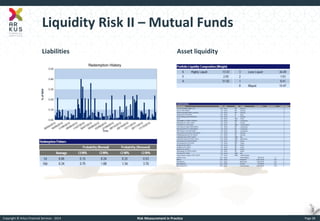
Liabilities 
Asset liquidity
Copyright © Arkus Financial Services - 2014 
Risk Measurement in Practice 
Page 29 
Model Risk 
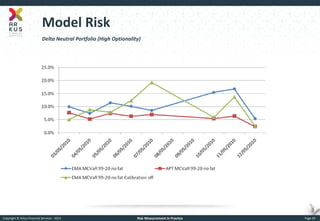
Delta Neutral Portfolio (High Optionality)
Copyright © Arkus Financial Services - 2014 
Risk Measurement in Practice 
Page 30 
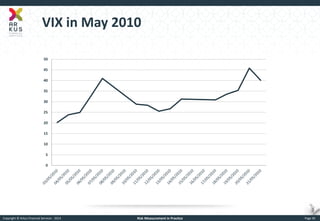
VIX in May 2010 
0 
5 
10 
15 
20 
25 
30 
35 
40 
45 
50
Copyright © Arkus Financial Services - 2014 
Risk Measurement in Practice 
Page 31 
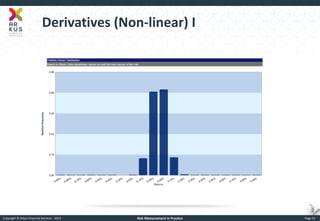
Derivatives (Non-linear) I
Copyright © Arkus Financial Services - 2014 
Risk Measurement in Practice 
Page 32 
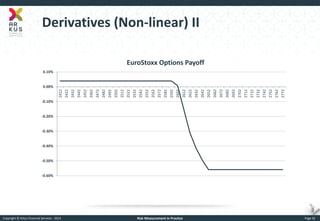
Derivatives (Non-linear) II 
-0.60% 
-0.50% 
-0.40% 
-0.30% 
-0.20% 
-0.10% 
0.00% 
0.10% 
2412 
2422 
2432 
2442 
2452 
2462 
2472 
2482 
2492 
2502 
2512 
2522 
2532 
2542 
2552 
2562 
2572 
2582 
2592 
2602 
2612 
2622 
2632 
2642 
2652 
2662 
2672 
2682 
2692 
2702 
2712 
2722 
2732 
2742 
2752 
2762 
2772 
EuroStoxx Options Payoff
Copyright © Arkus Financial Services - 2014 
Risk Measurement in Practice 
Page 33 
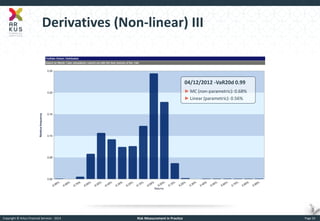
Derivatives (Non-linear) III 
04/12/2012 -VaR20d 0.99 
►MC (non-parametric): 0.68% 
►Linear (parametric): 0.56%
Copyright © Arkus Financial Services - 2014 
Risk Measurement in Practice 
Page 34 
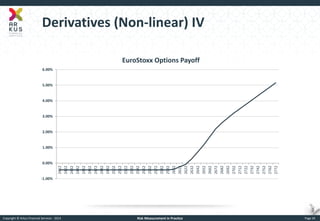
Derivatives (Non-linear) IV 
-1.00% 
0.00% 
1.00% 
2.00% 
3.00% 
4.00% 
5.00% 
6.00% 
2412 
2422 
2432 
2442 
2452 
2462 
2472 
2482 
2492 
2502 
2512 
2522 
2532 
2542 
2552 
2562 
2572 
2582 
2592 
2602 
2612 
2622 
2632 
2642 
2652 
2662 
2672 
2682 
2692 
2702 
2712 
2722 
2732 
2742 
2752 
2762 
2772 
EuroStoxx Options Payoff
Copyright © Arkus Financial Services - 2014 
Risk Measurement in Practice 
Page 35 
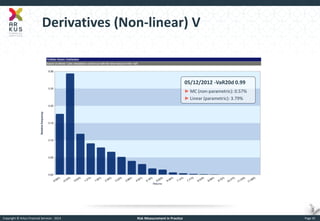
Derivatives (Non-linear) V 
05/12/2012 -VaR20d 0.99 
►MC (non-parametric): 0.57% 
►Linear (parametric): 3.79%
Copyright © Arkus Financial Services - 2014 
Risk Measurement in Practice 
Page 36 
Counterparty Risk 
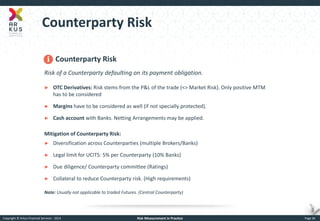
Counterparty Risk Risk of a Counterparty defaulting on its payment obligation. 
►OTC Derivatives: Risk stems from the P&L of the trade (<> Market Risk). Only positive MTM has to be considered 
►Margins have to be considered as well (if not specially protected). 
►Cash account with Banks. Netting Arrangements may be applied. Mitigation of Counterparty Risk: 
►Diversification across Counterparties (multiple Brokers/Banks) 
►Legal limit for UCITS: 5% per Counterparty (10% Banks) 
►Due diligence/ Counterparty committee (Ratings) 
►Collateral to reduce Counterparty risk. (High requirements) Note: Usually not applicable to traded Futures. (Central Counterparty)
Copyright © Arkus Financial Services - 2014 
Risk Measurement in Practice 
Page 37 
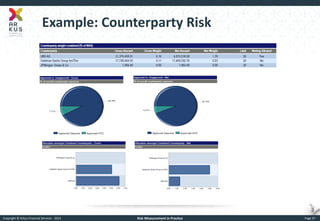
Example: Counterparty Risk
Copyright © Arkus Financial Services - 2014 
Risk Measurement in Practice 
Risk Monitoring & Governance
Copyright © Arkus Financial Services - 2014 
Risk Measurement in Practice 
Page 39 
Risk Monitoring & Governance 
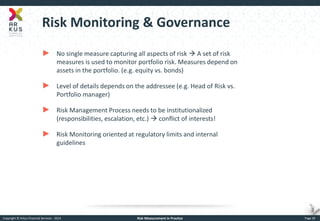
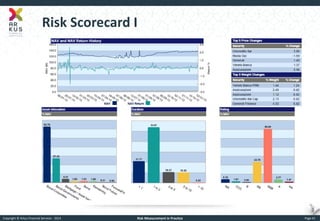
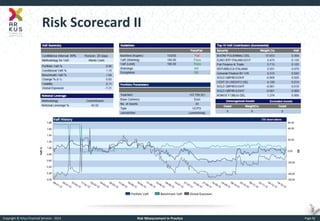
►No single measure capturing all aspects of risk  A set of risk measures is used to monitor portfolio risk. Measures depend on assets in the portfolio. (e.g. equity vs. bonds) 
►Level of details depends on the addressee (e.g. Head of Risk vs. Portfolio manager) 
►Risk Management Process needs to be institutionalized (responsibilities, escalation, etc.)  conflict of interests! 
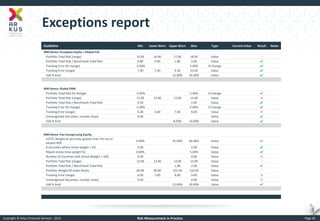
►Risk Monitoring oriented at regulatory limits and internal guidelines
Copyright © Arkus Financial Services - 2014 
Risk Measurement in Practice 
Page 40 
Exceptions report 
Guideline 
Min 
Lower Warn 
Upper Warn 
Max 
Type 
Current Value 
Result 
Notes 
IRM Demo: European Equity + Global FoF 
Portfolio Total Risk (range) 
15.00 
16.00 
17.00 
18.00 
Value 
? 
Portfolio Total Risk / Benchmark Total Risk 
0.80 
0.90 
1.80 
2.00 
Value 
✔ 
Tracking Error (% change) 
-5.00% 
5.00% 
% Change 
✔ 
Tracking Error (range) 
7.00 
7.50 
9.50 
10.00 
Value 
✔ 
VaR % limit 
15.00% 
20.00% 
Value 
✔ 
IRM Demo: Global EMB 
Portfolio Total Risk (% change) 
-5.00% 
5.00% 
% Change 
✔ 
Portfolio Total Risk (range) 
11.00 
12.00 
13.00 
14.00 
Value 
X 
Portfolio Total Risk / Benchmark Total Risk 
0.50 
2.00 
Value 
✔ 
Tracking Error (% change) 
-5.00% 
5.00% 
% Change 
✔ 
Tracking Error (range) 
5.00 
6.00 
7.00 
8.00 
Value 
X 
Unrecognised Securities: number (max) 
0.00 
Value 
✔ 
VaR % limit 
8.00% 
10.00% 
Value 
✔ 
IRM Demo: Pan Europe Long Equity 
UCITS: Weight of securities greater than 5% not to exceed 40% 
0.00% 
35.00% 
40.00% 
Value 
✔ 
# securities where active weight > 2% 
0.00 
2.00 
Value 
✔ 
Illiquid stocks (max weight %) 
0.00% 
5.00% 
Value 
✔ 
Number of Countries with Active Weight > 10% 
0.00 
0.00 
Value 
X 
Portfolio Total Risk (range) 
12.00 
13.00 
14.00 
15.00 
Value 
? 
Portfolio Total Risk / Benchmark Total Risk 
1.80 
2.00 
Value 
✔ 
Portfolio Weight Of Index Stocks 
80.00 
90.00 
101.00 
110.00 
Value 
? 
Tracking Error (range) 
6.00 
7.00 
8.00 
9.00 
Value 
X 
Unrecognised Securities: number (max) 
0.00 
0.00 
Value 
X 
VaR % limit 
15.00% 
20.00% 
Value 
✔
Copyright © Arkus Financial Services - 2014 
Risk Measurement in Practice 
Page 41 
Risk Scorecard I
Copyright © Arkus Financial Services - 2014 
Risk Measurement in Practice 
Page 42 
Risk Scorecard II
Copyright © Arkus Financial Services - 2014 
Risk Measurement in Practice 
Page 43 
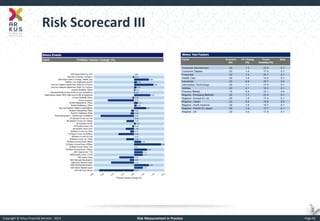
Risk Scorecard III
Copyright © Arkus Financial Services - 2014 
Risk Measurement in Practice 
Summary
Copyright © Arkus Financial Services - 2014 
Risk Measurement in Practice 
Page 45 
Summary 
►s usually refers to the annualized standard deviation of returns 
►VaR used extensively, easy interpretation  introduces substantial other shortfalls 
►VaR needs supplementary information to overcome these (model validation, stress tests etc.) 
►Other types of risk need to be monitored as well 
►Risk Management Process 
►Attention: Risk of creating Data Dump
Copyright © Arkus Financial Services - 2014 
Risk Measurement in Practice 
Page 46 
Further Reading 
►Jorion, Phillipe (2007), Value at Risk: The Benchmark for Managing Financial Risk, 3rd ed. McGraw-Hill. 
►Hull, John C. (2009), Option, Futures and other Derivatives, Pearson International Edition. 
►Artzner et al. (1999), Coherent measures of risk, Mathematical Finance , Vol. 9., No. 3; p.223 -228. Regulatory information: 
►http://www.esma.europa.eu/system/files/10_788.pdf 
►http://www.irml.net/documentation.php
Copyright © Arkus Financial Services - 2014 
Risk Measurement in Practice 
Page 47 
Questions?
Copyright © Arkus Financial Services - 2014 
Risk Measurement in Practice 
Page 48 
Contact
Risk Measurement in practice

Risk Measurement in practice

  • 1.
    RISK MEASUREMENT INPRACTICE Martin Ewen 15/07/2014
  • 2.
    Copyright © ArkusFinancial Services - 2014 Risk Measurement in Practice Page 2 Outline ►Introduction ►How is s actually measured in practice? ►Value at Risk ►Other types of risk ►Risk monitoring & Governance ►Summary
  • 3.
    Copyright © ArkusFinancial Services - 2014 Risk Measurement in Practice Introduction
  • 4.
    Copyright © ArkusFinancial Services - 2014 Risk Measurement in Practice Page 4 Introduction PRACTITIONERS ACADEMICS REGULATORS INVESTORS ►Widely used concept in Financial Economics: Risk = s ►(Standard deviation of returns of an asset or portfolio) ►Used to be mainly concerned in a systemic context (Bank Regulation) ►Recently started to care about risk a little more ►How to measure s with real world data? ►What else is needed to monitor risk? Sigma? s s
  • 5.
    Copyright © ArkusFinancial Services - 2014 Risk Measurement in Practice How is s actually measured in practice?
  • 6.
    Copyright © ArkusFinancial Services - 2014 Risk Measurement in Practice Page 6 How is s actually measured in practice? VOLATILITY
  • 7.
    Copyright © ArkusFinancial Services - 2014 Risk Measurement in Practice Page 7 Sigma I ►Intraday vs. daily vs. weekly vs. monthly ► Availability constraint for illiquid assets (e.g. Real Estate Funds, Private Equity Funds) ►How long is the time series of returns to be chosen? ►Moving fixed window vs. increasing window ►Length of window (smoothing)
  • 8.
    Copyright © ArkusFinancial Services - 2014 Risk Measurement in Practice Page 8 S&P 500 Standard deviations 0.00% 1.00% 2.00% 3.00% 4.00% 5.00% 6.00% 7.00% 8.00% 9.00% 10.00% Weekly Std. (3m) Daily Std. (3m)
  • 9.
    Copyright © ArkusFinancial Services - 2014 Risk Measurement in Practice Page 9 Fixed vs. increasing window Daily Std. (3m fixed) Daily Std. (increasing) 0.00% 0.50% 1.00% 1.50% 2.00% 2.50% 3.00% 3.50% 4.00% 4.50% 5.00%
  • 10.
    Copyright © ArkusFinancial Services - 2014 Risk Measurement in Practice Page 10 Sigma II ► Factor models (will the CAPM do the job?) ► Time series models (EWMA,GARCH etc.) Forecast models ► Measuring volatility using information from derivative markets (implied volatility) ► Particularly important when calculating volatility for portfolios with a large number of assets ►Availability constraint for illiquid assets (e.g. Real Estate Funds, Private Equity Funds) ►Treatment of OTC instruments (no published market prices) ►Newly launched assets or products (IPO, Certificates etc.)
  • 11.
    Copyright © ArkusFinancial Services - 2014 Risk Measurement in Practice Page 11 Observed Facts Observed facts concerning the calculation of sigma in practice ►Volatility usually refers to the annualized standard deviation of returns; ►In documents published to investors most commonly realized returns (daily/weekly) are used to calculate volatility and performance measures (Sharpe Ratio etc.); ►Portfolios investing extensively in derivatives tend to use shorter time horizons; ►Idem for traders; ►European Regulators oblige investment funds to be categorized into one of seven risk classes according to the so called Synthetic Risk Reward Indicator (SRRI), which is based on the volatility of weekly returns over the last five years. “Set-up depends on purpose of calculation and nature of the underlying assets/portfolios”
  • 12.
    Copyright © ArkusFinancial Services - 2014 Risk Measurement in Practice Page 12 S&P500 volatility of weekly returns 0.00% 5.00% 10.00% 15.00% 20.00% 25.00% 30.00% 4 5 6 7
  • 13.
    Copyright © ArkusFinancial Services - 2014 Risk Measurement in Practice Page 13 Hang Seng volatility of weekly returns 0.00% 5.00% 10.00% 15.00% 20.00% 25.00% 30.00% 35.00% 4 5 6 7
  • 14.
    Copyright © ArkusFinancial Services - 2014 Risk Measurement in Practice Page 14 0.00% 1.00% 2.00% 3.00% 4.00% 5.00% 6.00% ML Global Corporate Bonds Volatility of weekly returns 2 3 4
  • 15.
    Copyright © ArkusFinancial Services - 2014 Risk Measurement in Practice Page 15 Critics ►Sigma treats positive and negative variations equally ( semi-standard deviation); ►No clear interpretation with regard to investment decisions; ►Does not necessarily capture all risks that need to be monitored; ►Potentially confusing due to different calculation set-ups (opportunistic disclosure of performance measures); ►Problems dealing with derivatives (e.g. may be gamed by using derivatives).
  • 16.
    Copyright © ArkusFinancial Services - 2014 Risk Measurement in Practice Value at Risk
  • 17.
    Copyright © ArkusFinancial Services - 2014 Risk Measurement in Practice Page 17 Value at Risk VaR VaR is the worst loss over a target horizon such that there is a low, pre-specified probability that the actual loss will be larger. P(L<VaR) ≤ 1-α (α=confidence interval) Source: Jorion (2007) ►VaR is used to measure capital requirements for banks (Basle II and III) ►Regulatory VaR limit for mutual funds (either absolute or relative to a Benchmark) ►Used to determine position limits for traders ►Concept is as well applied by non-financial institutions (e.g. scenarios for business lines)
  • 18.
    Copyright © ArkusFinancial Services - 2014 Risk Measurement in Practice Page 18 VaR Methods I Parametric VaR If distribution of returns can be assumed to belong to a parametric family. Estimate parameters of the distribution and compute VaR. E.g. for a normal distribution: VaR 푡,훼=훿∗훼∗√푡 Non-Parametric VaR Read VaR from the corresponding percentile of empirical or simulated distribution of returns of asset or portfolio. (No assumption about return distribution is made) Estimated from realized returns of risk factor (e.g. single stock, interest rates) Corresponding percentile of normal distribution, e.g. 1,645 at 95% CI Scaling factor depending on time horizon used, e.g. t=20d when VaR 20d is calculated and sigma is based on 1d returns. (iid assumption)
  • 19.
    Copyright © ArkusFinancial Services - 2014 Risk Measurement in Practice Page 19 Empirical distribution of S&P 500 returns 0 200 400 600 800 1000 1200 1400 1600 -6.78% -6.28% -5.78% -5.28% -4.78% -4.28% -3.78% -3.28% -2.78% -2.28% -1.78% -1.28% -0.78% -0.28% 0.22% 0.72% 1.22% 1.72% 2.22% 2.72% 3.22% 3.72% 4.22% 4.72% 5.22% 5.72% 6.22% 6.72% 7.22% 7.72% 8.22% 8.72% 9.22% 9.72% 10.22% 10.72% ►Parametric VaR 0.95 20d = 1.08%* 1.654 *√20 = 8.00% ►Non-Parametric VaR 0.95 20d ≈ 7.23 %
  • 20.
    Copyright © ArkusFinancial Services - 2014 Risk Measurement in Practice Page 20 VaR Methods II Delta-Normal Method Use Delta exposures of positions to risk factors and estimated covariance matrix of risk factors to compute VaR. Historical Simulation Simulate changes in portfolio value using historical changes in risk factors applied to todays‘ levels. Monte Carlo Simulation Random shocks used to generate return distribution (several distributions for risk factors may be used, sophisticated models use Copulas to model joint distributions). Efficient method for large portfolios with plain vanilla assets. Requires high computing power, but adequate method for portfolios with high optionality (Full Valuation).
  • 21.
    Copyright © ArkusFinancial Services - 2014 Risk Measurement in Practice Page 21 Backtesting VaR Idea Monitor VaR results by comparing actual portfolio return between t and t+1 to VaR calculated in t (dirty and clean method) Question How many failures would you expect for a daily VaR in one year on a confidence level of 99%?
  • 22.
    Copyright © ArkusFinancial Services - 2014 Risk Measurement in Practice Page 22 VaR Analysis Important for Practitioner: What drives risk? ►Incremental VaR: Difference in VaR of the portfolio with and without the position (esp. used for MC/HS ) ►Marginal VaR: Change in VaR if an additional dollar was invested in a given component (dVaR/dx) ►Component VaR: Partition of the portfolio that shows how much VaR would change if position was sold, CVaRi = VaR Source: Jorion (2007)
  • 23.
    Copyright © ArkusFinancial Services - 2014 Risk Measurement in Practice Page 23 Example Incremental VaR Extraction from comparison report for an equity portfolio POSITION COMPARISON PortfolioID SecurityID SecurityName Date1 NoOfShares1 Value1 UnderlyingPrice1 Date2 NoOfShares2 Value2 UnderlyingPrice2 RelatiVeQuantityChange 1234 180207 DAX FUTURE ######## -250.00 -1,838,375.00 7,358.23 20/05/2011 250.00 1,817,875.00 7,266.82 -200.00% 1234 94478 Surgutneftegaz-Sp ADR ######## 16,000.00 108,002.74 20/05/2011 -100.00% INCREMENTAL VAR PortfolioID SecurityID SecurityName CodeISIN EMACode APTCode SecurityType Date_1 IncrementalVaR_1 Date_2 IncrementalVaR_2 IncrementalVaR_Change 1234 180206 DAX INDEX DAX INDEX 187653 DAXINDX Index (/Tracker) 19/05/2011 -1.96% 20/05/2011 2.24% 4.20% 1234 94478 Surgutneftegaz-Sp ADR US8688612048 281014 US8688612048 Equity 19/05/2011 0.20% 20/05/2011 -0.20% Incremental VaR in t VaR 0.95 20d goes from 10.2% to 15.1% between the two dates ►Interpretation?
  • 24.
    Copyright © ArkusFinancial Services - 2014 Risk Measurement in Practice Page 24 Critics ►VaR does not consider what happens when it is surpassed Tail Risk (expected shortfall) ►Focus on VaR can lead to neglecting other sources of risk ►Introduces substantial Model Risk ►Nassim Taleb: Black Swans, “Fooled by Randomness“ ►Non coherent in the sense of Artzner et al. (1999) ►VaR needs to be supplemented by other metrics (Tail Risk measures, Stress Testing, Scenario Analysis, Derivative measures, etc.) ►Notional Leverage obligatory for UCITS funds (convert Derivatives into exposure in the Underlying).
  • 25.
    Copyright © ArkusFinancial Services - 2014 Risk Measurement in Practice Types of risk
  • 26.
    Copyright © ArkusFinancial Services - 2014 Risk Measurement in Practice Page 26 Types of Risk Market Risk Sigma, Value at Risk (VaR), Expected Shortfall Credit Risk Ratings, Concentration Ratios, Probability Models, VaR Liquidity Risk Bid/Ask Spread, LVaR, Turnover Ratios, Cash Flow Simulations Operational Risk Qualitative (SLA, Certification), Model Risk
  • 27.
    Copyright © ArkusFinancial Services - 2014 Risk Measurement in Practice Page 27 Liquidity Risk I ►Various concepts to assess asset liquidity: Days of traded volume held (SEC rule5d to liquidate position without market impact) Rating of asset or issuer (assuming relation between quality and ability to sell asset) Bid-Ask Spread (Tends to be a little late!) ►Overall Portfolio Liquidity assessed by liquidity grid (liquidity classes). Assets are put into liquidity buckets according to pre-specified rules. (Rules specific to system – heuristic vs scientific) ►Also: LVaR=VaR + L (L being and add up based on the spread e.g. 0.5*(ms+a*ss )) (Assumes that worst market loss and the spread widening occurs simultaneously. Generally high correlation between volatility and spreads, but not true for all assets.) Liability side ►What are the obligations (payments) I have to meet? ►Recurring/One-Off Asset side ►How liquid are assets? ►What is the discount in case of immediate sale? vs. ►Liability side assessed on the basis of Redemptions or Net Redemptions. UCITS funds are obliged to stress test their redemptions.
  • 28.
    Copyright © ArkusFinancial Services - 2014 Risk Measurement in Practice Page 28 Liquidity Risk II – Mutual Funds Liabilities Asset liquidity
  • 29.
    Copyright © ArkusFinancial Services - 2014 Risk Measurement in Practice Page 29 Model Risk Delta Neutral Portfolio (High Optionality)
  • 30.
    Copyright © ArkusFinancial Services - 2014 Risk Measurement in Practice Page 30 VIX in May 2010 0 5 10 15 20 25 30 35 40 45 50
  • 31.
    Copyright © ArkusFinancial Services - 2014 Risk Measurement in Practice Page 31 Derivatives (Non-linear) I
  • 32.
    Copyright © ArkusFinancial Services - 2014 Risk Measurement in Practice Page 32 Derivatives (Non-linear) II -0.60% -0.50% -0.40% -0.30% -0.20% -0.10% 0.00% 0.10% 2412 2422 2432 2442 2452 2462 2472 2482 2492 2502 2512 2522 2532 2542 2552 2562 2572 2582 2592 2602 2612 2622 2632 2642 2652 2662 2672 2682 2692 2702 2712 2722 2732 2742 2752 2762 2772 EuroStoxx Options Payoff
  • 33.
    Copyright © ArkusFinancial Services - 2014 Risk Measurement in Practice Page 33 Derivatives (Non-linear) III 04/12/2012 -VaR20d 0.99 ►MC (non-parametric): 0.68% ►Linear (parametric): 0.56%
  • 34.
    Copyright © ArkusFinancial Services - 2014 Risk Measurement in Practice Page 34 Derivatives (Non-linear) IV -1.00% 0.00% 1.00% 2.00% 3.00% 4.00% 5.00% 6.00% 2412 2422 2432 2442 2452 2462 2472 2482 2492 2502 2512 2522 2532 2542 2552 2562 2572 2582 2592 2602 2612 2622 2632 2642 2652 2662 2672 2682 2692 2702 2712 2722 2732 2742 2752 2762 2772 EuroStoxx Options Payoff
  • 35.
    Copyright © ArkusFinancial Services - 2014 Risk Measurement in Practice Page 35 Derivatives (Non-linear) V 05/12/2012 -VaR20d 0.99 ►MC (non-parametric): 0.57% ►Linear (parametric): 3.79%
  • 36.
    Copyright © ArkusFinancial Services - 2014 Risk Measurement in Practice Page 36 Counterparty Risk Counterparty Risk Risk of a Counterparty defaulting on its payment obligation. ►OTC Derivatives: Risk stems from the P&L of the trade (<> Market Risk). Only positive MTM has to be considered ►Margins have to be considered as well (if not specially protected). ►Cash account with Banks. Netting Arrangements may be applied. Mitigation of Counterparty Risk: ►Diversification across Counterparties (multiple Brokers/Banks) ►Legal limit for UCITS: 5% per Counterparty (10% Banks) ►Due diligence/ Counterparty committee (Ratings) ►Collateral to reduce Counterparty risk. (High requirements) Note: Usually not applicable to traded Futures. (Central Counterparty)
  • 37.
    Copyright © ArkusFinancial Services - 2014 Risk Measurement in Practice Page 37 Example: Counterparty Risk
  • 38.
    Copyright © ArkusFinancial Services - 2014 Risk Measurement in Practice Risk Monitoring & Governance
  • 39.
    Copyright © ArkusFinancial Services - 2014 Risk Measurement in Practice Page 39 Risk Monitoring & Governance ►No single measure capturing all aspects of risk  A set of risk measures is used to monitor portfolio risk. Measures depend on assets in the portfolio. (e.g. equity vs. bonds) ►Level of details depends on the addressee (e.g. Head of Risk vs. Portfolio manager) ►Risk Management Process needs to be institutionalized (responsibilities, escalation, etc.)  conflict of interests! ►Risk Monitoring oriented at regulatory limits and internal guidelines
  • 40.
    Copyright © ArkusFinancial Services - 2014 Risk Measurement in Practice Page 40 Exceptions report Guideline Min Lower Warn Upper Warn Max Type Current Value Result Notes IRM Demo: European Equity + Global FoF Portfolio Total Risk (range) 15.00 16.00 17.00 18.00 Value ? Portfolio Total Risk / Benchmark Total Risk 0.80 0.90 1.80 2.00 Value ✔ Tracking Error (% change) -5.00% 5.00% % Change ✔ Tracking Error (range) 7.00 7.50 9.50 10.00 Value ✔ VaR % limit 15.00% 20.00% Value ✔ IRM Demo: Global EMB Portfolio Total Risk (% change) -5.00% 5.00% % Change ✔ Portfolio Total Risk (range) 11.00 12.00 13.00 14.00 Value X Portfolio Total Risk / Benchmark Total Risk 0.50 2.00 Value ✔ Tracking Error (% change) -5.00% 5.00% % Change ✔ Tracking Error (range) 5.00 6.00 7.00 8.00 Value X Unrecognised Securities: number (max) 0.00 Value ✔ VaR % limit 8.00% 10.00% Value ✔ IRM Demo: Pan Europe Long Equity UCITS: Weight of securities greater than 5% not to exceed 40% 0.00% 35.00% 40.00% Value ✔ # securities where active weight > 2% 0.00 2.00 Value ✔ Illiquid stocks (max weight %) 0.00% 5.00% Value ✔ Number of Countries with Active Weight > 10% 0.00 0.00 Value X Portfolio Total Risk (range) 12.00 13.00 14.00 15.00 Value ? Portfolio Total Risk / Benchmark Total Risk 1.80 2.00 Value ✔ Portfolio Weight Of Index Stocks 80.00 90.00 101.00 110.00 Value ? Tracking Error (range) 6.00 7.00 8.00 9.00 Value X Unrecognised Securities: number (max) 0.00 0.00 Value X VaR % limit 15.00% 20.00% Value ✔
  • 41.
    Copyright © ArkusFinancial Services - 2014 Risk Measurement in Practice Page 41 Risk Scorecard I
  • 42.
    Copyright © ArkusFinancial Services - 2014 Risk Measurement in Practice Page 42 Risk Scorecard II
  • 43.
    Copyright © ArkusFinancial Services - 2014 Risk Measurement in Practice Page 43 Risk Scorecard III
  • 44.
    Copyright © ArkusFinancial Services - 2014 Risk Measurement in Practice Summary
  • 45.
    Copyright © ArkusFinancial Services - 2014 Risk Measurement in Practice Page 45 Summary ►s usually refers to the annualized standard deviation of returns ►VaR used extensively, easy interpretation  introduces substantial other shortfalls ►VaR needs supplementary information to overcome these (model validation, stress tests etc.) ►Other types of risk need to be monitored as well ►Risk Management Process ►Attention: Risk of creating Data Dump
  • 46.
    Copyright © ArkusFinancial Services - 2014 Risk Measurement in Practice Page 46 Further Reading ►Jorion, Phillipe (2007), Value at Risk: The Benchmark for Managing Financial Risk, 3rd ed. McGraw-Hill. ►Hull, John C. (2009), Option, Futures and other Derivatives, Pearson International Edition. ►Artzner et al. (1999), Coherent measures of risk, Mathematical Finance , Vol. 9., No. 3; p.223 -228. Regulatory information: ►http://www.esma.europa.eu/system/files/10_788.pdf ►http://www.irml.net/documentation.php
  • 47.
    Copyright © ArkusFinancial Services - 2014 Risk Measurement in Practice Page 47 Questions?
  • 48.
    Copyright © ArkusFinancial Services - 2014 Risk Measurement in Practice Page 48 Contact