Copyright © Arkus Financial Services - 2014 
Mountain Range options 
Page 1 
MOUNTAIN RANGE OPTIONS Paolo Pirruccio
Copyright © Arkus Financial Services - 2014 
Mountain Range options 
Page 2 
Mountain Range options 
►Originally marketed by Société Générale in 1998. 
►Traded over-the-counter (OTC), typically by private banks and institutional investors such as hedge funds. 
►These options have combined characteristics of Range (multi – year time ranges) and Basket options (more than one underlying). 
Introduction
Copyright © Arkus Financial Services - 2014 
Mountain Range options 
Page 3 
Mountain Range options 
Being struck on two or more underlying assets, mountain range options are particularly relevant for hedgers who want to cover several positions with one derivative. Instead of monitoring multiple options written on individual assets, a basket option can be structured to achieve the same coverage. The advantage of this feature is that the combined volatility will be lower than the volatility of the individual assets. A lower volatility will result in a cheaper option price, which can significantly decrease the costs implied by hedging. All these features made Mountain Range Options an appealing product which usually offer a minimum capital guarantee, plus the variable part of returns determined by the stock performances. It can be useful for investors who want a capital protection. 
Usage
Copyright © Arkus Financial Services - 2014 
Mountain Range options 
Page 4 
Mountain Range options 
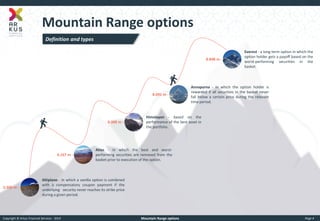
Himalayan - based on the performance of the best asset in the portfolio. 
Altiplano - in which a vanilla option is combined with a compensatory coupon payment if the underlying security never reaches its strike price during a given period. 
Annapurna - in which the option holder is rewarded if all securities in the basket never fall below a certain price during the relevant time period. 
Atlas - in which the best and worst- performing securities are removed from the basket prior to execution of the option. 
Everest - a long-term option in which the option holder gets a payoff based on the worst-performing securities in the basket. 
3.300 m - 
4.167 m - 
8.000 m - 
8.091 m - 
8.848 m - 
Definition and types
Copyright © Arkus Financial Services - 2014 
Risk-based Governance Solutions 
Altiplano Options 
Al·ti·pla·no [al-tuh-plah-noh; for 1 also Spanish ahl-tee-plah-naw] 
1.A plateau region in South America, situated in the Andes of Argentina, Bolivia and Peru. 
2.Financial instrument in which a vanilla option is combined with a compensatory coupon payment if the underlying security never reaches its strike price during a given period.
Copyright © Arkus Financial Services - 2014 
Mountain Range options 
Page 6 
“Altiplano con Memoria” Options 
푷풂풚풐풇풇풊=휼 푵 ∗푪 ∗풊 풊풇 풊=ퟏ 푷풂풚풐풇풇(풊)=휼 (푵 ∗푪 ∗풊 − 푪풏) 풊−ퟏ 풏=ퟏ 풊풇 풊=ퟐ,ퟑ,..,풏 
휼= ퟏ 풊풇 푴풊풏 ퟏ≤풋≤풏,풕ퟏ≤풕≤풕ퟐ 푺풋 풕 푺풋 ퟎ≥푳 ퟎ 풆풍풔풆 
►The Payoff is thus different from zero only if none of the stocks is below the barrier during the specified time period 
►C is a fixed coupon payment 
►i is the Barrier Observation Date 
►Sj represents the value of the j-th stock 
►휼 is a binary variable equal to the condition set for the barrier value 
►L is the predetermined limit 
Payoff structure
Copyright © Arkus Financial Services - 2014 
Mountain Range options 
Page 7 
“Altiplano con Memoria” Options 
1.Generate normally distributed random variates through the Inverse Transform Method 
2.Simulate the correlated multi asset path through the Cholesky Decomposition 
3.Check, for each barrier observation date, if each single underlying is above the barrier limit 
If one of the underlying assets is below the barrier limit  Payoff(i) = 0 
If none of the underlying assets is below the barrier limit: 푷풂풚풐풇풇풊=휼 푵 ∗푪 ∗풊 풊풇 풊=ퟏ 푷풂풚풐풇풇(풊)=휼 (푵 ∗푪 ∗풊 − 푪풏) 풊−ퟏ 풏=ퟏ 풊풇 풊=ퟐ,ퟑ,..,풏 
4.Store the payoff values into an array and discount each of them back at the appropriate discount rate 
5.Sum all the discounted payoffs to get the present value of the option 
6.Repeat the first 5 steps 20.000 times, to build a distribution of possible option values 
7.Take the average of all simulation outcomes to find the final price 
8.Greeks Estimation - Delta 
Pricing – The algorithm
Copyright © Arkus Financial Services - 2014 
Mountain Range options 
Page 8 
“Altiplano con Memoria” Options 
Consider an integral on the unit interval [0,1]: 
푰= 품풙풅풙 ퟏ ퟎ 
We may think of this integral as the expected value E[g(U)], where U is a uniform random variable on the interval (0,1) and estimate the expected value - a number – by a sample mean (which is a random variable). 
The only thing we have to do is generating a sequence Ui of independent random samples from the uniform distribution and then evaluate the sample mean: 푰풎= ퟏ 풎 품(푼풊) 풎 풊=ퟏ 
The strong law of large numbers implies that, with probability 1, 풍풊풎 풎 → + ∞ 푰풎=푰 
Pricing: the idea behind Monte Carlo Integration
Copyright © Arkus Financial Services - 2014 
Mountain Range options 
Page 9 
“Altiplano con Memoria” Options 
Suppose we are given the CDF F(x) = P(X ≤ x), and that we want to generate random variates according to F. If we are able to generate random variates according to F, then we could: 
1.Draw a random number U ~ U(0,1) 
2.Return X = F-1 (U) 
It can be shown that the random variate X generated by this method is characterized by the distribution function F. 
For example u = 0.975 would return 1.959, because 97.5% of the probability of a normal pdf occurs in the region where X < 1.959 
Pricing – Generating normal random variates through the Inverse Transform Method
Copyright © Arkus Financial Services - 2014 
Mountain Range options 
Page 10 
“Altiplano con Memoria” Options 
Consider a multivariate normal distribution with expected value μ and covariance matrix Σ (symmetric positive definite). 
The Cholesky Matrix M is a lower triangular matrix such that: 
횺= 푴푻퐌 Once retrieved this matrix, we may apply the following algorithm to generate correlated random numbers X: 
Generate n independent standard normal variates Z1, Z2 ,..., Zn 
Return 푿= 흁+ 푴푻퐙 ,where 풁=Z1, Z2 ,..., ZnT is a vector of uncorrelated variables 
Suppose we must generate sample paths for two correlated Wiener processes, having covariance matrix 횺= ퟏ흆 흆ퟏ 
It can be verified that the Cholesky Matrix is 퐌= ퟏퟎ 흆(ퟏ−흆ퟐ) . 
Hence, to simulate bidimensional correlated Wiener Process, we will create two independent standard normal variates Z1 and Z2 and use: 
풙ퟏ= 풁ퟏ and 풙ퟐ= 흆풁ퟏ+ (ퟏ−흆ퟐ)풁ퟐ 
Pricing – Correlated Random Numbers: Cholesky Factorization
Copyright © Arkus Financial Services - 2014 
Mountain Range options 
Page 11 
“Altiplano con Memoria” Options 
The pricing structure is primarily dependent on the correlation between the constituent stocks. 
In this example of a 7 asset basket, a small estimation error of 0.5% for 1 set of correlation, would lead to an estimation error of 10.5%, which in turn would make any final option value meaningless. 
This is why, together with analytical difficulties in deriving it for higher - dimensions problems, any closed form would be obsolete when dealing with these options. 
Stock 
A 
B 
C 
D 
E 
F 
G 
A 
1 
Corr(B,A) 
Corr(C,A) 
Corr(D,A) 
Corr(E,A) 
Corr(F,A) 
Corr(G,A) 
B 
Corr(B,A) 
1 
Corr(C,B) 
Corr(D,B) 
Corr(E,B) 
Corr(F,B) 
Corr(G,B) 
C 
Corr(C,A) 
Corr(C,B) 
1 
Corr(D,C) 
Corr(E,C) 
Corr(F,C) 
Corr(G,C) 
D 
Corr(D,A) 
Corr(D,B) 
Corr(D,C) 
1 
Corr(E,D) 
Corr(F,D) 
Corr(G,D) 
E 
Corr(E,A) 
Corr(E,B) 
Corr(E,C) 
Corr(E,D) 
1 
Corr(F,E) 
Corr(G,E) 
F 
Corr(F,A) 
Corr(F,B) 
Corr(F,C) 
Corr(F,D) 
Corr(F,E) 
1 
Corr(G,F) 
G 
Corr(G,A) 
Corr(G,B) 
Corr(G,C) 
Corr(G,D) 
Corr(G,E) 
Corr(G,F) 
1 
Pricing – the correlation estimation problem and the impossibility to use a closed form
Copyright © Arkus Financial Services - 2014 
Mountain Range options 
Page 12 
“Altiplano con Memoria” Options 
For path-dependent options (like Mountain Range Options), we need the whole path or, at least, a sequence of values of the underlying at given time events. 
The first step in simulating a price path is to choose a stochastic process to model changes in financial asset prices. 
Stock prices are often modelled by the GBM: 
풅푺풕=흁푺풕퐝퐭+ 흈푺풕풅푾풕 
Using Ito’s Lemma, we may transform the above equation into the following form: 
풅풍풐품푺풕=(흁− ퟏ ퟐ 흈ퟐ)풅풕+흈풅푾풕 
The last equation is particularly useful, as it can be integrated exactly and discretized, yielding to: 
푺풕=푺ퟎ풆(흂휹풕+흈휹풕휺) 
Pricing – Path Generation & the Geometric Brownian Motion
Copyright © Arkus Financial Services - 2014 
Mountain Range options 
Page 13 
0 
25 
50 
75 
100 
125 
150 
175 
200 
225 
250 
275 
300 
325 
350 
375 
400 
425 
450 
475 
500 
525 
550 
575 
600 
625 
650 
675 
700 
725 
750 
775 
800 
825 
850 
T1 
T2 
T3 
T4 
T5 
T6 
Level of the Underlying 
Barrier Observation Dates 
Case A: All coupons paid 
S1 
S2 
S3 
S4 
B1 
B2 
B3 
B4 
“Altiplano con Memoria” Options
Copyright © Arkus Financial Services - 2014 
Mountain Range options 
Page 14 
0 
25 
50 
75 
100 
125 
150 
175 
200 
225 
250 
275 
300 
325 
350 
375 
400 
425 
450 
475 
500 
525 
550 
575 
600 
625 
650 
675 
T1 
T2 
T3 
T4 
T5 
T6 
Level of the Underlying 
Barrier Observation Dates 
Case B – Some coupons paid (C1,C2 & C3) and some not (C4,C5 & C6) 
S1 
S2 
S4 
B1 
B2 
B3 
B4 
S3 
“Altiplano con Memoria” Options
Copyright © Arkus Financial Services - 2014 
Mountain Range options 
Page 15 
“Altiplano con Memoria” Options 
Greeks – Estimation - Delta 
The Greeks are the quantities representing the sensitivity of the price of derivatives to a change in underlying parameters on which the value of an instrument is dependent. 
The Delta, in particular, measures the rate of change of option value with respect to changes in the underlying asset price. 
In a Monte Carlo framework, Greeks estimation requires a Finite Difference Approximation approach. 
This method is based on the re-calculation of the option value with a slight change of one of the input parameters, so that the sensitivity of the option value to that parameter can be estimated. The parameter in question is the value of the underlying. 
휟= 흏풇(푺ퟎ) 흏푺ퟎ =퐥퐢퐦 휹푺ퟎ→ퟎ 풇푺ퟎ+휹푺ퟎ−풇푺ퟎ 휹푺ퟎ 
This idea is however to naive and it can be shown that taking a central difference may be preferable in order to reduce the variance of the estimator: 
휟= 풇푺ퟎ+휹푺ퟎ,흎−풇푺ퟎ−휹푺ퟎ,흎 ퟐ휹푺ퟎ
Copyright © Arkus Financial Services - 2014 
Mountain Range options 
Page 16 
Should you have any questions… 
Paolo Pirruccio 
Risk Analyst 
paolo.pirruccio@arkus-fs.com
Copyright © Arkus Financial Services - 2014 
Mountain Range options 
Page 17

Mountain Range Options

  • 1.
    Copyright © ArkusFinancial Services - 2014 Mountain Range options Page 1 MOUNTAIN RANGE OPTIONS Paolo Pirruccio
  • 2.
    Copyright © ArkusFinancial Services - 2014 Mountain Range options Page 2 Mountain Range options ►Originally marketed by Société Générale in 1998. ►Traded over-the-counter (OTC), typically by private banks and institutional investors such as hedge funds. ►These options have combined characteristics of Range (multi – year time ranges) and Basket options (more than one underlying). Introduction
  • 3.
    Copyright © ArkusFinancial Services - 2014 Mountain Range options Page 3 Mountain Range options Being struck on two or more underlying assets, mountain range options are particularly relevant for hedgers who want to cover several positions with one derivative. Instead of monitoring multiple options written on individual assets, a basket option can be structured to achieve the same coverage. The advantage of this feature is that the combined volatility will be lower than the volatility of the individual assets. A lower volatility will result in a cheaper option price, which can significantly decrease the costs implied by hedging. All these features made Mountain Range Options an appealing product which usually offer a minimum capital guarantee, plus the variable part of returns determined by the stock performances. It can be useful for investors who want a capital protection. Usage
  • 4.
    Copyright © ArkusFinancial Services - 2014 Mountain Range options Page 4 Mountain Range options Himalayan - based on the performance of the best asset in the portfolio. Altiplano - in which a vanilla option is combined with a compensatory coupon payment if the underlying security never reaches its strike price during a given period. Annapurna - in which the option holder is rewarded if all securities in the basket never fall below a certain price during the relevant time period. Atlas - in which the best and worst- performing securities are removed from the basket prior to execution of the option. Everest - a long-term option in which the option holder gets a payoff based on the worst-performing securities in the basket. 3.300 m - 4.167 m - 8.000 m - 8.091 m - 8.848 m - Definition and types
  • 5.
    Copyright © ArkusFinancial Services - 2014 Risk-based Governance Solutions Altiplano Options Al·ti·pla·no [al-tuh-plah-noh; for 1 also Spanish ahl-tee-plah-naw] 1.A plateau region in South America, situated in the Andes of Argentina, Bolivia and Peru. 2.Financial instrument in which a vanilla option is combined with a compensatory coupon payment if the underlying security never reaches its strike price during a given period.
  • 6.
    Copyright © ArkusFinancial Services - 2014 Mountain Range options Page 6 “Altiplano con Memoria” Options 푷풂풚풐풇풇풊=휼 푵 ∗푪 ∗풊 풊풇 풊=ퟏ 푷풂풚풐풇풇(풊)=휼 (푵 ∗푪 ∗풊 − 푪풏) 풊−ퟏ 풏=ퟏ 풊풇 풊=ퟐ,ퟑ,..,풏 휼= ퟏ 풊풇 푴풊풏 ퟏ≤풋≤풏,풕ퟏ≤풕≤풕ퟐ 푺풋 풕 푺풋 ퟎ≥푳 ퟎ 풆풍풔풆 ►The Payoff is thus different from zero only if none of the stocks is below the barrier during the specified time period ►C is a fixed coupon payment ►i is the Barrier Observation Date ►Sj represents the value of the j-th stock ►휼 is a binary variable equal to the condition set for the barrier value ►L is the predetermined limit Payoff structure
  • 7.
    Copyright © ArkusFinancial Services - 2014 Mountain Range options Page 7 “Altiplano con Memoria” Options 1.Generate normally distributed random variates through the Inverse Transform Method 2.Simulate the correlated multi asset path through the Cholesky Decomposition 3.Check, for each barrier observation date, if each single underlying is above the barrier limit If one of the underlying assets is below the barrier limit  Payoff(i) = 0 If none of the underlying assets is below the barrier limit: 푷풂풚풐풇풇풊=휼 푵 ∗푪 ∗풊 풊풇 풊=ퟏ 푷풂풚풐풇풇(풊)=휼 (푵 ∗푪 ∗풊 − 푪풏) 풊−ퟏ 풏=ퟏ 풊풇 풊=ퟐ,ퟑ,..,풏 4.Store the payoff values into an array and discount each of them back at the appropriate discount rate 5.Sum all the discounted payoffs to get the present value of the option 6.Repeat the first 5 steps 20.000 times, to build a distribution of possible option values 7.Take the average of all simulation outcomes to find the final price 8.Greeks Estimation - Delta Pricing – The algorithm
  • 8.
    Copyright © ArkusFinancial Services - 2014 Mountain Range options Page 8 “Altiplano con Memoria” Options Consider an integral on the unit interval [0,1]: 푰= 품풙풅풙 ퟏ ퟎ We may think of this integral as the expected value E[g(U)], where U is a uniform random variable on the interval (0,1) and estimate the expected value - a number – by a sample mean (which is a random variable). The only thing we have to do is generating a sequence Ui of independent random samples from the uniform distribution and then evaluate the sample mean: 푰풎= ퟏ 풎 품(푼풊) 풎 풊=ퟏ The strong law of large numbers implies that, with probability 1, 풍풊풎 풎 → + ∞ 푰풎=푰 Pricing: the idea behind Monte Carlo Integration
  • 9.
    Copyright © ArkusFinancial Services - 2014 Mountain Range options Page 9 “Altiplano con Memoria” Options Suppose we are given the CDF F(x) = P(X ≤ x), and that we want to generate random variates according to F. If we are able to generate random variates according to F, then we could: 1.Draw a random number U ~ U(0,1) 2.Return X = F-1 (U) It can be shown that the random variate X generated by this method is characterized by the distribution function F. For example u = 0.975 would return 1.959, because 97.5% of the probability of a normal pdf occurs in the region where X < 1.959 Pricing – Generating normal random variates through the Inverse Transform Method
  • 10.
    Copyright © ArkusFinancial Services - 2014 Mountain Range options Page 10 “Altiplano con Memoria” Options Consider a multivariate normal distribution with expected value μ and covariance matrix Σ (symmetric positive definite). The Cholesky Matrix M is a lower triangular matrix such that: 횺= 푴푻퐌 Once retrieved this matrix, we may apply the following algorithm to generate correlated random numbers X: Generate n independent standard normal variates Z1, Z2 ,..., Zn Return 푿= 흁+ 푴푻퐙 ,where 풁=Z1, Z2 ,..., ZnT is a vector of uncorrelated variables Suppose we must generate sample paths for two correlated Wiener processes, having covariance matrix 횺= ퟏ흆 흆ퟏ It can be verified that the Cholesky Matrix is 퐌= ퟏퟎ 흆(ퟏ−흆ퟐ) . Hence, to simulate bidimensional correlated Wiener Process, we will create two independent standard normal variates Z1 and Z2 and use: 풙ퟏ= 풁ퟏ and 풙ퟐ= 흆풁ퟏ+ (ퟏ−흆ퟐ)풁ퟐ Pricing – Correlated Random Numbers: Cholesky Factorization
  • 11.
    Copyright © ArkusFinancial Services - 2014 Mountain Range options Page 11 “Altiplano con Memoria” Options The pricing structure is primarily dependent on the correlation between the constituent stocks. In this example of a 7 asset basket, a small estimation error of 0.5% for 1 set of correlation, would lead to an estimation error of 10.5%, which in turn would make any final option value meaningless. This is why, together with analytical difficulties in deriving it for higher - dimensions problems, any closed form would be obsolete when dealing with these options. Stock A B C D E F G A 1 Corr(B,A) Corr(C,A) Corr(D,A) Corr(E,A) Corr(F,A) Corr(G,A) B Corr(B,A) 1 Corr(C,B) Corr(D,B) Corr(E,B) Corr(F,B) Corr(G,B) C Corr(C,A) Corr(C,B) 1 Corr(D,C) Corr(E,C) Corr(F,C) Corr(G,C) D Corr(D,A) Corr(D,B) Corr(D,C) 1 Corr(E,D) Corr(F,D) Corr(G,D) E Corr(E,A) Corr(E,B) Corr(E,C) Corr(E,D) 1 Corr(F,E) Corr(G,E) F Corr(F,A) Corr(F,B) Corr(F,C) Corr(F,D) Corr(F,E) 1 Corr(G,F) G Corr(G,A) Corr(G,B) Corr(G,C) Corr(G,D) Corr(G,E) Corr(G,F) 1 Pricing – the correlation estimation problem and the impossibility to use a closed form
  • 12.
    Copyright © ArkusFinancial Services - 2014 Mountain Range options Page 12 “Altiplano con Memoria” Options For path-dependent options (like Mountain Range Options), we need the whole path or, at least, a sequence of values of the underlying at given time events. The first step in simulating a price path is to choose a stochastic process to model changes in financial asset prices. Stock prices are often modelled by the GBM: 풅푺풕=흁푺풕퐝퐭+ 흈푺풕풅푾풕 Using Ito’s Lemma, we may transform the above equation into the following form: 풅풍풐품푺풕=(흁− ퟏ ퟐ 흈ퟐ)풅풕+흈풅푾풕 The last equation is particularly useful, as it can be integrated exactly and discretized, yielding to: 푺풕=푺ퟎ풆(흂휹풕+흈휹풕휺) Pricing – Path Generation & the Geometric Brownian Motion
  • 13.
    Copyright © ArkusFinancial Services - 2014 Mountain Range options Page 13 0 25 50 75 100 125 150 175 200 225 250 275 300 325 350 375 400 425 450 475 500 525 550 575 600 625 650 675 700 725 750 775 800 825 850 T1 T2 T3 T4 T5 T6 Level of the Underlying Barrier Observation Dates Case A: All coupons paid S1 S2 S3 S4 B1 B2 B3 B4 “Altiplano con Memoria” Options
  • 14.
    Copyright © ArkusFinancial Services - 2014 Mountain Range options Page 14 0 25 50 75 100 125 150 175 200 225 250 275 300 325 350 375 400 425 450 475 500 525 550 575 600 625 650 675 T1 T2 T3 T4 T5 T6 Level of the Underlying Barrier Observation Dates Case B – Some coupons paid (C1,C2 & C3) and some not (C4,C5 & C6) S1 S2 S4 B1 B2 B3 B4 S3 “Altiplano con Memoria” Options
  • 15.
    Copyright © ArkusFinancial Services - 2014 Mountain Range options Page 15 “Altiplano con Memoria” Options Greeks – Estimation - Delta The Greeks are the quantities representing the sensitivity of the price of derivatives to a change in underlying parameters on which the value of an instrument is dependent. The Delta, in particular, measures the rate of change of option value with respect to changes in the underlying asset price. In a Monte Carlo framework, Greeks estimation requires a Finite Difference Approximation approach. This method is based on the re-calculation of the option value with a slight change of one of the input parameters, so that the sensitivity of the option value to that parameter can be estimated. The parameter in question is the value of the underlying. 휟= 흏풇(푺ퟎ) 흏푺ퟎ =퐥퐢퐦 휹푺ퟎ→ퟎ 풇푺ퟎ+휹푺ퟎ−풇푺ퟎ 휹푺ퟎ This idea is however to naive and it can be shown that taking a central difference may be preferable in order to reduce the variance of the estimator: 휟= 풇푺ퟎ+휹푺ퟎ,흎−풇푺ퟎ−휹푺ퟎ,흎 ퟐ휹푺ퟎ
  • 16.
    Copyright © ArkusFinancial Services - 2014 Mountain Range options Page 16 Should you have any questions… Paolo Pirruccio Risk Analyst paolo.pirruccio@arkus-fs.com
  • 17.
    Copyright © ArkusFinancial Services - 2014 Mountain Range options Page 17