Basics of
Value At Risk
Value At Risk - Introduction
• All portfolio management is about risk and return
• “Return” is an unambiguous and self explanatory concept, but “risk”
is a harder concept to pin down
• In equity markets, we can think of risk in terms of volatility or betas or
factor loadings;
• in fixed-income markets, we have the notions of volatility, duration,
and convexity;
• while in the context of options, there are the delta, gamma, theta,
and other greeks
VAR Introduction
• 1990s, a new tool emerged for measuring portfolio risk called Value-at-Risk
or VaR, which was explicitly geared towards gauging the adequacy of capital
held to meet losses on risky portfolios
• The first prominent mention of VaR occurs in a 1993 report of the Group of
Thirty titled “Derivatives: Practices and Principles,” which recommended
the use of VaR and stress-testing to evaluate the riskiness of portfolios
• VaR was introduced by J.P. Morgan’s as part of Risk Metrics system in
1994.
• VaR is one of the popular measure of portfolio risk for gauging capital
adequacy.
VAR a Probability Measure
• VAR is a probability-based measure of loss potential for a company, a
fund, a portfolio, a transaction, or a strategy.
• Any position that exposes one to loss is potentially a candidate for
VAR measurement.
• VAR is most widely and easily used to measure the loss from market
risk, but it can also be used-subject to much greater complexity-to
measure the loss from credit risk and other types of risks.
• VAR is the loss that would be exceeded with a given probability over
a specific time period.
VAR contd.
•Therefore, the loss that would be exceeded with a
given probability is a loss that would be expected to
occur over a specific time period.
•There is a big difference among potential losses that
are incurred daily, weekly, monthly, quarterly, or
annually.
•Potential losses over longer periods should be larger
than those over shorter periods.
VAR contd.
•The VAR for a portfolio is $1.5 million for one
day with a probability of 0.05.
•Consider what this statement says: There is a 5
percent chance that the portfolio will lose at
least $1.5 million in a single day.
•The emphasis here should be on the fact that
the loss is a minimum, not a maximum.
VAR contd.
•To state the VAR as a maximum, we would
say that the probability is 0.95, or that we
are 95 percent confident, that the portfolio
will lose no more than $1.5 million
Summary on VAR
• First, we see that VAR is a loss that would be exceeded.
Hence, it is a measure of a minimum loss
• Second, we see that VAR is associated with a given
probability
• It is the loss that would be exceeded with a given probability
• Thus we would state that there is a certain percent chance
that a particular loss would be exceeded.
• Finally, VAR is defined for a specific period of time.
VAR contd.
•Value at Risk (VaR) is an attempt to provide a single
number summarizing the total risk in a portfolio of
financial assets
•It has become widely used by corporate treasurers
and fund managers as well as by financial institutions.
Bank regulators also use VaR in determining the
capital a bank is required to keep for the risks it is
bearing.
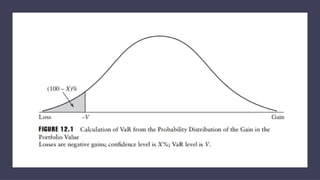
THE VaR MEASURE
• When using the value-at-risk measure, an analyst is interested in
making a statement of the following form:
• I am X percent certain there will not be a loss of more than V dollars
in the next N days.
• The variable V is the VaR of the portfolio
• It is a function of two parameters: the time horizon (N days) and the
confidence level (X%).
• It is the loss level over N days that has a probability of only (100-X)%
of being exceeded.
VAR calculation
• When N days is the time horizon and X% is the confidence level, VaR is
the loss corresponding to the (100- X)th percentile of the distribution
of the gain in the value of the portfolio over the next N days.
• Note that, when we look at the probability distribution of the gain, a
loss is a negative gain and VaR is concerned with the left tail of the
distribution
• When we look at the probability distribution of the loss, a gain is a
negative loss and VaR is concerned with the right tail of the
distribution
The VAR & Expected Shortfall
•VaR is an attractive measure because it is easy to
understand.
•In essence, it asks the simple question ‘‘How bad can
things get?’’
•Expected shortfall asks ‘‘If things do get bad, how
much can the company expect to lose?’’
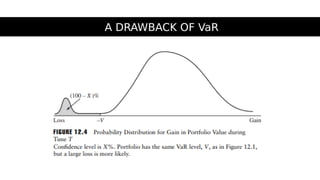
A DRAWBACK OF VaR
Illustration - VAR
• Assume a Portfolio : $1,000,000
• What is the maximum loss in a single day?
• 5% Value At Risk for 1 Day : $12,5000
• What is the meaning?
• 95% confident , losses will not exceed $12,500 in a single day
• There is a 5% chance that Portfolio Losses will be $12,500 or more
• 95% confident maximum losses will be $12,500
• 5% chance minimum losses will be $12,500
Definition of VAR
• VAR is the dollar or percentage loss in portfolio (asset) value
that will be equalled or exceeded only X Per cent of the time
• Daily VAR(5%) of $15,000 indicates that there is a 5% chance
that On any given day , the portfolio will experience a loss of
$15,000 or more.
• Which means that there is a 95% chance on any given day
the portfolio will experience either a loss less than $15,000
or gain.
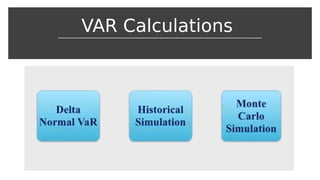
VAR Calculations
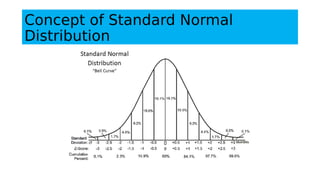
Concept of Standard Normal
Distribution
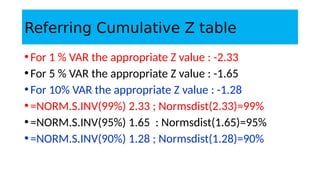
Referring Cumulative Z table
•For 1 % VAR the appropriate Z value : -2.33
•For 5 % VAR the appropriate Z value : -1.65
•For 10% VAR the appropriate Z value : -1.28
•=NORM.S.INV(99%) 2.33 ; Normsdist(2.33)=99%
•=NORM.S.INV(95%) 1.65 : Normsdist(1.65)=95%
•=NORM.S.INV(90%) 1.28 ; Normsdist(1.28)=90%
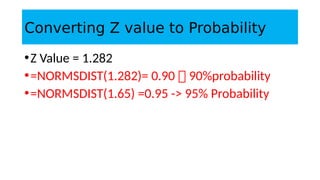
Converting Z value to Probability
•Z Value = 1.282
•=NORMSDIST(1.282)= 0.90  90%probability
•=NORMSDIST(1.65) =0.95 -> 95% Probability
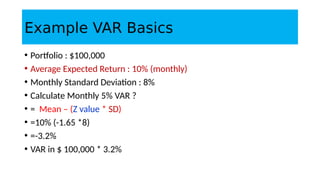
Example VAR Basics
• Portfolio : $100,000
• Average Expected Return : 10% (monthly)
• Monthly Standard Deviation : 8%
• Calculate Monthly 5% VAR ?
• = Mean – (Z value * SD)
• =10% (-1.65 *8)
• =-3.2%
• VAR in $ 100,000 * 3.2%
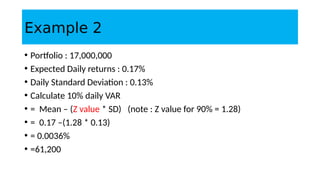
Example 2
• Portfolio : 17,000,000
• Expected Daily returns : 0.17%
• Daily Standard Deviation : 0.13%
• Calculate 10% daily VAR
• = Mean – (Z value * SD) (note : Z value for 90% = 1.28)
• = 0.17 –(1.28 * 0.13)
• = 0.0036%
• =61,200
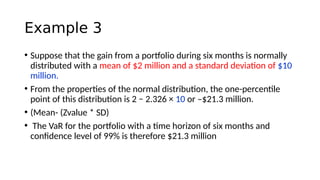
Example 3
• Suppose that the gain from a portfolio during six months is normally
distributed with a mean of $2 million and a standard deviation of $10
million.
• From the properties of the normal distribution, the one-percentile
point of this distribution is 2 − 2.326 × 10 or –$21.3 million.
• (Mean- (Zvalue * SD)
• The VaR for the portfolio with a time horizon of six months and
confidence level of 99% is therefore $21.3 million
Important Points on
VAR
Important Points on VAR
•Value-at-Risk (VaR) is essentially a measure of
volatility, specifically how volatile a bank’s assets
are
•VaR also takes into account the correlation
between different sets of assets in the overall
portfolio
STATISTICAL CONCEPTS
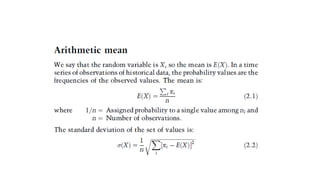
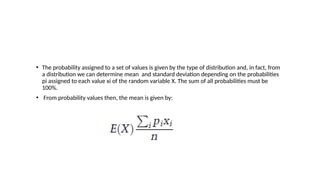
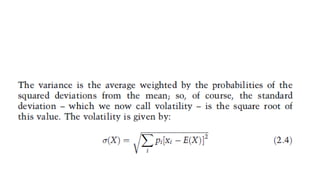
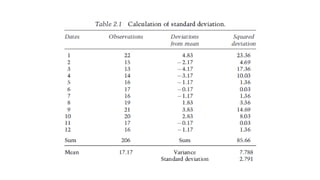
• The probability assigned to a set of values is given by the type of distribution and, in fact, from
a distribution we can determine mean and standard deviation depending on the probabilities
pi assigned to each value xi of the random variable X. The sum of all probabilities must be
100%.
• From probability values then, the mean is given by:
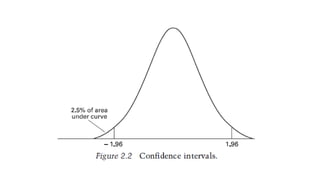
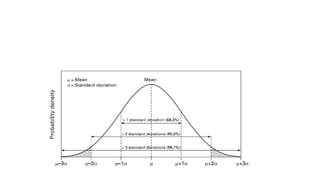
In the normal distribution, 2.5% of the outcomes are expected to fall
more than 1.96 standard deviations from the mean.
So, that means 95% of the outcomes would be expected to fall within
1.96 standard deviations.
That is, there is a 95% chance that the random variable will fall
between 1.96 standard deviations and -1.96 standard deviations.
This would be referred to as a ‘two-sided’ (or ‘two-tailed’) confidence
interval
VOLATILITY
• In financial market terms, volatility is a measure of how much the price
of an asset moves each day (or week or month, and so on).
• Volatility is important for both VaR measurement and in the valuation of
options.
• Volatility is important for both VaR measurement and in the valuation
of options.
• Statistically, volatility is defined as the fluctuation in the underlying asset
price over a certain period of time.
• Fluctuation is derived from the change in price between one day’s
closing price and the next day’s closing price.
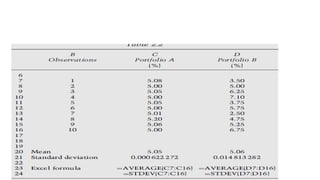
historical volatility
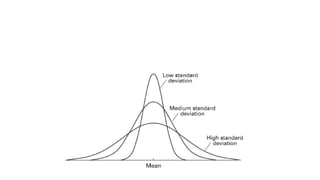
Differing Standard Deviations
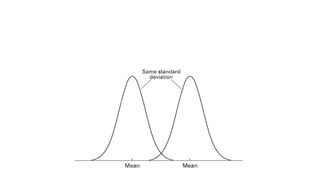
Differing means around the same standard deviation
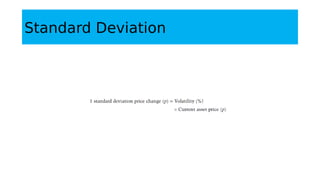
Standard Deviation
Differing standard deviations
THE NORMAL DISTRIBUTION AND
VaR
• Many VaR models use the normal curve to calculate the estimation of
losses over a specified time period.
CORRELATION
• The correlation between different assets and classes of assets is an
important measure for risk managers because of the role
diversification plays in risk reduction
• Correlation is a measure of how much the price of one asset moves in
relation to the price of another asset.
• In a portfolio comprised of only two assets, the VaR of this portfolio is
reduced if the correlation between the two assets is weak or negative.
• The simplest measure of correlation is the correlation coefficient. This
is a value between1 andþ1, with a perfect positive correlation
indicated by 1, while a perfect negative correlation is given by 1.
• Note that this assumes a linear (straight line) relationship between
the two assets.
• A correlation of 0 suggests that there is no linear relationship.
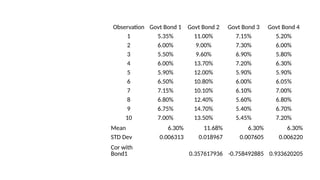
Correlation,
STD Dev,
Mean – with
different
Observations
Observation Govt Bond 1 Govt Bond 2 Govt Bond 3 Govt Bond 4
1 5.35% 11.00% 7.15% 5.20%
2 6.00% 9.00% 7.30% 6.00%
3 5.50% 9.60% 6.90% 5.80%
4 6.00% 13.70% 7.20% 6.30%
5 5.90% 12.00% 5.90% 5.90%
6 6.50% 10.80% 6.00% 6.05%
7 7.15% 10.10% 6.10% 7.00%
8 6.80% 12.40% 5.60% 6.80%
9 6.75% 14.70% 5.40% 6.70%
10 7.00% 13.50% 5.45% 7.20%
Mean 6.30% 11.68% 6.30% 6.30%
STD Dev 0.006313 0.018967 0.007605 0.006220
Cor with
Bond1 0.357617936 -0.758492885 0.933620205
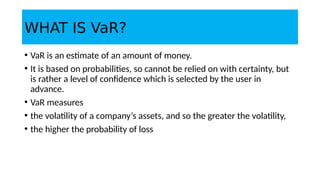
WHAT IS VaR?
• VaR is an estimate of an amount of money.
• It is based on probabilities, so cannot be relied on with certainty, but
is rather a level of confidence which is selected by the user in
advance.
• VaR measures
• the volatility of a company’s assets, and so the greater the volatility,
• the higher the probability of loss
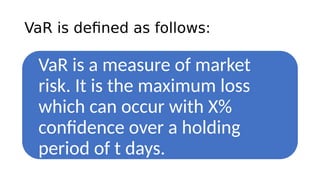
VaR is defined as follows:
VaR is a measure of market
risk. It is the maximum loss
which can occur with X%
confidence over a holding
period of t days.
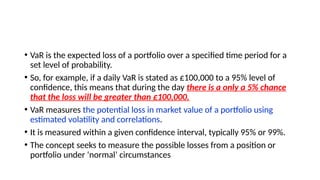
• VaR is the expected loss of a portfolio over a specified time period for a
set level of probability.
• So, for example, if a daily VaR is stated as £100,000 to a 95% level of
confidence, this means that during the day there is a only a 5% chance
that the loss will be greater than £100,000.
• VaR measures the potential loss in market value of a portfolio using
estimated volatility and correlations.
• It is measured within a given confidence interval, typically 95% or 99%.
• The concept seeks to measure the possible losses from a position or
portfolio under ‘normal’ circumstances
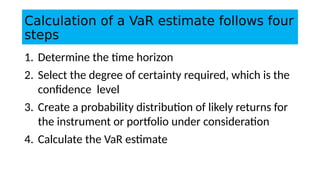
Calculation of a VaR estimate follows four
steps
1. Determine the time horizon
2. Select the degree of certainty required, which is the
confidence level
3. Create a probability distribution of likely returns for
the instrument or portfolio under consideration
4. Calculate the VaR estimate
VAR Redefined
VaR is the largest likely loss from
market risk (expressed in currency
units) that an asset or portfolio will
suffer over a time interval and with a
degree of certainty selected by the
user.
Three main methods for calculating
VaR.
1. the correlation method (or variance/covariance
method);
2. Historical simulation;
3. Monte Carlo simulation.
Correlation method
•This is also known as the variance–covariance,
parametric or analytic method.
•This method assumes the returns on risk factors are
normally distributed, the correlations between risk
factors are constant and the delta (or price sensitivity
to changes in a risk factor) of each portfolio
constituent is constant
Historical simulation method
• The historical simulation method for calculating VaR is the simplest
and avoids some of the pitfalls of the correlation method.
• Specifically, the three main assumptions behind correlation (normally
distributed returns, constant correlations, constant deltas) are not
needed in this case.
• For historical simulation the model calculates potential losses using
actual historical returns in the risk factors and so captures the non-
normal distribution of risk factor returns.
The attractive features of VaR as a
risk metric are as follows
• It corresponds to an amount that could be lost with some chosen
probability.
• It measures the risk of the risk factors as well as the risk factor
sensitivities.
• It can be compared across different markets and different exposures.
• It is a universal metric that applies to all activities and to all types of risk.
• It can be measured at any level, from an individual trade or portfolio, up
to a single enterprise-wide VaR measure covering all the risks in the firm
as a whole
VAR Interpretation
•1% 1-day VaR=$2 million,
•then we are 99% confident that we
would lose no more than $2 million from
holding the portfolio for 1 day.
Problem on VAR
• Bank Z has investment of Rs 50 Crores in shares of ABC Ltd.
• The daily volatility is 2% (SD)
• At 99%, confidence level, Calculate
• 1. Daily VaR
• 2. Weekly VaR(7days)
• 3. Monthly VaR(30 days)
• 4. Yearly VaR ( 250days)
Solution
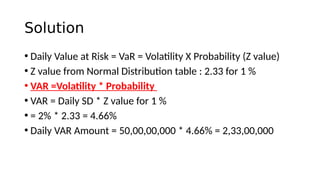
• Daily Value at Risk = VaR = Volatility X Probability (Z value)
• Z value from Normal Distribution table : 2.33 for 1 %
• VAR =Volatility * Probability
• VAR = Daily SD * Z value for 1 %
• = 2% * 2.33 = 4.66%
• Daily VAR Amount = 50,00,00,000 * 4.66% = 2,33,00,000
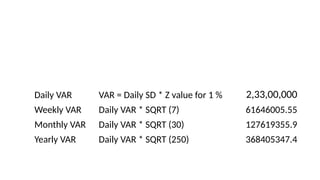
VAR calculation for different periods
Daily VAR VAR = Daily SD * Z value for 1 % 2,33,00,000
Weekly VAR Daily VAR * SQRT (7) 61646005.55
Monthly VAR Daily VAR * SQRT (30) 127619355.9
Yearly VAR Daily VAR * SQRT (250) 368405347.4
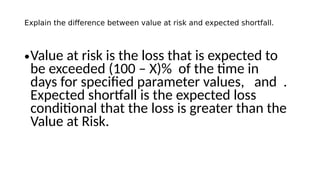
Explain the difference between value at risk and expected shortfall.
•Value at risk is the loss that is expected to
be exceeded (100 – X)% of the time in
days for specified parameter values, and .
Expected shortfall is the expected loss
conditional that the loss is greater than the
Value at Risk.
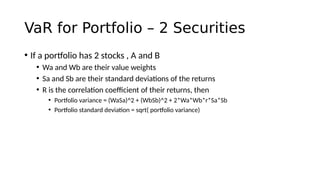
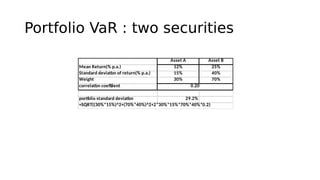
VaR for Portfolio – 2 Securities
• If a portfolio has 2 stocks , A and B
• Wa and Wb are their value weights
• Sa and Sb are their standard deviations of the returns
• R is the correlation coefficient of their returns, then
• Portfolio variance = (WaSa)^2 + (WbSb)^2 + 2*Wa*Wb*r*Sa*Sb
• Portfolio standard deviation = sqrt( portfolio variance)
Portfolio VaR : two securities
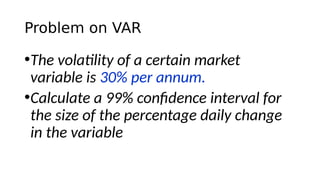
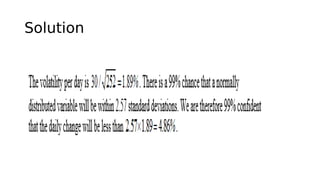
Problem on VAR
•The volatility of a certain market
variable is 30% per annum.
•Calculate a 99% confidence interval for
the size of the percentage daily change
in the variable
Solution
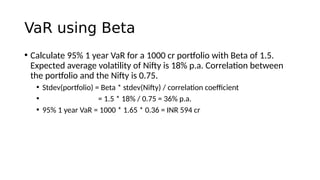
VaR using Beta
• Calculate 95% 1 year VaR for a 1000 cr portfolio with Beta of 1.5.
Expected average volatility of Nifty is 18% p.a. Correlation between
the portfolio and the Nifty is 0.75.
• Stdev(portfolio) = Beta * stdev(Nifty) / correlation coefficient
• = 1.5 * 18% / 0.75 = 36% p.a.
• 95% 1 year VaR = 1000 * 1.65 * 0.36 = INR 594 cr
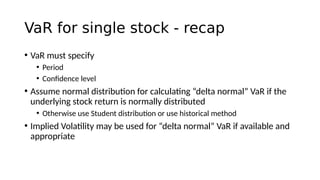
VaR for single stock - recap
• VaR must specify
• Period
• Confidence level
• Assume normal distribution for calculating “delta normal” VaR if the
underlying stock return is normally distributed
• Otherwise use Student distribution or use historical method
• Implied Volatility may be used for “delta normal” VaR if available and
appropriate
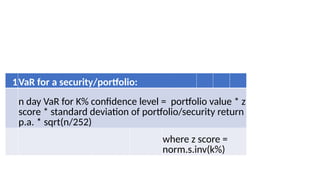
VAR Formula
1VaR for a security/portfolio:
n day VaR for K% confidence level = portfolio value * z
score * standard deviation of portfolio/security return
p.a. * sqrt(n/252)
where z score =
norm.s.inv(k%)
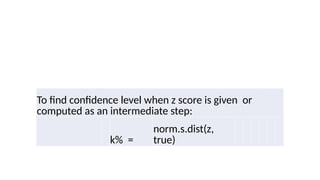
VaR Formula 2
To find confidence level when z score is given or
computed as an intermediate step:
k% =
norm.s.dist(z,
true)

Value_At_Risk_An_Introduction.pptx.pdf

  • 1.
  • 2.
    Value At Risk- Introduction • All portfolio management is about risk and return • “Return” is an unambiguous and self explanatory concept, but “risk” is a harder concept to pin down • In equity markets, we can think of risk in terms of volatility or betas or factor loadings; • in fixed-income markets, we have the notions of volatility, duration, and convexity; • while in the context of options, there are the delta, gamma, theta, and other greeks
  • 3.
    VAR Introduction • 1990s,a new tool emerged for measuring portfolio risk called Value-at-Risk or VaR, which was explicitly geared towards gauging the adequacy of capital held to meet losses on risky portfolios • The first prominent mention of VaR occurs in a 1993 report of the Group of Thirty titled “Derivatives: Practices and Principles,” which recommended the use of VaR and stress-testing to evaluate the riskiness of portfolios • VaR was introduced by J.P. Morgan’s as part of Risk Metrics system in 1994. • VaR is one of the popular measure of portfolio risk for gauging capital adequacy.
  • 4.
    VAR a ProbabilityMeasure • VAR is a probability-based measure of loss potential for a company, a fund, a portfolio, a transaction, or a strategy. • Any position that exposes one to loss is potentially a candidate for VAR measurement. • VAR is most widely and easily used to measure the loss from market risk, but it can also be used-subject to much greater complexity-to measure the loss from credit risk and other types of risks. • VAR is the loss that would be exceeded with a given probability over a specific time period.
  • 5.
    VAR contd. •Therefore, theloss that would be exceeded with a given probability is a loss that would be expected to occur over a specific time period. •There is a big difference among potential losses that are incurred daily, weekly, monthly, quarterly, or annually. •Potential losses over longer periods should be larger than those over shorter periods.
  • 6.
    VAR contd. •The VARfor a portfolio is $1.5 million for one day with a probability of 0.05. •Consider what this statement says: There is a 5 percent chance that the portfolio will lose at least $1.5 million in a single day. •The emphasis here should be on the fact that the loss is a minimum, not a maximum.
  • 7.
    VAR contd. •To statethe VAR as a maximum, we would say that the probability is 0.95, or that we are 95 percent confident, that the portfolio will lose no more than $1.5 million
  • 8.
    Summary on VAR •First, we see that VAR is a loss that would be exceeded. Hence, it is a measure of a minimum loss • Second, we see that VAR is associated with a given probability • It is the loss that would be exceeded with a given probability • Thus we would state that there is a certain percent chance that a particular loss would be exceeded. • Finally, VAR is defined for a specific period of time.
  • 9.
    VAR contd. •Value atRisk (VaR) is an attempt to provide a single number summarizing the total risk in a portfolio of financial assets •It has become widely used by corporate treasurers and fund managers as well as by financial institutions. Bank regulators also use VaR in determining the capital a bank is required to keep for the risks it is bearing.
  • 10.
    THE VaR MEASURE •When using the value-at-risk measure, an analyst is interested in making a statement of the following form: • I am X percent certain there will not be a loss of more than V dollars in the next N days. • The variable V is the VaR of the portfolio • It is a function of two parameters: the time horizon (N days) and the confidence level (X%). • It is the loss level over N days that has a probability of only (100-X)% of being exceeded.
  • 11.
    VAR calculation • WhenN days is the time horizon and X% is the confidence level, VaR is the loss corresponding to the (100- X)th percentile of the distribution of the gain in the value of the portfolio over the next N days. • Note that, when we look at the probability distribution of the gain, a loss is a negative gain and VaR is concerned with the left tail of the distribution • When we look at the probability distribution of the loss, a gain is a negative loss and VaR is concerned with the right tail of the distribution
  • 13.
    The VAR &Expected Shortfall •VaR is an attractive measure because it is easy to understand. •In essence, it asks the simple question ‘‘How bad can things get?’’ •Expected shortfall asks ‘‘If things do get bad, how much can the company expect to lose?’’
  • 14.
  • 15.
    Illustration - VAR •Assume a Portfolio : $1,000,000 • What is the maximum loss in a single day? • 5% Value At Risk for 1 Day : $12,5000 • What is the meaning? • 95% confident , losses will not exceed $12,500 in a single day • There is a 5% chance that Portfolio Losses will be $12,500 or more • 95% confident maximum losses will be $12,500 • 5% chance minimum losses will be $12,500
  • 16.
    Definition of VAR •VAR is the dollar or percentage loss in portfolio (asset) value that will be equalled or exceeded only X Per cent of the time • Daily VAR(5%) of $15,000 indicates that there is a 5% chance that On any given day , the portfolio will experience a loss of $15,000 or more. • Which means that there is a 95% chance on any given day the portfolio will experience either a loss less than $15,000 or gain.
  • 17.
  • 18.
    Concept of StandardNormal Distribution
  • 19.
    Referring Cumulative Ztable •For 1 % VAR the appropriate Z value : -2.33 •For 5 % VAR the appropriate Z value : -1.65 •For 10% VAR the appropriate Z value : -1.28 •=NORM.S.INV(99%) 2.33 ; Normsdist(2.33)=99% •=NORM.S.INV(95%) 1.65 : Normsdist(1.65)=95% •=NORM.S.INV(90%) 1.28 ; Normsdist(1.28)=90%
  • 20.
    Converting Z valueto Probability •Z Value = 1.282 •=NORMSDIST(1.282)= 0.90  90%probability •=NORMSDIST(1.65) =0.95 -> 95% Probability
  • 21.
    Example VAR Basics •Portfolio : $100,000 • Average Expected Return : 10% (monthly) • Monthly Standard Deviation : 8% • Calculate Monthly 5% VAR ? • = Mean – (Z value * SD) • =10% (-1.65 *8) • =-3.2% • VAR in $ 100,000 * 3.2%
  • 22.
    Example 2 • Portfolio: 17,000,000 • Expected Daily returns : 0.17% • Daily Standard Deviation : 0.13% • Calculate 10% daily VAR • = Mean – (Z value * SD) (note : Z value for 90% = 1.28) • = 0.17 –(1.28 * 0.13) • = 0.0036% • =61,200
  • 23.
    Example 3 • Supposethat the gain from a portfolio during six months is normally distributed with a mean of $2 million and a standard deviation of $10 million. • From the properties of the normal distribution, the one-percentile point of this distribution is 2 − 2.326 × 10 or –$21.3 million. • (Mean- (Zvalue * SD) • The VaR for the portfolio with a time horizon of six months and confidence level of 99% is therefore $21.3 million
  • 24.
  • 25.
    Important Points onVAR •Value-at-Risk (VaR) is essentially a measure of volatility, specifically how volatile a bank’s assets are •VaR also takes into account the correlation between different sets of assets in the overall portfolio
  • 26.
  • 27.
    • The probabilityassigned to a set of values is given by the type of distribution and, in fact, from a distribution we can determine mean and standard deviation depending on the probabilities pi assigned to each value xi of the random variable X. The sum of all probabilities must be 100%. • From probability values then, the mean is given by:
  • 31.
    In the normaldistribution, 2.5% of the outcomes are expected to fall more than 1.96 standard deviations from the mean. So, that means 95% of the outcomes would be expected to fall within 1.96 standard deviations. That is, there is a 95% chance that the random variable will fall between 1.96 standard deviations and -1.96 standard deviations. This would be referred to as a ‘two-sided’ (or ‘two-tailed’) confidence interval
  • 32.
    VOLATILITY • In financialmarket terms, volatility is a measure of how much the price of an asset moves each day (or week or month, and so on). • Volatility is important for both VaR measurement and in the valuation of options. • Volatility is important for both VaR measurement and in the valuation of options. • Statistically, volatility is defined as the fluctuation in the underlying asset price over a certain period of time. • Fluctuation is derived from the change in price between one day’s closing price and the next day’s closing price.
  • 33.
  • 34.
  • 35.
    Differing means aroundthe same standard deviation
  • 36.
  • 37.
  • 38.
    THE NORMAL DISTRIBUTIONAND VaR • Many VaR models use the normal curve to calculate the estimation of losses over a specified time period.
  • 39.
    CORRELATION • The correlationbetween different assets and classes of assets is an important measure for risk managers because of the role diversification plays in risk reduction • Correlation is a measure of how much the price of one asset moves in relation to the price of another asset. • In a portfolio comprised of only two assets, the VaR of this portfolio is reduced if the correlation between the two assets is weak or negative. • The simplest measure of correlation is the correlation coefficient. This is a value between1 andþ1, with a perfect positive correlation indicated by 1, while a perfect negative correlation is given by 1.
  • 40.
    • Note thatthis assumes a linear (straight line) relationship between the two assets. • A correlation of 0 suggests that there is no linear relationship.
  • 41.
    Correlation, STD Dev, Mean –with different Observations Observation Govt Bond 1 Govt Bond 2 Govt Bond 3 Govt Bond 4 1 5.35% 11.00% 7.15% 5.20% 2 6.00% 9.00% 7.30% 6.00% 3 5.50% 9.60% 6.90% 5.80% 4 6.00% 13.70% 7.20% 6.30% 5 5.90% 12.00% 5.90% 5.90% 6 6.50% 10.80% 6.00% 6.05% 7 7.15% 10.10% 6.10% 7.00% 8 6.80% 12.40% 5.60% 6.80% 9 6.75% 14.70% 5.40% 6.70% 10 7.00% 13.50% 5.45% 7.20% Mean 6.30% 11.68% 6.30% 6.30% STD Dev 0.006313 0.018967 0.007605 0.006220 Cor with Bond1 0.357617936 -0.758492885 0.933620205
  • 42.
    WHAT IS VaR? •VaR is an estimate of an amount of money. • It is based on probabilities, so cannot be relied on with certainty, but is rather a level of confidence which is selected by the user in advance. • VaR measures • the volatility of a company’s assets, and so the greater the volatility, • the higher the probability of loss
  • 43.
    VaR is definedas follows: VaR is a measure of market risk. It is the maximum loss which can occur with X% confidence over a holding period of t days.
  • 44.
    • VaR isthe expected loss of a portfolio over a specified time period for a set level of probability. • So, for example, if a daily VaR is stated as £100,000 to a 95% level of confidence, this means that during the day there is a only a 5% chance that the loss will be greater than £100,000. • VaR measures the potential loss in market value of a portfolio using estimated volatility and correlations. • It is measured within a given confidence interval, typically 95% or 99%. • The concept seeks to measure the possible losses from a position or portfolio under ‘normal’ circumstances
  • 45.
    Calculation of aVaR estimate follows four steps 1. Determine the time horizon 2. Select the degree of certainty required, which is the confidence level 3. Create a probability distribution of likely returns for the instrument or portfolio under consideration 4. Calculate the VaR estimate
  • 46.
    VAR Redefined VaR isthe largest likely loss from market risk (expressed in currency units) that an asset or portfolio will suffer over a time interval and with a degree of certainty selected by the user.
  • 47.
    Three main methodsfor calculating VaR. 1. the correlation method (or variance/covariance method); 2. Historical simulation; 3. Monte Carlo simulation.
  • 48.
    Correlation method •This isalso known as the variance–covariance, parametric or analytic method. •This method assumes the returns on risk factors are normally distributed, the correlations between risk factors are constant and the delta (or price sensitivity to changes in a risk factor) of each portfolio constituent is constant
  • 49.
    Historical simulation method •The historical simulation method for calculating VaR is the simplest and avoids some of the pitfalls of the correlation method. • Specifically, the three main assumptions behind correlation (normally distributed returns, constant correlations, constant deltas) are not needed in this case. • For historical simulation the model calculates potential losses using actual historical returns in the risk factors and so captures the non- normal distribution of risk factor returns.
  • 50.
    The attractive featuresof VaR as a risk metric are as follows • It corresponds to an amount that could be lost with some chosen probability. • It measures the risk of the risk factors as well as the risk factor sensitivities. • It can be compared across different markets and different exposures. • It is a universal metric that applies to all activities and to all types of risk. • It can be measured at any level, from an individual trade or portfolio, up to a single enterprise-wide VaR measure covering all the risks in the firm as a whole
  • 51.
    VAR Interpretation •1% 1-dayVaR=$2 million, •then we are 99% confident that we would lose no more than $2 million from holding the portfolio for 1 day.
  • 52.
    Problem on VAR •Bank Z has investment of Rs 50 Crores in shares of ABC Ltd. • The daily volatility is 2% (SD) • At 99%, confidence level, Calculate • 1. Daily VaR • 2. Weekly VaR(7days) • 3. Monthly VaR(30 days) • 4. Yearly VaR ( 250days)
  • 53.
    Solution • Daily Valueat Risk = VaR = Volatility X Probability (Z value) • Z value from Normal Distribution table : 2.33 for 1 % • VAR =Volatility * Probability • VAR = Daily SD * Z value for 1 % • = 2% * 2.33 = 4.66% • Daily VAR Amount = 50,00,00,000 * 4.66% = 2,33,00,000
  • 54.
    VAR calculation fordifferent periods Daily VAR VAR = Daily SD * Z value for 1 % 2,33,00,000 Weekly VAR Daily VAR * SQRT (7) 61646005.55 Monthly VAR Daily VAR * SQRT (30) 127619355.9 Yearly VAR Daily VAR * SQRT (250) 368405347.4
  • 55.
    Explain the differencebetween value at risk and expected shortfall. •Value at risk is the loss that is expected to be exceeded (100 – X)% of the time in days for specified parameter values, and . Expected shortfall is the expected loss conditional that the loss is greater than the Value at Risk.
  • 56.
    VaR for Portfolio– 2 Securities • If a portfolio has 2 stocks , A and B • Wa and Wb are their value weights • Sa and Sb are their standard deviations of the returns • R is the correlation coefficient of their returns, then • Portfolio variance = (WaSa)^2 + (WbSb)^2 + 2*Wa*Wb*r*Sa*Sb • Portfolio standard deviation = sqrt( portfolio variance)
  • 57.
    Portfolio VaR :two securities
  • 58.
    Problem on VAR •Thevolatility of a certain market variable is 30% per annum. •Calculate a 99% confidence interval for the size of the percentage daily change in the variable
  • 59.
  • 60.
    VaR using Beta •Calculate 95% 1 year VaR for a 1000 cr portfolio with Beta of 1.5. Expected average volatility of Nifty is 18% p.a. Correlation between the portfolio and the Nifty is 0.75. • Stdev(portfolio) = Beta * stdev(Nifty) / correlation coefficient • = 1.5 * 18% / 0.75 = 36% p.a. • 95% 1 year VaR = 1000 * 1.65 * 0.36 = INR 594 cr
  • 61.
    VaR for singlestock - recap • VaR must specify • Period • Confidence level • Assume normal distribution for calculating “delta normal” VaR if the underlying stock return is normally distributed • Otherwise use Student distribution or use historical method • Implied Volatility may be used for “delta normal” VaR if available and appropriate
  • 62.
    VAR Formula 1VaR fora security/portfolio: n day VaR for K% confidence level = portfolio value * z score * standard deviation of portfolio/security return p.a. * sqrt(n/252) where z score = norm.s.inv(k%)
  • 63.
    VaR Formula 2 Tofind confidence level when z score is given or computed as an intermediate step: k% = norm.s.dist(z, true)