

















RISK & RETURN
MEASUREMENT
RUBY SHARMA
What is a risk ?
RUBY SHARMARUBY SHARMA
RISK IS…..
Risk is defined in financial terms as the chance that an outcome or
investment's actual gains will differ from an expected outcome
or return. Risk includes the possibility of losing some or all of an
original investment.
The existence of volatility in the occurrence of an expected incident is
called risk .Higher the unpredictability greater is the risk.
In finance, risk is the probability that actual results will differ from
expected results.
RUBY SHARMARUBY SHARMA
RISK….
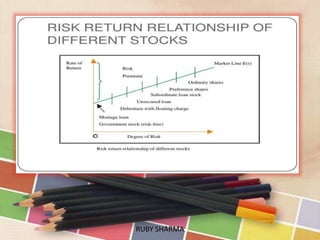
Risk is defined as the volatility of returns.
Quantifiably, risk is usually assessed by considering historical
behaviors and outcomes. In finance, standard deviation is a common
metric associated with risk. Standard deviation provides a measure of
the volatility of asset prices in comparison to their historical averages in
a given time frame.
RUBY SHARMARUBY SHARMA
RISK….
Each investor has a unique risk profile that determines their willingness
and ability to withstand risk. In general, as investment risks rise,
investors expect higher returns to compensate for taking those risks.
Risk can be reduced using diversification and hedging strategies.
RUBY SHARMARUBY SHARMA
CAUSES OF RISK
 Wrong method of investment
 Wrong timing of investment
 Wrong quality of investment
 interest rate risk
 Maturity period or length of investment
 Terms of lending
 National and international factors
 Natural calamities
RUBY SHARMARUBY SHARMA
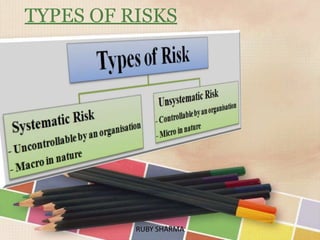
TYPES OF RISKS
RUBY SHARMARUBY SHARMA
Systematic and unsystematic
risk
Systematic risk is uncontrollable by an organization and
macro in nature.
Unsystematic risk is controllable by an organization and
micro in nature.
RUBY SHARMARUBY SHARMA
SYSTEMATIC RISK
Systematic risk is due to the influence of external factors on an
organization. Such factors are normally uncontrollable from an
organization's point of view.
It is a macro in nature as it affects a large number of organizations
operating under a similar stream or same domain. It cannot be planned
by the organization.
RUBY SHARMARUBY SHARMA
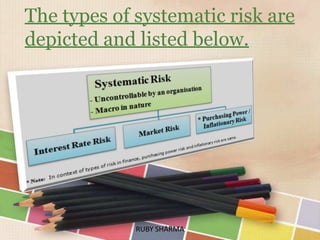
The types of systematic risk are
depicted and listed below.
RUBY SHARMARUBY SHARMA
Interest rate risk
Interest-rate risk arises due to variability in the interest rates from time
to time. It particularly affects debt securities as they carry the fixed rate
of interest.
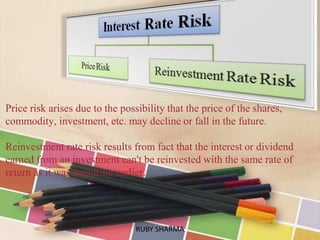
The types of interest-rate risk are depicted and listed below.
Price risk and
Reinvestment rate risk.
RUBY SHARMARUBY SHARMA
Price risk arises due to the possibility that the price of the shares,
commodity, investment, etc. may decline or fall in the future.
Reinvestment rate risk results from fact that the interest or dividend
earned from an investment can't be reinvested with the same rate of
return as it was acquiring earlier.
RUBY SHARMARUBY SHARMA
Market risk
Market risk is associated with consistent fluctuations seen in the trading
price of any particular shares or securities. That is, it arises due to rise
or fall in the trading price of listed shares or securities in the stock
market.
RUBY SHARMARUBY SHARMA
Purchasing power or
inflationary risk
Purchasing power risk is also known as inflation risk. It is so, since it
originates from the fact that it affects a purchasing power adversely. It
is not desirable to invest in securities during an inflationary period.
The types of power or inflationary risk are:
Demand inflation risk and
Cost inflation risk.
RUBY SHARMARUBY SHARMA
Demand inflation risk and
Cost inflation risk.
Demand inflation risk arises due to increase in price, which result from
an excess of demand over supply. It occurs when supply fails to cope
with the demand and hence cannot expand anymore.
Cost inflation risk arises due to sustained increase in the prices of goods
and services. It is actually caused by higher production cost. A high cost
of production inflates the final price of finished goods consumed by
people.
RUBY SHARMARUBY SHARMA
Unsystematic Risk
Unsystematic risk is due to the influence of internal factors prevailing
within an organization. Such factors are normally controllable from an
organization's point of view.
It is a micro in nature as it affects only a particular organization. It can
be planned, so that necessary actions can be taken by the organization to
mitigate (reduce the effect of) the risk.
The types of unsystematic risk are depicted and listed below.
Business or liquidity risk,
Financial risk
credit risk and
Operational risk.
RUBY SHARMARUBY SHARMA
Business risk :
Business risk can be internal as all as external. Internal
risk is caused due to improper product mix ,non
availability of raw materials, absence of strategic
management etc. External risk arises due to change in
operating conditions caused by conditions thrust upon the
firm which are beyond its control eg; business cycle,
government controls, international market conditions etc.
RUBY SHARMARUBY SHARMA
Financial risk :
This risk is associated with the capital structure of a
company. A company with no debt financing has no
financial risk. The extent of financial risk depends on the
leverage of the firms capital structure.
RUBY SHARMARUBY SHARMA
Credit or default risk
The credit risk deals with the probability of meeting with a
default. It is primarily the probability that a buyer will
default. Proper management can reduce the chances of
non payment of loan .
RUBY SHARMARUBY SHARMA
TOOLS FOR MEASURING
RISK
 Standard deviation
 Beta
RUBY SHARMARUBY SHARMA
Standard deviation
Standard deviation. The investment industry’s primary measure of risk
is standard deviation. Standard deviation really tells you how much an
investment will fluctuate from the average return.
The return of any investment has an average, which is also the expected
return, but most returns will be different from the average: some will
be more, others will be less. The more individual returns deviate from
the expected return, the greater the risk and the greater the potential
reward.
The degree to which all returns for a particular investment or asset
deviate from the expected return of the investment is a measure of its
risk.
RUBY SHARMARUBY SHARMA
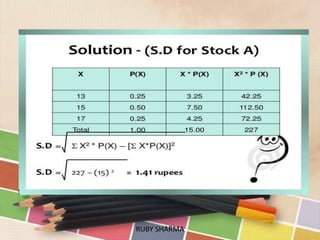
EXAMPLE
OUTCOME RETURN
FROM STOCK
(A ) X
PROB. (X) RETURN
FROM STOCK
(B) Y
PROB.(Y)
1 13 .25 7 .25
2 15 .50 15 .50
3 17 .25 23 .25
RUBY SHARMARUBY SHARMA
SOLUTION
STOCK X STOCK Y
EXPECTED RETURN 15 RUPEES 15 RUPEES
S.D. 1.41 RUPEES 5.66 RUPEES
Comparing the two stocks, we see that both stocks have the same expected
returns. But the SD or risk is different.
The S.D of stock B > S.D of stock A
We can say that the return of stock B is prone to higher fluctuation as
compared to stock A
RUBY SHARMARUBY SHARMA
Limitations of Using Standard Deviation
as a Risk Measurement Metric
Standard deviation as a risk measurement metric only shows how the
annual returns of an investment are spread out, and it does not
necessarily mean that the outcomes will be consistent in the future. The
investments may be affected by other non-related factors such as
interest rate changes and market competition, and the annual return may
fall outside the predicted range. It means that standard deviation should
not be used as the final risk measurement tool, but should be used
alongside other risk measurement functions.
RUBY SHARMARUBY SHARMA
Limitations of Using Standard Deviation
as a Risk Measurement Metric
Another weakness of deviation risk measurement is that it assumes a
normal distribution of data values. It means that there is a uniform
probability for achieving values above or below the mean. For example,
68% of the time, all individual values will fall one standard deviation
away from the mean. The assumption may not apply to all types of
investments.
RUBY SHARMARUBY SHARMA
Coefficient of variation
Coefficient of variation is a measure used to assess the total risk per unit
of return of an investment.
It is calculated by dividing the standard deviation of an investment by
its expected rate of return.
Since most investors are risk-averse, they want to minimize their risk
per unit of return. Coefficient of variation provides a standardized
measure of comparing risk and return of different investments. A
rational investor would select an investment with lowest coefficient of
variation.
RUBY SHARMA
Coefficient of variation
RUBY SHARMA
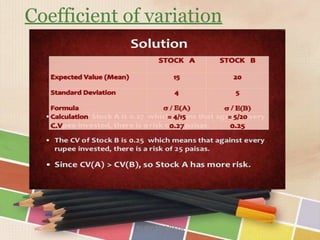
 CV is a measure of relative risk.
 It tells us the risk associated with each unit of money
invested.
 Formula:
CV = (x) / E(X)
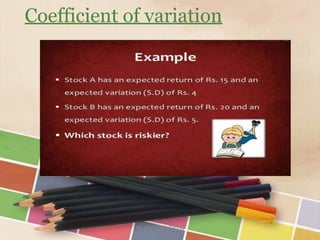
Coefficient of variation
RUBY SHARMA
Coefficient of variation
RUBY SHARMA
Beta
A coefficient, that describes how the expected return of a stock or
portfolio is correlated to the return of the financial market as a whole.
Essentially, beta measures the systematic risk of a security or a
portfolio, demonstrating how volatile it is in relation to the entire
market or a particular benchmark.
Beta is calculated using regression analysis. Numerically, it represents
the tendency for a security's returns to respond to swings in the
market. Formula to calculate required rate of return with beta is:
RUBY SHARMARUBY SHARMA
R = Rf + ( Rm – Rf)*
BETA
 Beta =+1.0, one percent change in the market index
return causes exactly one percent change in stock
return. It indicates that the stock moves in tandem with
the market .
 Beta =+0.5,one percent change in the market index
return causes exactly 0.5percent change in stock return.
It is considered to be ‘defensive’ and less volatile
compared to the market.
 Beta =+2.0, one percent change in the market index
return causes exactly 2 percent change in stock return.
It is considered to be ‘aggressive’ and more volatile
than the market.
RUBY SHARMA
Suppose the risk free rate of return for security is 6%. Market rate is
12% and beta is 1.25. Then the required rate of return for the security
would be :
R = 6 +(12-6)*1.25
R= 13.5%
Reconsider the above example but suppose that the value of Beta =
1.60. Then the return would be:
R = 6 +(12-6)*1.60
R= 15.6%
So, we see that greater the value of beta, the greater the systematic
risk and in turn the greater the required rate of return.
RUBY SHARMA

Risk & return measurement

  • 1.
  • 2.
    What is arisk ? RUBY SHARMARUBY SHARMA
  • 3.
    RISK IS….. Risk isdefined in financial terms as the chance that an outcome or investment's actual gains will differ from an expected outcome or return. Risk includes the possibility of losing some or all of an original investment. The existence of volatility in the occurrence of an expected incident is called risk .Higher the unpredictability greater is the risk. In finance, risk is the probability that actual results will differ from expected results. RUBY SHARMARUBY SHARMA
  • 4.
    RISK…. Risk is definedas the volatility of returns. Quantifiably, risk is usually assessed by considering historical behaviors and outcomes. In finance, standard deviation is a common metric associated with risk. Standard deviation provides a measure of the volatility of asset prices in comparison to their historical averages in a given time frame. RUBY SHARMARUBY SHARMA
  • 5.
    RISK…. Each investor hasa unique risk profile that determines their willingness and ability to withstand risk. In general, as investment risks rise, investors expect higher returns to compensate for taking those risks. Risk can be reduced using diversification and hedging strategies. RUBY SHARMARUBY SHARMA
  • 6.
    CAUSES OF RISK Wrong method of investment  Wrong timing of investment  Wrong quality of investment  interest rate risk  Maturity period or length of investment  Terms of lending  National and international factors  Natural calamities RUBY SHARMARUBY SHARMA
  • 7.
    TYPES OF RISKS RUBYSHARMARUBY SHARMA
  • 8.
    Systematic and unsystematic risk Systematicrisk is uncontrollable by an organization and macro in nature. Unsystematic risk is controllable by an organization and micro in nature. RUBY SHARMARUBY SHARMA
  • 9.
    SYSTEMATIC RISK Systematic riskis due to the influence of external factors on an organization. Such factors are normally uncontrollable from an organization's point of view. It is a macro in nature as it affects a large number of organizations operating under a similar stream or same domain. It cannot be planned by the organization. RUBY SHARMARUBY SHARMA
  • 10.
    The types ofsystematic risk are depicted and listed below. RUBY SHARMARUBY SHARMA
  • 11.
    Interest rate risk Interest-raterisk arises due to variability in the interest rates from time to time. It particularly affects debt securities as they carry the fixed rate of interest. The types of interest-rate risk are depicted and listed below. Price risk and Reinvestment rate risk. RUBY SHARMARUBY SHARMA
  • 12.
    Price risk arisesdue to the possibility that the price of the shares, commodity, investment, etc. may decline or fall in the future. Reinvestment rate risk results from fact that the interest or dividend earned from an investment can't be reinvested with the same rate of return as it was acquiring earlier. RUBY SHARMARUBY SHARMA
  • 13.
    Market risk Market riskis associated with consistent fluctuations seen in the trading price of any particular shares or securities. That is, it arises due to rise or fall in the trading price of listed shares or securities in the stock market. RUBY SHARMARUBY SHARMA
  • 14.
    Purchasing power or inflationaryrisk Purchasing power risk is also known as inflation risk. It is so, since it originates from the fact that it affects a purchasing power adversely. It is not desirable to invest in securities during an inflationary period. The types of power or inflationary risk are: Demand inflation risk and Cost inflation risk. RUBY SHARMARUBY SHARMA
  • 15.
    Demand inflation riskand Cost inflation risk. Demand inflation risk arises due to increase in price, which result from an excess of demand over supply. It occurs when supply fails to cope with the demand and hence cannot expand anymore. Cost inflation risk arises due to sustained increase in the prices of goods and services. It is actually caused by higher production cost. A high cost of production inflates the final price of finished goods consumed by people. RUBY SHARMARUBY SHARMA
  • 16.
    Unsystematic Risk Unsystematic riskis due to the influence of internal factors prevailing within an organization. Such factors are normally controllable from an organization's point of view. It is a micro in nature as it affects only a particular organization. It can be planned, so that necessary actions can be taken by the organization to mitigate (reduce the effect of) the risk. The types of unsystematic risk are depicted and listed below. Business or liquidity risk, Financial risk credit risk and Operational risk. RUBY SHARMARUBY SHARMA
  • 17.
    Business risk : Businessrisk can be internal as all as external. Internal risk is caused due to improper product mix ,non availability of raw materials, absence of strategic management etc. External risk arises due to change in operating conditions caused by conditions thrust upon the firm which are beyond its control eg; business cycle, government controls, international market conditions etc. RUBY SHARMARUBY SHARMA
  • 18.
    Financial risk : Thisrisk is associated with the capital structure of a company. A company with no debt financing has no financial risk. The extent of financial risk depends on the leverage of the firms capital structure. RUBY SHARMARUBY SHARMA
  • 19.
    Credit or defaultrisk The credit risk deals with the probability of meeting with a default. It is primarily the probability that a buyer will default. Proper management can reduce the chances of non payment of loan . RUBY SHARMARUBY SHARMA
  • 20.
  • 21.
    TOOLS FOR MEASURING RISK Standard deviation  Beta RUBY SHARMARUBY SHARMA
  • 22.
    Standard deviation Standard deviation.The investment industry’s primary measure of risk is standard deviation. Standard deviation really tells you how much an investment will fluctuate from the average return. The return of any investment has an average, which is also the expected return, but most returns will be different from the average: some will be more, others will be less. The more individual returns deviate from the expected return, the greater the risk and the greater the potential reward. The degree to which all returns for a particular investment or asset deviate from the expected return of the investment is a measure of its risk. RUBY SHARMARUBY SHARMA
  • 23.
  • 24.
    EXAMPLE OUTCOME RETURN FROM STOCK (A) X PROB. (X) RETURN FROM STOCK (B) Y PROB.(Y) 1 13 .25 7 .25 2 15 .50 15 .50 3 17 .25 23 .25 RUBY SHARMARUBY SHARMA
  • 25.
  • 26.
  • 27.
    SOLUTION STOCK X STOCKY EXPECTED RETURN 15 RUPEES 15 RUPEES S.D. 1.41 RUPEES 5.66 RUPEES Comparing the two stocks, we see that both stocks have the same expected returns. But the SD or risk is different. The S.D of stock B > S.D of stock A We can say that the return of stock B is prone to higher fluctuation as compared to stock A RUBY SHARMARUBY SHARMA
  • 28.
    Limitations of UsingStandard Deviation as a Risk Measurement Metric Standard deviation as a risk measurement metric only shows how the annual returns of an investment are spread out, and it does not necessarily mean that the outcomes will be consistent in the future. The investments may be affected by other non-related factors such as interest rate changes and market competition, and the annual return may fall outside the predicted range. It means that standard deviation should not be used as the final risk measurement tool, but should be used alongside other risk measurement functions. RUBY SHARMARUBY SHARMA
  • 29.
    Limitations of UsingStandard Deviation as a Risk Measurement Metric Another weakness of deviation risk measurement is that it assumes a normal distribution of data values. It means that there is a uniform probability for achieving values above or below the mean. For example, 68% of the time, all individual values will fall one standard deviation away from the mean. The assumption may not apply to all types of investments. RUBY SHARMARUBY SHARMA
  • 30.
    Coefficient of variation Coefficientof variation is a measure used to assess the total risk per unit of return of an investment. It is calculated by dividing the standard deviation of an investment by its expected rate of return. Since most investors are risk-averse, they want to minimize their risk per unit of return. Coefficient of variation provides a standardized measure of comparing risk and return of different investments. A rational investor would select an investment with lowest coefficient of variation. RUBY SHARMA
  • 31.
    Coefficient of variation RUBYSHARMA  CV is a measure of relative risk.  It tells us the risk associated with each unit of money invested.  Formula: CV = (x) / E(X)
  • 32.
  • 33.
  • 34.
    Beta A coefficient, thatdescribes how the expected return of a stock or portfolio is correlated to the return of the financial market as a whole. Essentially, beta measures the systematic risk of a security or a portfolio, demonstrating how volatile it is in relation to the entire market or a particular benchmark. Beta is calculated using regression analysis. Numerically, it represents the tendency for a security's returns to respond to swings in the market. Formula to calculate required rate of return with beta is: RUBY SHARMARUBY SHARMA R = Rf + ( Rm – Rf)*
  • 35.
    BETA  Beta =+1.0,one percent change in the market index return causes exactly one percent change in stock return. It indicates that the stock moves in tandem with the market .  Beta =+0.5,one percent change in the market index return causes exactly 0.5percent change in stock return. It is considered to be ‘defensive’ and less volatile compared to the market.  Beta =+2.0, one percent change in the market index return causes exactly 2 percent change in stock return. It is considered to be ‘aggressive’ and more volatile than the market. RUBY SHARMA
  • 36.
    Suppose the riskfree rate of return for security is 6%. Market rate is 12% and beta is 1.25. Then the required rate of return for the security would be : R = 6 +(12-6)*1.25 R= 13.5% Reconsider the above example but suppose that the value of Beta = 1.60. Then the return would be: R = 6 +(12-6)*1.60 R= 15.6% So, we see that greater the value of beta, the greater the systematic risk and in turn the greater the required rate of return. RUBY SHARMA