Business Risk  Case Study   Ba32
Opportunity creates threat Risk Management is like playing chess or soccer. For every opportunity you seize you create a threat The threat could be due to a well planned counterattack or due to a defensive lapse. Risk management is mitigating those threats by creating a defensive wall, and at times even sacrificing opportunities for the defense.
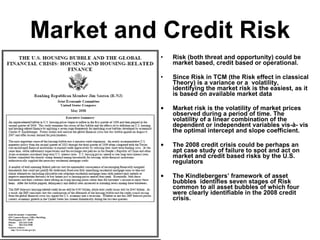
Market and Credit Risk Risk (both threat and opportunity) could be market based, credit based or operational. Since Risk in TCM (the Risk effect in classical Theory) is a variance or a  volatility, identifying the market risk is the easiest,  as it is based on available market data Market risk is the volatility of market prices observed during a period of time. The volatility of a linear combination of the dependent or independent variables vis-à- vis the optimal intercept and slope coefficient. The 2008 credit crisis could be perhaps an apt case study of failure to spot and act on market and credit based risks by the U.S. regulators The Kindlebergers’ framework of asset bubbles  identifies seven stages of Risk common to all asset bubbles of which four were clearly identifiable in the 2008 credit crisis.        
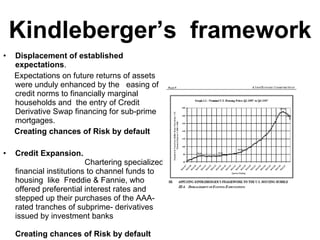
Kindleberger’s  framework Displacement of established expectations . Expectations on future returns of assets were unduly enhanced by the  easing of credit norms to financially marginal households and  the entry of Credit Derivative Swap financing for sub-prime mortgages. Creating chances of Risk by default Credit Expansion.  Chartering specialized financial institutions to channel funds to housing  like  Freddie & Fannie, who offered preferential interest rates and  stepped up their purchases of the AAA-rated tranches of subprime- derivatives issued by investment banks   Creating chances of Risk by default
Kindleberger’s  framework Overtrading, revulsion and discredit  Changes made in FAS 133 & 138 for hedge accounting treatment of derivatives in 2002 accelerated  the private issuance of sub- prime related RMBS/ CDO/CMO by investment banks. The rush for derivatives caused the issue of mortgages even without completion of securitization documents by many investment banks in hunt of profits. Creates chances of Risk by manipulation Swindles  A large many of the transactions reportedly issued without proper trackback  record in absence of the electronic recording system that was being set up during 2002-2006 period and unprecedented demand and paperwork in “ fully   deregulated let loose markets .” increased chance of fraudulent transaction and price swindles.  Creating chances of Risk by fraud
Identifying what to protect? Markets is a happening place. What to risk manage to have effective control? Obviously market movements and variations. Variance creates trends. Trends create predictors. Predictors help develop prediction analytics to manage risks So first objective is to define the boundary conditions of  instruments with high trading volumes and unusual variance, both growth or declines, which usually bring out the predictors.
Identify how to protect Chart route map and dispersion Do the segmentation  Frame the boundary conditions Draw the boundary limits  Measure volatility  Record unusual trends, discover previously undetected patterns. Investigate relationships in data and do anomaly detection to arrive at possible risk causes Forecast and suggest protection guidelines
The route map Chart the route maps that will draw reference from past historical trends All route maps will draw inference from variables affecting route both linear and complex. All variables will be factorized on route map and final projections shall be made by integrating the survey data with dependant and independent variables .  Thus the route map will be dynamic and adaptive and not a static representation of historical data
Do the segmentation Creating meaningful segments needs vast user experience and a birds eye view. Databases are partitioned as per a select metric by segmentation or clustering. Associations, patterns, hierarchy, class, statutory, demographic, gender, lifestyle, attitudinal, political, ethnicity, technology, transactional, maturity, brand empathy, grid intensity, environmental and profile data etc. are some of the popularly used segments or clusters. Segmentation must be followed by data pruning. This helps trashing irrelevant data and trends that confuse risk analytics.
Framing the boundary conditions In this age of information overload, too much data is often the reason for inaction. For example whereas mortgage credit expansion figure to housing may be relevant, the total credit expansion figures may be redundant while studying the housing crisis. Framing boundary conditions is hence a must which gives us the binding metric for the predictors used for such analytics. Boundary conditions help in data pruning and this must be validated and updated from time to time.  Boundary conditions depend on the object or the parameter being monitored and must be set by an experienced user only. No external IT company or outsourced party must fix boundary conditions.
Draw  the boundary limits Boundary limits are based on boundary conditions. They may be validated and updated from time to time for greater adaptability. They are the mathematical limits that define the boundaries for propensity modeling or any forecasting . In case of associations or basket analysis, boundary limits must be put for each independent variable from time to time.  For example a dairy foods, meat and fruit basket will have different limits for each at different times of the year. 1000 pounds of meat may be indicator of good sales in summer but poor off take in winter for a store.
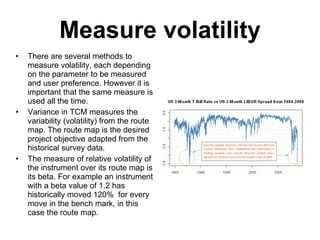
Measure volatility There are several methods to measure volatility, each depending on the parameter to be measured and user preference. However it is important that the same measure is used all the time. Variance in TCM measures the variability (volatility) from the route map. The route map is the desired project objective adapted from the historical survey data. The measure of relative volatility of the instrument over its route map is its beta. For example an instrument with a beta value of 1.2 has historically moved 120%  for every move in the bench mark, in this case the route map.
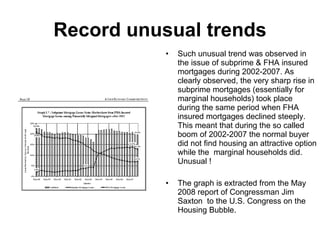
Record unusual trends Such unusual trend was observed in the issue of subprime & FHA insured mortgages during 2002-2007. As clearly observed, the very sharp rise in subprime mortgages (essentially for marginal households) took place during the same period when FHA insured mortgages declined steeply. This meant that during the so called boom of 2002-2007 the normal buyer did not find housing an attractive option while the  marginal households did. Unusual !  The graph is extracted from the May 2008 report of Congressman Jim Saxton  to the U.S. Congress on the Housing Bubble.
Investigate relationships Investigate relationships in data Do anomaly detection Arrive at possible risk causes Sharp rise in issue of mortgages for subprime and steep  fall in the FHA insured segment during the same period. Co-relate with sharp rise in houses mortgages Co-relate lack of proper electronic recording of securitization Co-relate with voluminous increase of manual securitization work Possibility of normal households availing the benefits for marginal  households which means reduction in overall risk, as normal households have better repaying capacity. Possibility of swindlers taking advantage of the absence of electronic recording and creating multiple fraudulent transactions which means increasing the overall risk
Forecasting in predictive analytics The variance  quantifies volatility The variance “beta” shows the extent of volatility as compared to the route map Co-relation  helps mapping the trends on a uniform platform and drawing inference.  Predictive analytics forecasts possible risks and issues early warning signals Records and reports the trends and predicts risk causes and recommends solutions  to regulatory controllers, that chances of a threat against the given opportunity is high
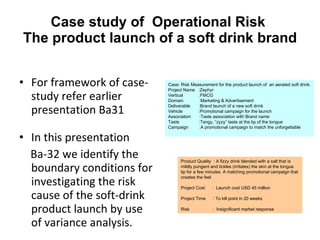
Case study of  Operational Risk  The product launch of a soft drink brand For framework of case-study refer earlier presentation Ba31 In this presentation Ba-32 we identify the boundary conditions for investigating the risk cause of the soft-drink product launch by use of variance analysis. Case: Risk Measurement for the product launch of  an aerated soft drink. Project Name  :Zephyr Vertical  :FMCG Domain  :Marketing & Advertisement Deliverable  :Brand launch of a new soft drink  Vehicle  :Promotional campaign for the launch  Association  :Taste association with Brand name Taste  :Tangy, “zyzy” taste at the tip of the tongue  Campaign  :A promotional campaign to match the unforgettable Product Quality  : A fizzy drink blended with a salt that is mildly pungent and tickles (irritates) the skin at the tongue tip for a few minutes. A matching promotional campaign that creates the feel Project Cost  :  Launch cost USD 45 million Project Time  : To kill point in 20 weeks Risk  :  Insignificant market response
Protecting operational Risk Unlike a market or credit based risk, an operational risk like any project risk is more complex to predict and consequently more difficult to mitigate. Nonetheless CERN,NASA, FEDEX, FIAT or RELIANCE report few failures. The reason is that internal risk management and control makes them measure risk & sacrifice opportunities in event of a perceived threat through a process called risk transfer. In this case study we are protecting the “ launch of   the soft drink in the market place ” in which case there is not only a threat due to a defensive lapse, but also threat due to an unexpected counterattack from a rival soft drink brand.
Identify how to protect Chart route map of constraints Do the segmentation  Frame the boundary conditions Draw the boundary limits  Measure variance Record unusual trends, and undetected patterns. Investigate relationships in data and do anomaly detection to arrive at possible risk causes Forecast and suggest protection guidelines
Drawing the route map Survey historical data, market share, segment share, competitor data, buyer profiles etc. and tabulate as per the  four constraints. The scope constraint, the time constraint, the quality constraint and cost constraint. This not only helps in plotting the route map but also in segmentation. All variables will be adapted on route map and final projections shall be made by integrating the historical survey data with all dependant and independent linear and complex variables.
Identifying the variables Scope and Quality constraints Taste attributes: Fizzy, tangy, crap, pungent, bland, sweet, light, pulpy, sharp, mellow, terrific etc. etc. Promotion attributes : Washout, ordinary, potential, good, steady, classy, rocking, explosive etc. etc.
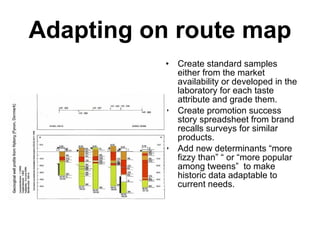
Adapting on route map Create standard samples either from the market availability or developed in the laboratory for each taste attribute and grade them. Create promotion success story spreadsheet from brand recalls surveys for similar products. Add new determinants “more fizzy than” “ or “more popular among tweens”  to make historic data adaptable to current needs.
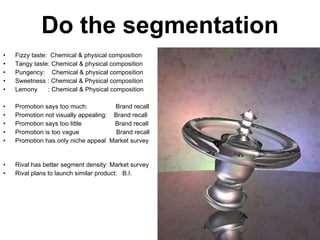
Do the segmentation Fizzy taste:  Chemical & physical composition  Tangy taste: Chemical & physical composition  Pungency:  Chemical & physical composition Sweetness : Chemical & Physical composition Lemony  : Chemical & Physical composition  Promotion says too much:  Brand recall  Promotion not visually appealing:  Brand recall  Promotion says too little  Brand recall  Promotion is too vague  Brand recall  Promotion has only niche appeal  Market survey  Rival has better segment density: Market survey Rival plans to launch similar product:  B.I.
Frame the boundary conditions Framing the boundary conditions is done by the project manager or the risk manager in a project, that is the experienced user and updated from time to time. It is a crucial task that will lead to  data selection, data pruning and finalization of predictors for the analytics. No outside service provider, consultant or I.T. company should be entrusted with this function as it is critical for risk analytics.
Selected boundary conditions Taste attributes: Fizzy Taste attributes: Tangy Taste attributes: Pungent Critical attributes difficult to maintain as per technical manager’s experience Promotion says too much Promotion shows poor recall Critical attributes difficult to control as per promotion manager’s experience A rival launches a similar product  Possible move as per strategy manager
Business Risk Management Series slides This slide show is a sequel to our earlier presentation Living Dangerously :  Managing Risks in Business Ba01 (available at slide share) Business Risk Case study : Laying down the framework Ba31 (available at slide share) Others in the pipeline, shortly due are Defining the  time period of evaluation  Ba 33 Specifying the terms of reference of acceptable quality  Ba 34 Identifying the relevant predictors Ba 35  Investigating the Risk cause Ba 36 Measuring Risk and determining the Value at Risk  Ba 37 Formulating the Risk Response  Ba 38 Risk margin and  transferring of Risk Ba 39 Mitigating Threat by sacrificing Opportunity Ba 40
Acknowledgements Data  for Market & Credit Risk Case Studies adopted from May 2008 Housing Bubble Study report by Congressman Jim Saxton. Operational Case study : from Time Cycle Module Vol 1 To our Art director  Mrs. Katerina Voutsara. To Google images, flickr.com, and other websites for images
Our references The Project Management Time Cycle – Vol. I   TIME CYCLE MODULE:  From concept to feasibility  ISBN 1440493332  available at Amazon Economy to Ecology Our goal is to help promote clean, safe and better practices in economy and ecology worldwide. Balanced, efficient and a little more sustainable. Kindle Blog  Ecothrust   ASIN: B0029ZAUAY  For any queries mail to  [email_address]
Related presentations Business Risk management Series http://www.slideshare.net/SandipSen/living-dangerously-managing-risks-in-business-ba01ppt Business Risk Case Studies Ba31 http://www.slideshare.net/SandipSen/business-risk-case-study-ba31

Business Risk Case Study Ba 32

  • 1.
    Business Risk Case Study Ba32
  • 2.
    Opportunity creates threatRisk Management is like playing chess or soccer. For every opportunity you seize you create a threat The threat could be due to a well planned counterattack or due to a defensive lapse. Risk management is mitigating those threats by creating a defensive wall, and at times even sacrificing opportunities for the defense.
  • 3.
    Market and CreditRisk Risk (both threat and opportunity) could be market based, credit based or operational. Since Risk in TCM (the Risk effect in classical Theory) is a variance or a volatility, identifying the market risk is the easiest, as it is based on available market data Market risk is the volatility of market prices observed during a period of time. The volatility of a linear combination of the dependent or independent variables vis-à- vis the optimal intercept and slope coefficient. The 2008 credit crisis could be perhaps an apt case study of failure to spot and act on market and credit based risks by the U.S. regulators The Kindlebergers’ framework of asset bubbles identifies seven stages of Risk common to all asset bubbles of which four were clearly identifiable in the 2008 credit crisis.        
  • 4.
    Kindleberger’s frameworkDisplacement of established expectations . Expectations on future returns of assets were unduly enhanced by the easing of credit norms to financially marginal households and the entry of Credit Derivative Swap financing for sub-prime mortgages. Creating chances of Risk by default Credit Expansion. Chartering specialized financial institutions to channel funds to housing like Freddie & Fannie, who offered preferential interest rates and stepped up their purchases of the AAA-rated tranches of subprime- derivatives issued by investment banks Creating chances of Risk by default
  • 5.
    Kindleberger’s frameworkOvertrading, revulsion and discredit Changes made in FAS 133 & 138 for hedge accounting treatment of derivatives in 2002 accelerated the private issuance of sub- prime related RMBS/ CDO/CMO by investment banks. The rush for derivatives caused the issue of mortgages even without completion of securitization documents by many investment banks in hunt of profits. Creates chances of Risk by manipulation Swindles A large many of the transactions reportedly issued without proper trackback record in absence of the electronic recording system that was being set up during 2002-2006 period and unprecedented demand and paperwork in “ fully deregulated let loose markets .” increased chance of fraudulent transaction and price swindles. Creating chances of Risk by fraud
  • 6.
    Identifying what toprotect? Markets is a happening place. What to risk manage to have effective control? Obviously market movements and variations. Variance creates trends. Trends create predictors. Predictors help develop prediction analytics to manage risks So first objective is to define the boundary conditions of instruments with high trading volumes and unusual variance, both growth or declines, which usually bring out the predictors.
  • 7.
    Identify how toprotect Chart route map and dispersion Do the segmentation Frame the boundary conditions Draw the boundary limits Measure volatility Record unusual trends, discover previously undetected patterns. Investigate relationships in data and do anomaly detection to arrive at possible risk causes Forecast and suggest protection guidelines
  • 8.
    The route mapChart the route maps that will draw reference from past historical trends All route maps will draw inference from variables affecting route both linear and complex. All variables will be factorized on route map and final projections shall be made by integrating the survey data with dependant and independent variables . Thus the route map will be dynamic and adaptive and not a static representation of historical data
  • 9.
    Do the segmentationCreating meaningful segments needs vast user experience and a birds eye view. Databases are partitioned as per a select metric by segmentation or clustering. Associations, patterns, hierarchy, class, statutory, demographic, gender, lifestyle, attitudinal, political, ethnicity, technology, transactional, maturity, brand empathy, grid intensity, environmental and profile data etc. are some of the popularly used segments or clusters. Segmentation must be followed by data pruning. This helps trashing irrelevant data and trends that confuse risk analytics.
  • 10.
    Framing the boundaryconditions In this age of information overload, too much data is often the reason for inaction. For example whereas mortgage credit expansion figure to housing may be relevant, the total credit expansion figures may be redundant while studying the housing crisis. Framing boundary conditions is hence a must which gives us the binding metric for the predictors used for such analytics. Boundary conditions help in data pruning and this must be validated and updated from time to time. Boundary conditions depend on the object or the parameter being monitored and must be set by an experienced user only. No external IT company or outsourced party must fix boundary conditions.
  • 11.
    Draw theboundary limits Boundary limits are based on boundary conditions. They may be validated and updated from time to time for greater adaptability. They are the mathematical limits that define the boundaries for propensity modeling or any forecasting . In case of associations or basket analysis, boundary limits must be put for each independent variable from time to time. For example a dairy foods, meat and fruit basket will have different limits for each at different times of the year. 1000 pounds of meat may be indicator of good sales in summer but poor off take in winter for a store.
  • 12.
    Measure volatility Thereare several methods to measure volatility, each depending on the parameter to be measured and user preference. However it is important that the same measure is used all the time. Variance in TCM measures the variability (volatility) from the route map. The route map is the desired project objective adapted from the historical survey data. The measure of relative volatility of the instrument over its route map is its beta. For example an instrument with a beta value of 1.2 has historically moved 120% for every move in the bench mark, in this case the route map.
  • 13.
    Record unusual trendsSuch unusual trend was observed in the issue of subprime & FHA insured mortgages during 2002-2007. As clearly observed, the very sharp rise in subprime mortgages (essentially for marginal households) took place during the same period when FHA insured mortgages declined steeply. This meant that during the so called boom of 2002-2007 the normal buyer did not find housing an attractive option while the marginal households did. Unusual ! The graph is extracted from the May 2008 report of Congressman Jim Saxton to the U.S. Congress on the Housing Bubble.
  • 14.
    Investigate relationships Investigaterelationships in data Do anomaly detection Arrive at possible risk causes Sharp rise in issue of mortgages for subprime and steep fall in the FHA insured segment during the same period. Co-relate with sharp rise in houses mortgages Co-relate lack of proper electronic recording of securitization Co-relate with voluminous increase of manual securitization work Possibility of normal households availing the benefits for marginal households which means reduction in overall risk, as normal households have better repaying capacity. Possibility of swindlers taking advantage of the absence of electronic recording and creating multiple fraudulent transactions which means increasing the overall risk
  • 15.
    Forecasting in predictiveanalytics The variance quantifies volatility The variance “beta” shows the extent of volatility as compared to the route map Co-relation helps mapping the trends on a uniform platform and drawing inference. Predictive analytics forecasts possible risks and issues early warning signals Records and reports the trends and predicts risk causes and recommends solutions to regulatory controllers, that chances of a threat against the given opportunity is high
  • 16.
    Case study of Operational Risk The product launch of a soft drink brand For framework of case-study refer earlier presentation Ba31 In this presentation Ba-32 we identify the boundary conditions for investigating the risk cause of the soft-drink product launch by use of variance analysis. Case: Risk Measurement for the product launch of an aerated soft drink. Project Name :Zephyr Vertical :FMCG Domain :Marketing & Advertisement Deliverable :Brand launch of a new soft drink Vehicle :Promotional campaign for the launch Association :Taste association with Brand name Taste :Tangy, “zyzy” taste at the tip of the tongue Campaign :A promotional campaign to match the unforgettable Product Quality : A fizzy drink blended with a salt that is mildly pungent and tickles (irritates) the skin at the tongue tip for a few minutes. A matching promotional campaign that creates the feel Project Cost : Launch cost USD 45 million Project Time : To kill point in 20 weeks Risk : Insignificant market response
  • 17.
    Protecting operational RiskUnlike a market or credit based risk, an operational risk like any project risk is more complex to predict and consequently more difficult to mitigate. Nonetheless CERN,NASA, FEDEX, FIAT or RELIANCE report few failures. The reason is that internal risk management and control makes them measure risk & sacrifice opportunities in event of a perceived threat through a process called risk transfer. In this case study we are protecting the “ launch of the soft drink in the market place ” in which case there is not only a threat due to a defensive lapse, but also threat due to an unexpected counterattack from a rival soft drink brand.
  • 18.
    Identify how toprotect Chart route map of constraints Do the segmentation Frame the boundary conditions Draw the boundary limits Measure variance Record unusual trends, and undetected patterns. Investigate relationships in data and do anomaly detection to arrive at possible risk causes Forecast and suggest protection guidelines
  • 19.
    Drawing the routemap Survey historical data, market share, segment share, competitor data, buyer profiles etc. and tabulate as per the four constraints. The scope constraint, the time constraint, the quality constraint and cost constraint. This not only helps in plotting the route map but also in segmentation. All variables will be adapted on route map and final projections shall be made by integrating the historical survey data with all dependant and independent linear and complex variables.
  • 20.
    Identifying the variablesScope and Quality constraints Taste attributes: Fizzy, tangy, crap, pungent, bland, sweet, light, pulpy, sharp, mellow, terrific etc. etc. Promotion attributes : Washout, ordinary, potential, good, steady, classy, rocking, explosive etc. etc.
  • 21.
    Adapting on routemap Create standard samples either from the market availability or developed in the laboratory for each taste attribute and grade them. Create promotion success story spreadsheet from brand recalls surveys for similar products. Add new determinants “more fizzy than” “ or “more popular among tweens” to make historic data adaptable to current needs.
  • 22.
    Do the segmentationFizzy taste: Chemical & physical composition Tangy taste: Chemical & physical composition Pungency: Chemical & physical composition Sweetness : Chemical & Physical composition Lemony : Chemical & Physical composition Promotion says too much: Brand recall Promotion not visually appealing: Brand recall Promotion says too little Brand recall Promotion is too vague Brand recall Promotion has only niche appeal Market survey Rival has better segment density: Market survey Rival plans to launch similar product: B.I.
  • 23.
    Frame the boundaryconditions Framing the boundary conditions is done by the project manager or the risk manager in a project, that is the experienced user and updated from time to time. It is a crucial task that will lead to data selection, data pruning and finalization of predictors for the analytics. No outside service provider, consultant or I.T. company should be entrusted with this function as it is critical for risk analytics.
  • 24.
    Selected boundary conditionsTaste attributes: Fizzy Taste attributes: Tangy Taste attributes: Pungent Critical attributes difficult to maintain as per technical manager’s experience Promotion says too much Promotion shows poor recall Critical attributes difficult to control as per promotion manager’s experience A rival launches a similar product Possible move as per strategy manager
  • 25.
    Business Risk ManagementSeries slides This slide show is a sequel to our earlier presentation Living Dangerously : Managing Risks in Business Ba01 (available at slide share) Business Risk Case study : Laying down the framework Ba31 (available at slide share) Others in the pipeline, shortly due are Defining the time period of evaluation Ba 33 Specifying the terms of reference of acceptable quality Ba 34 Identifying the relevant predictors Ba 35 Investigating the Risk cause Ba 36 Measuring Risk and determining the Value at Risk Ba 37 Formulating the Risk Response Ba 38 Risk margin and transferring of Risk Ba 39 Mitigating Threat by sacrificing Opportunity Ba 40
  • 26.
    Acknowledgements Data for Market & Credit Risk Case Studies adopted from May 2008 Housing Bubble Study report by Congressman Jim Saxton. Operational Case study : from Time Cycle Module Vol 1 To our Art director Mrs. Katerina Voutsara. To Google images, flickr.com, and other websites for images
  • 27.
    Our references TheProject Management Time Cycle – Vol. I TIME CYCLE MODULE: From concept to feasibility ISBN 1440493332 available at Amazon Economy to Ecology Our goal is to help promote clean, safe and better practices in economy and ecology worldwide. Balanced, efficient and a little more sustainable. Kindle Blog Ecothrust ASIN: B0029ZAUAY For any queries mail to [email_address]
  • 28.
    Related presentations BusinessRisk management Series http://www.slideshare.net/SandipSen/living-dangerously-managing-risks-in-business-ba01ppt Business Risk Case Studies Ba31 http://www.slideshare.net/SandipSen/business-risk-case-study-ba31