Understanding
Construction
Risk
Assessment
A basic guide
Understanding risk assessments
You, as the employer, are the one who stands between your workers and an accident!
Look at what can•	
hurt you or your
workers;
Decide what you•	
are going to do;
Write down what•	
you are going to
do;
Tell your workers;•	
Do it!•
A short guide to risk assessments
The following pages include examples of dangerous situations on site and how you can manage similar situations to protect the
health and safety of your employees.
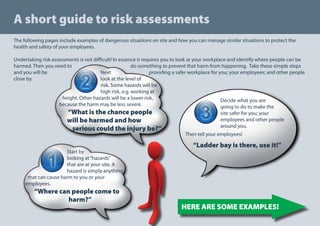
Undertaking risk assessments is not difficult! In essence it requires you to look at your workplace and identify where people can be
harmed. Then you need to do something to prevent that harm from happening. Take these simple steps
and you will be 		 	 providing a safer workplace for you; your employees; and other people
close by.
Start by
looking at“hazards”
that are at your site. A
hazard is simply anything
that can cause harm to you or your
employees.
“Where can people come to
harm?”
Next
look at the level of
risk. Some hazards will be
high risk, e.g. working at
height. Other hazards will be a lower risk,
because the harm may be less severe.
“What is the chance people
will be harmed and how
serious could the injury be?”
Decide what you are
going to do to make the
site safer for you; your
employees and other people
around you.
Then tell your employees!
“Ladder bay is there, use it!”
HERE ARE SOME EXAMPLES!
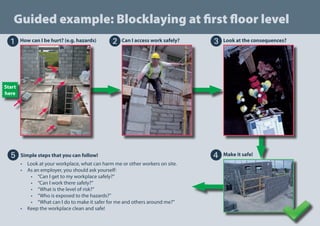
Guided example: Blocklaying at first floor level
How can I be hurt? (e.g. hazards) Can I access work safely? Look at the consequences?
Make it safe!Simple steps that you can follow!
Look at your workplace, what can harm me or other workers on site.•	
As an employer, you should ask yourself:•	
“Can I get to my workplace safely?”•	
“Can I work there safely?”•	
“What is the level of risk?”•	
“Who is exposed to the hazards?”•	
“What can I do to make it safer for me and others around me?”•	
Keep the workplace clean and safe!•	
u
x
v w
y
Start
here
How can I be hurt? (e.g. hazards)
Look at the consequences?Can I access work safely?
Make it safe! Look - Act!
Different trades
will be undertaking
different
construction
activities on site.
As an employer,
you must look at
the tasks that your
employees are
carrying out and
work out what the
level of risk is to
their safety.
This is part of the
risk assessment
process.
Here we are looking
at steel erection,
which is a high risk
activity.
You must act to
minimise the risks.
u x
v w
y
Start
here
Guided example: Steel erection
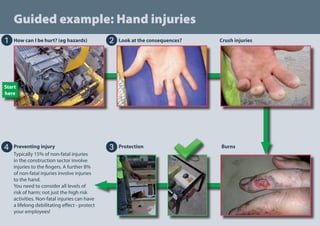
Guided example: Hand injuries
How can I be hurt? (eg hazards) Look at the consequences? Crush injuries
BurnsProtectionPreventing injury
Typically 15% of non-fatal injuries
in the construction sector involve
injuries to the fingers. A further 8%
of non-fatal injuries involve injuries
to the hand.
You need to consider all levels of
risk of harm; not just the high risk
activities. Non-fatal injuries can have
a lifelong debilitating effect - protect
your employees!
u
x
v
w
Start
here
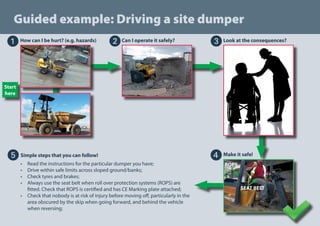
Guided example: Driving a site dumper
How can I be hurt? (e.g. hazards) Can I operate it safely? Look at the consequences?
Make it safe!Simple steps that you can follow!
Read the instructions for the particular dumper you have;•	
Drive within safe limits across sloped ground/banks;•	
Check tyres and brakes;•	
Always use the seat belt when roll over protection systems (ROPS) are•	
fitted. Check that ROPS is certified and has CE Marking plate attached;
Check that nobody is at risk of injury before moving off, particularly in the•	
area obscured by the skip when going forward, and behind the vehicle
when reversing;
u
x
v w
y
Start
here
SEAT BELT
ROPS
How can I be hurt? (e.g. hazards)
Look at the consequences?Can I operate it safely?
Make it safe! Quick and Easy!
If you are operating
a machine (e.g. a
360o
excavator)
then you are
responsible for
the safe use of the
machine, including
the correct use of
the quick hitch.
Make sure that
the safety pin is
fully inserted into
the quick hitch.
The attachment
must be properly
attached before
you use it. Always
check!
Never swing the
attachment over
other workers or
allow them to work
directly under the
attachment.
u x
v w
y
Start
here
Guided example: Using a quick hitch device
The first thing to think about
when doing a risk assessment is
“How likely is it that someone
can be harmed by this hazard?”
The likelihood of someone being
harmed varies depending on the
environment, the work activities
and how often someone is going
to be exposed to the hazard.
Using your experience and
knowledge, you should be able
to work out the likelihood quickly
and easily.
Risk assessment: What is“likelihood”?
Increasing LIKELIHOOD that someone will be hurt
Unsafe
scaffolding
Safe
scaffolding
Lesslikely
tohappen
Morelikelytohappen
Risk assessment: What is“consequence”?
The next issue to consider is the
consequence (or severity) of the
hazard;“How serious could the
injury be?”
The severity can be influenced
by the environment and the
provision of a safe place of work
and a safe system of work.
Using your experience and
knowledge, you should be able
to work out the severity quickly
and easily.
Increasing SEVERITY of injury
Major
injuries
Minor
injuries
Minor
injuries
Majorinjuries,rangingfrompermanent
disabilitytodeath
You must put appropriate control measures in place, for all levels of risk, including low risk.
Controlling the risks: SSWP can help you
We have looked at three examples where it has gone wrong on construction sites. As an employer,
you need to make sure it does not go wrong on your site. To help you, the Health and Safety
Authority has produced the Safe System of Work Plans (SSWP). The primary objective of the SSWP
is to identify the major hazards associated with your work activities and to ensure that appropriate
controls are in place before work commences. The SSWP is a three-part process:
Part 1: Planning the activity;•	
Part 2: Hazard Identification, and Control Identification;•	
Part 3: Sign off.•	
There are currently six SSWP Construction Forms available, including forms for House Building;
Ground Works; Demolition; Civil Engineering; New Commercial Building; and Working on Roads.
Where it went wrong
Risk assessments: Summary of key components
You must carry out risk
assessments, as part of your Safety
Statement. Write these down and show them
to your employees.
Here are the three key
components of a risk
assessment.
Take a good look at the
construction site and the
work that you are doing
there. What you are looking
for are the situations where
people can be harmed (e.g. hazards). This can
include people other than your employees. Look
at how you get to your work area on site, is there
safe access? Look at how you carry out the
work, how can you be harmed?
At this
stage you should have a
written list of hazards and the
level of risk for each of these.
You now need to decide what you are going to
do about each hazard. Talk to your employees about
the hazards. Write down the control measures and
show these to your employees. Using the SSWP
that is best suited to your work, will help you
carry out risk assessments.
When you
know each of the hazards
that are there on site, you
need to assess the level of
risk that you and your employees are exposed to.
This is a simple step to take, just think about how
likely it is that you could be harmed by each hazard
and then how seriously you could be hurt. This will
help you to rank the hazards. Some will be high
risk, others medium risk or low risk hazards.
Understanding_Construction_Risk_Assessment

Understanding_Construction_Risk_Assessment

  • 1.
  • 2.
    Understanding risk assessments You,as the employer, are the one who stands between your workers and an accident! Look at what can• hurt you or your workers; Decide what you• are going to do; Write down what• you are going to do; Tell your workers;• Do it!•
  • 3.
    A short guideto risk assessments The following pages include examples of dangerous situations on site and how you can manage similar situations to protect the health and safety of your employees. Undertaking risk assessments is not difficult! In essence it requires you to look at your workplace and identify where people can be harmed. Then you need to do something to prevent that harm from happening. Take these simple steps and you will be providing a safer workplace for you; your employees; and other people close by. Start by looking at“hazards” that are at your site. A hazard is simply anything that can cause harm to you or your employees. “Where can people come to harm?” Next look at the level of risk. Some hazards will be high risk, e.g. working at height. Other hazards will be a lower risk, because the harm may be less severe. “What is the chance people will be harmed and how serious could the injury be?” Decide what you are going to do to make the site safer for you; your employees and other people around you. Then tell your employees! “Ladder bay is there, use it!” HERE ARE SOME EXAMPLES!
  • 4.
    Guided example: Blocklayingat first floor level How can I be hurt? (e.g. hazards) Can I access work safely? Look at the consequences? Make it safe!Simple steps that you can follow! Look at your workplace, what can harm me or other workers on site.• As an employer, you should ask yourself:• “Can I get to my workplace safely?”• “Can I work there safely?”• “What is the level of risk?”• “Who is exposed to the hazards?”• “What can I do to make it safer for me and others around me?”• Keep the workplace clean and safe!• u x v w y Start here
  • 5.
    How can Ibe hurt? (e.g. hazards) Look at the consequences?Can I access work safely? Make it safe! Look - Act! Different trades will be undertaking different construction activities on site. As an employer, you must look at the tasks that your employees are carrying out and work out what the level of risk is to their safety. This is part of the risk assessment process. Here we are looking at steel erection, which is a high risk activity. You must act to minimise the risks. u x v w y Start here Guided example: Steel erection
  • 6.
    Guided example: Handinjuries How can I be hurt? (eg hazards) Look at the consequences? Crush injuries BurnsProtectionPreventing injury Typically 15% of non-fatal injuries in the construction sector involve injuries to the fingers. A further 8% of non-fatal injuries involve injuries to the hand. You need to consider all levels of risk of harm; not just the high risk activities. Non-fatal injuries can have a lifelong debilitating effect - protect your employees! u x v w Start here
  • 7.
    Guided example: Drivinga site dumper How can I be hurt? (e.g. hazards) Can I operate it safely? Look at the consequences? Make it safe!Simple steps that you can follow! Read the instructions for the particular dumper you have;• Drive within safe limits across sloped ground/banks;• Check tyres and brakes;• Always use the seat belt when roll over protection systems (ROPS) are• fitted. Check that ROPS is certified and has CE Marking plate attached; Check that nobody is at risk of injury before moving off, particularly in the• area obscured by the skip when going forward, and behind the vehicle when reversing; u x v w y Start here SEAT BELT ROPS
  • 8.
    How can Ibe hurt? (e.g. hazards) Look at the consequences?Can I operate it safely? Make it safe! Quick and Easy! If you are operating a machine (e.g. a 360o excavator) then you are responsible for the safe use of the machine, including the correct use of the quick hitch. Make sure that the safety pin is fully inserted into the quick hitch. The attachment must be properly attached before you use it. Always check! Never swing the attachment over other workers or allow them to work directly under the attachment. u x v w y Start here Guided example: Using a quick hitch device
  • 9.
    The first thingto think about when doing a risk assessment is “How likely is it that someone can be harmed by this hazard?” The likelihood of someone being harmed varies depending on the environment, the work activities and how often someone is going to be exposed to the hazard. Using your experience and knowledge, you should be able to work out the likelihood quickly and easily. Risk assessment: What is“likelihood”? Increasing LIKELIHOOD that someone will be hurt Unsafe scaffolding Safe scaffolding Lesslikely tohappen Morelikelytohappen
  • 10.
    Risk assessment: Whatis“consequence”? The next issue to consider is the consequence (or severity) of the hazard;“How serious could the injury be?” The severity can be influenced by the environment and the provision of a safe place of work and a safe system of work. Using your experience and knowledge, you should be able to work out the severity quickly and easily. Increasing SEVERITY of injury Major injuries Minor injuries Minor injuries Majorinjuries,rangingfrompermanent disabilitytodeath You must put appropriate control measures in place, for all levels of risk, including low risk.
  • 11.
    Controlling the risks:SSWP can help you We have looked at three examples where it has gone wrong on construction sites. As an employer, you need to make sure it does not go wrong on your site. To help you, the Health and Safety Authority has produced the Safe System of Work Plans (SSWP). The primary objective of the SSWP is to identify the major hazards associated with your work activities and to ensure that appropriate controls are in place before work commences. The SSWP is a three-part process: Part 1: Planning the activity;• Part 2: Hazard Identification, and Control Identification;• Part 3: Sign off.• There are currently six SSWP Construction Forms available, including forms for House Building; Ground Works; Demolition; Civil Engineering; New Commercial Building; and Working on Roads. Where it went wrong
  • 12.
    Risk assessments: Summaryof key components You must carry out risk assessments, as part of your Safety Statement. Write these down and show them to your employees. Here are the three key components of a risk assessment. Take a good look at the construction site and the work that you are doing there. What you are looking for are the situations where people can be harmed (e.g. hazards). This can include people other than your employees. Look at how you get to your work area on site, is there safe access? Look at how you carry out the work, how can you be harmed? At this stage you should have a written list of hazards and the level of risk for each of these. You now need to decide what you are going to do about each hazard. Talk to your employees about the hazards. Write down the control measures and show these to your employees. Using the SSWP that is best suited to your work, will help you carry out risk assessments. When you know each of the hazards that are there on site, you need to assess the level of risk that you and your employees are exposed to. This is a simple step to take, just think about how likely it is that you could be harmed by each hazard and then how seriously you could be hurt. This will help you to rank the hazards. Some will be high risk, others medium risk or low risk hazards.