Introduction to
Metadata
Jenn Riley
Metadata Librarian
IU Digital Library Program
6/25/07 SEI 2
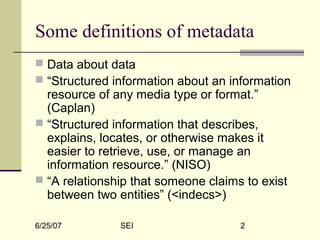
Some definitions of metadata
 Data about data
 “Structured information about an information
resource of any media type or format.”
(Caplan)
 “Structured information that describes,
explains, locates, or otherwise makes it
easier to retrieve, use, or manage an
information resource.” (NISO)
 “A relationship that someone claims to exist
between two entities” (<indecs>)
6/25/07 SEI 3
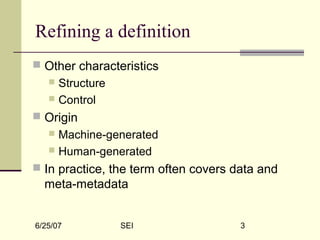
Refining a definition
 Other characteristics
 Structure
 Control
 Origin
 Machine-generated
 Human-generated
 In practice, the term often covers data and
meta-metadata
6/25/07 SEI 4
Metadata and cataloging
 Depends on what you mean by:
 metadata, and
 cataloging!
 But, in general:
 Metadata is broader in scope than cataloging
 Much metadata creation takes place outside of
libraries
 Good metadata practitioners use fundamental
cataloging principles in non-MARC environments
 Metadata created for many different types of
materials
6/25/07 SEI 5
What metadata is not
 Just a new word for cataloging
 Only for Internet resources
 Necessarily in electronic form
 Only created by professionals
 A fundamentally new idea
 A reason to forget everything we know about
describing and managing resources
6/25/07 SEI 7
Some forms of metadata in cultural
heritage institutions
 Catalog cards
 OPACs
 Finding aids
 Inventories
 Registers
 Slide labels
6/25/07 SEI 8
Uses of metadata in cultural heritage
institutions
 Searching
 Browsing
 Display for users
 Interoperability
 Management of digital objects
 Preservation
 Navigation
6/25/07 SEI 9
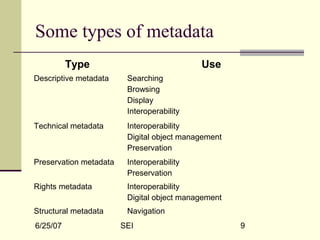
Some types of metadata
Type Use
Descriptive metadata Searching
Browsing
Display
Interoperability
Technical metadata Interoperability
Digital object management
Preservation
Preservation metadata Interoperability
Preservation
Rights metadata Interoperability
Digital object management
Structural metadata Navigation
6/25/07 SEI 10
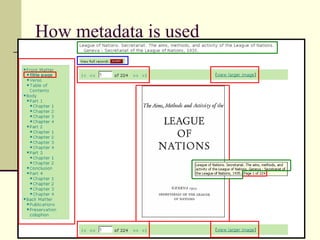
How metadata is used
6/25/07 SEI 11
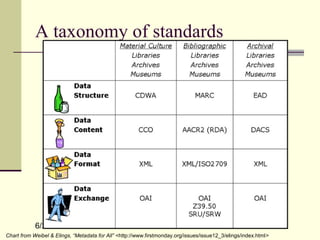
A taxonomy of standards
Chart from Weibel & Elings, “Metadata for All” <http://www.firstmonday.org/issues/issue12_3/elings/index.html>
6/25/07 SEI 12
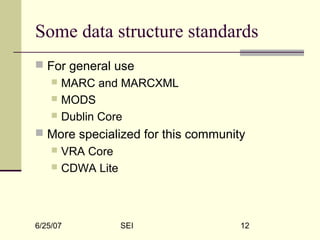
Some data structure standards
 For general use
 MARC and MARCXML
 MODS
 Dublin Core
 More specialized for this community
 VRA Core
 CDWA Lite
6/25/07 SEI 13Slide courtesy of Jan Eklund, UC Berkeley
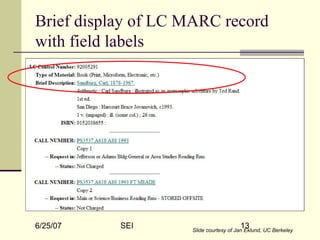
Brief display of LC MARC record
with field labels
6/25/07 SEI 14Slide courtesy of Jan Eklund, UC Berkeley
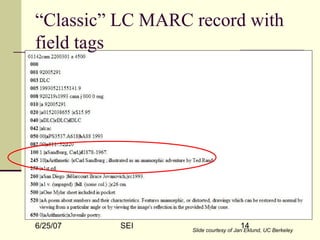
“Classic” LC MARC record with
field tags
6/25/07 SEI 15
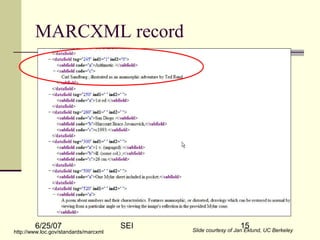
http://www.loc.gov/standards/marcxml Slide courtesy of Jan Eklund, UC Berkeley
MARCXML record
6/25/07 SEI 16
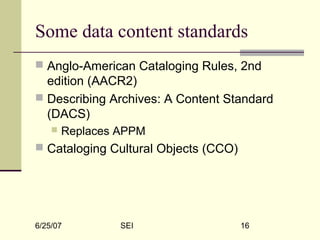
Some data content standards
 Anglo-American Cataloging Rules, 2nd
edition (AACR2)
 Describing Archives: A Content Standard
(DACS)
 Replaces APPM
 Cataloging Cultural Objects (CCO)
6/25/07 SEI 17
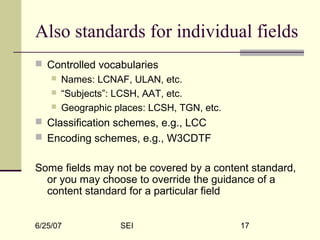
Also standards for individual fields
 Controlled vocabularies
 Names: LCNAF, ULAN, etc.
 “Subjects”: LCSH, AAT, etc.
 Geographic places: LCSH, TGN, etc.
 Classification schemes, e.g., LCC
 Encoding schemes, e.g., W3CDTF
Some fields may not be covered by a content standard,
or you may choose to override the guidance of a
content standard for a particular field
6/25/07 SEI 18
Creating descriptive metadata
 “Digital library” systems
 ContentDM
 ExLibris Digitool
 Greenstone
 Library catalogs
 Spreadsheets & databases
 XML
6/25/07 SEI 19
Challenges for descriptive VR
metadata
 No infrastructure for copy cataloging
 Often describe unique rather than mass-
produced works
 Description tends to be more subjective than
traditional library cataloging
 Many whole/part and derivative relationships
 Generally describe surrogates rather than
actual works
6/25/07 SEI 20
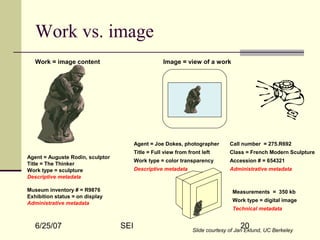
Work = image content Image = view of a work
Agent = Auguste Rodin, sculptor
Title = The Thinker
Work type = sculpture
Descriptive metadata
Museum inventory # = R9876
Exhibition status = on display
Administrative metadata
Agent = Joe Dokes, photographer Call number = 275.R692
Title = Full view from front left Class = French Modern Sculpture
Work type = color transparency Accession # = 654321
Descriptive metadata Administrative metadata
Measurements = 350 kb
Work type = digital image
Technical metadata
Work vs. image
Slide courtesy of Jan Eklund, UC Berkeley
6/25/07 SEI 21
The role of community
 There’s no one “right way” to record
descriptive metadata
 But we shouldn’t each have to start from
scratch with our own planning
 Collaboration within defined communities is
the key to success

Introduction to Metadata

  • 1.
    Introduction to Metadata Jenn Riley MetadataLibrarian IU Digital Library Program
  • 2.
    6/25/07 SEI 2 Somedefinitions of metadata  Data about data  “Structured information about an information resource of any media type or format.” (Caplan)  “Structured information that describes, explains, locates, or otherwise makes it easier to retrieve, use, or manage an information resource.” (NISO)  “A relationship that someone claims to exist between two entities” (<indecs>)
  • 3.
    6/25/07 SEI 3 Refininga definition  Other characteristics  Structure  Control  Origin  Machine-generated  Human-generated  In practice, the term often covers data and meta-metadata
  • 4.
    6/25/07 SEI 4 Metadataand cataloging  Depends on what you mean by:  metadata, and  cataloging!  But, in general:  Metadata is broader in scope than cataloging  Much metadata creation takes place outside of libraries  Good metadata practitioners use fundamental cataloging principles in non-MARC environments  Metadata created for many different types of materials
  • 5.
    6/25/07 SEI 5 Whatmetadata is not  Just a new word for cataloging  Only for Internet resources  Necessarily in electronic form  Only created by professionals  A fundamentally new idea  A reason to forget everything we know about describing and managing resources
  • 6.
    6/25/07 SEI 7 Someforms of metadata in cultural heritage institutions  Catalog cards  OPACs  Finding aids  Inventories  Registers  Slide labels
  • 7.
    6/25/07 SEI 8 Usesof metadata in cultural heritage institutions  Searching  Browsing  Display for users  Interoperability  Management of digital objects  Preservation  Navigation
  • 8.
    6/25/07 SEI 9 Sometypes of metadata Type Use Descriptive metadata Searching Browsing Display Interoperability Technical metadata Interoperability Digital object management Preservation Preservation metadata Interoperability Preservation Rights metadata Interoperability Digital object management Structural metadata Navigation
  • 9.
    6/25/07 SEI 10 Howmetadata is used
  • 10.
    6/25/07 SEI 11 Ataxonomy of standards Chart from Weibel & Elings, “Metadata for All” <http://www.firstmonday.org/issues/issue12_3/elings/index.html>
  • 11.
    6/25/07 SEI 12 Somedata structure standards  For general use  MARC and MARCXML  MODS  Dublin Core  More specialized for this community  VRA Core  CDWA Lite
  • 12.
    6/25/07 SEI 13Slidecourtesy of Jan Eklund, UC Berkeley Brief display of LC MARC record with field labels
  • 13.
    6/25/07 SEI 14Slidecourtesy of Jan Eklund, UC Berkeley “Classic” LC MARC record with field tags
  • 14.
    6/25/07 SEI 15 http://www.loc.gov/standards/marcxmlSlide courtesy of Jan Eklund, UC Berkeley MARCXML record
  • 15.
    6/25/07 SEI 16 Somedata content standards  Anglo-American Cataloging Rules, 2nd edition (AACR2)  Describing Archives: A Content Standard (DACS)  Replaces APPM  Cataloging Cultural Objects (CCO)
  • 16.
    6/25/07 SEI 17 Alsostandards for individual fields  Controlled vocabularies  Names: LCNAF, ULAN, etc.  “Subjects”: LCSH, AAT, etc.  Geographic places: LCSH, TGN, etc.  Classification schemes, e.g., LCC  Encoding schemes, e.g., W3CDTF Some fields may not be covered by a content standard, or you may choose to override the guidance of a content standard for a particular field
  • 17.
    6/25/07 SEI 18 Creatingdescriptive metadata  “Digital library” systems  ContentDM  ExLibris Digitool  Greenstone  Library catalogs  Spreadsheets & databases  XML
  • 18.
    6/25/07 SEI 19 Challengesfor descriptive VR metadata  No infrastructure for copy cataloging  Often describe unique rather than mass- produced works  Description tends to be more subjective than traditional library cataloging  Many whole/part and derivative relationships  Generally describe surrogates rather than actual works
  • 19.
    6/25/07 SEI 20 Work= image content Image = view of a work Agent = Auguste Rodin, sculptor Title = The Thinker Work type = sculpture Descriptive metadata Museum inventory # = R9876 Exhibition status = on display Administrative metadata Agent = Joe Dokes, photographer Call number = 275.R692 Title = Full view from front left Class = French Modern Sculpture Work type = color transparency Accession # = 654321 Descriptive metadata Administrative metadata Measurements = 350 kb Work type = digital image Technical metadata Work vs. image Slide courtesy of Jan Eklund, UC Berkeley
  • 20.
    6/25/07 SEI 21 Therole of community  There’s no one “right way” to record descriptive metadata  But we shouldn’t each have to start from scratch with our own planning  Collaboration within defined communities is the key to success