Metadata 101   An introduction to data about data R. John Robertson, Digital Libraries class 28 th  April 2005
Who? What? Why? Project(s): Metadata Workflow Investigation, mandate An introduction to metadata Inform you about other settings for your skills: not just digital libraries – IR’s; LOR’s; records management; webpages.. Bibliography at end, notes online Ask questions; tell me if you can’t hear me
What is metadata? Answers on a postcard… What do you know about metadata?  Simple definitions… Data about data; information about information Getting trickier Lack of consensus “ Metadata is machine understandable information for the web”  “ Metadata is data about data. The term refers to any data used to aid the identification, description and location of networked electronic resources.”  Discussing formal metadata
Overview What does metadata have to do with digital libraries? What is metadata (1)? What does metadata do? What is metadata (2)? Why do you need it? How do you create metadata? Workflow Quality Why bother with workflow or quality?
What I’m not doing Technical systems stuff – rdf / xml bindings… Limits to examples Not how to create metadata, rather how and why to choose and manage metadata
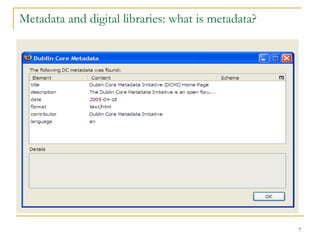
Metadata and digital libraries: what is metadata? Firefox plug-in [bottom right]
Metadata and digital libraries: what is metadata?
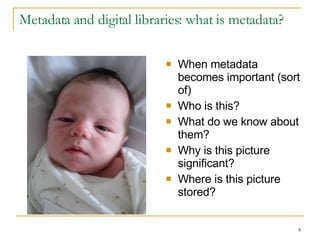
Metadata and digital libraries: what is metadata? When metadata becomes important (sort of) Who is this? What do we know about them? Why is this picture significant? Where is this picture stored?
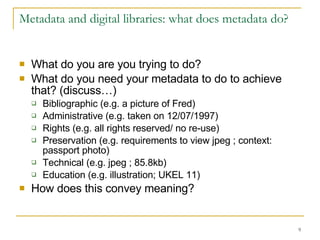
Metadata and digital libraries: what does metadata do? What do you are you trying to do? What do you need your metadata to do to achieve that? (discuss…) Bibliographic (e.g. a picture of Fred) Administrative (e.g. taken on 12/07/1997) Rights (e.g. all rights reserved/ no re-use) Preservation (e.g. requirements to view jpeg ; context: passport photo) Technical (e.g. jpeg ; 85.8kb) Education (e.g. illustration; UKEL 11) How does this convey meaning?
Metadata and digital libraries: what is metadata (part 2)? Definition from Weibel (1998) how to think about data… Structure : ‘a data model […] for specifying semantic schemas’ e.g. Dublin Core Semantic : ‘agreed content description standards’ e.g. author name conventions; controlled vocabularies Syntax : ‘syntax for expressing metadata’ e.g. XML binding for Dublin Core
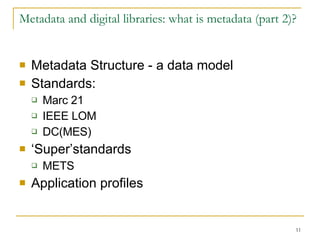
Metadata and digital libraries: what is metadata (part 2)? Metadata Structure - a data model  Standards:  Marc 21 IEEE LOM DC(MES) ‘ Super’standards  METS Application profiles
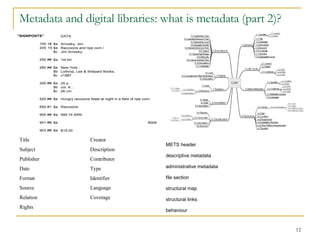
Metadata and digital libraries: what is metadata (part 2)? Title Creator Subject Description Publisher Contributor Date Type Format Identifier Source Language Relation Coverage Rights METS header descriptive metadata administrative metadata file section structural map structural links behaviour
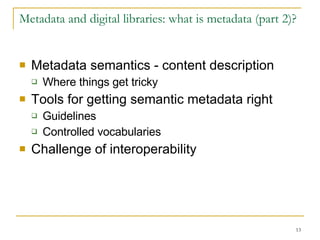
Metadata and digital libraries: what is metadata (part 2)? Metadata semantics - content description  Where things get tricky Tools for getting semantic metadata right Guidelines Controlled vocabularies Challenge of interoperability
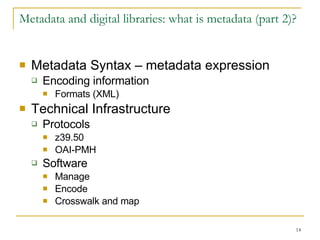
Metadata and digital libraries: what is metadata (part 2)? Metadata Syntax – metadata expression Encoding information  Formats (XML)  Technical Infrastructure Protocols  z39.50 OAI-PMH Software  Manage Encode Crosswalk and map
Metadata and digital libraries: why do you need metadata? How else could you manage stuff? Browse limits Free text limits Other limits
Metadata generation: workflow and quality How do you create metadata? Who creates? What do they create? Why should they? How much does it cost… Why do you need good metadata and what does that mean anyway?
Metadata generation: workflow What? Who? (Actors/ Agents/ Roles) Automatic: good at/ bad at Creator: good at/ bad at LIS professional: good at/ bad at Other professional: good at/ bad at Why? How much?
Metadata generation: quality Good enough metadata Fitness for purpose Metadata metrics accuracy reliability verification documentation consistency completeness sufficiency timeliness persistence etc.
Metadata quality: why bother? Functional digital libraries Interoperability Migration Exchange Participation Cost
Which leads to… Amazon Merlot Jorum Cross-searching library catalogues  e-journal access CORDRA Scotland’s Culture … and hopefully, interesting jobs for all of us
Key references National Information Standards Organization. (2004).  Understanding Metadata . NISO Press. Available from: http://www.niso.org/standards/resources/UnderstandingMetadata.pdf. Last accessed 21st December 2004. NISO Framework Advisory Group. (2004).  A Framework of Guidance for Building Good Digital Collections . 2nd ed. Bethesda, MD: National Information Standards Organization. Available from: http://www.niso.org/framework/framework2.html. . Last accessed 10th Nov 2004. Weibel, S.L. (1998). The Metadata Landscape: conventions for semantics, syntax, and structure in the Internet Commons. In:  Metadiversity. Proceedings of the Conference ,   Natural Bridge, VA. Available from: http://www.nfais.org/publications/metadiversity_preprints6.htm. Last accessed 20th January 2005.  Currier, S., Barton, J., O'Beirne, R. & Ryan, B. (2004). Quality assurance for digital learning object repositories: issues for the metadata creation process. ALT-J, 12(1), pp.5-20.   Dushay, N. & Hillmann, D.I. (2003). Analyzing metadata for effective use and re-use. DC-2003: 2003 Dublin Core Conference, Seattle.   Greenberg, J., Pattuelli, M. C., Parsia, B., &  Robertson, W. D. (2001).  Author-generated Dublin Core metadata for web resources: a baseline study in an organization. Journal of Digital Information, 2(2).
The end Questions now? Questions later – contact: [email_address] Rm 12:12

Metadata 101public

  • 1.
    Metadata 101 An introduction to data about data R. John Robertson, Digital Libraries class 28 th April 2005
  • 2.
    Who? What? Why?Project(s): Metadata Workflow Investigation, mandate An introduction to metadata Inform you about other settings for your skills: not just digital libraries – IR’s; LOR’s; records management; webpages.. Bibliography at end, notes online Ask questions; tell me if you can’t hear me
  • 3.
    What is metadata?Answers on a postcard… What do you know about metadata? Simple definitions… Data about data; information about information Getting trickier Lack of consensus “ Metadata is machine understandable information for the web” “ Metadata is data about data. The term refers to any data used to aid the identification, description and location of networked electronic resources.” Discussing formal metadata
  • 4.
    Overview What doesmetadata have to do with digital libraries? What is metadata (1)? What does metadata do? What is metadata (2)? Why do you need it? How do you create metadata? Workflow Quality Why bother with workflow or quality?
  • 5.
    What I’m notdoing Technical systems stuff – rdf / xml bindings… Limits to examples Not how to create metadata, rather how and why to choose and manage metadata
  • 6.
    Metadata and digitallibraries: what is metadata? Firefox plug-in [bottom right]
  • 7.
    Metadata and digitallibraries: what is metadata?
  • 8.
    Metadata and digitallibraries: what is metadata? When metadata becomes important (sort of) Who is this? What do we know about them? Why is this picture significant? Where is this picture stored?
  • 9.
    Metadata and digitallibraries: what does metadata do? What do you are you trying to do? What do you need your metadata to do to achieve that? (discuss…) Bibliographic (e.g. a picture of Fred) Administrative (e.g. taken on 12/07/1997) Rights (e.g. all rights reserved/ no re-use) Preservation (e.g. requirements to view jpeg ; context: passport photo) Technical (e.g. jpeg ; 85.8kb) Education (e.g. illustration; UKEL 11) How does this convey meaning?
  • 10.
    Metadata and digitallibraries: what is metadata (part 2)? Definition from Weibel (1998) how to think about data… Structure : ‘a data model […] for specifying semantic schemas’ e.g. Dublin Core Semantic : ‘agreed content description standards’ e.g. author name conventions; controlled vocabularies Syntax : ‘syntax for expressing metadata’ e.g. XML binding for Dublin Core
  • 11.
    Metadata and digitallibraries: what is metadata (part 2)? Metadata Structure - a data model Standards: Marc 21 IEEE LOM DC(MES) ‘ Super’standards METS Application profiles
  • 12.
    Metadata and digitallibraries: what is metadata (part 2)? Title Creator Subject Description Publisher Contributor Date Type Format Identifier Source Language Relation Coverage Rights METS header descriptive metadata administrative metadata file section structural map structural links behaviour
  • 13.
    Metadata and digitallibraries: what is metadata (part 2)? Metadata semantics - content description Where things get tricky Tools for getting semantic metadata right Guidelines Controlled vocabularies Challenge of interoperability
  • 14.
    Metadata and digitallibraries: what is metadata (part 2)? Metadata Syntax – metadata expression Encoding information Formats (XML) Technical Infrastructure Protocols z39.50 OAI-PMH Software Manage Encode Crosswalk and map
  • 15.
    Metadata and digitallibraries: why do you need metadata? How else could you manage stuff? Browse limits Free text limits Other limits
  • 16.
    Metadata generation: workflowand quality How do you create metadata? Who creates? What do they create? Why should they? How much does it cost… Why do you need good metadata and what does that mean anyway?
  • 17.
    Metadata generation: workflowWhat? Who? (Actors/ Agents/ Roles) Automatic: good at/ bad at Creator: good at/ bad at LIS professional: good at/ bad at Other professional: good at/ bad at Why? How much?
  • 18.
    Metadata generation: qualityGood enough metadata Fitness for purpose Metadata metrics accuracy reliability verification documentation consistency completeness sufficiency timeliness persistence etc.
  • 19.
    Metadata quality: whybother? Functional digital libraries Interoperability Migration Exchange Participation Cost
  • 20.
    Which leads to…Amazon Merlot Jorum Cross-searching library catalogues e-journal access CORDRA Scotland’s Culture … and hopefully, interesting jobs for all of us
  • 21.
    Key references NationalInformation Standards Organization. (2004). Understanding Metadata . NISO Press. Available from: http://www.niso.org/standards/resources/UnderstandingMetadata.pdf. Last accessed 21st December 2004. NISO Framework Advisory Group. (2004). A Framework of Guidance for Building Good Digital Collections . 2nd ed. Bethesda, MD: National Information Standards Organization. Available from: http://www.niso.org/framework/framework2.html. . Last accessed 10th Nov 2004. Weibel, S.L. (1998). The Metadata Landscape: conventions for semantics, syntax, and structure in the Internet Commons. In: Metadiversity. Proceedings of the Conference , Natural Bridge, VA. Available from: http://www.nfais.org/publications/metadiversity_preprints6.htm. Last accessed 20th January 2005. Currier, S., Barton, J., O'Beirne, R. & Ryan, B. (2004). Quality assurance for digital learning object repositories: issues for the metadata creation process. ALT-J, 12(1), pp.5-20. Dushay, N. & Hillmann, D.I. (2003). Analyzing metadata for effective use and re-use. DC-2003: 2003 Dublin Core Conference, Seattle. Greenberg, J., Pattuelli, M. C., Parsia, B., & Robertson, W. D. (2001). Author-generated Dublin Core metadata for web resources: a baseline study in an organization. Journal of Digital Information, 2(2).
  • 22.
    The end Questionsnow? Questions later – contact: [email_address] Rm 12:12