FRBR
      13 March 2013
     Thomas Meehan
Head of Current Cataloguing
   t.meehan@ucl.ac.uk
FRBR
Functional
Requirements for
Bibliographic
Records
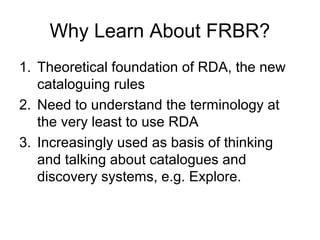
Why Learn About FRBR?
1. Theoretical foundation of RDA, the new
   cataloguing rules
2. Need to understand the terminology at
   the very least to use RDA
3. Increasingly used as basis of thinking
   and talking about catalogues and
   discovery systems, e.g. Explore.
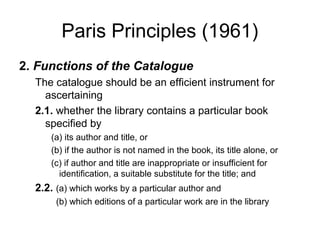
Paris Principles (1961)
2. Functions of the Catalogue
  The catalogue should be an efficient instrument for
    ascertaining
  2.1. whether the library contains a particular book
    specified by
      (a) its author and title, or
      (b) if the author is not named in the book, its title alone, or
      (c) if author and title are inappropriate or insufficient for
        identification, a suitable substitute for the title; and
  2.2. (a) which works by a particular author and
       (b) which editions of a particular work are in the library
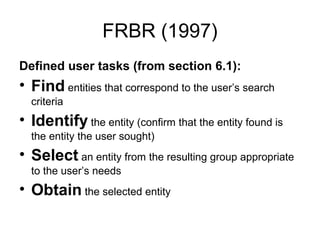
FRBR (1997)
Defined user tasks (from section 6.1):
• Find entities that correspond to the user’s search
  criteria
• Identify the entity (confirm that the entity found is
  the entity the user sought)
• Select an entity from the resulting group appropriate
  to the user’s needs
• Obtain the selected entity
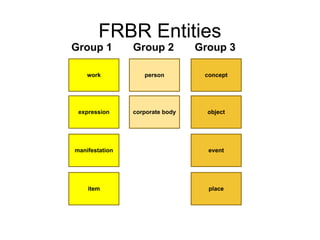
FRBR Entities
Group 1   Group 2   Group 3
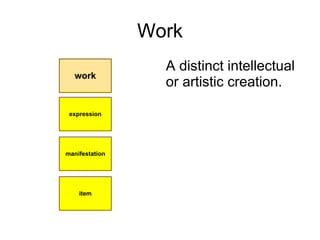
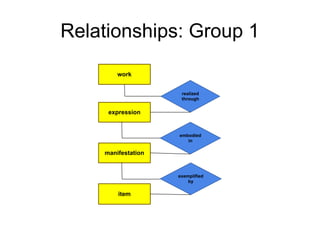
Work
  A distinct intellectual
  or artistic creation.
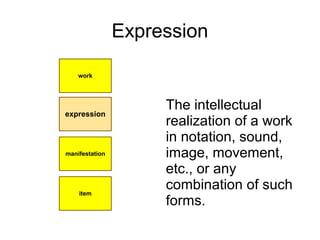
Expression


     The intellectual
     realization of a work
     in notation, sound,
     image, movement,
     etc., or any
     combination of such
     forms.
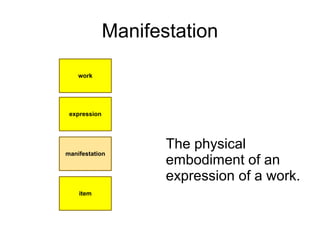
Manifestation


       The physical
       embodiment of an
       expression of a work.
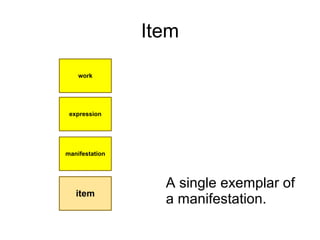
Item


  A single exemplar of
  a manifestation.
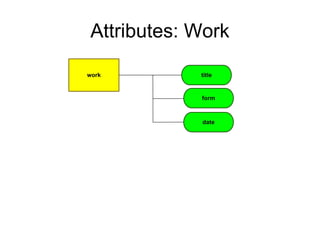
Attributes: Work
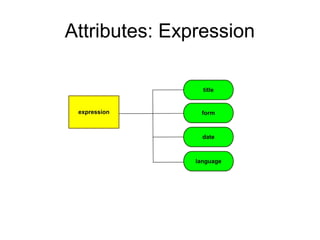
Attributes: Expression
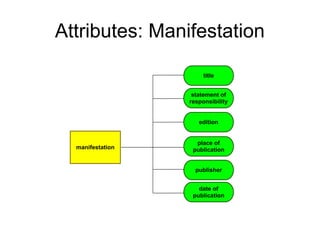
Attributes: Manifestation
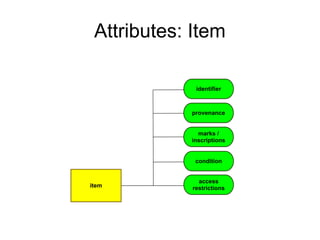
Attributes: Item
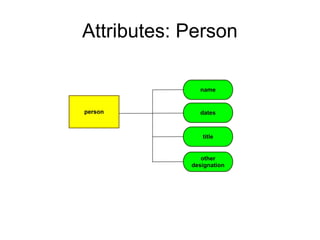
Attributes: Person
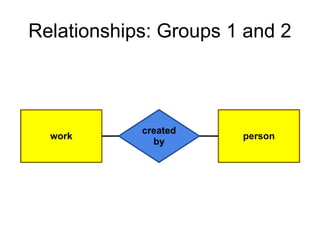
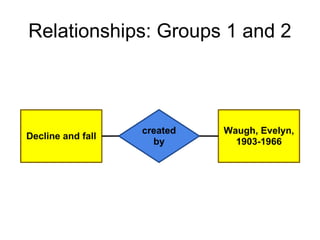
Relationships: Groups 1 and 2
Relationships: Group 1
FRBR Example
Example of FRBR, based on Michael
 Ondaatje’s The English patient:

• http://www.ucl.ac.uk/~ucyltpm/cat/frbrtraini
  ng/frbr_example.html
Work: Newton’s Principia
[Newton’s Principia (Work)]
   –   (title) “Principia”
   –   (form) “treatise”
   –   (date) “1687”
   –   <is created by> [Isaac Newton, 1642-1727 (Person)]
   –   <is realized through>
        • [Newton’s Principia in Latin, 1726 (Expression)]
        • [Newton’s Principia in English, 1729 (Expression)]
        • [Newton’s Principia in English, 1999 (Expression)]
Expression: Newton’s
        Principia in Latin, 1726
[Newton’s Principia in Latin, 1726 (Expression)]
–(title) “Philosophiæ naturalis principia mathematica”
–(form) “text”
–(date) “1726”
–(language) “Latin”
–<is embodied in> [Newton’s Principia in Latin, 1871
(Manifestation)]
Manifestation: Newton’s
        Principia in Latin, 1871
[Newton’s Principia in Latin, 1871 (Manifestation)]
   –   (title) “Sir Isaac Newton’s Principia”
   –   (place of publication) “Glasgow”
   –   (publisher) “James Maclehose”
   –   (date) “1871”
   –   <is exemplified by> [30217010236531 (Item)]
Item: 30217010236531
[30217010236531(Item)]
   – (identifier) “30217010236531”
Expression: Newton’s
       Principia in English, 1729
[Newton’s Principia in English, 1729 (Expression)]
   –   (title) “The mathematical principles of natural philosophy”
   –   (form) “text”
   –   (date) “1729”
   –   (language) “English”
   –   <is translated by> [Andrew Motte, d. 1734]
   –   <is embodied in> [Newton’s Principia in English, 1934
       (Manifestation)]
Manifestation: Newton’s
    Principia in English, 1934
Newton’s Principia in Latin, 1934 (Manifestation)
   – (title) “Sir Isaac Newton’s Mathematical principles of natural
     philosophy and his system of the world”
   – (statement of responsibility) “translated into English by
     Andrew Motte in 1729”
   – (place of publication) “Cambridge”
   – (publisher) “Cambridge University Press”
   – (date) “1934”
   – <is exemplified by> [30217009902085 (Item)]
Item: 3021700902085
[3021700902085 (Item)]
•(identifier) “3021700902085”
Expression: Newton’s
    Principia in English, 1999
[Newton’s Principia in English, 1999 (Expression)]
   – (title) “The principia : mathematical principles of natural
     philosophy”
   – (form) “text”
   – (date) “1999”
   – (language) “English”
   – <is translated by> [I. Bernard Cohen, 1914-2003]
   – <is translated by> [Anne Miller Whitman, 1937-1984]
   – <is embodied in> [Newton’s Principia in English, 1999
     (Manifestation)]
Manifestation: Newton’s
    Principia in English, 1999
[Newton’s Principia in English, 1999 (Manifestation)]
   – (title) “The principia : mathematical principles of natural
     philosophy”
   – (statement of responsibility) “a new translation by I.
     Bernard Cohen and Anne Whitman”
   – (place of publication) “Berkeley”
   – (publisher) “University of California Press”
   – (date) “1999”
   – <is exemplified by> [2809033542 (Item)]
Item: 2809033542
[2809033542 (Item)]
•(identifier) “2809033542”
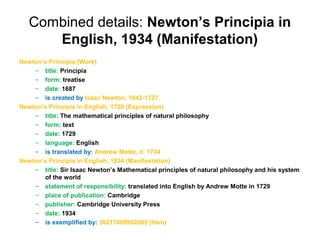
Combined details: Newton’s Principia in
      English, 1934 (Manifestation)
Newton’s Principia (Work)
    – title: Principia
    – form: treatise
    – date: 1687
    – is created by Isaac Newton, 1642-1727.
Newton’s Principia in English, 1729 (Expression)
    – title: The mathematical principles of natural philosophy
    – form: text
    – date: 1729
    – language: English
    – is translated by: Andrew Motte, d. 1734
Newton’s Principia in English, 1934 (Manifestation)
    – title: Sir Isaac Newton’s Mathematical principles of natural philosophy and his system
       of the world
    – statement of responsibility: translated into English by Andrew Motte in 1729
    – place of publication: Cambridge
    – publisher: Cambridge University Press
    – date: 1934
    – is exemplified by: 30217009902085 (Item)
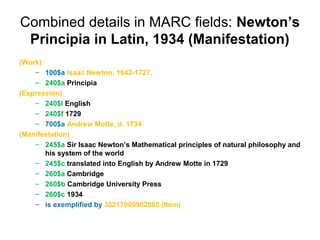
Combined details in MARC fields: Newton’s
 Principia in Latin, 1934 (Manifestation)
(Work)
    – 100$a Isaac Newton, 1642-1727.
    – 240$a Principia
(Expression)
    – 240$l English
    – 240$f 1729
    – 700$a Andrew Motte, d. 1734
(Manifestation)
    – 245$a Sir Isaac Newton’s Mathematical principles of natural philosophy and
       his system of the world
    – 245$c translated into English by Andrew Motte in 1729
    – 260$a Cambridge
    – 260$b Cambridge University Press
    – 260$c 1934
    – is exemplified by 30217009902085 (Item)
FRBR Example 2
Example of FRBR, based on three editions
 of Newton’s Principia:

• http://www.ucl.ac.uk/~ucyltpm/cat/frbrtraini
  ng/frbr_example_newton.html
Related standards
• FRBR (Functional Requirements for Bibliographic Records)
• FRAD (Functional Requirements for Authority Data, formerly
    FRAR)
•   FRANAR (Functional Requirements And Numbering of Authority
    Records, the title of a Working Group that authored FRAD and
    ISADN)
•   FRAR (see FRAD)
• FRSAD (Functional Requirements for Subject Authority Data,
    formerly FRSAR)
•   FRSAR (see FRSAD)
•   FRBRoo (FRBR object-oriented)
FRAD (Person) details for Isaac Newton

[Isaac Newton, 1642-1727 (Person)]
     – (date of birth) “1642”
     – (date of death) “1727”
     – (title of person) “Sir”
     – (gender) “male”
     – (place of birth): “Woolsthorpe-by-Colsterworth, Lincolnshire”
     – (place of death) “London”
     – (country) “England”
     – (place of residence) “England”
     – (affiliation): “University of Cambridge”
     – (language of person) “English”, “Latin”
     – (field of activity) “science”, “mathematics”
     – (profession/occupation) “scholar”, “Master of the Mint”
     – <has appellation> [Sir Isaac Newton (Name)]
FRAD (Name) details for Sir Isaac Newton

[Sir Isaac Newton (Name)]
   –   (type of name) “personal”
   –   (name string) “Sir Isaac Newton”
   –   (language of name) “English”
   –   (script of name): “Latin”
   –   <earlier name relationship> [Isaac Newton (Name)]
   –   <is basis for> [LC Name Authority Record 79007443]
Is it any good?
•   A theoretical underpinning to cataloguing practice
•   Clarifies the role of things like uniform titles
•   Focuses on user needs
•   Influential in the design of catalogues and discovery systems: should make search more intuitive
•   Entity-relationship model fits well with linked data, even if WEMI doesn’t
•   Not widely tested (although see Scherzo: http://webapp1.dlib.indiana.edu/scherzo/)
•   Not implemented on a big scale
•   Very rigid model
•   Uses attributes instead of entities
•   Only ever a draft
•   Describes abstract things
•   Hard to grasp
•   Much overlap/confusion between WEMI entities
•   What does an electronic Item look like?
•   How do ebooks, ejournals, websites, etc, fit into FRBR model?
•   Aggregates
FRBR and Explore
•   Groups records into Works based on author/title (100/245) and
    author/uniform title (100/240) matches
•   Shows Manifestations within Works groups, skipping Expressions,
    although some Expression information is available using the facets
    (e.g. language)
•   Details for Works are taken from one Manifestation (although not
    publisher any more): misleading
•   Does not show relationships
•   Only Manifestations are treated as entities, not Works or Persons

Data needs to be FRBRised for Explore or any other system to do
  it properly.
More Information
Standards
•[FRBR] Functional requirements for bibliographic records : final report / IFLA Study Group on the Functional Requirements for
Bibliographic Records. München : K.G. Saur, 1998. http://www.ifla.org/publications/functional-requirements-for-bibliographic-records
•[FRAD] Functional requirements for authority data : a conceptual model / edited by Glenn E. Patton. München: K.G. Saur, 2009.
http://www.ifla.org/publications/functional-requirements-for-authority-data
•[FRSAD] Functional requirements for subject authority data (FRSAD) : a conceptual model / edited by Marcia Lei Zeng, Maja Žumer &
Athena Salaba. http://www.ifla.org/node/5849


Other Works
•FRBR : a guide for the perplexed / Robert L. Maxwell. Chicago : American Library Association, 2008. A good thorough run through of FRBR,
including some criticism, and the different approaches taken by FRBR and FRAD.
•Understanding FRBR : what it is and how it will affect our retrieval tools / edited by Arlene G. Taylor. Westport, Conn. : Libraries
Unlimited, 2007. A collection of articles including several introductory ones. Not always as accessible as it could be.
•Introducing RDA : a guide to the basics / Chris Oliver. London : Facet, 2010. Includes a good brief introduction to FRBR and FRAD. Chris
Oliver was appointed copy editor of RDA in 2011 with the task of rewriting the text for readability.
•Practical cataloguing : AACR, RDA and MARC 21 / Anne Welsh and Sue Batley. London : Facet, 2012. Includes good brief introduction to
FRBR (chapter 2) and FRBR as the foundation of RDA (chapter 5).
•Library of Congress (LC) RDA Training Materials. http://www.loc.gov/catworkshop/RDA%20training%20materials/LC%20RDA
%20Training/LC%20RDA%20course%20table.html Includes various slides, manuals, webinars, quizzes, etc. on FRBR.


Training
•FRBR for the Terrified. Run by CILIP CIG in various places in the UK. Look out for new courses on their blog:
http://communities.cilip.org.uk/blogs/catalogueandindex/
FRBR
[FRBR presentation]
  (title) “FRBR”
  (date) “13 March 2013”
  <created by> [Thomas Meehan]


[Thomas Meehan]
  (address) t.meehan@ucl.ac.uk
  (profession/occupation) “Head of Current Cataloguing”
  <has appellation> “Thomas Meehan”

FRBR

  • 1.
    FRBR 13 March 2013 Thomas Meehan Head of Current Cataloguing t.meehan@ucl.ac.uk
  • 2.
  • 3.
    Why Learn AboutFRBR? 1. Theoretical foundation of RDA, the new cataloguing rules 2. Need to understand the terminology at the very least to use RDA 3. Increasingly used as basis of thinking and talking about catalogues and discovery systems, e.g. Explore.
  • 4.
    Paris Principles (1961) 2.Functions of the Catalogue The catalogue should be an efficient instrument for ascertaining 2.1. whether the library contains a particular book specified by (a) its author and title, or (b) if the author is not named in the book, its title alone, or (c) if author and title are inappropriate or insufficient for identification, a suitable substitute for the title; and 2.2. (a) which works by a particular author and (b) which editions of a particular work are in the library
  • 5.
    FRBR (1997) Defined usertasks (from section 6.1): • Find entities that correspond to the user’s search criteria • Identify the entity (confirm that the entity found is the entity the user sought) • Select an entity from the resulting group appropriate to the user’s needs • Obtain the selected entity
  • 6.
    FRBR Entities Group 1 Group 2 Group 3
  • 7.
    Work Adistinct intellectual or artistic creation.
  • 8.
    Expression The intellectual realization of a work in notation, sound, image, movement, etc., or any combination of such forms.
  • 9.
    Manifestation The physical embodiment of an expression of a work.
  • 10.
    Item Asingle exemplar of a manifestation.
  • 11.
  • 12.
  • 13.
  • 14.
  • 15.
  • 16.
  • 17.
  • 18.
  • 19.
    FRBR Example Example ofFRBR, based on Michael Ondaatje’s The English patient: • http://www.ucl.ac.uk/~ucyltpm/cat/frbrtraini ng/frbr_example.html
  • 20.
    Work: Newton’s Principia [Newton’sPrincipia (Work)] – (title) “Principia” – (form) “treatise” – (date) “1687” – <is created by> [Isaac Newton, 1642-1727 (Person)] – <is realized through> • [Newton’s Principia in Latin, 1726 (Expression)] • [Newton’s Principia in English, 1729 (Expression)] • [Newton’s Principia in English, 1999 (Expression)]
  • 21.
    Expression: Newton’s Principia in Latin, 1726 [Newton’s Principia in Latin, 1726 (Expression)] –(title) “Philosophiæ naturalis principia mathematica” –(form) “text” –(date) “1726” –(language) “Latin” –<is embodied in> [Newton’s Principia in Latin, 1871 (Manifestation)]
  • 22.
    Manifestation: Newton’s Principia in Latin, 1871 [Newton’s Principia in Latin, 1871 (Manifestation)] – (title) “Sir Isaac Newton’s Principia” – (place of publication) “Glasgow” – (publisher) “James Maclehose” – (date) “1871” – <is exemplified by> [30217010236531 (Item)]
  • 23.
    Item: 30217010236531 [30217010236531(Item)] – (identifier) “30217010236531”
  • 24.
    Expression: Newton’s Principia in English, 1729 [Newton’s Principia in English, 1729 (Expression)] – (title) “The mathematical principles of natural philosophy” – (form) “text” – (date) “1729” – (language) “English” – <is translated by> [Andrew Motte, d. 1734] – <is embodied in> [Newton’s Principia in English, 1934 (Manifestation)]
  • 25.
    Manifestation: Newton’s Principia in English, 1934 Newton’s Principia in Latin, 1934 (Manifestation) – (title) “Sir Isaac Newton’s Mathematical principles of natural philosophy and his system of the world” – (statement of responsibility) “translated into English by Andrew Motte in 1729” – (place of publication) “Cambridge” – (publisher) “Cambridge University Press” – (date) “1934” – <is exemplified by> [30217009902085 (Item)]
  • 26.
  • 27.
    Expression: Newton’s Principia in English, 1999 [Newton’s Principia in English, 1999 (Expression)] – (title) “The principia : mathematical principles of natural philosophy” – (form) “text” – (date) “1999” – (language) “English” – <is translated by> [I. Bernard Cohen, 1914-2003] – <is translated by> [Anne Miller Whitman, 1937-1984] – <is embodied in> [Newton’s Principia in English, 1999 (Manifestation)]
  • 28.
    Manifestation: Newton’s Principia in English, 1999 [Newton’s Principia in English, 1999 (Manifestation)] – (title) “The principia : mathematical principles of natural philosophy” – (statement of responsibility) “a new translation by I. Bernard Cohen and Anne Whitman” – (place of publication) “Berkeley” – (publisher) “University of California Press” – (date) “1999” – <is exemplified by> [2809033542 (Item)]
  • 29.
  • 30.
    Combined details: Newton’sPrincipia in English, 1934 (Manifestation) Newton’s Principia (Work) – title: Principia – form: treatise – date: 1687 – is created by Isaac Newton, 1642-1727. Newton’s Principia in English, 1729 (Expression) – title: The mathematical principles of natural philosophy – form: text – date: 1729 – language: English – is translated by: Andrew Motte, d. 1734 Newton’s Principia in English, 1934 (Manifestation) – title: Sir Isaac Newton’s Mathematical principles of natural philosophy and his system of the world – statement of responsibility: translated into English by Andrew Motte in 1729 – place of publication: Cambridge – publisher: Cambridge University Press – date: 1934 – is exemplified by: 30217009902085 (Item)
  • 31.
    Combined details inMARC fields: Newton’s Principia in Latin, 1934 (Manifestation) (Work) – 100$a Isaac Newton, 1642-1727. – 240$a Principia (Expression) – 240$l English – 240$f 1729 – 700$a Andrew Motte, d. 1734 (Manifestation) – 245$a Sir Isaac Newton’s Mathematical principles of natural philosophy and his system of the world – 245$c translated into English by Andrew Motte in 1729 – 260$a Cambridge – 260$b Cambridge University Press – 260$c 1934 – is exemplified by 30217009902085 (Item)
  • 32.
    FRBR Example 2 Exampleof FRBR, based on three editions of Newton’s Principia: • http://www.ucl.ac.uk/~ucyltpm/cat/frbrtraini ng/frbr_example_newton.html
  • 33.
    Related standards • FRBR(Functional Requirements for Bibliographic Records) • FRAD (Functional Requirements for Authority Data, formerly FRAR) • FRANAR (Functional Requirements And Numbering of Authority Records, the title of a Working Group that authored FRAD and ISADN) • FRAR (see FRAD) • FRSAD (Functional Requirements for Subject Authority Data, formerly FRSAR) • FRSAR (see FRSAD) • FRBRoo (FRBR object-oriented)
  • 34.
    FRAD (Person) detailsfor Isaac Newton [Isaac Newton, 1642-1727 (Person)] – (date of birth) “1642” – (date of death) “1727” – (title of person) “Sir” – (gender) “male” – (place of birth): “Woolsthorpe-by-Colsterworth, Lincolnshire” – (place of death) “London” – (country) “England” – (place of residence) “England” – (affiliation): “University of Cambridge” – (language of person) “English”, “Latin” – (field of activity) “science”, “mathematics” – (profession/occupation) “scholar”, “Master of the Mint” – <has appellation> [Sir Isaac Newton (Name)]
  • 35.
    FRAD (Name) detailsfor Sir Isaac Newton [Sir Isaac Newton (Name)] – (type of name) “personal” – (name string) “Sir Isaac Newton” – (language of name) “English” – (script of name): “Latin” – <earlier name relationship> [Isaac Newton (Name)] – <is basis for> [LC Name Authority Record 79007443]
  • 36.
    Is it anygood? • A theoretical underpinning to cataloguing practice • Clarifies the role of things like uniform titles • Focuses on user needs • Influential in the design of catalogues and discovery systems: should make search more intuitive • Entity-relationship model fits well with linked data, even if WEMI doesn’t • Not widely tested (although see Scherzo: http://webapp1.dlib.indiana.edu/scherzo/) • Not implemented on a big scale • Very rigid model • Uses attributes instead of entities • Only ever a draft • Describes abstract things • Hard to grasp • Much overlap/confusion between WEMI entities • What does an electronic Item look like? • How do ebooks, ejournals, websites, etc, fit into FRBR model? • Aggregates
  • 37.
    FRBR and Explore • Groups records into Works based on author/title (100/245) and author/uniform title (100/240) matches • Shows Manifestations within Works groups, skipping Expressions, although some Expression information is available using the facets (e.g. language) • Details for Works are taken from one Manifestation (although not publisher any more): misleading • Does not show relationships • Only Manifestations are treated as entities, not Works or Persons Data needs to be FRBRised for Explore or any other system to do it properly.
  • 38.
    More Information Standards •[FRBR] Functionalrequirements for bibliographic records : final report / IFLA Study Group on the Functional Requirements for Bibliographic Records. München : K.G. Saur, 1998. http://www.ifla.org/publications/functional-requirements-for-bibliographic-records •[FRAD] Functional requirements for authority data : a conceptual model / edited by Glenn E. Patton. München: K.G. Saur, 2009. http://www.ifla.org/publications/functional-requirements-for-authority-data •[FRSAD] Functional requirements for subject authority data (FRSAD) : a conceptual model / edited by Marcia Lei Zeng, Maja Žumer & Athena Salaba. http://www.ifla.org/node/5849 Other Works •FRBR : a guide for the perplexed / Robert L. Maxwell. Chicago : American Library Association, 2008. A good thorough run through of FRBR, including some criticism, and the different approaches taken by FRBR and FRAD. •Understanding FRBR : what it is and how it will affect our retrieval tools / edited by Arlene G. Taylor. Westport, Conn. : Libraries Unlimited, 2007. A collection of articles including several introductory ones. Not always as accessible as it could be. •Introducing RDA : a guide to the basics / Chris Oliver. London : Facet, 2010. Includes a good brief introduction to FRBR and FRAD. Chris Oliver was appointed copy editor of RDA in 2011 with the task of rewriting the text for readability. •Practical cataloguing : AACR, RDA and MARC 21 / Anne Welsh and Sue Batley. London : Facet, 2012. Includes good brief introduction to FRBR (chapter 2) and FRBR as the foundation of RDA (chapter 5). •Library of Congress (LC) RDA Training Materials. http://www.loc.gov/catworkshop/RDA%20training%20materials/LC%20RDA %20Training/LC%20RDA%20course%20table.html Includes various slides, manuals, webinars, quizzes, etc. on FRBR. Training •FRBR for the Terrified. Run by CILIP CIG in various places in the UK. Look out for new courses on their blog: http://communities.cilip.org.uk/blogs/catalogueandindex/
  • 39.
    FRBR [FRBR presentation] (title) “FRBR” (date) “13 March 2013” <created by> [Thomas Meehan] [Thomas Meehan] (address) t.meehan@ucl.ac.uk (profession/occupation) “Head of Current Cataloguing” <has appellation> “Thomas Meehan”