METADATA: A PRACTICE AND ITS SERVICES TOWARDS
DIGITAL ENVIRONMENT
SECTIONS SPEAKERS
Introduction and Overview Sumanta Bag
Metadata records and conceptual model Kaustav Saha
Approaches and standards towards metadata Debashis Naskar
Interoperability & Services towards Digital Environment Vikas Bhushan
Research landscape and Conclusion Sayon Roy
4/1/2015
INTRODUCTION
• What is Resource
• Introduction to Metadata
– Definition
– Examples
• Purpose of Metadata
• Usage of Metadata
• Types of Metadata
4/1/2015
What is resource?
• Resource is something that can be identified, the
identification having two distinct purposes,viz., naming
and addressing the resources.
4/1/2015
What is Metadata ?
• Metadata is a piece of information describing a resource.
(Resources include books, websites, Maps, Videos, etc.).
• It represents the who, what, when, where, why, and how of a
resource.
• Structured data about something which are text, images, sound,
movement, objects ,events, services etc.
4/1/2015
Example of Metadata [cont..]
• Label on a product giving details of the product
E.g. actual contents of a food product; Protein and vitamins
content; calories, etc.
entity
attributes
4/1/2015
Example of metadata [cont..]
commons.wikimedia.org/wiki/File: Medicine_bottles.jpg4/1/2015
Metadata for an Image
4/1/2015
http://www.webopedia.com/DidYouKnow/Computer_Science/2007/metadata.asp
Metadata uses in library and publishing documents
Metadata have been used in a variety of applications, such as:
• Libraries
• Database publishing
• Dictionary and encyclopedia publishing
• Book publishing
4/1/2015
WHY DO WE NEED METADATA?
• Understanding the content
• Information search and Retrieval
• Sharing
• Processing
• Management
- Preservation
4/1/2015
Metadata purpose
http://aspiresquared.co.uk/2011/01/metadata-what-is-its-purpose4/1/2015
Metadata Records and Conceptual Model
-Kaustav Saha
TYPES OF METADATA
Metadata
Descriptive
Administrative
Structural
Technical
Rights
Metadata Record
• In the context of libraries, archives and bibliographic agencies:
 Catalogue record / Bibliographic Record
 A record providing a description of a document and is made accessible / searchable
under several access points
• Authority records
Function of Metadata Records
• Two major purposes:
 Resource Discovery
-Identification
- Collocation
 House Keeping
• Resource discovery encompasses the following user tasks:
– Find
– Identity
– Select
– Obtain
FRBR Model
• FRBR is a conceptual model
• Entities-Group 1, Group 2, Group 3
• The entity relationship model is generalized way to look at the bibliographic
universe.
• Conceptual model are useful as the basis development of next generation cataloguing
rules
Conceptual Model
Relationship
Created
Entity A Entity B
Work
Lipika
Person
R.N. Tagore
Was created by
FRBR Model [Group 1]
Intellectual/ artistic content
Physical Recording
Of content
Expression
WORK
Manifestation
Item
Is realized through
Is exmplified by
Is embodied
In a
FRBR Model [Group 2]
WORK
EXPRESSION
MANIFESTATION
ITEM
PERSON
CORPORATE BODY
Is owned by
Is produced by
Is realized by
is created by
FRBR Model [Group 3]
• The entities in the third group represent an additional set of
entities that serve as the subjects of works.
• The group includes:
– Concept
– Object
– Event
– Place
Bibliographic relationship
• Relationship between different manifestations of work
• Relationship between a work and a translation or adaptation of the work
• Relationship between different works that are associated with the same person/ body
Approaches and Standards towards
Metadata
-Debashis Naskar
Approaches of Metadata
Traditional Automated Dig. Library
AACR2/CCC/CC/
LCCS/DDC/LCSH
AACR2/ISO 2709/
CCF/MARC
Metadata/DCMI/
EAD/METS/
MODS/MARC21
4/1/2015
Metadata Schema
• Metadata schema to choose from and
the number is growing rapidly.
• Metadata schemes describing a
particular type of information resource.
• Metadata can be encoded in any
definable syntax.
4/1/2015
Different Metadata Schema
• General Purpose
-Dublin Core, MODS
• Cultural Objects and Visual Resources
-VRA Core
• Educational Resources
-IEEE LOM
• Archival and Presentation Metadata
-EAD
• Government Purpose Metadata
- e-GMS
• Multimedia Objects
-MPEG-7
4/1/2015
What is Dublin Core
 Introduction
-Set of Vocabulary terms
-Set of Metadata Elements
http://blogs.microsoft.co.il/blogs/itaysk/dublin_thumb_1E0094AA.png
4/1/2015
Dublin Core Elements
Dublin Core
Content Intellectual Property Instantiation
 Title
 Description
 Type
 Subject
 Source
 Relation
 Coverage
 Creator
 Publisher
 Rights
 Contributor
 Date
 Format
 Identifier
 language
4/1/2015
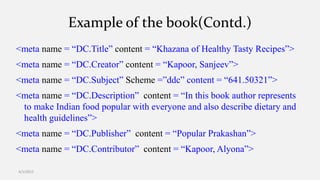
Example of the book(Contd.)
<meta name = “DC.Title” content = “Khazana of Healthy Tasty Recipes”>
<meta name = “DC.Creator” content = “Kapoor, Sanjeev”>
<meta name = “DC.Subject” Scheme =”ddc” content = “641.50321”>
<meta name = “DC.Description” content = “In this book author represents
to make Indian food popular with everyone and also describe dietary and
health guidelines”>
<meta name = “DC.Publisher” content = “Popular Prakashan”>
<meta name = “DC.Contributor” content = “Kapoor, Alyona”>
4/1/2015
Example of the book
<meta name = “DC.Date.Created” content = “2000”>
<meta name = “DC.Type” content = “Book”>
<meta name = “DC.Format” content = “text”>
<meta name = “DC.Identifier” Scheme = “ISBN” content = “978-81-7154-671-8”>
<meta name = “DC.Language” content = “english”>
<meta name = “DC.Coverage” content = “India,Chinese,Italian and Thai ”>
4/1/2015
http://cdn.shopify.com/s/files/1/0106/6232/products/sk_healthy_tasty_large.jpg?27
A Simple Approach To Validation
Use of DC-dot
4/1/2015
http://www.emeraldinsight.com/content_images/fig/1640170201002.png
Interoperability & Services Towards Digital
Environment
-Vikas Bhushan
4/1/2015
Interoperability
“Interoperability is the ability of multiple systems with different hardware
and software platforms, data structures, and interfaces to exchange data
with minimal loss of content and functionality”
-(NISO, 2004:2)
Image Source: http://www.niso.org/home/
4/1/2015
Interoperability at the Schema Level
 Derivation: A new schema is derived from an existing one.
 Application Profiles (Aps) : It is created based on one single schema but
tailored to different user communities.eg DC- Library Application profile
 Frameworks: It can be considered a skeleton upon which various objects
are integrated for any given solution.
 Crosswalks : It is “a mapping of the elements, semantics, and syntax from
one metadata scheme to those of another”.
4/1/2015
Pictorial view of Schema Derivation & Framework
4/1/2015
Image Source : www.dlib.org
Example of Schema Derivation
A Framework & the Schemas associated with the Framework
Crosswalks
1. Direct crosswalking : Applied when only two (or a limited number of )
schemas are involved.
2. Cross-switching : Applied to a situation in which multiple schemas are
involved.
4/1/2015
Direct Crosswalk
Schema A Schema B
4/1/2015
Establishing a Crosswalk between two Schemas
Pictorial representation of Cross Switching
Schema A
Schema B
Schema C Schema D
Switch
4/1/2015
Cross-Switching when multiple Schemas are involved
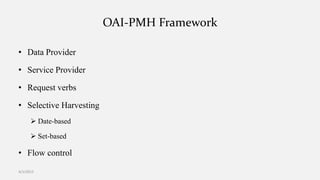
OAI-PMH Framework
• Data Provider
• Service Provider
• Request verbs
• Selective Harvesting
 Date-based
 Set-based
• Flow control
4/1/2015
OAI-PMH framework
http://www.oaforum.org4/1/2015
Metadata Services
Metadata Services include the common types listed here.
• Metadata registries
• Metadata repositories
• Metadata development and production services
4/1/2015
Metadata Harvesting Services in India
Sr.
No.
Name URL Host Software
used
1 Search Digital Libraries (SDL) http://drtc.isibang.ac.in/sdl DRTC,
Bangalore
PKP System
2 SJPI Cross Journal Search Service http://144.16.72.144/harvester/ NCSI, IISc PKP System
3 SEED http://eprint.iitd.ac.in/seed/ IIT, Delhi PKP System
4 Open J-Gate www.openj-gate.com/ Informatics
India Ltd.
------
5 Knowledge
Harvester@INSA
http://61.16.154.195/harvester/ INSA PKP System
4/1/2015
Research landscape and Conclusion
- Sayon Roy
4/1/2015
Metadata Research Landscape
• Research in Metadata Architecture
• Research in Metadata Modeling
• Research in Metadata Semantics
4/1/2015
Research in Metadata Architecture
• The term metadata architecture first appeared in Berners-Lee’s article on
the axioms of Web architecture
• His view “The architecture is of metadata represented as a set of
independent assertions”
(Berners-Lee, 1997)
4/1/2015
Research in Metadata Architecture
• Berners-Lee’s view on metadata architecture represents a computer
science perspective in which data are encoded in machine-processable
form and communicated via protocols.
• Research in metadata architecture in the past decade was divided into
two paradigms:
 Paradigm of processability
 Paradigm of executability
4/1/2015
Research in Metadata modeling
• Metadata models constitute just one of the many frontiers of research in
recent years. In addition to the abstract models developed by the
metadata community
• E.g., Dublin Core Abstract Model (DCAB), CDWA and CCO entity
relationship model, and the FRBR conceptual model researchers have
used varying approaches to analyze domains and seek effective ways to
build metadata models. These approaches can be divided into broad
categories:
 Element-based expansion
 Ontological modeling
4/1/2015
Research in Metadata Semantics
• Metadata semantics is not simply a technical issue concerned about
element definition or controlled vocabulary.
• Community tagging, social bookmarking, or any form of social
semantics raises a great challenge to the authority and effectiveness of
controlled semantics as represented by subject heading lists, thesauri,
classification schemes, and taxonomies.
4/1/2015
Conclusion
• According to Kennedy and Schauder, “Metadata are a description or profile of a
document or other information object.
• As the repositories as well as information and communication technology come
together to make the information age a reality, it is important to understand the
critical roles that can be played by metadata in the development of effective
authoritative, interoperable, scalable and preservative cultural heritage
information and record keeping system.
• With the emergence of web as a data warehouse, metadata has heightened in
importance. Without metadata, web storage is just an ocean of poorly catalogued
material.
• As even after considering universal protocol for data exchange with different
DL’s there is need for standards for metadata, although Dublin Core has been
proposed for its simplicity and popularity. Hence , one would anticipate the
emergence of generalized protocol.
• Metadata development has shaped a number of distinctive-yet related- research
fields in just over a decade. A large and growing portion of metadata development
is the result of the continuous pursuit for more effective organization, retrieval,
and management of digital information
4/1/2015
References
• www.niso.org/standards/resources/UnderstandingMetadata.pdf
• dublincore.org/metadata-basics/
• Krishnamurty M and Manjunath (2013). Metadata Standard: A Perspective; ILA
Conference, 906-914
• eprints.rclis.org/15829/
• kmr.nada.kth.se/papers/SemanticWeb/FutureOfLOMI.pdf
• www.jiscdigitalmedia.ac.uk/guide/metadata-standards-and-interoperability
• www.openarchives.org/pmh/
• www.ands.org.au › ANDS Guides › Content Providers Guid
• Zeng, M.L and Qin, J (2008) Metadata, Neal Schuman publishers,268-297.
• Amin S(2003) Introduction to OAI-PMH; 203-09
4/1/2015
Any Question?
http://us.123rf.com/400wm/400/400/scottff72/scottff721202/scottff72120200006/12376546-question-mark-with-questions-like-who-what-where-when-why-and-how-that-can-represent-confusion-in-co.jpg
4/1/2015
http://www.shineweddinginvitations.com/wp-content/uploads/WeddingThankYouCard.jpg
4/1/2015

METADATA: A PRACTICE AND ITS SERVICES TOWARDS DIGITAL ENVIRONMENT

  • 1.
    METADATA: A PRACTICEAND ITS SERVICES TOWARDS DIGITAL ENVIRONMENT
  • 2.
    SECTIONS SPEAKERS Introduction andOverview Sumanta Bag Metadata records and conceptual model Kaustav Saha Approaches and standards towards metadata Debashis Naskar Interoperability & Services towards Digital Environment Vikas Bhushan Research landscape and Conclusion Sayon Roy 4/1/2015
  • 3.
    INTRODUCTION • What isResource • Introduction to Metadata – Definition – Examples • Purpose of Metadata • Usage of Metadata • Types of Metadata 4/1/2015
  • 4.
    What is resource? •Resource is something that can be identified, the identification having two distinct purposes,viz., naming and addressing the resources. 4/1/2015
  • 5.
    What is Metadata? • Metadata is a piece of information describing a resource. (Resources include books, websites, Maps, Videos, etc.). • It represents the who, what, when, where, why, and how of a resource. • Structured data about something which are text, images, sound, movement, objects ,events, services etc. 4/1/2015
  • 6.
    Example of Metadata[cont..] • Label on a product giving details of the product E.g. actual contents of a food product; Protein and vitamins content; calories, etc. entity attributes 4/1/2015
  • 7.
    Example of metadata[cont..] commons.wikimedia.org/wiki/File: Medicine_bottles.jpg4/1/2015
  • 8.
    Metadata for anImage 4/1/2015 http://www.webopedia.com/DidYouKnow/Computer_Science/2007/metadata.asp
  • 9.
    Metadata uses inlibrary and publishing documents Metadata have been used in a variety of applications, such as: • Libraries • Database publishing • Dictionary and encyclopedia publishing • Book publishing 4/1/2015
  • 10.
    WHY DO WENEED METADATA? • Understanding the content • Information search and Retrieval • Sharing • Processing • Management - Preservation 4/1/2015
  • 11.
  • 12.
    Metadata Records andConceptual Model -Kaustav Saha
  • 13.
  • 14.
    Metadata Record • Inthe context of libraries, archives and bibliographic agencies:  Catalogue record / Bibliographic Record  A record providing a description of a document and is made accessible / searchable under several access points • Authority records
  • 15.
    Function of MetadataRecords • Two major purposes:  Resource Discovery -Identification - Collocation  House Keeping • Resource discovery encompasses the following user tasks: – Find – Identity – Select – Obtain
  • 16.
    FRBR Model • FRBRis a conceptual model • Entities-Group 1, Group 2, Group 3 • The entity relationship model is generalized way to look at the bibliographic universe. • Conceptual model are useful as the basis development of next generation cataloguing rules
  • 17.
    Conceptual Model Relationship Created Entity AEntity B Work Lipika Person R.N. Tagore Was created by
  • 18.
    FRBR Model [Group1] Intellectual/ artistic content Physical Recording Of content Expression WORK Manifestation Item Is realized through Is exmplified by Is embodied In a
  • 19.
    FRBR Model [Group2] WORK EXPRESSION MANIFESTATION ITEM PERSON CORPORATE BODY Is owned by Is produced by Is realized by is created by
  • 20.
    FRBR Model [Group3] • The entities in the third group represent an additional set of entities that serve as the subjects of works. • The group includes: – Concept – Object – Event – Place
  • 21.
    Bibliographic relationship • Relationshipbetween different manifestations of work • Relationship between a work and a translation or adaptation of the work • Relationship between different works that are associated with the same person/ body
  • 22.
    Approaches and Standardstowards Metadata -Debashis Naskar
  • 23.
    Approaches of Metadata TraditionalAutomated Dig. Library AACR2/CCC/CC/ LCCS/DDC/LCSH AACR2/ISO 2709/ CCF/MARC Metadata/DCMI/ EAD/METS/ MODS/MARC21 4/1/2015
  • 24.
    Metadata Schema • Metadataschema to choose from and the number is growing rapidly. • Metadata schemes describing a particular type of information resource. • Metadata can be encoded in any definable syntax. 4/1/2015
  • 25.
    Different Metadata Schema •General Purpose -Dublin Core, MODS • Cultural Objects and Visual Resources -VRA Core • Educational Resources -IEEE LOM • Archival and Presentation Metadata -EAD • Government Purpose Metadata - e-GMS • Multimedia Objects -MPEG-7 4/1/2015
  • 26.
    What is DublinCore  Introduction -Set of Vocabulary terms -Set of Metadata Elements http://blogs.microsoft.co.il/blogs/itaysk/dublin_thumb_1E0094AA.png 4/1/2015
  • 27.
    Dublin Core Elements DublinCore Content Intellectual Property Instantiation  Title  Description  Type  Subject  Source  Relation  Coverage  Creator  Publisher  Rights  Contributor  Date  Format  Identifier  language 4/1/2015
  • 28.
    Example of thebook(Contd.) <meta name = “DC.Title” content = “Khazana of Healthy Tasty Recipes”> <meta name = “DC.Creator” content = “Kapoor, Sanjeev”> <meta name = “DC.Subject” Scheme =”ddc” content = “641.50321”> <meta name = “DC.Description” content = “In this book author represents to make Indian food popular with everyone and also describe dietary and health guidelines”> <meta name = “DC.Publisher” content = “Popular Prakashan”> <meta name = “DC.Contributor” content = “Kapoor, Alyona”> 4/1/2015
  • 29.
    Example of thebook <meta name = “DC.Date.Created” content = “2000”> <meta name = “DC.Type” content = “Book”> <meta name = “DC.Format” content = “text”> <meta name = “DC.Identifier” Scheme = “ISBN” content = “978-81-7154-671-8”> <meta name = “DC.Language” content = “english”> <meta name = “DC.Coverage” content = “India,Chinese,Italian and Thai ”> 4/1/2015 http://cdn.shopify.com/s/files/1/0106/6232/products/sk_healthy_tasty_large.jpg?27
  • 30.
    A Simple ApproachTo Validation Use of DC-dot 4/1/2015 http://www.emeraldinsight.com/content_images/fig/1640170201002.png
  • 31.
    Interoperability & ServicesTowards Digital Environment -Vikas Bhushan 4/1/2015
  • 32.
    Interoperability “Interoperability is theability of multiple systems with different hardware and software platforms, data structures, and interfaces to exchange data with minimal loss of content and functionality” -(NISO, 2004:2) Image Source: http://www.niso.org/home/ 4/1/2015
  • 33.
    Interoperability at theSchema Level  Derivation: A new schema is derived from an existing one.  Application Profiles (Aps) : It is created based on one single schema but tailored to different user communities.eg DC- Library Application profile  Frameworks: It can be considered a skeleton upon which various objects are integrated for any given solution.  Crosswalks : It is “a mapping of the elements, semantics, and syntax from one metadata scheme to those of another”. 4/1/2015
  • 34.
    Pictorial view ofSchema Derivation & Framework 4/1/2015 Image Source : www.dlib.org Example of Schema Derivation A Framework & the Schemas associated with the Framework
  • 35.
    Crosswalks 1. Direct crosswalking: Applied when only two (or a limited number of ) schemas are involved. 2. Cross-switching : Applied to a situation in which multiple schemas are involved. 4/1/2015
  • 36.
    Direct Crosswalk Schema ASchema B 4/1/2015 Establishing a Crosswalk between two Schemas
  • 37.
    Pictorial representation ofCross Switching Schema A Schema B Schema C Schema D Switch 4/1/2015 Cross-Switching when multiple Schemas are involved
  • 38.
    OAI-PMH Framework • DataProvider • Service Provider • Request verbs • Selective Harvesting  Date-based  Set-based • Flow control 4/1/2015
  • 39.
  • 40.
    Metadata Services Metadata Servicesinclude the common types listed here. • Metadata registries • Metadata repositories • Metadata development and production services 4/1/2015
  • 41.
    Metadata Harvesting Servicesin India Sr. No. Name URL Host Software used 1 Search Digital Libraries (SDL) http://drtc.isibang.ac.in/sdl DRTC, Bangalore PKP System 2 SJPI Cross Journal Search Service http://144.16.72.144/harvester/ NCSI, IISc PKP System 3 SEED http://eprint.iitd.ac.in/seed/ IIT, Delhi PKP System 4 Open J-Gate www.openj-gate.com/ Informatics India Ltd. ------ 5 Knowledge Harvester@INSA http://61.16.154.195/harvester/ INSA PKP System 4/1/2015
  • 42.
    Research landscape andConclusion - Sayon Roy 4/1/2015
  • 43.
    Metadata Research Landscape •Research in Metadata Architecture • Research in Metadata Modeling • Research in Metadata Semantics 4/1/2015
  • 44.
    Research in MetadataArchitecture • The term metadata architecture first appeared in Berners-Lee’s article on the axioms of Web architecture • His view “The architecture is of metadata represented as a set of independent assertions” (Berners-Lee, 1997) 4/1/2015
  • 45.
    Research in MetadataArchitecture • Berners-Lee’s view on metadata architecture represents a computer science perspective in which data are encoded in machine-processable form and communicated via protocols. • Research in metadata architecture in the past decade was divided into two paradigms:  Paradigm of processability  Paradigm of executability 4/1/2015
  • 46.
    Research in Metadatamodeling • Metadata models constitute just one of the many frontiers of research in recent years. In addition to the abstract models developed by the metadata community • E.g., Dublin Core Abstract Model (DCAB), CDWA and CCO entity relationship model, and the FRBR conceptual model researchers have used varying approaches to analyze domains and seek effective ways to build metadata models. These approaches can be divided into broad categories:  Element-based expansion  Ontological modeling 4/1/2015
  • 47.
    Research in MetadataSemantics • Metadata semantics is not simply a technical issue concerned about element definition or controlled vocabulary. • Community tagging, social bookmarking, or any form of social semantics raises a great challenge to the authority and effectiveness of controlled semantics as represented by subject heading lists, thesauri, classification schemes, and taxonomies. 4/1/2015
  • 48.
    Conclusion • According toKennedy and Schauder, “Metadata are a description or profile of a document or other information object. • As the repositories as well as information and communication technology come together to make the information age a reality, it is important to understand the critical roles that can be played by metadata in the development of effective authoritative, interoperable, scalable and preservative cultural heritage information and record keeping system. • With the emergence of web as a data warehouse, metadata has heightened in importance. Without metadata, web storage is just an ocean of poorly catalogued material. • As even after considering universal protocol for data exchange with different DL’s there is need for standards for metadata, although Dublin Core has been proposed for its simplicity and popularity. Hence , one would anticipate the emergence of generalized protocol. • Metadata development has shaped a number of distinctive-yet related- research fields in just over a decade. A large and growing portion of metadata development is the result of the continuous pursuit for more effective organization, retrieval, and management of digital information 4/1/2015
  • 49.
    References • www.niso.org/standards/resources/UnderstandingMetadata.pdf • dublincore.org/metadata-basics/ •Krishnamurty M and Manjunath (2013). Metadata Standard: A Perspective; ILA Conference, 906-914 • eprints.rclis.org/15829/ • kmr.nada.kth.se/papers/SemanticWeb/FutureOfLOMI.pdf • www.jiscdigitalmedia.ac.uk/guide/metadata-standards-and-interoperability • www.openarchives.org/pmh/ • www.ands.org.au › ANDS Guides › Content Providers Guid • Zeng, M.L and Qin, J (2008) Metadata, Neal Schuman publishers,268-297. • Amin S(2003) Introduction to OAI-PMH; 203-09 4/1/2015
  • 50.
  • 51.