SEI 2013

• Download these copies:
• http://bit.ly/12ca24p (Worksheet)
• http://bit.ly/14LJ6nW (Reference)

6/19/2013

If you don’t have the
handouts…

1
Metadata Overview
Jenn Riley
Head, Carolina Digital Library and Archives
The University of North Carolina at Chapel Hill
SEI 2013

6/19/2013

How in the world am I
supposed to deal with this?!?

3
6/19/2013
SEI 2013

Don’t panic. You can make
good decisions with the right
information.
We’ll begin with some theory,
and then move on to practice.

4
SEI 2013

• “Data about data”
• “Structured information about an information resource of any
media type or format.” (Caplan)
• “Structured information that describes, explains, locates, or
otherwise makes it easier to retrieve, use, or manage an
information resource.” (NISO)
• “Metadata is constructed, constructive, and actionable.”
(Coyle)
• “Data which removes from a user (human or machine) the
need to have full advance knowledge of the existence or
characteristics of things of potential interest in the
environment.” (Dempsey)
• “An item of metadata is a relationship that someone claims to
exist between two entities.” (<indecs>)
• …

6/19/2013

Many definitions of metadata

5
SEI 2013

• Characteristics
• Structure
• Control
• Origin
• Machine-generated
• Human-generated
• Increasingly conceived as a relationship
• Don’t get stuck on the difference between data,
metadata, and meta-metadata

6/19/2013

Refining a definition

6
Slide labels
Online catalogs

Finding aids
R
e
g
i

V
R
d
Inventories
a
t
a
b
a
s

SEI 2013

Catalog cards

6/19/2013

Some uses of metadata in
cultural heritage institutions

7
Some types of metadata
Type

Use

Technical metadata

Interoperability/exchange
Digital object management
Preservation

Preservation metadata

Interoperability/exchange
Preservation

Rights metadata

Interoperability/exchange
Digital object management

Structural metadata

Navigation

6/19/2013

Searching
Browsing
Display
Interoperability/exchange

SEI 2013

Descriptive metadata

8
SEI 2013

6/19/2013

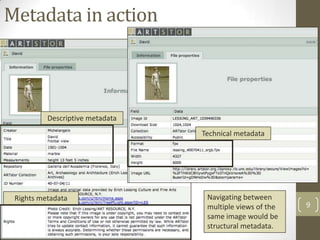
Metadata in action

Descriptive metadata
Technical metadata

Rights metadata

Navigating between
multiple views of the
same image would be
structural metadata.

9
We’ll primarily talk
about descriptive
metadata this morning

SEI 2013

The lines between these
types are rarely clear

6/19/2013

But…

10
SEI 2013

6/19/2013

And you also need to know about…

11

Chart by Elings & Waibel, “Metadata for All” <http://firstmonday.org/htbin/cgiwrap/bin/ojs/index.php/fm/article/view/1628/1543>
SEI 2013

6/19/2013

2 minutes on XML

12
General principles to apply

• Look to the community for best practices
• Know why you’re doing something a certain way
• Display, search, browse
• Current and reasonable future discovery needs
• If it’s not immediately justifiable, ask the hard questions

• Avoid the temptation to over-describe
• Document your decisions
• Consider uses of your metadata beyond your local system

SEI 2013

• Art images vs. documentary images
• Pedagogical vs. museum object management vs. archival

6/19/2013

• Tie your choice of standards to your purpose

13
Let’s look at some options.

6/19/2013
SEI 2013

So now what?

14
•
•
•
•
•
•
•

VRA Core
CDWA
CDWA Lite
LIDO
MARC
MODS
Dublin Core

• Data structure
(technical)
• MIX
• EXIF (mostly)

SEI 2013

• Data structure
(descriptive)

6/19/2013

Some metadata standards of
use to VR professionals

• Data content
• CCO
• RDA/AACR2
• DACS
15
SEI 2013

6/19/2013

CCO content standard

16
From http://cco.vrafoundation.org/
Also see CCO Ten Key Concepts
• Try to constrain the full standard for your local
implementation
• Don’t fret too much if your case isn’t covered or you find it
ambiguous

SEI 2013

• In some situations, it’s OK to pick and choose when to
apply it
• It’s just a set of rules (that humans wrote) and therefore
is wide open to interpretation

6/19/2013

Using a content standard

• Provided examples are useful, but they’re not the rules
• Alternatives to CCO
• AACR2/RDA if you want a more “bibliographic” approach
• DACS if you want a more archival approach, focusing on the
description of whole collections rather than individual items

17
• Currently hosted online by LC, maintained by an
advisory group

SEI 2013

• THIS is the metadata structure standard that you
really need to know
• Designed by visual resources specialists

6/19/2013

Visual Resources Association
Core Categories (VRA Core)

• Focus on creation, style, culture
• Best used on collections of reproductions of
works of art & architecture
18
SEI 2013

• Distinguishes between collection, work,
and image
• Provides for values for both display and
indexing
• Schemas for unrestricted and restricted
versions

6/19/2013

Important features of VRA Core

19
6/19/2013
SEI 2013

20
This record
in XML
Let’s create some VRA!

Date: Unknown but not later than
1867

SEI 2013

oil on panel
23.5 x 18.5 cm

6/19/2013

Good memories by Ange Francois,
Belgian painter (1800-1867)

Look at data values guidelines
for each element.

21
http://commons.wikimedia.org/wiki/
File:MemoriesAngeFrancois.jpeg
SEI 2013

• Strong museum, curatorial focus
• Strong on culture, physical location
• Meant to describe original works, not surrogates or
reproductions
• Best used for unique materials owned and managed by your
institution
• Base metadata format for many museum collection
management systems
• No formally specified encoding, but recommends storing data
in a relational structure
• Guidelines are nearly as prescriptive as a content standard

6/19/2013

Categories for the Description
of Works of Art (CDWA)

22
23

SEI 2013

6/19/2013
And again, in CDWA…

Date: Unknown but not later than
1867

SEI 2013

oil on panel
23.5 x 18.5 cm

6/19/2013

Good memories by Ange Francois,
Belgian painter (1800-1867)

Look at data values guidelines
for each element.

24
http://commons.wikimedia.org/wiki/
File:MemoriesAngeFrancois.jpeg
SEI 2013

• CDWA Lite = Simplified version of the full CDWA
• In XML
• For data sharing
• LIDO = Lightweight Information Describing Objects
• Expansion of CDWA Lite
• Combined with museumdat
• Also intended for use in data harvesting, between
institutions
• Intended to supersede both CDWA Lite and
museumdat

6/19/2013

CDWA Derivatives

25
SEI 2013

• Used in library catalogs
• Might use if
• You wanted discovery through the library catalog
• Your unit is an integral part of an academic library
system and does not invest in an image database for
teaching
• You can do it, but it’s not a great fit
• MARCXML sometimes used when MARC exists but an
XML form is needed
• BIBFRAME is in planning phase as successor
• I won’t suggest that we do a MARC exercise here.
(Woohoo!)

6/19/2013

MARC

26
SEI 2013

• “Bibliographic” in nature
• No natural places for some data elements crucial for
visual resources, such as cultural origin of an object
• Doesn’t make work vs. image distinction
• Might use if:
• You’re integrating your VR material material into a
wider digital library context
• You are describing documentary images rather than
art images
• You already have a system that can handle it

6/19/2013

Metadata Object Description
Schema (MODS)

27
And again, this time in MODS…

Date: Unknown but not later than
1867

SEI 2013

oil on panel
23.5 x 18.5 cm

6/19/2013

Good memories by Ange Francois,
Belgian painter (1800-1867)

Don’t worry about the “right”
data values.

28
http://commons.wikimedia.org/wiki/
File:MemoriesAngeFrancois.jpeg
SEI 2013

• An extremely basic metadata structure standard,
originally developed for documents on the web
• Intended to be core across all resource domains
• This is the format used for the OAI-PMH
metadata sharing protocol
• Rarely if ever used as a native metadata format
in the cultural heritage sector

6/19/2013

Simple Dublin Core

29
Qualified Dublin Core

• Native format in some digital library systems
• DSpace
• CONTENTdm

SEI 2013

• Additional elements
• Element qualifiers
• Syntax encoding schemes

6/19/2013

• A more robust version of simple Dublin Core

• Might use if:
• You’re integrating your VR material material into a wider digital
library context
• You are describing documentary images rather than art images
• You already have a system that can handle it

30
And now in Qualified Dublin Core…

Date: Unknown but not later than
1867

SEI 2013

oil on panel
23.5 x 18.5 cm

6/19/2013

Good memories by Ange Francois,
Belgian painter (1800-1867)

Don’t worry about the “right”
data values.

31
http://commons.wikimedia.org/wiki/
File:MemoriesAngeFrancois.jpeg
Let’s think more carefully about
what goes in those fields.

6/19/2013
SEI 2013

But this is only
the first step.

Content standards + vocabulary control
32
SEI 2013

• Also known as:
• Controlled vocabularies
• Authority control
• Use it for fields where:
• You want browseability
• Many different resources will have the same value in a
field
• One thing might be known by different names and it
would be useful to discover those things together

6/19/2013

Vocabulary control

33
6/19/2013
SEI 2013

Which fields in VRA core would
benefit from vocabulary control?

34
SEI 2013

Most have a mechanism for new terms to
be proposed

6/19/2013

Controlled vocabularies are highly
specialized – other communities may have
some that are useful for you

Let’s look at some
controlled vocabularies
useful for VR collections
35
SEI 2013

6/19/2013

Art & Architecture Thesaurus
(AAT)

36
SEI 2013

6/19/2013

Thesaurus for Geographic
Names (TGN)

37
SEI 2013

6/19/2013

Union List of Artists’ Names
(ULAN)

38
A work authority file
In a pilot phase from Getty vocabularies
Records conform to CDWA and CCO
Contributions accepted in their own XML format, CDWA Lite,
and LIDO in the future
• Records include:
•
•
•
•
•
•

Creator
Creation date
Measurements
Materials
Current location
Etc.

SEI 2013

•
•
•
•

6/19/2013

Cultural Objects Name
Authority (CONA)

39
SEI 2013

6/19/2013

Thesaurus for Graphic
Materials (TGM) I & II

40
VRA Work Title ≈ CDWA Title Text ≈ MODS <titleInfo><title>

A documented crosswalk lays the
groundwork for automatically
transforming metadata from one
structure standard into another.

SEI 2013

Surprise! You’ve done some
of this already today.

6/19/2013

Getting from one format to
another; aka, metadata mapping

41
SEI 2013

6/19/2013

Much mapping work pre-exists
for you

42

http://www.getty.edu/research/publications/electronic_publications/intrometadata/crosswalks.html
SEI 2013

• Store metadata internal to an image file or
externally?
• Store natively in XML or in a relational database or
some other way?
• How widely can/will you share your metadata?
• What will your workflow look like?

6/19/2013

There will be many
implementation issues

• Description vs. authority control
• Digitize first or describe first?
• Is there any pre-existing metadata you can reuse?

• What can you to in today’s implementation to make
migration to future systems easier?

43
SEI 2013

• All discovery and digital asset
management systems have limitations
• Be informed so you can push where
reasonable, and contribute effectively to
system selection and implementation
process
• Be careful about hacking your data to
accommodate a local system quirk

6/19/2013

Your interaction with the
system

44
* http://www.w3.org/DesignIssues/LinkedData.html

SEI 2013

• A semantic web strategy, allowing systems to interact with a
big web of shared data
• Tim Berners Lee’s Linked Data Design Principles*
• Use URIs as names for things
• Use HTTP URIs so that people can look up those names.
• When someone looks up a URI, provide useful information,
using the standards (RDF, SPARQL)
• Include links to other URIs. so that they can discover more
things.
• Getty vocabularies planned release as LOD soon
• Library school thesis by Jeff Mixter exposed VRA Core as LOD:
http://jmixter.s3-website-us-east-1.amazonaws.com/thesis/

6/19/2013

A word about Linked (Open) Data

45
SEI 2013

• There’s an active metadata community to talk
with
• Increasingly catalogers are working closely with
technical staff
• Practice, practice, practice
• The metadata landscape is rapidly changing; get
involved!
• I’d be happy to talk further: jennriley@unc.edu

6/19/2013

What’s next?

46
This work by Jenn Riley is licensed under a Creative Commons Attribution-NonCommercialShareAlike 3.0 Unported License.

Metadata Overview

  • 1.
    SEI 2013 • Downloadthese copies: • http://bit.ly/12ca24p (Worksheet) • http://bit.ly/14LJ6nW (Reference) 6/19/2013 If you don’t have the handouts… 1
  • 2.
    Metadata Overview Jenn Riley Head,Carolina Digital Library and Archives The University of North Carolina at Chapel Hill
  • 3.
    SEI 2013 6/19/2013 How inthe world am I supposed to deal with this?!? 3
  • 4.
    6/19/2013 SEI 2013 Don’t panic.You can make good decisions with the right information. We’ll begin with some theory, and then move on to practice. 4
  • 5.
    SEI 2013 • “Dataabout data” • “Structured information about an information resource of any media type or format.” (Caplan) • “Structured information that describes, explains, locates, or otherwise makes it easier to retrieve, use, or manage an information resource.” (NISO) • “Metadata is constructed, constructive, and actionable.” (Coyle) • “Data which removes from a user (human or machine) the need to have full advance knowledge of the existence or characteristics of things of potential interest in the environment.” (Dempsey) • “An item of metadata is a relationship that someone claims to exist between two entities.” (<indecs>) • … 6/19/2013 Many definitions of metadata 5
  • 6.
    SEI 2013 • Characteristics •Structure • Control • Origin • Machine-generated • Human-generated • Increasingly conceived as a relationship • Don’t get stuck on the difference between data, metadata, and meta-metadata 6/19/2013 Refining a definition 6
  • 7.
    Slide labels Online catalogs Findingaids R e g i V R d Inventories a t a b a s SEI 2013 Catalog cards 6/19/2013 Some uses of metadata in cultural heritage institutions 7
  • 8.
    Some types ofmetadata Type Use Technical metadata Interoperability/exchange Digital object management Preservation Preservation metadata Interoperability/exchange Preservation Rights metadata Interoperability/exchange Digital object management Structural metadata Navigation 6/19/2013 Searching Browsing Display Interoperability/exchange SEI 2013 Descriptive metadata 8
  • 9.
    SEI 2013 6/19/2013 Metadata inaction Descriptive metadata Technical metadata Rights metadata Navigating between multiple views of the same image would be structural metadata. 9
  • 10.
    We’ll primarily talk aboutdescriptive metadata this morning SEI 2013 The lines between these types are rarely clear 6/19/2013 But… 10
  • 11.
    SEI 2013 6/19/2013 And youalso need to know about… 11 Chart by Elings & Waibel, “Metadata for All” <http://firstmonday.org/htbin/cgiwrap/bin/ojs/index.php/fm/article/view/1628/1543>
  • 12.
  • 13.
    General principles toapply • Look to the community for best practices • Know why you’re doing something a certain way • Display, search, browse • Current and reasonable future discovery needs • If it’s not immediately justifiable, ask the hard questions • Avoid the temptation to over-describe • Document your decisions • Consider uses of your metadata beyond your local system SEI 2013 • Art images vs. documentary images • Pedagogical vs. museum object management vs. archival 6/19/2013 • Tie your choice of standards to your purpose 13
  • 14.
    Let’s look atsome options. 6/19/2013 SEI 2013 So now what? 14
  • 15.
    • • • • • • • VRA Core CDWA CDWA Lite LIDO MARC MODS DublinCore • Data structure (technical) • MIX • EXIF (mostly) SEI 2013 • Data structure (descriptive) 6/19/2013 Some metadata standards of use to VR professionals • Data content • CCO • RDA/AACR2 • DACS 15
  • 16.
    SEI 2013 6/19/2013 CCO contentstandard 16 From http://cco.vrafoundation.org/ Also see CCO Ten Key Concepts
  • 17.
    • Try toconstrain the full standard for your local implementation • Don’t fret too much if your case isn’t covered or you find it ambiguous SEI 2013 • In some situations, it’s OK to pick and choose when to apply it • It’s just a set of rules (that humans wrote) and therefore is wide open to interpretation 6/19/2013 Using a content standard • Provided examples are useful, but they’re not the rules • Alternatives to CCO • AACR2/RDA if you want a more “bibliographic” approach • DACS if you want a more archival approach, focusing on the description of whole collections rather than individual items 17
  • 18.
    • Currently hostedonline by LC, maintained by an advisory group SEI 2013 • THIS is the metadata structure standard that you really need to know • Designed by visual resources specialists 6/19/2013 Visual Resources Association Core Categories (VRA Core) • Focus on creation, style, culture • Best used on collections of reproductions of works of art & architecture 18
  • 19.
    SEI 2013 • Distinguishesbetween collection, work, and image • Provides for values for both display and indexing • Schemas for unrestricted and restricted versions 6/19/2013 Important features of VRA Core 19
  • 20.
  • 21.
    Let’s create someVRA! Date: Unknown but not later than 1867 SEI 2013 oil on panel 23.5 x 18.5 cm 6/19/2013 Good memories by Ange Francois, Belgian painter (1800-1867) Look at data values guidelines for each element. 21 http://commons.wikimedia.org/wiki/ File:MemoriesAngeFrancois.jpeg
  • 22.
    SEI 2013 • Strongmuseum, curatorial focus • Strong on culture, physical location • Meant to describe original works, not surrogates or reproductions • Best used for unique materials owned and managed by your institution • Base metadata format for many museum collection management systems • No formally specified encoding, but recommends storing data in a relational structure • Guidelines are nearly as prescriptive as a content standard 6/19/2013 Categories for the Description of Works of Art (CDWA) 22
  • 23.
  • 24.
    And again, inCDWA… Date: Unknown but not later than 1867 SEI 2013 oil on panel 23.5 x 18.5 cm 6/19/2013 Good memories by Ange Francois, Belgian painter (1800-1867) Look at data values guidelines for each element. 24 http://commons.wikimedia.org/wiki/ File:MemoriesAngeFrancois.jpeg
  • 25.
    SEI 2013 • CDWALite = Simplified version of the full CDWA • In XML • For data sharing • LIDO = Lightweight Information Describing Objects • Expansion of CDWA Lite • Combined with museumdat • Also intended for use in data harvesting, between institutions • Intended to supersede both CDWA Lite and museumdat 6/19/2013 CDWA Derivatives 25
  • 26.
    SEI 2013 • Usedin library catalogs • Might use if • You wanted discovery through the library catalog • Your unit is an integral part of an academic library system and does not invest in an image database for teaching • You can do it, but it’s not a great fit • MARCXML sometimes used when MARC exists but an XML form is needed • BIBFRAME is in planning phase as successor • I won’t suggest that we do a MARC exercise here. (Woohoo!) 6/19/2013 MARC 26
  • 27.
    SEI 2013 • “Bibliographic”in nature • No natural places for some data elements crucial for visual resources, such as cultural origin of an object • Doesn’t make work vs. image distinction • Might use if: • You’re integrating your VR material material into a wider digital library context • You are describing documentary images rather than art images • You already have a system that can handle it 6/19/2013 Metadata Object Description Schema (MODS) 27
  • 28.
    And again, thistime in MODS… Date: Unknown but not later than 1867 SEI 2013 oil on panel 23.5 x 18.5 cm 6/19/2013 Good memories by Ange Francois, Belgian painter (1800-1867) Don’t worry about the “right” data values. 28 http://commons.wikimedia.org/wiki/ File:MemoriesAngeFrancois.jpeg
  • 29.
    SEI 2013 • Anextremely basic metadata structure standard, originally developed for documents on the web • Intended to be core across all resource domains • This is the format used for the OAI-PMH metadata sharing protocol • Rarely if ever used as a native metadata format in the cultural heritage sector 6/19/2013 Simple Dublin Core 29
  • 30.
    Qualified Dublin Core •Native format in some digital library systems • DSpace • CONTENTdm SEI 2013 • Additional elements • Element qualifiers • Syntax encoding schemes 6/19/2013 • A more robust version of simple Dublin Core • Might use if: • You’re integrating your VR material material into a wider digital library context • You are describing documentary images rather than art images • You already have a system that can handle it 30
  • 31.
    And now inQualified Dublin Core… Date: Unknown but not later than 1867 SEI 2013 oil on panel 23.5 x 18.5 cm 6/19/2013 Good memories by Ange Francois, Belgian painter (1800-1867) Don’t worry about the “right” data values. 31 http://commons.wikimedia.org/wiki/ File:MemoriesAngeFrancois.jpeg
  • 32.
    Let’s think morecarefully about what goes in those fields. 6/19/2013 SEI 2013 But this is only the first step. Content standards + vocabulary control 32
  • 33.
    SEI 2013 • Alsoknown as: • Controlled vocabularies • Authority control • Use it for fields where: • You want browseability • Many different resources will have the same value in a field • One thing might be known by different names and it would be useful to discover those things together 6/19/2013 Vocabulary control 33
  • 34.
    6/19/2013 SEI 2013 Which fieldsin VRA core would benefit from vocabulary control? 34
  • 35.
    SEI 2013 Most havea mechanism for new terms to be proposed 6/19/2013 Controlled vocabularies are highly specialized – other communities may have some that are useful for you Let’s look at some controlled vocabularies useful for VR collections 35
  • 36.
    SEI 2013 6/19/2013 Art &Architecture Thesaurus (AAT) 36
  • 37.
    SEI 2013 6/19/2013 Thesaurus forGeographic Names (TGN) 37
  • 38.
    SEI 2013 6/19/2013 Union Listof Artists’ Names (ULAN) 38
  • 39.
    A work authorityfile In a pilot phase from Getty vocabularies Records conform to CDWA and CCO Contributions accepted in their own XML format, CDWA Lite, and LIDO in the future • Records include: • • • • • • Creator Creation date Measurements Materials Current location Etc. SEI 2013 • • • • 6/19/2013 Cultural Objects Name Authority (CONA) 39
  • 40.
    SEI 2013 6/19/2013 Thesaurus forGraphic Materials (TGM) I & II 40
  • 41.
    VRA Work Title≈ CDWA Title Text ≈ MODS <titleInfo><title> A documented crosswalk lays the groundwork for automatically transforming metadata from one structure standard into another. SEI 2013 Surprise! You’ve done some of this already today. 6/19/2013 Getting from one format to another; aka, metadata mapping 41
  • 42.
    SEI 2013 6/19/2013 Much mappingwork pre-exists for you 42 http://www.getty.edu/research/publications/electronic_publications/intrometadata/crosswalks.html
  • 43.
    SEI 2013 • Storemetadata internal to an image file or externally? • Store natively in XML or in a relational database or some other way? • How widely can/will you share your metadata? • What will your workflow look like? 6/19/2013 There will be many implementation issues • Description vs. authority control • Digitize first or describe first? • Is there any pre-existing metadata you can reuse? • What can you to in today’s implementation to make migration to future systems easier? 43
  • 44.
    SEI 2013 • Alldiscovery and digital asset management systems have limitations • Be informed so you can push where reasonable, and contribute effectively to system selection and implementation process • Be careful about hacking your data to accommodate a local system quirk 6/19/2013 Your interaction with the system 44
  • 45.
    * http://www.w3.org/DesignIssues/LinkedData.html SEI 2013 •A semantic web strategy, allowing systems to interact with a big web of shared data • Tim Berners Lee’s Linked Data Design Principles* • Use URIs as names for things • Use HTTP URIs so that people can look up those names. • When someone looks up a URI, provide useful information, using the standards (RDF, SPARQL) • Include links to other URIs. so that they can discover more things. • Getty vocabularies planned release as LOD soon • Library school thesis by Jeff Mixter exposed VRA Core as LOD: http://jmixter.s3-website-us-east-1.amazonaws.com/thesis/ 6/19/2013 A word about Linked (Open) Data 45
  • 46.
    SEI 2013 • There’san active metadata community to talk with • Increasingly catalogers are working closely with technical staff • Practice, practice, practice • The metadata landscape is rapidly changing; get involved! • I’d be happy to talk further: jennriley@unc.edu 6/19/2013 What’s next? 46 This work by Jenn Riley is licensed under a Creative Commons Attribution-NonCommercialShareAlike 3.0 Unported License.

Editor's Notes

  • #21 Things to point out:* Work and image in separate records*Separate elements for display and indexing values*Use of controlled vocabularies*Connections to research relevant to the work
  • #37 Facets:Associated conceptsPhysical attributesStyles and periodsAgentsActivitiesMaterialsObjectsBrand names
  • #42 Mappings performed via XSLT, or a full programming language.
  • #44 Have a group discussion about these issues.