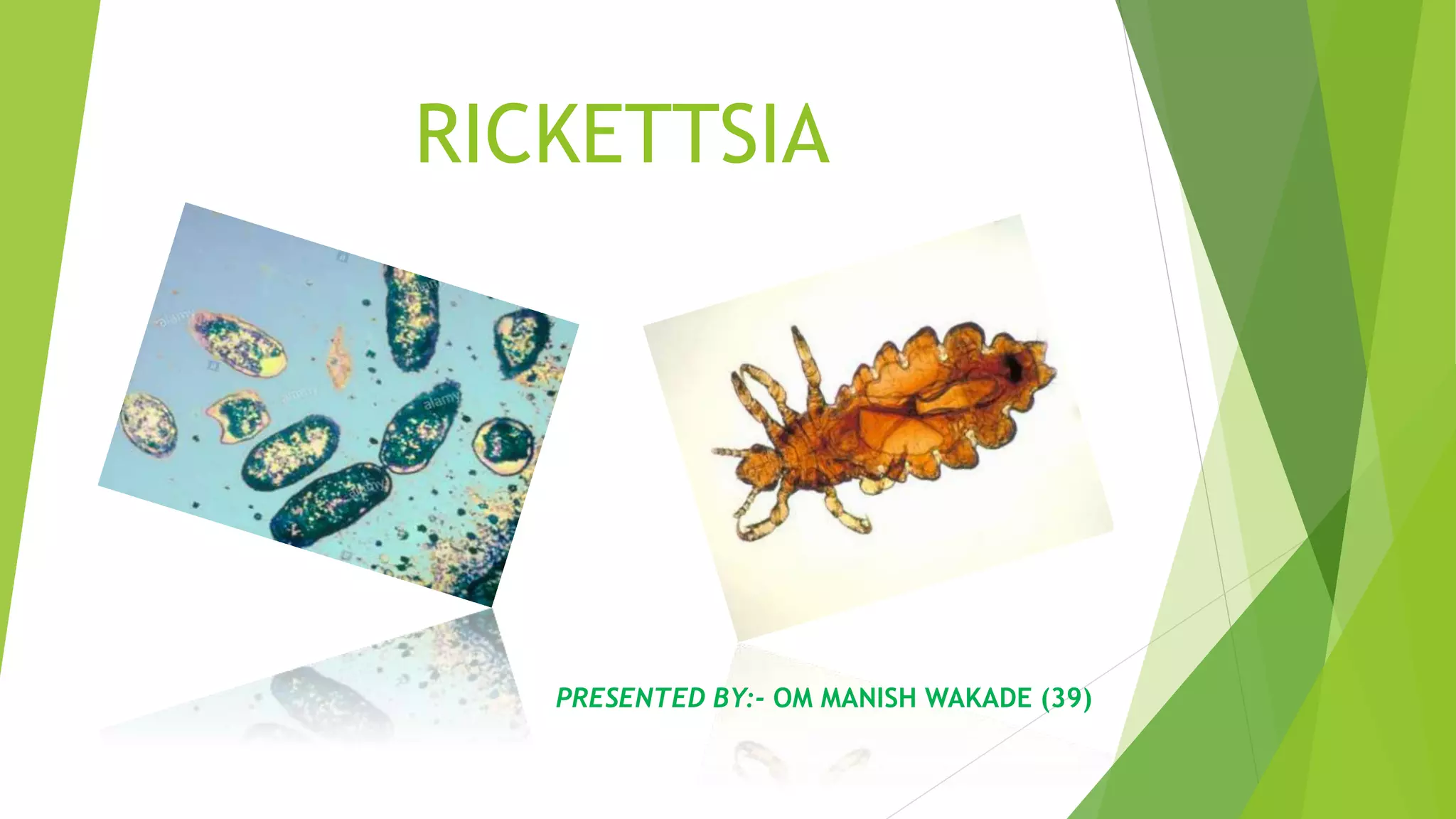
RICKETTSIA
PRESENTED BY:- OM MANISH WAKADE (39)
/rɪˈkɛtsɪə/
PRESENTED BY:- OM MANISH WAKADE (39)
Ruh. Ket. See. Uh
PRESENTED BY:- OM MANISH WAKADE (39)
CONTENT
 Introduction
 History
 Life Cycle
 Classification
 Structure & Antigenic Type
 Pathogenesis
 Infection
 Disease Cause By Rickettsia
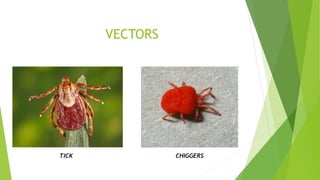
 Vectors
 Diagnosis
 Control
 Cultivation
 Recent research
INTRODUCTION
 Domain: Bacteria
 Phylum: Proteobacteria
 Class: Alphaproteobacteria
 Order: Rickettsiales
 Family: Rickettsiaceae
 Genus: Scientific
name: Rickettsia
 Rickettsia is a genus of non motile,
Gram Negative, non spore forming
bacteria that may occur in the form
of Cocci (0.1um diameter), Bacilli
(1-4 um long) or Threads( about 10
um long).
 The term RICKETTSIA is not related
to rickets ( which is deficiency
disease resulting from lack of
vitamin D).
Bacteria
belongs to
which kingdom?
CHEMO-ORGANOTROPIC HETEROTROPS
HISTORY
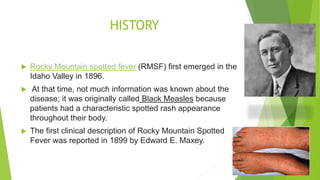
 Rocky Mountain spotted fever (RMSF) first emerged in the
Idaho Valley in 1896.
 At that time, not much information was known about the
disease; it was originally called Black Measles because
patients had a characteristic spotted rash appearance
throughout their body.
 The first clinical description of Rocky Mountain Spotted
Fever was reported in 1899 by Edward E. Maxey.
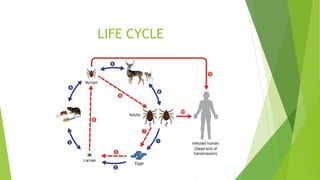
LIFE CYCLE
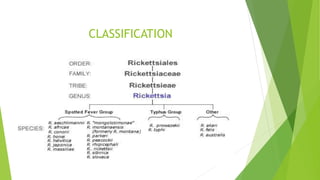
CLASSIFICATION
STRUCTURE & ANTIGENIC TYPE
 Rickettsia species are small, Gram-negative bacilli that are
obligate intracellular parasites of eukaryotic cells.
 This genus consists of two antigenically defined groups:
1. Spotted fever group; &
2. Typhus group,
 Which are related; scrub typhus rickettsiae differ in lacking
lipopolysaccharide, peptidoglycan, and a slime layer, and belong
in the separate, although related, genus Orientia.
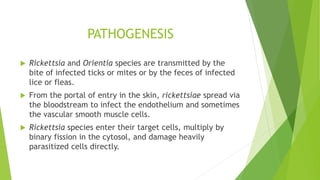
What is
obligate
intracellular
parasites?
PATHOGENESIS
 Rickettsia and Orientia species are transmitted by the
bite of infected ticks or mites or by the feces of infected
lice or fleas.
 From the portal of entry in the skin, rickettsiae spread via
the bloodstream to infect the endothelium and sometimes
the vascular smooth muscle cells.
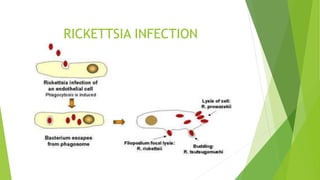
 Rickettsia species enter their target cells, multiply by
binary fission in the cytosol, and damage heavily
parasitized cells directly.
RICKETTSIA INFECTION
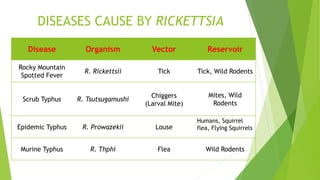
DISEASES CAUSE BY RICKETTSIA
Disease Organism Vector Reservoir
Rocky Mountain
Spotted Fever
R. Rickettsii Tick Tick, Wild Rodents
Scrub Typhus R. Tsutsugamushi
Chiggers
(Larval Mite)
Mites, Wild
Rodents
Epidemic Typhus R. Prowazekii Louse
Humans, Squirrel
flea, Flying Squirrels
Murine Typhus R. Thphi Flea Wild Rodents
VECTORS
TICK CHIGGERS
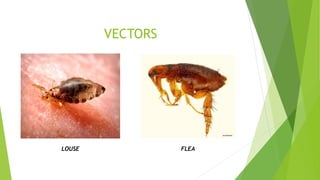
VECTORS
LOUSE FLEA
DIAGNOSIS
 Rickettsia are difficult to diagnose both clinically and in the
laboratory.
Steps for diagnosis :-
 recognize common epidemiologic situations and clinical
manifestations of TBRD;
 obtain appropriate history and diagnostic tests for TBRD;
 develop a differential diagnosis that includes and ranks TBRD;
 make treatment decisions based on epidemiologic and clinical evidence;
 recognize that doxycycline is the treatment of choice for both adults
and children;
DIAGNOSIS
 recognize that early and empiric antibiotic therapy can prevent
severe morbidity or death;
 identify the availability, limitations, and utility of
confirmatory laboratory assays;
 recognize potential severe manifestations of TBRD; and
 report suspected and confirmed cases to appropriate public
health authorities to assist with control measures and public
health education efforts.
CONTROL
 Rickettsia species are susceptible to the broad-spectrum
antibiotics, doxycycline, tetracycline,and
chloramphenicol.
 Prevention of exposure to infected arthropods offers
some protection.
 A vaccine exists for epidemic typhus but is not readily
available.
CULTIVATION
 Initially the culture is obtain from the vector and is
develop in special medium i.e. Leptospira medium.
 After a minute yellowish gray, semitransparent, shining,
oval or round like appearance will obtain.
 Then slightly raised the colonies near the condensation
water.
 After several days the colonies shows a tendency to
coalesce.
CULTIVATION
 As the condensation water is slightly turbid and contains a
grayish deposit, rather then sticky sediment.
 The old strains grow well on broth which shows slight
milky appearance.
Tip:- No growth is obtained under anaerobic conditions.
RECENT RESEARCH
 How environmental factors affects pathogenic bacteria
spread by ticks.
 Findings new way to identify non-antibiotic drugs.
 Antioxidants may protect against Rocky Mountain spotted
fever and other tick borne illness.
https://www.ncbi.nlm.nih.gov/books/NBK7624/
Rickettsia
Rickettsia

Rickettsia

  • 1.
    RICKETTSIA PRESENTED BY:- OMMANISH WAKADE (39)
  • 2.
  • 3.
    Ruh. Ket. See.Uh PRESENTED BY:- OM MANISH WAKADE (39)
  • 4.
    CONTENT  Introduction  History Life Cycle  Classification  Structure & Antigenic Type  Pathogenesis  Infection  Disease Cause By Rickettsia  Vectors  Diagnosis  Control  Cultivation  Recent research
  • 5.
    INTRODUCTION  Domain: Bacteria Phylum: Proteobacteria  Class: Alphaproteobacteria  Order: Rickettsiales  Family: Rickettsiaceae  Genus: Scientific name: Rickettsia  Rickettsia is a genus of non motile, Gram Negative, non spore forming bacteria that may occur in the form of Cocci (0.1um diameter), Bacilli (1-4 um long) or Threads( about 10 um long).  The term RICKETTSIA is not related to rickets ( which is deficiency disease resulting from lack of vitamin D). Bacteria belongs to which kingdom? CHEMO-ORGANOTROPIC HETEROTROPS
  • 6.
    HISTORY  Rocky Mountainspotted fever (RMSF) first emerged in the Idaho Valley in 1896.  At that time, not much information was known about the disease; it was originally called Black Measles because patients had a characteristic spotted rash appearance throughout their body.  The first clinical description of Rocky Mountain Spotted Fever was reported in 1899 by Edward E. Maxey.
  • 7.
  • 8.
  • 9.
    STRUCTURE & ANTIGENICTYPE  Rickettsia species are small, Gram-negative bacilli that are obligate intracellular parasites of eukaryotic cells.  This genus consists of two antigenically defined groups: 1. Spotted fever group; & 2. Typhus group,  Which are related; scrub typhus rickettsiae differ in lacking lipopolysaccharide, peptidoglycan, and a slime layer, and belong in the separate, although related, genus Orientia. What is obligate intracellular parasites?
  • 10.
    PATHOGENESIS  Rickettsia andOrientia species are transmitted by the bite of infected ticks or mites or by the feces of infected lice or fleas.  From the portal of entry in the skin, rickettsiae spread via the bloodstream to infect the endothelium and sometimes the vascular smooth muscle cells.  Rickettsia species enter their target cells, multiply by binary fission in the cytosol, and damage heavily parasitized cells directly.
  • 11.
  • 12.
    DISEASES CAUSE BYRICKETTSIA Disease Organism Vector Reservoir Rocky Mountain Spotted Fever R. Rickettsii Tick Tick, Wild Rodents Scrub Typhus R. Tsutsugamushi Chiggers (Larval Mite) Mites, Wild Rodents Epidemic Typhus R. Prowazekii Louse Humans, Squirrel flea, Flying Squirrels Murine Typhus R. Thphi Flea Wild Rodents
  • 13.
  • 14.
  • 15.
    DIAGNOSIS  Rickettsia aredifficult to diagnose both clinically and in the laboratory. Steps for diagnosis :-  recognize common epidemiologic situations and clinical manifestations of TBRD;  obtain appropriate history and diagnostic tests for TBRD;  develop a differential diagnosis that includes and ranks TBRD;  make treatment decisions based on epidemiologic and clinical evidence;  recognize that doxycycline is the treatment of choice for both adults and children;
  • 16.
    DIAGNOSIS  recognize thatearly and empiric antibiotic therapy can prevent severe morbidity or death;  identify the availability, limitations, and utility of confirmatory laboratory assays;  recognize potential severe manifestations of TBRD; and  report suspected and confirmed cases to appropriate public health authorities to assist with control measures and public health education efforts.
  • 17.
    CONTROL  Rickettsia speciesare susceptible to the broad-spectrum antibiotics, doxycycline, tetracycline,and chloramphenicol.  Prevention of exposure to infected arthropods offers some protection.  A vaccine exists for epidemic typhus but is not readily available.
  • 18.
    CULTIVATION  Initially theculture is obtain from the vector and is develop in special medium i.e. Leptospira medium.  After a minute yellowish gray, semitransparent, shining, oval or round like appearance will obtain.  Then slightly raised the colonies near the condensation water.  After several days the colonies shows a tendency to coalesce.
  • 19.
    CULTIVATION  As thecondensation water is slightly turbid and contains a grayish deposit, rather then sticky sediment.  The old strains grow well on broth which shows slight milky appearance. Tip:- No growth is obtained under anaerobic conditions.
  • 20.
    RECENT RESEARCH  Howenvironmental factors affects pathogenic bacteria spread by ticks.  Findings new way to identify non-antibiotic drugs.  Antioxidants may protect against Rocky Mountain spotted fever and other tick borne illness.
  • 21.