Home
Developers References Summary
1: Introduction
2: Definition
3: Types of Fluids
Rheology
4: Rheological
Flow Models
5: Measurements
6: Instruments
Topic overview
Rheological
Flow Models
Types of
Fluids
Measurement
s
Definition
IntroductionIntroduction
to Rheologyto Rheology
Instruments
From www.iopro.auc.dk
Home
Developers References Summary
1: Introduction
2: Definition
3: Types of Fluids
Rheology
4: Rheological
Flow Models
5: Measurements
6: Instruments
The term ”Rheology” was invented by Professor Bingham of
Lafayette College, Easton, PA, on the advice of a colleague, the
Professor of Classics. The definition of rheology (see section 2) was
accepted when the American Society of Rheology was founded in
1929.
Robert Hooke (1635-1703):
 in 1678 he developed his ”True Theory of Elasticy”:
”the power of any spring is the same proportion with the tension thereof”.
Isaac Newton (1643-1727):
 in 1687 he published the scientific book ”Principia”:
”the resistance which arises from the lack of slipperiness is proportional to the
velocity with which the parts of the liquid are separated from one another”.
In the 19th
century scientists discovered solids with liquid-like
responses and liquids with solid-like responses.
Today, rheology is an integral part of industry. It is used by scientists
working with plastics, paint, inks, detergent, oils, drilling fluids, and in
quality and process control.
1: Introduction
Home
Developers References Summary
1: Introduction
2: Definition
3: Types of Fluids
Rheology
4: Rheological
Flow Models
5: Measurements
6: Instruments
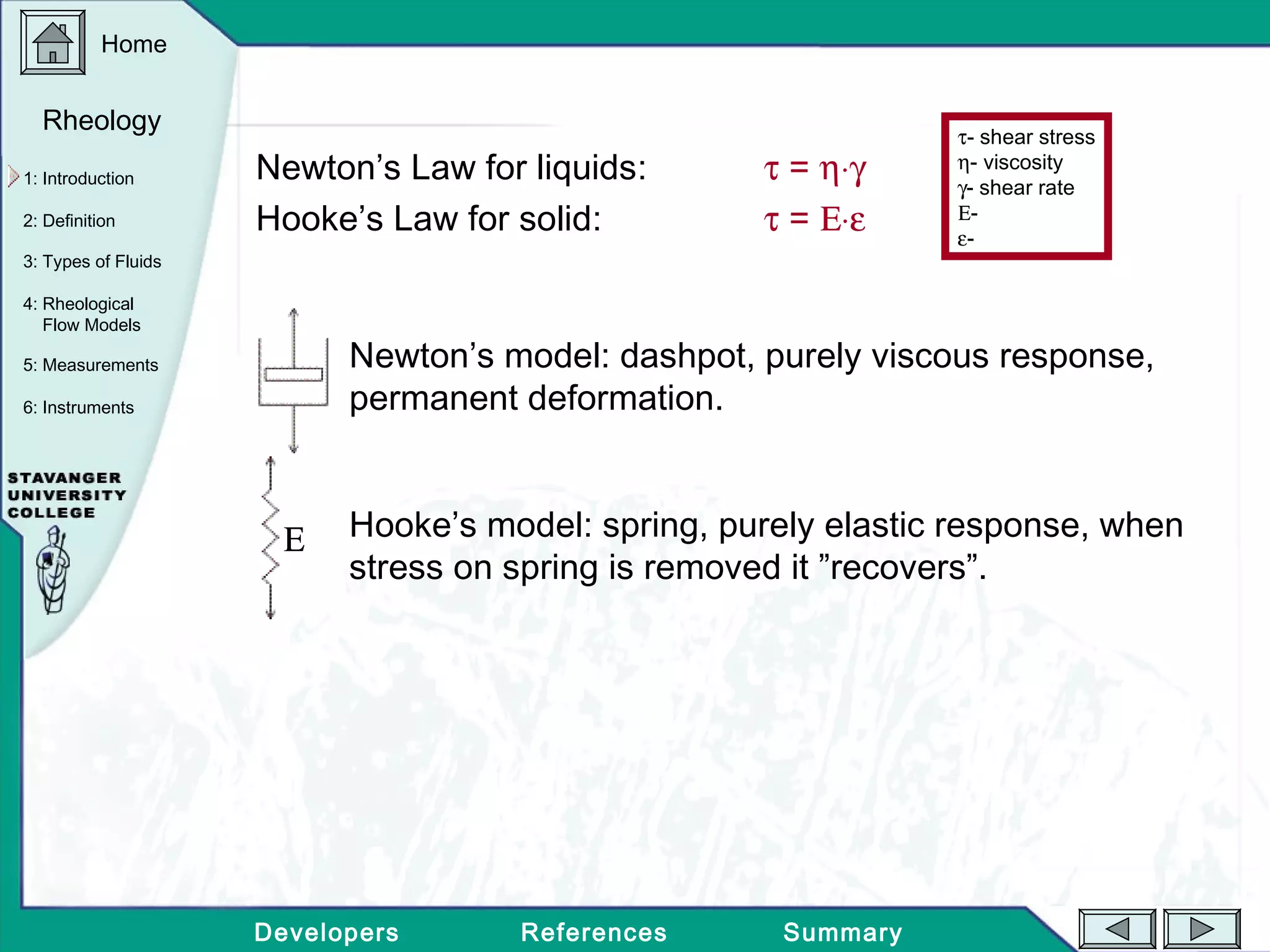
Newton’s Law for liquids: τ = η⋅γ
Hooke’s Law for solid: τ = Ε⋅ε
τ- shear stress
η- viscosity
γ- shear rate
Ε-
ε-
Ε
Newton’s model: dashpot, purely viscous response,
permanent deformation.
Hooke’s model: spring, purely elastic response, when
stress on spring is removed it ”recovers”.
Home
Developers References Summary
1: Introduction
2: Definition
3: Types of Fluids
Rheology
4: Rheological
Flow Models
5: Measurements
6: Instruments
Difficult Subject
Rheology is a difficult subject.
For example, rheology is interdisciplinary and most scientists
and engineers have to move from a possibly restricted
expertise and develop a broader scientific approach.
A cursory glance at most text books on rheology would soon
convince the non-mathematicians of the need to come to
terms with at least some aspects of non-trivial mathematics.
In this module we will give you an introduction to rheology
and explain mathematical complication to the nonspecialist.
Home
Developers References Summary
1: Introduction
2: Definition
3: Types of Fluids
Rheology
4: Rheological
Flow Models
5: Measurements
6: Instruments
2: Definition
Rheology is the science of flow and deformation of matter.
The relationship between pressure
and velocity on the flow regime.
From IDF 1982
The increase in force compared to
fluid velocity.
From IDF 1982
The telescoping concentric
cylinder of a fluid in laminar flow.
From IDF 1982
A given material can behave like a solid or a liquid
depending on the time scale of the deformation process.
Home
Developers References Summary
1: Introduction
2: Definition
3: Types of Fluids
Rheology
4: Rheological
Flow Models
5: Measurements
6: Instruments
3: Types of Fluids
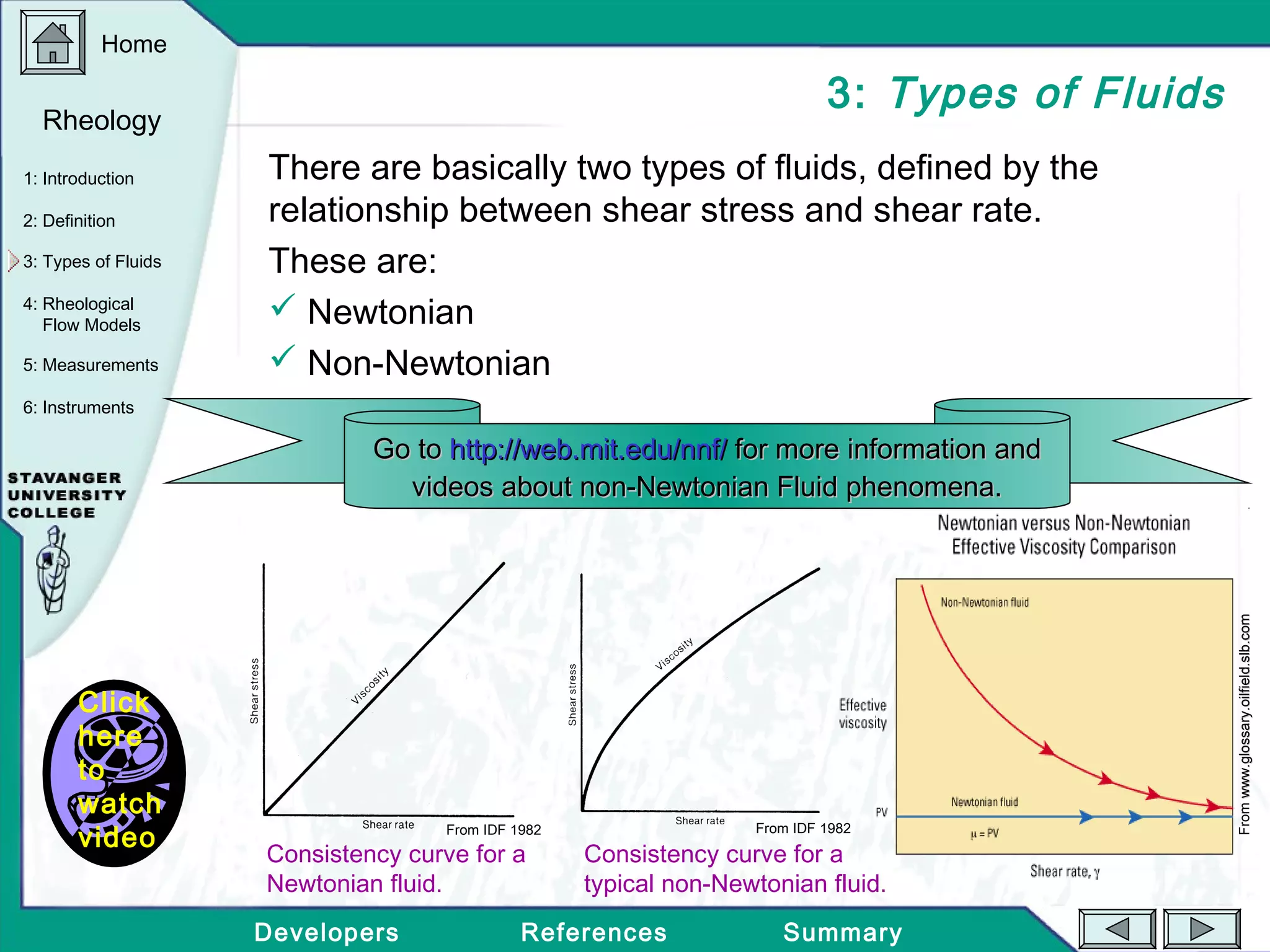
There are basically two types of fluids, defined by the
relationship between shear stress and shear rate.
These are:
 Newtonian
 Non-Newtonian
Click
here
to
watch
video
Go toGo to http://web.http://web.mitmit..eduedu//nnfnnf// for more information andfor more information and
videos about non-Newtonian Fluid phenomena.videos about non-Newtonian Fluid phenomena.
Fromwww.glossary.oilfield.slb.comwww.glossary.oilfield.slb.com
Consistency curve for a
typical non-Newtonian fluid.
From IDF 1982
Consistency curve for a
Newtonian fluid.
From IDF 1982
Home
Developers References Summary
1: Introduction
2: Definition
3: Types of Fluids
Rheology
4: Rheological
Flow Models
5: Measurements
6: Instruments
A Newtonian fluid is a fluid or dispersion whose rheological
behaviour is described by Newton’s law of viscosity.
There are different types of non-Newtonian fluids:
 Pseudoplastic, a shear-tinning fluid.
 Dilatant, a shear-thickening fluid.
 Thixotropic: pseudoplastic flow that is time-dependent. At
constant applied shear rate, viscosity gradually decreases.
 Viscoelastic, a liquid (or solid) with both viscous and elastic
properties.
Home
Developers References Summary
1: Introduction
2: Definition
3: Types of Fluids
Rheology
4: Rheological
Flow Models
5: Measurements
6: Instruments
Video
Sett inn tekst
Home
Developers References Summary
1: Introduction
2: Definition
3: Types of Fluids
Rheology
4: Rheological
Flow Models
5: Measurements
6: Instruments
Newtonian Fluid
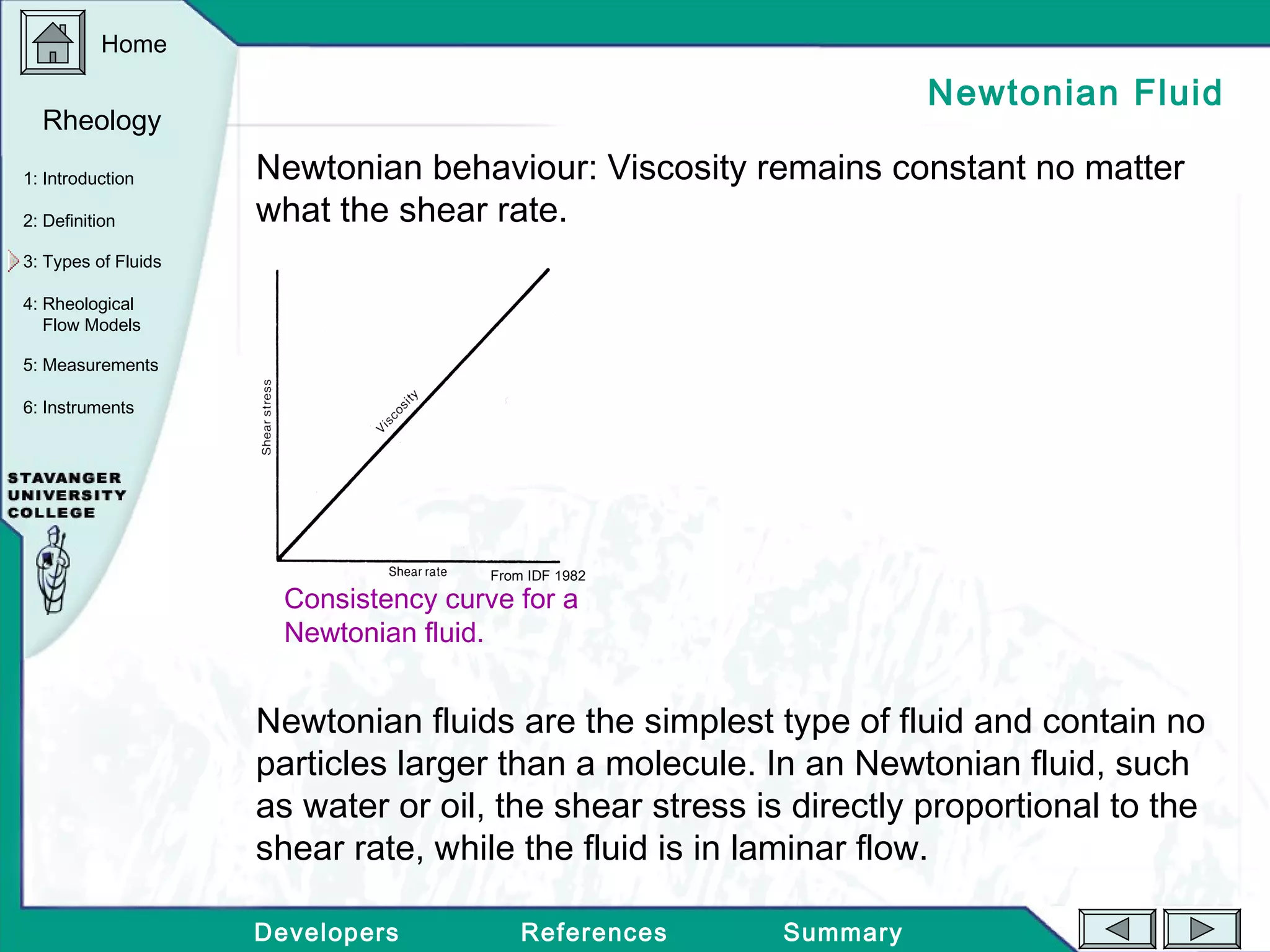
Newtonian behaviour: Viscosity remains constant no matter
what the shear rate.
Newtonian fluids are the simplest type of fluid and contain no
particles larger than a molecule. In an Newtonian fluid, such
as water or oil, the shear stress is directly proportional to the
shear rate, while the fluid is in laminar flow.
Consistency curve for a
Newtonian fluid.
From IDF 1982
Home
Developers References Summary
1: Introduction
2: Definition
3: Types of Fluids
Rheology
4: Rheological
Flow Models
5: Measurements
6: Instruments
Shear-thinning non-Newtonian Liquid
Shear-thinning: The reduction of viscosity with increasing
rate of shear in a steady shear flow.
Paint and toothpaste is shear-thinning fluids.
The consistency curve for a
Bingham Plastic fluid and the
apparent viscosity.
From IDF 1982
Home
Developers References Summary
1: Introduction
2: Definition
3: Types of Fluids
Rheology
4: Rheological
Flow Models
5: Measurements
6: Instruments
Shear-thickening non-Newtonian Liquid
Shear-thickening: The increase of viscosity with increasing
rate of shear in a steady shear flow.
Cream is a shear-thickening fluid.
The consistency curve for a
Pseudoplastic fluid.
From IDF 1982
Home
Developers References Summary
1: Introduction
2: Definition
3: Types of Fluids
Rheology
4: Rheological
Flow Models
5: Measurements
6: Instruments
Viscoelastic Fluid
Descriptive term for a liquid having both viscous and elastic
properties.
A viscoelastic liquid will deform and flow under the influence
of an applied shear stress, but when the stress is removed
the liquid will slowly recover from some of the deformation.
Viscoelastic fluids have molecules in which the load-
deformation relationship is time dependant.
From www.iopro.auc.dkFrom www.iopro.auc.dk
Home
Developers References Summary
1: Introduction
2: Definition
3: Types of Fluids
Rheology
4: Rheological
Flow Models
5: Measurements
6: Instruments
Viscoelastic Fluid
Viscoelasticity: everything flows, you just have to wait long
enough (think of the earth’s crust or glass).
Home
Developers References Summary
1: Introduction
2: Definition
3: Types of Fluids
Rheology
4: Rheological
Flow Models
5: Measurements
6: Instruments
4: Rheological Flow Models
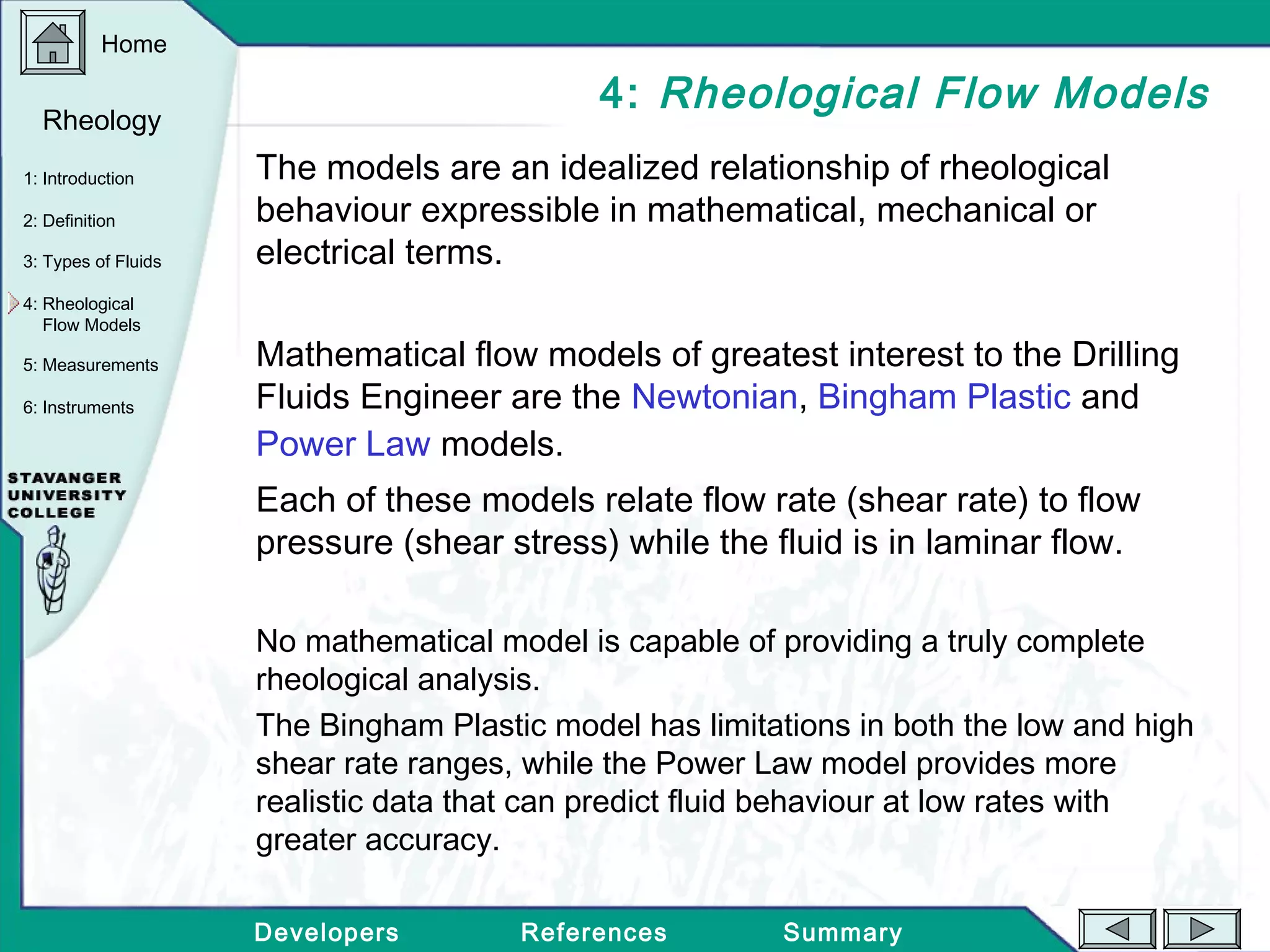
The models are an idealized relationship of rheological
behaviour expressible in mathematical, mechanical or
electrical terms.
Mathematical flow models of greatest interest to the Drilling
Fluids Engineer are the Newtonian, Bingham Plastic and
Power Law models.
Each of these models relate flow rate (shear rate) to flow
pressure (shear stress) while the fluid is in laminar flow.
No mathematical model is capable of providing a truly complete
rheological analysis.
The Bingham Plastic model has limitations in both the low and high
shear rate ranges, while the Power Law model provides more
realistic data that can predict fluid behaviour at low rates with
greater accuracy.
Home
Developers References Summary
1: Introduction
2: Definition
3: Types of Fluids
Rheology
4: Rheological
Flow Models
5: Measurements
6: Instruments
The Newtonian Model
The Newtonian model has no value in predicting the
behaviour of a drilling fluid, as the majority of drilling fluids do
not conform to the govering Newtonian fluids.
γητ ⋅=
Consistency curve for a
Newtonian fluid.
From IDF 1982
η – viscosity, Pas
τ – shear stress, Pa
γ – shear rate, sec-1
Home
Developers References Summary
1: Introduction
2: Definition
3: Types of Fluids
Rheology
4: Rheological
Flow Models
5: Measurements
6: Instruments
The Bingham Plastic Model
The Bingham Plastic model establishes a distinct relationship
between shear stress, yield point, plastic viscosity and shear
rate.
RPM
rpmθ⋅
=
300
ViscosityApparant
300600ViscosityPlastic θθ −=
θ - dial reading
rpm – rotation per minute
600300300 2ViscosityPlasticPointYield θθθ −⋅=−=
PV: the portion of the resistance to flow (viscosity) that
is caused by interparticle friction (relates to solids
concentration, size and shape of the solids, viscosity of
the liquid phase).
YP: the portion of viscosity that is related to the
interparticle attractive force.
From IDF 1982
Home
Developers References Summary
1: Introduction
2: Definition
3: Types of Fluids
Rheology
4: Rheological
Flow Models
5: Measurements
6: Instruments
The Power Law Model
The Power Law model is considerably more complex than
the Bingham Plastic model, but it provides for far greater
accuracy in the determination of shear stress at low shear
rates.
n
K γτ ⋅=
τ – shear stress, N/m2
= Pa = 10 dynes/cm2
γ – shear rate, sec-1
K – consistency index (constant)
n – Power Law index
The Power Law model actually describes
three types of fluids, based on the n value:
n=1: The fluid is Newtonian
n<1: The fluid is non-Newtonian
n>1: The fluid is Dilatent
Home
Developers References Summary
1: Introduction
2: Definition
3: Types of Fluids
Rheology
4: Rheological
Flow Models
5: Measurements
6: Instruments
5: Measurements
Rheology: Flow property measurements.
All fluids exhibit a certain resistance to flow, which is loosely
termed viscosity. Viscosity is defined as the relationship
between the shear stress (flow pressure) and the shear rate
(flow rate).
A non-Newtonian fluid is a fluid whose viscosity depends on
the force applied.
Temperature and pressure effects can alter rheological
properties drastically.
Home
Developers References Summary
1: Introduction
2: Definition
3: Types of Fluids
Rheology
4: Rheological
Flow Models
5: Measurements
6: Instruments
Shear Stress
Shear stress: The force required to overcome a fluid’s
resistance to flow, divided by the area that force is acting
upon.
A
F
=τ
τ – shear stress, N/m2
= Pa = 10 dynes/cm2
F – force applied, N
A – surface area subjected to stress, m2
Home
Developers References Summary
1: Introduction
2: Definition
3: Types of Fluids
Rheology
4: Rheological
Flow Models
5: Measurements
6: Instruments
Shear Rate
Shear rate: The relative velocity of the fluid layers divided by
their normal separation distance.
d
U
=γ γ – shear rate, sec-1
U – velocity, m/sec
d – plate distance, m
Home
Developers References Summary
1: Introduction
2: Definition
3: Types of Fluids
Rheology
4: Rheological
Flow Models
5: Measurements
6: Instruments
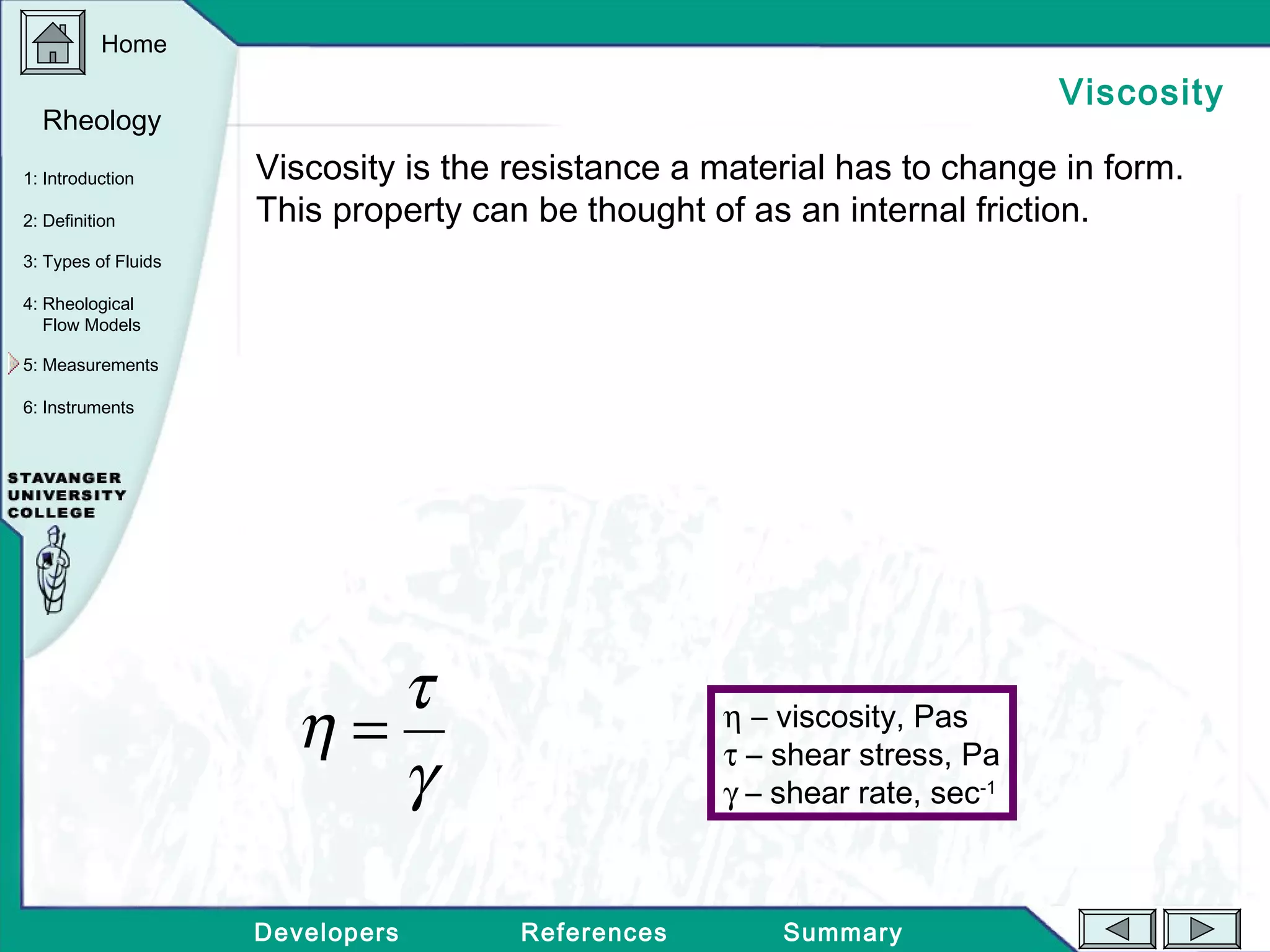
Viscosity
Viscosity is the resistance a material has to change in form.
This property can be thought of as an internal friction.
γ
τ
η = η – viscosity, Pas
τ – shear stress, Pa
γ – shear rate, sec-1
Home
Developers References Summary
1: Introduction
2: Definition
3: Types of Fluids
Rheology
4: Rheological
Flow Models
5: Measurements
6: Instruments
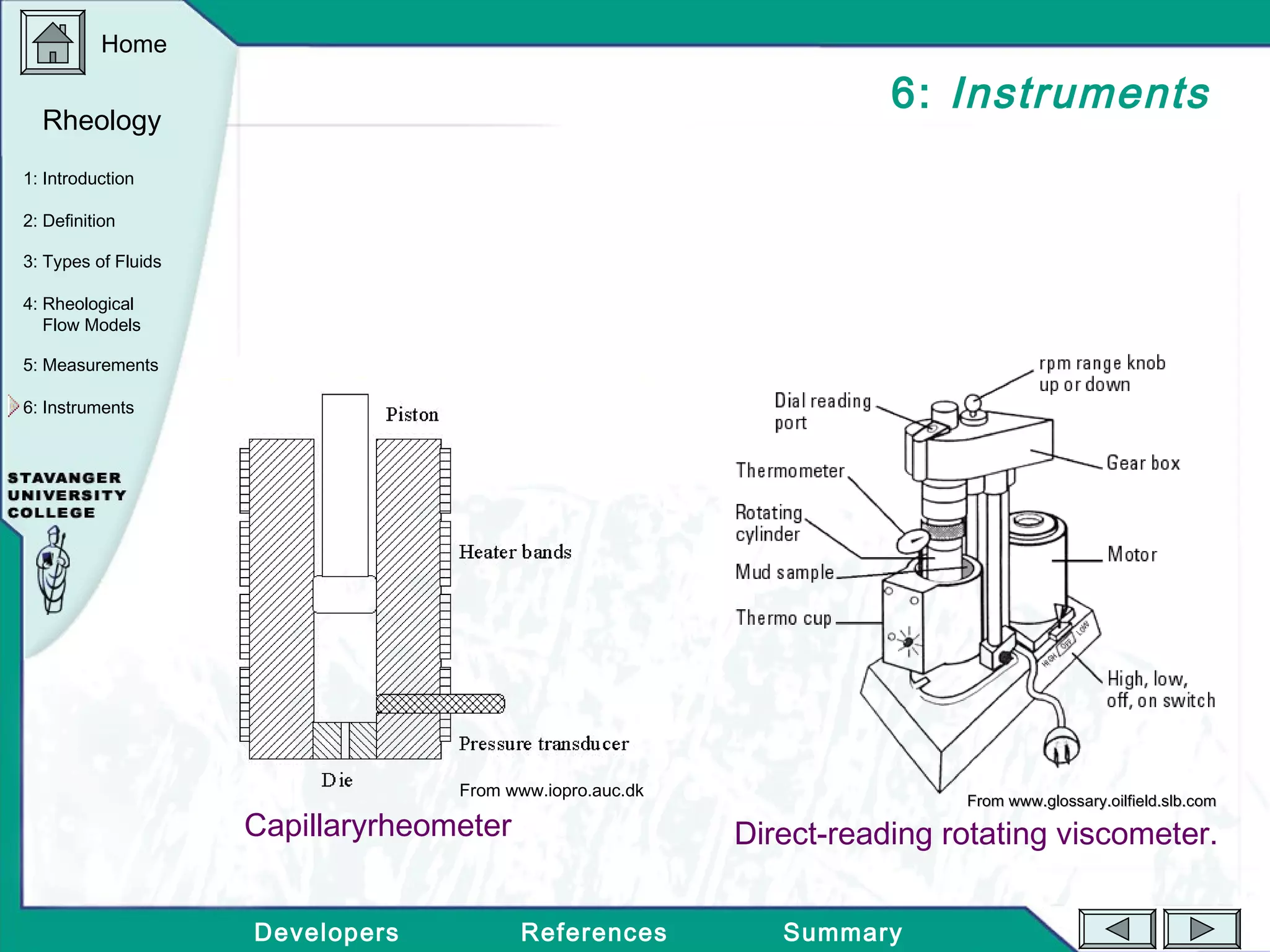
6: Instruments
Capillaryrheometer Direct-reading rotating viscometer.
From www.iopro.auc.dk
FromFrom www.glossary.oilfield.slb.comwww.glossary.oilfield.slb.com
Home
Developers References Summary
1: Introduction
2: Definition
3: Types of Fluids
Rheology
4: Rheological
Flow Models
5: Measurements
6: Instruments
Summary
In this module we have given you an
introduction to the subject rheology !

Rheology (1)

  • 2.
    Home Developers References Summary 1:Introduction 2: Definition 3: Types of Fluids Rheology 4: Rheological Flow Models 5: Measurements 6: Instruments Topic overview Rheological Flow Models Types of Fluids Measurement s Definition IntroductionIntroduction to Rheologyto Rheology Instruments From www.iopro.auc.dk
  • 3.
    Home Developers References Summary 1:Introduction 2: Definition 3: Types of Fluids Rheology 4: Rheological Flow Models 5: Measurements 6: Instruments The term ”Rheology” was invented by Professor Bingham of Lafayette College, Easton, PA, on the advice of a colleague, the Professor of Classics. The definition of rheology (see section 2) was accepted when the American Society of Rheology was founded in 1929. Robert Hooke (1635-1703):  in 1678 he developed his ”True Theory of Elasticy”: ”the power of any spring is the same proportion with the tension thereof”. Isaac Newton (1643-1727):  in 1687 he published the scientific book ”Principia”: ”the resistance which arises from the lack of slipperiness is proportional to the velocity with which the parts of the liquid are separated from one another”. In the 19th century scientists discovered solids with liquid-like responses and liquids with solid-like responses. Today, rheology is an integral part of industry. It is used by scientists working with plastics, paint, inks, detergent, oils, drilling fluids, and in quality and process control. 1: Introduction
  • 4.
    Home Developers References Summary 1:Introduction 2: Definition 3: Types of Fluids Rheology 4: Rheological Flow Models 5: Measurements 6: Instruments Newton’s Law for liquids: τ = η⋅γ Hooke’s Law for solid: τ = Ε⋅ε τ- shear stress η- viscosity γ- shear rate Ε- ε- Ε Newton’s model: dashpot, purely viscous response, permanent deformation. Hooke’s model: spring, purely elastic response, when stress on spring is removed it ”recovers”.
  • 5.
    Home Developers References Summary 1:Introduction 2: Definition 3: Types of Fluids Rheology 4: Rheological Flow Models 5: Measurements 6: Instruments Difficult Subject Rheology is a difficult subject. For example, rheology is interdisciplinary and most scientists and engineers have to move from a possibly restricted expertise and develop a broader scientific approach. A cursory glance at most text books on rheology would soon convince the non-mathematicians of the need to come to terms with at least some aspects of non-trivial mathematics. In this module we will give you an introduction to rheology and explain mathematical complication to the nonspecialist.
  • 6.
    Home Developers References Summary 1:Introduction 2: Definition 3: Types of Fluids Rheology 4: Rheological Flow Models 5: Measurements 6: Instruments 2: Definition Rheology is the science of flow and deformation of matter. The relationship between pressure and velocity on the flow regime. From IDF 1982 The increase in force compared to fluid velocity. From IDF 1982 The telescoping concentric cylinder of a fluid in laminar flow. From IDF 1982 A given material can behave like a solid or a liquid depending on the time scale of the deformation process.
  • 7.
    Home Developers References Summary 1:Introduction 2: Definition 3: Types of Fluids Rheology 4: Rheological Flow Models 5: Measurements 6: Instruments 3: Types of Fluids There are basically two types of fluids, defined by the relationship between shear stress and shear rate. These are:  Newtonian  Non-Newtonian Click here to watch video Go toGo to http://web.http://web.mitmit..eduedu//nnfnnf// for more information andfor more information and videos about non-Newtonian Fluid phenomena.videos about non-Newtonian Fluid phenomena. Fromwww.glossary.oilfield.slb.comwww.glossary.oilfield.slb.com Consistency curve for a typical non-Newtonian fluid. From IDF 1982 Consistency curve for a Newtonian fluid. From IDF 1982
  • 8.
    Home Developers References Summary 1:Introduction 2: Definition 3: Types of Fluids Rheology 4: Rheological Flow Models 5: Measurements 6: Instruments A Newtonian fluid is a fluid or dispersion whose rheological behaviour is described by Newton’s law of viscosity. There are different types of non-Newtonian fluids:  Pseudoplastic, a shear-tinning fluid.  Dilatant, a shear-thickening fluid.  Thixotropic: pseudoplastic flow that is time-dependent. At constant applied shear rate, viscosity gradually decreases.  Viscoelastic, a liquid (or solid) with both viscous and elastic properties.
  • 9.
    Home Developers References Summary 1:Introduction 2: Definition 3: Types of Fluids Rheology 4: Rheological Flow Models 5: Measurements 6: Instruments Video Sett inn tekst
  • 10.
    Home Developers References Summary 1:Introduction 2: Definition 3: Types of Fluids Rheology 4: Rheological Flow Models 5: Measurements 6: Instruments Newtonian Fluid Newtonian behaviour: Viscosity remains constant no matter what the shear rate. Newtonian fluids are the simplest type of fluid and contain no particles larger than a molecule. In an Newtonian fluid, such as water or oil, the shear stress is directly proportional to the shear rate, while the fluid is in laminar flow. Consistency curve for a Newtonian fluid. From IDF 1982
  • 11.
    Home Developers References Summary 1:Introduction 2: Definition 3: Types of Fluids Rheology 4: Rheological Flow Models 5: Measurements 6: Instruments Shear-thinning non-Newtonian Liquid Shear-thinning: The reduction of viscosity with increasing rate of shear in a steady shear flow. Paint and toothpaste is shear-thinning fluids. The consistency curve for a Bingham Plastic fluid and the apparent viscosity. From IDF 1982
  • 12.
    Home Developers References Summary 1:Introduction 2: Definition 3: Types of Fluids Rheology 4: Rheological Flow Models 5: Measurements 6: Instruments Shear-thickening non-Newtonian Liquid Shear-thickening: The increase of viscosity with increasing rate of shear in a steady shear flow. Cream is a shear-thickening fluid. The consistency curve for a Pseudoplastic fluid. From IDF 1982
  • 13.
    Home Developers References Summary 1:Introduction 2: Definition 3: Types of Fluids Rheology 4: Rheological Flow Models 5: Measurements 6: Instruments Viscoelastic Fluid Descriptive term for a liquid having both viscous and elastic properties. A viscoelastic liquid will deform and flow under the influence of an applied shear stress, but when the stress is removed the liquid will slowly recover from some of the deformation. Viscoelastic fluids have molecules in which the load- deformation relationship is time dependant. From www.iopro.auc.dkFrom www.iopro.auc.dk
  • 14.
    Home Developers References Summary 1:Introduction 2: Definition 3: Types of Fluids Rheology 4: Rheological Flow Models 5: Measurements 6: Instruments Viscoelastic Fluid Viscoelasticity: everything flows, you just have to wait long enough (think of the earth’s crust or glass).
  • 15.
    Home Developers References Summary 1:Introduction 2: Definition 3: Types of Fluids Rheology 4: Rheological Flow Models 5: Measurements 6: Instruments 4: Rheological Flow Models The models are an idealized relationship of rheological behaviour expressible in mathematical, mechanical or electrical terms. Mathematical flow models of greatest interest to the Drilling Fluids Engineer are the Newtonian, Bingham Plastic and Power Law models. Each of these models relate flow rate (shear rate) to flow pressure (shear stress) while the fluid is in laminar flow. No mathematical model is capable of providing a truly complete rheological analysis. The Bingham Plastic model has limitations in both the low and high shear rate ranges, while the Power Law model provides more realistic data that can predict fluid behaviour at low rates with greater accuracy.
  • 16.
    Home Developers References Summary 1:Introduction 2: Definition 3: Types of Fluids Rheology 4: Rheological Flow Models 5: Measurements 6: Instruments The Newtonian Model The Newtonian model has no value in predicting the behaviour of a drilling fluid, as the majority of drilling fluids do not conform to the govering Newtonian fluids. γητ ⋅= Consistency curve for a Newtonian fluid. From IDF 1982 η – viscosity, Pas τ – shear stress, Pa γ – shear rate, sec-1
  • 17.
    Home Developers References Summary 1:Introduction 2: Definition 3: Types of Fluids Rheology 4: Rheological Flow Models 5: Measurements 6: Instruments The Bingham Plastic Model The Bingham Plastic model establishes a distinct relationship between shear stress, yield point, plastic viscosity and shear rate. RPM rpmθ⋅ = 300 ViscosityApparant 300600ViscosityPlastic θθ −= θ - dial reading rpm – rotation per minute 600300300 2ViscosityPlasticPointYield θθθ −⋅=−= PV: the portion of the resistance to flow (viscosity) that is caused by interparticle friction (relates to solids concentration, size and shape of the solids, viscosity of the liquid phase). YP: the portion of viscosity that is related to the interparticle attractive force. From IDF 1982
  • 18.
    Home Developers References Summary 1:Introduction 2: Definition 3: Types of Fluids Rheology 4: Rheological Flow Models 5: Measurements 6: Instruments The Power Law Model The Power Law model is considerably more complex than the Bingham Plastic model, but it provides for far greater accuracy in the determination of shear stress at low shear rates. n K γτ ⋅= τ – shear stress, N/m2 = Pa = 10 dynes/cm2 γ – shear rate, sec-1 K – consistency index (constant) n – Power Law index The Power Law model actually describes three types of fluids, based on the n value: n=1: The fluid is Newtonian n<1: The fluid is non-Newtonian n>1: The fluid is Dilatent
  • 19.
    Home Developers References Summary 1:Introduction 2: Definition 3: Types of Fluids Rheology 4: Rheological Flow Models 5: Measurements 6: Instruments 5: Measurements Rheology: Flow property measurements. All fluids exhibit a certain resistance to flow, which is loosely termed viscosity. Viscosity is defined as the relationship between the shear stress (flow pressure) and the shear rate (flow rate). A non-Newtonian fluid is a fluid whose viscosity depends on the force applied. Temperature and pressure effects can alter rheological properties drastically.
  • 20.
    Home Developers References Summary 1:Introduction 2: Definition 3: Types of Fluids Rheology 4: Rheological Flow Models 5: Measurements 6: Instruments Shear Stress Shear stress: The force required to overcome a fluid’s resistance to flow, divided by the area that force is acting upon. A F =τ τ – shear stress, N/m2 = Pa = 10 dynes/cm2 F – force applied, N A – surface area subjected to stress, m2
  • 21.
    Home Developers References Summary 1:Introduction 2: Definition 3: Types of Fluids Rheology 4: Rheological Flow Models 5: Measurements 6: Instruments Shear Rate Shear rate: The relative velocity of the fluid layers divided by their normal separation distance. d U =γ γ – shear rate, sec-1 U – velocity, m/sec d – plate distance, m
  • 22.
    Home Developers References Summary 1:Introduction 2: Definition 3: Types of Fluids Rheology 4: Rheological Flow Models 5: Measurements 6: Instruments Viscosity Viscosity is the resistance a material has to change in form. This property can be thought of as an internal friction. γ τ η = η – viscosity, Pas τ – shear stress, Pa γ – shear rate, sec-1
  • 23.
    Home Developers References Summary 1:Introduction 2: Definition 3: Types of Fluids Rheology 4: Rheological Flow Models 5: Measurements 6: Instruments 6: Instruments Capillaryrheometer Direct-reading rotating viscometer. From www.iopro.auc.dk FromFrom www.glossary.oilfield.slb.comwww.glossary.oilfield.slb.com
  • 24.
    Home Developers References Summary 1:Introduction 2: Definition 3: Types of Fluids Rheology 4: Rheological Flow Models 5: Measurements 6: Instruments Summary In this module we have given you an introduction to the subject rheology !