Seda YILDIRIM
THE THEORETICAL
FRAMEWORK FOR
USAGE OF RFID
TECHNOLOGY IN RETAIL
SECTOR
Introduction
Increasing global competiton
and advances in information
technology (IT) affected the way
how firms conduct
business(Lee and Lee,2009:1).
The great usage of intelligent technologies such as
wireless networks and Radio- Frequency Identification
(RFID)(Kourouthanassis and Giaglis,2005) has moved
during the past decade from labs and niche uses into a
broader range of application(Slettemeas,2009).
According to Kotler & Keller (2006), retailers
are improving their skills in demand
forecasting, merchandise selection, stock
control, space allocation, and display with
use of IT. For example, supermarket chains
are using scanner data to manage their
merchandise mix on a store-by-store basis.
Research Method
This study used a monitoring model to describe the RFID
technology usage in retail sector in a general idea. And the
following below questions will be answered here:
•What is RFID?
•How is the historical development of RFID?
•What are the basic components of RFID?
•Why RFID is so important for retailers?
•What are RFID’s benefits?
•Why should retailers use RFID technology?
of RFID
Radio-Frequency Identification
(RFID) technology can be
defined as an a wireless sensor
technology which is based on
the detection of electromagnetic
signal(Domdouzis et. al.,
2007:350) .
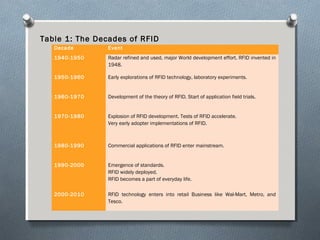
Table 1: The Decades of RFID
Decade Event
1940-1950 Radar refined and used, major World development effort. RFID invented in
1948.
1950-1960 Early explorations of RFID technology, laboratory experiments.
1960-1970 Development of the theory of RFID. Start of application field trials.
1970-1980 Explosion of RFID development. Tests of RFID accelerate.
Very early adopter implementations of RFID.
1980-1990 Commercial applications of RFID enter mainstream.
1990-2000 Emergence of standards.
RFID widely deployed.
RFID becomes a part of everyday life.
2000-2010 RFID technology enters into retail Business like Wal-Mart, Metro, and
Tesco.
According to Ngai et. al (2008) RFID technology developed
rapidly by American originated companies such as Wal-Mart,
and European companies such as Metro and Tesco, has
caused other companies to take a great attention for what
RFID can do for them and whether they should give further
consideration for adaptation .
Regarding the Chow et al. (2006) RFID uses the radio waves
to identify objects and this technology has been widely applied
in numerous areas in the supply chain activities such as
manufacturing and distribution of physical goods, shipping and
port operations and inventory management.
Components of RFID
In general RFID system has three basic components as
an RFID tag (transponder), a reader (transceiver), and a
database (Slettemeas, 2009:221).
Radio frequency identification (RFID) is a small tag
which contains an integrated chip and an antenna to
send radio waves transmitted from the RFID reader in
order to process, and then store information.
RFID Tags
As stated before the tags have an importance for the right
RFID technology solutions. According to Ngai et. al (2008)
the tag has an identity (ID) that can be broadcast to a
reader that is operating on the same frequency and under
the same tag protocol RFID devices are known as tags and
they fall into two broad categories: those with a power
supply (a battery) and those without.
The main blocks of the RFID tag are the following (Ashry et.
al.,2009:1504):
Rectifier: This block rectifies the input RF signal and generates the
needed DC voltage to power the other blocks of the system.
Demodulator: This block is the receiver of the system that detects
the commands sent by the RFID reader.
Control logic: This is the digital part of the system that controls all
other blocks of the system.
Internal clock: This is an internal clock generator that supplies an
internally generated clock to the digital part.
Modulator: This block is the transmitter of the system that sends
the tag ID to the RFID reader.
Readers
The reader consists typically of a transmitter and
receiver, a control unit and a coupling element
(antenna) to interact with the transponder (Dastoori
et. al.,2009:468). RFID reader is a device that can
read data from and write data to compatible RFID
tags.
Read Ranges and Tag Frequency
In general, frequency allocations are
managed through legislation and regulation
by individual governments. Internationally,
there are differences in frequencies allocated
for RFID applications although
standardization through ISO (International
Organization for Standardization) and similar
organisations is assisting in compatibility.
For RFID application, there are generally
three frequency ranges. (Roberts, 2006: 20).
The frequency of transmitting information is a
key factor in determining performance levels
and applications for the system. Almost, all
RFID systems operate on one of four
frequency bands: low frequency (LF), high
frequency (HF), ultra high frequency (UHF),
and microwave (MF) (Tajima, 2007: 262).
Table 2: Operating Frequencies and Performance Characteristics
  Low frequency
(LF)
High frequency
(HF)
Ultra high
frequency
(UHF)
Microwave
frequency
(MF)
Frequency range 125-134 Kz 13.56Mz 860-930MHz 2.45GHz
Tag type Passive Mainly passive Active and passive Active and
passive
Read
range(passive)
< 0.5 m 1.0m 3.0m 10m
Tag size Larger Larger Smaller Smaller
Data transfer rate Slow Medium Fast Fastest
Ability to read
near metal or wet
surface
Best Better Worse Worst
Tag cost High Lower than LF
tags
Lowest High
Typical
application
Livestock
tracking, cardkey
tracking, Exxon
Mobil Speedpass
Lower than LF
tags Airline
baggage
handling, library
book tracking,
electronic article
surveillance
Supply chain
tracking,
warehouse
management
Electronic toll
collection,
Railroad
monitoring
Applications of RFID Technology
Extant literature shows that the usage of RFID technology is
a quite new issue.
Important fields and industrial sectors for the
application of RFID are (European Policy
Outlook RFID, 2007):
Manufacturing and production (e.g., the
automotive industry),
Transport and logistics
Retail and consumer goods
Public transport
Health care
Anti-counterfeiting
Ticketing
ePayment
(National) Security
Recycling
Table 3: The Overview of RFID Technology Applied in Various Industries
Benefits of RFID Usage
RFID technology has an opportunity to enterprise wide
technology with inter-organizational implications in the
same tendency as the Internet and networked PCs. This
can bring both business process and society fundemantal
changes.
RFID’s recent advances have enabled its early adoption
in many commercial applications, such as supply chain
management, logistics, and transportation. Because
businesses expect to get better efficiency, accuracy,
visibility, and security performance in the supply
chain(Ustundağ and Tanyas, 2009; 37).
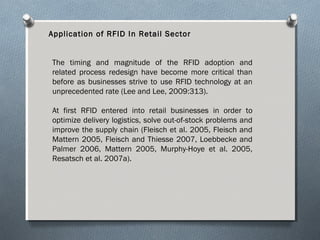
Application of RFID In Retail Sector
The timing and magnitude of the RFID adoption and
related process redesign have become more critical than
before as businesses strive to use RFID technology at an
unprecedented rate (Lee and Lee, 2009:313).
At first RFID entered into retail businesses in order to
optimize delivery logistics, solve out-of-stock problems and
improve the supply chain (Fleisch et al. 2005, Fleisch and
Mattern 2005, Fleisch and Thiesse 2007, Loebbecke and
Palmer 2006, Mattern 2005, Murphy-Hoye et al. 2005,
Resatsch et al. 2007a).
There are also given potential use of RFID at the palet and case
levels throught the value chain, from manufacturer to point of sales
(POS) (Loebbecke, 2005:5):
Product Transport: Manufacturer or retailer affixes RFID tags to
all product pallets and cases before they are shipped. The tags are
electronically time-stamped and then entered into the central
computer of the retailer’s RFID goods tracking system. The tagged
pallets and cases can thus be identified and located along the
entire logistics chain, all the way to the sales floor.
Leobbecke(2004) also stated RFID tagging on item and he
discussed about RFID’s oppurtunities for retail sector by tagging
items:
New types of services in stores, such as personalized
advertising displays and self-check-out, aimed at increasing
customer loyalty and promoting sales.
Electronic price labeling in stores, making price tags easer to
understand and more current.
Improved theft protection in stores, because products cannot be
taken out of this store without payment
Warehouse Dispatch: Goods ready to be shipped to a
store are taken from the central warehouse to dispatch
area. As they pass through the exit gate, an RFID
transceiver reads the codes on the pallets and cases and
passes this data on to the RFID goods flow system. The
goods then have the status of “on route to destination”.
Goods Delivery to the Store Stockroom: RFID helps match
arriving goods to orders. When a truck arrives at a store, its
pallets are once again identified by an RFID reader, which can
handle as many as 35 pallet or case tags per second. The goods
are then registered as “in the store stockroom”.
Warehouse Management and Storage Processes: Once
received, the goods flow system registers the goods at being in the
stockroom. Each storage location has an RFID tag, which is stored in
the RFID goods flow system along with the RFID numbers of the
pallets and cases stored at each location.
Transport of Goods into the Sales Room: RFID
readers, located at the store stockroom exit doors,
identify every palet and case that is moved into the
store. These readers send the relevant RFID numbers to
the RFID goods flow system, which identifies the
products as “ transported into the store”.
Standardization of RFID
The International Organization for
Standardization (ISO) has created standards
for tracking cattle with RFID. ISO 11784
defines how data is structured on the tag.
ISO 11785 defines the air interface protocol.
ISO has created a standard for the air
interface protocol for RFID tags used in
payment systems and contactless smart
cards (ISO 14443) and in vicinity cards (ISO
15693). It also has established standards for
testing the conformance of RFID tags and
readers to a standard (ISO 18047), and for
testing the performance of RFID tags and
readers (ISO 18046).
Advantages of RFID Usage in
Retail Sector
Levy and Weitz(2003) stated main
advantages of RFID usage in the retail sector
which are:
Reduced warehouse and distribution labour
costs. Reducing manuel labour intensive
operations with sensors tracking
shipments(items)can reduce labour cost by
30 percent.
Reduced point-of-sale costs. The main saving are due to
reduced labour hours needed to check inventory and
facilitation of self-scan checkouts that is shortening
checkout times.
Inventory savings. Less inventory errors. Companies do not
need to review inventory as frequent as previously and
informations about current levels of stock are much more
accurate.
Elimination of counterfeited merchandise. With RFID tag on the
original merchandise it will be much harder for counterfeiters to
sell fake merchandise to retailers.
Facilitation of selling process. Retailers install RFID readers in
stores with digital displays to help consumers in their search for
product of interest or to provide them with information about
certain product. Consumers will also be able to see availability
of the indifferent colours and sizes. Furthermore it can also
facilitate cross-selling.
Reduced theft. Not just in the store but through the
whole supply chain RFID can be used to minimize
opportunities for theft. Small and valuable items carry
RFID tags in the stores. RFID tags are attached to high
value apparel to prevent shoplifting while a customer
tries them in the dressing room etc.
Reduced out of stock conditions. Product tracking
enables real time response to decreased stocks either in
the warehouse or on the store shelves.
Conclusion
RFID technology is being used for a number
of purposes. A significant area of its usage is
the retail business.
In addition to its functional benefits, RFID
provides a significant advantage for retailers
regarding inventory management. Although,
RFID has remarkable advantages, yet there
are some barriers to wider implementation of
this technology. RFID is still an immature
technology. To be become a well established
and widely accepted technology, like the
barcode system, RFID needs further
development.
Choosing the right technological
infrastructure is extremely important. The
main burdens of this technology are its
relatively high installation cost and, currently
the limitation of using a tag only once in a
product. RFID technology seems to make a
significant progress within a decade.
By giving theoretical framework of RFID in
retail industry, we want to provide useful
informaitons about RFID technogy usage in
retail sector for new researchers.
Espeacially, for researchers who live in
countries that there are no any usages of
RFID technology in business world. For
example, In turkey there aren’t any usages of
RFID technology in retail sector but it will be
expected for both manufacturers and
suppliers.
RFID in retail sector

RFID in retail sector

  • 1.
    Seda YILDIRIM THE THEORETICAL FRAMEWORKFOR USAGE OF RFID TECHNOLOGY IN RETAIL SECTOR
  • 2.
    Introduction Increasing global competiton andadvances in information technology (IT) affected the way how firms conduct business(Lee and Lee,2009:1).
  • 3.
    The great usageof intelligent technologies such as wireless networks and Radio- Frequency Identification (RFID)(Kourouthanassis and Giaglis,2005) has moved during the past decade from labs and niche uses into a broader range of application(Slettemeas,2009).
  • 4.
    According to Kotler& Keller (2006), retailers are improving their skills in demand forecasting, merchandise selection, stock control, space allocation, and display with use of IT. For example, supermarket chains are using scanner data to manage their merchandise mix on a store-by-store basis.
  • 5.
    Research Method This studyused a monitoring model to describe the RFID technology usage in retail sector in a general idea. And the following below questions will be answered here: •What is RFID? •How is the historical development of RFID? •What are the basic components of RFID? •Why RFID is so important for retailers? •What are RFID’s benefits? •Why should retailers use RFID technology?
  • 6.
    of RFID Radio-Frequency Identification (RFID)technology can be defined as an a wireless sensor technology which is based on the detection of electromagnetic signal(Domdouzis et. al., 2007:350) .
  • 7.
    Table 1: TheDecades of RFID Decade Event 1940-1950 Radar refined and used, major World development effort. RFID invented in 1948. 1950-1960 Early explorations of RFID technology, laboratory experiments. 1960-1970 Development of the theory of RFID. Start of application field trials. 1970-1980 Explosion of RFID development. Tests of RFID accelerate. Very early adopter implementations of RFID. 1980-1990 Commercial applications of RFID enter mainstream. 1990-2000 Emergence of standards. RFID widely deployed. RFID becomes a part of everyday life. 2000-2010 RFID technology enters into retail Business like Wal-Mart, Metro, and Tesco.
  • 8.
    According to Ngaiet. al (2008) RFID technology developed rapidly by American originated companies such as Wal-Mart, and European companies such as Metro and Tesco, has caused other companies to take a great attention for what RFID can do for them and whether they should give further consideration for adaptation . Regarding the Chow et al. (2006) RFID uses the radio waves to identify objects and this technology has been widely applied in numerous areas in the supply chain activities such as manufacturing and distribution of physical goods, shipping and port operations and inventory management.
  • 9.
    Components of RFID Ingeneral RFID system has three basic components as an RFID tag (transponder), a reader (transceiver), and a database (Slettemeas, 2009:221). Radio frequency identification (RFID) is a small tag which contains an integrated chip and an antenna to send radio waves transmitted from the RFID reader in order to process, and then store information.
  • 10.
    RFID Tags As statedbefore the tags have an importance for the right RFID technology solutions. According to Ngai et. al (2008) the tag has an identity (ID) that can be broadcast to a reader that is operating on the same frequency and under the same tag protocol RFID devices are known as tags and they fall into two broad categories: those with a power supply (a battery) and those without.
  • 11.
    The main blocksof the RFID tag are the following (Ashry et. al.,2009:1504): Rectifier: This block rectifies the input RF signal and generates the needed DC voltage to power the other blocks of the system. Demodulator: This block is the receiver of the system that detects the commands sent by the RFID reader. Control logic: This is the digital part of the system that controls all other blocks of the system. Internal clock: This is an internal clock generator that supplies an internally generated clock to the digital part. Modulator: This block is the transmitter of the system that sends the tag ID to the RFID reader.
  • 12.
    Readers The reader consiststypically of a transmitter and receiver, a control unit and a coupling element (antenna) to interact with the transponder (Dastoori et. al.,2009:468). RFID reader is a device that can read data from and write data to compatible RFID tags.
  • 13.
    Read Ranges andTag Frequency In general, frequency allocations are managed through legislation and regulation by individual governments. Internationally, there are differences in frequencies allocated for RFID applications although standardization through ISO (International Organization for Standardization) and similar organisations is assisting in compatibility.
  • 14.
    For RFID application,there are generally three frequency ranges. (Roberts, 2006: 20). The frequency of transmitting information is a key factor in determining performance levels and applications for the system. Almost, all RFID systems operate on one of four frequency bands: low frequency (LF), high frequency (HF), ultra high frequency (UHF), and microwave (MF) (Tajima, 2007: 262).
  • 15.
    Table 2: OperatingFrequencies and Performance Characteristics   Low frequency (LF) High frequency (HF) Ultra high frequency (UHF) Microwave frequency (MF) Frequency range 125-134 Kz 13.56Mz 860-930MHz 2.45GHz Tag type Passive Mainly passive Active and passive Active and passive Read range(passive) < 0.5 m 1.0m 3.0m 10m Tag size Larger Larger Smaller Smaller Data transfer rate Slow Medium Fast Fastest Ability to read near metal or wet surface Best Better Worse Worst Tag cost High Lower than LF tags Lowest High Typical application Livestock tracking, cardkey tracking, Exxon Mobil Speedpass Lower than LF tags Airline baggage handling, library book tracking, electronic article surveillance Supply chain tracking, warehouse management Electronic toll collection, Railroad monitoring
  • 16.
    Applications of RFIDTechnology Extant literature shows that the usage of RFID technology is a quite new issue. Important fields and industrial sectors for the application of RFID are (European Policy Outlook RFID, 2007): Manufacturing and production (e.g., the automotive industry), Transport and logistics Retail and consumer goods Public transport Health care Anti-counterfeiting Ticketing ePayment (National) Security Recycling
  • 17.
    Table 3: TheOverview of RFID Technology Applied in Various Industries
  • 18.
    Benefits of RFIDUsage RFID technology has an opportunity to enterprise wide technology with inter-organizational implications in the same tendency as the Internet and networked PCs. This can bring both business process and society fundemantal changes. RFID’s recent advances have enabled its early adoption in many commercial applications, such as supply chain management, logistics, and transportation. Because businesses expect to get better efficiency, accuracy, visibility, and security performance in the supply chain(Ustundağ and Tanyas, 2009; 37).
  • 19.
    Application of RFIDIn Retail Sector The timing and magnitude of the RFID adoption and related process redesign have become more critical than before as businesses strive to use RFID technology at an unprecedented rate (Lee and Lee, 2009:313). At first RFID entered into retail businesses in order to optimize delivery logistics, solve out-of-stock problems and improve the supply chain (Fleisch et al. 2005, Fleisch and Mattern 2005, Fleisch and Thiesse 2007, Loebbecke and Palmer 2006, Mattern 2005, Murphy-Hoye et al. 2005, Resatsch et al. 2007a).
  • 20.
    There are alsogiven potential use of RFID at the palet and case levels throught the value chain, from manufacturer to point of sales (POS) (Loebbecke, 2005:5): Product Transport: Manufacturer or retailer affixes RFID tags to all product pallets and cases before they are shipped. The tags are electronically time-stamped and then entered into the central computer of the retailer’s RFID goods tracking system. The tagged pallets and cases can thus be identified and located along the entire logistics chain, all the way to the sales floor.
  • 21.
    Leobbecke(2004) also statedRFID tagging on item and he discussed about RFID’s oppurtunities for retail sector by tagging items: New types of services in stores, such as personalized advertising displays and self-check-out, aimed at increasing customer loyalty and promoting sales. Electronic price labeling in stores, making price tags easer to understand and more current. Improved theft protection in stores, because products cannot be taken out of this store without payment
  • 22.
    Warehouse Dispatch: Goodsready to be shipped to a store are taken from the central warehouse to dispatch area. As they pass through the exit gate, an RFID transceiver reads the codes on the pallets and cases and passes this data on to the RFID goods flow system. The goods then have the status of “on route to destination”.
  • 23.
    Goods Delivery tothe Store Stockroom: RFID helps match arriving goods to orders. When a truck arrives at a store, its pallets are once again identified by an RFID reader, which can handle as many as 35 pallet or case tags per second. The goods are then registered as “in the store stockroom”.
  • 24.
    Warehouse Management andStorage Processes: Once received, the goods flow system registers the goods at being in the stockroom. Each storage location has an RFID tag, which is stored in the RFID goods flow system along with the RFID numbers of the pallets and cases stored at each location.
  • 25.
    Transport of Goodsinto the Sales Room: RFID readers, located at the store stockroom exit doors, identify every palet and case that is moved into the store. These readers send the relevant RFID numbers to the RFID goods flow system, which identifies the products as “ transported into the store”.
  • 26.
    Standardization of RFID TheInternational Organization for Standardization (ISO) has created standards for tracking cattle with RFID. ISO 11784 defines how data is structured on the tag. ISO 11785 defines the air interface protocol. ISO has created a standard for the air interface protocol for RFID tags used in payment systems and contactless smart cards (ISO 14443) and in vicinity cards (ISO 15693). It also has established standards for testing the conformance of RFID tags and readers to a standard (ISO 18047), and for testing the performance of RFID tags and readers (ISO 18046).
  • 27.
    Advantages of RFIDUsage in Retail Sector Levy and Weitz(2003) stated main advantages of RFID usage in the retail sector which are: Reduced warehouse and distribution labour costs. Reducing manuel labour intensive operations with sensors tracking shipments(items)can reduce labour cost by 30 percent.
  • 28.
    Reduced point-of-sale costs.The main saving are due to reduced labour hours needed to check inventory and facilitation of self-scan checkouts that is shortening checkout times. Inventory savings. Less inventory errors. Companies do not need to review inventory as frequent as previously and informations about current levels of stock are much more accurate.
  • 29.
    Elimination of counterfeitedmerchandise. With RFID tag on the original merchandise it will be much harder for counterfeiters to sell fake merchandise to retailers. Facilitation of selling process. Retailers install RFID readers in stores with digital displays to help consumers in their search for product of interest or to provide them with information about certain product. Consumers will also be able to see availability of the indifferent colours and sizes. Furthermore it can also facilitate cross-selling.
  • 30.
    Reduced theft. Notjust in the store but through the whole supply chain RFID can be used to minimize opportunities for theft. Small and valuable items carry RFID tags in the stores. RFID tags are attached to high value apparel to prevent shoplifting while a customer tries them in the dressing room etc. Reduced out of stock conditions. Product tracking enables real time response to decreased stocks either in the warehouse or on the store shelves.
  • 31.
    Conclusion RFID technology isbeing used for a number of purposes. A significant area of its usage is the retail business. In addition to its functional benefits, RFID provides a significant advantage for retailers regarding inventory management. Although, RFID has remarkable advantages, yet there are some barriers to wider implementation of this technology. RFID is still an immature technology. To be become a well established and widely accepted technology, like the barcode system, RFID needs further development.
  • 32.
    Choosing the righttechnological infrastructure is extremely important. The main burdens of this technology are its relatively high installation cost and, currently the limitation of using a tag only once in a product. RFID technology seems to make a significant progress within a decade.
  • 33.
    By giving theoreticalframework of RFID in retail industry, we want to provide useful informaitons about RFID technogy usage in retail sector for new researchers. Espeacially, for researchers who live in countries that there are no any usages of RFID technology in business world. For example, In turkey there aren’t any usages of RFID technology in retail sector but it will be expected for both manufacturers and suppliers.