Revision Checklist for IGCSE
           Geography 0460
           A guide for Students
Revision Checklist for IGCSE Geography 0460
                                          A Guide for Students

How to use this guide

The guide describes what you need to know about your IGCSE Geography examination.

It will help you to plan your revision programme for the examination and will explain what the
examiners are looking for in the answers you write. It can also be used to help you to revise
by using the tick boxes in Section 3, ‘What you need to know’ to check what you know and
which topic areas of Geography you have covered.

The guide contains the following sections:

Section 1: How will you be tested?

This section will give you information about the different examination Papers that are
available.

Section 2: What will you be tested on?

This section describes the areas of knowledge, understanding and skills that the Examiners
will test you on.

Section 3: What you need to know

This shows the syllabus content in a simple way so that you can check:

    •   which topics you need to know
    •   details about each topic in the syllabus
    •   how much of the syllabus you have covered

Appendices

This section covers other things you need to know such as:

    •   the importance of the command words that Examiners use in the examination Papers
    •   important geographical words

Not all the information will be relevant to you. You will have to select what you need to cover
in Sections (1) and (3) by finding out from your teacher whether you are doing Coursework or
the alternative Paper to coursework.


IGCSE Geography 0460 Revision Checklist
Section 1: How will you be tested?

1.1 About the examinations you will take

You will take three Papers: two theory Papers, i.e. Paper 1 and Paper 2, and one practical
Paper, either .Paper 3 (coursework) or Paper 4 (alternative to coursework).

Your teacher will be able to tell you whether you are doing coursework (Paper 3) or taking
Paper 4.


If you are doing coursework, you will complete two assignments and just take Paper 1 and
Paper 2 in the examination. However, if you are not doing coursework, you will take three
Papers in the examination, i.e. Paper1, Paper 2 and Paper 4.

1.2 About the theory Papers

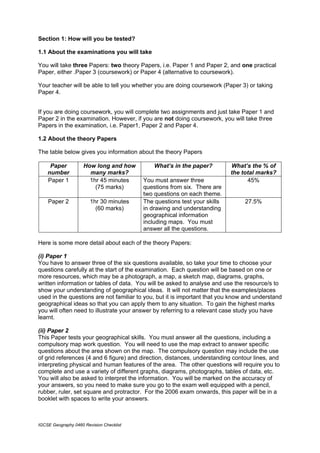
The table below gives you information about the theory Papers

     Paper           How long and how         What’s in the paper?         What’s the % of
    number             many marks?                                         the total marks?
    Paper 1            1hr 45 minutes     You must answer three                  45%
                         (75 marks)       questions from six. There are
                                          two questions on each theme.
    Paper 2             1hr 30 minutes    The questions test your skills        27.5%
                          (60 marks)      in drawing and understanding
                                          geographical information
                                          including maps. You must
                                          answer all the questions.

Here is some more detail about each of the theory Papers:

(i) Paper 1
You have to answer three of the six questions available, so take your time to choose your
questions carefully at the start of the examination. Each question will be based on one or
more resources, which may be a photograph, a map, a sketch map, diagrams, graphs,
written information or tables of data. You will be asked to analyse and use the resource/s to
show your understanding of geographical ideas. It will not matter that the examples/places
used in the questions are not familiar to you, but it is important that you know and understand
geographical ideas so that you can apply them to any situation. To gain the highest marks
you will often need to illustrate your answer by referring to a relevant case study you have
learnt.

(ii) Paper 2
This Paper tests your geographical skills. You must answer all the questions, including a
compulsory map work question. You will need to use the map extract to answer specific
questions about the area shown on the map. The compulsory question may include the use
of grid references (4 and 6 figure) and direction, distances, understanding contour lines, and
interpreting physical and human features of the area. The other questions will require you to
complete and use a variety of different graphs, diagrams, photographs, tables of data, etc.
You will also be asked to interpret the information. You will be marked on the accuracy of
your answers, so you need to make sure you go to the exam well equipped with a pencil,
rubber, ruler, set square and protractor. For the 2006 exam onwards, this paper will be in a
booklet with spaces to write your answers.


IGCSE Geography 0460 Revision Checklist
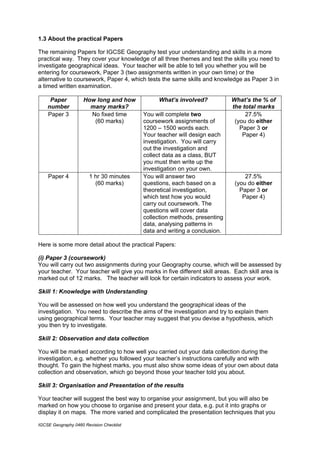
1.3 About the practical Papers

The remaining Papers for IGCSE Geography test your understanding and skills in a more
practical way. They cover your knowledge of all three themes and test the skills you need to
investigate geographical ideas. Your teacher will be able to tell you whether you will be
entering for coursework, Paper 3 (two assignments written in your own time) or the
alternative to coursework, Paper 4, which tests the same skills and knowledge as Paper 3 in
a timed written examination.

     Paper           How long and how          What’s involved?             What’s the % of
    number             many marks?                                          the total marks
    Paper 3            No fixed time      You will complete two                  27.5%
                        (60 marks)        coursework assignments of          (you do either
                                          1200 – 1500 words each.              Paper 3 or
                                          Your teacher will design each         Paper 4)
                                          investigation. You will carry
                                          out the investigation and
                                          collect data as a class, BUT
                                          you must then write up the
                                          investigation on your own.
    Paper 4            1 hr 30 minutes    You will answer two                    27.5%
                         (60 marks)       questions, each based on a         (you do either
                                          theoretical investigation,           Paper 3 or
                                          which test how you would              Paper 4)
                                          carry out coursework. The
                                          questions will cover data
                                          collection methods, presenting
                                          data, analysing patterns in
                                          data and writing a conclusion.

Here is some more detail about the practical Papers:

(i) Paper 3 (coursework)
You will carry out two assignments during your Geography course, which will be assessed by
your teacher. Your teacher will give you marks in five different skill areas. Each skill area is
marked out of 12 marks. The teacher will look for certain indicators to assess your work.

Skill 1: Knowledge with Understanding

You will be assessed on how well you understand the geographical ideas of the
investigation. You need to describe the aims of the investigation and try to explain them
using geographical terms. Your teacher may suggest that you devise a hypothesis, which
you then try to investigate.

Skill 2: Observation and data collection

You will be marked according to how well you carried out your data collection during the
investigation, e.g. whether you followed your teacher’s instructions carefully and with
thought. To gain the highest marks, you must also show some ideas of your own about data
collection and observation, which go beyond those your teacher told you about.

Skill 3: Organisation and Presentation of the results

Your teacher will suggest the best way to organise your assignment, but you will also be
marked on how you choose to organise and present your data, e.g. put it into graphs or
display it on maps. The more varied and complicated the presentation techniques that you

IGCSE Geography 0460 Revision Checklist
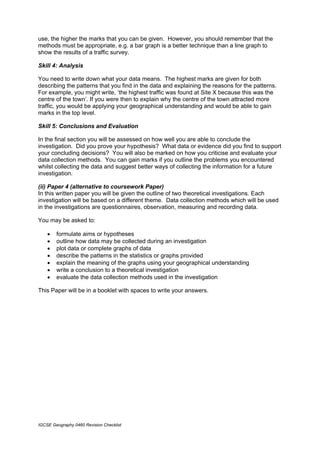
use, the higher the marks that you can be given. However, you should remember that the
methods must be appropriate, e.g. a bar graph is a better technique than a line graph to
show the results of a traffic survey.

Skill 4: Analysis

You need to write down what your data means. The highest marks are given for both
describing the patterns that you find in the data and explaining the reasons for the patterns.
For example, you might write, ‘the highest traffic was found at Site X because this was the
centre of the town’. If you were then to explain why the centre of the town attracted more
traffic, you would be applying your geographical understanding and would be able to gain
marks in the top level.

Skill 5: Conclusions and Evaluation

In the final section you will be assessed on how well you are able to conclude the
investigation. Did you prove your hypothesis? What data or evidence did you find to support
your concluding decisions? You will also be marked on how you criticise and evaluate your
data collection methods. You can gain marks if you outline the problems you encountered
whilst collecting the data and suggest better ways of collecting the information for a future
investigation.

(ii) Paper 4 (alternative to coursework Paper)
In this written paper you will be given the outline of two theoretical investigations. Each
investigation will be based on a different theme. Data collection methods which will be used
in the investigations are questionnaires, observation, measuring and recording data.

You may be asked to:

    •   formulate aims or hypotheses
    •   outline how data may be collected during an investigation
    •   plot data or complete graphs of data
    •   describe the patterns in the statistics or graphs provided
    •   explain the meaning of the graphs using your geographical understanding
    •   write a conclusion to a theoretical investigation
    •   evaluate the data collection methods used in the investigation

This Paper will be in a booklet with spaces to write your answers.


IGCSE Geography 0460 Revision Checklist
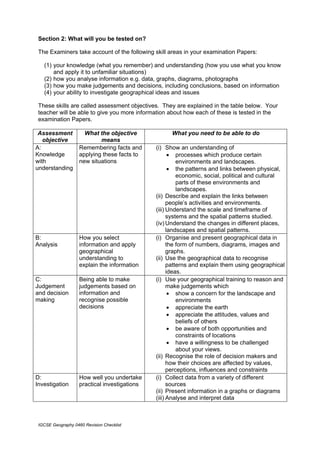
Section 2: What will you be tested on?

 The Examiners take account of the following skill areas in your examination Papers:

   (1) your knowledge (what you remember) and understanding (how you use what you know
       and apply it to unfamiliar situations)
   (2) how you analyse information e.g. data, graphs, diagrams, photographs
   (3) how you make judgements and decisions, including conclusions, based on information
   (4) your ability to investigate geographical ideas and issues

 These skills are called assessment objectives. They are explained in the table below. Your
 teacher will be able to give you more information about how each of these is tested in the
 examination Papers.

 Assessment           What the objective             What you need to be able to do
   objective                means
A:                  Remembering facts and      (i) Show an understanding of
Knowledge           applying these facts to           • processes which produce certain
with                new situations                       environments and landscapes.
understanding                                         • the patterns and links between physical,
                                                         economic, social, political and cultural
                                                         parts of these environments and
                                                         landscapes.
                                               (ii) Describe and explain the links between
                                                     people’s activities and environments.
                                               (iii) Understand the scale and timeframe of
                                                     systems and the spatial patterns studied.
                                               (iv) Understand the changes in different places,
                                                     landscapes and spatial patterns.
B:                  How you select             (i) Organise and present geographical data in
Analysis            information and apply            the form of numbers, diagrams, images and
                    geographical                     graphs.
                    understanding to           (ii) Use the geographical data to recognise
                    explain the information          patterns and explain them using geographical
                                                     ideas.
C:                  Being able to make         (i) Use your geographical training to reason and
Judgement           judgements based on              make judgements which
and decision        information and                   • show a concern for the landscape and
making              recognise possible                   environments
                    decisions                         • appreciate the earth
                                                      • appreciate the attitudes, values and
                                                         beliefs of others
                                                      • be aware of both opportunities and
                                                         constraints of locations
                                                      • have a willingness to be challenged
                                                         about your views.
                                               (ii) Recognise the role of decision makers and
                                                     how their choices are affected by values,
                                                     perceptions, influences and constraints
D:                  How well you undertake     (i) Collect data from a variety of different
Investigation       practical investigations         sources
                                               (ii) Present information in a graphs or diagrams
                                               (iii) Analyse and interpret data


 IGCSE Geography 0460 Revision Checklist
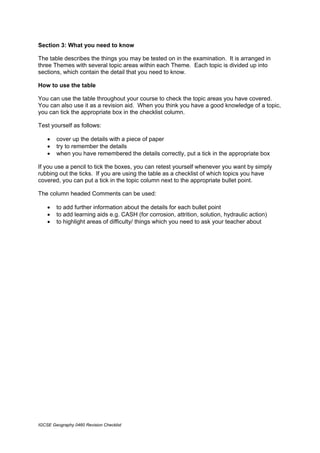
Section 3: What you need to know

The table describes the things you may be tested on in the examination. It is arranged in
three Themes with several topic areas within each Theme. Each topic is divided up into
sections, which contain the detail that you need to know.

How to use the table

You can use the table throughout your course to check the topic areas you have covered.
You can also use it as a revision aid. When you think you have a good knowledge of a topic,
you can tick the appropriate box in the checklist column.

Test yourself as follows:

    •   cover up the details with a piece of paper
    •   try to remember the details
    •   when you have remembered the details correctly, put a tick in the appropriate box

If you use a pencil to tick the boxes, you can retest yourself whenever you want by simply
rubbing out the ticks. If you are using the table as a checklist of which topics you have
covered, you can put a tick in the topic column next to the appropriate bullet point.

The column headed Comments can be used:

    •   to add further information about the details for each bullet point
    •   to add learning aids e.g. CASH (for corrosion, attrition, solution, hydraulic action)
    •   to highlight areas of difficulty/ things which you need to ask your teacher about


IGCSE Geography 0460 Revision Checklist
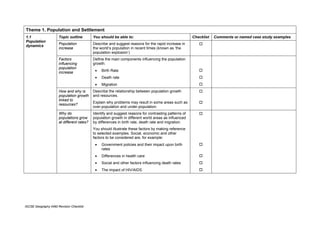
Theme 1. Population and Settlement
1.1                   Topic outline         You should be able to:                                     Checklist   Comments or named case study examples
Population
                      Population            Describe and suggest reasons for the rapid increase in
dynamics
                      increase              the world’s population in recent times (known as ‘the
                                            population explosion’)
                      Factors               Define the main components influencing the population
                      influencing           growth:
                      population
                      increase               •   Birth Rate
                                             •   Death rate
                                             •   Migration
                      How and why is        Describe the relationship between population growth
                      population growth     and resources.
                      linked to
                                            Explain why problems may result in some areas such as
                      resources?
                                            over-population and under-population.
                      Why do                Identify and suggest reasons for contrasting patterns of
                      populations grow      population growth in different world areas as influenced
                      at different rates?   by differences in birth rate, death rate and migration.
                                            You should illustrate these factors by making reference
                                            to selected examples. Social, economic and other
                                            factors to be considered are, for example:
                                             •   Government policies and their impact upon birth
                                                 rates
                                             •   Differences in health care
                                             •   Social and other factors influencing death rates
                                             •   The impact of HIV/AIDS


IGCSE Geography 0460 Revision Checklist
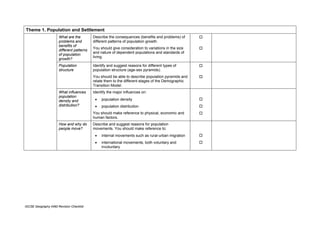
Theme 1. Population and Settlement
                      What are the         Describe the consequences (benefits and problems) of
                      problems and         different patterns of population growth.
                      benefits of
                                           You should give consideration to variations in the size
                      different patterns
                                           and nature of dependent populations and standards of
                      of population
                                           living.
                      growth?
                      Population           Identify and suggest reasons for different types of
                      structure            population structure (age-sex pyramids).
                                           You should be able to describe population pyramids and
                                           relate them to the different stages of the Demographic
                                           Transition Model.
                      What influences      Identify the major influences on:
                      population
                      density and           •   population density
                      distribution?         •   population distribution
                                           You should make reference to physical, economic and
                                           human factors.
                      How and why do       Describe and suggest reasons for population
                      people move?         movements. You should make reference to:
                                            •   internal movements such as rural-urban migration
                                            •   international movements, both voluntary and
                                                involuntary


IGCSE Geography 0460 Revision Checklist
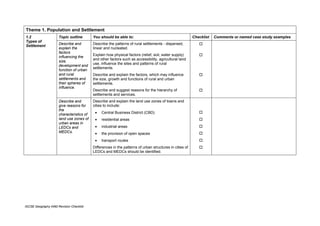
Theme 1. Population and Settlement
1.2                   Topic outline        You should be able to:                                         Checklist   Comments or named case study examples
Types of
                      Describe and         Describe the patterns of rural settlements - dispersed,
Settlement
                      explain the          linear and nucleated.
                      factors
                                           Explain how physical factors (relief, soil, water supply)
                      influencing the
                                           and other factors such as accessibility, agricultural land
                      size,
                                           use, influence the sites and patterns of rural
                      development and
                                           settlements.
                      function of urban
                      and rural            Describe and explain the factors, which may influence
                      settlements and      the size, growth and functions of rural and urban
                      their spheres of     settlements.
                      influence.
                                           Describe and suggest reasons for the hierarchy of
                                           settlements and services.
                      Describe and         Describe and explain the land use zones of towns and
                      give reasons for     cities to include:
                      the
                      characteristics of    •   Central Business District (CBD)
                      land use zones of     •   residential areas
                      urban areas in
                      LEDCs and             •   industrial areas
                      MEDCs.                •   the provision of open spaces
                                            •   transport routes
                                           Differences in the patterns of urban structures in cities of
                                           LEDCs and MEDCs should be identified.


IGCSE Geography 0460 Revision Checklist
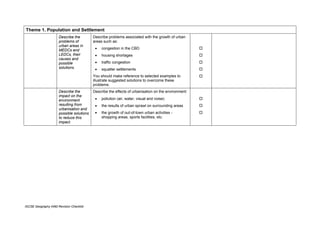
Theme 1. Population and Settlement
                      Describe the         Describe problems associated with the growth of urban
                      problems of          areas such as:
                      urban areas in
                      MEDCs and             •   congestion in the CBD
                      LEDCs, their          •   housing shortages
                      causes and
                      possible              •   traffic congestion
                      solutions.            •   squatter settlements
                                           You should make reference to selected examples to
                                           illustrate suggested solutions to overcome these
                                           problems.
                      Describe the         Describe the effects of urbanisation on the environment:
                      impact on the
                      environment           •   pollution (air, water, visual and noise)
                      resulting from        •   the results of urban sprawl on surrounding areas
                      urbanisation and
                      possible solutions    •   the growth of out-of-town urban activities -
                      to reduce this            shopping areas, sports facilities, etc.
                      impact.


IGCSE Geography 0460 Revision Checklist
Theme 2. The Natural Environment
2.1                   Topic outline       You should be able to:                                      Checklist   Comments or named case study examples
Structure,
landforms and
landscape
processes
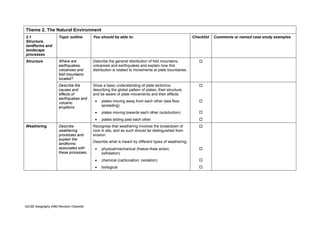
Structure             Where are           Describe the general distribution of fold mountains,
                      earthquakes,        volcanoes and earthquakes and explain how this
                      volcanoes and       distribution is related to movements at plate boundaries.
                      fold mountains
                      located?
                      Describe the        Show a basic understanding of plate tectonics,
                      causes and          describing the global pattern of plates, their structure,
                      effects of          and be aware of plate movements and their effects:
                      earthquakes and
                      volcanic             •   plates moving away from each other (sea floor
                      eruptions                spreading)
                                           •   plates moving towards each other (subduction)
                                           •   plates sliding past each other
Weathering            Describe            Recognise that weathering involves the breakdown of
                      weathering          rock in situ, and as such should be distinguished from
                      processes and       erosion.
                      explain the
                                          Describe what is meant by different types of weathering:
                      landforms
                      associated with      •   physical/mechanical (freeze-thaw action,
                      these processes.         exfoliation)
                                           •   chemical (carbonation, oxidation)
                                           •   biological


IGCSE Geography 0460 Revision Checklist
Theme 2. The Natural Environment
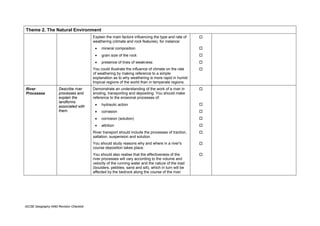
                                          Explain the main factors influencing the type and rate of
                                          weathering (climate and rock features), for instance:
                                           •   mineral composition
                                           •   grain size of the rock
                                           •   presence of lines of weakness
                                          You could illustrate the influence of climate on the rate
                                          of weathering by making reference to a simple
                                          explanation as to why weathering is more rapid in humid
                                          tropical regions of the world than in temperate regions.
River                 Describe river      Demonstrate an understanding of the work of a river in
Processes             processes and       eroding, transporting and depositing. You should make
                      explain the         reference to the erosional processes of:
                      landforms
                      associated with      •   hydraulic action
                      them.                •   corrasion
                                           •   corrosion (solution)
                                           •   attrition
                                          River transport should include the processes of traction,
                                          saltation, suspension and solution.
                                          You should study reasons why and where in a river's
                                          course deposition takes place.
                                          You should also realise that the effectiveness of the
                                          river processes will vary according to the volume and
                                          velocity of the running water and the nature of the load
                                          (boulders, pebbles, sand and silt), which in turn will be
                                          affected by the bedrock along the course of the river.


IGCSE Geography 0460 Revision Checklist
Theme 2. The Natural Environment
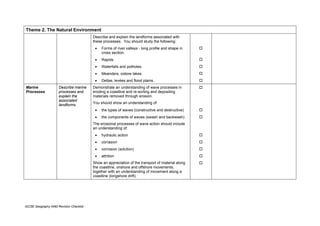
                                          Describe and explain the landforms associated with
                                          these processes. You should study the following:
                                           •   Forms of river valleys - long profile and shape in
                                               cross section.
                                           •   Rapids.
                                           •   Waterfalls and potholes.
                                           •   Meanders, oxbow lakes.
                                           •   Deltas, levées and flood plains.
Marine                Describe marine     Demonstrate an understanding of wave processes in
Processes             processes and       eroding a coastline and re-sorting and depositing
                      explain the         materials removed through erosion.
                      associated
                                          You should show an understanding of:
                      landforms.
                                           •   the types of waves (constructive and destructive)
                                           •   the components of waves (swash and backwash)
                                          The erosional processes of wave action should include
                                          an understanding of:
                                           •   hydraulic action
                                           •   corrasion
                                           •   corrosion (solution)
                                           •   attrition
                                          Show an appreciation of the transport of material along
                                          the coastline, onshore and offshore movements,
                                          together with an understanding of movement along a
                                          coastline (longshore drift).


IGCSE Geography 0460 Revision Checklist
Theme 2. The Natural Environment
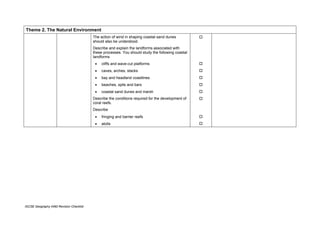
                                          The action of wind in shaping coastal sand dunes
                                          should also be understood.
                                          Describe and explain the landforms associated with
                                          these processes. You should study the following coastal
                                          landforms
                                           •   cliffs and wave-cut platforms
                                           •   caves, arches, stacks
                                           •   bay and headland coastlines
                                           •   beaches, spits and bars
                                           •   coastal sand dunes and marsh
                                          Describe the conditions required for the development of
                                          coral reefs.
                                          Describe
                                           •   fringing and barrier reefs
                                           •   atolls


IGCSE Geography 0460 Revision Checklist
Theme 2. The Natural Environment
2.2                   Topic outline       You should be able to:                                     Checklist   Comments or named case study examples
Weather,
Climate and
Natural
Vegetation
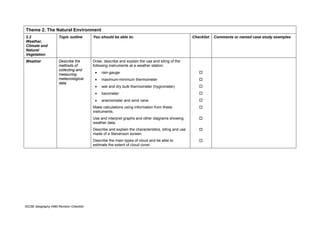
Weather               Describe the        Draw, describe and explain the use and siting of the
                      methods of          following instruments at a weather station:
                      collecting and
                      measuring            •   rain-gauge
                      meteorological       •   maximum-minimum thermometer
                      data.
                                           •   wet and dry bulb thermometer (hygrometer)
                                           •   barometer
                                           •   anemometer and wind vane
                                          Make calculations using information from these
                                          instruments.
                                          Use and interpret graphs and other diagrams showing
                                          weather data.
                                          Describe and explain the characteristics, siting and use
                                          made of a Stevenson screen.
                                          Describe the main types of cloud and be able to
                                          estimate the extent of cloud cover.


IGCSE Geography 0460 Revision Checklist
Theme 2. The Natural Environment
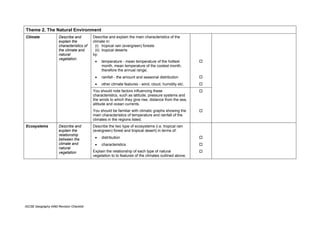
Climate               Describe and         Describe and explain the main characteristics of the
                      explain the          climate in:
                      characteristics of    (i) tropical rain (evergreen) forests
                      the climate and       (ii) tropical deserts
                      natural              by:
                      vegetation.
                                            •   temperature - mean temperature of the hottest
                                                month, mean temperature of the coolest month,
                                                therefore the annual range;
                                            •   rainfall - the amount and seasonal distribution
                                            •   other climate features - wind, cloud, humidity etc.
                                           You should note factors influencing these
                                           characteristics, such as latitude, pressure systems and
                                           the winds to which they give rise, distance from the sea,
                                           altitude and ocean currents.
                                           You should be familiar with climatic graphs showing the
                                           main characteristics of temperature and rainfall of the
                                           climates in the regions listed.
Ecosystems            Describe and         Describe the two type of ecosystems (i.e. tropical rain
                      explain the          (evergreen) forest and tropical desert) in terms of:
                      relationship
                      between the           •   distribution
                      climate and           •   characteristics
                      natural
                      vegetation           Explain the relationship of each type of natural
                                           vegetation to to features of the climates outlined above.


IGCSE Geography 0460 Revision Checklist
Theme 2. The Natural Environment
2.3 Inter-            Topic outline       You should be able to:                                      Checklist   Comments or named case study examples
relationships
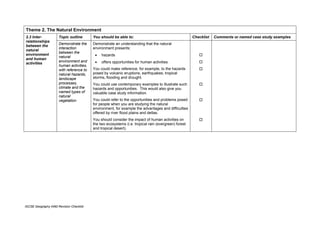
                      Demonstrate the     Demonstrate an understanding that the natural
between the
                      interaction         environment presents:
natural
                      between the
environment
                      natural              •   hazards
and human
activities
                      environment and      •   offers opportunities for human activities.
                      human activities,
                      with reference to   You could make reference, for example, to the hazards
                      natural hazards,    posed by volcanic eruptions, earthquakes, tropical
                      landscape           storms, flooding and drought.
                      processes,          You could use contemporary examples to illustrate such
                      climate and the     hazards and opportunities. This would also give you
                      named types of      valuable case study information.
                      natural
                      vegetation          You could refer to the opportunities and problems posed
                                          for people when you are studying the natural
                                          environment, for example the advantages and difficulties
                                          offered by river flood plains and deltas.
                                          You should consider the impact of human activities on
                                          the two ecosystems (i.e. tropical rain (evergreen) forest
                                          and tropical desert).


IGCSE Geography 0460 Revision Checklist
Theme 3. Economic Development and the Use of Resources
3.1                   Topic outline       You should be able to:                                  Checklist   Comments or named case study examples
Agricultural
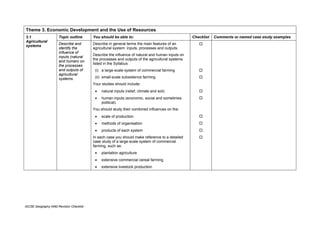
                      Describe and        Describe in general terms the main features of an
systems
                      identify the        agricultural system: inputs, processes and outputs.
                      influence of
                                          Describe the influence of natural and human inputs on
                      inputs (natural
                                          the processes and outputs of the agricultural systems
                      and human) on
                                          listed in the Syllabus:
                      the processes
                      and outputs of       (i) a large-scale system of commercial farming
                      agricultural
                      systems.             (ii) small-scale subsistence farming
                                          Your studies should include:
                                           •   natural inputs (relief, climate and soil)
                                           •   human inputs (economic, social and sometimes
                                               political).
                                          You should study their combined influences on the:
                                           •   scale of production
                                           •   methods of organisation
                                           •   products of each system
                                          In each case you should make reference to a detailed
                                          case study of a large-scale system of commercial
                                          farming, such as:
                                           •   plantation agriculture
                                           •   extensive commercial cereal farming
                                           •   extensive livestock production


IGCSE Geography 0460 Revision Checklist
Theme 3. Economic Development and the Use of Resources
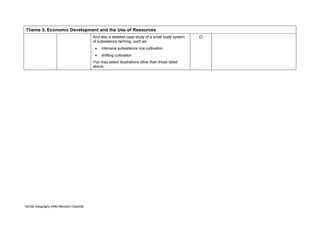
                                          And also a detailed case study of a small scale system
                                          of subsistence farming, such as:
                                           •   intensive subsistence rice cultivation
                                           •   shifting cultivation
                                          You may select illustrations other than those listed
                                          above.


IGCSE Geography 0460 Revision Checklist
Theme 3. Economic Development and the Use of Resources
3.2                   Topic outline        You should be able to:                                     Checklist   Comments or named case study examples
Industrial
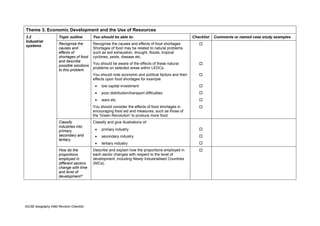
                      Recognise the        Recognise the causes and effects of food shortages.
systems
                      causes and           Shortages of food may be related to natural problems
                      effects of           such as soil exhaustion, drought, floods, tropical
                      shortages of food    cyclones, pests, disease etc.
                      and describe
                                           You should be aware of the effects of these natural
                      possible solutions
                                           problems on selected areas within LEDCs.
                      to this problem.
                                           You should note economic and political factors and their
                                           effects upon food shortages for example
                                            •   low capital investment
                                            •   poor distribution/transport difficulties
                                            •   wars etc.
                                           You should consider the effects of food shortages in
                                           encouraging food aid and measures, such as those of
                                           the 'Green Revolution' to produce more food.
                      Classify             Classify and give illustrations of:
                      industries into
                      primary,              •   primary industry
                      secondary and         •   secondary industry
                      tertiary.
                                            •   tertiary industry
                      How do the           Describe and explain how the proportions employed in
                      proportions          each sector changes with respect to the level of
                      employed in          development, including Newly Industrialised Countries
                      different sectors    (NICs).
                      change with time
                      and level of
                      development?


IGCSE Geography 0460 Revision Checklist
Theme 3. Economic Development and the Use of Resources
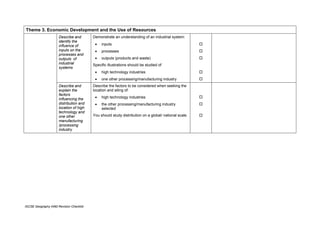
                      Describe and        Demonstrate an understanding of an industrial system:
                      identify the
                      influence of         •   inputs
                      inputs on the        •   processes
                      processes and
                      outputs of           •   outputs (products and waste)
                      industrial          Specific illustrations should be studied of
                      systems
                                           •   high technology industries
                                           •   one other processing/manufacturing industry
                      Describe and        Describe the factors to be considered when seeking the
                      explain the         location and siting of:
                      factors
                      influencing the      •   high technology industries
                      distribution and     •   the other processing/manufacturing industry
                      location of high         selected
                      technology and
                      one other           You should study distribution on a global/ national scale.
                      manufacturing
                      /processing
                      industry


IGCSE Geography 0460 Revision Checklist
Theme 3. Economic Development and the Use of Resources
3.3                   Topic outline       You should be able to:                                        Checklist   Comments or named case study examples
Leisure
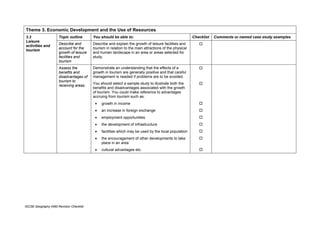
                      Describe and        Describe and explain the growth of leisure facilities and
activities and
                      account for the     tourism in relation to the main attractions of the physical
tourism
                      growth of leisure   and human landscape in an area or areas selected for
                      facilities and      study.
                      tourism
                      Assess the          Demonstrate an understanding that the effects of a
                      benefits and        growth in tourism are generally positive and that careful
                      disadvantages of    management is needed if problems are to be avoided.
                      tourism to
                                          You should select a sample study to illustrate both the
                      receiving areas.
                                          benefits and disadvantages associated with the growth
                                          of tourism. You could make reference to advantages
                                          accruing from tourism such as:
                                           •   growth in income
                                           •   an increase in foreign exchange
                                           •   employment opportunities
                                           •   the development of infrastructure
                                           •   facilities which may be used by the local population
                                           •   the encouragement of other developments to take
                                               place in an area
                                           •   cultural advantages etc.


IGCSE Geography 0460 Revision Checklist
Theme 3. Economic Development and the Use of Resources
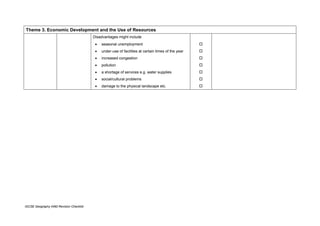
                                          Disadvantages might include
                                           •   seasonal unemployment
                                           •   under-use of facilities at certain times of the year
                                           •   increased congestion
                                           •   pollution
                                           •   a shortage of services e.g. water supplies
                                           •   social/cultural problems
                                           •   damage to the physical landscape etc.


IGCSE Geography 0460 Revision Checklist
Theme 3. Economic Development and the Use of Resources
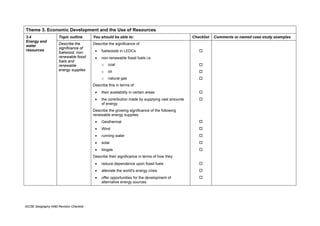
3.4                   Topic outline       You should be able to:                                 Checklist   Comments or named case study examples
Energy and
                      Describe the        Describe the significance of
water
                      significance of
resources
                      fuelwood, non-       •   fuelwoods in LEDCs
                      renewable fossil     •   non-renewable fossil fuels i.e.
                      fuels and
                      renewable                o   coal
                      energy supplies          o   oil
                                               o   natural gas
                                          Describe this in terms of:
                                           •   their availability in certain areas
                                           •   the contribution made by supplying vast amounts
                                               of energy.
                                          Describe the growing significance of the following
                                          renewable energy supplies:
                                           •   Geothermal
                                           •   Wind
                                           •   running water
                                           •   solar
                                           •   biogas
                                          Describe their significance in terms of how they:
                                           •   reduce dependence upon fossil fuels
                                           •   alleviate the world's energy crisis
                                           •   offer opportunities for the development of
                                               alternative energy sources.


IGCSE Geography 0460 Revision Checklist
Theme 3. Economic Development and the Use of Resources
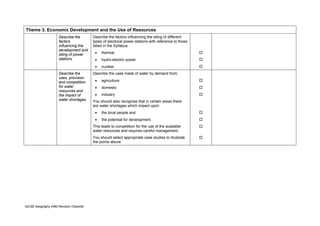
                      Describe the        Describe the factors influencing the siting of different
                      factors             types of electrical power stations with reference to those
                      influencing the     listed in the Syllabus
                      development and
                      siting of power      •   thermal
                      stations             •   hydro-electric power
                                           •   nuclear
                      Describe the        Describe the uses made of water by demand from:
                      uses, provision
                      and competition      •   agriculture
                      for water            •   domestic
                      resources and
                      the impact of        •   industry
                      water shortages     You should also recognise that in certain areas there
                                          are water shortages which impact upon
                                           •   the local people and
                                           •   the potential for development.
                                          This leads to competition for the use of the available
                                          water resources and requires careful management.
                                          You should select appropriate case studies to illustrate
                                          the points above.


IGCSE Geography 0460 Revision Checklist
Theme 3. Economic Development and the Use of Resources
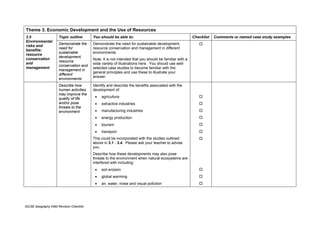
3.5                   Topic outline       You should be able to:                                        Checklist   Comments or named case study examples
Environmental
                      Demonstrate the     Demonstrate the need for sustainable development,
risks and
                      need for            resource conservation and management in different
benefits:
                      sustainable         environments.
resource
                      development,
conservation                              Note: It is not intended that you should be familiar with a
                      resource
and                                       wide variety of illustrations here. You should use well-
                      conservation and
management                                selected case studies to become familiar with the
                      management in
                                          general principles and use these to illustrate your
                      different
                                          answer.
                      environments
                      Describe how        Identify and describe the benefits associated with the
                      human activities    development of:
                      may improve the
                      quality of life      •   agriculture
                      and/or pose          •   extractive industries
                      threats to the
                      environment          •   manufacturing industries
                                           •   energy production
                                           •   tourism
                                           •   transport
                                          This could be incorporated with the studies outlined
                                          above in 3.1 - 3.4. Please ask your teacher to advise
                                          you.
                                          Describe how these developments may also pose
                                          threats to the environment when natural ecosystems are
                                          interfered with including:
                                           •   soil erosion
                                           •   global warming
                                           •   air, water, noise and visual pollution


IGCSE Geography 0460 Revision Checklist
Theme 3. Economic Development and the Use of Resources
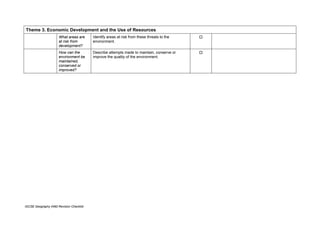
                      What areas are      Identify areas at risk from these threats to the
                      at risk from        environment.
                      development?
                      How can the         Describe attempts made to maintain, conserve or
                      environment be      improve the quality of the environment.
                      maintained,
                      conserved or
                      improved?


IGCSE Geography 0460 Revision Checklist
Appendices

Command words and phrases used in Geography examination Papers

Examiners use command words to help you to understand what they are looking for in your
answers. This table explains what each of these words or phrases means and will help you to
understand the kind of answer you should write. The list of command words is in alphabetical
order. You should remember that the meaning of a term may vary slightly depending on how the
question is worded.

Annotate             You have to add labels of notes or short comments to a diagram, map or
                     photograph. More than one word is needed.
Calculate            You need to give a numerical answer. You should show your working,
                     especially where two or more steps are involved.
Compare              You have to identify similarities and differences. Usually you need to look
                     carefully at two or more sets of data, places, features or geographical ideas,
                     then explain how they are similar and how they are different.
Complete             You need to add the remaining details.
                     e.g. finish a graph using the data or finish a statement, which has been started
                     for you.
Define               You need to state the meaning of something.
                     e.g. Longshore drift is the movement of material along the coast.
Describe             You need to state the main points about something, (to say what it is like).
                     e.g. describe the movement of a pebble along a beach.
                     You may also be asked to describe:
                           • observations e.g. describe what is shown on the photograph
                           • patterns e.g. describe the change shown by the rainfall data
                           • processes e.g. describe how a waterfall is formed
                     Describe is often used with other command words.
                     e.g. Name and describe [name the feature and write the factual details of].
                     e.g. Describe and explain [set out the factual details and give reasons for].

Draw                 You should produce a simple line drawing. The most important points should
                     be shown and usually you should label them.
                     e.g. Draw and label a diagram to show a nucleated settlement.
Explain or                (i) You have to give reasons for your answer.
Account for          OR
                         (ii) refer to a particular geographical theory
                     e.g. explain why rainfall is higher in areas of high altitude
Factor               You need to state what characteristics bring about a certain result
                     e.g. What factors influence the formation of rain?
Identify             You have to recognise a specific feature or features shown, for example, on a
                     graph, photograph, map or text, e.g. identify the spit.
Illustrating              (i) You should use specific examples or case studies to support your
your answer                   comments.
                     OR
                          (ii) You need to produce a labelled diagram to show the important points.
Insert or Label You should add specific names or details to show a feature or features.


IGCSE Geography 0460 Revision Checklist
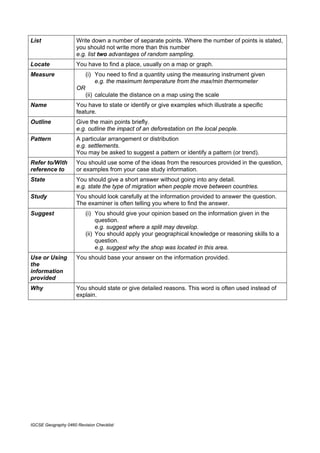
List                 Write down a number of separate points. Where the number of points is stated,
                     you should not write more than this number
                     e.g. list two advantages of random sampling.
Locate               You have to find a place, usually on a map or graph.
Measure                   (i) You need to find a quantity using the measuring instrument given
                              e.g. the maximum temperature from the max/min thermometer
                     OR
                          (ii) calculate the distance on a map using the scale
Name                 You have to state or identify or give examples which illustrate a specific
                     feature.
Outline              Give the main points briefly.
                     e.g. outline the impact of an deforestation on the local people.
Pattern              A particular arrangement or distribution
                     e.g. settlements.
                     You may be asked to suggest a pattern or identify a pattern (or trend).
Refer to/With        You should use some of the ideas from the resources provided in the question,
reference to         or examples from your case study information.
State                You should give a short answer without going into any detail.
                     e.g. state the type of migration when people move between countries.
Study                You should look carefully at the information provided to answer the question.
                     The examiner is often telling you where to find the answer.
Suggest                   (i) You should give your opinion based on the information given in the
                               question.
                               e.g. suggest where a split may develop.
                          (ii) You should apply your geographical knowledge or reasoning skills to a
                               question.
                               e.g. suggest why the shop was located in this area.
Use or Using         You should base your answer on the information provided.
the
information
provided
Why                  You should state or give detailed reasons. This word is often used instead of
                     explain.


IGCSE Geography 0460 Revision Checklist

Revision checklist for igcse geography

  • 1.
    Revision Checklist forIGCSE Geography 0460 A guide for Students
  • 2.
    Revision Checklist forIGCSE Geography 0460 A Guide for Students How to use this guide The guide describes what you need to know about your IGCSE Geography examination. It will help you to plan your revision programme for the examination and will explain what the examiners are looking for in the answers you write. It can also be used to help you to revise by using the tick boxes in Section 3, ‘What you need to know’ to check what you know and which topic areas of Geography you have covered. The guide contains the following sections: Section 1: How will you be tested? This section will give you information about the different examination Papers that are available. Section 2: What will you be tested on? This section describes the areas of knowledge, understanding and skills that the Examiners will test you on. Section 3: What you need to know This shows the syllabus content in a simple way so that you can check: • which topics you need to know • details about each topic in the syllabus • how much of the syllabus you have covered Appendices This section covers other things you need to know such as: • the importance of the command words that Examiners use in the examination Papers • important geographical words Not all the information will be relevant to you. You will have to select what you need to cover in Sections (1) and (3) by finding out from your teacher whether you are doing Coursework or the alternative Paper to coursework. IGCSE Geography 0460 Revision Checklist
  • 3.
    Section 1: Howwill you be tested? 1.1 About the examinations you will take You will take three Papers: two theory Papers, i.e. Paper 1 and Paper 2, and one practical Paper, either .Paper 3 (coursework) or Paper 4 (alternative to coursework). Your teacher will be able to tell you whether you are doing coursework (Paper 3) or taking Paper 4. If you are doing coursework, you will complete two assignments and just take Paper 1 and Paper 2 in the examination. However, if you are not doing coursework, you will take three Papers in the examination, i.e. Paper1, Paper 2 and Paper 4. 1.2 About the theory Papers The table below gives you information about the theory Papers Paper How long and how What’s in the paper? What’s the % of number many marks? the total marks? Paper 1 1hr 45 minutes You must answer three 45% (75 marks) questions from six. There are two questions on each theme. Paper 2 1hr 30 minutes The questions test your skills 27.5% (60 marks) in drawing and understanding geographical information including maps. You must answer all the questions. Here is some more detail about each of the theory Papers: (i) Paper 1 You have to answer three of the six questions available, so take your time to choose your questions carefully at the start of the examination. Each question will be based on one or more resources, which may be a photograph, a map, a sketch map, diagrams, graphs, written information or tables of data. You will be asked to analyse and use the resource/s to show your understanding of geographical ideas. It will not matter that the examples/places used in the questions are not familiar to you, but it is important that you know and understand geographical ideas so that you can apply them to any situation. To gain the highest marks you will often need to illustrate your answer by referring to a relevant case study you have learnt. (ii) Paper 2 This Paper tests your geographical skills. You must answer all the questions, including a compulsory map work question. You will need to use the map extract to answer specific questions about the area shown on the map. The compulsory question may include the use of grid references (4 and 6 figure) and direction, distances, understanding contour lines, and interpreting physical and human features of the area. The other questions will require you to complete and use a variety of different graphs, diagrams, photographs, tables of data, etc. You will also be asked to interpret the information. You will be marked on the accuracy of your answers, so you need to make sure you go to the exam well equipped with a pencil, rubber, ruler, set square and protractor. For the 2006 exam onwards, this paper will be in a booklet with spaces to write your answers. IGCSE Geography 0460 Revision Checklist
  • 4.
    1.3 About thepractical Papers The remaining Papers for IGCSE Geography test your understanding and skills in a more practical way. They cover your knowledge of all three themes and test the skills you need to investigate geographical ideas. Your teacher will be able to tell you whether you will be entering for coursework, Paper 3 (two assignments written in your own time) or the alternative to coursework, Paper 4, which tests the same skills and knowledge as Paper 3 in a timed written examination. Paper How long and how What’s involved? What’s the % of number many marks? the total marks Paper 3 No fixed time You will complete two 27.5% (60 marks) coursework assignments of (you do either 1200 – 1500 words each. Paper 3 or Your teacher will design each Paper 4) investigation. You will carry out the investigation and collect data as a class, BUT you must then write up the investigation on your own. Paper 4 1 hr 30 minutes You will answer two 27.5% (60 marks) questions, each based on a (you do either theoretical investigation, Paper 3 or which test how you would Paper 4) carry out coursework. The questions will cover data collection methods, presenting data, analysing patterns in data and writing a conclusion. Here is some more detail about the practical Papers: (i) Paper 3 (coursework) You will carry out two assignments during your Geography course, which will be assessed by your teacher. Your teacher will give you marks in five different skill areas. Each skill area is marked out of 12 marks. The teacher will look for certain indicators to assess your work. Skill 1: Knowledge with Understanding You will be assessed on how well you understand the geographical ideas of the investigation. You need to describe the aims of the investigation and try to explain them using geographical terms. Your teacher may suggest that you devise a hypothesis, which you then try to investigate. Skill 2: Observation and data collection You will be marked according to how well you carried out your data collection during the investigation, e.g. whether you followed your teacher’s instructions carefully and with thought. To gain the highest marks, you must also show some ideas of your own about data collection and observation, which go beyond those your teacher told you about. Skill 3: Organisation and Presentation of the results Your teacher will suggest the best way to organise your assignment, but you will also be marked on how you choose to organise and present your data, e.g. put it into graphs or display it on maps. The more varied and complicated the presentation techniques that you IGCSE Geography 0460 Revision Checklist
  • 5.
    use, the higherthe marks that you can be given. However, you should remember that the methods must be appropriate, e.g. a bar graph is a better technique than a line graph to show the results of a traffic survey. Skill 4: Analysis You need to write down what your data means. The highest marks are given for both describing the patterns that you find in the data and explaining the reasons for the patterns. For example, you might write, ‘the highest traffic was found at Site X because this was the centre of the town’. If you were then to explain why the centre of the town attracted more traffic, you would be applying your geographical understanding and would be able to gain marks in the top level. Skill 5: Conclusions and Evaluation In the final section you will be assessed on how well you are able to conclude the investigation. Did you prove your hypothesis? What data or evidence did you find to support your concluding decisions? You will also be marked on how you criticise and evaluate your data collection methods. You can gain marks if you outline the problems you encountered whilst collecting the data and suggest better ways of collecting the information for a future investigation. (ii) Paper 4 (alternative to coursework Paper) In this written paper you will be given the outline of two theoretical investigations. Each investigation will be based on a different theme. Data collection methods which will be used in the investigations are questionnaires, observation, measuring and recording data. You may be asked to: • formulate aims or hypotheses • outline how data may be collected during an investigation • plot data or complete graphs of data • describe the patterns in the statistics or graphs provided • explain the meaning of the graphs using your geographical understanding • write a conclusion to a theoretical investigation • evaluate the data collection methods used in the investigation This Paper will be in a booklet with spaces to write your answers. IGCSE Geography 0460 Revision Checklist
  • 6.
    Section 2: Whatwill you be tested on? The Examiners take account of the following skill areas in your examination Papers: (1) your knowledge (what you remember) and understanding (how you use what you know and apply it to unfamiliar situations) (2) how you analyse information e.g. data, graphs, diagrams, photographs (3) how you make judgements and decisions, including conclusions, based on information (4) your ability to investigate geographical ideas and issues These skills are called assessment objectives. They are explained in the table below. Your teacher will be able to give you more information about how each of these is tested in the examination Papers. Assessment What the objective What you need to be able to do objective means A: Remembering facts and (i) Show an understanding of Knowledge applying these facts to • processes which produce certain with new situations environments and landscapes. understanding • the patterns and links between physical, economic, social, political and cultural parts of these environments and landscapes. (ii) Describe and explain the links between people’s activities and environments. (iii) Understand the scale and timeframe of systems and the spatial patterns studied. (iv) Understand the changes in different places, landscapes and spatial patterns. B: How you select (i) Organise and present geographical data in Analysis information and apply the form of numbers, diagrams, images and geographical graphs. understanding to (ii) Use the geographical data to recognise explain the information patterns and explain them using geographical ideas. C: Being able to make (i) Use your geographical training to reason and Judgement judgements based on make judgements which and decision information and • show a concern for the landscape and making recognise possible environments decisions • appreciate the earth • appreciate the attitudes, values and beliefs of others • be aware of both opportunities and constraints of locations • have a willingness to be challenged about your views. (ii) Recognise the role of decision makers and how their choices are affected by values, perceptions, influences and constraints D: How well you undertake (i) Collect data from a variety of different Investigation practical investigations sources (ii) Present information in a graphs or diagrams (iii) Analyse and interpret data IGCSE Geography 0460 Revision Checklist
  • 7.
    Section 3: Whatyou need to know The table describes the things you may be tested on in the examination. It is arranged in three Themes with several topic areas within each Theme. Each topic is divided up into sections, which contain the detail that you need to know. How to use the table You can use the table throughout your course to check the topic areas you have covered. You can also use it as a revision aid. When you think you have a good knowledge of a topic, you can tick the appropriate box in the checklist column. Test yourself as follows: • cover up the details with a piece of paper • try to remember the details • when you have remembered the details correctly, put a tick in the appropriate box If you use a pencil to tick the boxes, you can retest yourself whenever you want by simply rubbing out the ticks. If you are using the table as a checklist of which topics you have covered, you can put a tick in the topic column next to the appropriate bullet point. The column headed Comments can be used: • to add further information about the details for each bullet point • to add learning aids e.g. CASH (for corrosion, attrition, solution, hydraulic action) • to highlight areas of difficulty/ things which you need to ask your teacher about IGCSE Geography 0460 Revision Checklist
  • 8.
    Theme 1. Populationand Settlement 1.1 Topic outline You should be able to: Checklist Comments or named case study examples Population Population Describe and suggest reasons for the rapid increase in dynamics increase the world’s population in recent times (known as ‘the population explosion’) Factors Define the main components influencing the population influencing growth: population increase • Birth Rate • Death rate • Migration How and why is Describe the relationship between population growth population growth and resources. linked to Explain why problems may result in some areas such as resources? over-population and under-population. Why do Identify and suggest reasons for contrasting patterns of populations grow population growth in different world areas as influenced at different rates? by differences in birth rate, death rate and migration. You should illustrate these factors by making reference to selected examples. Social, economic and other factors to be considered are, for example: • Government policies and their impact upon birth rates • Differences in health care • Social and other factors influencing death rates • The impact of HIV/AIDS IGCSE Geography 0460 Revision Checklist
  • 9.
    Theme 1. Populationand Settlement What are the Describe the consequences (benefits and problems) of problems and different patterns of population growth. benefits of You should give consideration to variations in the size different patterns and nature of dependent populations and standards of of population living. growth? Population Identify and suggest reasons for different types of structure population structure (age-sex pyramids). You should be able to describe population pyramids and relate them to the different stages of the Demographic Transition Model. What influences Identify the major influences on: population density and • population density distribution? • population distribution You should make reference to physical, economic and human factors. How and why do Describe and suggest reasons for population people move? movements. You should make reference to: • internal movements such as rural-urban migration • international movements, both voluntary and involuntary IGCSE Geography 0460 Revision Checklist
  • 10.
    Theme 1. Populationand Settlement 1.2 Topic outline You should be able to: Checklist Comments or named case study examples Types of Describe and Describe the patterns of rural settlements - dispersed, Settlement explain the linear and nucleated. factors Explain how physical factors (relief, soil, water supply) influencing the and other factors such as accessibility, agricultural land size, use, influence the sites and patterns of rural development and settlements. function of urban and rural Describe and explain the factors, which may influence settlements and the size, growth and functions of rural and urban their spheres of settlements. influence. Describe and suggest reasons for the hierarchy of settlements and services. Describe and Describe and explain the land use zones of towns and give reasons for cities to include: the characteristics of • Central Business District (CBD) land use zones of • residential areas urban areas in LEDCs and • industrial areas MEDCs. • the provision of open spaces • transport routes Differences in the patterns of urban structures in cities of LEDCs and MEDCs should be identified. IGCSE Geography 0460 Revision Checklist
  • 11.
    Theme 1. Populationand Settlement Describe the Describe problems associated with the growth of urban problems of areas such as: urban areas in MEDCs and • congestion in the CBD LEDCs, their • housing shortages causes and possible • traffic congestion solutions. • squatter settlements You should make reference to selected examples to illustrate suggested solutions to overcome these problems. Describe the Describe the effects of urbanisation on the environment: impact on the environment • pollution (air, water, visual and noise) resulting from • the results of urban sprawl on surrounding areas urbanisation and possible solutions • the growth of out-of-town urban activities - to reduce this shopping areas, sports facilities, etc. impact. IGCSE Geography 0460 Revision Checklist
  • 12.
    Theme 2. TheNatural Environment 2.1 Topic outline You should be able to: Checklist Comments or named case study examples Structure, landforms and landscape processes Structure Where are Describe the general distribution of fold mountains, earthquakes, volcanoes and earthquakes and explain how this volcanoes and distribution is related to movements at plate boundaries. fold mountains located? Describe the Show a basic understanding of plate tectonics, causes and describing the global pattern of plates, their structure, effects of and be aware of plate movements and their effects: earthquakes and volcanic • plates moving away from each other (sea floor eruptions spreading) • plates moving towards each other (subduction) • plates sliding past each other Weathering Describe Recognise that weathering involves the breakdown of weathering rock in situ, and as such should be distinguished from processes and erosion. explain the Describe what is meant by different types of weathering: landforms associated with • physical/mechanical (freeze-thaw action, these processes. exfoliation) • chemical (carbonation, oxidation) • biological IGCSE Geography 0460 Revision Checklist
  • 13.
    Theme 2. TheNatural Environment Explain the main factors influencing the type and rate of weathering (climate and rock features), for instance: • mineral composition • grain size of the rock • presence of lines of weakness You could illustrate the influence of climate on the rate of weathering by making reference to a simple explanation as to why weathering is more rapid in humid tropical regions of the world than in temperate regions. River Describe river Demonstrate an understanding of the work of a river in Processes processes and eroding, transporting and depositing. You should make explain the reference to the erosional processes of: landforms associated with • hydraulic action them. • corrasion • corrosion (solution) • attrition River transport should include the processes of traction, saltation, suspension and solution. You should study reasons why and where in a river's course deposition takes place. You should also realise that the effectiveness of the river processes will vary according to the volume and velocity of the running water and the nature of the load (boulders, pebbles, sand and silt), which in turn will be affected by the bedrock along the course of the river. IGCSE Geography 0460 Revision Checklist
  • 14.
    Theme 2. TheNatural Environment Describe and explain the landforms associated with these processes. You should study the following: • Forms of river valleys - long profile and shape in cross section. • Rapids. • Waterfalls and potholes. • Meanders, oxbow lakes. • Deltas, levées and flood plains. Marine Describe marine Demonstrate an understanding of wave processes in Processes processes and eroding a coastline and re-sorting and depositing explain the materials removed through erosion. associated You should show an understanding of: landforms. • the types of waves (constructive and destructive) • the components of waves (swash and backwash) The erosional processes of wave action should include an understanding of: • hydraulic action • corrasion • corrosion (solution) • attrition Show an appreciation of the transport of material along the coastline, onshore and offshore movements, together with an understanding of movement along a coastline (longshore drift). IGCSE Geography 0460 Revision Checklist
  • 15.
    Theme 2. TheNatural Environment The action of wind in shaping coastal sand dunes should also be understood. Describe and explain the landforms associated with these processes. You should study the following coastal landforms • cliffs and wave-cut platforms • caves, arches, stacks • bay and headland coastlines • beaches, spits and bars • coastal sand dunes and marsh Describe the conditions required for the development of coral reefs. Describe • fringing and barrier reefs • atolls IGCSE Geography 0460 Revision Checklist
  • 16.
    Theme 2. TheNatural Environment 2.2 Topic outline You should be able to: Checklist Comments or named case study examples Weather, Climate and Natural Vegetation Weather Describe the Draw, describe and explain the use and siting of the methods of following instruments at a weather station: collecting and measuring • rain-gauge meteorological • maximum-minimum thermometer data. • wet and dry bulb thermometer (hygrometer) • barometer • anemometer and wind vane Make calculations using information from these instruments. Use and interpret graphs and other diagrams showing weather data. Describe and explain the characteristics, siting and use made of a Stevenson screen. Describe the main types of cloud and be able to estimate the extent of cloud cover. IGCSE Geography 0460 Revision Checklist
  • 17.
    Theme 2. TheNatural Environment Climate Describe and Describe and explain the main characteristics of the explain the climate in: characteristics of (i) tropical rain (evergreen) forests the climate and (ii) tropical deserts natural by: vegetation. • temperature - mean temperature of the hottest month, mean temperature of the coolest month, therefore the annual range; • rainfall - the amount and seasonal distribution • other climate features - wind, cloud, humidity etc. You should note factors influencing these characteristics, such as latitude, pressure systems and the winds to which they give rise, distance from the sea, altitude and ocean currents. You should be familiar with climatic graphs showing the main characteristics of temperature and rainfall of the climates in the regions listed. Ecosystems Describe and Describe the two type of ecosystems (i.e. tropical rain explain the (evergreen) forest and tropical desert) in terms of: relationship between the • distribution climate and • characteristics natural vegetation Explain the relationship of each type of natural vegetation to to features of the climates outlined above. IGCSE Geography 0460 Revision Checklist
  • 18.
    Theme 2. TheNatural Environment 2.3 Inter- Topic outline You should be able to: Checklist Comments or named case study examples relationships Demonstrate the Demonstrate an understanding that the natural between the interaction environment presents: natural between the environment natural • hazards and human activities environment and • offers opportunities for human activities. human activities, with reference to You could make reference, for example, to the hazards natural hazards, posed by volcanic eruptions, earthquakes, tropical landscape storms, flooding and drought. processes, You could use contemporary examples to illustrate such climate and the hazards and opportunities. This would also give you named types of valuable case study information. natural vegetation You could refer to the opportunities and problems posed for people when you are studying the natural environment, for example the advantages and difficulties offered by river flood plains and deltas. You should consider the impact of human activities on the two ecosystems (i.e. tropical rain (evergreen) forest and tropical desert). IGCSE Geography 0460 Revision Checklist
  • 19.
    Theme 3. EconomicDevelopment and the Use of Resources 3.1 Topic outline You should be able to: Checklist Comments or named case study examples Agricultural Describe and Describe in general terms the main features of an systems identify the agricultural system: inputs, processes and outputs. influence of Describe the influence of natural and human inputs on inputs (natural the processes and outputs of the agricultural systems and human) on listed in the Syllabus: the processes and outputs of (i) a large-scale system of commercial farming agricultural systems. (ii) small-scale subsistence farming Your studies should include: • natural inputs (relief, climate and soil) • human inputs (economic, social and sometimes political). You should study their combined influences on the: • scale of production • methods of organisation • products of each system In each case you should make reference to a detailed case study of a large-scale system of commercial farming, such as: • plantation agriculture • extensive commercial cereal farming • extensive livestock production IGCSE Geography 0460 Revision Checklist
  • 20.
    Theme 3. EconomicDevelopment and the Use of Resources And also a detailed case study of a small scale system of subsistence farming, such as: • intensive subsistence rice cultivation • shifting cultivation You may select illustrations other than those listed above. IGCSE Geography 0460 Revision Checklist
  • 21.
    Theme 3. EconomicDevelopment and the Use of Resources 3.2 Topic outline You should be able to: Checklist Comments or named case study examples Industrial Recognise the Recognise the causes and effects of food shortages. systems causes and Shortages of food may be related to natural problems effects of such as soil exhaustion, drought, floods, tropical shortages of food cyclones, pests, disease etc. and describe You should be aware of the effects of these natural possible solutions problems on selected areas within LEDCs. to this problem. You should note economic and political factors and their effects upon food shortages for example • low capital investment • poor distribution/transport difficulties • wars etc. You should consider the effects of food shortages in encouraging food aid and measures, such as those of the 'Green Revolution' to produce more food. Classify Classify and give illustrations of: industries into primary, • primary industry secondary and • secondary industry tertiary. • tertiary industry How do the Describe and explain how the proportions employed in proportions each sector changes with respect to the level of employed in development, including Newly Industrialised Countries different sectors (NICs). change with time and level of development? IGCSE Geography 0460 Revision Checklist
  • 22.
    Theme 3. EconomicDevelopment and the Use of Resources Describe and Demonstrate an understanding of an industrial system: identify the influence of • inputs inputs on the • processes processes and outputs of • outputs (products and waste) industrial Specific illustrations should be studied of systems • high technology industries • one other processing/manufacturing industry Describe and Describe the factors to be considered when seeking the explain the location and siting of: factors influencing the • high technology industries distribution and • the other processing/manufacturing industry location of high selected technology and one other You should study distribution on a global/ national scale. manufacturing /processing industry IGCSE Geography 0460 Revision Checklist
  • 23.
    Theme 3. EconomicDevelopment and the Use of Resources 3.3 Topic outline You should be able to: Checklist Comments or named case study examples Leisure Describe and Describe and explain the growth of leisure facilities and activities and account for the tourism in relation to the main attractions of the physical tourism growth of leisure and human landscape in an area or areas selected for facilities and study. tourism Assess the Demonstrate an understanding that the effects of a benefits and growth in tourism are generally positive and that careful disadvantages of management is needed if problems are to be avoided. tourism to You should select a sample study to illustrate both the receiving areas. benefits and disadvantages associated with the growth of tourism. You could make reference to advantages accruing from tourism such as: • growth in income • an increase in foreign exchange • employment opportunities • the development of infrastructure • facilities which may be used by the local population • the encouragement of other developments to take place in an area • cultural advantages etc. IGCSE Geography 0460 Revision Checklist
  • 24.
    Theme 3. EconomicDevelopment and the Use of Resources Disadvantages might include • seasonal unemployment • under-use of facilities at certain times of the year • increased congestion • pollution • a shortage of services e.g. water supplies • social/cultural problems • damage to the physical landscape etc. IGCSE Geography 0460 Revision Checklist
  • 25.
    Theme 3. EconomicDevelopment and the Use of Resources 3.4 Topic outline You should be able to: Checklist Comments or named case study examples Energy and Describe the Describe the significance of water significance of resources fuelwood, non- • fuelwoods in LEDCs renewable fossil • non-renewable fossil fuels i.e. fuels and renewable o coal energy supplies o oil o natural gas Describe this in terms of: • their availability in certain areas • the contribution made by supplying vast amounts of energy. Describe the growing significance of the following renewable energy supplies: • Geothermal • Wind • running water • solar • biogas Describe their significance in terms of how they: • reduce dependence upon fossil fuels • alleviate the world's energy crisis • offer opportunities for the development of alternative energy sources. IGCSE Geography 0460 Revision Checklist
  • 26.
    Theme 3. EconomicDevelopment and the Use of Resources Describe the Describe the factors influencing the siting of different factors types of electrical power stations with reference to those influencing the listed in the Syllabus development and siting of power • thermal stations • hydro-electric power • nuclear Describe the Describe the uses made of water by demand from: uses, provision and competition • agriculture for water • domestic resources and the impact of • industry water shortages You should also recognise that in certain areas there are water shortages which impact upon • the local people and • the potential for development. This leads to competition for the use of the available water resources and requires careful management. You should select appropriate case studies to illustrate the points above. IGCSE Geography 0460 Revision Checklist
  • 27.
    Theme 3. EconomicDevelopment and the Use of Resources 3.5 Topic outline You should be able to: Checklist Comments or named case study examples Environmental Demonstrate the Demonstrate the need for sustainable development, risks and need for resource conservation and management in different benefits: sustainable environments. resource development, conservation Note: It is not intended that you should be familiar with a resource and wide variety of illustrations here. You should use well- conservation and management selected case studies to become familiar with the management in general principles and use these to illustrate your different answer. environments Describe how Identify and describe the benefits associated with the human activities development of: may improve the quality of life • agriculture and/or pose • extractive industries threats to the environment • manufacturing industries • energy production • tourism • transport This could be incorporated with the studies outlined above in 3.1 - 3.4. Please ask your teacher to advise you. Describe how these developments may also pose threats to the environment when natural ecosystems are interfered with including: • soil erosion • global warming • air, water, noise and visual pollution IGCSE Geography 0460 Revision Checklist
  • 28.
    Theme 3. EconomicDevelopment and the Use of Resources What areas are Identify areas at risk from these threats to the at risk from environment. development? How can the Describe attempts made to maintain, conserve or environment be improve the quality of the environment. maintained, conserved or improved? IGCSE Geography 0460 Revision Checklist
  • 29.
    Appendices Command words andphrases used in Geography examination Papers Examiners use command words to help you to understand what they are looking for in your answers. This table explains what each of these words or phrases means and will help you to understand the kind of answer you should write. The list of command words is in alphabetical order. You should remember that the meaning of a term may vary slightly depending on how the question is worded. Annotate You have to add labels of notes or short comments to a diagram, map or photograph. More than one word is needed. Calculate You need to give a numerical answer. You should show your working, especially where two or more steps are involved. Compare You have to identify similarities and differences. Usually you need to look carefully at two or more sets of data, places, features or geographical ideas, then explain how they are similar and how they are different. Complete You need to add the remaining details. e.g. finish a graph using the data or finish a statement, which has been started for you. Define You need to state the meaning of something. e.g. Longshore drift is the movement of material along the coast. Describe You need to state the main points about something, (to say what it is like). e.g. describe the movement of a pebble along a beach. You may also be asked to describe: • observations e.g. describe what is shown on the photograph • patterns e.g. describe the change shown by the rainfall data • processes e.g. describe how a waterfall is formed Describe is often used with other command words. e.g. Name and describe [name the feature and write the factual details of]. e.g. Describe and explain [set out the factual details and give reasons for]. Draw You should produce a simple line drawing. The most important points should be shown and usually you should label them. e.g. Draw and label a diagram to show a nucleated settlement. Explain or (i) You have to give reasons for your answer. Account for OR (ii) refer to a particular geographical theory e.g. explain why rainfall is higher in areas of high altitude Factor You need to state what characteristics bring about a certain result e.g. What factors influence the formation of rain? Identify You have to recognise a specific feature or features shown, for example, on a graph, photograph, map or text, e.g. identify the spit. Illustrating (i) You should use specific examples or case studies to support your your answer comments. OR (ii) You need to produce a labelled diagram to show the important points. Insert or Label You should add specific names or details to show a feature or features. IGCSE Geography 0460 Revision Checklist
  • 30.
    List Write down a number of separate points. Where the number of points is stated, you should not write more than this number e.g. list two advantages of random sampling. Locate You have to find a place, usually on a map or graph. Measure (i) You need to find a quantity using the measuring instrument given e.g. the maximum temperature from the max/min thermometer OR (ii) calculate the distance on a map using the scale Name You have to state or identify or give examples which illustrate a specific feature. Outline Give the main points briefly. e.g. outline the impact of an deforestation on the local people. Pattern A particular arrangement or distribution e.g. settlements. You may be asked to suggest a pattern or identify a pattern (or trend). Refer to/With You should use some of the ideas from the resources provided in the question, reference to or examples from your case study information. State You should give a short answer without going into any detail. e.g. state the type of migration when people move between countries. Study You should look carefully at the information provided to answer the question. The examiner is often telling you where to find the answer. Suggest (i) You should give your opinion based on the information given in the question. e.g. suggest where a split may develop. (ii) You should apply your geographical knowledge or reasoning skills to a question. e.g. suggest why the shop was located in this area. Use or Using You should base your answer on the information provided. the information provided Why You should state or give detailed reasons. This word is often used instead of explain. IGCSE Geography 0460 Revision Checklist