Case Study: Mount Etna
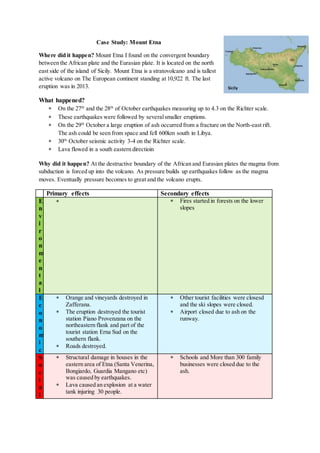
Where did it happen? Mount Etna I found on the convergent boundary
between the African plate and the Eurasian plate. It is located on the north
east side of the island of Sicily. Mount Etna is a stratovolcano and is tallest
active volcano on The European continent standing at 10,922 ft. The last
eruption was in 2013.
What happened?
 On the 27th
and the 28th
of October earthquakes measuring up to 4.3 on the Richter scale.
 These earthquakes were followed by severalsmaller eruptions.
 On the 29th
October a large eruption of ash occurred from a fracture on the North-east rift.
The ash could be seen from space and fell 600km south in Libya.
 30th
October seismic activity 3-4 on the Richter scale.
 Lava flowed in a south eastern directioin
Why did it happen? At the destructive boundary of the African and Eurasian plates the magma from
subduction is forced up into the volcano. As pressure builds up earthquakes follow as the magma
moves. Eventually pressure becomes to great and the volcano erupts.
Primary effects Secondary effects
E
n
v
i
r
o
n
m
e
n
t
a
l
  Fires started in forests on the lower
slopes
E
c
o
n
o
m
i
c
 Orange and vineyards destroyed in
Zafferana.
 The eruption destroyed the tourist
station Piano Provenzana on the
northeastern flank and part of the
tourist station Erna Sud on the
southern flank.
 Roads destroyed.
 Other tourist facilities were closesd
and the ski slopes were closed.
 Airport closed due to ash on the
runway.
S
o
c
i
a
l
 Structural damage in houses in the
eastern area of Etna (Santa Venerina,
Bongiardo, Guardia Mangano etc)
was caused by earthquakes.
 Lava caused an explosion at a water
tank injuring 30 people.
 Schools and More than 300 family
businesses were closed due to the
ash.
Sicily
Immediate responses Long term responses
 Italian government gave £5.6 million in
aid.
 A ship equipped with an emergency
clinic was positioned off Catania in case
of emergency.
 Damaged buildings rebuilt
 Scientists improve the monitoring of the
volcano
 Italian government gave tax breaks to
help villagers through the crisis.
Howdid they cope with lava flows? There was attempts divert the lava flow away from villages
such as Zafferena. This was done by creating barriers which stopped the lava. Us helicopters dropped
2 tonnes of concrete blocks to stop the lava flow. Similarly earth dams were built to redirect the lava
flow and 500kg of mines were exploded to divert the lava. These attempts were mostly successful
however there was damage to tourist structures around Rifugio Sapienza.
Howwas the hazard managed? The volcano is being constantly monitored by scientists and, as the
area has frequent eruptions the locals know what to do and there is evacuation plans in place.

Mount Etna case study

  • 1.
    Case Study: MountEtna Where did it happen? Mount Etna I found on the convergent boundary between the African plate and the Eurasian plate. It is located on the north east side of the island of Sicily. Mount Etna is a stratovolcano and is tallest active volcano on The European continent standing at 10,922 ft. The last eruption was in 2013. What happened?  On the 27th and the 28th of October earthquakes measuring up to 4.3 on the Richter scale.  These earthquakes were followed by severalsmaller eruptions.  On the 29th October a large eruption of ash occurred from a fracture on the North-east rift. The ash could be seen from space and fell 600km south in Libya.  30th October seismic activity 3-4 on the Richter scale.  Lava flowed in a south eastern directioin Why did it happen? At the destructive boundary of the African and Eurasian plates the magma from subduction is forced up into the volcano. As pressure builds up earthquakes follow as the magma moves. Eventually pressure becomes to great and the volcano erupts. Primary effects Secondary effects E n v i r o n m e n t a l   Fires started in forests on the lower slopes E c o n o m i c  Orange and vineyards destroyed in Zafferana.  The eruption destroyed the tourist station Piano Provenzana on the northeastern flank and part of the tourist station Erna Sud on the southern flank.  Roads destroyed.  Other tourist facilities were closesd and the ski slopes were closed.  Airport closed due to ash on the runway. S o c i a l  Structural damage in houses in the eastern area of Etna (Santa Venerina, Bongiardo, Guardia Mangano etc) was caused by earthquakes.  Lava caused an explosion at a water tank injuring 30 people.  Schools and More than 300 family businesses were closed due to the ash. Sicily
  • 2.
    Immediate responses Longterm responses  Italian government gave £5.6 million in aid.  A ship equipped with an emergency clinic was positioned off Catania in case of emergency.  Damaged buildings rebuilt  Scientists improve the monitoring of the volcano  Italian government gave tax breaks to help villagers through the crisis. Howdid they cope with lava flows? There was attempts divert the lava flow away from villages such as Zafferena. This was done by creating barriers which stopped the lava. Us helicopters dropped 2 tonnes of concrete blocks to stop the lava flow. Similarly earth dams were built to redirect the lava flow and 500kg of mines were exploded to divert the lava. These attempts were mostly successful however there was damage to tourist structures around Rifugio Sapienza. Howwas the hazard managed? The volcano is being constantly monitored by scientists and, as the area has frequent eruptions the locals know what to do and there is evacuation plans in place.