AS Unit 2:  Extreme Weather The nature and   distribution of different types of extreme   weather


The Geography Dept A level Blog! www.kingsgeography.blogspot.com
Development Compass Rose
 
Extreme Weather Events Tornado Hurricane Drought Wildfire Blizzards / Ice Storms Heatwaves Continual Depressions (prolonged wind and rain) WHICH TYPE OF EXTREME WEATHER HAS THE MOST IMPACT? WHY? Use the compass rose to sort all the ideas from your group.
 
How can we classify an extreme weather event? Scale :   Widespread – small scale/local Development :  rapid – slow Duration : Long – short Economic Costs : High – Low Fatalities : High – Low Any other?
We all think about and talk about the weather. It affects our decisions and can change our lives….
What is the IMPACT of weather? Classify  all your DETAILED responses  into… SOCIO-CULTURAL ( people and society) ENVIRONMENTAL/ECOLOGICAL ECONOMIC
Socio-Cultural Accident records from A&E (impact of cold vs hot, especially at festivals, sporting events etc)  Health and low-level ozone Impact on sporting activities, e.g. (i)  Football  – visibility, rain, waterlogged pitch, (ii)  Tennis , rain, high winds, visibility (iii)  Cricket,   rain (heat (problem for players), visibility, humidity (ball swing) (iv)  Formula 1  – choice of types: dry vs wet etc
Climate change indicators, e.g. dates of: frog spawn, butterflies, bumblebee, ladybird.  Dates of appearance, comparison with previous years (‘Springwatch’) Weather conditions and use of water by people and plants  Qualitative observations of grass quality / stress due to lack of moisture; plant health, e.g. symptoms of frost, water-logging; plant stress detection glasses Environmental / Ecological
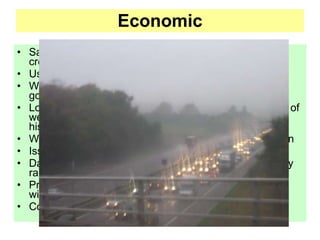
Sales in stores, e.g. summer vs winter clothing, ice-creams, beer, BBQs.  Use of special promotions to meet demand  Work – poor weather absences, or loss of days due to good weather (questionnaire at school?) Loss of agricultural output / productivity, e.g correlation of weather (especially drought) to commodity prices, oral histories  Window of opportunity, i.e. extension of summer season Issue of water resources, e.g. irrigation of golf-courses  Damage to roads in extreme weather, e.g. high intensity rain triggers landslides (susceptibility score) Property damage, e.g. claims on subsidence (drought), windstorm damage, freezing (burst pipe) Costs of abandonment policies for outdoor spectacles  Economic
Extended Weekly Task  … in addition to your own background reading! Keep a weather diary for 7 days  (see  weather diary exemplars ) What should this include? How do I record it? Use the STUDY ROOM with weather station (online soon!) Read into the info sheet on  The passing of a depression  –  this may occur over the next 14 days! Next weeks lesson: This will start with a brief look at  WEATHER EXTREMES IN THE UK . You might like to find out for example, the coldest recorded temperature, the wettest place, or the warmest month on record.

Unit 2 extreme weather 1

  • 1.
    AS Unit 2: Extreme Weather The nature and distribution of different types of extreme weather
  • 2.
  • 3.
  • 4.
  • 5.
  • 6.
  • 7.
  • 8.
  • 9.
    The Geography DeptA level Blog! www.kingsgeography.blogspot.com
  • 10.
  • 11.
  • 12.
    Extreme Weather EventsTornado Hurricane Drought Wildfire Blizzards / Ice Storms Heatwaves Continual Depressions (prolonged wind and rain) WHICH TYPE OF EXTREME WEATHER HAS THE MOST IMPACT? WHY? Use the compass rose to sort all the ideas from your group.
  • 13.
  • 14.
    How can weclassify an extreme weather event? Scale : Widespread – small scale/local Development : rapid – slow Duration : Long – short Economic Costs : High – Low Fatalities : High – Low Any other?
  • 15.
    We all thinkabout and talk about the weather. It affects our decisions and can change our lives….
  • 16.
    What is theIMPACT of weather? Classify all your DETAILED responses into… SOCIO-CULTURAL ( people and society) ENVIRONMENTAL/ECOLOGICAL ECONOMIC
  • 17.
    Socio-Cultural Accident recordsfrom A&E (impact of cold vs hot, especially at festivals, sporting events etc) Health and low-level ozone Impact on sporting activities, e.g. (i) Football – visibility, rain, waterlogged pitch, (ii) Tennis , rain, high winds, visibility (iii) Cricket, rain (heat (problem for players), visibility, humidity (ball swing) (iv) Formula 1 – choice of types: dry vs wet etc
  • 18.
    Climate change indicators,e.g. dates of: frog spawn, butterflies, bumblebee, ladybird. Dates of appearance, comparison with previous years (‘Springwatch’) Weather conditions and use of water by people and plants Qualitative observations of grass quality / stress due to lack of moisture; plant health, e.g. symptoms of frost, water-logging; plant stress detection glasses Environmental / Ecological
  • 19.
    Sales in stores,e.g. summer vs winter clothing, ice-creams, beer, BBQs. Use of special promotions to meet demand Work – poor weather absences, or loss of days due to good weather (questionnaire at school?) Loss of agricultural output / productivity, e.g correlation of weather (especially drought) to commodity prices, oral histories Window of opportunity, i.e. extension of summer season Issue of water resources, e.g. irrigation of golf-courses Damage to roads in extreme weather, e.g. high intensity rain triggers landslides (susceptibility score) Property damage, e.g. claims on subsidence (drought), windstorm damage, freezing (burst pipe) Costs of abandonment policies for outdoor spectacles Economic
  • 20.
    Extended Weekly Task … in addition to your own background reading! Keep a weather diary for 7 days (see weather diary exemplars ) What should this include? How do I record it? Use the STUDY ROOM with weather station (online soon!) Read into the info sheet on The passing of a depression – this may occur over the next 14 days! Next weeks lesson: This will start with a brief look at WEATHER EXTREMES IN THE UK . You might like to find out for example, the coldest recorded temperature, the wettest place, or the warmest month on record.