The Physical Characteristics of Tropical CyclonesCase Study: The 1970 Bhola Cyclone
Cyclones, Hurricanes, TyphoonsNamed according to region (1)Cyclones – Develop over the Indian Ocean(1)Hurricanes - Develop over Atlantic and eastern Pacific Oceans(1)Typhoons – Develop over western Pacific Oceans(1)All produce similar effects(1)EyeTyphoon Odessa, Philippines
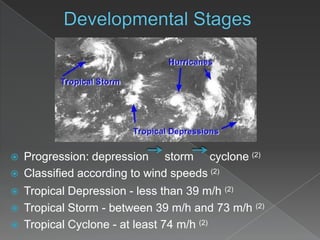
Developmental StagesProgression: depression     storm     cyclone(2) Classified according to wind speeds(2)Tropical Depression - less than 39 m/h (2)Tropical Storm - between 39 m/h and 73 m/h (2) Tropical Cyclone - at least 74 m/h (2)
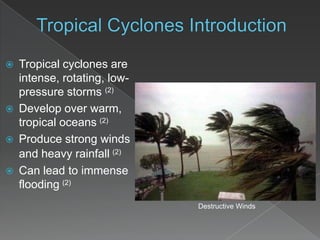
Tropical Cyclones IntroductionTropical cyclones are intense, rotating, low-pressure storms (2)Develop over warm, tropical oceans(2) Produce strong winds and heavy rainfall(2)Can lead to immense flooding(2) Destructive Winds
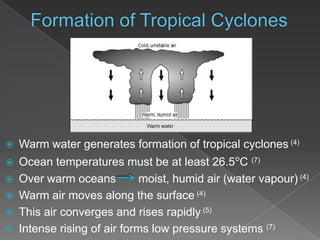
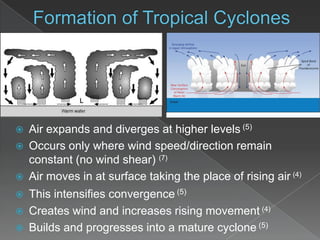
Formation of Tropical CyclonesWarm water generates formation of tropical cyclones(4)Ocean temperatures must be at least 26.5°C(7)Over warm oceans       moist, humid air (water vapour)(4)Warm air moves along the surface(4)This air converges and rises rapidly(5) Intense rising of air forms low pressure systems (7)
Formation of Tropical CyclonesAs air rises, it cools, becomes saturated and condenses(4)Water vapour condenses into liquid droplets(4)Formation of thunderclouds(5) Condensation releases heat stored in water vapour(4)This latent heat warms the atmosphere(4)Air becomes lighter causing strong updrafts(4)
Formation of Tropical CyclonesAir expands and diverges at higher levels(5) Occurs only where wind speed/direction remain constant (no wind shear) (7)Air moves in at surface taking the place of rising air(4)This intensifies convergence(5)Creates wind and increases rising movement(4)Builds and progresses into a mature cyclone(5)
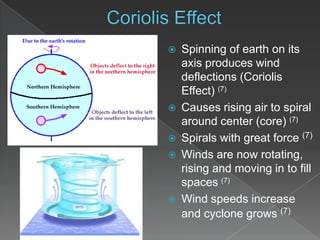
Coriolis EffectSpinning of earth on its axis produces wind deflections (Coriolis Effect) (7)Causes rising air to spiral around center (core) (7)Spirals with great force (7)Winds are now rotating, rising and moving in to fill spaces (7)Wind speeds increase and cyclone grows (7)
Coriolis EffectNorthern hemisphere winds are blowing counter-clockwise around center core (6) Southern hemisphere winds are blowing clockwise around center core (6)
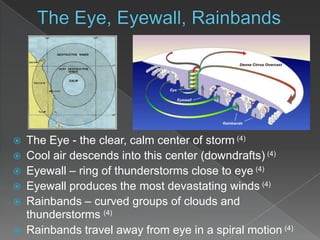
The Eye, Eyewall, RainbandsThe Eye - the clear, calm center of storm(4)Cool air descends into this center (downdrafts)(4)Eyewall – ring of thunderstorms close to eye(4)Eyewall produces the most devastating winds(4)Rainbands – curved groups of clouds andthunderstorms (4)Rainbands travel away from eye in a spiral motion(4)
Storm SurgesOccur when tropical cyclones reach land (3)Storm surge – raised swell of water (3)60 to 80 km across (3)Around 2 to 5 meters higher than normal tides (3)Created by heavy winds and cause flooding (3)
Locations of Tropical CyclonesBetween 10 to 30° North and South of equator (2) Within the tropic of Cancer and Capricorn (2)Poleward side of the Intertropical Convergence Zone (2) Zone of low pressure (ITCZ) (2) Coriolis effect greatly reduced at equator (4)No tropical cyclones occur at equator (4)ITCZTropical Cyclone Appearances
Tropical Cyclone Categories
Case Study: The 1970 Bhola CycloneStorm Survivors
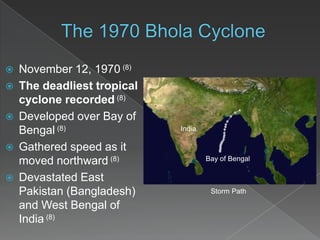
The 1970 Bhola CycloneNovember 12, 1970(8)The deadliest tropical cyclone recorded(8)Developed over Bay of Bengal(8)Gathered speed as it moved northward(8)Devastated East Pakistan (Bangladesh) and West Bengal of India(8)IndiaBay of BengalStorm Path
The Bhola Cyclone CharacteristicsWind speeds reached 115 m/h (8)Strength of a category 3 hurricane (8)33 foot high storm surge (8)Massive storm surge caused flooding and fatalities (8)Bhola Cyclone on November 11, 1970
The Bhola Cyclone - DamageStorm surge: Flooded low-lying islands
Wiped out crops

Tropicalcyclones 091124165030-phpapp02

  • 1.
    The Physical Characteristicsof Tropical CyclonesCase Study: The 1970 Bhola Cyclone
  • 2.
    Cyclones, Hurricanes, TyphoonsNamedaccording to region (1)Cyclones – Develop over the Indian Ocean(1)Hurricanes - Develop over Atlantic and eastern Pacific Oceans(1)Typhoons – Develop over western Pacific Oceans(1)All produce similar effects(1)EyeTyphoon Odessa, Philippines
  • 3.
    Developmental StagesProgression: depression storm cyclone(2) Classified according to wind speeds(2)Tropical Depression - less than 39 m/h (2)Tropical Storm - between 39 m/h and 73 m/h (2) Tropical Cyclone - at least 74 m/h (2)
  • 4.
    Tropical Cyclones IntroductionTropicalcyclones are intense, rotating, low-pressure storms (2)Develop over warm, tropical oceans(2) Produce strong winds and heavy rainfall(2)Can lead to immense flooding(2) Destructive Winds
  • 5.
    Formation of TropicalCyclonesWarm water generates formation of tropical cyclones(4)Ocean temperatures must be at least 26.5°C(7)Over warm oceans moist, humid air (water vapour)(4)Warm air moves along the surface(4)This air converges and rises rapidly(5) Intense rising of air forms low pressure systems (7)
  • 6.
    Formation of TropicalCyclonesAs air rises, it cools, becomes saturated and condenses(4)Water vapour condenses into liquid droplets(4)Formation of thunderclouds(5) Condensation releases heat stored in water vapour(4)This latent heat warms the atmosphere(4)Air becomes lighter causing strong updrafts(4)
  • 7.
    Formation of TropicalCyclonesAir expands and diverges at higher levels(5) Occurs only where wind speed/direction remain constant (no wind shear) (7)Air moves in at surface taking the place of rising air(4)This intensifies convergence(5)Creates wind and increases rising movement(4)Builds and progresses into a mature cyclone(5)
  • 8.
    Coriolis EffectSpinning ofearth on its axis produces wind deflections (Coriolis Effect) (7)Causes rising air to spiral around center (core) (7)Spirals with great force (7)Winds are now rotating, rising and moving in to fill spaces (7)Wind speeds increase and cyclone grows (7)
  • 9.
    Coriolis EffectNorthern hemispherewinds are blowing counter-clockwise around center core (6) Southern hemisphere winds are blowing clockwise around center core (6)
  • 10.
    The Eye, Eyewall,RainbandsThe Eye - the clear, calm center of storm(4)Cool air descends into this center (downdrafts)(4)Eyewall – ring of thunderstorms close to eye(4)Eyewall produces the most devastating winds(4)Rainbands – curved groups of clouds andthunderstorms (4)Rainbands travel away from eye in a spiral motion(4)
  • 11.
    Storm SurgesOccur whentropical cyclones reach land (3)Storm surge – raised swell of water (3)60 to 80 km across (3)Around 2 to 5 meters higher than normal tides (3)Created by heavy winds and cause flooding (3)
  • 12.
    Locations of TropicalCyclonesBetween 10 to 30° North and South of equator (2) Within the tropic of Cancer and Capricorn (2)Poleward side of the Intertropical Convergence Zone (2) Zone of low pressure (ITCZ) (2) Coriolis effect greatly reduced at equator (4)No tropical cyclones occur at equator (4)ITCZTropical Cyclone Appearances
  • 13.
  • 14.
    Case Study: The1970 Bhola CycloneStorm Survivors
  • 15.
    The 1970 BholaCycloneNovember 12, 1970(8)The deadliest tropical cyclone recorded(8)Developed over Bay of Bengal(8)Gathered speed as it moved northward(8)Devastated East Pakistan (Bangladesh) and West Bengal of India(8)IndiaBay of BengalStorm Path
  • 16.
    The Bhola CycloneCharacteristicsWind speeds reached 115 m/h (8)Strength of a category 3 hurricane (8)33 foot high storm surge (8)Massive storm surge caused flooding and fatalities (8)Bhola Cyclone on November 11, 1970
  • 17.
    The Bhola Cyclone- DamageStorm surge: Flooded low-lying islands
  • 18.