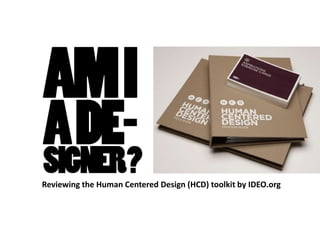
Reviewing the Human Centered Design (HCD) toolkit by IDEO.org
WHAT IS “AM I A DESIGNER?”
A global research project on the impact of social entrepreneurship
and human centered design on poverty reduction
WHAT?
From November 2012 until April 2013 we
(Jeroen & Boukje) are traveling the world to
spend some time on five continents in order
to: (a) visit entrepreneurial and design related
projects that claim to contribute to poverty
reduction and ask them what their recipe's
are; (b) ask people around the world
(professionals, end-users etc.) about their
opinions on design, entrepreneurship in
relationship to poverty and start a discussion;
(c) use the collected data and our own insights
to evaluate and possible improve the most
used Human Centered Design toolkit
worldwide: the HCD toolkit from Ideo.org (d)
possibly even contribute a little bit to poverty
reduction ourselves by sharing our own
knowledge through workshops, advice, design,
business development etc.
We want to know what we should teach our
students or share with our clients to make
them the changemakers of the future and we
felt that we couldn’t learn this from books. We
will ask questions, meet people, take pictures,
write blogs, start discussions, collaborate on
real projects from both foreign and local
NGOs, enterprises and universities and
hopefully also have some time to relax and
enjoy all the beautiful landscapes & people we
are hoping to see/meet.
If you want to know more about our trip and
our goals visit: www.amiadesigner.com
This slide set will focus on the outcomes of the
evaluation of the HCD toolkit by Ideo.org
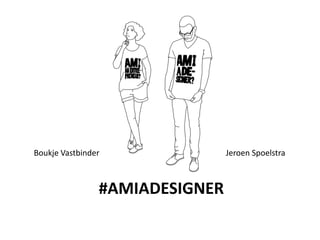
#AMIADESIGNER
Boukje Vastbinder Jeroen Spoelstra
WHO?
Boukje Vastbinder (30) is both co- owner of
Enyini and lecturer sustainable entrepreneur-
ship at the Delft University of Technology.
Boukje is convinced that, through entrepre-
neurship and collaboration, social initiatives
can improve people’s lives on the long term
and she would like to contribute to this
transition as an entrepreneur, researcher,
lecturer and human!
Is she an entrepreneur? That depends on your
definition of entrepreneurship.
Linkedin:http://nl.linkedin.com/pub/boukje-
vastbinder/20/890/140
Jeroen Spoelstra (35) is a passionate lecturer
in design and applied creativity at the
Amsterdam University of Applied Sciences. He
finds his inspiration out of his other passions
mountain biking, surfing and traveling. He uses
sports, traveling and being outside to get
inspired and give inspirational lectures and
workshops. Design to him has shifted from
making desirable products to creating mea-
ningful and real solutions that can make a
difference.
Is he a designer? That depends on your
definition of design.
Linkedin:http://www.linkedin.com/pub/jeroen
-spoelstra/8/b05/3a1
DESIGN:
THE PROCESS OF CREATING
SOMETHING NEW
ENTREPRENEURSHIP:
CREATING VALUE BY COMBINING
OPPERTUNITIES WITH STRENGHTS
Our current definitions of design and entrepreneurship:
Slide met tools invoegen
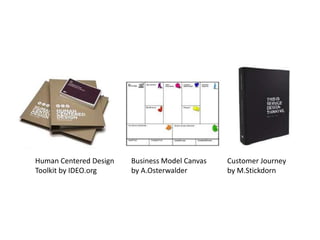
Human Centered Design Business Model Canvas Customer Journey
Toolkit by IDEO.org by A.Osterwalder by M.Stickdorn
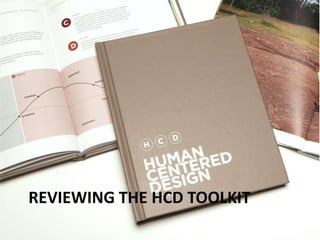
REVIEWING THE HCD TOOLKIT
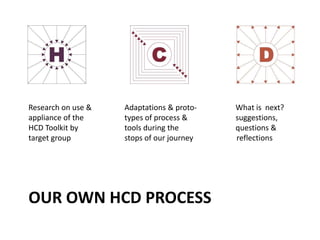
OUR OWN HCD PROCESS
Research on use & Adaptations & proto- What is next?
appliance of the types of process & suggestions,
HCD Toolkit by tools during the questions &
target group stops of our journey reflections
HEAR
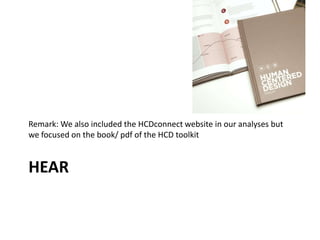
Remark: We also included the HCDconnect website in our analyses but
we focused on the book/ pdf of the HCD toolkit
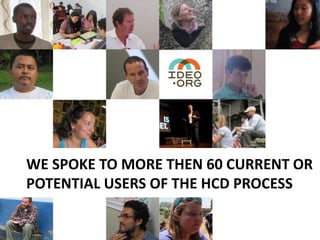
WE SPOKE TO MORE THEN 60 CURRENT OR
POTENTIAL USERS OF THE HCD PROCESS
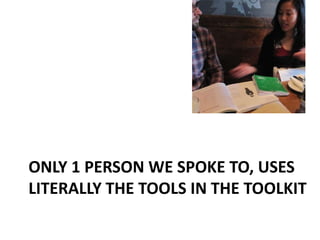
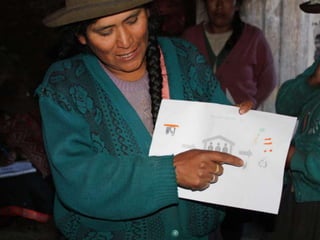
ONLY 1 PERSON WE SPOKE TO, USES
LITERALLY THE TOOLS IN THE TOOLKIT
POSITIVE REFLECTIONS ON TOOLKIT
- After reading this I thought: Is there
any other way to design then this?
- It legitimized what we already did
& believed in!
- This could change the world!
- Great that this is available for free:
thank you!
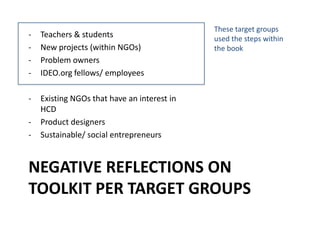
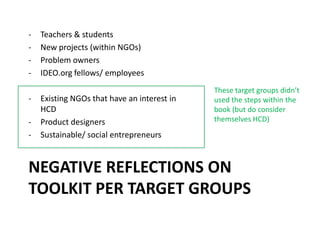
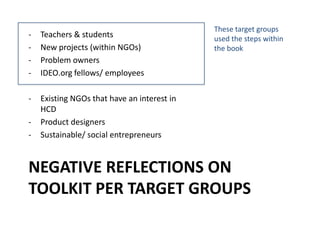
NEGATIVE REFLECTIONS ON
TOOLKIT PER TARGET GROUPS
- Teachers & students
- New projects (within NGOs)
- Problem owners
- IDEO.org fellows/ employees
- Existing NGOs that have an interest in
HCD
- Product designers
- Sustainable/ social entrepreneurs
NEGATIVE REFLECTIONS ON
TOOLKIT PER TARGET GROUPS
- Teachers & students
- New projects (within NGOs)
- Problem owners
- IDEO.org fellows/ employees
- Existing NGOs that have an interest in
HCD
- Product designers
- Sustainable/ social entrepreneurs
These target groups
used the steps within
the book
NEGATIVE REFLECTIONS ON
TOOLKIT PER TARGET GROUPS
- Teachers & students
- New projects (within NGOs)
- Problem owners
- IDEO.org fellows/ employees
- Existing NGOs that have an interest in
HCD
- Product designers
- Sustainable/ social entrepreneurs
These target groups didn’t
used the steps within the
book (but do consider
themselves HCD)
NEGATIVE REFLECTIONS ON
TOOLKIT PER TARGET GROUPS
- Teachers & students
- New projects (within NGOs)
- Problem owners
- IDEO.org fellows/ employees
- Existing NGOs that have an interest in
HCD
- Product designers
- Sustainable/ social entrepreneurs
These target groups
used the steps within
the book
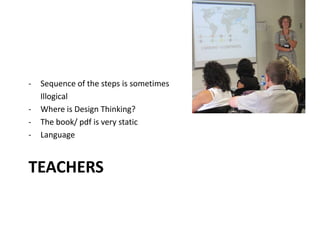
TEACHERS
- Sequence of the steps is sometimes
Illogical
- Where is Design Thinking?
- The book/ pdf is very static
- Language
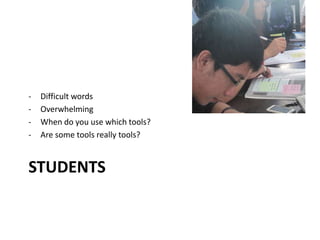
STUDENTS
- Difficult words
- Overwhelming
- When do you use which tools?
- Are some tools really tools?
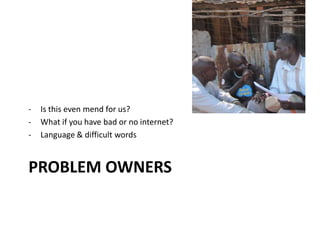
PROBLEM OWNERS
- Is this even mend for us?
- What if you have bad or no internet?
- Language & difficult words
IDEO.ORG FELLOWS/ EMPLOYEES
- ?
- ?
- What is your feedback on the
(use of the) HCD Toolkit?
NEGATIVE REFLECTIONS ON
TOOLKIT PER TARGET GROUPS
- Teachers & students
- New projects (within NGOs)
- Problem owners
- IDEO.org fellows/ employees
- Existing NGOs that have an interest in
HCD
- Product designers
- Sustainable/ social entrepreneurs
These target groups didn’t
used the steps within the
book (but do consider
themselves HCD)
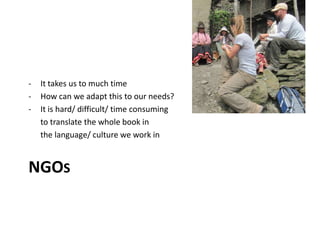
NGOS
- It takes us to much time
- How can we adapt this to our needs?
- It is hard/ difficult/ time consuming
to translate the whole book in
the language/ culture we work in
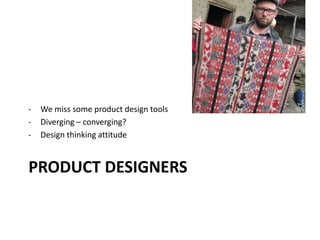
PRODUCT DESIGNERS
- We miss some product design tools
- Diverging – converging?
- Design thinking attitude
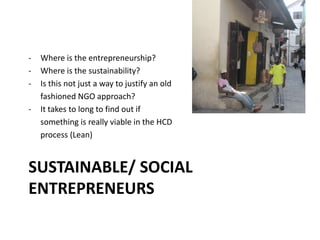
SUSTAINABLE/ SOCIAL
ENTREPRENEURS
- Where is the entrepreneurship?
- Where is the sustainability?
- Is this not just a way to justify an old
fashioned NGO approach?
- It takes to long to find out if
something is really viable in the HCD
process (Lean)
OUR QUESTIONS TO IDEO.ORG
- What was the main target group you
had in mind when you designed the
HCDtoolkit and platform?
- Do you know in which categories the
70.000 downloaders and 13.000
HCDconnect users belong?
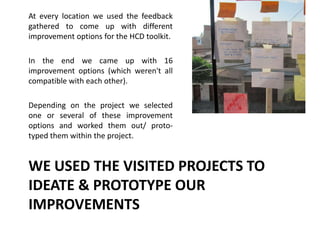
WE USED THE VISITED PROJECTS TO
IDEATE & PROTOTYPE OUR
IMPROVEMENTS
At every location we used the feedback
gathered to come up with different
improvement options for the HCD toolkit.
In the end we came up with 16
improvement options (which weren't all
compatible with each other).
Depending on the project we selected
one or several of these improvement
options and worked them out/ proto-
typed them within the project.
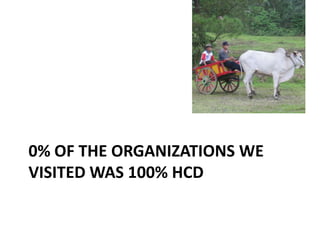
0% OF THE ORGANIZATIONS WE
VISITED WAS 100% HCD
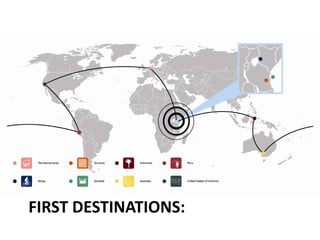
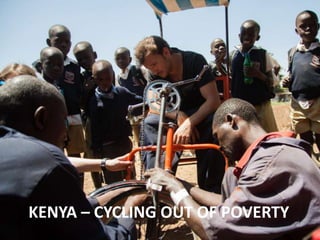
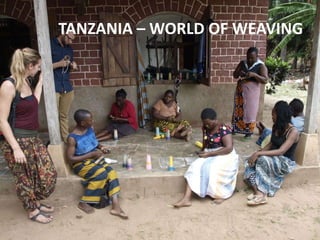
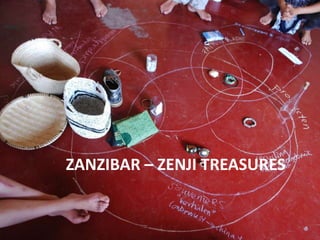
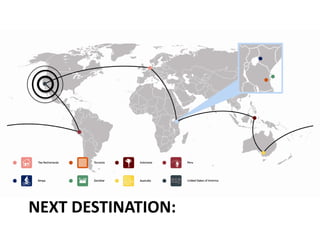
FIRST DESTINATIONS:
KENYA – CYCLING OUT OF POVERTY
TANZANIA – WORLD OF WEAVING
ZANZIBAR – ZENJI TREASURES
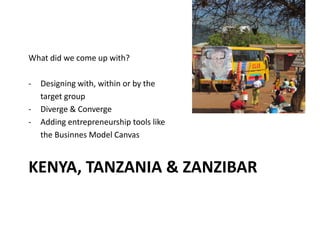
KENYA, TANZANIA & ZANZIBAR
What did we come up with?
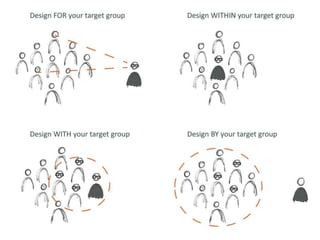
- Designing with, within or by the
target group
- Diverge & Converge
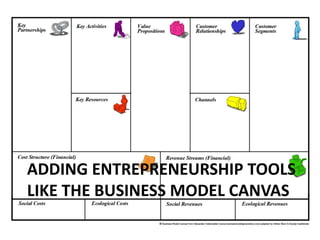
- Adding entrepreneurship tools like
the Businnes Model Canvas
MOVIE WOW
HTTP://VIMEO.COM/56763716
This movie was shot during our
collaboration with the World Of
Weaving (WOW) project in Tanzania
and reflects on the following
questions:
- whether you can transfer design
skills to everyone,
- whether you would even want this
- and what sort of design skills:
product design or project design?
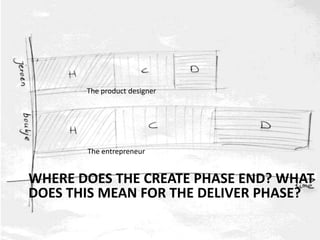
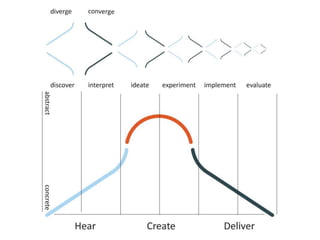
WHERE DOES THE CREATE PHASE END? WHAT
DOES THIS MEAN FOR THE DELIVER PHASE?
The product designer
The entrepreneur
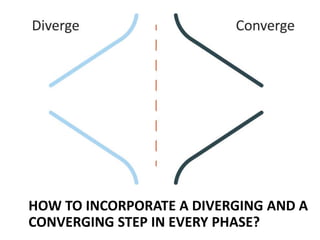
HOW TO INCORPORATE A DIVERGING AND A
CONVERGING STEP IN EVERY PHASE?
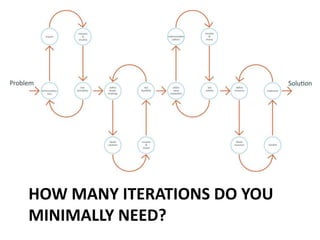
HOW MANY ITERATIONS DO YOU
MINIMALLY NEED?
ADDING ENTREPRENEURSHIP TOOLS
LIKE THE BUSINESS MODEL CANVAS
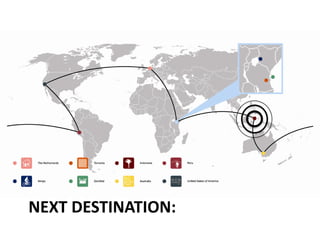
NEXT DESTINATION:
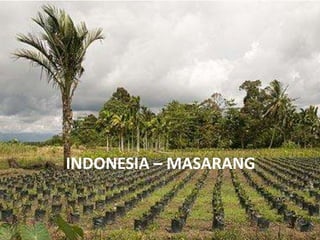
INDONESIA – MASARANG
WILLIE SMITS
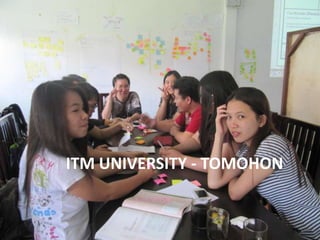
ITM UNIVERSITY - TOMOHON
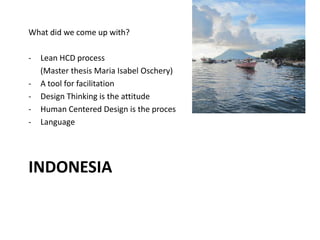
INDONESIA
What did we come up with?
- Lean HCD process
(Master thesis Maria Isabel Oschery)
- A tool for facilitation
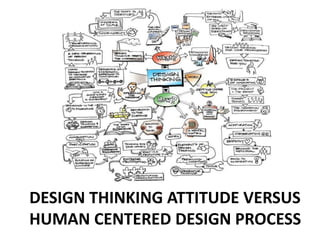
- Design Thinking is the attitude
- Human Centered Design is the proces
- Language
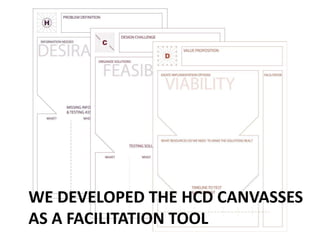
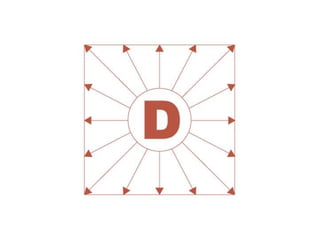
WE DEVELOPED THE HCD CANVASSES
AS A FACILITATION TOOL
MOVIE ITM
HTTP://VIMEO.COM/59137121
The first drafts of the HCD canvasses
were prototyped during a HCD course
we gave at the Institute Technologi
Minahasa (ITM) in Indonesia covering
4 full days.
DESIGN THINKING ATTITUDE VERSUS
HUMAN CENTERED DESIGN PROCESS
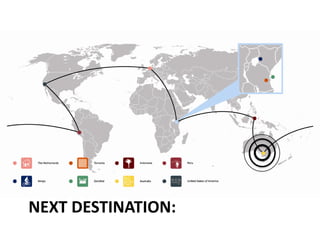
NEXT DESTINATION:
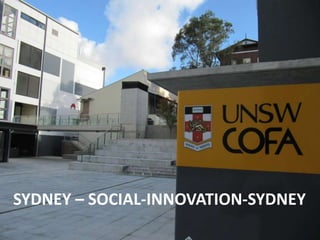
SYDNEY – SOCIAL-INNOVATION-SYDNEY
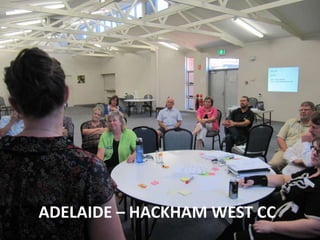
ADELAIDE – HACKHAM WEST CC
AUSTRALIA
What did we come up with?
- Who is your target group? Elderly, poor
youngsters? Does it matter?
- What is the future of HCD & DT in
design education?
- Gathering feedback, feedback,
feedback!
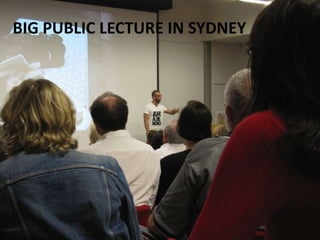
BIG PUBLIC LECTURE IN SYDNEY
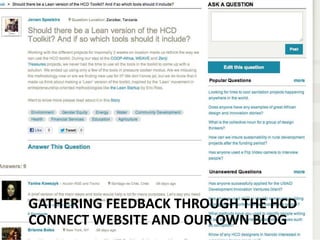
GATHERING FEEDBACK THROUGH THE HCD
CONNECT WEBSITE AND OUR OWN BLOG
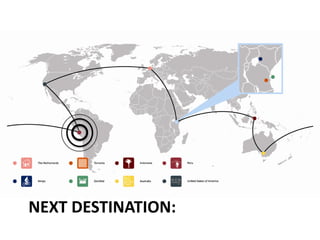
NEXT DESTINATION:
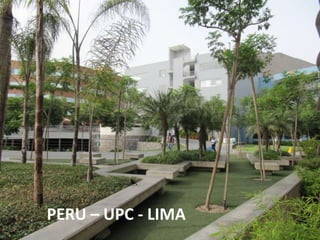
PERU – UPC - LIMA
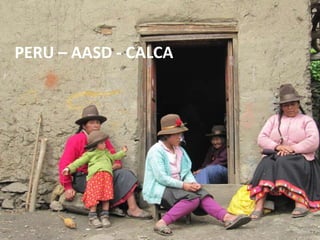
PERU – AASD - CALCA
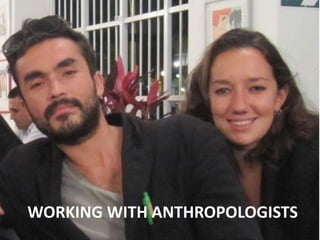
WORKING WITH ANTHROPOLOGISTS
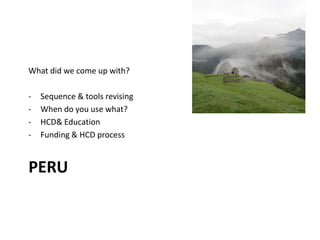
PERU
What did we come up with?
- Sequence & tools revising
- When do you use what?
- HCD& Education
- Funding & HCD process
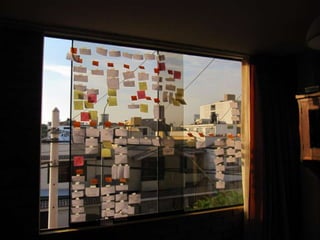
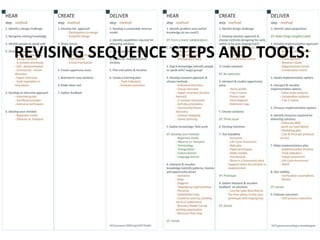
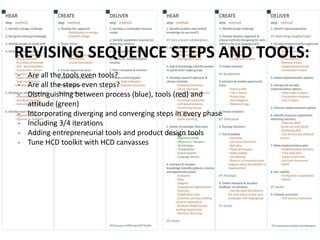
REVISING SEQUENCE STEPS AND TOOLS:
- Are all the tools even tools?
- Are all the steps even steps?
- Distinguishing between process (blue), tools (red) and
attitude (green)
- Incorporating diverging and converging steps in every phase
- Including 3/4 iterations
- Adding entrepreneurial tools and product design tools
- Tune HCD toolkit with HCD canvasses
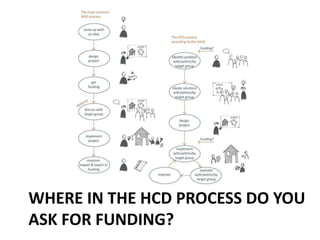
WHERE IN THE HCD PROCESS DO YOU
ASK FOR FUNDING?
MOVIE AASD
HTTP://VIMEO.COM/62952376
This movie was shot during our
collaboration with the Andean Alliance
for Sustainable Development (AASD) in
Peru and reflects on the following
questions:
- when do you ask for funding within
a HCD process?
- what does that mean for the HCD
toolkit?
- and what does that mean for the
HCD website& funding options?
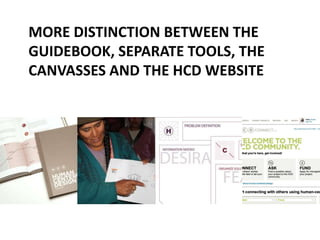
MORE DISTINCTION BETWEEN THE
GUIDEBOOK, SEPARATE TOOLS, THE
CANVASSES AND THE HCD WEBSITE
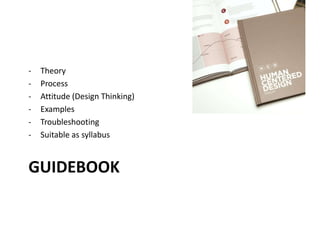
GUIDEBOOK
- Theory
- Process
- Attitude (Design Thinking)
- Examples
- Troubleshooting
- Suitable as syllabus
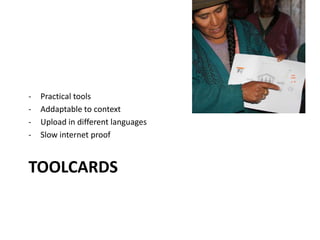
TOOLCARDS
- Practical tools
- Addaptable to context
- Upload in different languages
- Slow internet proof
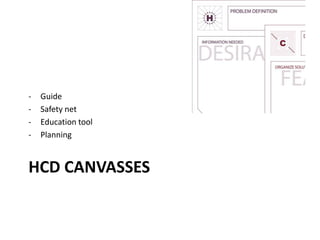
HCD CANVASSES
- Guide
- Safety net
- Education tool
- Planning
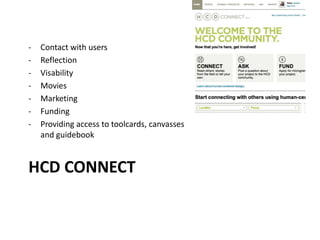
HCD CONNECT
- Contact with users
- Reflection
- Visability
- Movies
- Marketing
- Funding
- Providing access to toolcards, canvasses
and guidebook
OUR QUESTIONS FOR IDEO.ORG
- Why is the content of the guidebook, pdf
and online tools different?
- Are you the only one funding HCD
projects through the website?
NEXT DESTINATION:
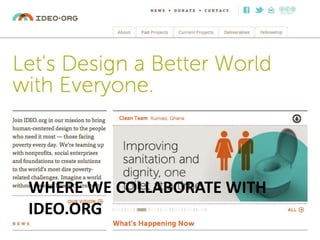
WHERE WE COLLABORATE WITH
IDEO.ORG
WHAT IS NEXT FOR US?
- Universities in Indonesia & Peru want
to use the HCD canvasses and are
developing HCD & DT courses
- NGOs a social enterprises want out help
to implement the HCD process
- We are going to use our experience
& output in our own work back in the NL
WHAT IS NEXT FOR US?
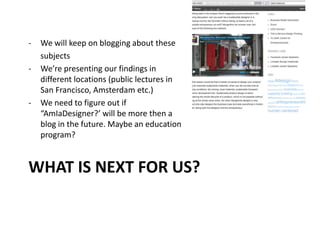
- We will keep on blogging about these
subjects
- We’re presenting our findings in
different locations (public lectures in
San Francisco, Amsterdam etc.)
- We need to figure out if
“AmIaDesigner?’ will be more then a
blog in the future. Maybe an education
program?
WHAT IS NEXT FOR IDEO.ORG?
- Wich improvement options would work
for you?
- How do we continue?
- Method-day : input and output
OUR SUGGESTIONS - LONG TERM
- Adapt guidebook
- Develop examples of different uses
of the toolkit (scenario’s)
- Develop theory on process & attitude
- Add new examples
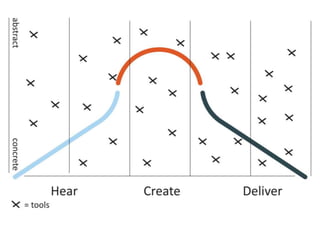
- Categorize the tools (concrete – abstract)
- Research > publication(s)
- Adapt HCD Connect website
- Consider alternative funding schemes
- Prototyping the adaptations
- Alerting the press when it is all finished
OUR SUGGESTIONS - SHORT TERM
- Adapt tool cards:
- Make them independent from each other
- Use less difficult words
- Use less cultural dependent images
- Make them all 1 A4
- Add ‘upload tool in other language’ option
to the website
- Add H,C,D canvasses to the website
(or we can do that on our website and you
can link to them?)
- Make choises in consistant terminolgy
(for example: is it a ‘tool’ or a ‘method’?)
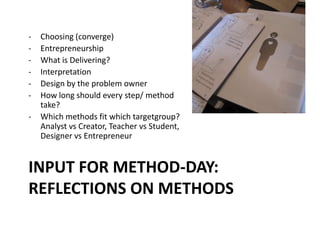
INPUT FOR METHOD-DAY:
REFLECTIONS ON METHODS
- Choosing (converge)
- Entrepreneurship
- What is Delivering?
- Interpretation
- Design by the problem owner
- How long should every step/ method
take?
- Which methods fit which targetgroup?
Analyst vs Creator, Teacher vs Student,
Designer vs Entrepreneur
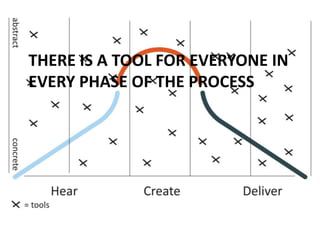
THERE IS A TOOL FOR EVERYONE IN
EVERY PHASE OF THE PROCESS
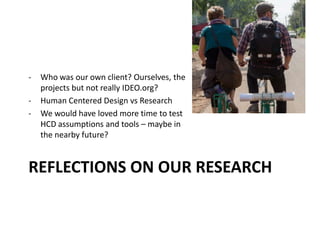
REFLECTIONS ON OUR RESEARCH
- Who was our own client? Ourselves, the
projects but not really IDEO.org?
- Human Centered Design vs Research
- We would have loved more time to test
HCD assumptions and tools – maybe in
the nearby future?
Reviewing the human centered design toolkit by IDEO.org

Reviewing the human centered design toolkit by IDEO.org

  • 1.
    Reviewing the HumanCentered Design (HCD) toolkit by IDEO.org
  • 2.
    WHAT IS “AMI A DESIGNER?” A global research project on the impact of social entrepreneurship and human centered design on poverty reduction
  • 3.
    WHAT? From November 2012until April 2013 we (Jeroen & Boukje) are traveling the world to spend some time on five continents in order to: (a) visit entrepreneurial and design related projects that claim to contribute to poverty reduction and ask them what their recipe's are; (b) ask people around the world (professionals, end-users etc.) about their opinions on design, entrepreneurship in relationship to poverty and start a discussion; (c) use the collected data and our own insights to evaluate and possible improve the most used Human Centered Design toolkit worldwide: the HCD toolkit from Ideo.org (d) possibly even contribute a little bit to poverty reduction ourselves by sharing our own knowledge through workshops, advice, design, business development etc. We want to know what we should teach our students or share with our clients to make them the changemakers of the future and we felt that we couldn’t learn this from books. We will ask questions, meet people, take pictures, write blogs, start discussions, collaborate on real projects from both foreign and local NGOs, enterprises and universities and hopefully also have some time to relax and enjoy all the beautiful landscapes & people we are hoping to see/meet. If you want to know more about our trip and our goals visit: www.amiadesigner.com This slide set will focus on the outcomes of the evaluation of the HCD toolkit by Ideo.org
  • 4.
  • 5.
    WHO? Boukje Vastbinder (30)is both co- owner of Enyini and lecturer sustainable entrepreneur- ship at the Delft University of Technology. Boukje is convinced that, through entrepre- neurship and collaboration, social initiatives can improve people’s lives on the long term and she would like to contribute to this transition as an entrepreneur, researcher, lecturer and human! Is she an entrepreneur? That depends on your definition of entrepreneurship. Linkedin:http://nl.linkedin.com/pub/boukje- vastbinder/20/890/140 Jeroen Spoelstra (35) is a passionate lecturer in design and applied creativity at the Amsterdam University of Applied Sciences. He finds his inspiration out of his other passions mountain biking, surfing and traveling. He uses sports, traveling and being outside to get inspired and give inspirational lectures and workshops. Design to him has shifted from making desirable products to creating mea- ningful and real solutions that can make a difference. Is he a designer? That depends on your definition of design. Linkedin:http://www.linkedin.com/pub/jeroen -spoelstra/8/b05/3a1
  • 6.
    DESIGN: THE PROCESS OFCREATING SOMETHING NEW ENTREPRENEURSHIP: CREATING VALUE BY COMBINING OPPERTUNITIES WITH STRENGHTS Our current definitions of design and entrepreneurship:
  • 7.
    Slide met toolsinvoegen Human Centered Design Business Model Canvas Customer Journey Toolkit by IDEO.org by A.Osterwalder by M.Stickdorn
  • 8.
  • 9.
    OUR OWN HCDPROCESS Research on use & Adaptations & proto- What is next? appliance of the types of process & suggestions, HCD Toolkit by tools during the questions & target group stops of our journey reflections
  • 11.
    HEAR Remark: We alsoincluded the HCDconnect website in our analyses but we focused on the book/ pdf of the HCD toolkit
  • 12.
    WE SPOKE TOMORE THEN 60 CURRENT OR POTENTIAL USERS OF THE HCD PROCESS
  • 13.
    ONLY 1 PERSONWE SPOKE TO, USES LITERALLY THE TOOLS IN THE TOOLKIT
  • 15.
    POSITIVE REFLECTIONS ONTOOLKIT - After reading this I thought: Is there any other way to design then this? - It legitimized what we already did & believed in! - This could change the world! - Great that this is available for free: thank you!
  • 16.
    NEGATIVE REFLECTIONS ON TOOLKITPER TARGET GROUPS - Teachers & students - New projects (within NGOs) - Problem owners - IDEO.org fellows/ employees - Existing NGOs that have an interest in HCD - Product designers - Sustainable/ social entrepreneurs
  • 17.
    NEGATIVE REFLECTIONS ON TOOLKITPER TARGET GROUPS - Teachers & students - New projects (within NGOs) - Problem owners - IDEO.org fellows/ employees - Existing NGOs that have an interest in HCD - Product designers - Sustainable/ social entrepreneurs These target groups used the steps within the book
  • 18.
    NEGATIVE REFLECTIONS ON TOOLKITPER TARGET GROUPS - Teachers & students - New projects (within NGOs) - Problem owners - IDEO.org fellows/ employees - Existing NGOs that have an interest in HCD - Product designers - Sustainable/ social entrepreneurs These target groups didn’t used the steps within the book (but do consider themselves HCD)
  • 19.
    NEGATIVE REFLECTIONS ON TOOLKITPER TARGET GROUPS - Teachers & students - New projects (within NGOs) - Problem owners - IDEO.org fellows/ employees - Existing NGOs that have an interest in HCD - Product designers - Sustainable/ social entrepreneurs These target groups used the steps within the book
  • 20.
    TEACHERS - Sequence ofthe steps is sometimes Illogical - Where is Design Thinking? - The book/ pdf is very static - Language
  • 21.
    STUDENTS - Difficult words -Overwhelming - When do you use which tools? - Are some tools really tools?
  • 22.
    PROBLEM OWNERS - Isthis even mend for us? - What if you have bad or no internet? - Language & difficult words
  • 23.
    IDEO.ORG FELLOWS/ EMPLOYEES -? - ? - What is your feedback on the (use of the) HCD Toolkit?
  • 24.
    NEGATIVE REFLECTIONS ON TOOLKITPER TARGET GROUPS - Teachers & students - New projects (within NGOs) - Problem owners - IDEO.org fellows/ employees - Existing NGOs that have an interest in HCD - Product designers - Sustainable/ social entrepreneurs These target groups didn’t used the steps within the book (but do consider themselves HCD)
  • 25.
    NGOS - It takesus to much time - How can we adapt this to our needs? - It is hard/ difficult/ time consuming to translate the whole book in the language/ culture we work in
  • 26.
    PRODUCT DESIGNERS - Wemiss some product design tools - Diverging – converging? - Design thinking attitude
  • 27.
    SUSTAINABLE/ SOCIAL ENTREPRENEURS - Whereis the entrepreneurship? - Where is the sustainability? - Is this not just a way to justify an old fashioned NGO approach? - It takes to long to find out if something is really viable in the HCD process (Lean)
  • 28.
    OUR QUESTIONS TOIDEO.ORG - What was the main target group you had in mind when you designed the HCDtoolkit and platform? - Do you know in which categories the 70.000 downloaders and 13.000 HCDconnect users belong?
  • 30.
    WE USED THEVISITED PROJECTS TO IDEATE & PROTOTYPE OUR IMPROVEMENTS At every location we used the feedback gathered to come up with different improvement options for the HCD toolkit. In the end we came up with 16 improvement options (which weren't all compatible with each other). Depending on the project we selected one or several of these improvement options and worked them out/ proto- typed them within the project.
  • 31.
    0% OF THEORGANIZATIONS WE VISITED WAS 100% HCD
  • 32.
  • 33.
    KENYA – CYCLINGOUT OF POVERTY
  • 34.
  • 35.
  • 36.
    KENYA, TANZANIA &ZANZIBAR What did we come up with? - Designing with, within or by the target group - Diverge & Converge - Adding entrepreneurship tools like the Businnes Model Canvas
  • 37.
    MOVIE WOW HTTP://VIMEO.COM/56763716 This moviewas shot during our collaboration with the World Of Weaving (WOW) project in Tanzania and reflects on the following questions: - whether you can transfer design skills to everyone, - whether you would even want this - and what sort of design skills: product design or project design?
  • 39.
    WHERE DOES THECREATE PHASE END? WHAT DOES THIS MEAN FOR THE DELIVER PHASE? The product designer The entrepreneur
  • 40.
    HOW TO INCORPORATEA DIVERGING AND A CONVERGING STEP IN EVERY PHASE?
  • 42.
    HOW MANY ITERATIONSDO YOU MINIMALLY NEED?
  • 43.
    ADDING ENTREPRENEURSHIP TOOLS LIKETHE BUSINESS MODEL CANVAS
  • 44.
  • 45.
  • 46.
  • 47.
  • 48.
    INDONESIA What did wecome up with? - Lean HCD process (Master thesis Maria Isabel Oschery) - A tool for facilitation - Design Thinking is the attitude - Human Centered Design is the proces - Language
  • 49.
    WE DEVELOPED THEHCD CANVASSES AS A FACILITATION TOOL
  • 50.
    MOVIE ITM HTTP://VIMEO.COM/59137121 The firstdrafts of the HCD canvasses were prototyped during a HCD course we gave at the Institute Technologi Minahasa (ITM) in Indonesia covering 4 full days.
  • 51.
    DESIGN THINKING ATTITUDEVERSUS HUMAN CENTERED DESIGN PROCESS
  • 52.
  • 53.
  • 54.
  • 55.
    AUSTRALIA What did wecome up with? - Who is your target group? Elderly, poor youngsters? Does it matter? - What is the future of HCD & DT in design education? - Gathering feedback, feedback, feedback!
  • 56.
  • 57.
    GATHERING FEEDBACK THROUGHTHE HCD CONNECT WEBSITE AND OUR OWN BLOG
  • 58.
  • 59.
  • 60.
  • 61.
  • 62.
    PERU What did wecome up with? - Sequence & tools revising - When do you use what? - HCD& Education - Funding & HCD process
  • 64.
  • 65.
    REVISING SEQUENCE STEPSAND TOOLS: - Are all the tools even tools? - Are all the steps even steps? - Distinguishing between process (blue), tools (red) and attitude (green) - Incorporating diverging and converging steps in every phase - Including 3/4 iterations - Adding entrepreneurial tools and product design tools - Tune HCD toolkit with HCD canvasses
  • 66.
    WHERE IN THEHCD PROCESS DO YOU ASK FOR FUNDING?
  • 67.
    MOVIE AASD HTTP://VIMEO.COM/62952376 This moviewas shot during our collaboration with the Andean Alliance for Sustainable Development (AASD) in Peru and reflects on the following questions: - when do you ask for funding within a HCD process? - what does that mean for the HCD toolkit? - and what does that mean for the HCD website& funding options?
  • 68.
    MORE DISTINCTION BETWEENTHE GUIDEBOOK, SEPARATE TOOLS, THE CANVASSES AND THE HCD WEBSITE
  • 69.
    GUIDEBOOK - Theory - Process -Attitude (Design Thinking) - Examples - Troubleshooting - Suitable as syllabus
  • 70.
    TOOLCARDS - Practical tools -Addaptable to context - Upload in different languages - Slow internet proof
  • 71.
    HCD CANVASSES - Guide -Safety net - Education tool - Planning
  • 72.
    HCD CONNECT - Contactwith users - Reflection - Visability - Movies - Marketing - Funding - Providing access to toolcards, canvasses and guidebook
  • 73.
    OUR QUESTIONS FORIDEO.ORG - Why is the content of the guidebook, pdf and online tools different? - Are you the only one funding HCD projects through the website?
  • 75.
  • 76.
    WHERE WE COLLABORATEWITH IDEO.ORG
  • 77.
    WHAT IS NEXTFOR US? - Universities in Indonesia & Peru want to use the HCD canvasses and are developing HCD & DT courses - NGOs a social enterprises want out help to implement the HCD process - We are going to use our experience & output in our own work back in the NL
  • 78.
    WHAT IS NEXTFOR US? - We will keep on blogging about these subjects - We’re presenting our findings in different locations (public lectures in San Francisco, Amsterdam etc.) - We need to figure out if “AmIaDesigner?’ will be more then a blog in the future. Maybe an education program?
  • 79.
    WHAT IS NEXTFOR IDEO.ORG? - Wich improvement options would work for you? - How do we continue? - Method-day : input and output
  • 80.
    OUR SUGGESTIONS -LONG TERM - Adapt guidebook - Develop examples of different uses of the toolkit (scenario’s) - Develop theory on process & attitude - Add new examples - Categorize the tools (concrete – abstract) - Research > publication(s) - Adapt HCD Connect website - Consider alternative funding schemes - Prototyping the adaptations - Alerting the press when it is all finished
  • 81.
    OUR SUGGESTIONS -SHORT TERM - Adapt tool cards: - Make them independent from each other - Use less difficult words - Use less cultural dependent images - Make them all 1 A4 - Add ‘upload tool in other language’ option to the website - Add H,C,D canvasses to the website (or we can do that on our website and you can link to them?) - Make choises in consistant terminolgy (for example: is it a ‘tool’ or a ‘method’?)
  • 82.
    INPUT FOR METHOD-DAY: REFLECTIONSON METHODS - Choosing (converge) - Entrepreneurship - What is Delivering? - Interpretation - Design by the problem owner - How long should every step/ method take? - Which methods fit which targetgroup? Analyst vs Creator, Teacher vs Student, Designer vs Entrepreneur
  • 84.
    THERE IS ATOOL FOR EVERYONE IN EVERY PHASE OF THE PROCESS
  • 85.
    REFLECTIONS ON OURRESEARCH - Who was our own client? Ourselves, the projects but not really IDEO.org? - Human Centered Design vs Research - We would have loved more time to test HCD assumptions and tools – maybe in the nearby future?