

design process 
BIH UI/UX BOOTCAMP / Microsoft Innovation Center @ Botswana Innovation Hub / bihux.tumblr.com
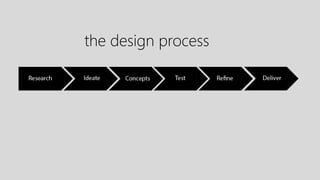
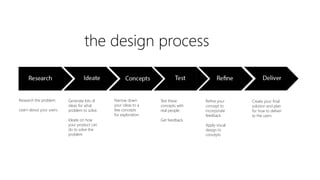
the design process
WIRED
Research the problem. 
Learn about your users. 
Generate lots of 
ideas for what 
problem to solve. 
Ideate on how 
your product can 
do to solve the 
problem 
Narrow down 
your ideas to a 
few concepts 
for exploration. 
Test these 
concepts with 
real people. 
Get feedback. 
Refine your 
concept to 
incorporate 
feedback. 
Apply visual 
design to 
concepts 
Create your final 
solution and plan 
for how to deliver 
to the users 
the design process
Research the 
problem. Learn 
about your users. 
Investigate 
competitive 
products 
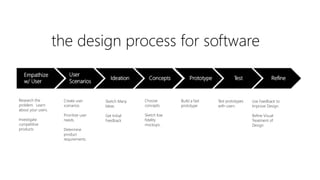
the design process for software 
Create user 
scenarios. 
Prioritize user 
needs. 
Determine 
product 
requirements 
Sketch Many 
Ideas 
Get Initial 
Feedback 
Build a fast 
prototype 
Test prototypes 
with users 
Use Feedback to 
Improve Design. 
Refine Visual 
Treatment of 
Design 
Choose 
concepts 
Sketch low 
fidelity 
mockups .
http://mariamz.files.wordpress.com/2011/05/salul.jpg
Boagworld.com
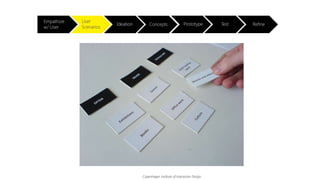
Copenhagen Institute of Interaction Design
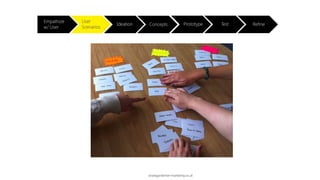
strategyinternet-marketing.co.uk
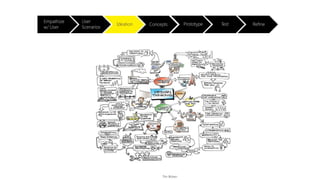
Tim Brown
Ww2.warwick.ac.uk
Aplayspace.com
http://mike.mediaintensive.com/wp-content/uploads/2013/08/Alert-wires-1.gif
QuickSprout
MICROSOFT IDEACAMP UX WORKSHOP 
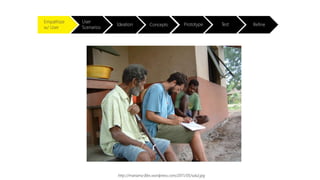
Site visits 
Jed Farlow
MICROSOFT IDEACAMP UX WORKSHOP 
User interviews 
Wikipedia
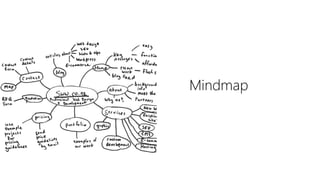
Mindmap
MICROSOFT IDEACAMP UX WORKSHOP 
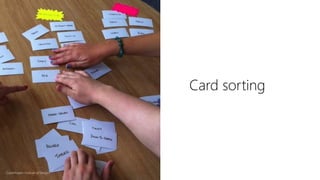
Card sorting 
Copenhagen Institute of Design
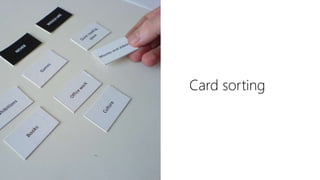
Card sorting
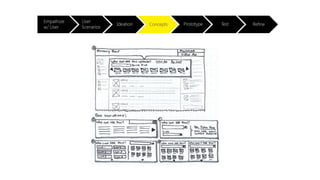
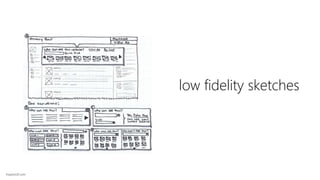
low fidelity sketches 
InspireUX.com
MICROSOFT IDEACAMP UX WORKSHOP 
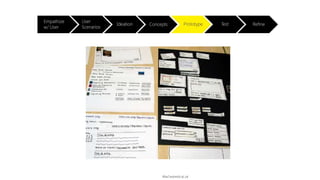
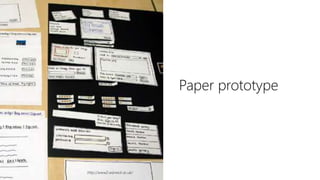
Paper prototype 
http://www2.warwick.ac.uk/
MICROSOFT IDEACAMP UX WORKSHOP 
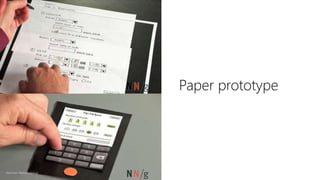
Paper prototype 
Norman Nielson Group
MICROSOFT IDEACAMP UX WORKSHOP 
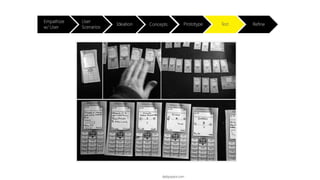
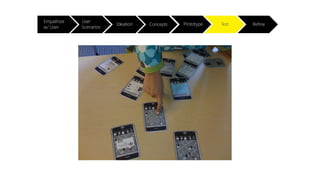
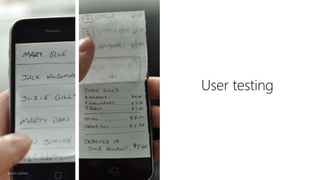
User testing 
Dustin Larimer
MICROSOFT IDEACAMP UX WORKSHOP 
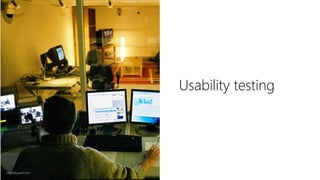
Usability testing 
Usabilitygeek.com
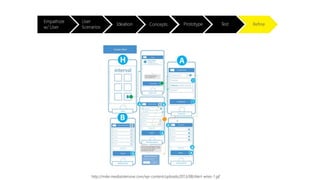
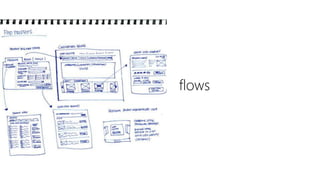
flows
MICROSOFT IDEACAMP UX WORKSHOP 
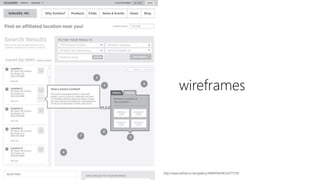
wireframes 
http://www.behance.net/gallery/WIREFRAMES/6771739

BIH - Design process

Editor's Notes

  • #2 How do people talk and interact with interfaces? Interfaces must communicate and inform the user on how it can be used. What happens when users see an interface? What is he or she thinking? Does he understand what he or she is looking at? What is the user supposed to do next? Traditionally called Human Computer Interaction, HCI represents the engineering approach we take to UX . It’s rooted in understanding how people use technology and how the components of a digital design help a user accomplish a task.
  • #4 Design process exists for a lot of things: Products Services Interfaces
  • #5 Design process exists for a lot of things: Products Services Interfaces
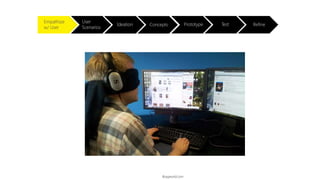
  • #20 use it to really understand your user and discover what their life is who they are
  • #21 use it to brainstorm associations around a word
  • #22 use it to prioritize what things are most important for your design to solve use it to get users to talk about what’s important for them 1. write down features on cards/post it’s 2. have the user sort them into groups 3. have the user rank these cards in order of importance.